200,000!

lolcat

http://icanhascheezburger.com

Hello, 200,000th visitor, whoever you may have been. OK, so that’s not a huge number by some standards, and the Bioscope stills lurks at no. 142,599 on the Technorati blog league table. And doubtless if we were to feature a few more pictures of comic cats, rather than concentrate quite so rigidly on the research aspects of early and silent cinema, then maybe we might be expanding the audience a little. But I’m rather pleased with the audience we have, and grateful to all who keep reading here.

Next stop, half a million. If I can just drum up a few more Chaplin-impersonating cats, and learn to loosen up the spelling a little…

The Researcher’s Guide to Screen Heritage

screenheritage

UK Screen Heritage Network

Today saw the launch at the British Library of the Researcher’s Guide to Screen Heritage. This is the the result of a project, led by the UK Screen Heritage Network, to map artefacts held in UK museums and archvies which relate to screen history. So this isn’t the films, or television programmes, but rather the costumes, sets, cameras, projectors, toys, documents, scripts, sheet music etc, and embracing a broader idea of screen history to inlcude magic lanterns, other kinds of slide presentation, digital media artefacts of today, and even art installations.

The resultant directory has been combined with an existing directory of moving image collections in the UK and Ireland, so that you can now search across the full range of moving image-related collections which are open to researchers. It a collection-level database, so you’ll find information on collections rather than individual titles; and it’s not everything, but it’s a strong start in attempting to map what what has generally lain scattered across the museums and seldom known about by film (or screen) historians.

So you are encouraged to explore for yourselves, but some of the gems from our area that you may learn about are:

  • the Black Country Living Museum in Dudley, which includes a complete 1920s cinema reconstructed and placed within the museum, plus a complete cinema percussionist’s kit used at the Picture House, Willenhall from 1923-27;
  • a collection of cinema slides dating from the First World War, consisting mainly of hand painted film publicity/advertising subjects, at the Clevedon Curzon Community Centre for the Arts;
  • the Barnes Collection of material relating to early film production in the South East, including Brighton and Hove pioneers George Albert Smith, James Williamson, William Friese-Greene, Esme Collings, Alfred Darling and Charles Urban, held by Hove Museum & Art Gallery;
  • early trade catalogues, oral history interviews on cinema-going and working in cinemas held by Beamish, The North of England Open Air Museum;
  • the collection of magic lantern slides used by the Congo Reform Association in their campaign to raise awareness about the abuses taking place under King Leopold II of Belgium’s regime in the Belgian Congo c.1880 to c.1909, held by Anti-Slavery International;
  • record of the Hepworth and Nettlefold studios at Elmbridge Museum.

As well as collections tucked away in unexpected corners, there are the leading museums in the field in the UK: the National Media Museum, Kingston Museum, the Cinema Museum, and the University of Exeter’s Bill Douglas Centre. The Researcher’s Guide to Screen Heritage is hosted by the British Universities Film & Video Council, and was developed for the UK Screen Heritage Network by the BUFVC, the National Media Museum and Screen Archive South East. Go explore.

It’s silent cinema, but not as we know it

damienbarr

A new kind of silent cinema is in town. The Andaz Hotel in London’s Liverpool Street has been trumpeting a special form of entertainment for its guests. It is offering them silent cinema. Marvellous, you may think, how immensely civilised, and does the lounge pianist provide the musical accompaniment as well? But, no, this is silent cinema of a different kind. The punters sit before the screen (the films are projected on to the wall of the 6-storey atrium), don wireless headphones, and then watch sound movies on screen but with the sounds hidden from all but themselves. Here’s how the hotel describes it:

Silent Cinema is a world first – it’s never been done anywhere else. Ever. Yet it’s beautifully simple: you wear wireless headphones to watch films on a full-size cinema screen. Sit back and relax without the unwelcome soundtrack – no noisy neighbours and no shhhhh! It’s like watching a movie at home only better because you’re in an amazing room full of like-minded people. And there’s a bar. You’re all enjoying an individual experience. Together.

Should you be in London at any time, you can book tickets via Ticketweb. There have been two screenings so far, both festive. They kicked things off with Black Christmas (oh joy) and on December 14th they’re showing It’s a Wonderful Life, with nothing to be heard bar the clink of glasses and the occasional sniffle.

Silent Cinema (of this kind) is not restricting itself to the Andaz. Damien Barr Silent Cinema, to be give its full, trademarked name (yes, Silent Cinema is now a trademarked term) has plans for further exhibition elsewhere, in London and Brighton, including outside screenings. Damien Barr is a journalist and radio playwright. So now you know.

Metropolis at Seminci

My thanks to John Riley for alerting me to these two videos. They depict the screening of Metropolis at the Seminci film festival in Valladolid, Spain, late October, when the Fritz Lang film was exhibited at the Miguel Delibes Auditorium with live orchestral accompaniment from the Orquesta Sinfónica de Castilla y León. Of itself, this might be of passing interest but nothing special. What pleases me is what these two festival-produced videos is what they capture of the atmosphere of a prestige silent screening. The first shows the audience arriving, chatting in the auditorium and taking their seats. It captures the sense of a cultural treat, the festival spirit. Brief as it is, it’s a people-watching treat.

And then the audience settles down, the orchestra takes its place, the conductor is applauded, the lights go down and the film begins. The second video captures such opening moments familiar to anyone who has attended a silent film show with orchestra, but there’s not much recorded of such events in this way, particularly the point where the film gets underway and we can see both orchestra and film on screen. It’s a brief record, but one worth sharing with you.

Japanese Cinema: Film Style and National Character

richie

Back we go to the Bioscope Library, and fresh on its shelves is Donald Richie’s Japanese Cinema: Film Style and National Character (1971). Richie’s classic study of Japanese cinema history (itself a revision of his original 1961 book Japanese Movies) has been reprinted online as is by the University of Michigan’s Center for Japanese Studies. Richie has this to say about the exercise:

For this online edition of my 1971 Japanese Cinema: Film Style and National Character, I have decided to leave the book as it is. It contains no major errors that I know of and its methodology represents its time – thirty-three years ago. I would write it differently now – in fact, I have, in A Hundred Years of Japanese Films (2001). Now, my ideas of film style have broadened and I am no longer so confident that such a thing as national character can be said to exist. Nonetheless, this book still has its uses.

Indeed it does. For our purposes, it provides a clear, cogent and thorough account of Japanese cinema in its silent era, which of course extended for longer than silents in the West, as Japanese films continued to be silent well into the 1930s. The book covers the arrival of the film in Japan in 1896; the first native entrepreneur showmen and producers; the rise of distinctive national cinema traits, notably the benshi narrators who elevated the presentation of film to a high art; and emerging artistry of filmmakers orking in genres such as the samurai historical dramas.

There have been fuller accounts since of the earliest years of Japanese film, and Richie cuts quite quickly to the 1920s/early 30s and the early masterpieces of Mizoguchi, Gosho and Ozu. But while one will want to look elsewhere for historical detail, Richie excels at binding together the medium with the nation that produced it and in delineating trends in the art of the film. The parallels drawn between Japanese cinema and contemporary achievements in Western art cinema perhaps show their age, but overall the opening section of this book is a fine way for anyone to begin their discovery of silent Japanese film.

Japanese Cinema is available as downloadable PDF or as individual page images. Do note that all illustrations have been removed from this online edition.

(Another) Kinemacolor centenary

kinemacolor19

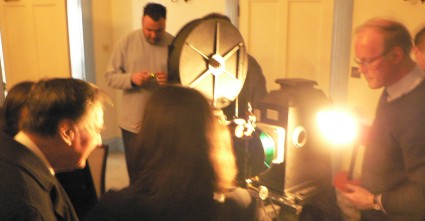
Brian Pritchard (right) demonstrating the No. 19 Kinemacolor projector to Bruce Mousell (left), step-grandson of Kinemacolor producer Charles Urban, February 2008

Kinemacolor, as you will probably have deduced by now, is of great interest to the Bioscope, and it was sad that so few could get to the invite-only ‘centenary’ screening of some Kinemacolor films which took place at the BFI National Archive in Berkhamsted in February of this year.

But if that was recognising the centenary of Kinemacolor as a public process (it was first shown to a public in May 1908), then there is the centenary of its name, since it wasn’t known as Kinemacolor until it had a matinee screening at the Palace Theatre, London, on 26 February 1909, swiftly followed by its commercial debut at the Palace on 1 March 1909.

All of which leads us to this cenentary event at the National Media Museum, Bradford, which is offering the chance to see Kinemacolor screening alongside other treasures. Here’s the blurb:

Here is news of a special presentation taking place on Sunday 15 February 2009 at the National Media Museum, Bradford to mark the centenary of Kinemacolor, the world’s first successful cinema colour process. Entitled Bringing Colour to the Movies – re-creating what it was like to go to the Picture Palace a century ago, it is presented by David Cleveland, Brian Pritchard and Nigel Lister, who provides piano accompaniment.

The show includes short films from the 1890s, comedies and trick films from between 1900 and 1908, the first successful British animated film Dream of Toyland and film of the Titanic in 1912. These are shown on a hand-turned Gaumont Chrono 35mm projector of about 1912, restored by Nigel Lister. This machine worked in the Picture Palace at Southwold, Suffolk and survived until 1958 under the raked seating of the cinema, from where it was rescued by David Cleveland.

Kinemacolor’s first public showing was on 26 February 1909 at the Palace Theatre, London. It was very successful for about six years, then, after losing a lawsuit claiming its patent invalid, Kinemacolor went into a rapid decline. At the height of Kinemacolor’s success there was a large library of films but these were later destroyed and very little survives. The Filmmuseum in Amsterdam have a few films and they have very kindly provided a print of one for this show.

The Kinemacolor projector used, No 19, is from the first batch delivered in 1910 and was used in the Argyll Theatre in Birkenhead. It somehow survived, and has been stored in the Wirral Museum. With the help of Colin Simpson, the Principal Museums Officer, the projector has been on loan to Brian Pritchard who has restored it to working order without altering the machine. With a motor to drive the mechanism at 32 frames per second and a new print of Italian Lakes (1910), Kinemacolor is on the screen once again.

The programme concludes with the science fiction drama of 1909 produced by Charles Urban called The Aerial Torpedo. This film demonstrates the one colour system in regular use throughout the silent period – tinting.

This special presentation will include an introduction and commentary between films by David Cleveland, with Brian Pritchard on the technicalities of Kinemacolor and Nigel Lister on the restoration of the Gaumont Chrono projector.

Bringing Colour to the Movies is on Sunday 15 February at 4.00 pm at On Location, National Media Museum, Bradford BD1 1NQ. Tickets £7.00 (full) and £5.00 (concessions). Call the Box Office 0870 70 10 200 (National Rate). Telephone booking 8.30am – 8.30pm daily, or book online at www.nationalmediamuseum.org.uk. Please note: seat numbers are limited, so early booking is advised.

An accompanying display of original objects and artefacts from the Museum’s Charles Urban archive and Cinematography collection, tells the story of Kinemacolor’s spectacular success. This will be on show from 10 February 2009 at Insight: the Collections and Research Centre on Level One of the Museum. Free entry Tuesdays–Sundays 10.00am–6.00pm.

As someone who spent years (literally) delving into the manifold riches of the Charles Urban archive (formerly of the Science Museum library in London but now held in Bradford), I can recommend going just to see a display of those alone. As for that lost Kinemacolor library,it is a tragedy that the great majority is lost. But we must never lose hope, and the Bioscope is keeping its eyes and ears open, and will let you know should it find anything, one day.

100 years ago

One of the elements of early cinema shows that is frequently forgotten is the presence of a lecturer. It certainly wasn’t the case for every show, and as cinemas spread, got bigger, and intertitles became common, the lecturer became redundant. But this inheritance from the variety theatres and fairground shows where films were first exhibited lingered for a time as cinemas were first developing and many felt the need to have the sometimes bewildering action on the screen explained to them.

How common were such lecturers? It is interesting that in all the memoirs of early cinema-going in London, of which I’ve made a special study, there is not a single mention of someone talking to the pictures. Nevertheless, there were definitely some around, though by the time of this article from The Bioscope of a hundred years ago they starting to become anachronistic. The article, with its quaint language and references to Greek oratory, is describing an ideal, much as other articles from this time describe the sort of music that the author feels should be played in cinemas, rather than the music that actually was.

So we have to read between the lines, and to understand that everything the writer says the lecturer should not do is what the average lecturer almost invariably did.

Explain the Pictures!

The Most Pressing Need of the Day is an intelligent description of Film Plots and Travel Pictures

There seems to be a tendency amongst present day managers to quietly lean back on the reputations they built up in the early years of the industry, confident that the impetus which they engendered then by real grit and toil will carry them along and keep them in the front rank for all time. We must always be on the qui vive. We must not be deceived and deluded by a long period of properity, but must watch for fresh and new fields of enterprise. Good pictures and good prices must not be the only consideration.

One of the most urgent requirements to-day is that every picture shall be introduced to the audience in a manner that will ensure the good points of the film being intelligently appreciated. The developments in the selection and the building up of subjects during the last few years have schooled us until we are quite decided that the lay mind – the mind which is not always devoted to the manufacture and the elucidation of screen mysteries – is quite incapable of seeing and of comprehending the inner nature and the underlying humanity which are the life and soul of to-day’s great creations. Nowadays the lecture is an attribute to success. Some managers have seen it already; others are slowly discovering the fact; while as to the remaining many, we are going to explain to them why they should lecture and how. And if they accept our advice, and act on it, we shall not wait long for their thanks.

Verbal explanation is necessary, finally, because it is impossible to place on the screen real pathos and real humanness – these must be preserved from the full glare of people’s eyes or the effect is lost; secondly, because spectators will not trouble to look for these latent qualities unless the search is suggested to them; and, thirdly, because educational travel pictures minus an explanation of why they should be considered important enough to occupy the screen tend to make interest wane and eventually to fade away altogether.

The Greek orator, when asked what was the essence of speech making, answered “Delivery”. The essence of giving a lecture on a bioscope picture is not distinguished by such a word. The lecturer’s key to success is “to tell the tale”. It should be told simply, clearly and intellectually. The lecturer should know the picture well before he attempts to explain it to others. He should keep perfect pace with the projecting machine, should quietly indicate the inner cause when the outer result is taking place. He should indulge in no stock phrases, no personal reminiscences which the picture may recall, no opaque phrases, no drawn-out, windy sentences; in fact, nothing which could possibly lower his description in the estimation of any single member of his audience. Let him always keep well in mind that he is talking to an assembly, not to a few of his acquaintances, who would probably laugh at his jokes and listen to his rhetoric merely for the sake of their friendship. Audiences do not tolerate any admixture of personality. They want the discription [sic] to be clear, unalloyed, to serve the purpose which it is intended to serve.

But while endeavouring to make himself understood by using words which everyone knows and sentences the meaning of which will be readily grasped by all, the lecturer must guard against falling into the opposite error – that of making his explanation too elementary. Either extreme is wrong, and not wanted. By making his story too academical he will run the risk of being thought by a portion of his audience, to be aiming higher than is necessary, and if he is so unfortunate as to lose himself for a moment, the chaos, which is always threatening, comes; while if he goes too far in the other direction his listeners will accuse him of looking down on them. So the only sensible course to pursue is a middle one. Let the words used be ordinary ones, but let the construction of the sentences be perfect. Do not have your lecture “scrappy” and disconnected. The more intellectual people object strongly to this, and never listen to it more than once.

Above all else, make the story bright. Make your explanation worthy of the beautiful picture you are showing. Every description can be made bright and sparkling, for it is not the subject but the way it is exploited that determines the amount of interest the narrative shall be accorded. Travel films can be described with a swing and a healthy raciness which help the listener to persuade himself that he, too, is bounding along and partaking of the pleasure of actual expedition, while the picture of sentiment and pathos lends itself to that terseness and conciseness which, while bordering almost on the abrupt, is the real acme of of pathetic narrative. Do not have your lecture like a few dry old extracts hitched up from a text book, and, without boring the audience, make yourself felt. Be an authority on the subject in hand; be the larger half of the show.

And when you have done all this you have faithfully discharged your duty. You have sown the seed of success and can look forward to the harvest. You begin to reap exactly one week after the inauguration of the lecture, and the crop increases weekly. So try it. Engage a lecturer or improvise one from your own material. Whether you have spoken in public or not matters little. Study your audiences, work on the ideas I have attempted to explain, and watch for the crowds being turned away.

The Bioscope, 10 December 1908, p. 5

Particularly amusing is the implication that there were lecturers who attempted to provide commentaries to films they had not seen. If all that you are doing is conducting a running jokey conversation with your friends in the audience, perhaps you may even have got away with it.

One last thought. Is this high-minded commentator (who ought to have read some of his own words about the use of clear language) thinking more of lecturers for magic lantern shows than cinema shows? He refers to film dramas and travel pictures, but there is more of an air of the church hall than the electric theatre about this curious piece.

Welcome to Screen Research

screenresearch

http://screenresearch.ning.com

Apologies, first of all, for somehat erratic service from the Bioscope of late. I have been waylaid by the most terrible cold, and can barely think straight, let alone type straight.

But in my lucid moments I have been at work on a new resource. Screen Research is a social network and information resource for anyone interested in moving image research. Where the Bioscope is a personal project which is devoted to early and silent cinema, Screen Research is intended to cover everything from pre-cinema to Internet TV.

It’s only been active for a very short while, but there is a blog, calendar of events, a directory (work-in-progress), loads of newsfeeds, and options for members to start up special interest groups or general discussions. It’s open to anyone who wants to sign up, though you can just browse what’s there. Its focus is activity in the UK, but it should have something for anyone. And, although it ranges far beyond silents, Buster Keaton in Sherlock Junior is the network’s icon.

Please do take a look, and sign up if interested: http://screenresearch.ning.com

Murnau, Borzage and Fox

murnau_borzage

dvdtimes.co.uk

Published on 9 December is the latest in the lavish boxed sets of silents which are raising the bar for DVD releases in our field. 20th Century Fox Home Video is releasing (in the USA) a 12-disc set of films directed by F.W. Murnau and Frank Borzage for the Fox Film Corporation in the 1920s and 1930s, Murnau, Borzage and Fox (1925-1932). The collection comprises:

Murnau silents:

Sunrise (1927) (Movietone score version and European silent version)
The City Girl (1930)

Borzage silents:

Lazybones (1925)
Seventh Heaven (1928)
Street Angel (1928)
Lucky Star (1929)

Borzage talkies:

They Had to see Paris (1929)
Liliom (1930)
Song O’ My Heart (1930) (full sound version and music/effects version)
Bad Girl (1931)
After Tomorrow (1932)
Young America (1932)

You also get a new documentary on Murnau and Borzage by John Cork, and two books of photographs on the films. What’s missing is Borrzage’s recently rediscovered (though incomplete) The River (1929), which is instead released on DVD by Edition Filmmuseum. There is, however a The River reconstruction featurette and stills gallery. For Murnau’s lost film, The 4 Devils, there is Janet Bergstrom’s film Murnau’s 4 Devils: Traces of a Lost Film, plus screenplay, treatment and stills gallery.

More information from the Fox Studio Classics site.

Pen and pictures no. 6 – George Bernard Shaw

george_bernard_shaw

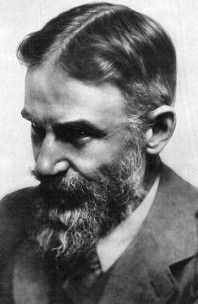
The literary intelligensia of the early twentieth century responded in various ways to the appearance of moving pictures. George Bernard Shaw (1856-1950), more than most, responded with words. All writers depend on words, but Shaw’s reputation in particular was based on words in profusion. He loved to talk, the characters in his plays love to talk and talk, and his writings in every other form beyond the theatre were all part of an unstoppable conversation the man was compelled to have with his times. So what possible interest could there be for him in the silent film?

When the first motion pictures were projected in Britain in 1896, Shaw was already renowned as a critic and a playwright, and into the new century gained increasing stature as a public figure whose opinion on everything was sought and enthusiastically given. His plays and the long prefaces he wrote for their printed versions became vehicles for his opinions on artistic, social and political matters.

It is no surprise, therefore, that Shaw had views on the cinema. Those views were many, but mostly they can be subdivided into filmgoing, film and theatre, money, education and censorship. So let us address each one of these in turn.

Filmgoing
Shaw was a keen cinemagoer from the 1900s onwards and throughout his long life. He enjoyed the full range of dramatic delights on offer, even if he thought some of the performers poor. In this extract from a 1912 letter to the renowned stage actress Mrs Patrick Campbell, he praises Max Linder and an unnamed Danish actress (maybe Asta Nielsen):

Do you ever study the cinema? I, who go to an ordinary theatre with effort and reluctance, cannot keep away from the cinema. The actor I know best is Max Linder, though I never heard his voice or saw his actual body in my life. But the difficulty is that though good looks and grace are supremely important in the cinema, most of the films are still made from pictures of second, third and fourth rate actresses, whose delighted willingness and energy, far from making up for their commonness, make it harder to bear. There is one woman whom I should shoot if her photograph were vulnerable. At Strassburg, however, I saw a drama which had evidently been played by a first rate Danish (or otherwise Scandanavian) company,with a really attractive leading lady, very sympathetic and expressive, without classical features but with sympathetic good looks …

Interesting that Shaw at this stage cannot really see the cinema as anything other than photographed drama rather than something truly with a life of its own, to be judged by what one saw on the screen rather than by what one thought of the process by which it got there.

Shaw’s most notable commitment to cinemagoing was as one of the original subscribers to the Film Society, formed in 1925 by a coterie of British intellectuals as a place to show artistic films (chiefly from the Soviet Union) which were unviewable elsewhere. Ivor Montagu was the founder: other notable members included Julian Huxley, John Maynard Keynes, Roger Fry, Michael Balcon, John Gielgud and Ellen Terry. It formed the cornerstone of British intellectual film culture.

Film and theatre
Shaw was fascinated by the relationship between film and stage, as a professional writer and as a theorist. He saw that films were a threat to the drama (and would be all the more so once they acquired sound), not least for what they exposed of the specialised nature of theatre. In Shaw’s eyes, the cinema was open to a wide range of talents, while “the art of the theatre is a far more specialized, more limited, and consequently more exacting art than the art of the picture palace”. This simplistic view, from 1915, he may have revised in later years, but he saw clearly (at a time when many still believed that better films would be made by employing renowned playwrights) that the two arts differed significantly. In 1921 he wrote:

I agree with [Eugène] Brieux that cinematography is an art in itself, and that the practice of transfering stage plays from the stage to the screen is a superstition. It imposes the very narrow physical limits of the stage on the practically boundless screen; and it deprives the stage play of the only feature that distinguishes Lear from Maria Marten or The Murder in the Red Barn; that is, the dialogue. Its success is in direct propotion to the quantity of screen stuff interpolated by the film producer; the more complete the transformation, the better the result.

Authors should write for the stage and the screen; but they should not try to kill the two birds with one stone.

Money
Shaw was a professional writer. He wrote plays to air social issues, but also to make money. So he was interested in the cinema as it affected him as a writer, and also (from his socialist viewpoint) as a capitalistic enterprise. Shaw received many invitations from film companies to film his plays, requests which he turned down throughout the silent era, even as the proffered sums grew higher and higher, for two reasons: (i) because his works could only best be served by the talkies, and (ii) because once a play had be filmed, it would lose its commercial worth in the theatres. This interesting latter point he made clear in a letter to writer William Lestoq in 1919:

Pygmalion is not available for filming.

Never let anyone tempt you to have a play of yours filmed until it is stone dead. The picture palace kills it for the theatre with mortal certainty. Pygmalion is still alive and kicking very heartily.

But it was also the deals that he was being offered that offended him. He knew, in any case, that all the movie magnates really wanted from him was his name – the product they could turn to their own desires as they pleased, if he would let them. Shaw’s canny business head is revealed in this letter from 1921:

Hearst [William Randolph Hearst, the press baron, was a movie producer as well] has sounded me out on the subject of films; but he has never suggested that his very handsome purchases of serial rights from me should carry Movie Rights with them. On the contrary, it is I who have been sounding him on the subject, because if I sell a film down for £10,000 down, the taxation is so enormous, both on the sum itself and on all the rest of my income (which is raised in the scale by the addition of this big sum), that I prefer an annual payment spread over years; and yet as the film firms are here today and gone tomorrow, one cannot trust to anything but a lump sum in dealing with them. A permanent institution like W.R.H. [William Randolph Hearst] would be much safer.

Shaw signed no contract with Hearst or anyone else. Wary of the silly sums of money being waved at him, warier still of how his art might be spoiled by the screen, he hung on until sound films (whose potential had interested him since the earliest synchronised sound experiments from the 1900s) were a commercial reality. However, he has less control over what got produced in some European countries, and a Czechoslovakian version of Cashel Byron’s Profession, Román boxera, appeared in 1921, while a little-known Austrian film, Jedermanns Weib, made in 1924 by Alexander Korda and starring his wife Maria, is loosely based on Pygmalion (she plays a Montmartre flower seller who is turned into a high society lady). The film was released in Britain in 1926 (as The Folly of Doubt) but there seems no evidence that Shaw was aware of it. (Korda in later years bid for the rights for Shaw’s works, but it was another Hungarian, Gabriel Pascal, who finally gained Shaw’s trust).

Education
Shaw demonstrated his habitual imagination in his views on the value of the cinematograph in education. Most social commentators, if they could find any good word for the early cinema, would point to its possible educative possibilities, but Shaw knew how narrow such sentiments usually were. It was the cinema itself that was an education, as he wrote in The Bioscope in 1914:

The cinematograph begins educating people when the projection lantern begins clicking, and does not stop until it leaves off. Whether it is shewing [sic] you what the South Polar ice barrier is like through the films of Mr [Herbert] Ponting, or making you silly and sentimental by pictorial novelets, it is educating you all the time. And it is educating you far more effectively when you think it is only amusing you than when it is avowedly instructing you in the habits of lobsters.

The cinema was not there to teach the moral virtues but rather the “immoral virtues” of “elegance, grace, beauty … which are so much more important than the moral ones”. Shaw is being too clever, as usual, but when he ends this intellectual sally by by declaring that the cinematograph “could easily make our ugliness look ridiculous” then one starts to understand what he is trying to say. The cinema teaches us to appreciate the beautiful. How true.

Censorship
On censorship, Shaw was bracingly sensible. In this 1928 piece, he defends screenings of Eisenstein’s Battleship Potemkin and the British film Dawn (about the execution of Nurse Edith Cavell in the First World War):

All the censorships, including film censorships, are merely pretexts for retaining a legal or quasi-legal power to suppress works which the authorities dislike. No film or play is ever interfered with merely because it is vicious. Dozens of films which carry the art of stimulating crude passion of every kind to the utmost possible point – aphrodisiac films, films of hatred, violence, murder, and jingoism – appear every season and pass unchallenged under the censor’s certificates. Then suddenly a film is suppressed, and a fuss got up about its morals, or its effect on our foreign relations … One of the best films ever produced as a work of pictorial art has for its subject a naval mutiny in the Russian Fleet in 1904 … The War Office and the Admiralty immediately object to it because it does not represent the quarterdeck and G.H.Q as peopled exclusively by popular and gallant angels in uniform. It is suppressed. Then comes the Edith Cavell film. It is an extraordinarily impressive demonstration of the peculiar horror of war as placing the rules of fighting above the doctrine of Christ, and geographical patriotism about humanity. No matter: the film is at once suppressed on the ridiculous pretext that it might offend Germany … The screen may wallow in ever extremity of vulgarity and villainy provided it whitewashes authority. But let it shew a single fleck on the whitewash, and no excellence, moral, pictorial, or histrionic, can save it from prompt suppression and defamation. That is what censorship means.

dukore

Shaw’s views on cinema are boldly expressed, and touch upon every corner of its production and its relationship to society. It is fortunate that there is a volume (to which this post is much indebted) which gathers together his writings on film: Bernard F. Dukore, Bernard Shaw on Cinema (1997), which I warmly recommend. Shaw did not wholly understand the medium about which he was so ready with an opinion (something which could be said about Shaw and any number of subjects). His careful nurturing of his plays until the talkies arrived was no protection against the persuasive tongues of such producers who promised him faithfulness to his text, and the first two Shaw talkies, How He Lied to Her Husband (1931) and Arms and the Man (1932) talked too much. Only with Pygmalion (1938), one of the jewels of 1930s British cinema, did Shaw and the cinema finally understand one another (and only then after two unofficial versions, one German (1935), one Dutch (1937), had vulgarised his work to the point of unrecognisability).

shaw_movietone

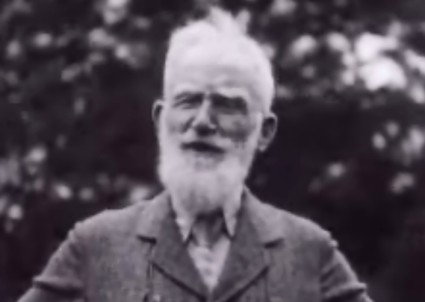
‘Well this is a surprise, have you all come to see me?’ Shaw addresses the Movietone newsreel cameras in 1929, from http://www.movietone.com

Is there anything else to add to Shaw’s interest in film in the silent era? Well, there was Shaw the film performer. As told in an earlier Pen and Pictures post, Shaw appeared in J.M. Barrie’s spoof cowboy film How Men Love, in 1914. In 1917 he turned up in the prologue, filmed at the Royal Academy of Dramatic Arts, to the film Masks and Faces. He gives a silent ‘interview’ to Pathe Gazette in a 1927 newsreel available on the British Pathe site.

But for Shaw the word was everything, and it is no surprise that his real film debut came with sound. He made a short film of some kind in 1926 (according to Dukore it was a ‘filmed interview’ made using film and phonograph, produced in Italy), and may have been interviewed for the Lee De Forest Phonofilm system in 1927 (information on this is contradictory). But it was in 1928 that he caused a sensation with his ebullient address to the Movietone newsreel cameras:

Well this is a surprise, have you all come to see me … ladies and gentlemen well I should never have expected this … its extremely kind of you and I’m very glad to see you … I’m very glad to have come as I like people to see me, I don’t know how it is but people who only know me from reading my books or sometimes see my plays get an unpleasant impression of me, and the people who meet me as you’ve been kind enough to meet me, when they see that I’m a most harmless person, I’m really a most kindly person …

This was a man who needed the camera to hear him.

(You can see and hear the 1928 interview at www.movietone.com – you have to register first, but it is free thereafter. The site dates the film as 1929, but that is for its British release).