Not only divas

Not Only Divas: Women Pioneers of Italian Cinema is an international conference taking place in Bologna, Italy, 14-16 December. The event is being promoted by the University of Bologna, the Biblioteca italiana delle Donne, the Associazione Orlando and the Women’s Film History Association. I haven’t been able to find any information about it online except in Italian, so here’s a translation from a flyer:

Until recently, the issue of women’s contribution to the creation and development of the film industry has been largely ignored in historiographical research, producing an image of silent cinema as a territory exclusively dominated by male agency and desire. In the last few years, however, a new line of international research has revealed a surprsing number of traces of women’s creative and professional participation in the silent film industry, showing clearly that the very few feminine names that have been traditionally credited in official film histories are in fact only the visible part of a much larger iceberg. One of the most interesting results of this research is actually to have revealed that in all national cinemas during the silent period the women working in the film industry in non-acting roles were far more numerous than in any other period of film history.

Though peculiar in many aspects, the case of Italian cinema is no exception. Besides Elvira Notari, pioneer of Neapolitan cinema, who has no doubt to be recalled as one of the most productive women directors of all times (second, perhaps, only to Alice Guy) and Francesca Bertini (the widely celebrated Diva, who in her late years repeatedly claimed for herself the maternity of her films), many others are the women who succeeded in entering as professionals the sphere of a mainly masculine industry. We can think as an example of the nowadays forgotten names of directors like Diana Karenne, Gemma Bellincioni, Giulia Cassini, Elettra Raggio; of screenwriters like Renée de Lion or Nelly Carrère; or even of a film distributor like Fanny Kluge.

The Not Only Divas Conference is the first step in a multiannual research project aimed at producing new knowledge on such pioneering figures by means of an articulated series of events, including film retrospectives, film restorations and publications.

More generally, the International Conference intends to stimulate a reflection on the scope of movement that was available in Italian silent cinema, in a particularly conservative socio-cultural context, for all the forms of feminine expression or women’s representation that are impossible simply to reduce to the tradiditional figure of the Diva.

The following thematic and methological issues will be considered :

  • Reconstruction of Italian women film pioneers’ biographies and production
  • Forms of women’s representation in Italian silent cinema
  • The anti-Divas: comic actresses and muscle-women
  • Women’s professional agency in the Italian socio-cultural context of the silent period
  • Italian silent cinema and female audiences
  • Relationships among women across film, theater and literature
  • Comparative analysis of the women’s role in Italian and foreign cinemas
  • The feminist movement in Italy during the silent period
  • The problem of sources: women’s history in the Italian film history

Conference director: Monica Dall’Asta, Università di Bologna

Please write for information to angelita.fiore [at] unibo.it

Excellent stuff, all part of a major re-investigation of women’s roles in silent cinema which is taking place worldwide at the moment. But I would like to know who it is can say for certain that there were more women working in the film industry in the silent period than at any other time. How has this been determined? If they mean behind-the-scenes roles (office workers, early film processing etc) and not just ‘creative’ roles, perhaps this may be right. But I’d like to see the evidence.

RIP Minoru Inuzuka

The last director to have made a silent film in the 1920s died last month. While Portugal’s Manoel De Oliveira, who made Douro, Faina Fluvial in 1931 is still with us (and still working), Japan’s Minoru Inuzuka directed his first silent feature in 1927, Sunae shibari: Dai-nihen, having previously contributed to the script of Kinugasa’s classic Kurutta ippêji (A Page of Madness) (1926). He was 106 years old.

Where now for the Cinema Museum?

The Cinema Museum, one of London’s hidden cinematic treasures, is under notice to quit from the former Lambeth workhouse building (where Charlie Chaplin’s mother was incarcerated) by March of next year. There’s an article in The Observer with the background story and an affectionate portrait of the museum itself.

Meanwhile, the Cinema Museum has just published its new website, which is delightfully rich in pictures of the collection, its building, and even buildings to which they might move next. There’s also a fascinating video tour of the collection, made in 2000, which can also be found on YouTube.

London thrills me

Blackmail

Blackmail (1929), from http://www.bfi.org.uk/whatson/lff

OK, back to normality, and a few short news items on silent matters which have built up over the past few days. To start with, under the title ‘London Thrills Me’, the London Film Festival is hosting two silent film screenings this week in Trafalgar Square. On 18 October you can see the silent version of Alfred Hitchcock’s classic Blackmail (1929), accompanied by Ivor Montagu’s delightful comic short, Blue Bottles (1928), starring Elsa Lanchester. Neil Brand provides the live piano score. The following day John Sweeney is the pianist in Trafalgar Square for Capital Tales, a selection of 100 years of London on film. The silents being screened are London Street Scenes – Trafalgar Square (1910), Blackfriars Bridge (1896), Petticoat Lane (1903), Old London Street Scenes (1903), Trafalgar Square Riot: Pathé’s Animated Gazette (1913), Hoxton… Saturday, July 3rd, Britannia Theatre (1920) – extract, The Fugitive Futurist: A Q-riosity by “Q” (1924), Cosmopolitan London (1924) – extract, and Piccadilly (1929) – extract. Both screenings begin at 18.30.

Pordenone diary – day five

Bible lands frame

One of the ‘Bible Lands’ films discovered by Lobster Films, from http://www.cinetecadelfriuli.org/gcm

In March of this year, someone spotted a small can of film in an antique shop window. It had the words ‘Collection ELGE’ on the can, indicating a Gaumont film (from the letters L.G. for Léon Gaumont). The discovery came to the attention of film historian Sabine Lenk, who in turn alerted Lobster Films of Paris, specialists in early film and inspired discoverers of the extraordinary. What lay within the antique shop, however, hinted at being their most exceptional discovery yet. There were ninety-three cans in the shop, the owner apologising that they were only negatives (!). They were Edison-perforation 35mm, some in ELGE cans, some in Lumière cans, with some shrinkage but little decomposition. And they appeared to date from 1897.

Films very rarely turn up these days from the 1890s, and when they do they tend to be in ones and twos. For ninety-three to emerge in one go is practically unprecedented. And there there was their subject matter. Handwritten titles on the opening frames indicated films taken in Nazareth and Bethlehem, and dramatised scenes of the life of Christ. Before a single film had been printed or viewed, it was clear that here was a truly major discovery.

Seven months on, and amazingly the collection was ready for exhibition at Pordenone. Inevitably enough, this being a collection of early, non-fiction films, the Verdi was less than full for this historic premiere. So there were folks who preferred their cappuccino to witnessing the most remarkable discovery of the festival, but more fool them. The rest of us heard an introduction from Serge Blomberg of Lobster, who said that the rolls of film bore number 1 to 203, with many missing. The films we were to see came from Palestine and Egypt. Other titles showing scenes in Turkey would be shown at a later date.
Bible lands frame

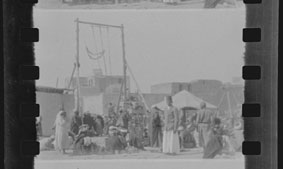
One of the ‘Bible Lands’ films discovered by Lobster Films, showing a funfair with swings, from http://www.cinetecadelfriuli.org/gcm

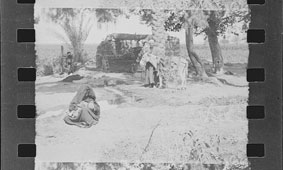
And so to the films. They were one-minute or so each in length, actualities of life in the Bible lands (as Lobster have labelled the films), very much in the Lumière style. Indeed, the films showed the sort of studied composition and coherent action encompassed within the frame and completed within the film’s duration that characterises Lumière productions. Some had two shots, some featured camera movement. They were all in superb condition. We saw camel drivers, a snake charmer (whose cobras tried to escape into nearby bushes and were hauled back, not best pleased), children dancing in front of the ruins at Luxor, street vendors in Cairo, an Arab street funeral procession, a funfair with swings pulled by ropes and a mini ‘big’ wheel, women drummers, men dancing, men and women making bricks, women preparing food, a panning shot of the Kedron Valley, women sowing seeds on horse-drawn ‘carts’ (they looked like sleds) outside Nazareth, and many more such scenes. Perhaps most impressive were the two or three films showing the shadouf being operated, the human-powered (usually child-powered) irrigation system with a bucket and a counterweighted arm. These were scenes that had gone on from centuries, millennia even, and here was the motion picture capturing them – in 1897 (or thereabouts), when in truth they could have been scenes from any time.

Following the actualities, we had the dramatic films. There were scenes from two lives of Christ – or at least, filmed in different locations. The first was clearly filmed in Palestine, presumably in Nazareth and Bethlehem themselves. These were brief scenes from the birth and childhood of Christ, extraordinarily featuring an Arab (Christianised?) Joseph and Mary. The Adoration of the Shepherds and then the Magi (not much difference between the two) took place by some steps, with a rough authenticity unlike any Nativity film you ever saw. Mary wore a large white shawl that covered much of her face. We saw further scenes with this couple, Mary on a donkey, the rest on the flight to Egypt, Mary breastfeeding her child, the toddler Jesus’s first steps (not a scene I remember from the Bible).

And then the backgrounds changed. The scenery became wooded, without buildings, and Mary, Joseph and Jesus (a young girl) were now played by white performers, with attitudes and iconography far closer to the conventional. These scenes appear to have been filmed in France, but they continued to surprise. We had an Annunciation scene with an angel Gabriel suddenly appearing (a trick effect unlikely to be as early as 1897), Joseph working at his carpentry, someone dropping a pot which the child Jesus then magically mended, Joseph rowing Mary and Jesus across a river, young girls dressed as angels joining Mary and Jesus. Most astonishing was the film where the child Jesus carried a cross, placed it upon the ground, and then lay down upon it. There is some precedent for this sort of intimation of the future on the part of the child Jesus in the Western art tradition, but it was still a mind-boggling feat of the imagination.
Bible lands frame

One of the ‘Bible Lands’ films discovered by Lobster Films, from http://www.cinetecadelfriuli.org/gcm

So who made these films, and who saw them? Although there is not certain evidence as yet, the most likely candidate is Albert Kirchner, also known as Léar. Kirchner was a French photographer and likely producer of risqué postcards, who is first recorded as having made a striptease film, Le Coucher de la Marie, with Eugène Pirou in 1896. Unblushingly moving from pornography to religion, Kirchner teamed up with a Catholic priest and educationalist, Father Bazile, to make short comedy films. In Spring 1897 he set off with one Father Bailly to film in Egypt and Palestine, returning to France to film a twelve-scene Life of Christ with Michel Coissac (a future film historian who wrote about this episode). This was the first-ever Life of Christ to be filmed, and it enjoyed huge popularity – the Reverend Thomas Dixon, author of The Clansman on which D.W. Griffith’s The Birth of a Nation would be based, exhibited it in America in 1898 – and was much imitated. Kirchner’s films were bought up by Gaumont, and some can be found listed in Gaumont catalogues. He then disappears from the historical record, but he may have died soon afterwards.

There was much excited discussion among the early film enthusiasts after the screening (there aren’t many of us who get wildly enthused by 1890s films, but we’re a dedicated breed). It seems unlikely that all the films date from 1897, given some of the sophisticated techniques on view at times, and we may have seen films produced by different hands. And so many questions. Why the two lives of Christ? Were the ‘authentic’ scenes shown in France, rejected by audiences, and scenes more in keeping with Western taste shot in their place? Or were the two lives really one and meant to be shown together, despite the changes in performers and costumes? Were the actuality scenes meant to be integrated with the dramatised scenes? We know that the films – assuming they are Kirchner’s – were popular, but what exactly did audiences see? It is only a few months since this extraordinary collection was discovered, and there is still a huge amount to be discovered. What is certain is that a gap in the history books needs to be filled, and we have a collection of views of life in Palestine and Egypt at the end of the nineteenth century which will not only excite the historians but enrich generations to come.

[Update (October 2008: The films are now known to have been made by the Abbés Mulsant and Chevalier in 1904. See Back to the Bible Lands post]

There were other films in the day, which I’ll touch on briefly. Two delightful Starewitch animations, Les Grenouilles Qui Demandent Un Roi (1922) caught the stern spirit of Aesop and La Fontaine very well, with fine comic glosses on the tale of the frogs who ask an exasperated God for a new king, eventually getting a stork which eats them all. La Voix du Rossignol (1923) was charming in its meticulously observed depiction of bird life. Der Kampf der Tertia (1929) was a German’s children’s feature film, directed by Max Mack and with beautfilly composed coastal scenes, about a group of schoolchildren who prevent a cull of cats in a neighbouring town being organised by Max Schreck (of Nosferatu fame). Happy, inconsequential stuff, though you couldn’t help but wonder what would be the fate of those bright-eyed youngsters ten years thence. All at Sea (1933), shown in the evening, was a home movie shot by Alistair Cooke (the future broadcaster) of a yachting trip he spent with Charlie Chaplin and an impossibly beautiful Paulette Goddard. Chaplin is seen impersonating Jean Harlow, Greta Garbo and the Prince of Wales (rather good), as well as going through a Napoleon routine. We also saw unpleasant details of a shark being caught, and the usual dull shots of ships in the distance which invariably fail enliven the home movies of rich or humble.

Pordenone

Pordenone

And so farewell to Pordenone for 2007. I left on the Thursday morning, and so missed the last three days, including the Corrick Collection of early films recently discovered in Australia, my favourite René Clair film, Un Chapeau de Paille d’Italie (An Italian Straw Hat) (1927), and the late D.W. Griffith film that I most admire, Isn’t Life Wonderful (1924). Ah well. If you want to find out more about the films on show at this year’s Giornate, the full catalogue is downloadable as a PDF (2.9MB), with marvellous detail, expertly edited as always by Cathy Surowiec. If you were at Pordenone and saw the films I saw and would like to make comments – or if you saw films I didn’t see and would like to tell us about them – please do so. And if you’ve never been to the Pordenone Silent Film Festival and these posts have made you think that perhaps you ought to one day – well, you’re right.

Pordenone diary – day four

E.A. Dupont filming Das Alte Gesetz

E.A. Dupont directing Das Alte Gesetz, from http://www.juedischesmuseum.de

Every Pordenone Silent Film Festival has the one outstanding title, a feature generally previously neglected or unknown, whose exhibition here revives its reputation and gets everyone talking. This year the palm d’or undoubtedly went to E.A. Dupont’s Das Alte Gesetz (1923). Ewald André Dupont has had a revival in reputation of late, owing to the visibility of his late British silents Moulin Rouge (1928) and especially Piccadilly (1929), and in the reference books he always gets a warm mention for Varieté (1925), one of the cast-iron classic silents, and a shake of the head in sorrow for the sharp dip in his career that occured with the arrival of sound.

Das Alte Gesetz has been more listed in filmographies than seen, but it is close to a masterpiece. Set in the mid-nineteenth century, it tells the tale of a young Jew, Baruch (Ernst Deutsch), who breaks away from his Orthodox village background and stern rabbi father to become an actor in Vienna. So it is reminiscent of The Jazz Singer in theme, but it is the technique and style that distinguish the film. Dupont knows how place people within the frame, how they move within that space, how to capture the tensions between people, how to film intensity. With the help of superb sets by Alfred Junge, he deftly contrasts the humble, ritualised Jewish life with the elegant, no less ritualised Viennese society, personnified by Henny Porten poignantly playing an archduchess attracted to Baruch. The portrait of theatrical life, from ramshackle touring theatre with its wobbly sets to the formalities of the Burgtheater are beautifully drawn, and Deutsch (excellent) ably persuades us of an adolescent enthusiasm for performance which gradually reveals real dramatic talent. It is the resolution of his new world with his past that forms the core of the film, and his stern father’s painful acceptance of his son’s new life is memorably drawn by Avrom Morewsky. Most touching is the scene where he apprehensively picks up a book of Shakespeare’s plays (we see Baruch in Romeo and Juliet and Hamlet), which he tries to open back-to-front (i.e. as though a Jewish religous text) before reading it and discovering that the truths that his son understands are not so far from those that govern his life. The film looks superb (photography by Theodor Sparkuhl) and ought eventually to find a DVD release. It certainly merits screenings at other festivals.

Annie Bos

Annie Bos, from http://www.stadstheater.nl

Das Alte Gesetz was heady stuff for 9.00am. It was followed by four titles featuring the great star of Dutch silent cinema, Annie Bos. No, I hadn’t heard of her either. She was popular through the teens in Holland, graduating from slight social comedies to melodramatic diva roles in imitation of the Italian actresses Lyda Borelli and Francesca Bertini. She started out in comedies about two naive Dutch girls, Mijntje and Trijntje. In Twee Zeeuwsche Meisjes in Zaanvoort (1913) we see a somewhat plump Annie as one of the duo who go to the seaside and… well, that’s about it, they go to the seaside, and they improvise some comedy, and passers-by in the background stare on in amusement. Boerenidylle (c.1914) is similarly unencumbered by narrative. Annie is courted by her farmhand boyfriend, nothing dramatic happens at all, and the scenery is beautiful. Full-on drama comes with the delirious De Wraak van het Visschersmeisje (The Revenge of the Fisherman’s Girl) (1914). Exploiting the availability of an exotic dancer who employed snakes in her act, this impressively ludicruous mini-drama has two characters savaged by a quite sizeable python, which brightened up the audience no end. The feature-length Toen ‘t Licht Verdween (1918) showed a slimmed-down Annie in full diva mode, as a woman whose growing blindness causes her the loss of her composer husband, while a hunchback organist who truly loves her tries to save her, only for her life to end in suicide.

We should turn to René Clair for some light relief, but alas in the 1920s he was still finding his way as a filmmaker, and Le Fantôme du Moulin Rouge (1925) was disappointingly conventional and ponderous. It tried to introduce fantasy elements – the hero is able to float disembodied through Paris, viewing events but unable to affect them – but it was uncertain whether to adopt a light or serious tone. Starewitch also seemed a little off-form with Liliya (1915), a curious attempt to illustrate the invasion of Belgium in 1914 with insects, and Dans les Griffes de l’Araignée (1920), a rather confusing drama involving spiders.

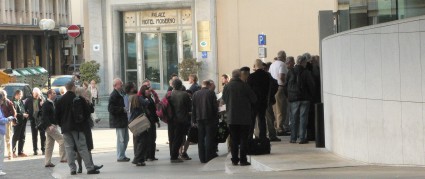
Wifi at Pordenone

To round off the day, here’s a telling scene taken in the early morning, before the festival office had been opened, but with the wifi service switched on. From right to left, Dennis Doros of Milestone Films, Thomas Christensen, curator at the Danish Film Archive, and Minnie Hu, a student at the University of Washington and journalist for the Seattle China Times.

Pordenone diary – day three

Queue outside the Verdi

Queue outside the Teatro Verdi

It was during the Pordenone festival that Peter Greenaway announced the death of cinema. He wasn’t at the festival himself, but rather in Korea at the Pusan International Film Festival, giving a masterclass, but his words went round the world, as words will these days. Now, the unfortunate demise of cinema is commonly reported – Pordenone stalwart Paolo Cherchi Usai has written a book on the subject – and still the corpse keeps dancing around on our many and various screens, but Greenaway had an interesting specific point to make:

Cinema’s death date was in 1983, when the remote control was introduced to the living room … Bill Viola is worth ten Martin Scorseses. Scorsese is old-fashioned and is making the same films that D.W. Griffith was making early last century … Every medium has to be redeveloped, otherwise we would still be looking at cave paintings … My desire to tell you stories is very strong but it’s difficult because I am looking for cinema that is non-narrative.

Well, aside from the irony that Scorcese wrote the foreword to Cherchi Usai’s book (which admittedly is on the preservation of cinema rather than the present and future reception of cinema), is he still making films like Griffith, and what have we been doing these past few years at Pordenone sitting through the entire works of Griffith, the arch-master of narrative cinema? And why aren’t the art works of Bill Viola on show at this silent film festival?

Pordenone serves both an academic-historical and a sentimental function. It displays the films of the first thirty years or so of cinema with full archival and scholarly rigour – intelligently selected titles presented as products of national, artistic or thematic output, with credits, sources, informative writing, all backed up with the best-available prints shown in the best-possible conditions. It also caters to the nostalgic, with conventional, albeit brilliantly played and usually improvised, music rich in themes from the early twentieth century, and an abiding fondness for the stars of that era. On day three (October 8th), for instance, we were treated to a visit from Jean Darling, one-time star of the ‘Our Gang’ shorts, and the day before we spoke on the phone to Hungarian actress and singer Márta Eggerth to thank her for the film of her that we had just seen. Some acknowledgment of modern silents is made at Pordenone, such as the ingenious pastiches of the Wisconsin Bioscope, but Bill Viola would look sadly out of place. This is a festival which looks back – to the roots of cinema, and to a lost past.

And, however scholarly, this is an audience that likes its stories. Non-fiction does begrudgingly receive its due at Pordenone, but many choose the opportunity of such screenings to visit the restaurants and cafés. Narrative cinema reigns supreme, and much of the academic enquiry seems in any case rooted in the ways in which silent cinema discovered how to tell a story. It’s a fundamental need. Martin Scorcese is still making films in the way D.W. Griffith made them, because the audience still wants to identify people, their personalities, their predicaments, and what happens to them under crisis. I suspect that he would be rather flattered by Peter Greenaway’s comparison of him with D.W. Griffith. But I also suspect that Greenaway would be dismayed by Pordenone’s faith in a cinema held in amber.

D.W. Griffith

D.W. Griffith

But enough of such speculation – what of the immediate reality of sitting through another Griffith turkey, One Exciting Night (1922)? Word went round that this unfamiliar title was even worse than Dream Street, and at 136 mins it was going to be a grim ordeal. The film is a murder mystery set in an old dark house – a theme that is all too familiar now, but was fresh then. Griffith had tried to secure the rights to The Bat, a hugely popular play about a mysterious house with money hidden in it and many suspicious characters after it. Unable to afford the rights, Griffith simply rewote the story himself (using the pseudonym Irene Sinclair). The plot concerns an inheritance, an orphan (Carol Dempster), bootleggers’ loot, and a host of characters in the obligatory multi-roomed house, one of whom is a murderer. Title cards warn us of the mysteries that are to follow and how we should not reveal the identity of the murderer to those who might want to see the film after us. However, the identity of the murderer is glaringly obvious from the start, the plot is incomprehensible, and the handling of it inept. Griffith simply could not apply the necessary techniques for the mystery genre, filming in a flat, obvious style, failing to bring any clarity to a complex, incoherent plot, and leaving the audience both bored and bewildered.

And yet, and yet… Three quarters of the way through the film changes. The plot becomes so incoherent, the rushing between rooms of the increasingly panicky characters so manic, that all narrative coherence disappears and a kind of insane magnificence takes over. It’s at this point that a hurricane is introduced into the proceedings. There’s nothing to announce it – it has just built up in the background, and suddenly the characters are all outside and at the mercy of the wild elements. The expensive hurricane sequence was added on as an afterthought (clearly hoping to recreate the excitement of the final scenes of Way Down East), and has been much criticised as an illogical irrelevance. But to me it seemed to have a mad logic to it, and the pianist John Sweeney (on top form throughout the festival) certainly responded with gusto. One Exciting Night is a bad film by any conventional standard, but the way in which it tries to hold up a narrative, gives up, then welcomes in chaos, might have found it some favour with Peter Greenaway after all. Even Carol Dempster is not that bad. What is dreadful is more eye-rolling blackface ‘comedy’ from Porter Strong, which critics at the time shamefully found among the film’s best features.

OK, so what else did we have on day three? More of Starewitch’s stop-motion animations, from his Russian period: Strekoza i Muravei (The Grasshopper and the Ant) (1911) and Veselye Stsenki iz Zhizni Zhivotnykh (Amusing Scenes from the Life of Insects) (1912); and from his French period: L’Épouvantail (1921) and Le Mariage de Babylas (1921). L’Épouvantail mixes live action (Starewitch himself as a yokel, plus his daughter Nina) with puppet animation in a very effective mixture of film trickery and slapstick, while Le Mariage de Babylas is a delightful tale of a spoiled wedding among a child’s toys, which shows Starewitch’s agreeable lack of sentimentality – he is the Roald Dahl of animators, showing meanness and mischievousness as well as wide-eyed wonder in his childhood tales.

Posta

The Teatro Verdi and the Posta café, Pordenone

The main place for conversations and future plans is the Posta café, immediately across the street from the Verdi, and here I spent some time discusing with others the ongoing Women and Film History International project, co-ordinated by Jane Gaines, which is investigating women film pioneers from the silent era worldwide, in an ambitious programme of investigation and publication. The aim is not only to bring some unfamiliar names to the fore, but to challenge received ideas about the creative filmmaking process. Hopefully some major screen retrospectives will follow as well, and that we keep up this process of continually reinvestigating film history.

Georges Melies

Georges Méliès, from http://www.victorian-cinema.net

I kept ducking out of the German feature films to engage in such chats, alas, but it just isn’t possible to see everything and stay sane. I ducked out of Jean Darling and the ‘Our Gang’ shorts for reasons of taste, but it was back to the Verdi for four newly discovered Georges Méliès titles. How wonderful it is that new Méliès titles keep turning up, and that Pordenone always makes a special presentation of them. This year, the Filmoteca de Catalunya delighted us with Évocation Spirite (1899), La Pyramide de Triboulet (1899), L’Artiste et le Mannequin (1900) and especially Éruption Volcanique à la Martinique (1902), a spectactular recreation of the eruption of Mount Pelée and the destruction of St Pierre on 8 May 1902 with vivid hand-coloured explosions. It’s high time we had an up-to-date list of extant Georges Méliès films published.

I saw about fifteen minutes of the Soviet-Armenian comedy feature Shor I Shorshor (1926). Fascinating as its peasant comedy might have been, and intriguing as it was that such a picture of ‘backward’ rural lifestyles should be issued by a Soviet studio, I do object to being made witness to a comic routine which involved a live chicken being pulled apart by our two heroes. Animals overall had a hard time of it at the Giornate. I walked out.

The day for me was rounded off in happy style by René Clair’s Paris Qui Dort (1923-25), which I’d not seen before. It’s an odd film really – Paris is frozen by a mysterious ray, and only a few characters who were in a plane plus a man who lives at the top of the Eiffel Tower remain active because they were above the ray when it shot out. There is ample opportunity for satire, when the comic group discover that normal social rules no longer apply, but little is done with the concept. Instead it is the lightness of spirit which carries the film. It was surprising however to see such clunking continuity errors – several people could be seen walking around in the supposedly sleep-bound streets of Paris. Lastly we had a generally very funny Louis Feuillade comedy, Séraphin ou les Jambes Nués (1921), starring Georges Biscot. We cannot now of course make films about the social embarassment caused by someone losing his trousers, for today no one would blink an eye at Séraphin’s dilemma. Happily, we can still laugh at such films, because we understand the time and place. Imaginative sympathy – that’s what Pordenone audiences do best.

Pordenone diary – day two

You could always go to the Pordenone Silent Film Festival, not see any films at all, and still have a marvellous and rewarding time. Some, it would appear, do just that. The weather is gorgeous, the restaurants inviting, every street is strewn with the chairs of pavement cafés, and much negotiating over the higher and lower politics of film archives goes on. It is the place where alliances are made, projects are hatched, and deals are done.

The Bioscope, however, rose with the lark (should they have such in Italy) on day two and headed for the Verdi. At Pordenone, screenings start at 9.00am in the main cinema and run til around 1.00pm, then resume 2.30pm, stop again around 6.00pm, then after supper it’s back for the final long haul from 8.30pm to midnight or so. There’s a second, smaller theatre, used for repeat showings and video screenings, the Ridotto. Had you seen everything at the Verdi on the Sunday, you would have seen seventeen titles. Many come with intertitles other than English, so earphone translation is provided. I have a stubborn belief that if a film is well-made enough, not knowing the language of the titles is not a problem – the pictures alone will suffice. This doesn’t entirely work, but I shunned the headphones, and just about got by.

First up was a selection of American shorts on social interest themes from the forthcoming Treasures from the American Film Archives III DVD. Regrettably, I missed The Black Hand (1906), the first Mafia-themed film and The Cost of Carelessness (1913), an educational film with a scene of children watching an educational film (OK, not everyone’s idea of a thrill, but I’d have been intrigued to see it). So, we kicked off with The Hazards of Helen: Episode 13 – The Escape on the Fast Frieght (1915). Not an obvious choice for a selection of films on social themes, but it was argued that Helen’s (Helen Holmes) position as a railroad telegraph operator assumed by her co-workers to be too feeble to do anything made an interesting social comment on the many women office workers of the time. Because, of course, Helen heroically fought villains across the top of the carriages of a speeding train, before returning to her job where no one was any the wiser about her. It’s not always realised that many of the early serials were not cliff-hangers, but rounded off the story neatly at the end of each episode, before resuming much the same narrative with the succeeding episode. Bud’s Recruit (1918) was a two-reel recruiting drama, where a group of neighbourhood kids form themselves into a ramshackle troop, led by all-American Bud, but it is his effete, bespectacled elder brother who by accident ends up joining the army – and of course discovering that it has made him into a true man. So a bit resistible in theme, but well-made – the director was King Vidor. Lastly in this set there was Labor’s Reward (1925), the one surviving reel of five from a dramatised history of unionism produced by the American Federation of Labor. It put particular emphasis on the exploitation of women workers, and begged audiences to buy only from shops which advertised union-made products. Quite fascinating, and a highly-polished production too.

The Cameraman's Revenge

The Cameraman’s Revenge, from Wikipedia

Pause for breath, then down go the lights for the first of the Ladislaw Starewitch strand. The reason for this seemes to have been a fine touring exhibition of artefacts and photographs of Starewitch’s work which was on display, but the films themselves were a mish-mash of old restorations. We saw Mest’ Kinematograficheskogo Operatora (The Cameraman’s Revenge) (1911), Prekrasaia Lukanida (The Beautiful Lucanid) (1910) and Rozhdestvo Obitatelei (The Insects’ Christmas) (1911), all products of Starewitch’s mindboggling idea to make stop-frame animation films using models of grasshoppers, stag beetles and such like. The Insects’ Christmas was a special delight, Santa Claus climbing down off a Christmas Tree to wake some insects out of hibernation and to treat them to their own festivities.

Pordenone Film Fair

Pordenone Film Fair

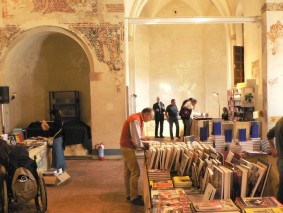
I missed the German film Rivalen (1923) as I had to go to my own crucial pavement café negotiation (the fruits of which you’ll have to wait until January 2009 to see), then to the Pordenone book fair, a fascinating mix of sturdy academic volumes on improbable themes in a multiplicity of languages, and posters, photographs and tattered memorablia for the cinema of the childhood of many of the older festival goers – but such is Pordenone.

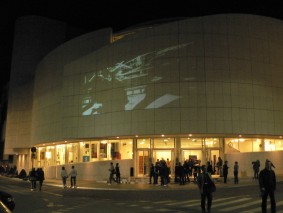
The afternoon kicked off with Entr’acte (1924), first off in the René Clair retrospective, with musical accompaniment of Erik Satie’s score by two pianists, Barbara Rizzi and Antonio Nimis. What more is there to say about one of the great jeu d’esprit of avant garde cinema, originally a filmed interlude shown between the two acts of the Dadaist Francis Picabia’s notorious ballet Relâche? The central action is a funeral procession, with the mourners initially lollopping along behind in mock-serious manner, before having to speed up to a manic rush as the hearse (pulled by a camel, naturally) gets faster and faster. A promo-reel for the festival was projected on the outside of the Verdi at night, which included this magical sequence, like so:

Teatro Verdi at night

Teatro Verdi at night, showing promotional video with scene from L’Entr’acte

Another strand was The Other Weimar. This initially puzzling title introduced the German cinema of the 1920s that we seldom see. Thanks to the studies of Kracauer and Eisner, much of the studies of German cinema at this time has focussed on Expressionism and the fevered productions whose themes seemed to anticipate the nightmares of Nazism. This strand showed the work of the directors who did not get round to making Caligari or Metropolis – those who tended to make the films that people actually went to see.

Wege Zu Kraft und Schönheit (The Way to Strength and Beauty) (1924-25) was a surprise inclusion, being a health, dance and sports documentary, albeit a popular one at the time – probably on account of its liberal displays of nudity. It was an example of the Ufa studio’s documentaries, or Kulturfilme, and most entertainingly had the festival-goers squirming in their seats as its theme of the need for us to get up off our backsides and start walking seemed all too relevant. Though it was a bit long and repetitive, it was made with mocking wit and some style, with plenty to fascinate fans of dance (including Mary Wigman and Tamara Karsavina) and sport (Babe Ruth, Helen Wills, Charley Paddock). And the keen-eyed would have spotted Leni Riefenstahl in her first film, no doubt picking up ideas for Olympia twelve years away, as a maid in a Roman bath sequence.

I cannot now remember what crucial meeting it can have been that led me to miss Fatty Arbuckle in The Cook (1918) and Max Davidson in the immortal Pass the Gravy (1928), but I hope it was really important.

In the evening, Jean Vigo’s A Propos de Nice (1930). We had been promised Michael Nyman playing his own piano score, but he was unwell, and was replaced by one of the Pordenone regulars, John Sweeney – who was magnificent. The films at Pordenone are accompanied by a small team of pianists, generally hidden from view beneath the stage, with a monitor showing them the action and headphones translating the titles. This year we had Neil Brand, Gabriel Thibaudeau, Günther Buchwald, John Sweeney, Stephen Horne, Donald Sosin, Phil Carli and Antonio Coppola. High praise to them all. A Propos de Nice is surprisingly amateurish in places (they didn’t know much about focus), but its cumulative vision of the human madness on display in Nice confirmed its greatness.

To mark the fiftieth anniversary of the Hungarian Film Archive, the evening’s feature film was Csak Egy Kislány Van a Világon (Only One Girl in the World) (1930), the first Hungarian sound film, though most of it was silent with sonorised score. This was the tale of two war veterans who love the same woman. She falls for the livelier, he falls for another woman when he travels to the city, his friend brings them together again, culminating in a sentimental rendition of the title song. It was a simple yet curiously appealing piece with the quality of a folk tale and a structure in movements that seemed to cry out for its expression as a nineteenth-century symphony. The heroine was played by the 18-year-old Márta Eggerth, now aged ninety-five, who remakably was not able to be at the screening because she is still working (as a teacher of singing). But David Robinson, the festival director, called her on the phone afterwards, and we were treated to the extraordinary experience of listening to this lively woman who sounded as spirited and lively as she had been in 1930, while she experienced the oddness of having her telephone conversation warmly applauded by an invisible audience.

And so to bed.

Pordenone diary – day one

Teatro Verdi

The new Teatro Verdi, Pordenone

The Giornate del Cinema Muto, or Pordenone Silent Film Festival, has been running since 1981, and has long since grown into the world’s premier silent film festival. Its scholarly tone, and multiplicity of languages owing to prints from archives worldwide may not be to everyone’s taste, but but for sheer variety, passion and principle, Pordenone stands alone. After a number of years in exile at nearby Sacile, while its old home, the Teatro Verdi, was being rebuilt, the festival returned to Pordenone in 2007. The Bioscope was there for five days, and reports for each days will now follow.

Pordenone is a relatively small, prosperous town in the Friuli region of north east Italy, an hour’s train journey out of Venice. The prosperity comes in part from Zanussi, the producers of assorted beloved electrical goods, being based nearby. The town seldom features in any tourist guides, but it is an attractive mixture of ancient and modern, replete with cafés and restaurants which for eight days in October heave with silent film fans, academics and film archivists. It is a pleasant place to be, and few complain of having to come back here year after year (and many take a day’s break over the eight days of the festival for that essential visit to Venice).

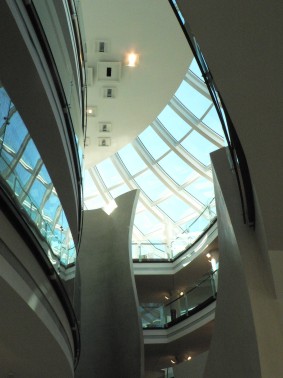
The new Verdi was naturally the focal point of this year’s festival and of many a cafe conversation. The old warhorse of a building could fit in a great many people and had a certain rough charm, but it was no surprise that the town wanted to revamp the building. And revamp it they have – the result is startling modernistic yet sympathetic to the surrounding buildings, with white stone and glass, eye-catching curves, and inside an ingenious use of space for public areas on four levels, including an exhibition gallery.

Teatro Verdi (interior)

Teatro Verdi, interior

Well, that’s the exterior and the immediate interior, but the auditorium itself got mixed reviews. Grand it may be for the shows and concerts which are the prime reason for the theatre’s existence, but for silent films it has its limitations. There were muttering about inadequate sight lines, and rather ludicrously the projection beam shone just above the first tier of seats, requiring the central portion to be kept clear by ropes, which however did not prevent the occasional shadow of a head appearing on the screen when someone got up. Hardly ideal for the world’s premier silent film event. The poorly-lit steps were another problem – several people fell over in the dark, including most unfortunately the most distinguished American archivist and historian Eileen Bowser, who had a bad fall on the first day and spent the remainder of the festival in hospital.

But enough of the venue, what about the films? Having registered, and equipped myself with festival bag, literature, name badge, catalogue and programme guide, I went straight in to catch most of Dream Street (1921). The programming at Pordenone is in themes, which this year included The Other Weimar, Ladislas Starewitch, René Clair, and Early Cinema, more of which in due course.

Dream Street

Charles Emmett Mack and Carol Dempster in Dream Street (1921), from http://www.silentladies.com

A theme which returns every year is the Griffith Project, which is a chronological survey of all surviving D.W. Griffith films, a gargantuan undertaking now reaching the years 1921-1924. This was the period where Griffith’s star began seriously to wane, and in Dream Street we have him at his very worst. Based on Thomas Burke material, as had been Broken Blossoms, it is set in a never-never London Limehouse, where Carol Dempster is a sadly less-than-adequate replacement for Lillian Gish, albeit playing a rather less down-trodden character. She plays Gypsy Fair (argh), loved by two brothers, unappealingly played by Ralph Graves (bullying but then having a religious conversion) and Ralph Emmett Mack (wimpish but psychotic). The film, in a way, is fascinating for being such a personal project – its sentimentality, high moralism, good-versus-evil symbolic characters, fear of violence, and lead female character representing all that is pure are all typical of Griffith at his most intense – but a combination of unsympathetic characters, heavy reliance on coincidence, general implausbility, and nauseating racism destroy the film. That, and Dempster, whose attempts to mimic the winsomeness and playfulness of Griffith’s Biograph heroines is painful to witness. The racism comes through the ‘evil’ Chinese figure, Sway Wan (Edward Peil), whose capture after an attempted assault on Dempster leads to her regrettable line, “That will teach you to leave white girls alone”, and a truly wretched blackface caricature from Porter Strong.

But more than story, character and theme, Dream Street is technically awful (i.e. from a directing point of view – photographically it is competent enough). Continuity shots are ineptly executed, the pacing is all wrong, nothing connects. The pianist, Gabriel Thibaudeau, got sympathetic applause after the screening for his valiant, if ultimately failed attempt to impose some sort of shape on a film that just did not know where it was going. I can’t believe that I’ve now seen Dream Street twice in my life…

The opening Saturday has just a few films, headed by an opening orchestral spectacular, which this year was Orphans of the Storm, amazingly made by Griffith the same year as Dream Street. But, having a certain aversion to spectacular musical presentation of silents, and wanting a quiet evening in any case, I returned to my hotel to gird myself for the rigours of the days to come. Which you’ll learn all about tomorrow…

Hugo Cabret review

The Invention of Hugo Cabret

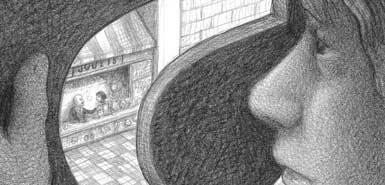
Illustration from The Invention of Hugo Cabret

Just time to give you this review by Ian Beck of Brian Selznick’s children’s book, The Invention of Hugo Cabret, already covered by an earlier post, in The Times. The inventively-illustrated book pays homage in its style to silent cinema, and Georges Méliès is a central character.

TO THE CASUAL EYE this is a daunting doorstop of a novel, a solid brick of 534 pages aimed squarely – and a little heavily – at the child reader.

Open the book, however, and something magical happens. Brian Selznick, who is well known in the US as an illustrator, has created a new and exciting hybrid, part novel, part picture book.

The narrative, written in simple, fable-like prose, is interrupted at crucial points by pages of eerie and heavily atmospheric, soft black-and-white tonal drawings. These move the story forward cinematically, then the words take over again, picking up exactly where the pictures have just stopped. It is like the exhilarating moment in a musical when a song seems to rise organically from the spoken drama; here the sequences of pictures suddenly rise like monochrome music. Instead of the action being described, we suddenly see it.

The early history of film is bound up, not to say embedded, in this moving story of Hugo Cabret, a 12-year-old orphan. The book opens with a wordless sequence of drawings. Beginning with a small image of the moon framed against a black page, exactly like an image from a silent film.

With each turn of the page, the images zoom out until the moon shines over the rooftops of Paris (deliberate echoes of René Clair and the golden age of French cinema), then the pictures widen further and our eye is taken into the city and among the crowds until we pick out young Hugo making his way through the caverns of the station that is his home.

It is 1931 and Hugo lives in a hidden chamber somewhere in the Gare du Nord. He spends his time caring for the clocks in the station, winding them and cleaning them. He feels an affinity with clockwork, and carries with him a mysterious notebook given to him by his father. The notebook has clues to the construction of a mechanical man, an automaton, which was damaged in a fire at the museum where Hugo’s father worked and perished.

Hugo believes that if he can repair the automaton, a seated figure holding a pen over a piece of paper, it will write him a message from his father.

He needs mechanical pieces to complete his work and attempts to steal them from a toyshop in the station. He is caught by the old man who runs it, and loses his notebook. But Hugo is helped in his task by Isabelle, the old man’s goddaughter. Through a combination of their abilities, they manage to make the figure work. It does indeed write a message, but it is not from Hugo’s father, and only deepens the mystery.

The substance of the story concerns the pioneering days of fantasy film-making, in particular that genius of the early silent cinema, Georges Méliès, who made the iconic 1902 film A Trip to the Moon, in which a rocket lands in the moon’s eye.

The story is an engaging meditation on fantasy, inventiveness, and a thrilling mystery in its own right. No knowledge of early cinema is necessary to enjoy it, but for those who do know just a little, the rewards are even greater.

Selznick should be applauded not only for extending the form of the illustrated book, but also for mining such a rich and neglected seam for his storytelling. If this book encourages a wider interest in the lost world of silent cinema, that would be a job well done. But it is also to be hoped that this new hybrid form will be developed in further ways by other authors and artists.