The demise of the American Kinetoscope Company, as reported in The London Gazette of 15 February 1895
The London Gazette is said to be Britain’s oldest continuously-published newspaper. It was founded in 1665 and has ever since been a record of official announcements. It is not a conventional newspaper, however, being instead a highly specialised resource used by policy-makers, the legal profession and historians. It is an official newspaper of record and is a government publication, published by The Stationery Office .
It groups the information it holds into the following categories: State, Parliament, Ecclesiastical, Public Finance, Transport, Planning, Health, Environment, Water, Agriculture & Fisheries, Energy, Post & Telecom, Competition, Corporate Insolvency, Personal Insolvency, Companies & Financial Regulations, Partnerships, Societies Regulation, Personal Legal.
For the silent film researcher, the London Gazette is an unexpected treasure trove. The journal has supplied official reports on all company insolvenices, and browsing through its archives brings up hundreds of records of film and cinema industry companies that went bust. It makes for sad but very revealing reading. And the great thing is that the Gazette‘s archives have been digitised and are fully word-searchable.
Searching is by the search box found on the website front page. An advanced search option allows you to narrow searches by date, phrase, page number and by some selected historical events. Narrowing down the date fields to 1895-1929 brings up 1,832 results under the word ‘cinema’, 765 under ‘cinematograph’, 1,455 under ‘film’, and 87 under ‘bioscope’. So there is plenty to be found. Each record leads you to a PDF copy of the relevant page, from which it is then possible to browse acros the rest of the issue. Each record supplies you with date, issue number and page number, and search results can be sorted by relevance, oldest or newest date. The texts are fully word-searchable, and though the OCR is uncorrected it is of a good standard.
So what sort of records do we find? Using our traditional search term of ‘kinetoscope’, which brings up just the one record for 1895-1929, we make the striking discovery of a film business being dissolved before any film had been produced in the country. In February 1895, the month in which Birt Acres is believed to have shot the UK’s first 35mm film, the American Kinetoscope Company, a partnership between Greek entrepreneurs George Georgiades and Theo Tragidis, was dissolved, as reported in the Gazette of 15 February 1895:
NOTICE is hereby given that the Partnership heretofore subsisting between us the undersigned George Georgiades and Theo Tragidis carrying on business as Dealers in Novelties at 62 Broad-street in the city of London under the style or firm of the American Kinetoscope Company has been dissolved by mutual consent as and from the llth day of February 1895. All debts due to and owing by the said late firm will be received and paid by the said Theo Tragidis.— Dated llth day of February 1895.
GEORGE GEORGIADES
THEO TRAGIDIS
This mysterious duo played an important part in British film history, being the customers who asked Robert Paul late in 1894 to manufacture Kinetoscopes for their Edison 35mm films, after which Paul decided it would be worthwile breaking into this business himself, so starting up the British film industry.
More typical is the sort of report we get on the demise of the Globe Film Company in the Gazette of 25 August 1916. They just happens to have been the producers of the fake Titanic newsreel we wrote about recently:
The Companies Acts, 1908 and 1913.
Special Resolutions of the GLOBE FILM CO.Limited.
Passed the 28th day of July, 1916.
Confirmed the 14th day of August, 1916.
AT an Extraordinary General Meeting of the Members of the Globe Film Co. Limited, duly convened, and held at 81, Shaftesbury-avenue, in the city of Westminster, on the 28th day of July, 1916, the following Special Resolutions were duly passed; and at a subsequent Extraordinary General Meeting of the said Company, also duly convened, and held at the same place, on the 14th day of August, 1916, the following Special Resolutions were duly confirmed, viz.:—
” (1) That it is desirable to reconstruct the Company, and accordingly that the Company be wound up voluntarily; and that Henry McLellan, of 6A, Devonshire-square, in the city of London, Chartered Accountant, be and he is hereby appointed Liquidator for the purpose of such winding-up.
” (2) That the said Liquidator be and he is hereby authorized to consent to the registration of a new Company, to be named ‘Globe Films Limited,’ with a memorandum and articles of association which have already been prepared with the privity and approval of the directors of this Company.
” (3) That the draft agreement submitted to this Meeting and expressed to be made between this Company and its Liquidator of the one part, and Globe Films Limited of the other part, be and the same is hereby approved, and that the Liquidator be and he is hereby authorized, subject to section 192 of the Companies (Consolidation) Act, 1908, to enter into an agreement with such new Company, when incorporated, in the terms of the said draft, and to carry the same into effect, with such (if any) modifications as he thinks expedient.”
HY. PESSERS, Chairman.
There is a lot of this, sometimes formal reports, sometimes simple lists of titles of companies that are being wound-up. There are also bankruptcy notices for individuals in the film trade (such as Mollie Hanbury, film actress, reported 29 August 1922), and official notices of legislation and regulations relating to films, such as the Cinematograph Act of 1909 (as reported in the Gazette of 21 December 1909) or prescription on the amount of celluloid one could have in a building under the Defence of the Realm Act (reported 13 October 1914).
If you are looking for human interest, you will have to read between the lines. These are dry accounts of official transactions, which give you names, dates, occupations and locations, and little more. But you do seen the motion picture business as a business, and not as usually portrayed. Rather than a world of artistic endeavour and happy entertainment, here we see year after year of failures, as so many tried to join in the boom and failed. A close analysis of the reports in the London Gazette would be interesting for what it might illustrate of the ebbs and flows of a new business trying to put down roots. Much of that business is in the exhibition rather than the production side (so many failed cinemas), but that is an accurate reflection of where the balance of the money lay.
The records are not unique, and you can find much the same information on bankruptcies and windings-up in the Board of Trade records at The National Archives (as described in an earlier post). But it’s a side of film history that is too often overlooked, a side which must bring a healthy dash of realism to our understanding of what the early film business was. It was paved with broken dreams – and here’s the evidence.
The twelfth Domitor conference, entitled “Performing New Media, 1890-1915” takes place in the UK at the University of Brighton, 18 to 22 June 2012. Domitor is the international society for the study of early cinema, and has held a conference every second year since 1990. This is the first time it has been held in the UK.
The conference aims to examine the relationship between performance and turn-of-the-century media technologies, such as the magic lantern, the phonograph, and motion pictures. Its title, Performing New Media, neatly makes the point that the impact of these new technologies upon the 1890s/1910s is paralleled by the impact of the new media technologies of today. This should give the conference a particularly interesting resonance or two, and there will be a special session on “Digital Technologies and New Media circa 1900”. Our new media are changing access to, perceptions of, and the historical interpretation of the media of 100 years ago.
A draft programme has been published, downloadable in PDF form on the Domitor site, or laid out helpfully you below.
MONDAY 18th June 2012
8:30 Pastries and beverages
9:00 Welcomes by Anne Boddington (Dean of Faculty, Faculty of Arts, University of Brighton); Frank Gray (Director, Screen Archive South East); Scott Curtis (President, Domitor)
Gregory A. Waller (Indiana University), “Circulating and Exhibiting Moving Pictures of the Australian Antarctic Expedition (1911-3)”
Rositza Alexandrova (University of Cambridge), “Cinegramme-Sending from the Ilinden Uprising”
Rielle Navitski (University of California, Berkeley), “‘Mixtures of Féerie and Document’: Sensational Theater and True-Crime Films in Rio de Janeiro and São Paulo, 1908-1913”
10:30 Break
10:50 Panel 2: Sallis Benney Theatre
Music, Opera, and Song
Beatrice Birardi (Società Italiana di Musicologia), “From ‘Chamber’ to Cinema: The Music by Carlo Graziani Walter for Gli ultimi giorni di Pompei (Italy, 1913)”
Bernhard Kuhn (Bucknell University), “Intermediality Italian Style: Operaticality and Metareferentiality in the Cinema of the Early 1910s”
Jaume Radigales (Université Ramon Llull, Barcelona) and Isabel Villanueva (Universitat Internacional de Catalunya, Barcelona), “Le rôle de l’opéra dans le cinéma primitif : Étude des cas”
Anupama Kapse (Queens College, City University of New York), “Song and Dance in the Indian Silent Film”
Panel 3: Boardroom at Grand Parade
Exhibition beyond Theatres and Cinemas
Jon Burrows (University of Warwick), “Automatic Entertainment: Early Cinema in the Penny Arcade”
Oliver Gaycken (University of Maryland), “‘Denizens of the Deep’: F. Martin Duncan, Natural History Filmmaking, and the Brighton Aquarium”
Oksana Chefranova (New York University), “The Screen in the Garden: Moving Image Shows in Moscow circa 1900”
12:10 Lunch
1:10 Panel 4: Sallis Benney Theatre
Music, Colour, and Sound
Christopher Natzén (National Library of Sweden), “‘Such Music Cannot Be Regarded as Real or Genuine Art’: Swedish Cinema Musicians in 1908-1909”
Mélissa Gignac (Université Paris 7), “Le son dans les années 1910 : un exemple d’autonomisation progressive des films”
Jennifer Peterson (University of Colorado, Boulder), “Lyrical Education: Music and Color in Early Nonfiction Film”
Joshua Yumibe (University of St Andrews), “Colour as Performance in Visual Music, Film Tinting, and Digital Painting”
Panel 5: Boardroom at Grand Parade
Picture Personalities
Charles O’Brien (Carleton University), “Griffith Goes West: The Move to California and Its Impact on Actors’ Performances in the Biograph Films”
Laura Horak (Stockholm University), “Performing the Film Director: Mauritz Stiller and Vingarne”
Ian Christie (Birkbeck College, University of London), “Performers – On Stage and Now on Screen”
Chris O’Rourke (University of Cambridge), “In the Flesh: Personal Appearances and the Picture Personality in Britain before 1915”
2:30 Break
2:50 Panel 6: Sallis Benney Theatre
Performance and Pedagogy
Marina Dahlquist (Stockholm University), “Health on Display: The Panama Pacific Exposition (1915) as Sanitary Venue”
Frank Kessler and Sabine Lenk (Utrecht University), “‘Kinoreformbewegung’ Revisited: Performing the
Cinematograph as a Pedagogical Tool”
David Williams (independent scholar), “The Letchworth Experiment, 1914-1917”
Kaveh Askari (University of Western Washington), “The Artist’s Studio on Display: Workspace as Educational Space”
Panel 7: Boardroom at Grand Parade
Performing Femininity
Liz Clarke (Wilfrid Laurier University), “Old Wars and New Women: Performing Active Femininity”
Diana Anselmo-Sequeira (University of California, Irvine), “‘Neither Here, Nor There, But Everywhere’: How Early American Film Disembodied Adolescent Girlhood”
Leslie Midkiff DeBauche (University of Wisconsin, Stevens Point), “When the Law Is the Audience: Codifying Performance in a New Medium”
4:10 Break
4:40 Panel 8: Sallis Benney Theatre
Reconsidering Early Japanese Film: Sounds, Stories, and Performances
Panel Chair: Hiroshi Komatsu (Waseda University)
Ryo Okubo (University of Tokyo), “Teachers, Benshi, and Itinerant Entertainers: Magic Lantern Performances in Japan at the End of the Nineteenth Century”
Sawako Ogawa (University of Tokyo), “From Kodan to Kyugeki: How the Japanese Storytelling Tradition of Kodan Was Assimilated into Early Japanese Cinema”
Manabu Ueda (Ritsumeikan University), “The Development of Regional Characteristics during the Emergence of Moving Picture Theaters: A Comparison between Tokyo and Kyoto”
Masaki Daibo (Waseda University), “Reception of Film d’Art and Its Impact on Japanese Sound Culture”
6:30 Evening Event: Blackwell book reception
TUESDAY 19th June 2012
8:30 Pastries and beverages
9:00 Panel 9: Sallis Benney Theatre
Vaudeville and Comedy
Donald Crafton (University of Notre Dame), “McCay and Keaton: The Intermediality of Vaudeville, Animation and Slapstick Cinema”
Maggie Hennefeld (Brown University), “Performing Film Form: Vaudeville Theater and Early Motion Picture Comedy”
Gwendolyn Waltz (independent scholar), “20 Minutes or Less: Short-Form Film-and-Theatre Hybrids—Skits, Sketches, Playlets, & Acts in Vaudeville, Variety, Revues, &c”
Pierre Chemartin and Santiago Hidalgo (Université de Montréal), “Learning Film Performance Through Comics”
Nadi Tofighian (Stockholm University), “Circuit of Commerce and Cinema: Singapore and the Southeast Asian Film Market”
Joel Frykholm (Stockholm University), “From Movie Palace to Media Spaces: New Perspectives on the Exhibition Contexts of the Multi-Reel Feature Film, 1913–1915”
John Fullerton (Stockholm University), “Reframing the Panorama in Mexico: Early Actuality Film and Nineteenth-Century Lithographs and Photographs”
Anne Bachmann (Stockholm University), “Trajectories between Oslo, Copenhagen and Stockholm: What Norwegian Male Stars Brought to Swedish Biograph, 1913–1915”
Natascha Drubek (University of Regensburg) “Unruly Projectionists and Censorship in the Cinema of Czarist Russia”
Denis Condon (National University of Ireland, Maynooth), “‘Offensive and Riotous Behaviour’: Regulating the Irish Cinema Audience, 1910-15”
Alison Griffiths (Baruch College, City University of New York), “Old New Media: The Time Warp Case of Motion Pictures in Prison”
12:00 Lunch
1:00 Panel 12: Sallis Benney Theatre
Old and New Media
Giusy Pisano (Université Paris-Est), “Au commencement était le son!”
André Gaudreault (Université de Montréal) and Philippe Marion (Université de Louvain), “D’un tournant de siècle à l’autre : l’animation restaurée”
Wanda Strauven (University of Amsterdam), “The Performing Screens of Early Cinema”
Andrea Haller (Deutsches Filminstitut), “Presenting New Media of the Nineteenth Century in the Context of the Twenty-First-Century Museum: The Case of the German Film Museum in Frankfurt”
Katherine Groo (University of Aberdeen), “Cut, Paste, Glitch, and Stutter: Remixing Early Film (History)”
2:30 Break
3:00 Special Session: Digital Technologies and New Media circa 1900: Sallis Benney Theatre
Valentine Robert (Université de Lausanne/Université de Montréal), “De la page à la performance, de la toile à l’écran − ou comment la nouvelle culture des médias s’approprie et transforme le tableau vivant”
M. Magdalena Brotons Capó (Universitat de les illes Balears), “Les plaques de lanterne magique à l’origine de l’image cinématographique”
Sarah Dellmann (Utrecht University), “Getting to know the Dutch: Magic Lantern Series on the Netherlands Considered as Screen Practice”
Ludwig Vogl-Bienek (University of Trier), “Screening Sensations and Live Performance”
6:30 Break, Evening Event: Magic Lantern Show with David Francis
WEDNESDAY 20th June 2012
8:30 Pastries and beverages
9:00 Panel 14: Sallis Benney Theatre
The Circus and the Occult
Annie Fee (University of Washington), “Circus and Cinema: A Fairground Audience at the Gaumont-Palace”
Patrick Désile (Université de Paris), “Cirque et premier cinéma : Antagonismes et convergences”
Emmanuel Plasseraud (Université Paris-Est Marne-La-Vallée), “Médiums et nouveaux médias : Projections cinématographiques et performances médiumniques entre 1895 et 1915”
Panel 15: Room G4
Literature, Visuality, and Early Film
Pam Thurschwell (University of Sussex), “G.A. Smith, Psychical Research and Film: Disembodied Aesthetics and the Illusion of Embodiment”
Laura Marcus (Oxford University), “Conrad’s Figurative Understandings of the Cinema”
Jonathan Freedman (University of Michigan), “Henry James and G.A. Smith: Illusion and Visuality”
10:00 Break
10:30 Panel 16: Sallis Benney Theatre
Shadowplay
Thierry Lecointe (chercheur indépendant), “Entre nouveauté et continuité : Le spectacle cinématographique serait-il une emergence du théâtre d’ombres français?”
Marco Bellano (Università degli Studi di Padova), “The Sound of the Shadows: The Aesthetics of Music for Shadow Plays in Late-Nineteenth-Century France”
Panel 17: Room G4
Institutional Histories of Moving Pictures in the South West UK before 1914
John Plunkett (University of Exeter), “Variety Halls and Touring Visual Entertainment in Plymouth, 1860-1890”
Joe Kember (University of Exeter), “Plymouth’s ‘Home of Cinema’: The Long Institutional History of British Town Hall Picture Shows”
Rosalind Leveridge (University of Exeter), “‘A Complete Entertainment from the Moment They Enter’: Cinema and Community in the Coastal Resorts of the South West, 1909-1914”
11:30 Lunch
12:30 Panel 18: Sallis Benney Theatre
Narrators
Alain Boillat (Université de Lausanne), “Projections fixes / animées: approche historiographique et théorique”
Judith Buchanan (University of York), “‘Guttersnipe’s Dialects and ‘élocution soignée’: The Ranging Cultural Performance Registers of Early Cinema Lecturers”
May Adadol Ingawanij (University of Westminster), “A Late ‘Early’ Cinema: Orality and Siam’s 16mm Era”
Martin Loiperdinger (University of Trier), “Missing Believed Lost: The Film Narrator Then and Now”
1:50 Break
2:10 Special Session: Brighton 1978/2012: Sallis Benney Theatre
4:00 Sessions end
6:00 Evening Event: Frank Gray’s Brighton Show
THURSDAY 21st June 2012
8:30 Pastries and beverages
9:00 Panel 19: Sallis Benney Theatre
Technology I
Benoît Turquety (Université de Lausanne), “L’histoire des techniques comme source pour l’histoire des pratiques performatives”
Katharina Loew (University of Oregon), “Specters of the Theater: 3-D Cinema in the 1910s”
Doron Galili (Oberlin College), “The Invention that Will Out-Edison Edison: Early Cinema and Moving Image Transmission”
Ted Hovet (Western Kentucky University), “From Circle to Oblong: Standardizing the Borders of the Projected Image in the 1890s”
William Boddy (Baruch College, City University of New York), “The Spectacle of Technology: Cinema and Outdoor Advertising in Early-Twentieth-Century Visual Culture”
Panel 20: Room G4
Place and Exhibition
Marta Braun (Ryerson University) and Charlie Keil (University of Toronto), “Architecture and Performance: Toronto’s Screen Media Landscape at the Turn of the Century”
Paul S. Moore (Ryerson University), “Early Cinema’s ‘Social Media’ Moment: Local Views in Mainstream Picture Shows in North America before the Nickelodeon”
Leigh Mercer (University of Washington), “Barcelona on the Move: The Metropolitan Cinemaway at the Intersection of Tourism, Entertainment, and Urbanism”
Begoña Soto Vázquez (Universidad Rey Juan Carlos, Madrid), “Cinema as Extension of the Train and the Journal: Considering a New Audience for the Cinematograph, Madrid 1900-1912”
Philippe Gauthier (Université de Montréal/Université de Lausanne), “L’historiographie de la performance dans le cinéma des premiers temps et l’émergence de l’histoire universitaire du cinéma”
Gunnar Iversen (Norwegian University of Science and Technology), “Performing New Media and the Creation of National Identity: Kräusslich and Köpke in Norway before 1910”
Stephen Putnam Hughes (University of London), “Performing Authority at the Cinema in Victorian India”
Shelley Stamp (University of California, Santa Cruz), “Lois Weber at Rex: Performing Femininity Across Media”
Panel 22: Room G4
Performance Beyond the Silent Screen: Comedy, Criminality and the Fashioning of a Multimodal Cinema
April Miller (University of Northern Colorado), “Vamp until Ready: Parlor Songs, Pseudoscience, and the Ephemeral Performance of the Silent Screen Vampire”
Vicki Callahan (University of Wisconsin, Milwaukee), “Simulation Platforms for Writing Film History: A Scalar Presentation on Mabel Normand and Cinematic Performance”
Michele Torre (Southern Illinois University, Carbondale), “Transforming Comedic Performance for the ‘New Media’: Lina Bauer Does Film Comedy”
12:10 Lunch
1:10 Panel 23: Sallis Benney Theatre
Technology II
Richard Brown (independent scholar), “A New Look at Old History”
Paul Spehr (independent scholar), “Scopes, Phones, Graphs and Grams: Movies and Phonographs at the Introduction of Cinema”
Frank M. Scheide (University of Arkansas), “Freeman Owens: Early Arkansas Home Movie Exhibitor, Cinematographer, and Inventor of Motion Picture Technology from 1908-1972”
Stephen Herbert (Kingston University, London), “Recreating the First Cameras: A Twelve-Year Project”
2:30 Break
2:40 Special Session: Domitor General Assembly: Sallis Benney Theatre
4:00 Break
4:30 Panel 24: Sallis Benney Theatre
Programming and Performance
Laurent Guido (Université de Lausanne) and Laurent Le Forestier (Université de Rennes), “Performance et programmes : le cinéma programmé parmi des performances / les performances dans les programmes de cinéma”
Richard Abel (University of Michigan), “Motion Picture Advertisements, Programming and Performance”
Ansje van Beusekom (Utrecht University), “Performing Films in Winter 1904, 1905, and 1906: Albert Freres and Their Exhibition Skills in Multipurpose Buildings in Dutch Cities”
Ranita Chatterjee (University of Westminster), “‘Bringing out from Europe the Latest Scientific Illusion’: Performing New Media in British India”
Priska Morrissey (Université Rennes 2), “De l’invention des génériques: étude du cas français (1908-1914)”
6:00 Evening Event: Conference Dinner (details to be announced)
Frederic Tabet (Université Paris-Est), “La transparence du Fregoligraph”
Christelle Odoux (chercheuse indépendante), “L’application par Émile Reynaud de la photographie à son Théâtre optique: les Photo-peintures animées (1896)”
Jean-Baptiste Massuet (Université Rennes 2), “L’appropriation des Lightning Sketches par le Cinématographe, de la performance scénique au cartoon”
Malcolm Cook (Birkbeck College, University of London), “Performance Times: The Lightning Cartoon and the Emergence of Animation”
Panel 26: Room G4
Early Cinema (A)live! Sound, Body Performances, and Media Constructions of Presence
Wolfgang Fuhrmann (University of Zürich), “Listening to the Image: Ethnographic Film’s Long Beginning”
Kristina Köhler (University of Zürich), “Tango Mad and Affected by Cinematographitis: The 1910s Dance Crazes, Early Cinema, and Rhythmic ‘Contagions’ between Screens and Audiences”
Daniel Wiegand (University of Zürich), “‘Performed Live and Talking. No Kinematograph’: Amateur Performances of Tableaux Vivants and Local Film Exhibition in Germany around 1900”
Franziska Heller (University of Zürich), “Lumière Re-Mastered? Early Cinema Today and Its ‘Digital Performance’”
10:20 Break
10:45 Panel 27: Sallis Benney Theatre
Stage and Screen
Ivo Blom (VU University of Amsterdam), “The Cross-Medial Case of Lyda Borelli”
Nic Leonhardt (LMU Munich), “Pictorial Dramaturgy. Theatre and Visual Media around 1900”
Stephen Bottomore (independent scholar), “The Lady of Ostend”
12:00 Lunch
1:00 Panel 28: Sallis Benney Theatre
Showmen
Caitlin McGrath (independent scholar), “‘The Eye is a Great Educator’: J. K. Dixon at Kodak”
Peter Walsh (Sheffield University), “Standards of Practice in Transition: The Showmanship of Jasper Redfern as It Emerged”
Maria A. Velez-Serna (University of Glasgow), “Mapping Showmanship Skills and Practices in Scotland”
Artemis Willis (University of Chicago), “‘Marvelous and Fascinating’: L. Frank Baum’s Fairylogue and Radio Plays”
2:30 Break
3:00 Special Session: Closing Roundtable: Sallis Benney Theatre
4:00 End of conference
This is certainly a remarkable range of papers and themes, with a healthy mixture of leading names in the field and new scholars coming to the fore. The Bioscope will be there for a couple of days at least, and will be producing an on-the-spot conference report for you. There are a lot of old friends named above that it will be good to see again.
The full delegate rate for the five days is £140.00 (concessions rate £80.00), with a daily rate of £30.00. All presenters have to be members of Domitor, but attendees not presenting do not have to be members, which is a sensible arrangement. Further details and online booking are provided by the University of Brighton. General information on the conference, including location and travel information, are available on the Domitor site.
By the way, it’s been noticeable this year how very few conferences there seem to be worldwide this year that are either directly or indirectly devoted to silent cinema. If anyone knows of such events coming up, do let me know.
The London Olympic Games creep ever closer, and we are going to see all manner of institutions pulling out the stops to express to us what it all means. Well, what it all means is people winning races, but those of an Olympian frame of mind like to think that it’s a bit more uplifting and inspiring than that. So it is that British Airways has sponsored its ‘Great Britons‘ initiative, designed to provide “a global platform for up and coming British talent in food, art and film” in the run up to the Olympic and Paralympic Games. From this has come this short, modern silent film, entitled Boy.
The ten-minute film was scripted by ‘Great Britons’ sponsored talent Prasanna Puwanarajah. It is directed by Justin Chadwick and photographed by Danny Cohen, with a score by Alex Heffes, and stars Timothy Spall as a carpenter mourning the death of his cyclist son who finds some sort of redemption at the Olympic park’s Velodrome.
It’s surprisingly downbeat in theme, but expertly put together and they hope that its lack of dialogue will mean that it strikes a chord with audiences worldwide. British Airways will be showing the also be showing the film on flights in the months leading up to the Games. Anyway, see what you think.
We’ll be having more on silent films and the Olympics here at the Bioscope over the next few months.
Although this film is held by British Pathé, it was originally issued by Pathé’s rival Gaumont. The first shots of the Titanic in Belfast are the only genuine extant footage of the ship. The film then continues with shots of survivors in New York, regrettably re-edited by British Pathé in 2012 to turn a ten-minute newsreel into two minutes
Those of you recently returned from Mars may be interested to know that we are celebrating the centenary of the sinking of the Titanic this month. Those of you who have spent your time on planet Earth these past few months will not have been able to get away from the books, films, television programmes, souvenirs, exhibitions, commemorative issues, tea towels and who knows what else that has been foisted upon us, and you are probably heartily sick of the subject. Nevertheless, it is an event of some cultural significance, and we feel it would be remiss if we did not try and saying something about the Titanic and silent film.
But even here the field is already crowded, with newsreels from the time being readily available online and many probably knowing by now that little film of the liner actually exists, and that much of what screened at at the time that purported to show the Titanic was in fact footage of its sister ship the Olympic. If you see footage that it is claimed shows the launch, passengers embarking, the Titanic at sea, scenes on deck, or indeed the ship sinking, pleased be assured that it is not the Titanic that you are watching.
So, just what was filmed of the Titanic, and what survives today? That will be the subject of our post.
Newsfilm and documentaries are always made with a purpose; that was as true in 1912 as it is today. There had to be real interest in the topic, such as its newsworthiness. And the hard fact is that the Titanic was not news until it sank. The Olympic, the Titanic and the Gigantic (which was postponed and subsequently became the Britannic) were three liners planned by the White Star Line to capture trans-Atlantic business from its great rival Cunard. Cunard had the fastest liners afloat (it took five days to cross from the UK to the USA), and rather than beat them for speed White Star Line went for size and luxury. Its super-liners would be a little slower than Cunard’s, but they would beat them hand down when it came to dimensions and luxury.
The first to be built and to be launched (28 October 1910) was the Olympic. It was the Olympic that grabbed most of the headlines, and attracted the film cameras. There were newsreels of its launch and of life on board ship, and a spectacular documentary was made by the Kineto company, entitled S.S. Olympic, which covered its construction from the laying of the keel to launch. When the time came for the Titanic to be launched, two years later, there wasn’t the same interest. What had been front page news for the first ship was relegated to the inside pages for its successor, and the film companies for the most part ignored it. So, for example, the Kineto film of the Olympic was made by producer Charles Urban, who had initially approached Harland & Wolff for permission to film the construction of both liners. The shipbuilders were happy with this, but Urban took what must have seemed the more practical action and film the construction of the Olympic alone, in black-and-white (a film which survives) and in colour using his Kinemacolor process (a film sadly lost). The Titanic he seems to have ignored.
Part of S.S. Olympic (1910), the Kineto documentary on the construction of the Titanic’s sister ship. The two ships were very similar, and the film gives a good idea of what the construction of the Titanic would have looked like
So what was filmed? The film historian Stephen Bottomore, in his essential book The Titanic and Silent Cinema, suggests that there were five films or film sequences made of the Titanic. One of these can be discounted, as it merely showed the liner’s anchor being transported, but let us examine the other four (plus a fifth possibility that Bottomore also discusses).
The first is a puzzle. When the Titanic sank, producers searched around desperately for any footage that related to the liner. Gaumont concentrated on the scenes in New York where the survivors were received. This newsreel, which demonstrated a desire for accuracy, was released as an issue of The Animated Weekly in the USA and as a Gaumont special in the UK. There were (and are) several versions of this reel, one of which shown in the USA (but not in the UK) had this intertitle for its first scene:
Laying the keel of the Titanic
Who filmed this? It is a mystery. The keel of the Titanic was first laid in Belfast on 31 March 1909. There is no other record of such a film being made that I can trace (or Bottomore), and the scene does not occur in any of the surviving versions of the film. Did Urban film part of the Titanic‘s construction after all (if he had sought rights to do so from Hardland & Wolff it is unlikely that any other company would have had permission)? But then why did he never release it (it is not mentioned in any of Urban’s catalogues)? And why did this part of the newsreel disappear when the most of rest survived? Was it film of the Olympic‘s keel being laid? (unlikely, given Gaumont’s efforts to show true footage) Or might it have been shot by Films Ltd, producers of the second film of the Titanic?
The second scene in the Animated Weekly newsreel showed the launch of the Titanic in Belfast on 31 May 1911. The film was not produced by Gaumont, but rather by Films Ltd, a Liverpool-based company with an office in Belfast. The footage does not survive, and Bottomore quotes the only account we have of it, a most unhelpful two-liner from the Kinematograph and Lantern Weekly film trade journal:
Thousands who were unable to see the launch will avail themselves of this opportunity. Even those who saw the launch may in this film see some feature that they missed.
The fact that the launch was filmed by a minor film company and paid only meagre attention by the film press shows what comparatively little interest the Titanic had for the media at this point. The Animated Weekly film with these two sequences was first shown in New York on 21 April, just six days after the disaster, so if they were shipped from Belfast then would have had to have been sent out on 16 April, which seems an extraordinarily rapid turnaround. But for some strange reason the laying of the keel and the launch were not included in the British version of the reel issued by Gaumont at the start of May, and are now lost.
Instead Gaumont in the UK showed the only film of the Titanic to survive today. On 3 February 1912 a camera operator filmed the Titanic being moved into the Thompson dry dock, Belfast. The film was taken from the quayside looking up at the ship, showing the prow, and comprises seven shots from roughly the same camera position, one of them a panning shot along the length of the ship (there is a useful short analysis of the footage on Encyclopedia Titanica).
The first record we have of it being shown is when it featured in the Gaumont Graphic newsreel of 18 April 1912 (three days after the sinking), issue number 112, where it was falsely billed as ‘The Titanic Leaving Belfast Lough Bound for Southampton April 2 1912’. The news of the disaster had only just come through to the UK and Gaumont had moved swiftly to obtain the film, showing 100 feet in its next newsreel release. The full Gaumont Graphic no. 112 issue was:
1 – The British Dog Show at Earls Court
2 – Bob Sleighing
3 – Lord Mayor of Belfast Inspecting the Australian Cadets
4 – The Titanic Leaving Belfast Lough Bound for Southampton April 2 1912
5 – Paris Fashions
The Gaumont Graphic issue ledger for 18 April credits the film as “Prov Cine Local”, which must mean the operator was working for Provincial Cinematograph Theatres, a cinema chain with a strong presence in Ireland.
Gaumont issued a longer film in the UK at the start of May which was the Animated Weekly release from the USA except, except – most oddly – that there were no shots of the Titanic itself. It included footage of Captain Smith (on board the Olympic), ice floes, a flashing title with the distress code C.Q.D. (which preceded S.O.S. – both signals were employed by the Titanic), and scenes in New York with survivors and news reporters. At a later date the 2 February 1912 footage was added to this reel, and it is this version that is embedded at the top of this post.
Captain Smith from the Globe newsreel supposedly showing the Titanic (which he captained) but which actually shows the Olympic in New York in 1911 – the name Olympic has been painted out by the film company or an exhibitor but can be seen unobscured in this frame grab, top right
False claims for footage of the Titanic were made right from the start. Bottomore records a New York theatre as claiming to have colour footage of the Titanic‘s launch which it showed on 17 April. This was clearly the Kinemacolor film of the Olympic. Another company, the British-based Globe Film Company, issued a newsreel on the disaster which can be found in several archives (in different versions), which shamelessly used footage of the Olympic from 1911 throughout, going so far as to blot out the word Olympic where it appears on the ship and to remove the names of New York tugs seen beside the ship when the film claims to be showing us the Titanic at Southampton.
Advertisement for the Topical Budget newsreel film of the Titanic at Southampton, now lost, from The Bioscope 25 April 1912
The fourth and final film of the Titanic known to have been made was a newsreel of the ship at Southampton. Topical Budget, a British newsreel produced by the Topical Film Company, included the following two titles for its issue of 17 April 1912 (just two days after the sinking):
The Titanic at Southampton, prior to her maiden voyage, which has proved so disastrous.
The White Star Line. Anxious crowds awaiting news outside the London office.
All that is known about this film is an advertisement in The Bioscope for 25 April 1912. The newsreel’s own records for this period are lost, as is the film [Update– the film has been found – see comments]. The mystery is why the footage was not better exploited. If, as it seems, it was the only film of the Titanic at Southampton, then Topical had a scoop the whole world wanted to see. The Titanic had left Southampton on 10 April, and we do not know whether Topical showed the launch in one of its issues that week (British newseels were issued twice-weekly) and then showed it again for the issue on the 17th, or whether it had filmed the launch but not bothered to use the footage (full issue records for the newsreel do not survive from this period). Or might they have stooped to subterfuge and used the Provincial Cinematograph Theatres footage, and labelled as being shot in Southampton? There is no way of knowing.
William H. Harbeck, from Moving Picture News
There might have been other films of the Titanic made, but none were advertised in the film trade papers or cinema listings that historians have pored over. But what of film taken on board the Titanic? One of most intriguing discoveries from Stephen Bottomore’s research is that there were at least two cameramen on the liner when she sank. One was William Harbeck, an American producer of travelogues who had five cameras and 110,000 feet of film with him. He may have been seen filming on board when the Titanic had a near collision with the liner New York in Southampton harbour, as witnessed by passenger Lawrence Beesley, who wrote in his book The Loss of S.S. Titanic:
No one was more interested than a young American kinematograph photographer, who, with his wife, followed the whole scene with eager eyes, turning the handle of his camera with the most evident pleasure as he recorded the unexpected incident on his films. It was obviously quite a windfall for him to have been on board at such a time. But neither the film nor those who exposed it reached the other side, and the record of the accident from the Titanic’s deck has never been thrown on the screen.
Harbeck was American, but he wasn’t that young (he was 44), and the woman with him was not his wife, but otherwise this seems likely to have been him. Some have speculated that the cameraman was the 19-year-old American Daniel Marvin, son of Harry Marvin, president of the Biograph film company, who was returning from honeymoon in Europe with his American wife Mary. But they were first class passengers, whereas Bessley and Harbeck were second class (and hence on another deck); moreover, Bessley elsewhere refers to Harbeck’s ‘wife’ as being “evidently French”, as Henriette Yvois certainly was.
Another man potentially with a camera was Jean-Noël Malachard, a French newsreel cameraman with Pathé-Journal who was journeying to New York to join the company’s American branch. Both Harbeck and Malachard drowned, with any film that they may have taken going down with them, though as the sinking itself took place at night there was no way they could have even attempted to record the disaster itself.
So we have four films that were made of the Titanic, with maybe a fifth shot on board as the liner left Southampton:
c.31 March 1909 – laying of the keel at Belfast – producer known – length unknown – film lost
31 May 1911 – launch at Belfast – producer Films Ltd – length unknown – film lost
3 February 1912 – moving into dry dock at Belfast – producer Provincial Cinematograph Theatres – length 100ft – film extant
c.10 April 1912 – at Southampton, prior to depature – producer Topical Film Company – length c.60ft – film lost [Stop press: This film has been found! But does it show the Titanic? See comments]
10 April 1912 – footage possibly shot of near collision with US liner New York – producer William Harbeck – length unknown – film lost
What does the extant film of the Titanic signify? Of itself, it has little to say. It is not very interesting film of a big ship. It evokes no sense of loss, greatness, vaingloriousness, hubris or tragedy. We bring those feelings to the film, once we are told what it signifies. We invest our feelings in what we see on the screen. Yet there is that special frisson when we see the footage and realise that what is now history was once actuality. A connection is made that is part of the unique power of film, collapsing time while simultaneously making us aware of the yawning gap of time. The footage of the Titanic exposes the limitations of film as historical record, while at the same time showing how powerful even the plainest film can be if we bring powerful thoughts to bear upon it. There is also that special connection between actuality and drama, where each offsets the other. The actuality only makes us yearn to see the story told. The dramatic only makes us want to see anything that makes it clear that our dreams have some basis in reality.
The key source for studying the Titanic and contemporary film is the aforementioned The Titanic and Silent Cinema by Stephen Bottomore, to which this post is much indebted. Among the huge number of Titanic publications, I recommend Richard Howells’ The Myth of the Titanic for its insightful analysis of the disaster’s cultural significance, with some subtle readings of the films made about the tragedy. As he wisely points out, there are two Titanics out there: the real Titanic that lies beneath the ocean waves, and the Titanic of myth that sails on in literature, musicals, movies and memories.
I am giving a talk on the Titanic and film at the Cinema Museum on Sunday 15 April, where we will be tracing the story of the disaster through both newsreels and fiction films. Neil Brand will be at the piano. It will be interesting to see what the audience will make of an interweaving of the actual and the dramatic, as we tell the story once again, as the Titanic sinks beneath waves again, as we shiver at what it tells us of our fallibility and fragility all over again.
Part one of Some Activities of the Bermondsey Borough Council. Part two is here and part three is here
Film archivists know the real treasures in their collections, and while they continue to cater those who wish to see the better known and more obvious classics, it is often the less familiar titles that nevertheless demonstrate the special power of the medium that find favour within the archives. So it was that during my time at the BFI, one of the films that we frequently held us as being the greatest in our collection was Some Activities of the Bermondsey Borough Council (1931).
Never did a great film have so unprepossessing a title, but in the 1920s and ’30s Bermondsey council in London was at the forefront of public health propaganda (in the best sense of the word) and the use of film. At a time before the National Health Service, when many in London’s poorer district suffered from preventable illnesses caused by poor living conditions, the council’s Public Health Department undertook a bold programme to improve public health and to make the people of Bermondsey and Southwark aware of the need for and the opportunities for following a healthy lifestyle. Driven by husband and wife team Alfred and Ada Salter (he became Bermondsey’s MP, she its Mayor, the first female mayor in London), and with films mostly made by H.W. Bush, the Department made or sponsored some 33 films over the two decades, screenings these for free in any space where people might gather, including street screenings, employing cinemotor vans which came with portable projection equipment.
The films include such titles as Where There’s Life There’s Soap (1933), Health and Clothing (1928), The Empty Bed (1937) and Maternity and Child Welfare (1930). All were made silent, for economic reasons and ease of exhibition as much as anything else. All are imbued with a palpable sense of purpose and dedication to a good cause. You derive a real sense of the goodness of people, as well as a sense of shame at the conditions in which people were living well into the twentieth century (though the emphasis is on good work done rather than bad things that needed to be eradicated). Some Activities of the Bermondsey Borough Council Itself is so compelling to watch, not merely for its account of the public health programme, but for its unadorned images of ordinary life in the city (just the views of streets with which the film opens have a special thrill, simply because such views on film are so rare for this period).
Cinemotor, designed for exhibiting films or lantern slides, from the Wellcome Library
The films that survive are preserved by the BFI, with copies held at the medical charity the Wellcome Trust, and it is the Wellcome which has put some of the film on its YouTube channel and on its own site to accompany an exhibition entitled Here Comes Good Health, on the wotk of the Bermondsey Public Health Department. The exhibition runs at the Wellcome (on Euston Road, London) 22 February-3 June 2012, and you can read about the Council’s work, see films and photographs on the exhibition website.
If you are interested to find out more, there is a particularly handsome new publication by Elizabeth Lebas, who has been researching British ‘municipal’ films for some years now, Forgotten Futures: British Municipal Cinema 1920-1980. There is more information on the exhibition, the Public Health Department and its films, with plenty of links to other resources, on the Wellcome Library’s blog.
I also recommend an engrossing account by composer Felicity Ford (on her blog The Domestic Soundscape) who is writing a soundtrack for a related municipal film, Bathing and Dressing (1935), made by the National Council for Maternity and Child Welfare and Carnegie Welfare Centre, Shoreditch. She describes her research process, including locating contemporary sounds and oral history interviews from the British Library, that bring the people and the times back to life as much as do the films.
Back in November 2010 the silent film historian and restorer Kevin Brownlow was deservedly given an honorary Academy Award. He received his award at the Academy of Motion Picture Arts & Sciences’ annual Governors Awards ceremony alongside two other noteworthy film figures, Francies Ford Coppola and Eli Wallach (Jean-Luc Godard was also given an honorary Award, but naturally he declined to turn up).
One imagines that the conversation between Brownlow and Coppola turned toward Napoléon, the epic 1927 film by Abel Gance which Brownlow had dedicated his life towards restoring, and which Coppola had presented in the USA back in 1981 in a re-edited restoration with a score by his father, Carmine Coppola. Perhaps while clutching their statuettes they decided that the time had come to end the block on any screening of the film in the States that did not feature the Coppola score, which for thirty years had prevented American film enthusiasts from seeing the film in form in which Brownlow had restored – and was continuing to restore, since the film had grown longer in the intervening years, had had its colour tinting and toning restored, and of course came with Carl Davis’ famous (and ever-expanding) score. It was time for Napoléon to return to America.
The real Napoléon helped build America, of course. When he was planning to invade England in 1803, and in need of funds, he approached the American negotiators hoping to purchase New Orleans for $10M (this at a time when large parts of North America was still owned by the French) and instead offered them the whole of Louisiana for $15M. It was one of the biggest land bargains in history, and helped make the United States become what it is today. And Napoléon failed to invade England.
Maybe Abel Gance would have got round to including the Louisiana Purchase as part of the six films he dreamed of making about Napoléon. He would certainly have been reluctant to leave out any detail of the Emperor’s life if it revealed the mark that he had made upon history. Gance’s astonishing, preposterous ambition was indeed to make six lengthy films documenting the life of the Emperor, a project he began in 1925. Of course he did not have the financing in place for six films, not even for one at first, but after his original financiers failed him Gance found from a Russian, Jacques Grinieff, sufficient to complete film number one, which took Napoléon from childhood, through the French revolution, to his invasion of Italy.
The nine-image pillow fight from Napoléon, from the Smithsonian’s Reel Culture blog
The film, full title Napoléon Vu par Abel Gance, premiered at the Paris Opéra on 7 April 1927. It ran for three-and-a-half hours, with a score by Arthur Honegger; later a six-and-a-half-hour version was screened, though Gance’s original cut is said to have been nine hours. A film at such a length would always have struggled to find screenings, and the film was cut down into a variety of shorter, increasingly incomprehensible versions. Its commercial fate, and the arrival of sound, condemned Gance’s six-film dreams to dust (though his script for part six, Napoléon in exile on St Helena, was filmed in 1929 by Lupu Pick in Germany as Napoléon auf St Helena).
Time moves on, and in 1955 a 76-year-old Abel Gance turned up at the British Film Institute in London. Happily the distinguished elderly filmmaker was recognised, but then Deputy Curator Liam O’Leary did an extraordinary thing. He called for a 17-year-old boy to meet M. Gance (his mother had to telephone him at school when he was in the middle of an exam), since he was known to be an enthusiast for the man’s work. It’s hard to imagine such an occurence today, but back in 1955 that was how Kevin Brownlow first met Abel Gance, and it set in train a mission by the young man to restore Napoléon (which he’d first encountered on 9.5mm when aged 15) and with it the reputation of a by then forgotten master of the silent cinema. (The Ann Harding’s Treasures blog has an interview with Brownlow where he recalls the anecdote).
Abel Gance and Kevin Brownlow
The history of Napoléon’s restoration has been amply documented, not least by Kevin Brownlow himself in his book Napoleon. The restoration premiered in 1979 at the Telluride Film Festival, Colorado, with Gance in attendance (he died in 1981, aged 92). It was in 1980, with funding from Thames Television in the UK, that Napoléon made it full impact, when it was presented in London, at four hours and 50 minutes in length and with a score by Carl Davis. Its effect on audiences was cataclymsic (I was a little too young to be aware of all this, and only caught up with Napoléon on television a few years later). The film was a bravura advertisement for all that the camera could do. With its rapid editing, hand-held (and horse-back held) camera shots, super-impositions on a phantasmagoric scale, camera effects adopted from the avant garde, startling camera angles, above all its multiple screen effects (at one point – a pillow fight – the screen divides into nine separate, interelated images), culminating in the overpowering Polyvision triple-screen effect at the end of the film as Napoléon leads his army into Italy, it was one of the most powerful demonstrations of cinematic imagination that many in the audience had seen. It was as revolutionary in theme (it covers the French revolution, of course) as it was in technique, so that the two became as one. It did not only restore Napoléon and the reputation of Abel Gance; to a considerable extent it helped restore the silent film as an art form. We were all made to see what Kevin Brownlow had always believed.
Time moves on again, and screenings of Napoléon have become increasingly rare, owing as much to the compleixites of rights issues as the expense of putting on a film, at such a length, with full orchestra, and requiring an 85-foot-wide screen for the climax. A generation or more of silent film fans has grown up without having seen Napoléon, save for a rather lame VHS and DVD version with the Carmine Coppola score which lessened Gance’s reputation rather than enhanced it. In 2000 Brownlow unveiled the film’s colour tinting and toning for the first time at a UK screening at the Royal Festival Hall. It was now a shade over five-and-a-half hours long. It was last screened in the UK in 2004.
Building the support system for the screening at the Paramount Theatre, Oakland, from http://www.mercuynews.com
And so to 2012, and the long-running and sometimes bitter battle which had kept the full Napoléon from American screens came to an end with the film’s screening at the 3,000-seat Paramount Theatre, Oakland, San Francisco on 24 and 25 March (with further screenings scheduled for 31 March and 1 April). The film is five-and-a-half long (at 20fps), calling for lunch and two refreshment breaks along the way. Carl Davis conducted the 46-piece Oakland East Bay Symphony orchestra. The whole thing has cost some $700,000 to put on – and they’re probably going to lose money on it (the screenings have not been complete sell-outs…)
The reactions have begun with ecstatic, and then worked their way up from that. There are vivid reviews by Kenneth Turan in the Los Angeles Times and by Mick LaSalle for the San Francisco Chronicle. Manohla Dargis in the New York Times gives a good account of the film’s and the film restoration’s histories. The San Francisco Silent Film Festival, hosts for the screenings, provides a handy set of FAQs (from which we learn that there is not to be a DVD or Blu-Ray release – not until someone invents Polyvision TV screens, it would seem). MercuryNews.com has a photo slideshow of preparations for the screening at the Paramount Theatre. The Mubi Notebook has helpfully collected together and summarised the main web celebrations of the film’s screenings. And Carl Davis has provided a diary of his experiences on his website.
Napoléon is more than a restoration, indeed it is more of a re-creation, an attempt by Brownlow to build ever closer to that original conception of the film, to re-enter the mind of Abel Gance. There have been so many versions of the film (Gance tinkered with his film for years, much as Brownlow would then do), it would be hard to point to any one that would be definitive. Is the longest version the best? Of course not – at least, not necessarily so – but that doesn’t seem to be the point. It is the quest that matters, quite as much as whatever stage the film may have reached at its successive screenings. The auteur was once Abel Gance; now the auteur is Kevin Brownlow.
It is rumoured that Napoléon may now be coming to the Royal Festival Hall in London in November 2013. Perhaps it will be longer still (a further restoration is rumoured). Perhaps some have started queuing already. It has been twelve years since I last saw the film, and I have to admit that at the time I was impressed, but not overwhelmed. I found the film to be a technical showcase with plenty of felicities but without much real insight, and with an indifferent central performance from Albért Dieudonné (the boy Napoléon is played by Vladimir Roudenko, who is much better). Style alone is not greatness, though it may be great to watch. I hope I get the chance to see the film once more and to find myself proven wrong. I hope everyone gets a chance to see it.
Nosferatu, rejected by the BBFC in 1922, from DVD Beaver
Last week we wrote a post on the British Board of Film Classification, whose centenary occurs this year, and whose website includes a database of the films it has examined since 1912. The films can be searched by date and classification, and so it is possibile to produce a list of all of the films of the silent era rejected by the BBFC as being unsuitable for screening in the UK.
There are 208 of them, but the database provides little more than English language title, the date of examination, the distributor who submitted the film, and the classification (R for Rejected). Some of the films are familiar titles (Battleship Potemkin, America, The Seashell and the Clergyman) others much less so, and while most are American there are films from several other countries less easy to identify. It should be noted that this is not a complete list of all films rejected by the BBFC in the silent era, records for the rejection of some films (such as Lois Weber’s abortion drama Where Are My Children?) apparently no longer existing. Other films (such as Auction of Souls) were never submited to the BBFC, which would have rejected them otherwise.
It would be good to know the correct title, date and country of origin for each film. There records at the BBFC that may say more, though in most cases the films are simply listed in annual reports and give no more information than is provided on the database. So we have produced a list and started to identify them. This has mostly involved cross-checking with the Internet Movie Database, plus books written on the BBFC which discuss particular titles. But there are many gaps, and the Bioscope invites you to help fill them.
Each record below gives the title as submitted to the BBFC (hyperlinked to the BBFC database record), the date of examination, the name of the distributor, and then the true title, country, year, director and production company where I have been able to find these. Certain producers and distributors recur with interesting frequency: Fox Films, Nordisk, Cines, Trans Atlantic (European agents for Universal), Thanhouser and Pathé Frères among them, while there are some obscure companies involved, such as Inter Ocean, about whom it would be good to know more. The BBFC records have been copied as they appear, including typos and anachronistic references to film companies that only came into being after this period (Gaumont-British, 20th Century-Fox).
As for the kinds of film censored, the BBFC’s website does not give the reasons for rejection and to give plot summaries where these exist could be misleading, as the reason for rejection was not always so obvious (Nosferatu, for example, was probably rejected – under the title Dracula – on account of a copyright claim in Germany from the estate of Bram Stoker rather than for its horrific content). But there are films on prostitution (The White Slave Traffic), drugs (The Case of the Doped Actress), venereal disease (The Spreading Evil), politics (Irish Destiny), childbirth (The Mysteries of Birth), racial prejudice (Free and Equal) and religion (Leaves from the Book of Satan). Some of these were not so much rejected for their content as for being propagandist in tone, the BBFC having decided to rule against films which solicited public opinion. There are newsreels from the wartime period, the only time topicals were subject to censorship. There are films whose offensive character it is now hard to see (how did Hal Roach come to upset them so often?).
If you can help to identify any of the films (or correct y identifications), please say so through the comments and I’ll add the details to the post. The films are listed in the alphabetical order offered by the BBFC database, with definite articles (A and THE) recognised.
A BACHELOR APARTMENT – 24/03/1922 – Inter Ocean Films Ltd = perhaps Bachelor Apartments (USA 1921 d. Johnnie Walker p.c. Georgia Hopkins) A DAUGHTER OF THE DON – 25/09/1922 – Inter Ocean Photoplays Ltd = possibly The Daughter of the Don (USA 1916 d. Henry Kabierske p.c. Monrovia) A FOOL THERE WAS – 06/06/1916 – Fox Film Company Ltd = A Fool There Was (USA 1915 d. Frank Powell p.c. Fox) A HERO OF GALLIPOLI – 27/09/1916 – A1 Features & Exclusives = perhaps The Hero of the Dardanelles (Australia 1915 d. Alfred Rolfe p.c. Australasian Films) A MAN WITHOUT A SOUL – 21/07/1916 – London Film Co Ltd = The Man Without a Soul (UK 1916 d. George Loane Tucker p.c. London) A PARISIAN ROMANCE – 20/07/1916 – Fox Film Company Ltd = A Parisian Romance (USA 1916 d. Frederick A. Thomson p.c. Fox) A ROYAL BULL FIGHT – 24/04/1923 – Tayers Ltd A SALVAGE – 11/07/1913 – M.P. Sales Agency Ltd A SCREAM IN THE NIGHT – 05/01/1923 – Ward’s Productions Ltd = possibly A Scream in the Night (USA 1923 d. Leander De Cordova, Burton L. King p.c. A.H. Fischer Features) A SHOP GIRL’S PERIL – 15/10/1913 – M.P. Sales Agency Ltd A SNAKE’S MEAL – 15/10/1913 – M.P. Sales Agency Ltd A SPLENDID WASTER – 12/07/1917 – International Variety Agency Lt = The Splendid Waster (South Africa 1916 d. Harold Shaw p.c. African Film Productions) A TRUTHFUL LIAR – 22/10/1924 – W & F Film Service Ltd = A Truthful Liar (USA 1924 d. Hampton el Ruth p.c. Hal Roach) (or possibly The Truthful Liar, USA 1922) A WOMAN – 08/01/1915 – Cines Co A WOMEN’S [i.e. Woman’s] FATE – 14/01/1924 – M & F Film Agency Ltd ACROSS NO MANS LAND WITH TANKS – 23/04/1917 – Screen Plays Co ADVENTURES OF MAIZIE CH 10 “LITTLE ANNIE LOONIE” – 16/07/1926 – Wardour Films Ltd = The Adventures of Mazie: Little Andy Looney (USA 1925) AIR RAID ON LONDON – 01/06/1915 – Eclair Film Co. Ltd ALL MAN – 30/04/1919 – Vitagraph Film Hiring Co. Ltd = All Man (USA 1918 d. Paul Scardon p.c. Vitagraph) ANIMALS LIKE HUMANS – 31/08/1923 – Gaumont Co Ltd ARRIVAL OF SINN FEIN PRISONERS OF DUBLIN – 14/07/1917 – Trans Atlantic Film Co Ltd ARRIVAL OF THE GUNTESS MARKEIVING [i.e. Countess Markievicz] ON HER RELEASE – 14/07/1917 – Trans Atlantic Film Co Ltd AS MAN MADE HER / 04/05/1917 – Gaumont British Dist = As Man Made Her (USA 1917 d. George Archainbaud p.c. Peerless) AS THE SHADOW FALLS – 11/02/1916 – Trans Atlantic Film Co Ltd = As the Shadow Falls (USA 1915 d. William Worthington p.c. Universal) AT THE MERCY OF MAN – 18/09/1919 – Littleton Park Film Prods = possibly At the Mercy of Men (USA 1918 d. Charles Miller p.c. Select Pictures) BATTLING BUNYAN – 30/04/1925 – Ideal Films Ltd = Battling Bunyan (USA 1924 d. Paul Hurst p.c. Crown) BELOW THE DEADLINE – 15/09/1929 – Argosy Film Co Ltd = probably Below the Deadline (USA 1929 d. J.P. McGowan p.c. Chesterfield) BEYOND THE BARRICADE – 15/12/1921 – Nordisk Films Co. Ltd = Har jeg Ret til at tage mit eget Liv? (Denmark 1920 d. Holger-Madsen p.c. Nordisk) BIRDS OF PREY – 07/06/1927 – Film Booking Offices Ltd = probably Birds of Prey (USA 1927 d. William James Craft p.c. Columbia) BLINDFOLDED – 07/08/1918 – Gaumont British Dist = probably Blindfolded (USA 1918 d. Raymond B. West p.c. Paralta) BOLSHELVISM ON TRIAL – 21/03/1922 – Peter Freres Cinema Ltd [presumably Pathé Frères] BOSTON BLACKIE – 27/06/1923 – Fox Film Company Ltd = Boston Blackie (USA 1923 d. Scott R. Dunlap p.c. Fox) CABARET NIGHTS – 10/09/1928 – First National Pathe Ltd CAPTURING WILD ANIMALS IN THE ROCKIES – NOS 1, 2, 3, 4 – 22/07/1920 – Gaumont Co Ltd CAPTURING WILD ANIMALS IN THE WILDERNESS – NOS 1, 2, 3, 4 – 22/07/1920 – Gaumont Co Ltd CASANOVA’S SON – 11/02/1929 – Leon Wynbergen Ltd CHILDREN OF DESTINY – 05/01/1923 – Ward’s Productions Ltd = maybe Children of Destiny (USA 1920 d. George Irving p.c. Weber Productions) COCAINE – 12/05/1922 – Astra Films Ltd = Cocaine (later While London Sleeps) (UK 1922 d. Graham Cutts p.c. Master) CONSCIENCE – 09/11/1917 – 20th Century Fox Film Co. Ltd = Conscience (USA 1917 d. Bertram Bracken p.c. Fox) CORALIE & CO – 30/07/1914 – Cines Co = Madame Coralie & Co. (Italy 1914) CUPID ARTHUR & CO – 22/11/1915 – Cines Co DAMAGED GOODS – 21/11/1919 – Royal Film Agency = Damaged Goods (UK 1919 d. Alexander Butler p.c. Samuelson) DEALERS IN HUMAN LIVES – 18/09/1914 – Ruffles [i.e. Ruffell’s] Imperial Bioscope Ltd DON’T FLIRT – 14/05/1925 – Peter Freres Cinema Ltd [presumably Pathé Frères] = presumably Don’t Flirt (USA 1923 d. Len Powers p.c. Hal Roach) DRACULA – 11/12/1922 – Y Froehlich = Nosferatu (Germany 1922 d. F.W. Murnau p.c. Jofa-Atelier Berlin-Johannisthal) EAGLE’S EYE,THE – 29/10/1918 – Film Booking Offices Ltd = The Eagle’s Eye (USA 1918 d. George Lessey et al p.c. Wharton) ECLAIR JOURNAL NO.13 1ST EDITION ARMOURED MOTOR CARS – 27/03/1915 – Eclair Film Co. Ltd = newsreel ECLAIR JOURNAL NO.25 1ST EDITION – A CITY OF FIRES – ANTI GERMAN SCENES IN JOHANNESBURG – 19/06/1915 – Eclair Film Co. Ltd = newsreel ENGLISH AVIATOR IN THE FAR EAST – 12/05/1916 – Urban Trading Co Ltd ENGLISH SEAPLANE AT SALONIKA – 12/05/1916 – Urban Trading Co Ltd FEAR – 18/01/1917 – Llanhouser Films Ltd [i.e. Thanhouser] = Fear (USA 1917 p.c. Thanhouser) FIT TO MARRY – 22/03/1923 – Joseph Klein FLYING WHEELS – 08/06/1926 – Famous Players Film Co Ltd = Flying Wheels (USA 1926 d. Edward Ludwig p.c. Century) FOUR IRISH GIRLS – 22/02/1917 – Western Import Co Ltd FREE AND EQUAL – 25/03/1919- Stoll Film Co Ltd = possibly Free and Equal (USA 1918 d. Roy William Neill p.c. Thomas H. Ince) FRENCH FISHING SMACKS MOUNT QUICK FIRES AGAINST THE PIRATES – 12/03/1915 – Gaumont Co Ltd = newsreel FRENCH HOWITYERS [i.e. Howitzers] – 13/08/1915 – Gaumont Co Ltd FRENCH TROOPS LEAVING MARSEILLES FOR THE EAST – 19/03/1915 – Gaumont Co Ltd = newsreel FROU FROU – 14/06/1913 – A.E. Hubsch and Co. Ltd (There were American film adaptations of the play Frou-Frou in 1914, 1917 and 1918) FUNNICUS THE MINISTER – 27/01/1913 – Tyler Film Co Ltd = Gavroche remplace le ministre (France 1913 d. Romeo Bosetti p.c. Éclair) GERMAN KULTUZ [presumably Kultur] – 16/06/1917 – Kineto Ltd GETTING STRONG – 25/02/1924 – Regent Film Corp Ltd GLITTERING BROADWAY – 11/12/1916 – Pathe Freres Ltd GOD’S LAW – 24/04/1918 – Trans Atlantic Film Co Ltd = probably The People vs John Doe (USA 1916 d. Lois Weber p.c. Universal) GREATER THAN LOVE – 15/12/1921 – Associated Producers Ltd = Greater than Love (USA 1921 d. Fred Niblo p.c. J. Parker Read Jr. Productions) GREED NO. 14 – 19/05/1916 – Trans Atlantic Film Co Ltd GRIT – 11/02/1925 – George Smith Films Ltd = probably Grit (USA 1924 d. Frank Tuttle p.c. Film Guild) HANDCUFFS AND KISSES – 22/02/1922 – Peter Freres Cinema Ltd [presumably Pathé Frères] = presumably Handcuffs or Kisses (USA 1921 d. George Archinbaud p.c. Selznick) HEARTS IN EXILE – 09/08/1915 – Clarion Film Agency Ltd = Hearts in Exile (USA 1915 d. James Young p.c. World) HER DANGEROUS PATH EPISODE 9 – 21/01/1924 – Peter Freres Cinema Ltd [presumably Pathé Frères] = Her Dangerous Path [serial (USA 1923 d. Roy Clements p.c. Hal Roach) HER WHITE GOD – 20/05/1919 – Essanay Film Service Ltd HIS MODEL WIFE – 10/01/1918 – Oppidan Film Productions Ltd = possibly His Model Wife (USA 1917 d. Al Christie p.c. Christie) HIS ONLY SON – 30/05/1913 – Pathe Freres Ltd = possibly His Only Son (USA 1912 d. Jack Conway p.c. Nestor) HONOR’S CROSS – 01/08/1918 – Inter Ocean Films Ltd = Honor’s Cross (USA 1918 d. Wallace Worsley p.c. Selexart Pictures) HUMAN WRECKAGE – 16/01/1924 – R C Corporation ltd = Human Wreckage (USA 1923 d. John Griffith Wray p.c. Thomas H. Ince) HUMAN WRECKS – 08/04/1915 – Davison’s Film Sales Agency = possibly Wykolejeni (Poland 1913 d. Kazimierz Kamiński p.c. Sfinks) HYPOCRITES – 18/05/1917 – Western Import Co Ltd = probably Hypocrites (USA 1915 d. Louis Weber p.c. Hobart Bosworth Productions) I ALSO ACCUSE – 24/04/1923 – Foyers ltd = Moi aussi, j’accuse (France 1923 d. Alred Machin, Henri Wulschleger p.c. Les Films Alfred Machin/Pathé) INNOCENT – 24/03/1915 – Cines Co = L’Innocente (Italy 1912 p.c. Cines) INSPIRATION – 19/05/1916 – Thanhouser films ltd = Inspiration (USA 1915 d. George Foster Platt p.c. Thanhouser) INTERRUPTED – 24/01/1913 – Nordisk Films Co. Ltd IRISH DESTINY – 21/04/1926 – Eppels films ltd = Irish Destiny (Ireland 1926 d. George Dewhurst) IRISH REBELS ARRIVE IN LONDON AND ARE INCASCERATED IN – GAOL – 09/05/1916 – Peter Freres Cinema Ltd [presumably Pathé Frères] = newsreel IT MAY BE YOUR DAUGHTER – 10/02/1917 – M.P. Sales Agency Ltd = It May be Your Daughter (USA 1916 p.c. Moral Uplift Society of America) JUST AS HE THOUGHT – 30/11/1917 – American Film Co = Just as He Thought (USA 1916 p.c. American Film) LA CULOTTE DE RIGADIN – 05/12/1913 – Eclair Film Co. Ltd = La culotte de Rigadin (France 1914 d. George Monca p.c. Pathé Frères) LAWFUL CHEATERS – 30/11/1925 – Vitagraph Film Hiring Co. Ltd = presumably The Lawful Cheater (USA 1925 d. Frank O’Connor p.c. B.P. Schulberg) LEAVES FROM THE BOOK OF SATAN – 15/12/1921 – Nordisk Films Co. Ltd = Blade af Satans bog (Denmark 1921 d. Carl Th. Dreyer p.c. Nordisk) LIFE’S SHADOWS – 03/05/1927 – Wardour Films Ltd LITTLE MONTE CARLO – 15/12/1916 – M.P. Sales Agency Ltd LITTLE WHITE SLAVES – 03/07/1914 – Tyler Film Co Ltd = Kleine weiße Sklaven (Germany 1914 d. Oskar Ludwig Brandt p.c. Lloyd-Film) LOVE – 15/12/1921 – Assoc. Ind. Producers Ltd LOVE AND SACRIFICE – 21/07/1924 – Allied Artists Corpn. Ltd = America (USA 1924 d. D.W. Griffith p.c. D.W. Griffith Productions) LOVE AT FIRST FLIGHT – 20/02/1929 – Wardour Films Ltd = Love at First Flight (USA 1928 d. Edward F. Cline p.c. Mack Sennett) LOVE IS BLIND – 28/10/1913 – Gerrard Film Co Ltd = probably Love is Blind (USA 1913 d. Allan Dwan p.c. American Film Manufacturing Company) MARRIAGE – 19/12/1929 – Pro Patria Films Ltd MEPHISTS [presumably Mephisto] – 03/03/1913 – Elite Sales Agency Ltd MIRACULOUS WATERS – 23/02/1914 – New Agency Film Co MOTHER’S CONFESSION – 21/01/1916 – A. Reid & Co = A Mother’s Confession (USA 1915 d. Ivan Abramson p.c. Ivan Film) MOTHER, I NEED YOU – 23/10/1919 – L. Zimmerman = Mother, I Need You (USA 1918 d. Frank Beal) MY WIFE AND I – 07/04/1914 – A.E. Hubsch and Co. Ltd NABBED – 19/05/1916 – Trans Atlantic Film Co Ltd (There were two films titled Nabbed in 1915, one USA, one UK, neither connected to Universal/Trans Atlantic) NIGHT LIFE – 16/02/1928 – British Exhibitors Films Ltd NIGHT OUT, A – 08/09/1916 – Eclair Film Co. Ltd NOBODY – 30/04/1923 – Associated National Pictures NOBODY WOULD BELIEVE – 11/03/1913 – J. Frank Brockliss Ltd NORTH OF 50-50 – 14/05/1925 – Pathe Freres Ltd = North of 50-50 (USA 1924 d. Len Powers p.c. Hal Roach) OPEN ALL NIGHT – 27/11/1924 – Famous Players Film Co Ltd = Open All Night (USA 1924 d. Paul Bern p.c. Famous Players-Lasky) OUR LITTLE NELL – 14/05/1925 – Pathe Freres Ltd = Our Little Nell (USA 1924 d. Len Power p.c. Hal Roach) OUTSIDE THE LAW – 25/03/1927 – European Motion Picture Co Ltd PATHE DAILY GAZETTE – 03/10/1914 – Pathe Freres Ltd = newsreel PATHE GAZETTE – “BOMBING SCHOOL OF THE 10th MIDDLESEX” – 11/10/1915 – Pathe Freres Ltd = newsreel PATHE GAZETTE- “AFTER AN ADVANCE” AND “THROWING A GRENADE” – 12/10/1915 – Pathe Freres Ltd = newsreel PLUSCH AND PLUMOWSKI – 18/11/1927 – Butchers Film Service Ltd = Plüsch und Plumowski (Germany 1927 d. Hans Steinhoff p.c. Georg-Jacoby-Film) POTEMKIN – 30/09/1926 – Film Booking Offices Ltd = Bronenosets Potyomkin (USSR 1925 d. Sergei Eisenstein p.c. Goskino) RELIGION AND SUPERSTITION IN BELOOCHISTAN – 19/09/1913 – New Agency Film Co RIDERS OF THE NIGHT – 09/09/1919 – David Mundell = Riders of the Night (USA 1918 d. John H. Collins p.c. Metro) ROSE OF THE TENEMENTS – 10/06/1926 – Ideal Films Ltd = Rose of the Tenements (USA 1926 d. Phil Rosen p.c. Robertson-Cole) SALWATER [i.e. Saltwater] JANE – 10/06/1927 – Ideal Films Ltd SEALED LIPS – 30/03/1917 – Inter Ocean Films Ltd = possibly Sealed Lips (USA 1915 d. John Ince p.c. Equitable Motion Pictures) SHOOTIN’ FOR LOVE – 07/12/1923 – European Film Dist Ltd = Shootin’ for Love (USA 1923 d. Edward Sedgwick p.c. Universal) SINS OF YOUR YOUTH – 16/06/1914 – Oscar Rosenberg = possibly Ekspeditricen (Denmark 1911 d. August Blom p.c. Nordisk) SKIRTS – 26/02/1917 – Western Import Co Ltd = Skirts (USA 1917 d. Al Christie p.c. Christie) SPANISH BULL FIGHT – 14/03/1913 – Gerrard Films Ltd STORY OF SISTER RUTH – 11/04/1913 – Gaumont Co Ltd STRAFING THE KAISER – 03/02/1917 – Walturdaw Co Ltd = Pimple Strafing the Kaiser (UK 1916 d. Fred Evans/Joe Evans p.c. Piccadilly) SUBMARINE FOR ENGLAND’S NAVY LAUNCHED AT QUINCY MASS – 18/08/1915 – Gaumont Co Ltd = newsreel TANKS – 14/10/1916 – Kineto Ltd THE ACE OF BADS – 21/03/1927 – Famous Players Film Co Ltd = The Ace of Cads (USA 1926 d. Luther Reed p.c. Famous Players-Lasky) THE BACHELOR GIRL – 03/10/1923 – London & Counties Film Bureau THE BATTLE OF LIFE – 12/03/1917 – Fox Film Company Ltd = The Battle of Life (USA 1916 d. James Vincent p.c. Fox) THE BLACK TERROR – 12/06/1917 – Thanhouser Films Ltd = The Black Terror (USA 1916 d. Fred Kelsey p.c. Thanhouser) THE BLUE ROOM – 07/04/1914 – A.E. Hubsch and Co. Ltd THE CASE OF THE DOPED ACTRESS – 11/02/1919 – Life Dramas Ltd = The Case of a Doped Actress (UK 1919 d. Wilfred Carlton p.c. Life Dramas) THE CITY OF SIN – 20/09/1926 – Peter Freres Cinema Ltd [presumably Pathé Frères] THE COMPANIONATE MARRIAGE – 29/10/1928 – First National Pathe Ltd = Companionate Marriage (USA 1928 d. Erle C. Kenton p.c. C.M. Corporation) THE CRIMSON CROSS – 08/10/1913- Eclair Film Co. Ltd = The Crimson Cross (USA 1913 p.c. Eclair) THE CRIMSON STAIN – 08/03/1918 – Ideal Film Renting Co Ltd THE CRIMSON STAIN MYSTERY – 03/07/1919 – Inter Ocean Films Ltd = The Crimson Stain Mystery (USA 1916 d. T. Hayes Hunter p.c. Consolidated) THE DIVA IN STRAITS – 23/03/1914 – A.E. Hubsch and Co. Ltd THE DIVIDED LAW – 13/05/1919 – Inter Ocean Films Ltd THE DOUBLE ROOM MYSTERY – 12/03/1916 – Trans Atlantic Film Co Ltd = The Double Room Mystery (USA 1917 d. Hobart Henley p.c. Universal) THE DOWNFALL – 18/06/1924 – Regent Film Corp Ltd THE DRAGON – 31/05/1916 – F. Simmonds THE EEL – 26/02/1916 – Trans Atlantic Film Co Ltd = The Eel (USA 1916 d. Harry F. Millarde p.c. IMP) THE END OF THE ROAD – 01/10/1925 – Carcopal Film Co Ltd THE FIRE – 11/02/1916 – McEnnery Syndicate Ltd THE FOUR FEATHERS – 03/10/1917- Albion Cinema Supplies Ltd = probably The Four Feathers (USA 1915 d. J. Searle Dawley p.c. Dyreda) THE FOURTH ESTATE – 14/06/1917 – Fox Film Company Ltd = The Fourth Estate (USA 1916 d. Frank Powell p.c. Fox) THE GIRL FROM CHICAGO – 22/02/1917 – Players Management Ltd = The Girl from Chicago (USA 1916 p.c. Thanhouser) THE GIRL FROM EVERYWHERE – 11/12/1928 – Wardour Films Ltd = The Girl from Everywhere (USA 1927 d. Edward F. Cline p.c. Mack Sennett) THE GOOD PRECEPTRESS – 28/01/1913 – New Agency Film Co THE GREAT PHYSICIAN – 21/01/1913 – Thos. A. Edison Ltd = The Great Physician (USA 1913 d. Richard Ridgely p.c. Edison) THE GREAT SHADOW – 27/05/1920 – Walturdaw Co Ltd = The Great Shadow (USA/Canada 1920 d. Harley Knoles p.c. Adanac) THE HAND THAT RULES THE WORLD – 23/07/1914 – Trans Atlantic Film Co Ltd = The Hand that Rules the World (USA 1914 d. Edwin August p.c. Powers) THE HAUNTED SHIP – 16/02/1928 – British Exhibitors Films Ltd = The Haunted Ship (USA 1927 d. Forrest Sheldon p.c. Tiffany-Stahl) THE INHERITED BURDEN – 24/05/1915 – Dominion Exclusives THE KISS OF HATE – 22/09/1916 – Ruffles [presumably Ruffell’s] Exclusives Ltd = The Kiss of Hate (USA 1916 d. William Nigh p.c. Columbia) THE KITCHENER FILM – 13/04/1922 – Mr A Freeman = How Kitchener Was Betrayed (UK 1921 d. Percy Nash p.c. Screen Plays) THE LAND OF THE FOREFATHERS – 10/02/1917 – Gaumont Co Ltd THE LAST MAN ON EARTH – 27/11/1924 – Fox Film Company Ltd = The Last Man on Earth (USA d. John G. Blystone p.c. Fox) THE LAST SUPPER – 17/04/1914 – American Film Co = The Last Supper (USA 1914 d. Lorimer Johnston p.c. American Film Manufacturing Company) THE LIBERTINE – 09/05/1917 – Bolton’s Mutual Films = probably The Libertine (USA 1916 d. Joseph A. Golden, Julius Steger p.c. Triumph) THE LOST BAG – 23/05/1913 – Nordisk Films Co. Ltd = Naar Fruen gaar paa Eventyr (Denmark 1913 d. August Blom p.c. Nordisk) THE LOVE ADVENTURES OF FAUBLAS – 19/06/1913 – Paramount Film Service Ltd = Les aventures du chevalier de Faublas (France 1913 d. Henri Pouctal) THE LURE – 30/08/1915 – Elasion Film Co Ltd = possibly The Lure (USA 1914 d. Alice Guy p.c. Blaché Features) THE MARIONETTES – 29/10/1917 – Vitagraph Film Hiring Co. Ltd = The Marionettes (USA 1917 d. Thomas R. Mills p.c. Vitagraph) THE MOTHER – 06/12/1928 – Brunel & Monatgu Ltd = Mat (USSR 1926 d. Vsevolod Pudovkin p.c. Mezhrabpom-Rus) THE MYSTERIES OF BIRTH – 18/02/1929 – L. Wechsler THE NEW MOON – 16/02/1922 – Pathe Freres Ltd THE NIGHT BEFORE – 11/03/1913 – A.E. Hubsch and Co. Ltd THE ONE WOMAN – 10/07/1919 – Film Booking Offices Ltd = probably The One Woman (USA 1918 d. Reginald Barker p.c. Mastercraft THE PRICE OF YOUTH – 24/03/1921 – L. Zimmerman = probably The Price of Youth (USA 1922 d. Ben F. Wilson p.c. Berwilla) THE PRIEST AND PETER – 06/02/1913 – Universal Pictures THE RACK – 24/05/1916 – American Film Co = probably The Rack (USA 1915 d. Emile Chautard p.c. William A. Brady) THE RACKETEERS – 19/12/1929 – Producers Releasing Corp Ltd = possibly Love’s Conquest (USA 1929 d. Howard Higgin p.c. Pathé Exchange) THE RED KIMONA – 15/01/1926 – A Claresing [probably Clavering] = The Red Kimona (USA 1925 d. Walter Lang p.c. Blanc de Chine) THE SCARLET MARK – 12/03/1917 – Trans Atlantic Film Co Ltd = The Scarlet Mark (USA 1916 d. Lucius Henderson p.c. Victor) THE SEASHELL & THE CLERGYMAN – 13/11/1929 – Cinema Exclusives Ltd = La coquille et le clergyman (France 1928 d. Germaine Dulac p.c. Délia Film) THE SPREADING EVIL – 16/10/1919 – James Keane Productions = The Spreading Evil (USA 1918 d. James Keane p.c. James Keane Feature Photo-play Productions) THE UNPAINTED PORTRAIT – 10/05/1916 – Western Import Co Ltd = The Unpainted Portrait (USA 1914 p.c. Majestic) THE WAGER – 18/01/1917 – Ruffles [i.e. Ruffell’s] Exclusives Ltd = The Wager (USA 1916 d. George D. Baker p.c. Rolfe Photoplays) THE WEAVERS – 25/07/1927 – Pathe Freres Ltd = possibly Die Weber (Germany 1927 d. Friedrich Zelnik p.c. Friedrich-Zelnik-Film) THE WHELP – 01/03/1917 – Trans Atlantic Film Co Ltd = The Whelp (USA 1917 d. Millard K. Wilson p.c. IMP) THE WHISPERED NAME – 18/06/1917 – Trans Atlantic Film Co Ltd = The Whispered Name (USA 1917 d. Donald MacDonald p.c. Rex) THE WHITE SLAVE TRAFFIC – 25/07/1927 – F. Alfred = Mädchenhandel – Eine internationale Gefahr (Germany 1927 d. Jaap Speyer p.c. Liberty-Film) THE WOMAN HOUSE OF BRES[C]IA – 23/03/1921 – Elijah Day & Sons Ltd = Das Frauenhaus von Brescia (Germany 1920 d. Hubert Moest p.c. Moset-Film) THE WORD THAT KILLS – 25/02/1914 – Cines Co THE WRECKED ZEPPELIN – 03/10/1916 – H.D. Girdwood [i.e. Hilton DeWitt Girdwood] THE YOKE – 31/12/1915 – International Cine Corpn-Ltd = The Yoke (UK 1915 d. James Warry Vickers p.c. International Cine Corps) THE ZEPP[E]LINS LAST RAID – 20/02/1918 – Lionel Phillips THOSE WHO TOIL – 20/07/1916 – J.F. Brockliss Ltd THREE MEN AND A MAID – 22/06/1914 – Nordisk Films Co.Ltd THROUGH THE DARK – 11/02/1924 – Jury Metro-Goldwyn Ltd = Through the Dark (USA 1924 d. George W. Hill p.c. Cosmopolitan) TOIL AND TYRANNY – 31/05/1916 – Pathe Freres Ltd = Toil and Tyranny (USA 1915 d. Harry Harvey p.c. Balboa Amusement Producing Company) TRAPPED FOR HER DOUGH – 18/01/1917 – Trans Atlantic Film Co Ltd TWO’S COMPANY – 03/08/1928 – Brunel & Monatgu Ltd = possibly Tretya meshchanskaya (Bed and Sofa) d. Abram Room p.c. Sovkino) TWO-TIME MAMA – 05/05/1927 – Ideal Films Ltd = Two-Time Mama (USA 1927 d. Feed Guiol p.c. Hal Roach) UNDER THE BED – 18/06/1917 – Trans Atlantic Film Co Ltd = Under the Bed (USA 1917 d. Louis Chaudet p.c. Universal) VERA – 30/12/1915 – Cines Co WHAT HAPPENED AT 22 – 12/06/1917 – Bolton’s Mutual Films = What Happened at 22 (USA 1916 d. George Irving p.c. Frohman Amusement Corp.) WHAT THE CURATE SAW – 12/05/1916 – Regal Films International WHY MEN LEAVE HOME – 18/07/1913 – Imperial Film Co Ltd = Why Men Leave Home (USA 1913 p.c. IMP) WOMAN, WOMAN – 20/05/1919 – Fox Film Company Ltd = Woman, Woman! (USA 1919 d. Kenean Buel p.c. Fox) WONDERFUL NEW ARMOURED MOTOR CAR THAT DEFIES ALL ATTACKS – 09/07/1915 – Pathe Freres Ltd= newsreel YOU CAN’T BEAT THE LAW – 09/05/1928 – First National Pathe Ltd = You Can’t Beat the Law (USA 1928 d. Charles J. Hunt p.c. Trem Carr Pictures) ZEPP[E]LIN’S VISIT LONDON – 01/06/1915 – Gaumont Co Ltd
When the Silent Film Director app for the iPhone was released a year or so ago, we noted it in passing and gave it no further thought. Just another gimmicky smartphone app – in this case one which converted your videos into faux silents with sepia tone, scratches and intertitles – and not likely to make much of an impact.
Well, a year or so on, and Silent Film Director has turned out to be a cult hit. More thought has gone into to development than you might have expected, with respected silent film musician Ben Model serving as consultant. News stories regularly come down the wires that indicate its growing popularity, demonstrated not least by the number of videos produced in the format which are to be found on YouTube. Most are pretty much what you would expect, inconsequential home movies with a dash of tomfoolery, but there is clearly something about the time travel effect that converting 2012 into 1922 at the push of a button that appeals, and which has played its part, we suspect, in the increased appreciation of silent film generally which we cannot help but notice.
Some day someone will be able to write a thesis on the connection between The Artist and Silent Film Director in relation to the rebirth of silent films, but meanwhile things have come to their logical conclusion and we have the first iPhone Silent Film Festival, put on by MacPhun, the developers of Silent Film Director. Budding Hazanaviciuses have until May 28th to submit a video of up to three minutes in length, using the app. The rules are simple, and supplied in suitable style:
You don’t have to shoot your film with your iPhone, just use the app to edit and upload the results. The competition is open to anyone worldwide. Winners will be announced on June 1st, and there are weekly winners as well, with prizes including tickets to see Napoleon in San Francisco, which is commendably imaginative of them. You can view the videos on the Silent Film Director YouTube channel, from which we have picked the video at the top of this post because (a) it’s the first silent film we’ve seen with Barack Obama; (b) by who knows what design there happens to be a poster for The Cabinet of Dr Caligari in the background; (c) the footage is taken from 24-hour channel Russia Today, of all sources; and (d) it’s quite fun (the music is from that regular source for silent film music online, Incompetech.com).
(Apologies for the reduced activity from The Bioscope of late. We are busy with other matters, though we try to keep the news service active. Plus we’re working on one of those long posts which require far too much research.)
The notorious crucifixion scene from Auction of Souls (1919), shown uncertificated in the UK
If you look up the British Board of Film Classification in The Encylopedia of British Film, you are given a cross-reference to ‘censorship’. That’s a little hard, indeed misleading for an organisation which since 1985 has had the C in its initials standing for Classification rather than Censorship. They do not censor films as such (though some cuts are made where films infringe guidelines or actually break the laws of the land), they rate films according to social expectations. Those expectations are reflected in guidelines which have changed down the years as society and society’s relationship to the screen have changed. To follow the BBFC’s journey from censorship to classification is to understand how much films are profoundly connected to the temper of their times.
The British Board of Film Censors was formed one hundred years ago in 1912. Ever since motion pictures first appeared in Britain, the authorities sought to control them, though primarily they were concerned with how and where films were shown rather than what they showed. Tragic deaths at Newmarket in 1907 (where two woman and a girl died in a film fire) and Barnsley in 1908 (when sixteen children were crushed to death at crowded cinematograph show) demonstrated that film shows had to be brought under local authority control, though equally there was concern at the young, the mixed sexes and the working class being brought together in the dark where you couldn’t keep a proper eye on them. The fire risk was real, but it was also an excuse for the exercise of moral censure.
Existing legislation did not cover cinema shows, so in 1909 the Cinematograph Act was passed, which required cinemas to be licensed. Now attention turned to the films themselves. There was considerable social disquiet at the content of some films, particularly as a large part of the cinema audience consisted of children. Films were accused of encouraging children to steal, of corrupting morals, of transgressing the bonds of society.
There were calls for government censorship, and local authorities started to censor films for themselves, applying widely different standards. It was to bring about uniformity of decisions nationally, and to avoid the perils of state-imposed censorship, that the British film industry decide to police itself. So in November the British Board of Film Censors was formed, head by George Redford. The Secretary was J. Brooke Wilkinson, and there were four examiners. Every film to be screened in Britain had to be passed by the BBFC, though it had no statutory authority, those powers remaining with the local councils (who also administrated cinema licences) and who could override the BBFC’s decisions if they so chose. Topicals, or newsreels as they were to become, were made exempt from censorship (except in wartime). Film companies had to pay for films to be registered, which funded the service (and does to this day).
The BBFC began work on 1 January 1913, and there were two categories of certificate that it could assign to a film: U, for Universal exhibition, and A, for Adult only. Some films were subject to cuts; others were rejected entirely. In its first year of operation the BBFC examined 7,488 films, passed 6,681 as U, 627 as A, took exception to 166, and completely rejected 22 (figures from Rachael Low, The History of the British Film 1906-1914).
Originally there were only two rules applied by the BBFC to films, which were that they must not show the living figure of Christ, and that they must not show nudity. Otherwise they simply followed their sense of what would offend against morals or upset all or part of a cinema audience. No formal code was ever drawn up (in contrast to the Hayes Code in the USA), but gradually a set of guidelines grew and grew, as revealed by T.P. O’Connor in 1916 at an enquiry into cinema-going undertaken by the National Council of Public Morals, which listed, sometimes comically, all those scenes in a film which would cause them to reject a film in part or in its entirety:
1. Indecorous, ambiguous and irreverent titles and subtitles
2. Cruelty to animals
3. The irreverent treatment of sacred subjects
4. Drunken scenes carried to excess
5. Vulgar accessories in the staging
6. The modus operandi of criminals
7. Cruelty to young infants and excessive cruelty and torture to adults, especially women
8. Unnecessary exhibition of under-clothing
9. The exhibition of profuse bleeding
10. Nude figures
11. Offensive vulgarity, and impropriety in conduct and dress
12. Indecorous dancing
13. Excessively passionate love scenes
14. Bathing scenes passing the limits of propriety
15. References to controversial politics
16. Relations of capital and labour
17. Scenes tending to disparage public characters and institutions
18. Realistic horrors of warfare
19. Scenes and incidents calculated to afford information to the enemy
20. Incidents having a tendency to disparage our Allies
21. Scenes holding up the King’s uniform to contempt or ridicule
22. Subjects dealing with India, in which British Officers are seen in an odious light, and otherwise attempting to suggest the disloyalty of British Officers, Native States or bringing into disrepute
British prestige in the Empire
23. The exploitation of tragic incidents of the war
24. Gruesome murders and strangulation scenes
25. Executions
26. The effects of vitriol throwing
27. The drug habit. e.g. opium, morphia, cocaine, etc
28. Subjects dealing with White Slave traffic
29. Subjects dealing with premeditated seduction of girls
30. ‘First Night’ scenes
31. Scenes suggestive of immorality
32. Indelicate sexual situations
33. Situations accentuating delicate marital relations
34. Men and women in bed together
35. Illicit relationships
36. Prostitution and procuration
37. Incidents indicating the actual perpetration of criminal assaults on women
38. Scenes depicting the effect of venereal disease, inherited or acquired
39. Incidents suggestive of incestuous relations
40. Themes and references relative to ‘race suicide’
41. Confinements
42. Scenes laid in disorderly houses
43. Materialization of the conventional figure of Christ
Some might look at such a list and wonder what on was left that would make going to the cinema any fun at all. The BBFC started to gain for itself a reputation for extreme fuddy-duddy-ness, exemplied by the famous pronouncement on Germaine Dulac’s experimental work The Seashell and the Clergyman (1928):
The film is so cryptic as to be almost meaningless. If there is a meaning, it is doubtless objectionable.
which stands as one of the most memorable lines of film criticism ever written.
The Seashell and the Clergyman (La Coquille et le clergyman)
This reputation is not entirely fair. The BBFC took its work seriously, and when it took upon itself not to allow films that could be ‘calculated to demoralise an audience … or undermine the teachings of morality’ then it only did so after careful consideration of each film, measured against what it sensed to be the prevailing feeling of society. The problem was that the society familiar to the BBFC’s examiners in the 1920s was a narrow one, constrained by class and social prejudice. They tried to dictate the behaviour of society at large by muffling the films that people wanted to see, but banning the film did not halt the public taste for what it showed, nor did it halt the vice from happening in real life. The BBFC thought it was protecting society, but really it was protecting itself from that society – and it was fighting a losing battle.
Various decisions made by the BBFC in the 1920s have become renowned for what they reveal of the governing class’s fears and assumptions. Damaged Goods (1919), a coy drama about the dangers of venereal disease, was rejected outright (despite appeals from some authorities to allow screenings beause of the lessons the film made) as much because it was propagandist in tone as because of its subject matter. The same producer, Samuelson’s, subsequently submitted Married Love (1923), scripted by family planning pioneer Marie Stopes, which decorously approached the subject of birth control. This was passed with cuts once its propagandist tone had been cut down, Marie Stopes’ name had been removed, and the title was changed to Maisie’s Marriage.
On the subject of drugs, the BBFC rejected Mrs Wallace Reid’s impassioned Human Wreckage (1923), not wishing to countenance any film on the theme of drug addiction, yet it passed Graham Cutts’ Cocaine (1922), once its sensational title had been changed to While London Sleeps and after the producer Herbert Wilcox had defied the BBFC by securing screenings of the film in Manchester. Another Wilcox production, the ponderous Dawn (1928), on Nurse Edith Cavell (executed by the Germans during the war for helping Allied soldiers escape), which was denied a certificate because it might revive anti-German feeling. Political pressure was probably exercised, but many local authorities passed the film for screening anyway, demonstrating how the BBFC’s rulings were, after all, only guidelines.
Battleship Potemkin
Battleship Potemkin (1925) was a notable victim of the BBFC’s timorousness (the film had been screened without trouble in the USA), rejected because it forbade films that addressed issues of ‘political controversy’. As the BBFC website’s case study notes on the film state:
No doubt at the back of the BBFC’s mind was the nine day British general strike in May 1926 which had provoked fears amongst some quarters of society of a potential revolution in the UK.
It was claimed that the violence scenes in the film were further reason for its rejection, but no cuts were ordered for these, making its unwelcome political theme the real reason why it was refused a certificate, though it was shown in its uncertificated state at the London Film Society (it was eventually passed by the BBFC in 1954, with a X certificate).
Another example of a film screened in Britain despite hot having been passed by the BBFC was Auction of Souls. This semi-drama semi-documentary told of the Armenian genocide as experienced by escapee Aurora Mardiganian. It featured scenes of massacres, tortures, brutalities of every description, culminating in an horrific scene of a row of crucified naked women. It is hard to imagine such a film being made, still less being offered as a commercial proposition, yet it had been widely shown in America where it was produced. The film was shown at the Albert Hall in London by the League of Nations Union, before the BBFC had viewed it, and when the distributor refused to countenance any cuts the BBFC said it was inevitable that the film would be rejected (though it never actually reviewed the film formally). It was not just the shocking scenes but a fear expressed through the Foreign Office that the film could endanger ongoing peace talks with Turkey that influenced their thinking. Subsequently a London cinema showed it in defiance of its local authority which said that all films shown in its district needed a BBFC certificate. The cinema won the ensuing court case, but in the end the Home Office instituted a system whereby almost all local authorities agreed not to permit the screening of any film rejected by the BBFC. This decision helped cement the position of the BBFC at the heart of British film exhibition, a place that it retains to this day.
Many have mocked the BBFC of the 1920s, seeing it as an out-of-touch institution peopled by retired colonels and maiden aunts gently bent on maintaining the values of a past age which had probably never existed in the first place. The BBFC was unduly concerned by contentious moral issues, it did display political bias, and though ostensibly independent it did bow to political pressure from the Home Office. But it could also be argued as having helped save the British film business, carefully managing the conflicting interests of distributors, audiences and society’s guardians, in a manner that helped establish the cinema as an accepted feature of British life rather than the threat that many felt it represented back in 1912.
The British Board of Film Classification, as it now is, rarely rejects films outright these days. It demands cuts, certainly, measured against a regularly reviewed set of guidelines, but it seldom bans outright, despite films of a nature that would make Messrs Redford or O’Connor faint dead away with shock. It has to maintain a balance between those who abhor being told what they can or cannot see and protest at any cuts and those revolted or upset by cinema’s latest extremes and who call for such films to be banned. Striking a balance has always been at the heart of the BBFC’s work, even if the organisation of today is predicated on a trust in the audience’s good judgment that the BBFC of earlier decades was not.
The BBFC’s website is well worth visting. It has a history of the organisation, explanation of its guidelines, statistics, the law, and information on recent decisions. There are supplementary websites for parents, schools, and students of media regulation and film. Above all there is its database – a listing of films or videos that the BBFC has examined. Using the Advanced Search option with the date delimiters, the database turns out to have 4,590 titles for the silent era (1912-1929). This cannot be anywhere near the number of films that were actually examined by the BBFC for the period, but it is a rich resource nonetheless.
The records are a little on the spartan side. Mostly you get title, date submitted, distributor (i.e. the company that submitted the film for examination), length of cuts made (but no details of wat the cuts were or why they were made) and three categories – U, A or R for Rejected. Refining the search to Rejected titles only brings up 208 results. It is fascinating mixture of the familiar and the little known, identification of which is sometimes difficult because English titles are given for what were often foreign releases. But because this post has gone on long enough, further analysis of the 208 rejectees will have to be the subject of a follow-up post.
From the front cover of the 1912 pamphlet introducing the British Board of film Censors to the film business
The BBFC is marking its centenary in a number of ways. There is a centenary section of the site, which includes outlines various celebratory activities taking place and has an archive section looking back at past highlights and items of interest. Post number one in the archive contains a downloadable facsimile of a 1912 pamphlet introducing the BBFC to exhibitors and promising “absolutely independent and impartial censorship”.
There is to be a film season at the BFI Southbank marking the centenary later in the year, and a book marking “100 years of film classification” (they don’t say censorship) will be published in the Autumn. This is going to be particularly welcome, since it’s been a while since we had a good book published on British film censorship (or classification). If you do want to read more, a good place to start is James C. Robertson’s The British Board of Film Censors: Film Censorship in Britain 1896-1950 (1985) and The Hidden Cinema: British Film Censorship in Action, 1913-1972 (1989). For those interested in the legal side, Neville March Hunnings’ Film Censors and the Law (1967) is an exceptional work, exhaustive and illuminating, covering not only Britain but the history of film censorships in the USA, India, Canada, Australia, Denmark, France and the USSR. Also recommended is Annette Kuhn’s sophisticatedly argued Cinema, Censorship and Sexuality 1909-1925 (1988) and Picture Palace: A Social History of the Cinema (1974), written by Audrey Field, a BBFC examiner, who reveals that comonsense and a sympathetic understanding of people were hallmarks of at least some at the BBFC far earlier than many might suspect.
The BFI has scored a considerable coup, revealing that it has uncovered a copy of what is not only the earliest surviving film based on a Charles Dickens character (in this the bicentenary of Dickens’ death birth), but a film that apparently no-one had identified as being Dickensian before now. The film was discovered by the BFI’s silent film curator Bryony Dixon while she was investigating early films of China. She spotted the connection between a film in the archive entitled Man Meets Ragged Boy with a late 1900/early 1901 (the exact production date is uncertain) film The Death of Poor Joe, made for the Warwick Trading Company by Brighton director G.A. Smith, the title of which made Dixon think of the character Jo the Crossing Sweeper in Dickens’ novel Bleak House. The film was donated to the BFI back in the 1950s by collector Graham Head, who was a friend of Smith’s. The previous earliest surviving Dickens film was Scrooge; or, Marley’s Ghost, issued by Robert Paul in November 1901, as also held by the BFI.
So why was it missed all this time? Well, I don’t know why Man with Ragged Boy was overlooked, except that I don’t remember the title at all from the dim and distant days when I was at the BFI, so maybe it was lurking in some neglected corner for the past sixty years. But the reason no one seems to have spotted the Dickens connection is that Jo was written as Joe. Jo the Crossing Sweeper is a minor character in Bleak House, a pathetic, homeless boy who sweeps horse manure from the streets, knowing nothing but the wretched small life to which he is condemned, a metaphor for neglected childhood. In the novel, Jo collapses outside the gates of Tom-all-alone’s Cemetery before dying at a shooting gallery.
The character in the film we now have is partly Dickens, partly something else (Hans Christian Anderson’s The Little Match Girl, suggests the BFI press release). Here he dies in the snow outside the gates of an unspecified building, attended to by a nightwatchman who shines a lantern in the face of the dying boy, who clasps his hands together in prayer. There is no nightwatchman in the novel, and no snow, but Joe/Jo is carrying a broom which makes the identification with Dickens fairly certain (Jo in the novel also dies in mid-prayer).
The Biokam camera-projector, from a Warwick Trading Company catalogue
The film is a Warwick Trading Company production (manager one Charles Urban, of whom you will have heard me speak before now). At this time Warwick were issuing some films in both 35mm standard format and cheaper narrow gauge 17.5mm format for its Biokam camera-printer-projector, which was aimed at the domestic market. The Biokam, invented by Alfred Wrench, was originally designed for people to shoot their own films when it was launched in 1899, but Warwick soon started supplying ready-made films for people to project in their own homes. The Death of Poor Joe was one such film, though it is the 35mm version that survives, not the 17.5mm. The 17.5mm copy would either have been optically reduced to the narrower gauge, or possibly could have been restaged entirely for the different format, as sometimes happened with Biokam films. It is listed in the 1901 Warwick catalogue (catalogue number 1021), which was issued around March 1901. What is also intriguing about Biokam films is who made them. G.A. Smith himself was certainly in charge of their production, but there is this intriguing snippet from an October 1899 interview with Smith in the Brighton Herald which indicates a joint responsibility. The reporter complains that films look to be too expensive for the humble amateur:
“All in good time,” said Mr Smith. He brought out a small hand-camera. “This is a camera in which I am interested and which I expect will soon be all the rage. Films are being made for this that will cost only 3s. 6d. a minute.” Then Mrs Smith came in to borrow the identical camera, to go off and photograph the waves breaking over the Hove sea all.
Mrs G.A. Smith, film director? Quite possibly. Her name was Laura Bayley, and it looks like her who plays Joe/Jo in the film (or just possibly her sister Eva), though it has to be said she is rather too robust and tall to convince much as a neglected waif. The nightwatchman is possibly played by another Brighton performer, Tom Green, a regular in Smith’s films.
The film was very likely to have been based on a stage original (Bayley was a stage actress and pantomime artist in Brighton) or possibly a magic lantern slide set. It has that look of deliberation which comes when something is being followed closely, particularly the actions of the nightwatchman. Further investigation of the film’s production origins may reveal just how closely or tangentially it is related to Dickens’ novel. The film is also interesting for the effect of the nightwatchman’s lamp light (created by a light shining off-screen) and for the wind-blown backdrop with the shadows of branches – the film was clearly made in the open-air (probably St Ann’s Well Gardens in Hove, when Smith had an open-air studio).
Anyway, it is a cleverly timed discovery which has captured the news media’s attention. The film featured this evening at the BFI South Bank as a surprise extra item in a programme of silent Dickens film shorts, which will be repeated on 23 March. It’s already turned up on YouTube, as you will have seen, and the Bioscope must now adjust its Dickens on silent film filmography to incorporate this latest discovery.
Meanwhile let’s all look out for The Death of Nancy Sykes, made by the American Mutoscope Company in 1897 and starring Mabel Fenton as Nancy and Charles Ross as Bill Sykes, from Oliver Twist. The very first Dickensian film remains a lost film.


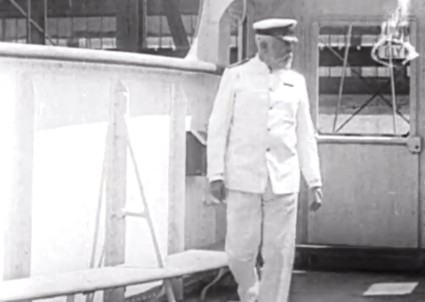
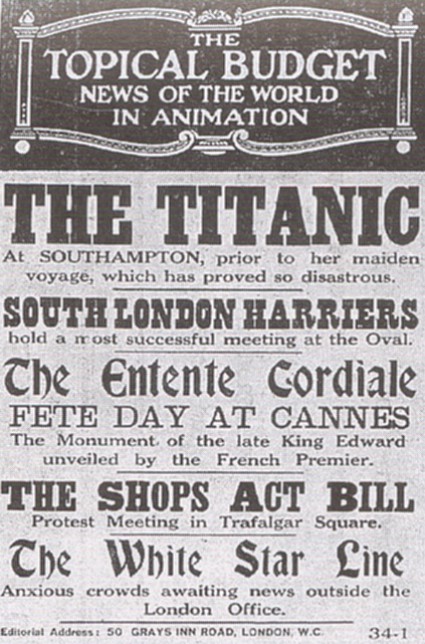

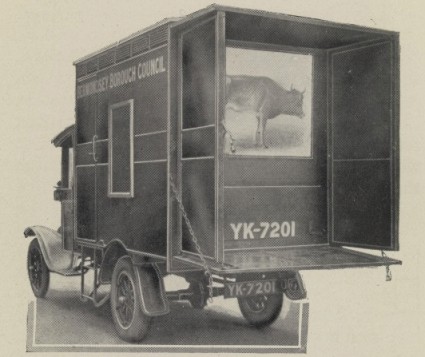

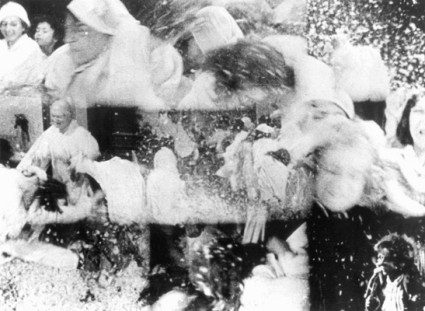

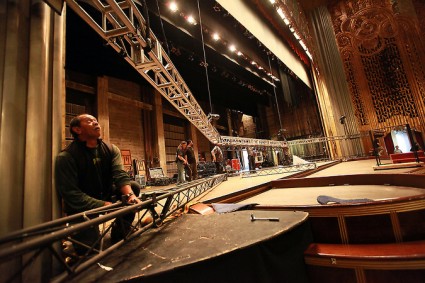
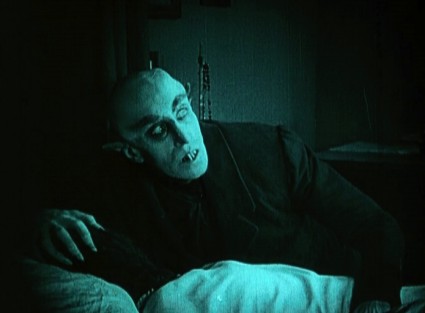


 The Bioscope