Bioscope Newsreel no. 26

Bali

Busy times, people, busy times. For assorted reasons the Bioscope Newsreel failed to hit the presses last week, but here we are again with a round-up of some of the week’s news in silent film.

Saving Lawrence
We have already written here at some length about Lowell Thomas’ film lecture, With Allenby in Palestine and Lawrence in Arabia (1919), which made T.E. Lawrence world famous. Now the National Film Preservation Fund has included the ‘film’ (much of it is slides) among the 64 to which it has awarded preservation grants. The award goes to Marist College in the USA, which holds Thomas’ personal collection. Read more.

Charlie in Bali
The Guardian reports on the discovery, announced by the Association Chaplin, of a fifty pages of dialogue for a potential talkie the Chaplin considered in 1932, entitled Bali (after the Indonesian island) and intended as a satire on colonialism. It came at a time when Chaplin was worried about the change in his art that had to come with the talkies. Kate Guyonvarch, the association’s director, is quoted as saying: “I had always assumed that when Chaplin had finished City Lights, he just had a long holiday. I now realise that this was a crucial crisis point in his life.” Read more.

Eric Campbell’s roots
The Scotsman reports with sorrow that Eric Campbell, Charlie Chaplin’s regular comic foil, was not a Scotsman from Dunoon as has been generally thought, but in fact English and hailed from Cheshire. Sadly, the commemorative plaque to Campbell that Dunoon put up in the mid-1990s is now to be taken down, and what of the subtitle of Kevin Macdonald’s documentary film, Chaplin’s Goliath: In Search of Scotland’s Forgotten Star? Read more.

100 Silent Films
Latest in a series of books devoted to films and nice round numbers published by the BFI and Palgrave is Bryony Dixon’s 100 Silent Films, published today. It is a strong indication of the growing popularity of silent films, and should be good for a debate or two once we see which films have made it into the golden 100 and which not. Expect a Bioscope review soon. Read more.

‘Til next time!

It’s a miracle!

A newspaper illustration of the Olympia stage production of The Miracle

A few years ago – specifically in 2008 and 2009 – you may recall that we ran the Bioscope Festival of Lost Films. It was a droll conceit, using a blog to put on a festival of silent films that no longer existed. We described the films as if we were watching them (and yet not watching them), in London venues that once were cinemas but are no more, and with silent film musicians of the past to accompany said films. Regular Bioscopists got into the swing of things, even commenting on details of the clothes they had worn for the evening. All in all, it was a fun thing to research and write. You can find links to all of the films shown as part of the 2008 and 2009 festival on the Series page.

However, we pulled the plug on the festival thereafter, for three reasons. One, the festival took up too much time to research. Two, we received several requests from readers for information on these films, which they had imagined were lost and who couldn’t quite grasp what the concept of a lost film festival was supposed to imply. Thirdly, we learned after the 2009 festival that one of the films had in all probability survived. Great news for film; not such great news for a lost film festival, so we decided enough was enough.

We then waited for official notice of the film having been discovered before telling you about it, only to have discovered today that the news has been out for a quite a while now. Tsk tsk – the Bioscope should do better than that. So, belatedly, it is a pleasure to be able to tell you that Das Mirakel (Germany 1912) is not a lost film. It is held by the CNC film archive in France, and was screened last year as part of a Lubitsch retrospective (Ernest Lubitsch appears in a minor role in the film) and was reviewed – in French – on that excellent blog, Ann Harding’s Treasures. Alas, she reports that while the film is in prime condition, the direction is amateurish and the performances absurdly histrionic. This is both a surprise, given that the film was based on production by one of the greats of 20th Century visual theatre Max Reinhardt, while also not a surprise at all given the film’s peculiar production history.

As we related in the original post about the film, Das Mirakel came about when the British theatrical impresario C.B. Cochran was looking for an entertainment on a suitably grand scale to fill the vast arena of London’s Olympia. Cochran had seen Max Reinhardt’s production in Germany of Oedipus Rex and invited the great producer to devise a new epic production that would make best use of Olympia.
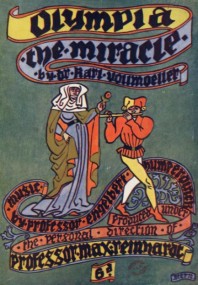
Reinhardt initially thought of recreating the Delhi Durbar ceremonies, held in India to mark the coronation of King George V in 1911. But instead he latched upon the idea of staging a medieval legend of a nun who escapes from her convent with a knight, experiencing assorted adventures and dangers, while at the convent a statue of the Virgin Mary miraculously comes to life and undertakes the nun’s duties. The major spectacle was provided by the drama’s cathedral setting, not to mention 1,000 performers, 2,000 costumes, 500 choristers, 25 horses, an orchestra of 2,000 and assorted examples of ingenious stage mechanics (see programme, left, from http://www.vam.ac.uk/users/node/9028). Given the distance between the audience and the action, the drama was presented in dumbshow (apart from the choir). The drama was written by Karl Vollmöller, with music composed by Engelbert Humperdink.

The Miracle, as it was known, was every bit the stage sensation that Cochran hoped it would be, with London audiences being overawed by its dramatic scale and its sentimental religosity when it opened over Christmas 1911. But where things get odd is when it comes to the film – or rather films – made of The Miracle. A film of The Miracle apears to have been an afterthought – a quick cash-in on the stage production’s popularity, at a time before Reinhardt gave any serious consideration of the possibilities of cinema (he would of course go on to produce a the classic Warners 1935 film A Midsummer Night’s Dream). It was originally reported that the film was to be made in London, but production instead moved to Austria, with producer Joseph Menchen and scenarist Michel Carré who was probably also the film’s director. Max Reinhardt himself seems to have had little to do with the film’s actual production. The oddness came with the camera operators and leading actress. The operators were the brothers William and Harold Jeapes, owner and chief cameraman at the Topical Budget newsreel. How they got the call to make the film is a mystery, but it was a hurried appointment, as William Jeapes later recounted:

In the first place, I may say that my own connection with the undertaking commenced just about twenty-four hours before I actually entered upon it, so you can imagine that there wasn’t much time for preparation. I received and accepted the request that I should take on the business, grabbed camera, films and baggage; caught the first train that was available, and, in almost less time than it takes to tell (as the novelists say) I was starting on the first preliminaries with Professor Reinhardt and M. Michel Carré (who adapted the play for the camera), near Vienna.

I left London on September 21st, and I returned on October 15th. During that time we were working regularly from the early morning until about 3 o’clock in the afternoon, at which hour it was necessary for the company to start back for Vienna, where ‘The Miracle’ was being played nightly – at the Rotunda. We did nothing on Sundays.

Jeapes and Jeapes were able newsreel operators, but were the last people you would have thought of to film a dramatic production, still less one so dependent on plausible illusion and a sense of scale. Odder still was that the key part of the Nun did not go to anyone from Reinhardt’s German production of the play, but instead went to an English actress without any film pedigree (or much of a stage one), Florence Winston. And she was Mrs William Jeapes. Other performers included Maria Carmi as The Madonna, Douglas Payne as The Knight, Ernst Matray as Spielmann, and somewhere in the background Ernst Lubitsch. All in all, a rum do.

As we wrote in 2009, the film received mixed reviews. Variety was dumbstruck, finding the film to be one of the wonders of its age:

The ‘Miracle’, reproduced from the wonderful Reinhardt pantomime of the same name presented at the London Olympia, is probably the finest exhibition of the “Celluloid drama” ever conceived. In some respects it is superior to the original pantomime spectacle, in that the paths of the performers – or characters – may be followed more minutely and with greater detail than is possible in the original, due to the possibility of showing the scenic progression with the unfolding of the plot … The whole presentment is remarkably impressive in general effect, the pictures so beautifully to resemble natural colors, the scenes so plentifully interspersed with captions announcing the progress of the tale, and finally the awakening to a realization that it was all a ghastly, enervating “dream”, is extraordinarily vivid. No spoken play could be more so.

The film’s lavish presentaton at special venues, with coloured print, a cathedral-like proscenium, organ, large choir and even incense wafting over the audience appears to have blinded some reviewers to the film’s actual shortcomings. The Bioscope (our favourite film trade paper) was more clear-sighted:

The whole play seems to have been adapted for the camera with only the most cursory regard for the latter’s possibilities and limitations. It has been forgotten that a scene viewed through an artifical glass lens is a very different thing from the same scene viewed in actuality by the naked eye … In the scenes showing the cathedral’s interior the stage is too deep, with the result that the players are constantly out of proportion with each other, and swell from midgets to giants in a fashion which is almost ludicrous as they move “down stage”.

Confusingly, there was a rival Miracle film, produced in Germany at the same time, which claimed that it was based on the legend rather than Vollmöller’s drama, to get round any copyright claim. It was also called Das Mirakel or Alte Legende – Eine Das Marienwunder, but in the UK it was marketed as Sister Beatrix. Produced by Continental-Kunstfilm GmbH in 1912, it was written and directed by Mime Misu, and is – we are fairly confident in stating – a lost film.

You can find details of the extant Das Mirakel on the CNC database. They credit the direction to Michael Carré and Max Reinhardt, but we doubt that Reinhardt had much to do with the film beyond initial negotiations (William Jeapes does at least note Reinhardt’s presence in Austria at the time of filming). Ann Harding’s Treasures’ review describes watching the hour-long film today as sheer torture, with acting styles of the flailing arm variety, no sense of composition or narrative, and a camera bolted to the floor simply recording theatre. She notes that a very much better film from the same source material exists, Jacques de Baroncelli’s La Légende de Soeur Béatrix (1923).

For all that, it would be good to have a chance to see Das Mirakel one day, just to get a sense of what so moved the variety reviewer. All it would need is a cathedral setting, an organ, a fair-sized choir and some incense. And every lost film found must be a cause for rejoicing, even if the story behind the film is of somewhat greater interest than the film itself. It is good to hae been wrong.

Motion picture studio directories

Actress Hope Hampton, from the frontispiece to the Motion Picture Studio Directory and Trade Annual for 1921

As we have noted before now, the plethora of online resources for family history that exist can be a particularly useful aid for early film research. Now the leading genealogy web service, Ancestry, has returned the compliment by making two American motion picture directories available on its site, for searching by those who subscribe to its services. The two volumess are the Motion Picture Studio Directory and Trade Annual for 1919 and 1921, which Ancestry has converted into database form, with this opening description:

Two directories to the actors, directors, producers, and technicians of the motion picture industry for the years 1919 and 1921 are contained in this database. Each directory has a biographical section with information about the listed individuals such as their name, birth date and place, a brief career bio sometimes including educational history, a physical description (for the actors) or special skills description (for production crew), and membership in clubs, unions, or other organizations. Many entries include addresses and some photographic portraits are featured. All are listed in an index at the back of each directory.

Section divisions for the directories are as follows: actors, actresses, child parts, directors, assistant directors, scenario editors and writers, cinematographers, studio managers, publicity men, laboratory and property men, and film cutters. The actors’ and actress’ sections are further sub-divided into leads, ingénues, characters, comedians, and heavies (villains). Biographical entries, besides the above listed information, also note films the individual has worked on and other important or relevant experience such as the bio of cinematographer Herbert Oswald Carleton which specifically mentions his early career as a mechanic and inventor as well as his patented invention, the Duplex Printing Machine.

Each person entry on the Ancestry database comprises: Surname, Birth date and place, Career summary, Description of physical appearance (actors) or other skills (technicians and crew), and Membership in clubs or societies. This is very handy for those searching for names across Ancestry’s gigantic database of genealogical information who require all such information to be in one place. However, it should be noted that the Motion Picture Studio Directory and Trade Annual for 1921 is freely availably online in word-searchable form from the Internet Archive, which also makes available Charles Donald Fox and Milton Silver’s Who’s Who on the Screen (1920) which the Bioscope has introduced before now and portraits with text from which are reproduced on the Bioscope’s Flickr site.

Sample page from the 1921 Motion Picture Studio Directory and Trade Annual

So it’s always worth checking twice with these things, and you can find summaries of Who’s Who on the Screen and now the Motion Picture Studio Directory and Trade Annual for 1921 in the ever-growing Bioscope Library.

Searching the BUFVC

http://beta.bufvc.ac.uk

We are mentioning with increasing frequency the existence of federated databases; that is, databases of databases, which allow you to search across multiple databases through a single search option. Sometimes they get called gateways or portals, but they are essentially all doing the same thing. We have already mentioned Connected Histories, JISC MediaHub, Canadiana and Europeana. There are others of major status in the pipeline which we will be covering at the appropriate time. But today we are looking at the BUFVC federated search environment aka All BUFVC.

The British Universities Film & Video Council is a small organisation that achieves big things. It exists to support the use of moving images and sound in UK higher education, and does so chiefly through a combination of information, online databases and a television and radio off-air recording service for educational users. Snappily known as the BUFVC, it used to employ your scribe not so long ago, so this may not be an entirely dispassionate review, but they do damn fine work with all the right principles – and this is a damn fine resource that they have created.

The federated search environment (a terrible phrase, friends) brings together nine databases and 13 million records. The databases include TRILT (a huge database of programme information on all UK TV and radio since 2001 and further records back to 1995), a database of some 30,000 educational titles aailable on DVD and tape, News on Screen (data on 180,000 British newsreels and cinemagazines from 1910 onwards), Shakespeare on Film, Television and Radio (7,000 records), TVTiP (television listings for the UK’s ITV channel 1955-1985), This Week (records for the ITV documentary series 1956-1982), and three independent local radio databases with associated recordings. As the publicity blurb puts it:

The search environment will transform moving image and sound resource discovery by replacing the need for researchers to locate databases and collections through multiple channels. It will enable creative discovery of content by opening up collections and connecting users with resources they were not previously aware of.

Before you get too excited, not all of this is accessible to everyone. Someone of the resources have been paid for with UK higher education monies and are accessible via password to UK HE institutions only, while TRILT is only available to BUFVC members, apart from the two most recent weeks’ programme data. Other records provide catalogue data, and then link to the film or sound recordings themselves, but you have to be in the UK HE club to access those. But that’s the BUFVC’s business to serve UK universities, and it’s highly commendable that they can still make so much of the catalogue data, and a great many digitised documents, available to all.

So there is a huge amount to discover for everyone. And here it does just about everything right that you would want to see from such a resource. Enter any search term and and result come up with title, short descriptions and some cheery icons which let you know database they come from, what genre type (e.g. radio, newsreel), what medium (e.g. film, sound) and whether any digital content is available online (subject to your particularl status). Individual records provide further information, depending on the nature of the original database. You can used the Advanced Search to refine searches by date, date range, medium, collection, availability, and genre. You can rate records, trace your preious searches, order search results by relevance, date or title, and results can be exported in XML format, as text or in citation format. There is first-rate faceting (i.e. letting you know how many of your search results break down into particular categories, and it even offers serendipitious related searches. What fun.

Search results for ‘charlie chaplin’

So what is there for the silent film researcher? The easiest thing to do is to used the adanced search and narrow search results to 1896-1929. You’ll find some 35,000 newsreel records and 500 Shakespeare records. The former are records of almost every British newsreel and film magazine released over that period, covering a huge variety of social and political stories as well as many items specifically relating to cinema subjects (17 newsreels on Chaplin, 20 for Pickford, 14 for Fairbanks). The BUFVC doesn’t hold the films, but the records will tell you who does (and link you to online copies including the freely-available titles held by British Pathe). The Shakespeare records are (hopefully) every title from the silent era relating to the Bard, a hugely useful resurce in itself, again with information on where extant copies may be found. But take away the date limiters and there is more to be found, among TV and radio programmes and DVD releases. 129 search results for Chaplin overall should give you an idea of the range.

The BUFVC federated search environment (it’s still a dreadful name, but I understand the idea is to have it appear on their front page so that the search facility effectively beomes the BUFVC online) is the result of a collaborative project between the BUFVC and Royal Holloway, University of London, and was funded by the Arts and Humanities Research Council. It was funded as part of something called the Digital Equipment and Database enhancement for Impact programme, and it is designed to create impact. Nine databases are too many to be offering separately – users will know about one or two, but ignore the others. They won’t be able to ignore this. It also establishes a platform onto which other databases could be added in time, enriching discovery all the more.

Go explore.

Parlons cinéma

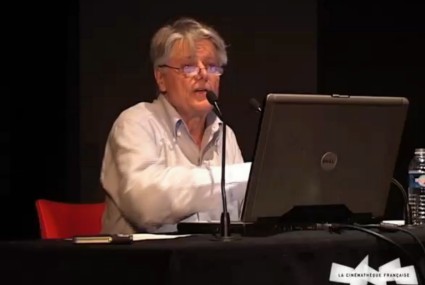
Maurice Gianati speaking on Alice Guy at the Cinémathèque Française

How’s your French? Regular Bioscopist Frank Kessler has kind sent me a listing of video on silent cinema and pre-cinema subjects which are available on the Cinémathèque Française website as part of its ‘Parlons cinéma‘ series. This is a series of videos (all in French) recording talks, conferences, debates, interviews and such like held at the Cinémathèque. They are knowledgeable and well-presented, with clips and PowerPoint slides interspersed among the talking heads.

This is list of some of the talks that fall within our area, covering such subjects as the Phantasmagoria, Alice Guy, Emile Reynaud, the phonograph in France, and introductions to Sergei Eisenstein and Laurel and Hardy:

From the little I’ve sampled, these are people who take their cinema seriously, and who can say that they’ve really tried cinema until they’ve tried it in French?

Aller explorer.

Broncho Billy silent film festival

The 14th annual Broncho Billy Silent Film Festival takes place at the Niles Edison Theater, 37417 Niles Boulevard, Fremont, California, 24-26 June. The festival schedule has been published, with highlights including Mack Sennett Studios, serial heroines Helen Holmes and Helen Gibson, and the ubiquitous Baby Peggy.

Here’s the outline programme:

FRIDAY Evening, June 24

6:30 to 7:30 PM Meet and Greet
Come and meet our guests and friends and have a light snack before our first show

8:00 PM Evening Main Program
Introduced by Robert S. Birchard
Manhandled – Gloria Swanson (1924)
The Golf Nut – short: Billy Bevan, Vernon Dent (1927)
When a Man’s a Prince – Ben Turpin, Madeline Hurlock (1926)
Bruce Loeb at the piano

SATURDAY June 25
Tours of Niles will be available in late morning (optional) – getting you back in time for the afternoon show.

SATURDAY Early Afternoon, June 25
12:30 PM Film Program – Focus on Mack Sennett Studios
Hosts Brent Walker, author of Mack’s Fun Factory and Richard Roberts, comedy film historian
Comrades – Mack Sennett (1911 Biograph)
The Water Nymph – Mabel Normand (1912 Keystone)
Shot in the Excitement – Al St. John, Alice Howell (1914 Keystone)
The Home Breakers – Mack Swain, Chester Conklin (1915 Keystone)
The Waiter’s Ball – Roscoe “Fatty” Arbuckle, Al St. John (1916 Keystone)
Whose Baby? – Gloria Swanson, Bobby Vernon (1917 Keystone)
Phil Carli at the piano

SUNDAY June 26
A Train ride through Niles Canyon will be available mid-morning (optional, at an additional low cost) – getting you back in time for the afternoon show.

SUNDAY Afternoon, June 26
12:30 PM Film Program – Women in Action: The Two Helens
Hosts Shirley Freitas Great Granddaughter of Helen Holmes & Larry Telles, author and silent film serial historian
Webs of Steel – Helen Holmes, director/husband J. P. McGowan (1925, Morris R. Schlank)
Ghost of the Canyon – short: Helen Gibson (1920, Capital)
David Drazin at the piano

SUNDAY Late Afternoon, June 26
3:30 PM Film Program
A BABY PEGGY FEATURE FILM
Introduced by Diana Serra Cary

The Family Secret – Baby Peggy, Gladys Hulette, Edward Earle, Frank Currier. (1924, Universal)
David Drazin at the piano

Ticket details, transport and accommodation information are all on the festival site.

Lady Lumberjack

Our story begins with Dorothea Mitchell, born in England in 1877 and raised in India, where her father was involved in railway construction. Disappointed in having no sons, Dorothea’s mother encouraged and her sister to becoming practiced in what were considered manly occupations, such as carpentry, marksmanship and military-style riding. The family returned to England in the 1890s, and when her father died Dorothea became, in her words, “the man of the family”. She emigrated to Canada in 1904, ran a boarding house in Toronto, then became the companion help to a mining engineer and his wife at Silver Mountain, Ontario. She went on to run a general store, then to manage a sawmill. Her family joined her when she succeeded, unusually, in obtaining land under the Homestead Act, such as was not generally granted to women.

In 1921 she moved to Port Arthur, becoming a teacher and then a bookkeeper. Her hobby was photography, and in 1929 she met Fred Cooper, a bakery store owner, who had purchased a 16mm film camera when he and his wife went on a trip to England. Cooper and Nitchell were seized with an enthusiasm to make a fiction film. Cooper and Mitchell established the Amateur Cinema Society of Thunder Bay (aka Port Arthur Amateur Cinema Society), which became a member of the Amateur Cinema League – an American-based but worldwide federation of amateur film clubs, evidence in itself of the great enthusiasm for amateur film production (particularly dramatic films) at this time, encouraged by the introduction of 16mm film stock in 1923.

Mitchell first looked for a script in filmmaking manuals of the period, but finding nothing to her liking decided to write a feature film script for herself. The Amateur Cinema Society of Thunder Bay’s first production was A Race for Ties (1929), directed by Harold Harcourt (a one-time military adviser to some Hollywood films), written by Dorothea Mitchell (she also acted in a small part) and photographed by Fred Cooper. Based on Mitchell’s own life experiences, the film told the tale of the competition between a small sawmill owner and a large timber company to obtain a major railway construction contract. She later wrote an account of the film’s production, from which this extract is taken:

Neither had any of us the foggiest notion how long the completed story would run. We just kept going. (The ultimate was 1600ft). Directly after a roll was exposed, it had to go east to be processed and on its return the cameraman, director and I would congregate in my office (evenings of course), run it through a projector and cut it up. As Secretary Treasurer (and a few other odd jobs for good measure). I kept a record of every clipping, placing each in numbered section of egg-boxes – I’d dozens of them! – until interiors were taken and could be inserted in appropriate spots. Yes, there was ample unseen work, as well as fun. It may interest modern amateur-movie makers to know that projectors at that time were treacherous creatures! If stopped while the lamp was “on,” the film scorched – naturally adding to the ticklishness of the constant reviewing necessary.

The film was followed just a few months later by production, Sleep Inn Beauty (1929), a short comedy about a bathing beauty contest, directed, written and photographed by the same trio.

A Race for Ties (1929)

The Society’s final production was to have been The Fatal Flower (1930), but although photography was completed, a lack of funds and apparently some waning enthusiasm from other Society members meant that the 45-minute film remained unedited and unviewed. Mitchell went on to take charge of the Voluntary Registration of Canadian Women during the Second World War, took up amateur filmmaking again in her sixties with the Victoria Amateur Movie Club, then turned to writing short stories and an autobiography of her younger days, Lady Lumberjack, published in 1968. She died in 1976, aged ninety-nine.

Happily, Mitchell’s films, along with her papers, have survived, and an active project exists to research and promote the work of Mitchell and the Amateur Cinema Society of Thunder Bay, centred on the website www.ladylumberjack.ca. Named after the title of the Society’s final, unfinished film, the aims of the Fatal Flower Project are to make available again the films made by the Society and now preserved by Library and Archives Canada, on DVD and online; to republished the book Lady Lumberjack; to produce educational packages; and boldest of all to finish off that unfinished film, The Fatal Flower. Using Mitchell’s original footage, the Project has edited the film and added its own titles in a style emulating that of Mitchell’s earlier films, produced a music score and even created period-style posters.

The Fatal Flower (1930), as reconstituted in 2002 by The Fatal Flower Project

And there’s more. Local filmmaker Kelly Saxberg, Fatal Flower Project member and someone greatly enthused by the story of her enterprising predecessor, has produced a documentary, Dorothea Mitchell: A Reel Pioneer, which tells the story of Mitchell, the Amateur Cinema Society of Thunder Bay and the reconstruction of The Fatal Flower. The documentary is embedded at the top of this post, and as you will have seen, A Race for Ties and The Fatal Flower have recently been made available online through Vimeo. The documentary can also be ordered on DVD.

The Fatal Flower Project talks up Dorothea Mitchell a good deal. The Fatal Flower itself is now headed by the words “a film by Dorothea Mitchell”, which wouldn’t have been on the original titles had they been written. There is much about the importance of her work to Canadian film history (A Race for Ties is championed as “Canada’s First Amateur Feature-Length Film”), particularly women in early Canadian film history (the documentary compares her to the rather better-known Nell Shipman). The literature stresses the importance of the films to the history of what is now Thunder Bay, Ontario, and there is much in the films that was clearly aimed at a very specific audience, the films haing been screened locally at the time to raise funds for charity.

Are the films any good? Of their kind, they are more than competent. They have all the hesitancies and gauchness of amateur dramatic films, but they were put together competently and entertainingly. Mitchell could construct an extended film story, and Harold Harcourt did rather well as a director for military adviser. There is good, varied use of locations, and the performances of the amateur cast are fine. You might need to be Canadian to see the most in the films and their story, still more someone from Thunder Bay, but there is something for anyone in the tale of Dorothea Mitchell and her film society, and the films charm and entertain. Perhaps most importantly the project serves to highlight the great enterprise, enthusiasm and cine-literacy demonstrated by the large number of amateur filmmakers at this time, whose love of the cinema could not be contained simply by going to the cinema. A very good job has been done all round.

The Lady Lumberjack site is at www.ladylumberjack.ca. It has detailed background information on Mitchell’s life and her films.

The films and documentary are available to view on the Lady Lumberjack Vimeo channel. SleepInn Beauty is not available online at present.

Mitchell’s books, all of the films and documentary are available for sale from www.ladylumberjack.ca/order.html

Chaplin in Babylon

Last year saw the appearance of a new silent film festival, the StummfilmLIVEfestival put on by the Babylon Kino cinema in Berlin, a 1929 cinema with original Art Deco screen and refurbished original organ. That first festival was a bold statement of intent, with an impressive ten-day line-up of classic silents. The Babylon Kino has made good on its promise to make the festival an annual event, and to keep up the eye-catching programming standard.

And so, from 15 July to 7 August 2011 the second StummfilmLIVEfestival will feature the complete film works of Charlie Chaplin – 80 films in twenty-four days (the filmographers among you might like to comment on whether there are precisely eighty films in Chaplin’s silent filmography). A full programme has not been published as yet, but there will be ten main screenings of the silent features with orchestral accompaniment by the Neues Kammerorchester Potsdam, conducted by Timothy Brock, on these dates:

15 Jul – The Gold Rush
16 Jul – City Lights
17 Jul – The Gold Rush
22 Jul – Modern Times
23 Jul – The Circus
24 Jul – The Kid
30 Jul – City Lights
31 Jul – A Woman of Paris
06 Aug – The Gold Rush
07 Aug – The Chaplin Review

Other musical accompaniment will be provided by Neil Brand, and Geraldine Chaplin is the guest of honour. As the Babylon website notes (in German only), eighty years ago, on 9 March 1931 Chaplin visited Berlin to promote his new film City Lights, so this is a sort of anniversary coming home for Chaplin. Tickets can now be booked for the orchestral screenings, and there are further details – in German only – on the festival site.

Female Hamlet

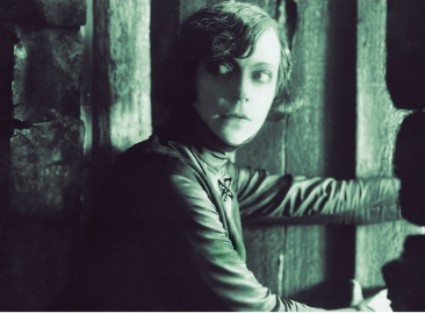
Asta Nielsen in Hamlet (1921)

The second notable Edition Filmmuseum DVD release to tell you about is Hamlet & Die Filmprimadonna, to be issued on 10 June 2011. It was 2009 when the DVD label first announced that a DVD of Asta Nielsen’s Hamlet (1920), from the coloured print discovered in 2005, was forthcoming. Whether it was licensing issues, or technical matters that held up the release I don’t know, and it doesn’t matter – all that matters is that such a key film, from a fine restored print, and with a highly commendable score, is available on DVD at last. It certainly ought to have an impact.

The Danish actress Asta Nielsen was probably the leading European film performer of the 1910s. Though her dark demeanour and unconventional beauty probably led to a lack of success in the USA, in European countries, especially Germany, she was revered, with films such as Afgrunden (The Abyss) (1910), Balletdanserinden (1911), Die Suffragette (1913) being among the most iconic and forward-looking of their age. She and husband/director Urban Gad moved to Germany in 1911 and it was in that country, after she had established the Art-Film company, that Nielsen (now parted from Gad) embarked a radical film interpretation of Hamlet. Possibly by this time Nielsen’s star was a little on the wane, but her taste for the bold and challenging was undimmed.

It was a bold enough decision to film Shakespeare, whose plays had lost favour with cinema audiences and producers once feature films had come in. But Nielsen and her directors Sven Gade and Heinz Schall went further. Though the essential structure of the film was taken from Shakespeare’s play, they went back to Shakespeare’s source material, in particular Saxo Grammaticus, to rid the play of its Renaissance trappings. And then they went further by making Hamlet a woman. The scriptwriter Erin Gepard apparently found justification for this in a obscure work of Shakespearean criticism, The Mystery of Hamlet (1881), by one Edward P. Vining. Vining’s earnest expressed thesis was that the deep-rooted mysteries lying at the hear of the play and particularly the character of Hamlet could be readily explained if you understood that Hamlet was a woman, forced to disguise her sex for political expediency, with the added complication of being in love with Horatio.

Here is some of Vining’s argument:

There is not only a masculine type of human perfection, but also a feminine type; and when it became evident that Hamlet was born lacking in many of the elements of virility, there grew up in him, as compensation, many of the perfections of character more properly the crown of the better half of the human race. All mankind has recognized the deep humanity of the melancholy prince, and many have been puzzled to find that they were instinctively compelled to bow before him in admiration, while still finding in him so many faults and weaknesses. The depths of human nature which Shakespeare touched in him have been felt by all, but it has scarcely been recognized that the charms of Hamlet’s mind are essentially feminine in their nature.

One has only to argue that Hamlet could have his feminine side and yet remain a prince to put Vining’s arguments in their place, but it is true that there have been a number of female Hamlets on the stage from the 18th century onwards. Among the stage performers who were not content to be confined to playing Ophelia have been Sarah Siddons in the 18th century, Charlotte Crampton, Clare Howard, Alice Marriott and Alma Murray in the 19th, and in more recent times Frances de la Tour and Angela Winkler. The evidence of such performers suggests both something particularly feminine in the character of Hamlet, but also a desire to lay claim to an iconically male role.

Perhaps the most notable female stage Hamlet also became the first film Hamlet when Sarah Bernhardt was filmed in 1900 in the duel scene from Hamlet. Not only was it the first film Hamlet but it was the first Shakespeare sound film, as it was made for the Phono-Cinéma-Théâtre, with the film synchronised to a phonograph recording. Female screen Hamlets post-Nielsen have been rare, though the Turkish actress Fatam Girik was the star of İntikam Meleği (1977), English title the helpfully literal Female Hamlet. It is perhaps because it is so often such a struggle just to get Shakespeare filmed that few producers or performers have felt any need to takes things further and explore such gender reversal. Opportunities on the stage have been that much greater in number, as Tony Howard documents in his excellent Women as Hamlet: Performance and Interpretation in Theatre, Film and Fiction.

Nielsen’s interpretation was therefore part of a clear (if marginal) stage tradition, but was something of a bolt out of the blue for film. There was nothing really to compare it to in 1921, and little since – it is a film that stands on its own. It is Nielsen’s great accomplishment that we immediately accept her as Hamlet. Her androgynous looks help to a degree, but crucially she is not trying to be a man playing Hamlet (as Bernhardt and her predecssors had done) – she plays a woman who must disguise herself as a man. There is no questioning of the rightness of the idea when we watch the film, and little sense of any forcing of the narrative to fit the thesis. It works on its own terms. It has its absurdities, inevitably, particularly when Horatio discovers that the dying Hamlet has been a woman all along, but that may simply be a fault of our modern eyes. Technically the film is no masterpiece. It is plainly directed, somewhat meanly produced, and not memorably performed aside from Nielsen. But it does succeed as a consistently imagined world, where people live, work, rule and affairs of state take place. As I wrote previously here about seeing the film in 2007, “there is a keen sense of palace life going on while the central figures progressively, and madly, destroy one another”. Moreover, there is no sense at all of something translated from stage to screen. The best Shakespearean cinema is invariably where cinema comes first.

The Edition Filmmuseum DVD derives from the colour version (i.e. tinted and toned) discovered in 2005 and restored by the Deutsches Filminstitut. It comes with a new score by Michael Riessler which I found especially haunting and appropriate when I heard it in 2007. The release is a two-DVD set. Disc 1 is the film (110 mins). Disc 2 has Die Filmprimadonna (1913), starring Nielsen and directed by Urban Gad; Nielsen home movies, films on the restoration process and a short entitled Der elektronische Hamlet 2007 (2008).

Bioscope Newsreel no. 25

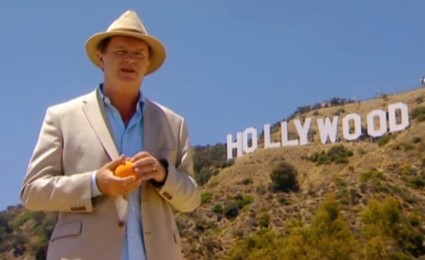
Paul Merton, a sign, and an orange

Another week has gone by, and silent films continues to make the headlines – almost literally so in the case of our first news story. Read on.

The continuing story of Zepped
Silent films made it through to the popular consciousness this week with the widely-publicised news of the upcoming (June 29th) auction of a curious 1916 film called Zepped (previously reported on by the Bioscope in detail). Amazingly the story made it to the main BBC news, plus a wide number of newspapers. The film, found on eBay, combines routine animation of the period with clips from Chaplin films. The ignorant claims being made in the press for what is a minor of work of passing interest to Chaplin experts and early animation buffs are frankly embarassing, though I dare say its owners will have the last laugh if they really do get the six-figure sum they are hoping for. Only if the figure includes pence, that’s what the Bioscope thinks… Read more.

Merton’s Hollywood
However, another instance of the popularisation of silent films has been surprisingly successful. Paul Merton’s earlier programmes on silent film comedy have been a bit of a mixed bag – enthusiastic but muddled. Paul Merton’s Birth of Hollywood, however, started off rather well last week, with an opinionated but informative and generally disciplined account of Hollywood’s formative years. We have quite high hopes of this evening’s second episode, which covers the Fatty Arbuckle scandal. Read more.

Napoleon’s maps
We have already enthused about The Cine-Tourist, a website on the mysterious and poetic connection between films and maps. Just up on the site is a page on the use of map imagery in Napoléon vu par Abel Gance (1927). It’s an engrossing and illuminating piece of close visual analysis, warmly recommended. Read more.

The balancing bluebottle
Those in the UK might like to listen out on Radio 4 this Sunday at 13:30 for a repeat of The Balancing Bluebottle, the engaging programme from 2009 on naturalist filmmaker F. Percy Smith, one of the great obscure filmmaker of the silent era. It’s presented by the Science Museum’s Tim Boon and the Bioscope makes a brief appearance, interviewed in a windy corner of Leicester Square. Read more.

The Bray Animation Project
A fine new website has been published by Tom Stathes dedicated to research into the 1913-1927 output of American animation studio Bray, producers of such series as Colonel Heeza Liar, Happy Hooligan and Krazy Kat, and featuring the work of Pat Sullivan, Max Fleischer, Pat Sullivan and John Bray himself. There is a studio history, filmography, ample illustrations and a discussion board. Read more.

‘Til next time!