Human Wreckage

Bioscope Festival of Lost Films

USA 1923

Director: John Griffith Wray
Production company: Thomas H. Ince Corporation
Director of photography: Henry Sharp
Script: C. Gardner Sullivan

Cast: Mrs Wallace Reid (Ethel MacFarland), James Kirkwood (Alan MacFarland), Bessie Love (Mary Finnegan), George Hackathorne (Jimmy Brown), Claire McDowell (Mrs Brown), Robert McKim (Dr Hillman), Harry Northrup (Steve Stone), Victory Bateman (Mrs Finnegan), Eric Mayne (Dr Blake), Otto Hoffman (Harris), Philip Sleeman (Dunn), George Clark (The Baby), Lucille Ricksen (Ginger Smith), George E. Cryer (A city official), Dr R.B. von Kleinsmid (An educator), Benjamin Bledsoe (A jurist), Louis D. Oaks (A police official), Martha Nelson McCan (A civic leader), Mrs Chester Ashley (A civic leader), John P. Carter (A civic leader), Mrs Charles F. Gray (A civic leader), Dr L. M. Powers (A health authority), Brig. C. R. Boyd (Salvation Army worker)

7,215 feet
Distributed by Film Booking Offices of America
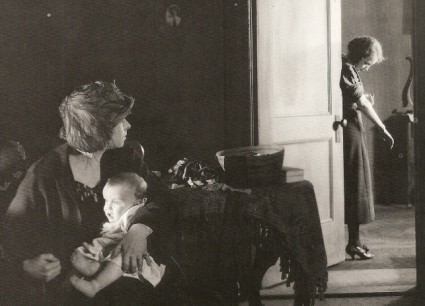
Human Wreckage

Mrs Wallace Reid and Bessie Love (right), in Human Wreckage

Ladies and gentlemen, good evening, and welcome to the third screening of the Bioscope Festival of Lost Films. Today we find ourselves at the Casino de Paris in London’s Oxford Street. This small but fine building, which first opened its doors on 18 September 1909, seats just 175 of you. The venue has been chosen for its select nature, as only an invited and carefully vetted audience could be allowed in to see this evening’s sensational production which – as you will know – has been banned by the British Board of Film Censors. It is only under special licence from the London County Council that we are able to show it to you at all. The music comes from that legend among silent film pianists, Mr Arthur Dulay (round of applause).

What is also special about this evening’s main film is that it is to be shown in the presence of its principal performer, Dorothy Davenport, previously a popular film actress but now perhaps best known to you all as Mrs Wallace Reid (murmurs of sympathy). For it was the unfortunate death of her husband, the much-loved Wallace Reid, as the result of a wretched morphine addiction, that led her to produce Human Wreckage, and she has been tireless in presenting the film herself at its screenings across America. She is in this country to promote the film’s serious message, and we welcome her (warm and prolonged applause).

The history of Wallace Reid you will know well. The highly popular American star of such popular films as The Affairs of Anatol and Forever, became addicted to morphine, it is said after he suffered injuries in a railroad crash in 1919, while making The Valley of the Giants. What was at first medical expediency became an increasing habit, to the extent that it is believed that Wallace had morphine administered to him by a doctor at Famous Players-Lasky studios, to ensure that he could complete the many motion pictures that were demanded of such a popular star (expressions of shock and dismay). Many among you will recall the apathetic look that Wallace bore in his later pictures – only now do we know why! His death came on 18 January 1923, aged just thirty-one (deathly silence).

Human Wreckage is not the story of Wallace Reid. Instead it is a product of Mrs Wallace Reid’s determination, following her husband’s death, to campaign against the evils of drug pedling and addiction. Of course, its theme of drug addiction runs against the normal American censorship codes, but the picture’s serious intent has seen it gain a special dispensation from Mr Will Hays, and it was made under the guidance of the Los Angeles Anti-Narcotic League. You will have noted the various civic and health figures included in the cast (murmurs of approval).
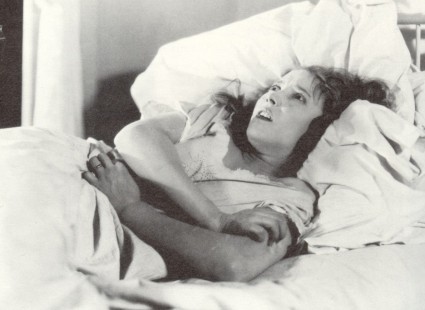
Bessie Love in Human Wreckage

Bessie Love as Mary Finnegan in Human Wreckage

The film tells of the evils of drug addiction as they affect several people. Jimmy Brown, a heroin addict, is arrested by the police but successfully defended in court by attorney Alan MacFarland. Jimmy is sent to hospital (where he endures the pains of withdrawal symptoms), while MacFarland, exhausted by pressure of work, is offered morphine by a friend. He gradually becomes addicted. Meanwhile his wife, Ethel, notices that a young girl, Mary Finnegan, living in the same tenement as Jimmy’s mother, is injecting herself with morphine. She is also putting morphine onto her breast to quieten the baby she is nursing. Mary tries to kill herself, but ends up in hospital and separated from her baby. Alan MacFarland is hired by Steve Stone, who is his own dealer, and manages to keep him out of jail. Ethel is unable to save her husband from his addiction, but then he discovers that despair has apparently led her to her own drug addiction, and this brings him to a shocked realisation of what he has put her through. Her ruse works, and he gives up morphine. Jimmy Brown takes Steve Stone on a mad taxi drive through the city, and both are killed in a crash. The film concludes with a plea from the MacFarlands for stronger laws to confront the evil of drugs.

The film has caused a sensation in the United States. Those uncertain about the film’s motives have been shaken by its sincerity and the power of its telling. Mrs Reid herself has been tireless in promoting the film, often introducing it herself, and using her profits to support the Wallace Reid Foundation Sanatorium, as well as establishing her own film production company (warm applause). It is no cheaply-made exposé; instead it has been handsomely produced by the Thomas Ince Corporation, and boasts some remarkable sets inspired by The Cabinet of Dr Caligari for one fantastical sequence. The producers’ confidence has been rewarded by the film’s noted financial success in America.

Here in Britain, where the American context of the story means less, the censors have been less accommodating. Our BBFC rejected the film in January 1924. Mrs Reid has organised some screenings for private individuals – our screening this evening is one of these – but this seems to have shocked the BBFC still further. The chief censor, Mr J. Brooke Wilkinson, has gone on to say:

There have been few, if any, films submitted to the Board since its inception which the examiners look upon as more dangerous than this film ‘human wreckage,’ and we see no possibility of altering it so as to make it suitable for public exhibition in this country.

And so it remains banned, and unseen (cries of ‘shame’).

The lost short accompanying our main feature is Dorian Gray (1913), also known as The Picture of Dorian Gray. How bitterly ironic it is that the young Wallace Reid should have starred in this film, playing Oscar Wilde’s seemingly unblemished young man, whose true, corrupted nature is revealed through a deteriorating portrait of him. The film was directed by Phillips Smalley and written by his talented wife Lois Weber, both of whom also appear in the film. It was made by the New York Motion Picture Corporation.

This has been a harrowing evening. We thank you all for you attention, and particularly to Mrs Reid for having graced us with her presence (loud applause). Tomorrow we will move around the corner to the Cambridge Circus Cinematograph Theatre, for a compelling Anglo-German production. Do join us.
Women and Silent Britain

Alma Reville

Alma Reville

The 11th British Silent Cinema Festival, Rats, Ruffians and Radicals: The Globalisation of Crime and the Silent British Film (3-6 April 2008), is hosting a special panel session on Women and Silent British Cinema.

This panel will be separate from the main festival theme and will introduce and report on the activities of two projects: the international Women Film Pioneers project and the recently- formed Women’s Film History UK. The panel will also present research being undertaken on women and silent Britain and the organisers are currently seeking proposals for twenty-minute papers on any aspect of women working within the British film industry during the silent era.

Topics can range from studies of individuals to practical research- related issues, and they would particularly welcome presentations that offer some reflection on the issues, questions and problems of researching women’s film history.

Those interested should email a 200-300 word outline proposal to Clare Watson and Nathalie Morris (University of East Anglia) at womenandsilentbritain@hotmail.com, no later than 31 January 2008.

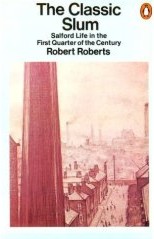
The Classic Slum

The Classic Slum

http://www.amazon.co.uk

It’s been a while since we had any memoirs of cinema-going. This, as regulars may know, is a particular research topic of mine, particularly memoirs of those who were children in London before the First World War.

The example below, however, comes from Salford. It comes from a renowned memoir of working class life, Robert Roberts’ The Classic Slum: Salford life in the first quarter of the century (1971). Roberts looks back to his childhood in Edwardian Salford, combining the personal with academic historical research in a uniquely powerful combination. As Roberts says, “few historians are the sons of labourers”, and his account of hard urban poverty hits you with eloquently-expressed authenticity.

The section from The Classic Slum on the cinema is typically evocative and filled with telling observations. He identifies the joyous effect that the cinema had upon its early, working class audiences, but also how it was a boon for women as a legitimised form of entertainment that had none of the social stigma of the pub. He also makes useful observations about seat pricing policies, children reading out intertitles to help out the illiterate, and the genuine educative value of the cinema.

Cinema in the early years of the century burst like a vision into the underman’s existence and, rapidly displacing both concert and theatre, became both his chief source of enjoyment and one of the greatest factors in his cultural development. For us in the village the world suddenly expanded. Many women who had lived in a kind of purdah since marriage (few respectable wives visited public houses) were to be noted now, escorted by their husbands, en route for the ‘pictures’, a strange sight indeed and one that led to much comment at the shop. Street corner gossip groups for a time grew thin and publicans complained angrily that the new fad was ruining trade: men were going to the films and merely calling in at the tavern for an hour before closing time. The disloyalty of it! Children begged, laboured and even thieved for the odd copper that would give them two hours of magic, crushed on a bench before the enchanting screen.

Moralists were not long in condemning cinema as the tap-root of every kind of delinquency. Cinema owners protested virtue: one kept an eight-foot-long poster across his box office: ‘CLEAN AND MORAL PICTURES. Prices – 2d. and 4d.’ In our district the Primitive Methodist chapel, recently bankrupt and closed, blossomed almost overnight into the ‘Kinema’. There during the first weeks would-be patrons of its twopenny seats literally fought each night for entrance and tales of crushed ribs and at least two broken limbs shocked the neighbourhood. In the beginning cinema managers, following the social custom of the theatre, made the error of grading seats, with the most expensive near the screen and the cheapest at the back of the house. For a short time the rabble lolled in comfort along the rear rows while their betters, paying three times as much, suffered cricked necks and eye strain in front. Caste and culture forbade mixing. A sudden change-over one evening, without warning, at all the local cinemas caused much bitterness and class recrimination. By 1913 our borough still retained its four theatres, but already thirteen premises had been licensed under the Cinematograph Act.

Yet silent films for all their joys presented the unlettered with a problem unknown in theatres – the printed word. Often in the early days of cinema, captions broke into the picture with explanations long, sententious and stage-ridden. To bypass this difficulty the short-sighted and illiterate would take children along to act as readers. In this capacity I saw my own first film. When the picture gave place to print on the screen a muddled Greek chorus of children’s voices rose from the benches, piping above the piano music. To hear them crash in unison on a polysyllable became for literate elders an entertainment in itself. At the cinema many an ill-educated adult received cheap and regular instruction with his pleasure, and some eventually picked up enough to dispense with their tutors. Yet in spite of all the aids to culture and learning, unknown fifty years before – compulsory education, free libraries, the spate of cheap print, the miles of postered hoarding, and the cinema, the brightest lure of all – among the lower working class a mass of illiterates, solid and sizeable, still remained.

Non solo dive

Non solo dive

http://www.nonsolodive.com

More information is now available on Non solo dive (Not Only Divas), a conference and retrospective on women and silent Italian cinema. The conference takes place in Bologna, 14-16 December, and here’s the line-up:

Friday, December 14

2.30 PM – Welcoming addresses

3.00 PM-6.30 PM – Session I:

Jane Gaines – Duke University and Columbia University (USA)
Are They Us?: Our Work on Women Working in the International Silent Film Industry
Christine Gledhill – University of Sunderland (UK)
Rethinking Women’s Film History from Britain
Elda Guerra – Associazione Orlando
Beyond Boundaries: The Women’s Movement at the turn of the 20th Century, and the Emergence of a New Subjectivity

Alberto Friedemann – Associazione Fert
Women Entrepreneurs in the Turin Film Industry during the Silent Period
Andrea Palladino – Documentary Filmmaker
The Amazing Story of Frieda Klug: Research Hypothesis for a Documentary about the Origins of Italian Cinema

Discussion

Saturday, December 15

9.30 AM-1.00 PM – Session II:

Cristina Jandelli – University of Florence
“The Sharpest of Them All”: Diana Karenne
Teresa Antolin – Archivio in penombra
Elena and the Men: Francesca Bertini and Film Historiography
Elena Dagrada – State University of Milan
The Temptation of Silence: Eleonora Duse and the Cinema

Elena Mosconi – Catholic University of Milan
Divas and Anti-Divas in Early Italian Cinema: Elettra Raggio and Astrea
Valeria Palumbo – Journalist, L’Europeo
Viper: the Myth of Anna Fougez
Ester De Miro D’Ayeta – University of Genoa
Sewing Celluloid Ribbons: The Obscure Career of Esterina Zuccarone, Editor and Working Woman in Turin

Discussion

3.00 PM-6.30 PM – Session III:

Luca Mazzei – University of Florence
Alone in the Dark. Memories and Narratives of Italian Female Viewers between 1898 and 1916
Silvio Alovisio – University of Turin
The Image of the Spectatrix in the Italian Film Press of the Twenties
Gina Annunziata – University of Siena
Matilde Serao and the Cinema

Roberta Gandolfi – University of Parma
“New Women” of the Italian Theater between Reform and Tradition, Feminism and Modernism
Vittorio Martinelli – Italian Association for Research in Film History
Origins of the Italian Star System
Claudia Gianetto – Museo Nazionale del Cinema
Gigetta Morano: An “Irresistible Force”

Discussion

Sunday, December 16

10.00 AM – 1.00 PM – Session IV:

Kim Tomadjoglou – American Film Institute (USA)
Rethinking the Cinema of Elvira Notari
Irela Nuñez, Franca Farina – Cineteca Nazionale
Women’s Films of the Cineteca Nazionale: Restored and to be Restored
Micaela Veronesi – Italian Association for Research in Film History
A Woman Wants to “Recreate the World”. Umanità, by Elvira Giallanella

Stella Dagna – Museo Nazionale del Cinema
In the Giant’s Shadow. Second Lead Actresses in the Maciste series
Elena D’Amelio – University of Padua
Damned and Beautiful. Powerful Women of the Italian Epic Genre

Discussion

Monica Dall’Asta – University of Bologna
Conclusions

That’s an impressive, specialised but wide-ranging line-up, and to complement it there’s a retrospective of relevant films running 2-15 December at the Cinema Lumière, Bologna. The highlights are two new restorations: Elvira Giallanella’s pacifist film Umanità (1919), restored by the Cineteca Nazionale and the Orlando Association, and Elvira Notari’s ‘A Santanotte (1921), a Neapolitan melodrama, restored by the same institutions in association with George Eastman House. Notari is the subject of Giuliana Bruno’s influential study, Streetwalking on a Ruined Map, and is now something of a cult figure. There are other Notari films on show, a collection of comedienne Lea Giunchi’s short films, Cenere (1916) (the only film of the legendary stage actress Elenora Duse), Francesca Bertini and Gustavo Serena’s Assunta Spina (1915), Giulia Rizzotto’s A Mosca Cieca (1921), and more.

The full conference and retrospective programme is downloadable here (PDF, 212MB, in Italian), and the website www.nonsolodive.com (also in Italian) will be active from 26 November. Clearly, knowing Italian will help, but English translation will be provided throughout the conference.

The rationale behind the event is given in this earlier post.

Women silent filmmakers in Britain

I’ve just uploaded a revised version of my filmography, Women Silent Filmmakers in Britain, onto my personal site. The story behind this was first reported in the Women behind the camera post. Essentially it’s a filmography of women directors, producers, editors, scriptwriters and camera operators active in Britain in the silent. It’s still very much a work in progress, and any comments or corrections are most welcome.

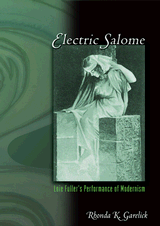
Electric Salome

Electric Salome

Princeton University Press

Electric Salome is the title of a recent book by Rhonda K. Garelick, which is her term to describe Loïe Fuller (1862-1928), one of the key performance artists of the late-19th/early 20th centuries. Fuller was a pioneer of modern dance, who made use of modern stage technologies of lighting and colour to create startling visual effects, particularly through her Serpentine Dance, where her swirling dresses combined with changing colour lighting to create haunting, phantasmagorical effects. She was beloved by artists and poets – Mallarmé, Toulouse-Lautrec, Rodin – and became the subject of early filmmakers.

Loïe Fuller

Loïe Fuller, a 1902 portrait by Frederick Glasier, from http://www.shorpy.com

Garelick’s book is strong on Fuller’s position as a figure of modernism and as a key figure in modern dance. It is, however, disappointingly weak on her early film appearances, reducing mention of these to a misleading footnote. There is much confusion over Fuller’s early film work, as she had many imitators – on stage and on film – and early films of skirt dancers are often mistakenly identified as her (see, for example, the site www.edisonfilm.com, which erroneously claims to show Fuller in a Edison film, though she never made a film for Edison).

For the record, these are the known films that were made of (or by) ‘La Loïe’:

Danse Serpentine (Lumière cat. no. 765, 1896) [extant]
La Loïe Fuller (Pathé, 1901) [extant]
Loïe Fuller (Pathé, 1905, coloured) [extant]
Le Lys de la vie (The Lily of Life) (1920) [extant]
Vision des rêves (1924)
Les Incertitudes de Coppelius (1927)

Le Lys de la vie

Le Lys de la vie (1921), from Bibliothèque nationale de France

Garelick has a little more to say about the later titles (only Le Lys de la vie survives among them). They were made by Fuller and her lover Gabrielle Bloch. The feature-length Le Lys de la vie sounds to be an extraordinary work – based on a story by Queen Marie of Romania, a combination of fairy tale and dance themes telling the story of two princesses competing for the love of a prince, played by René Clair, no less. Fuller herself directed but did not appear in the film, which seems to have been characterised by innovative cinematographic effects (such as incorporating negatives for some ghostly effects) mixed with conventional fairy tale elements.

Garelick tells us less about the other two, lost films. Apparently they were not completed, and were presumably semi-professional productions. It is likely that Fuller did not appear in them either (certainly not as a dancer – she was in her mid-60s, and died in 1928).

Loïe (not Loie as Garelick’s book has it throughout) Fuller was an iconic figure who continues to attract much scholarly interest. There’s a useful set of links about her on the Great Dance Weblog. As indicated above, films exists of her many imitators. She refused to be filmed by Edison, but the Edison studios did make films of other dancers in the 1890s, such as Ruth St Denis, Amy Muller and especially Annabelle, whose several Kinetoscope skirt dance films were clearly in imitation of Fuller and were often mistakenly (deliberately or otherwise) promoted as being films of Fuller herself.

Loie Fuller is a gorgeous-looking site which accompanies the book Traces of Light: Absence and Presence in the Work of Loïe Fuller, by modern Fuller imitator/acolyte Ann Cooper Albright.

Garelick’s book is a fine, insightful study with a strong theoretical basis, but as ever the facts about films are not just scanty but are not recognised as having any importance. The confusion that Fuller’s supposed film appearances created at the time persists, and she exists in those skirt films that survive more often as a guiding spirit than the woman herself.

Not only divas

Not Only Divas: Women Pioneers of Italian Cinema is an international conference taking place in Bologna, Italy, 14-16 December. The event is being promoted by the University of Bologna, the Biblioteca italiana delle Donne, the Associazione Orlando and the Women’s Film History Association. I haven’t been able to find any information about it online except in Italian, so here’s a translation from a flyer:

Until recently, the issue of women’s contribution to the creation and development of the film industry has been largely ignored in historiographical research, producing an image of silent cinema as a territory exclusively dominated by male agency and desire. In the last few years, however, a new line of international research has revealed a surprsing number of traces of women’s creative and professional participation in the silent film industry, showing clearly that the very few feminine names that have been traditionally credited in official film histories are in fact only the visible part of a much larger iceberg. One of the most interesting results of this research is actually to have revealed that in all national cinemas during the silent period the women working in the film industry in non-acting roles were far more numerous than in any other period of film history.

Though peculiar in many aspects, the case of Italian cinema is no exception. Besides Elvira Notari, pioneer of Neapolitan cinema, who has no doubt to be recalled as one of the most productive women directors of all times (second, perhaps, only to Alice Guy) and Francesca Bertini (the widely celebrated Diva, who in her late years repeatedly claimed for herself the maternity of her films), many others are the women who succeeded in entering as professionals the sphere of a mainly masculine industry. We can think as an example of the nowadays forgotten names of directors like Diana Karenne, Gemma Bellincioni, Giulia Cassini, Elettra Raggio; of screenwriters like Renée de Lion or Nelly Carrère; or even of a film distributor like Fanny Kluge.

The Not Only Divas Conference is the first step in a multiannual research project aimed at producing new knowledge on such pioneering figures by means of an articulated series of events, including film retrospectives, film restorations and publications.

More generally, the International Conference intends to stimulate a reflection on the scope of movement that was available in Italian silent cinema, in a particularly conservative socio-cultural context, for all the forms of feminine expression or women’s representation that are impossible simply to reduce to the tradiditional figure of the Diva.

The following thematic and methological issues will be considered :

  • Reconstruction of Italian women film pioneers’ biographies and production
  • Forms of women’s representation in Italian silent cinema
  • The anti-Divas: comic actresses and muscle-women
  • Women’s professional agency in the Italian socio-cultural context of the silent period
  • Italian silent cinema and female audiences
  • Relationships among women across film, theater and literature
  • Comparative analysis of the women’s role in Italian and foreign cinemas
  • The feminist movement in Italy during the silent period
  • The problem of sources: women’s history in the Italian film history

Conference director: Monica Dall’Asta, Università di Bologna

Please write for information to angelita.fiore [at] unibo.it

Excellent stuff, all part of a major re-investigation of women’s roles in silent cinema which is taking place worldwide at the moment. But I would like to know who it is can say for certain that there were more women working in the film industry in the silent period than at any other time. How has this been determined? If they mean behind-the-scenes roles (office workers, early film processing etc) and not just ‘creative’ roles, perhaps this may be right. But I’d like to see the evidence.

Pordenone diary – day three

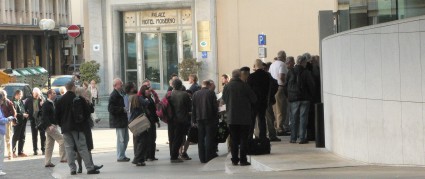
Queue outside the Verdi

Queue outside the Teatro Verdi

It was during the Pordenone festival that Peter Greenaway announced the death of cinema. He wasn’t at the festival himself, but rather in Korea at the Pusan International Film Festival, giving a masterclass, but his words went round the world, as words will these days. Now, the unfortunate demise of cinema is commonly reported – Pordenone stalwart Paolo Cherchi Usai has written a book on the subject – and still the corpse keeps dancing around on our many and various screens, but Greenaway had an interesting specific point to make:

Cinema’s death date was in 1983, when the remote control was introduced to the living room … Bill Viola is worth ten Martin Scorseses. Scorsese is old-fashioned and is making the same films that D.W. Griffith was making early last century … Every medium has to be redeveloped, otherwise we would still be looking at cave paintings … My desire to tell you stories is very strong but it’s difficult because I am looking for cinema that is non-narrative.

Well, aside from the irony that Scorcese wrote the foreword to Cherchi Usai’s book (which admittedly is on the preservation of cinema rather than the present and future reception of cinema), is he still making films like Griffith, and what have we been doing these past few years at Pordenone sitting through the entire works of Griffith, the arch-master of narrative cinema? And why aren’t the art works of Bill Viola on show at this silent film festival?

Pordenone serves both an academic-historical and a sentimental function. It displays the films of the first thirty years or so of cinema with full archival and scholarly rigour – intelligently selected titles presented as products of national, artistic or thematic output, with credits, sources, informative writing, all backed up with the best-available prints shown in the best-possible conditions. It also caters to the nostalgic, with conventional, albeit brilliantly played and usually improvised, music rich in themes from the early twentieth century, and an abiding fondness for the stars of that era. On day three (October 8th), for instance, we were treated to a visit from Jean Darling, one-time star of the ‘Our Gang’ shorts, and the day before we spoke on the phone to Hungarian actress and singer Márta Eggerth to thank her for the film of her that we had just seen. Some acknowledgment of modern silents is made at Pordenone, such as the ingenious pastiches of the Wisconsin Bioscope, but Bill Viola would look sadly out of place. This is a festival which looks back – to the roots of cinema, and to a lost past.

And, however scholarly, this is an audience that likes its stories. Non-fiction does begrudgingly receive its due at Pordenone, but many choose the opportunity of such screenings to visit the restaurants and cafés. Narrative cinema reigns supreme, and much of the academic enquiry seems in any case rooted in the ways in which silent cinema discovered how to tell a story. It’s a fundamental need. Martin Scorcese is still making films in the way D.W. Griffith made them, because the audience still wants to identify people, their personalities, their predicaments, and what happens to them under crisis. I suspect that he would be rather flattered by Peter Greenaway’s comparison of him with D.W. Griffith. But I also suspect that Greenaway would be dismayed by Pordenone’s faith in a cinema held in amber.

D.W. Griffith

D.W. Griffith

But enough of such speculation – what of the immediate reality of sitting through another Griffith turkey, One Exciting Night (1922)? Word went round that this unfamiliar title was even worse than Dream Street, and at 136 mins it was going to be a grim ordeal. The film is a murder mystery set in an old dark house – a theme that is all too familiar now, but was fresh then. Griffith had tried to secure the rights to The Bat, a hugely popular play about a mysterious house with money hidden in it and many suspicious characters after it. Unable to afford the rights, Griffith simply rewote the story himself (using the pseudonym Irene Sinclair). The plot concerns an inheritance, an orphan (Carol Dempster), bootleggers’ loot, and a host of characters in the obligatory multi-roomed house, one of whom is a murderer. Title cards warn us of the mysteries that are to follow and how we should not reveal the identity of the murderer to those who might want to see the film after us. However, the identity of the murderer is glaringly obvious from the start, the plot is incomprehensible, and the handling of it inept. Griffith simply could not apply the necessary techniques for the mystery genre, filming in a flat, obvious style, failing to bring any clarity to a complex, incoherent plot, and leaving the audience both bored and bewildered.

And yet, and yet… Three quarters of the way through the film changes. The plot becomes so incoherent, the rushing between rooms of the increasingly panicky characters so manic, that all narrative coherence disappears and a kind of insane magnificence takes over. It’s at this point that a hurricane is introduced into the proceedings. There’s nothing to announce it – it has just built up in the background, and suddenly the characters are all outside and at the mercy of the wild elements. The expensive hurricane sequence was added on as an afterthought (clearly hoping to recreate the excitement of the final scenes of Way Down East), and has been much criticised as an illogical irrelevance. But to me it seemed to have a mad logic to it, and the pianist John Sweeney (on top form throughout the festival) certainly responded with gusto. One Exciting Night is a bad film by any conventional standard, but the way in which it tries to hold up a narrative, gives up, then welcomes in chaos, might have found it some favour with Peter Greenaway after all. Even Carol Dempster is not that bad. What is dreadful is more eye-rolling blackface ‘comedy’ from Porter Strong, which critics at the time shamefully found among the film’s best features.

OK, so what else did we have on day three? More of Starewitch’s stop-motion animations, from his Russian period: Strekoza i Muravei (The Grasshopper and the Ant) (1911) and Veselye Stsenki iz Zhizni Zhivotnykh (Amusing Scenes from the Life of Insects) (1912); and from his French period: L’Épouvantail (1921) and Le Mariage de Babylas (1921). L’Épouvantail mixes live action (Starewitch himself as a yokel, plus his daughter Nina) with puppet animation in a very effective mixture of film trickery and slapstick, while Le Mariage de Babylas is a delightful tale of a spoiled wedding among a child’s toys, which shows Starewitch’s agreeable lack of sentimentality – he is the Roald Dahl of animators, showing meanness and mischievousness as well as wide-eyed wonder in his childhood tales.

Posta

The Teatro Verdi and the Posta café, Pordenone

The main place for conversations and future plans is the Posta café, immediately across the street from the Verdi, and here I spent some time discusing with others the ongoing Women and Film History International project, co-ordinated by Jane Gaines, which is investigating women film pioneers from the silent era worldwide, in an ambitious programme of investigation and publication. The aim is not only to bring some unfamiliar names to the fore, but to challenge received ideas about the creative filmmaking process. Hopefully some major screen retrospectives will follow as well, and that we keep up this process of continually reinvestigating film history.

Georges Melies

Georges Méliès, from http://www.victorian-cinema.net

I kept ducking out of the German feature films to engage in such chats, alas, but it just isn’t possible to see everything and stay sane. I ducked out of Jean Darling and the ‘Our Gang’ shorts for reasons of taste, but it was back to the Verdi for four newly discovered Georges Méliès titles. How wonderful it is that new Méliès titles keep turning up, and that Pordenone always makes a special presentation of them. This year, the Filmoteca de Catalunya delighted us with Évocation Spirite (1899), La Pyramide de Triboulet (1899), L’Artiste et le Mannequin (1900) and especially Éruption Volcanique à la Martinique (1902), a spectactular recreation of the eruption of Mount Pelée and the destruction of St Pierre on 8 May 1902 with vivid hand-coloured explosions. It’s high time we had an up-to-date list of extant Georges Méliès films published.

I saw about fifteen minutes of the Soviet-Armenian comedy feature Shor I Shorshor (1926). Fascinating as its peasant comedy might have been, and intriguing as it was that such a picture of ‘backward’ rural lifestyles should be issued by a Soviet studio, I do object to being made witness to a comic routine which involved a live chicken being pulled apart by our two heroes. Animals overall had a hard time of it at the Giornate. I walked out.

The day for me was rounded off in happy style by René Clair’s Paris Qui Dort (1923-25), which I’d not seen before. It’s an odd film really – Paris is frozen by a mysterious ray, and only a few characters who were in a plane plus a man who lives at the top of the Eiffel Tower remain active because they were above the ray when it shot out. There is ample opportunity for satire, when the comic group discover that normal social rules no longer apply, but little is done with the concept. Instead it is the lightness of spirit which carries the film. It was surprising however to see such clunking continuity errors – several people could be seen walking around in the supposedly sleep-bound streets of Paris. Lastly we had a generally very funny Louis Feuillade comedy, Séraphin ou les Jambes Nués (1921), starring Georges Biscot. We cannot now of course make films about the social embarassment caused by someone losing his trousers, for today no one would blink an eye at Séraphin’s dilemma. Happily, we can still laugh at such films, because we understand the time and place. Imaginative sympathy – that’s what Pordenone audiences do best.

Women and the Silent Screen V

The year wanes, darkness falls earlier, 2008 diaries are in the shops, and academics are looking to a new year and coming up with conferences. And so we have first news of the Fifth International Women and the Silent Screen Conference, to be held at Stockholm University, Sweden, 11–13 June 2008. Previously held at Utrecht, Santa Cruz, Montreal and Guadalajara, the conference promises a combination of archival screenings, keynote addresses and scholarly panels, on the theme of women and cinema during the first four decades of film history; that is, women as directors, screenwriters, producers, actors and filmgoers.

There’s a call for papers, which asks for abstracts of 200–300 words, together with a paper title and a two-line biographical statement, to be submitted by 15 December 2007, to wss@mail.film.su.se. More details (in English as well as Swedish) on the conference website.

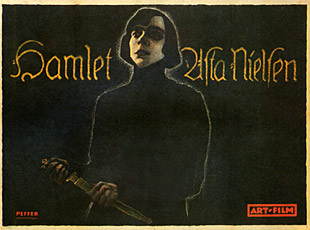
Asta Nielsen’s Hamlet

Hamlet

Asta Nielsen

Just back from the British Shakespeare Association conference, where I was able to tell them about the International Database of Shakespeare on Film, Television and Radio project that I’m supervising. This is an attempt at a ‘complete’ database of all Shakespeare-related titles ever produced in those three media, and so it will of course included all silent Shakespeare films. The ‘interim’ version of the database currently available doesn’t include any silents as yet, and you’ll have to wait for the proper release of the database in summer 2008 to see the full resource in all its glory.

The conference saw the first British presentation (on DVD) of the new restoration of the 1921 German Hamlet, starring Asta Nielsen. A tinted distribution print was discovered recently and has been restored by the Deutsche Filminstitut, using supplementary footage from the French distribution version in the Centre National de la Cinématographie. The film has long been available in black-and-white, but this the first time since the film’s original release that it has been possible to see it in its original colours, the processing work having been done by those acknowledged experts in silent film colour restoration, Haghefilm. The restoration then received its premiere at the Berlin Film Festival.

Hamlet was made for Nielsen’s eponymous production company, directed by Sven Gade and Heinz Schall. It is the best-known of silent Shakespeare films, if not quite (to my mind) the best of those that survive. The extraordinary aspect of the film is, of course, that Hamlet is played by a woman. For this they found academic justification, basing their interpretation on the scholarly endeavours of one Edward P. Vining, whose 1881 book The Mystery of Hamlet posited that the oddities of Hamlet’s behaviour might be explained by the fact that he was a woman in disguise. There had been (and continues to be) a tradition of female Hamlets, including Sarah Bernhardt, a glimpse of whose interpretation was filmed in 1900 (with accompanying sound effects).

Vining’s odd thesis helped legitimise Nielsen’s decision to play the part on film, but it is her luminous, intense performance that justifies it. She is extraordinary in the film, seeking to convey Hamlet’s agonising through diva-like dumbshow alone. The film has its dull patches, plus some unfortunate moments guaranteed to bring out the giggles in a modern audience, since a key aspect of the revisionist plot is that Hamlet is in love with Horatio (cue hoots of laughter when the astonished Horatio discovers, by manual examination, that the dying Hamlet is a woman). Shakespeareans may also be intrigued to find that Claudius dies in a fire, while it is Gertrude who administers the poison which she then drinks by accident – so all of those lying dead at the end of the film are women. The direction seldom rises above the routine, but there is a keen sense of palace life going on while the central figures progressively, and madly, destroy one another. It also gives no sense of a forced conversion from stage to screen – this is a wholly, and successfully reimagined work.

The best thing about the new restoration is its score by Michael Riessler. This blends conventional musical instrumentation with ‘archaic natural sounds’ and electronica. I found it extraordinarily haunting, and sympathetic to the film’s style and performances. The colour is colourful.

I don’t know when the restoration may get further UK screenings, but in the meanwhile, why not take a look at Tony Howard’s newly-published Women as Hamlet: Performance and Interpretation in Theatre, Film and Fiction, which tells the history of women playing Hamlet is a most entertainining and informative way. It has much to say on the film, and has Nielsen on the cover.