Return to Opotiki

http://www.silentfilmfest.org.nz

The Opotiki Silent Film Festival, the New Zealand festival where the audience gets into the swing of things by dressing up in 1920s costume, returns 3-5 September 2010. What sounds like a charming event takes place at Opotiki’s Art Deco DeLuxe Theatre, and here’s this year’s programme, in their own words:

1. ROMANCE/DRAMA
Rudolph Valentino
THE SON OF THE SHEIK
5.30pm Friday 3rd ~ 1926 ~ 63mins
Ahmed falls in love with Yasmin and they meet secretly until one night, her father and his bandit gang capture, torture and hold him for ransom. Will Ahmed believe that Yasmin betrayed him? A dramatic story of deceit and intrigue – will love win through in the end?

2. HORROR / COMEDY Double-Bill
7.30pm Friday 3rd
DR JEKYLL & MR HYDE
Vintage Horror 1920 ~ 67mins
Dr. Jekyll experiments with scientific means of revealing the hidden, dark side of man and releases a murderer from within himself.

DR PYCKLY & MR PRYDE
with Stan Laurel 1925 ~ 20mins
Comedy favourite Stan Laurel plays Dr. Pyckle. In a parody of the classic horror story, he turns into Mr. Pryde, a fiend who scours London for fresh victims… of practical jokes.

3. SWASHBUCKLER
ROBIN HOOD ~ Douglas Fairbanks Snr
2pm Saturday 4th ~ 1922 – 133mins
Classic Tale with our favourite Swashbuckling heart-throb. This was a big-budget spectacular of its age – a timeless story of romance and intrigue, staged on a herculean scale.

TO BE SHOWN IN THE MAIN THEATRE – WITH FULL PIANO ACCOMPANIMENT!

4. COMEDY TRIPLE-BILL
Charlie Chaplin, Buster Keaton & Harold Lloyd
4.30pm Saturday 4th ~ 72mins
The Champion, From Hand to Mouth & My Wife’s Relations. Three Classic shorts from the Kings of Comedy.

5. DESERT ROMANCE
THE SHEIK – Rudolph Valentino
7.30pm Saturday 4th ~ 1921 ~ 80mins
Tempestuous love between a madcap English beauty and a bronzed Arab chief! Sheik Ahmed desperately desires feisty British socialite Diana, so he carries her off to his desert tent-palace…

TO BE SHOWN IN THE MAIN THEATRE – WITH FULL PIANO ACCOMPANIMENT!

6. ALRED HITCHCOCK SILENT
THE FARMER’S WIFE
11am Sunday 5th ~ 1928 80mins
An amazing selection of European and US shorts providing a fascinating insight into life before the Talkies.

7. COMEDY TRIPLE-BILL
Charlie Chaplin, Buster Keaton & Harold Lloyd
1pm Sunday 5th ~ 67mins
The Tramp, An Eastern Westerner & Hard Luck. Three more delightful shorts from our silent comedy favourites.

More details from the festival site, which includes colourful photographs from last year’s festival.

Suffragettes before the camera

Asta Nielsen playing a suffragette undergoing forcefeeding in Die Suffragette (1913), from Stiftung Deutsche Kinemathek

Early film reflected the society in which it arose, and there is no clearer example of this than the campaign for women’s suffrage. The movement to gain women the vote in Britain reached its climax during the period when mass cinema-going was first underway in the early 1910s, and films reflected the popular understanding of the suffragettes. The militant woman became a standard figure in early ficition films, generally portrayed for comic or satiric effect. At the same time the suffragettes were regularly covered by the newsreels, a dynamic new medium for reporting what was happening in the world to a mass audience.

The relationship between women’s suffrage and early film is explored in Frühe Interventionen: Suffragetten – Extremistinnen der Sichtbarkeit (Early interventions / Suffragettes – extremists of visibility), a series of films and lectures being held at the Zeughauskino, Berlin, 23-27 September 2010. Behind the somewhat forbidding title is a tremendous programme of rare materials uncovered from archives across Europe and curated by Madeleine Bernstorff and Mariann Lewinsky. The films document not only the suffragettes as audiences saw them in fiction and non-fiction films, but also the role of women in early cinema generally, showing how trangressive, rebellious and sometimes just plain exuberant displays by women on screen echoed the drive for changes in society of which the campaign for the vote was but a part.

The Pickpocket (USA 1913), from EYE Film Institute Netherlands

Here is the programme:

Thursday 23. September 20:00 h

Radical maid(en)s
Cheerful young girls’ break-outs, class relations and radicalisations.

Sedgwick’ s Bioscope Showfront at Pendlebury Wakes, GB 1901, 30m 1’30“
La Grêve des bonnes, France 1907 184m, 10’
Tilly in a Boarding house GB 1911 D Alma Taylor, Chrissie White 7’
Pathé newsreel The Suffragette Derby, GB 1913, ca 5’
Miss Davison’s Funeral, GB 1913, 45m 2’
A Suffragette in Spite of Himself GB 1912 Edison R: Bannister Merwin D: Miriam Nesbitt, Ethel Browning, Marc McDermott 8’, 16mm
Break
Robinette presa per nihilista Italy 1912, D: Nilde Baracchi, 124m, 8’
Cunégonde reçoit sa famille France 1912 D: Cunegonde – name unknown, 116m, 6’
Les Ficelles de Leontine France 1910, D: Leontine – name unknown, 155m, 8’
Tilly and the fire engines GB 1911 2’ D: Alma Taylor, Chrissie White
[A Nervous Kitchenmaid] France c.1908, 74m, 4’
Introduction: Madeleine Bernstorff
Live piano accompaniment by Stephen Horne.

Friday 24. September 18:00 h

The Fanaticism of the Suffragettes
Lecture with images and filmclips by Madeleine Bernstorff

Following the lecture Mariann Lewinsky will present the DVDs Cento anni fa/A hundred Years ago: European Cinema of 1909 and Cento anni fa/A Hundred Years ago: Comic Actresses and Suffragettes 1910-1914 [for more information, see end of this post].

Friday 24. September 19:00 h

Militancies

Les Femmes députées France 1912 D: Madeleine Guitty 154m 8’
England. Scenes Outside The House Of Commons 28 January 1913 2’
Trafalgar Square Riot 10 August 1913 1913 2’
Milling The Militants: A Comical Absurdity GB 1913 7’
St. Leonards Outrage France 1913 21m 1’
Womens March Trough London: A Vast Procession Of Women Headed By Mrs Pankhurst. March Through London To Show The Minister Of Munitions Their Willingness To Help In Any War War Service GB 1915 23m 1’
Scottish Women’s Hospital Of The National Union Of Women’s Suffrage Societies France 1917 133m 6’30
Dans le sous-marin France 1908 Pathé 145m 5’
Introduction: Madeleine Bernstorff
Live piano accompaniment by Stephen Horne.

Friday 24. September 21:00 h

Women’s Life and Leisure in the Mitchell & Kenyon Collection
Presented by Vanessa Toulmin

The renowned Mitchell & Kenyon Collection provides an unparalled view of life at the turn of the twentieth century and this screening will allow us an opportunity to see women’s life and leisure in industrial England. The social and political background as well as working conditions will be shown on screen. The range and sheer diversity of women in the workplace will be revealed from the domestic to the industrial environment, women played an important role in the transition to modern society. From girls working in the coal mines to spinners and weavers leaving the factory this selection from the Collection will reveal previously unseen footage from the Archive, in a following workshop Vanessa Toulmin will speak about: Discovery and Investigation: The Research Process of the Mitchell & Kenyon Collection.

Women at Work: The ‘Hands’ Leaving Work at North-Street Mills, Chorley (1900), North Sea Fisheries, North Shields (1901), Employees Leaving Gilroy’s Jute Works, Dundee (1901), S.S. Skirmisher at Liverpool (1901), Birmingham University Procession on Degree Day (1901), Life in Wexford (1902), Black Diamonds – The Collier’s Daily Life (1904)
Women in the Social Environment: Liverpool Street Scenes (1901), Jamaica Street, Glasgow (1901), Manchester Street Scenes (1901), Manchester Band of Hope Procession (1901), Electric Tram Rides from Forster Square, Bradford (1902)
Leisure and Play: Sedgwick’s Bioscope Showfront at Pendlebury Wakes (1901), Spectators Promenading in Weston Park, Sheffield (1902), Trip to Sunny Vale Gardens at Hipperholme (1901), Bootle May Day Demonstration and Crowning of the May Queen (1903), Blackpool Victoria Pier (1904), Greens Racing Bantams at Preston Whit Fair (1906), Calisthenics (c. 1905).
Live piano accompaniment by Stephen Horne.

Saturday 25. September 18:00 h

La Neuropatologia
Lecture by Ute Holl+ screening of La Neuropatologia (I 1908)

La Neuropatologia is a medical instructional film by the Turin neurologist Camillo Negri. The film can be read – utilising medical-historical methology – as the presentation of an hysterical seizure, but it could also be called an expressionist drama, a love triangle. Medical fact cannot be visualized without the medical stage, the theatre, the mise-en-scène. End of the 19th century the visual turn in medical methodology and in neurological diagnosis gets introduced.

Saturday 25. September 19:00 h

Staging and Representation: A cinematographic studio

La Neuropatologia opens the view on representational relations. The Austrian company Saturn Film produced so-called ‘titillating’ films for a male audience, but the models also had her own ideas about erotic stagings. Normal work is part of an installation, and a re-enactment of four late-19th century photographies by Hannah Cullwick, who worked as a maid and produced numerous (self)portraits as part of a sado-masochist bond with her bourgeois boss Arthur Munby.

La Neuropatologia Italy 1908 Camillo Negro 107m 5’
La Ribalta (Fragment) Italy 1913 Mario Caserini D: Maria Gasparini 60 m 3’5’
Beim Photographen Austria 1907 Saturn 50m 3’
Das eitle Stubenmädchen Austria 1907 Saturn 50m 3’
Normal Work Germany 2007 Pauline Boudry, Renate Lorenz D: Werner Hirsch 13’ 16mm/DV
Concorso di bellezza fra bambini / Kindertentoonstellung Italy 1909 80m 4’
La nuova cameriera e troppo bella Italy 1912 D: Nilde Baracchi, 138m 7’
Rosalie et Léontine vont au théâtre France 1911, D: Sarah Duhamel + Leontine – name unknown 80m, 4’
L’intrigante France 1910 Albert Capellani 162m 8’
Introduction: Madeleine Bernstorff
Live piano accompaniment

Saturday 25. September 21:00h

Glittering stars, athletic women, first star personas
From 1910 on many female comedians had their own series. There was alsoa strong presence of female artistes and performers in the cinema before 1910.

Danse Serpentine / Annabella USA c.1902 Edison ca 2’ 16mm
La Confession France 1905 D: Name nicht bekannt 60m 3’
Femme jalouse France 1907 D: Name nicht bekannt 58m 3’
Lea e il gomitolo Italy 1913 D: Lea Giunchi 99m 5’
Danses Serpentines France / USA 1898-1902 D: U.a. Annabella 60m 3’
La Valse chaloupée France 1908 D: Mistinguett, Max Dearly 38m 2’
Sculpteur moderne France 1908 R: Segundo de Chomon D: Julienne Matthieu 8’
Les Soeurs Dainef France 1902 65m 3’
Introduction: Mariann Lewinsky
Live piano accompaniment Eunice Martins
+
Zigomar peau d’anguille France 1913 Eclair Victorin Jasset D: Alexandre Aquillere, Josette Andriot, 940m 45’
On the turntables: Julian Göthe

Sunday 26. September 18:00

Re-Reading Steinach
Lecture and video-presentation by Mareike Bernien

Re-Reading Steinach is a re-assembly of the popular-science film Steinachs Forschungen by Nicholas Kaufmann/UFA from 1922 – with the idea to analyze representations of normative and divergent body-and gender-constructions in the beginning of 20th century.

Sunday 26. September 19:00

Man/woman/norm/cinema
Cross-dressings of men and women: Elegant page-uniforms and pantskirts, men in nurse-dresses and the wonderful Lotion Magique which grows beards on breasts and breasts on bald heads.

Mes filles portent la jupes-culotte France 1911 120m 6’
Monsieur et Madame sont pressés France 1901 20m 1’
Le Poulet de Mme Pipelard France 1910 84m 5’
Cendrillon ou La Pantoufle merveilleuse France 1907 R: Albert Capellani 293 m 15’
Il duello al shrapnell Italy 1908 100m 5’
La Lotion magique France 1906 Pathé 80m 5’
La Grève des nourrices France 1907 190 m 10’
Schutzmann-Lied from Metropol-Revue 1908, Donnerwetter! – Tadellos! Germany 1909 D: Henry Bender Beta 2’ (digital sound image reconstruction by Christian Zwarg)
Introduction: Mariann Lewinsky and Madeleine Bernstorff
Introduction to Schutzmannlied: Dirk Foerstner
Live piano accompaniment

Sunday 26. September 21:00

The Woman of Tomorrow
Cinema before 1910 was abundant in non-fiction films about daily work. La Doctoresse is part of a comedy-serial by Mistinguett and her partner Prince. The Russian film The Woman of Tomorrow is about a successful feminist female doctor.

Recolte du sarasin France 1908
L’Industria di carta a Isola del Liri Italy 1909 147m 7’30“
La Doctoresse France 1910, D: Mistinguett, Charles Prince 140m 7’
Zhenshchina Zavtrashnego Dnya / The woman of tomorrow Russia 1914, D: Vera Yurevena, Ivan Mosjoukine, 795m 40’
Live piano accompaniment

Monday 27. September 18:00

Political Stagings of the Suffragettes in England
Lecture by Jana Günther on strategic image politics of the militant English suffragette movement: between permanent spectacle and crusade. The Suffragettes appropriated activist strategies of the workers’ movement and tried out acts of civil inobedience like chaining themselves to railings, hunger strikes and other distruptive acts.
+ presentation of the film A Busy Day aka A Militant Suffragette D:Charlie Chaplin, USA 1914 16mm 6’

Monday 27. September 19:00h

Die Suffragette

The restored version (by Stiftung Deutsche Kinemathek) of the Asta Nielsen melodrama Die Suffragette with some rediscovered scenes – including the force-feeding-scene which had been cut because of strict censorship regulations.

Bobby und die Frauenrechtlerinnen/Mijnher Baas + de vrije Vrouwen Germany 1911 Oskar Messter 112m 6’
Pickpocket USA 1913 260 m 13’
Les Résultats du féminisme France 1906 Alice Guy 5’
Die Suffragette Germany 1913 D: Asta Nielsen (Nelly Panburne) 60‘
Introduction: Karola Gramann + Heide Schlüpmann
Live piano accompaniment Eunice Martins

Monday 27. September 21:00h

The Year of the bodyguard
The film essay by Noël Burch deals with the subject of suffragettes in 1912 training under the first English female jiu-jitsu expert Edith Garrud to fight the police and protect their leaders.

Wife, The Weaker Vessel GB 1915 D: Ruby Belasco, Chrissie White, 190m 9’
Le Sorelle Bartels Italy 1910 74m 4’
The Year of the Bodyguard Noel Burch 1981 54’ ZDF
Works and Workers at Denton Holme GB 1910, 90m 5’

In the foyer of Zeughauskino there will be a video installation ‘I would be delighted to talk Suffrage’ by Austrian artist Fiona Rukschcio and a lightbox and bulletin board by Madeleine Bernstorff with materials from the National Archives, London on police spy photographs depicting the suffragettes.

Suffragette Demonstration at Newcastle, from BFI National Archive

Madeleine Bernstorff writes these words about women’s suffrage and film in the notes to the programme:

In the early twentieth century, the cause of women’s suffrage and the suffragette movement became a cinematic topic. Something seemingly untameable had appeared on the city streets, provoking a good deal of anxiety: women, often sheltered ladies of the bourgeoisie, were organising and even demanding participation in democratic processes! By 1913 more than 1,000 suffragettes had already gone to prison for their political actions. In addition to cartoons in the print media, newsreels and melodramas were produced along with countless comedies that referred – in all their ambivalence of subversion and affirmation – to the movement. They told the audience that women belonged at home and not at the ballot box, that these unleashed furies who now appeared in the streets en masse were growing mannish, neglecting their families and even setting public buildings ablaze. In the anti-suffragette films, women’s rights activists were often misguided souls who needed to be brought back to their proper calling. They also left plenty of room for nod-and-wink voyeurism on all sides. Men, too, masqueraded as suffragettes – to illustrate how inappropriate and grotesque it was for women to overstep their roles – or to act out against the prevailing order even more wildly?

The figure of the suffragette in early fiction (usually comedy- the seriousness of Asta Nielsen’s Die Suffragette is a notable exception) film is one that has been written about in several places, though never before has such an extensive collection of relevant films been seen in one place, to my knowledge. However, I would encourage those attending the event to look twice at the newsreels as well. There are many surviving newsreels showing the suffragettes – for the simple reason that they made it their business to be filmed.

The suffragettes showed themselves to be particularly media savvy by staging events that would attract the media. The simplest strategy was to organise marches with banners with bold slogans that could be easily picked up by the cameras. Then there was the obvious tactic of letting the newspapers and newsreels know beforehand of when a march or such like was going to take place. Just occasionally there was active co-operation with the newsreel companies. Rachael Low, in The History of the British Film 1906-1908, reproduces this report from the Kinematograph and Lantern Weekly 25 June 1908, p. 127, which shows how far this could go:

From certain sources whispers had reached us anent Mr. Harrison Ward’s secret conclaves with Mrs. Drummond and Miss Christabel Pankhurst, and as we surmised the plottings of the trio within the suffragette’s fortress have taken definite shape in the form of a picture history of recent performances of the ‘great shouters’ during their campaign … With exclusive right for kinematographing from the suffragists’ conning tower Mr. W. Jeapes obtained some exceptionally interesting pictures, those showing Mr. R.G. Knowles discussing the burning question with some of the leaders at the base of the tower being particularly good, the same remark applying to the life-size portraits of Mrs. ‘General’ Drummond, Miss Pankhurst and others. Mr. Jeapes and Mr. Ward probably never played to a bigger house than they did on Sunday, and the sight of the surging mass of humanity following the pantechnicon ‘conning tower’ as it emerged from Hyde Park, what time the energetic pair on top recorded the scene was something to arouse the envy of any kinematographer with an eye for picture effects.

The film, made by the Graphic Cinematograph Company, was a bit more than the average newsreel (it showed the major demonstration organised by the Women’s Social and Political Union that took place 21 June 1908 in Hyde Park). But the degree of pre-planning, co-operation and indeed the purchase of exclusive rights for a key camera position demonstrates that both news companies and suffragettes recognised the great value of one another, and that we should look on the newsreels of suffragettes as composed works rather than accidental actuality. We see what they wanted us to see.

Even when there wasn’t active co-operation with the newsreels, the suffragettes knew where cameras (still and motion picture) would be positioned, so that their protest acts would gain the greatest publicity. The best known example is that of the 1913 Derby, at which Emily Wilding Davison was killed after running onto the race-course and being knocked down by the King’s horse. The act was captured by a number of newsreels (the Pathé version is to be featured in Berlin) because they were all trained on the final bend before the end of the race, Tattenham Corner, and that is exactly where Davison chose to run out. Again, we see what they wanted us to see.

  • The Gaumont Graphic version of the 1913 Derby is here
  • The Pathé’s Animated Gazette version is here
  • The Topical Budget version is here (accessible to UK schools and libraries only)
  • (The Warwick Bioscope Chronicle version is here but I can’t make it play, and in any case Warwick either missed the incident or it has been cut from the extant film)
  • There are British Pathe compilations of suffragette newsreel footage here and especially here

There isn’t any information online about the Berlin screenings as yet (apart from this post, obviously), but information will appear on the Zeughauskino site once it gets round to publishing its September programme. (Now published)

Update (4 September): The full programme is now available (in German) from www.madeleinebernstorff.de (full marks for the striking design).

Finally, the DVD from this year’s Il Cinema Ritrovato mentioned above is now available for sale. Curated by Mariann Lewinsky, Cento anni fa: Attrici comiche e suffragette 1910-1914 / Comic Actresses and Suffragettes 1910-1914 is a DVD and booklet on nineteen films (Italian, French, English, American), featuring such female comedy stars as Tilly and Sally (Alma Taylor and Chrissie White), Cunégonde, Mistinguett, Rosalie, Lea and Gigetta, plus newsreel films (including two compilations) of suffragette action from the UK and USA. The DVD is priced 19.90 € and is available from the Cineteca Bologna site. For those not able to be in Berlin it’s going to be the next best thing.

My thanks to Madeleine Bernstorff for providing the programme information and stills.

Australia’s silent film festival

Miss Mend, from http://www.ozsilentfilmfestival.com.au

Australia’s eponymous Silent Film Festival returns a month earlier in the year than last year, with screenings over 11, 16, 18, 23 and 25 September. The festival takes place at Pitt Street Uniting Church and the Wesley Conference Centre, Sydney and features films from Australia, France, Germany, Japan, Russia and the USA. Here’s the full programme:

Sat-11/9/10
6:00 PM to 8:00 PM
For the Term of His Natural Life 1927 (Australia)
Pitt Street Uniting Church 264 Pitt Street Sydney

Directed: Norman Dawn
Starring: George Fisher, Arthur McLaglen, Jessica Harcourt, Beryl Gow, Mayne Lynton, Arthur Tauchert, Eva Novak and Dunstan Webb
Tickets: $20/$15 concession and children
Film: digital presentation of restored film
Duration: 98 minutes
Live music: accompanist Colin Offord
Presenter: Bruce Elder Senior Entertainment Writer with the Sydney Morning Herald

Thu-16/9/10
7:00 PM to 9:00 PM
Passing Fancy Dekigokoro 1933 (Japan)
Wesley Conference Centre 220 Pitt Street Sydney

Directed: by Yasujiro Ozu
Starring: Sakomoto Takeshi, Fushime Nabuko and Tomio Aoki
Tickets: $20/$15 concession and children
Film: digital presentation of restored film
Duration: 101 minutes
Live music: accompanist Riley Lee, world-class master of the shakuhachi.
Presenter: Dr. Carol Hayes Senior Lecturer, Japan Centre,School of Culture, History and Language College of Asia and the Pacific, The Australian National University

Peace through a bowl of tea. The Festival is pleased to present prior to the screening from 6.15-6.45pm a demonstration of a Japanese tea ceremony. This unique and rich event for Festival supporters is presented by the Japan Foundation and Chado Urasenke Tankokai Sydney Association Inc. The Festival acknowledges the assistance of Wakao Koike; Masafumi Konomi , Yoshiaki Matsunaga,, Ryoko Freeman and David Freeman.

Sat-18/9/10
10:15 AM to 12:00 PM
The Last Great Magic Lantern Show (Australia)
Wesley Conference Centre 220 Pitt Street Sydney

Presenters: Professor Ian and Margery Edwards and Antony Catrice
Tickets: $20/$15 concession and children
Film: Magic Lantern Slide Presentation
Duration: 75 minutes

Sat-18/9/10
12:15 PM to 2:15 PM
Comedies for Kids and the Young at Heart! (USA)
Wesley Conference Centre 220 Pitt Street Sydney

A selection of the Kings of Comedy at their funniest and at full throttle!
Charlie Chaplin in THE ADVENTURER (1917) 23 minutes; Buster Keaton in COPS (1922) 18 minutes; Laurel and Hardy in WRONG AGAIN (1929) 20 minutes; and Max Sennett’s LIZZIES OF THE FIELD (1924) 10 minutes. Winsor McKay, THE PET (1921) 11 mins See the Australian born star Billy Bevan in Lizzies of the Field driving his snoozenburg!

Tickets: $20/$15 concession and children
Film: digital presentation of restored film
Duration: 90 minutes
Live music: accompanist Mauro Colombis
Presenter: Dr Stephen Juan
Anthropologist Dr Stephen Juan is a commentator on all things human in books, newspapers, on radio and television. For more than three decades he taught at the University of Sydney where in retirement he remains the Ashley Montagu Fellow. The author of several best-selling books and member of Channel Nine’s Today, Stephen has long had an interest in cultural history generally and films in particular.

Sat-18/9/10
2:30 PM to 4:15 PM
The Cabinet of Doctor Caligari / Das Kabinett des Doktor Caligari 1919-20 (Germany)
Wesley Conference Centre 220 Pitt Street Sydney

Directed: by Robert Wiene
Starring: Werner Krauss, Conrad Veidt and Lil Dagover
Tickets: $20/$15 concession and children
Film: digital presentation of restored film
Duration: 76 minutes
Live music: accompanist Mauro Colombis
Presenter: Klaus Krischok Director, Goethe-Institut Australien

Sat-18/9/10
4:30 PM to 6:30 PM
Miss Mend Part One / Mess Mend 1926 (Russia)
Wesley Conference Centre 220 Pitt Street Sydney

Directed: by Boris Barnet and Fedor Ozep
Based on the novel by “Jim Dollar” aka Marietta Shaginian
Starring: Natalya Glan, Igor Ilyinsky and Vladimir Fogel
Tickets: $20/$15 concession and children
Film: digital presentation of restored film
Duration: 88 minutes
Live music: accompanist Maria Okunev
Presenter: Dr. Karen Pearlman Head of Screen Studies; Australian Film, Television and Radio School

Thu-23/9/10
7:00 PM to 9:00 PM
The Italian Straw Hat / Un chapeau de paille d’Italie 1927 (France)
Wesley Conference Centre 220 Pitt Street Sydney

Directed: by René Clair
Starring: Albert Préjean, Geymond Vital, Olga Tschechowa and Paul Ollivier
Tickets: $20/$15 concession and children
Film: digital presentation of restored film
Duration: 105 minutes
Live music: accompanist Sharolyn Kimmorley
Presenter: Jason di Rosso, Associate Producer MOVIETIME ABC Radio National and Film Writer GQ

Sat-25/9/10
10:15 AM to 12:00 PM
Buster Keaton and Snub Pollard! (USA)
Wesley Conference Centre 220 Pitt Street Sydney

NEIGHBOURS – 1920
Romeo and Juliet given an update and set in a tenement neighbourhood where Buster and Virginia’s family fight over the fence separating their respective homesteads. * 18 Minutes

THE PLAYHOUSE – 1921
The genius of old Stoneface as Buster plays everyone, including a monkey, in a theatre simultaneously. * 22 Minutes

MY WIFE’S RELATIONS – 1922
Buster to the fore again is falsely accused of breaking a window and is hauled before a judge who speaks no English and assumes they are there to be married. The family nightmare starts. * 22 Minutes

IT’S A GIFT – 1923
The talents of the incomparable Australian born, Snub Pollard. * 10 Minutes

Tickets: $20/$15 concession and children
Film: digital presentation of restored film
Duration: 72 minutes
Live music: accompanist Robert Constable
Presenter: Jason di Rosso, Associate Producer MOVIETIME ABC Radio National and Film Writer GQ

Sat-25/9/10
12:15 PM to 2:15 PM
Bardelys the Magnificent 1926 (USA)
Wesley Conference Centre 220 Pitt Street Sydney

Directed: by King Vidor
Starring: John Gilbert, Eleanor Boardman, Roy D’Arcy, Karl Dane and John T Murray
Tickets: $20/$15 concession and children
Film: digital presentation of restored film
Duration: 91 minutes
Live music: accompanist Robert Constable
Presenter: Jason di Rosso, Associate Producer MOVIETIME ABC Radio National and Film Writer GQ

Sat-25/9/10
3:00 PM to 4:00 PM
Fashion 1920s
Wesley Conference Centre 220 Pitt Street Sydney

Fashion 1920s – Presented by Charlotte Smith

Silent films have played a significant part in the evolution and development of fashion, and it is therefore very appropriate to include this special session in our journey back in time through the silent film medium.

Besides being a time capsule by giving us a fascinating and entertaining glimpse into how people lived and dressed in the past, silent films of the 1920s also presented fashion styles to a worldwide audience and to all classes of society. Many silent screen stars became fashion icons, leading new fashion trends and inspiring people of all walks of life to dress in a similar way.

Charlotte Smith, author of the best-selling book, Dreaming of Dior: Every Dress Tells a Story (HarperCollins Australia) is the curator of the famous Darnell Collection, having inherited it from her godmother, Doris Darnell, in 2004. Since then it has continued to grow to number over 5500 pieces representing 23 different countries, and is considered the largest private vintage clothing collection in Australia.

Tickets: $10/$5 concession and children
Duration: 60 minutes

Sat-25/9/10
4:30 PM to 6:30 PM
Chicago 1927 (USA)
Wesley Conference Centre 220 Pitt Street Sydney

Produced: by Cecil B DeMille
Directed: by Frank Urson
Starring: Phyllis Haver, Julia Faye, May Robson and Victor Varconi
Tickets: $20/$15 concession
Film: digital presentation of restored film
Duration: 112 minutes
Live music: accompanist Mauro Colombis
Presenter: Bruce Elder Senior Entertainment Writer with the Sydney Morning Herald

There are more details on the festival site, including booking information, further information on the films and the musicians, and an archive covering the programmes for 2009 and 2007.

Brazilian journey

http://www.cinemateca.gov.br/jornada

Last year we noted for the first time the remarkable festival of silent film in Brazil, the Jornada Brasiliera de Cinema Silencioso or Brazilian Journey of Silent Cinema. The festival returns again 6-15 August and has a strong enough programme to make you think seriously about chaning your holiday plans. The festival is organised by the Cinemateca Brasiliera, São Paulo and is curated by Carlos Roberto de Souza. As the festival press release puts it:

This annual event is dedicated to world cinema produced between the late nineteenth century until about 1930, when the arrival of sound changed the course of the cinematic art. Now in its 4th edition, the Journey has become an important part of the Brazilian cultural calendar, and allows an increasingly larger and more diversified audience to gain access to films from the silent cinema era.

All of the Festival’s scheduled features are to be accompanied by live musical performances in the Cinemateca-BNDES Theater, with ‘silent projections’ (I guess that means silent only) in the Cinemateca-Petrobras Theater.

As in previous festivals, a special feature is made of the production of a national cinema of the silent period and the work of a particular country’s film archive. This year the focus is Swedish silent cinema, and the selected works are restorations from the Swedish Film Archive (Svenska Filminstitutet / Kinemateket). Altogether, there are thirty-five titles, curated into six programmes.

The Nordic countries developed a film industry whose films spread all over the world, until the outbreak of World War I. Although after the war European production had ceded its economic importance to Hollywood movies, Sweden had one of the most brilliant cinemas in film history, with directors like Victor Sjöström and Mauritz Stiller producing great works of artistic expression, not to mention exceptional actors like Lars Hanson and Greta Garbo. The Jornada presents a selection of works that will show a wider panorama of Swedish silent cinema and the film restoration work which has been developed in that country for decades. The opening event will present the film The Blizzard / Gunnar Hedes Saga (Mauritz Stiller, 1923), with live musical performance from Dino Vicente. Alongside the great works of Sjöström and Stiller, to be shown in recent restorations, the festival will present the first film record made in Sweden (Konungens af Siam landstigning vid Logårdstrappan / Arrival of the King of Siam in Logårdstrappan, 1897), and the celebrated Häxan (Benjamin Christensen, 1922), in a print considered by the archive’s curator as the most beautiful of the entire collection.

The Jornada’s inaugural lecture will be given by Jon Wengström, curator of the Swedish Film Institute’s Archival Film Collections; its main themes will be Swedish silent cinema and the conservation work carried out in Sweden. He will speak about the criteria that guided his selection of Swedish Film Treasures, which include two films starring Greta Garbo – Die freudlose Gasse / The Joyless Street (G.W. Pabst, Germany, 1925) and Flesh and the Devil (Clarence Brown, USA, 1926), as well as the single existing fragment of the actress’s collaboration with Sjöström, The Divine Woman (USA, 1928), the scandalous Afgrunden / The Woman Always Pays (Urban Gad, Denmark, 1910), and the extraordinary The Wind (USA, 1928), directed by Sjöström and starring Lillian Gish, which will be presented in the version with musical soundtrack that was released at the time.

The Wind

Other highlights are the films The Dawn of a Tomorrow (James Kirkwood, USA, 1915), starring Mary Pickford, and the audacious Tretya Meshchanskaya / 3 Meshchanskaya Street, or Bed and Sofa (Abram Room, USSR, 1927).

The Jornada has a section which features highlights from Pordenone’s Giornate del Cinema Muto. This year Paolo Cherchi Usai has selected some American productions, the oldest one being the surprising Regeneration (1915), directed by Raoul Walsh; When the Clouds Roll By (1919), directed by Victor Fleming and starring Douglas Fairbanks and Stage Struck (Allan Dwan, 1925), with Gloria Swanson.

Another regular feature is silent films from Brazil. This year the festival will show some documentary feature films restored by the Cinemateca Brasileira in recent years, such as Companhia Paulista de Estrada de Ferro and Companhia Mogyana, portraying industrial labour and the building of the main railways in different cities of the São Paulo region. In the feature drama O Segredo do corcunda (Alberto Traversa, 1924) the train has an important dramatic function, to connect the State’s capital, from the magnificent Estação da Luz, to a small town, with its modest little train station. Turibio Santos, legendary guitarist and the director for many years of the Villa-Lobos Museum, will perform with this film as a special guest of the festival.

The programme “Window to Latin America” will show Wara Wara, made in Bolivia in 1929 by José María Velasco Maidana, which depicts an episode of the Inca civilization during the Spanish invasion. One of the few surviving Bolivian silent films, it was restored at the laboratory L’Immagine Ritrovata in Bologna, Italy, and has been presented at the festival Il Cinema Ritrovato, organized annually by the Cineteca del Comune di Bologna.

To honor the 80th anniversary of Cinédia, the main Brazilian film company in the 1930s, founded by Adhemar Gonzaga, the festival will present Lábios sem beijos, directed by Humberto Mauro, the only silent film the company produced (its subsequent movies were early sound films with musical accompaniment and synchronized dialogue, followed by 100% talkies).

The musicians who will be part of the 4th Jornada Brasiliera de Cinema Silencioso are Zérró dos Santos, Daniel Szafran, Wilson Sukorski, Max de Castro, Ruggero Ruschioni, Ana Fridman, Ricky Villas, Zé Luis Rinaldi, Simone Sou, André Abujamra, Marcio Nigro, Dino Vicente, Laércio de Freitas, Eric Nowinski, Marcelo Poletto, Ricardo Reis, Gustavo Barbosa, Daniel Murray, DUO N1, Basavizi, Dante Pignatari, Ricardo Carioba, Matheus Leston, Turibio Santos, Wandi Doratiotto, Danilo and Livio Tragtenberg.

More details are available (in Portuguese), including titles and full descriptions of all films, on the festival site.

Bonner Sommerkino 2010

Metropolis

Germany’s silent film festival Bonner Sommerkino returns to Bonn 12-22 August. The annual festival is gaining increasing prominence, and the programming is of a really high standard. The restored Metropolis is of course the highlight, as it is for several other festivals this year, but there are plenty of imaginative choices on offer, with intriguing selections from China, Japan, Great Britain, USA, Sweden and Germany. But will it be the last such silent film festival in Bonn? Here’s the outline programme:

Arkadenhof der Universität Bonn

Donnerstag, 12. August 2010
21.00 METROPOLIS
Deutschland 1925/26, Fritz Lang, 147 min

Freitag, 13. August 2010
21.00 SO IST PARIS (So This is Paris)
USA 1926, Ernst Lubitsch, 70 min

22.30 KÖNIGIN DER VAGABUNDEN (The Vagabond Queen)
Großbritannien 1929, Géza von Bolváry, 62 min

Samstag, 14. August 2010
21.00 DER GEISTERZUG (The Ghost Train)
Großbritannien 1927, Géza von Bolváry, 67 min

22.30 DER BLAUE EXPRESS (China Express)
UdSSR 1929, Ilja Trauberg, 76 min

Sonntag, 15. August 2010
21.00 DIE FILMPRIMADONNA (The Film Primadonna)
Deutschland 1913, Asta Nielsen, 17 min

DER KAMERAMANN (The Cameraman)
USA 1928, Buster Keaton, 75 min

Montag, 16. August 2010
21.00 ST. KILDA – ENGLANDS EINSAMSTE INSEL (St Kilda, Britain’s Loneliest Isle)
Großbritannien 1928, Robello /Mann, 18 min

GRASS
USA 1925, Ernest B. Schoedsack, Merian C. Cooper, 70 min

Dienstag, 17. August 2010
21.00 A POET FROM THE SEA (Haikiao Shiren)
China 1927, Hou Yao, 23 min

DAS MÄDCHEN VOM MOORHOF (The Woman He Chose)
Schweden 1917, Victor Sjöström, 82 min

Mittwoch, 18. August 2010
21.00 KLEINE GEHEIMNISSE (Don’t Tell Everything)
USA 1927, Leo McCarey, 20 min

HOTEL STADT LEMBERG (Hotel Imperial)
USA 1927, Mauritz Stiller, 82 min

Donnerstag, 19. August 2010
21.00 MODERN HORROR 100.000.000 (Modern kaidan: 100,000,000 yen)
Japan 1929, Torajiro Saito, 15 min

EIN BEUNRUHIGENDES ABENTEUER (Agonising Adventure)
Frankreich 1920, Jakov Protazanov, 82 min

Freitag, 20. August 2010
21.00 DER GENIALE ERFINDER (So’s Your Old Man)
USA 1926, W.C. Fields, 67 min

22.30 GEFANGENE SEELE
Deutschland 1917, Henny Porten, 75 min

Samstag, 21. August 2010
21.00 DIE HEILSJÄGER (The Salvation Hunters)
USA 1925, Josef von Sternberg, 76 min

22.30 DIE VIER GERECHTEN (The Four Just Men)
Großbritannien 1921, Edgar Wallace, 66 min

Sonntag, 22. August 2010
21.00 BEETHOVENS MONDSCHEINSONATE (the Origin of Beethoven’s Moonlight Sonata)
USA 1909, 9 min

FIAKER NR. 13
Österreich 1926, Mihaly Kertész, 116 min
Gesang: Pien Straesser

LVR-LandesMuseum Bonn

Sonntag, 15. August 2010
15.00 Die Entstehung von »Metropolis«
Vortrag von Werner Sudendorf

17.00 DER BETTLER VOM KÖLNER DOM
Deutschland 1927, Rolf Randolf, 105 min

Sonntag, 22. August 2010
15.00 DER KOMIKER MAX DAVIDSON
Vortrag von Stefan Drößler und Rob Stone

17.00 DER TUNNEL
Deutschland 1915, William Wauer, 95 min

Fuller programme details are on the festival site (in German).

The open-air screenings in the magificent courtyard of Bonn University are free, though the festival blurb warns that this may be the last year that the festival receives its 40,000€ support from the city of Bonn, so the festival itself ma be in peril. The City of Bonn certainly provides the audience with rich offerings – not just the films, but a starry line-up of musicians to accompany the films, including Christian Roderburg, Günter A. Buchwald, Neil Brand, Stephen Horne, Joachim Bärenz, Mark Pogolski, Pien Straesser and Sabrina Zimmermann.

More information (all in German) is on the festival site. And let’s hope that the chill winds of the economic downturn don’t hit silents as well. But one rathers fears that they will.

Pordenone just around the corner

Shingun (1930), directed by Kiyohiko Ushihara, from http://www.cinetecadelfriuli.org/gcm

Time winds slowly on, and it is only three months til the Giornate del Cinema Muto, or Pordenone Silent Film Festival – the highlight of the year for this silent film enthusiast, and a good many others of a similar persuasion.

This year’s festival takes place 2-9 October, and some details have already been made available of what looks like a particularly strong programme. Here are the outline details, with the major presentation being the work of the “Three Shochiku Masters” – Kiyohiko Ushihara, Yasujiro Shimazu and Hiroshi Shimizu:

Special Events
– THE NAVIGATOR (Buster Keaton, US 1924) [2.10.10]. The European Silent Screen Virtuosi [Bristol’s 6th Festival of Slapstick]
– Striking a New Note [ 3.10.10]
– Laura Minici Zotti: Magic Lantern Show [7.10.10]
– WINGS (William Wellman, US 1927) [9.10.10]. Score by Carl Davis performed by Orchestra Mitteleuropea
– RIEN QUE LES HEURES (Alberto Cavalcanti, 1926) + LA FOLIE DES VAILLANTS (Germaine Dulac, 1925) Musical accompaniment by Maud Nelissen + violoncello/cello, violino/violin.

Three Masters of Shochiku
Yasujiro Shimazu (1897-1945)
– ASU TENKI NI NAARE (Tomorrow will be fine) (1929) 55
– REIJIN (The Belle) (1930) 118′
– AI YO JINRUI TO TOMO NI ARE (Love, Be with Humanity) (1930) 181′
Hiroshi Shimizu (1903-1966)
– NANATSU NO UMI (Seven Seas) (1931-32), in two parts, 71′ + 81′
– GINGA (The Milky Way) (1931) 188′
– DAIGAKU NO WAKADANNA (The Boss’s Son at College) (1933) 85′ (silent film with contemporary synchronized score)
– MINATO NO NIHON MUSUME (Japanese Girls at the Harbour) (1933) 78’
– KINKANSHOKU (Eclipse) (1934) 97′ (silent film with synchronized score)
– TOKYO NO EIYU (A Hero of Tokyo) (1935) 64′ (silent film with synchronised score)
Kiyohiko Ushihara (1897-1985)
– SHINGUN (Marching On) (1930) 119′
– WAKAMONO YO NAZE NAKU KA (Young People Why Do You Cry?) (1930) 215′
Fragments:
– AA, MUJO (9’)
– JUNANKA (11′)
– KAIHIN NO JOO (The Queen on the Beach) (1927) (16′)

Room & Kalatozov
Abram Room
BUCHTA SMERTI (1926) 2284m
PREDATEL’ (1926) 2100m
TRETYA MESHCHANSKAYA (1927) (Bed and Sofa) 2025m
PRIVIDENIYE, KOTOROYE NE VOZVRASHCHAYETSYA (1930; sound added 1933) 2330m
YEVREI NA ZEMLE (1927) short
Mikhail Kalatozov
THEIR KINGDOM (Kalatozov, Nutsa Gogoberidze, 1928) fragments
JIM SUANTE (Sol Svanetii) (Salt of Svanetia) (1930)
LURSMANI CHEQMASHI (Gvozd v sapoge) (The Nail in the Boot) (1931)

The Canon Revisited
LE MIRACLE DES LOUPS (Raymond Bernard, France, 1924)
DRIFTERS (John Grierson 1929)
JIM SHUANTE (Salt of Svanetia) (Mikhail Kalatozov 1930)
MUTTER KRAUSENS FÄHRT INS GLÜCK (Phil Jutzi, Germany, 1929)
MOANA (Flaherty, 1926) 16mm transferred to Digibeta
HÆVNENS NAT (Benjamin Christensen 1915)
IL FUOCO (Pastrone, 1915)

Silence of the Amazon
Prog. I – Thomaz Reis
RITUAES E FESTAS BORORO 26’ c.
PARIMÃ FRONTEIRAS DO BRASIL 30’ c.
VIAGEM AO ROROIMÃ 25’c.
Programme II – Silvino Santos (1886-1970)
NO RASTRO DO ELDORADO (Alexander Hamilton Rice expedition, 1924-25) 85’ c.

“Making of” Films, 1 – France
AUTOUR DE LA ROUE
AUTOUR DE NAPOLEON
AUTOUR DE LA FIN DU MONDE
AUTOUR DE L’ARGENT (Dreville)
PARIS CINEMA (Chenal)

MoMA + NFA 75
ROBIN HOOD (Allan Dwan, 1923)
THE LAST MAN ON EARTH (1924)
VIOLETTES IMPÉRIALES (Henry Roussel, 1924)

Early Cinema
Early French Comedy
The Corrick Collection, 4

Rediscoveries and Restorations
Vincenzo Neri collection of medical films (1908-1928) 30’ approx
KARUSELLEN (Dimitri Buchowetski, 1922). Incomplete: Swedish Film Institute
KLOSTRET I SENDOMIR (Victor Sjöström 1919)
THE MOVIE ACTOR
SANTA LUCIA LUNTANA
THE TONIC (Ivor Montagu, 1928) 22’
[Selznick School short]

So that’s Japanese masters (including a chance to compare the aviation film Shingun with the American film that influenced it, Wings), Brazilian adventure films, Soviet silents, more classics brought before new audiences, rare examples of silent ‘making of’ films, and the usual run of rediscoveries, restorations and surprises.

More details will undoubtedly be added as we get nearer the time, and I’ll add them to this post as they appear. Meanwhile, if you’ve been to Pordenone before now, you can expect your registration for this year from the festival office by the end of this month. If you have not been to Pordenone and are thinking that this might just be the year when you do go, then you need to fill out a registration request form. More information, including travel and accommodation details, are available on the festival site (which is in English and Italian). And I hope to see you there.

Silents in Babylon

http://www.babylonberlin.de/stummfilme.htm

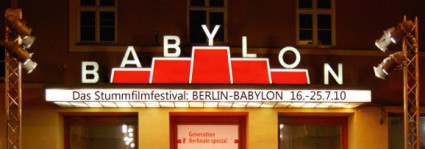
I’ve only just learned about a remarkable festival of silent film taking place at the Babylon Kino, Berlin, 16-25 July. BERLIN – BABYLON. Das StummfilmLiveFestival is a kind of greatest hits of silent cinema, a ten-day feast of some of the finest titles of the silent era. Organised in co-operation with the Cinema Ritrovato, Bologna, the goal of the festival is “to bring both classics and lesser known films to a broad audience in a fresh and innovative way”. Highlights include the opening film, Maciste All‘Inferno with live orchestral accompaniment; a free open-air screening of the restored Metropolis; the John Ford silents that Bologna curated recently; and a screening on July 17 of Walter Ruttmann‘s Berlin: Symphony of a Great City, where the film will play simultaneously over 3,000 monitors and 1,000 carriages of the Berlin U-Bahn. This will, the organisers say, “create the longest cinema in history, with a combined length of over 16 kilometers, where the rhythms of 1920’s Berlin mix with those of today”. Following this mass screening, the film will be shown at the Babylon Kino, accompanied by the electro duo Tronthaim.

A special feature is being made of the musical accompaniment, which will come from the starry line-up of Javier Peréz de Azpeitia, Joachim Bärenz, Neil Brand, Günter Buchwald, Marco Dalpane, Trio Glycerine, Jürgen Kurz, Tronthaim, Stephen Horne, Eunice Martins and Ekkehard Wölk. Screenings will take place in the Babylon Kino, located in East Berlin, a 1929 cinema with original Art Deco screen which lurks behind the modern screen and is to be used for silent screenings (as its refurbished original organ).

Here’s the programe:

Friday 16.7.10
19.30 Eröffnung MACISTE ALL’ INFERNO
I 1925, R.: Guido Brignone; mit Bartolomeo Pagano, 95 Min.
Musik: Marco Dalpane & Ensemble

22.00 Rosa-Luxemburg-Platz (Open Air)
METROPOLIS
D 1927, R.: Fritz Lang; mit Brigitte Helm, Gustav Fröhlich, Heinrich George, 150 Min.

Saturday 17.7.10
16.00 TAGEBUCH EINER VERLORENEN (Diary of a Lost Girl)
D 1929, R.: Georg Wilhelm Pabst; mit Louise Brooks, André Roanne, Fritz Rasp, Franziska Kinz, Sybille Schmitz , Valeska Gert, Kurt Gerron 104 min.
Musik: Javier Peréz de Azpeitia

17.00 CABIRIA
I 1914, R.: Giovanni Pastrone; mit Carolina Catena, Lidia Quaranta, Gina Maragnoni, 123 Min.
Musik: Joachim Bärenz

18.30 STRAIGHT SHOOTING
USA 1917, R.: John Ford; mit Harry Carey, Duke R. Lee, George Berrell, Molly Malone, Ted Brooks, 71 Min.
Musik: Javier Peréz de Azpeitia

20.00 THREE BAD MEN
USA 1926, R.: John Ford; Goerge O’Brien, Olive Borden, Lou Tellegen, 92 Min.
Musik: Joachim Bärenz

20.00 FOOLISH WIVES
USA 1922, R.: Erich von Stroheim; mit Erich von Stroheim, Miss DuPont, Maude George, 117 Min.
Musik: Javier Peréz de Azpeitia

22.00 BERLIN, DIE SINFONIE DER GROßSTADT (Berlin Symphony of a City)
D 1927, R.: Walter Ruttmann; 60 Min.
Musik: Tronthaim

22.15 DR. JEKYLL AND MR. HYDE
USA 1921, R.: John S. Robertson; mit John Barrymore, Charles Lane, Brandon Hurst, Cecil Clovelly, Nita Naldi, 67 Min.
Musik: Joachim Bärenz

23.15 BERLIN, DIE SINFONIE DER GROßSTADT (Berlin, Symphony of a City)
D 1927, R.: Walter Ruttmann; 60 Min.
Musik: Tronthaim
Walter Ruttmanns berühmter Montagefilm ist eine faszinierende Zeitreise ins Berlin der später 20er Jahre.

Sunday 18.7.10
14.30 DIE ABENTEUER DES PRINZEN ACHMED (The Adventures of Prince Achmed)
D 1926, R.: Lotte Reiniger; Scherenschnitt, 60 Min.
Musik: Trio Glycerine

16.00 MACISTE ALL’ INFERNO
I 1925, R.: Guido Brignone; mit Bartolomeo Pagano, 95 Min.
Musik: Joachim Bärenz

16.15 LA PASSION DE JEANNE D’ARC
F 1928, R.: Carl Theodor Dreyer; mit Maria Falconetti, Eugene Silvain, André Berley, Maurice Schutz, 110 min.
Musik: Javier Peréz de Azpeitia

18.00 GÖSTA BERLINGS SAGA
S 1924, R.: Mauritz Stiller; Greta Garbo, Lars Hanson, Gerda Lundequist, Otto Elg-Lundberg, 183 Min.
Musik: Javier Peréz de Azpeitia

18.30 QUEEN KELLY
USA 1929, R.: Erich von Stroheim; Gloria Swanson, Walter Byron, Seena Owen, 101 Min.
Musik: Joachim Bärenz

Monday 19.7.10
17:30 HARAKIRI
D 1919, R.: Fritz Lang; mit Paul Biensfeld, Lil Dagover, 80 Min
Musik: Joachim Bärenz

18.00 DAS GLÜCK(Happiness)
1934 USSR, R.: Alexander Medwedkin; mit Pjotr Sinowjew, Jelena Jegorowna, L. Nenaschewa, W. Uspenskij, G. Migorjan, 95 Min.
Musik: Javier Peréz de Azpeitia

19.30 GREED
USA 1924, R.: Erich von Stroheim; Zasu Pitts, Gibson Gowland, Jean Hersholt, Dale Fuller, 128 Min.
Musik: Joachim Bärenz

20.00 DER GOLEM
D 1920, R.: Paul Wegener und Carl Boese; mit Paul Wegener, Albert Steinrück, Lyda Salmonova, ernst Deutsch, Otto Gebühr, 85 Min.
Musik: Javier Peréz de Azpeitia

22.00 BLIND HUSBANDS
USA 1919, R.: Erich von Stroheim; mit Sam de Grasse, Francelia Billington, Erich von Stroheim, Gibson Gowland,
90 Min.
Musik: Javier Peréz de Azpeitia

22.15 THE UNKNOWN
USA 1927, R.: Tod Browning; mit Lon Chaney, Norman Kerry, Joan Crawford, Nick De Ruiz, 63 Min.
Musik: Joachim Bärenz

Tuesday 20.7.10
17.30 BUSTER KEATON SHORTS
Ca. 60 Min.
Musik: Neil Brand

19.30 DAS CABINET DES DR. CALIGARI
D 1919, R.: Robert Wiene; mit Werner Krauß, Conrad Veidt, Lil Dagover, Hans Heinrich von Twardowski, 75 Min.
Musik: Raphael Marionneau

19.30 THE CROWD
USA 1928, R.: King Vidor; mit James Murray, Eleanor Boardman, 104 Min.
Musik: Neil Brand

21.15 DIE FREUDLOSE GASSE (Joyless Street)
D 1925, R.: Georg Wilhelm Pabst, mit Greta Garbo, Asta Nielsen, Agnes Esterhazy, Henry Stuart, Robert Garrison, 178 Min.
Musik: Günter Buchwald

21.30 BALLET MECANIQUE / Dada-Kurzfilme
Ca. 60 Min.
Musik: Jürgen Kurz

Wednesday 21.7.10
18.00 DIE BERGKATZE
D 1921, R. Ernst Lubitsch; mit Pola Negri, Victor Janson, Paul Heidemann, 79 Min.
Musik: Trio Glycerine

18.15 DIE FRAU NACH DER MAN SICH SEHNT (Three Loves)
D 1929, R.: Kurt Bernhardt; mit Marlene Dietrich, Fritz Kortner, Frida Richard, Oskar Sima, Uno Henning, Karl Etlinger, Edith Edwards, Bruno Ziener, 76 Min.
Musik: Neil Brand

20.00 PANZERKREUZER POTEMKIN (Battleship Potemkin)
USSR 1925, R.: Sergei Eisenstein; mit Alexander Antonow, Wladimir Barski, Grigori Alexandrow, Iwan Bobrow, Michail Gomorow, Alexander Lewschin, N. Poltawzewa,75 Min.
Musik: Jürgen Kurz

20.00 ORLACS HÄNDE (The Hands of Orlac)
D 1924, R.: Robert Wiene; mit Conrad Veidt, Alexandra Sorina, Fritz Kortner, Carmen Cartellieri, Fritz Strassny, Paul Askonas, 110 Min.
Musik: Ekkehard Wölk

21.45 THE LODGER
GB 1927, Alfred Hitchcock; mit Marie Ault, Arthur Chesney, June, Malcolm Keen, Ivor Novello, 100 Min.
Musik: Neil Brand

22.00 THE UNKNOWN
USA 1927, R.: Tod Browning; mit Lon Chaney, Norman Kerry, Joan Crawford, Nick De Ruiz, 63 Min.
Musik: Günter Buchwald

Thursday 22.7.10
17.00 J’ACCUSE
F 1919, R.: Abel Gance; mit Romuald Joubé, Séverin-Mars, 144 Min.
Musik: Stephen Horne

18.00 STRAIGHT SHOOTING
USA 1917, R.: John Ford; mit Harry Carey, Duke R. Lee, George Berrell, Molly Malone, Ted Brooks, 71 Min.
Musik: Neil Brand

20.00 MR. WEST IM LANDE DER BOLSCHEWIKI (The Extraordinary Adventures of Mr West in the Land of the Bolsheviks)
USSR 1924, R.: Lev Kuleshov; mit Porfirij Podobed, Boris Barnet, Vsevolod Pudovkin, Sergej Komarov, Vera Lopatina, 94 Min.
Musik: Jürgen Kurz

20.00 BLACKMAIL
GB 1929, R.: Alfred Hitchcock; mit Anny Ondra, Sara Allgood, Charles Paton, 84 Min.
Musik: Günter Buchwald

22.00 QUEEN KELLY
USA 1929, R.: Erich von Stroheim; Gloria Swanson, Walter Byron, Seena Owen, 101 Min.
Musik: Neil Brand

22.00 A COTTAGE ON DARTMOOR
S/GB 1929, R.: Anthony Asquith; mit Uno Henning, Norah Baring, Hans Adalbert Schlettow, 84 Min.
Musik: Stephen Horne

Friday 23.7.10
17.30 BLOOD AND SAND
USA 1922, R.: Fred Niblo; mit Rudolph Valentino, Lila Lee, Nita Naldi, Rosa Rosanova, Walter Long,108 Min.
Musik: Neil Brand

18.00 THE UNKNOWN
USA 1927, R.: Tod Browning; mit Lon Chaney, Norman Kerry, Joan Crawford, Nick De Ruiz, 63 Min.
Musik: Stephen Horne

19.30 BLIND HUSBANDS
USA 1919, R.: Erich von Stroheim; mit Sam de Grasse, Francelia Billington, Erich von Stroheim, Gibson Gowland, 90 Min.
Musik: Stephen Horne

20.00 THE GENERAL
USA 1926, R.: Buster Keaton, Clyde Bruckman; mit Buster Keaton, Marion Mack, Glen Cavender Charles Henry Smith, 75 Min.
Musik: Neil Brand

21.30 INTOLERANCE
USA 1916, R.: D.W. Griffith; mit Mae Marsh, Robert Harron, Lilian Gish, F.A. Turner, Sam de Grasse, Vera Lewis, Mary Alden, 180 Min
Musik: Neil Brand

22.00 HÄXAN
DK/S 1922, R.: Benjamin Christensen; mit Maren Pedersen, Clara Pontoppidan, Elith Pio, Oscar Stribolt, Tora Teje, 107 Min.
Musik: Stephen Horne

Saturday 24.7.10
15:00 CHAPLIN SHORTS
Ca. 60 Min.
Musik: Ekkehard Wölk
THE IMMIGRANT (USA 1917, 24 Min.), EASY STREET (USA 1917, 19 Min.), THE RINK (USA 1916, 19 Min.)

15.30 DIE ABENTEUER DES PRINZEN ACHMED (The Adventures of Prince Achmed)
D 1926, R.: Lotte Reiniger; Scherenschnitt, 60 Min.
Musik: Stephen Horne

16.00 BERLIN, DIE SINFONIE DER GROßSTADT (Berlin, Symphony of a City)
D 1927, R.: Walter Ruttmann; 60 Min.
Musik: Ekkehard Wölk

17:30 GREED
USA 1924, R.: Erich von Stroheim; Zasu Pitts, Gibson Gowland, Jean Hersholt, Dale Fuller, 128 Min.
Musik: Neil Brand

18:00 HARAKIRI
D 1919, R.: Fritz Lang; mit Paul Biensfeld, Lil Dagover, 80 Min
Musik: Stephen Horne

19.45 DIE BÜCHSE DER PANDORA (Pandora’s Box)
D 1929, R.: Georg Wilhelm Pabst; mit Louise Brooks, Francis Lederer, Carl Goetz, Alice Roberts, 133 Min.
Musik: Eunice Martins

20:00 BERLIN, DIE SINFONIE DER GROßSTADT (Berlin, Symphony of a Great City)
D 1927, R.: Walter Ruttmann; 60 Min.
Musik: Trio Glycerine

21.30 NOSFERATU
D 1922, R.: Friedrich Wilhelm Murnau; mit Max Schreck, Gustav von Wangenheim, Greta Schröder, Alexander Granach, Ruth Landshoff, 94 Min
Musik: Stephen Horne

22.15 A PAGE OF MADNESS
J 1926, R.: Teinosuke Kinugasa; mit Masao Inoue, Yoshie Nakagawa, 60 Min.
Musik: Neil Brand

23.15 BERLIN, DIE SINFONIE DER GROßSTADT (Berlin, Symphony of a City)
D 1927, R.: Walter Ruttmann; 60 Min.
Musik: Tronthaim

Sunday 25.7.10
11:00 Neil Brand: THE SILENT PIANIST SPEAKS Lecture

14.00 MENSCHEN AM SONNTAG (People on a Sunday)
D 1930, R.: Robert Siodmak, Rochus Gliese, Edgar G. Ulmer und Fred Zinnemann; mit Erwin Splettstößer, Brigitte Borchert, Wolfgang von Waltershausen, Christl Ehlers, Annie Schreyer
Musik: Neil Brand

14.15 LAUREL AND HARDY SHORTS
Musik: Stephen Horne

That’s quite a line-up. More details are on the Babylon site – mostly in German, but there is a short section at the bottom of the web page in English. The site also says that this is festival no. 1 – let’s hope it can be the first of many.

More information on the Babylon Kino is on the Cinema Treasures site.

Mykkäelokuvafestivaaleilla

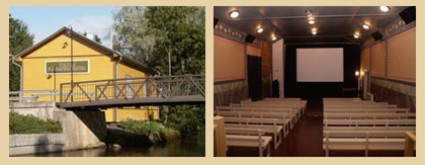
The Elävienkuvien Teatteri, Forssa, from http://www.forssasilentmovie.com

Mykkäelokuvafestivaaleilla, or – to give it its slightly less challenging name (for non-Finns) – the Forssa Silent Movie Festival, is Finland’s annual festival of silent film. This year’s festival takes place 27-29 August at the Elävienkuvien Teatteri, Forssa, with the lead attraction being four of John Ford’s silent features (hot on the heels of the silent Ford retrospective at Bologna). Most of the festival site is in Finnish, but they do supply one overview page in English, as follows:

This year’s eleventh international Silent Movie Festival will bring more classics to the silver screen. Main attention goes to legendary director John Ford. Ford became famous for his westerns after the silent era. One of Ford’s main actors was John Wayne, who also appeared on some of the silent film era movies. Traditions and Irish humour was vastly present in the movies of American-Irish director, who received an Oscar four times. From the 65 movies he directed in the silent era, only 15 has survived this long. Four of these will be shown on this year’s festival. The Shamrock Handicap, Hangman’s House, Three Bad Men and Iron Horse all portray Ford’s most beloved themes, Ireland and westerns.

We also honour the actor Lon Chaney. On August 26, day before the festival, will mark exactly 80 years from the actors death. The Hunchback of Notre Dame is a marvellous movie and a perfect example of Chaney’s transformation skills. Broken Blossoms, was D.W. Griffith‘s greatest success, which verified his position within the leading directors of movie industry. Lillian Gish performs brilliantly, complementing fine camerawork and storytelling. Master of comedy, Harold Lloyd is once again present in this year’s festival. Eagerly waited movie by Stroheim, Queen Kelly will finally be on the programme. Russian Film Industry is also covered in Lev Kuleshov‘s visually great movie Mr. West.

As usual, all the movies will be accompanied with live music. This year, the variety of performers is wide: from single musician to an entire sinfony orchestra. Händel-orchestra will accompany festival’s climax, The Iron Horse on Sunday.

We’ve listened to feedback from viewers, and picked the programme according to tips we received. We welcome everyone to the 11th International Silent Film Festival in Forssa Finland to enjoy some of the greatest movies of silent era.

This is the daily programme:

Friday 27 August

* 17:00 Mr West (Elävienkuvien Teatteri)
* 19:30 The Shamrock Handicap (Elävienkuvien Teatteri)
* 21:00 Queen Kelly (Elävienkuvien Teatteri)

Saturday 28 August

* 12:00 Grandma’s Boy (Elävienkuvien Teatteri)
* 14:30 Hangman’s House (Elävienkuvien Teatteri)
* 17:00 Broken Blossoms
* 19:30 3 Bad Men (Elävienkuvien Teatteri)
* 22:00 The Hunchback of Notre Dame (Elävienkuvien Teatteri)

Sunday 29 August

* 13:00 The Iron Horse (Urheilutalo Feeniks)

Further details (in Finnish) are available on the festival site, which includes an archive section with copies of previous festival websites going back to 2001.

Broncho Billy draws again

http://www.nilesfilmmuseum.org/festival2010.htm

The thirteenth annual Broncho Billy Silent Film Festival takes place 25-27 June 2010, held as usual at the Niles Edison Theater, Fremont, CA. Once again there is a healthy mixture of films from G.M. ‘Broncho Billy’ Anderson and his film company Essanay, as well as other American short comedies and dramas from the 1910s. Here’s the programme:

Friday Evening, June 25
8:00 PM PROGRAM

Bell Boy 13 – Douglas MacLean, John Steppling, Harry Todd (1923)
Western Chivalry – G. M. Anderson, Shorty Cunningham, Joe Dennis, William A. Russell, Clara Williams (1910)
Baby’s First Tooth – Martha Russell, J. H. Gilmour (1910)
Aviation at Los Angeles, California – Louis Paulhan, Glenn Curtiss, Lincoln Beachey, G. M. Anderson & others (1910)
David Drazin at the piano

Saturday Early Afternoon, June 26
12:30 PM FILM PROGRAM

The Customary Two Weeks – Robert Ellis, Kathryn Adams, Herbert Evans (1917)
The Mexican’s Faith – G. M. Anderson, Joseph Smith, Clara Williams, John B. O’Brien, Charles Morrison, Fred Church, Frank Hall, William A. Russell (1910)
The Ranch Girl’s Legacy – G. M. Anderson, Clara Williams, Joseph Smith, Frank Hall, Fred Ilenstine, John B. O’Brien (1910)
Jon Mirsalis at the piano

Saturday Late Afternoon, June 26
3:30 PM FILM PROGRAM

The Lottery Man – Thurlow Bergen, Lottie Alter, Allan Murnane, Oliver Hardy (1916)
Method in His Madness – Joseph Smith, Earl Howell, William A. Russell, Frank Hall, Fred Church, Neva Don Carlos, John B. O’Brien, Clara Williams, Fred Ilenstine, G. M. Anderson (1910)
The Ranger’s Bride – : G. M. Anderson, Joseph Smith, John B. O’Brien, Frank Hall, Fred Islenstine, Fred Church, Earl Howell (1910)
David Drazin at the piano

Saturday Evening, June 26
7:30 PM FILM PROGRAM

The Jack-Knife Man – Fred Turner, Harry Todd, Bobby Kelso, Lillian Leighton, Clair McDowell, Charles Arling, Florence Vidor (1920)
A Quiet Boarding House – Frank Hamilton (1910)
The Brother, Sister and the Cowpuncher – G. M. Anderson, Frank Hall, Gladys Field, Fred Church, Clara Williams, Charles Morrison, Joseph Smith, William A. Russell (1910)
Away Out West – Joseph Smith, Frank Hall, John B. O’Brien (1910)
A Darling Confusion – J. Warren Kerrigan (1910)
Judy Rosenberg at the piano

Sunday Afternoon, June 27
12:30 PM FILM PROGRAM

The Innocence of Ruth – Viola Dana, Edward Earle, Augustus Phillips (1916)
Under Western Skies – G. M. Anderson, Fred Church, Joseph Smith, Clara Williams, Frank Hall, Chick Morrison, John B. O’Brien, Fred Ilenstine, William A. Russell (1910)
The Deputy’s Love – G. M. Anderson, Clara Williams, Frank Hall, Chick Morrison, Elmer Thompson, Fred Church, John B. O’Brien, Joseph Smith, Robert Gray (1910)
Phil Carli at the piano

Sunday Late Afternoon, June 27
3:30 PM FILM PROGRAM

Just Squaw – Beatriz Michelena (1919)
The Gun Woman – Texas Guinan, Edward Brady, Walter Perkins, Francis McDonald (1918)
Bruce Loeb at the piano

Sunday Evening, June 27
7:30 PM FILM PROGRAM

Hawthorne of the USA – Wallace Reid, Harrison Ford, Lila Lee, Tully Marshall, Theodore Roberts (1919)
Whist! – J. Warren Kerrigan, Augustus Carney (1910)
He Met the Champion – August Carney (1910)
Pals of the Range – G. M. Anderson, John B. O’Brien, Clara Williams, Fred Church, Augustus Carney, Robert Gray, Chick Morrison (1910)
Phil Carli at the piano

As usual, details on tickets, accommodation and transportation are on the festival site. The organisers advise that there is limited seating and booking in advance – which you can do through their website – is strongly recommended.

A thief catcher

Charlie Chaplin (left) in A Thief Catcher, courtesy of Paul Gierucki and Slapsticon, via the Nitrateville discussion forum

Last year we learned of the discovery of Zepped, a previously unknown (well almost) Chaplin film, though it wasn’t a Chaplin film as such but rather some sequences and outtakes from Chaplin films intercut with actuality footage of Zeppelins and some animated sequences. It received a genuine release in 1916, and it will be interesting to see how Chaplin filmographers treat it (it hasn’t made it onto the Internet Movie Database as yet).

But now there is news of another discovery, and this is that much more exciting because it is a genuine Chaplin film, and one previously unknown.

It is known, because Chaplin himself tells us in his autobiography [update: this is incorrect – see comments], that as well as the starring roles that he played in Keystone comedies, he also played bit parts as a Keystone Kop in several pictures. However, Chaplin does not mention any titles, and despite much searching and hoping down the years, no print of a Keystone film has emerged with just such a Chaplin cameo … until now.

To be unveiled at this year’s Slapsticon featival will be A Thief Catcher, directed by Henry Lehrman and originally released on 19 February 1914. The film stars Keystone regulars Ford Sterling, Mack Swain, Edgar Kennedy with Chaplin making what the festival press release describes as “an extended and very funny cameo as a policeman”. The press release states that the film was shot between 5 and 26 January 1914, which to judge from release dates could make it the second or third film Chaplin made at Keystone, being released just after his third starring comedy, Mabel’s Strange Predicament, issued on 9 February 1914. Chaplin’s first film was Making a Living, released 2 February 1914, his second Kid Auto Races at Venice, released 7 February and the first film in which he donned the tramp’s costume.

The print of A Thief Catcher was discovered earlier this year by sharp-eyed film preservationst Paul E. Gierucki of CineMuseum LLC. The film is to be shown at Slapsticon 2010 as part of a Chaplin Rarities Programme on Saturday 17 July at 20:00 at the Spectrum Theater in Rosslyn, Virginia. The Rarities programme will be a newly recovered reel of Chaplin outtakes from his Mutual comedies, and a new print of Chaplin’s Liberty War Loan propaganda short, The Bond (1918) featuring outtakes from that film.

A bit part is just a bit part, but this is nevertheless a significant discovery. It is more film of Chaplin, it tells us a little more about his early career in film, it confirms what he reports in his autobiography, it shows us Chaplin in his pre-tramp form, and of course it will now send archivists and collectors anxiously to check out other Keystone films for other Chaplin Kop sightings. And how long before Her Friend the Bandit (1914), the one film in which Chaplin starred to remain a lost film, is re-discovered. As we said before now, there are no lost films, just corners where we haven’t looked yet.

Update: A frame still from A Thief Catcher has now been made available by its discoverer Paul Gierucki and is reproduced at the top of this post. Interestingly Chaplin is sporting his familiar moustache, indicating that the film was made after Kid Auto Races in Venice, and that he was using the moustache even for cameos.