StummFilmMusikTage 2011

Germany’s festival of silent film and music, StummFilmMusikTage, returns once more, but in a somewhat reduced state [nothing to worry about – see comments]. What was previously a three-day event at Erlangen is now three screenings over the one day, 29 January 2011:

4pm
Short Film Programme: Charlie Chaplin’s Adventures
The Rink (USA 1916)
Behind the Screen (USA 1916)
A Night in the Show (USA 1915)
Score and accompaniment: Yogo Pausch

5:30pm
Introduction: All Quiet on the Western Front

6:30pm
All Quiet on the Western Front (USA 1930, 145 min, Dir: Lewis Milestone)
Music: Manfred Knaak; Accompaniment: ensemble KONTRASTE conducted by Christian Schumann

10pm
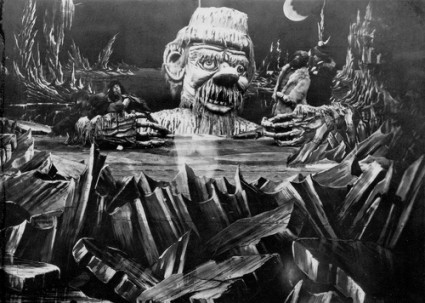
The End of the World (Verdens Undergang) (DK 1916, 74 min, Dir: August Blom)
Music and accompaniment: Interzone Perceptible

As before, the festival will be held in the Markgrafentheater Erlangen, a baroque theatre built in 1719 and still in use. There’s more information as always on the festival site, and they are now open for bookings.

For your diaries

Audience at the Pordenone silent film festival

In case you hadn’t noticed, 2011 is upon us, and in case you are wondering how you are going to fill it with worthwhile cultural activities, here’s what the year ahead holds for us in the way of silent film festivals, conferences and such like. Information on these is (or will be in due course) given in greater detail in the Bioscope’s Conferences and Festivals sections, while a summary listing of all events coming up is maintained in the Calendar section.

Things kick off in January with Slapstick, the annual festival of slapstick film celebrated in Bristol, UK. This year’s event takes place 27th-30th and features the usual mix of silent comedy greats (Chaplin, Keaton, Langdon) alongside live comedians of today (Neil Innes, Graeme Garden, Barry Cryer) – plus Kevin Brownlow and Shaun the Sheep (sadly not at the same time). The StummFilmMusikTage Erlangen is a festival of silent film music held in Erlangen, Germany. The 2011 festival dates haven’t been announced as yet, but they always seem to leave it to the last minute.

February sees the San Francisco Silent film Festival’s Annual Winter Event on the 12th. The Kansas Silent Film Festival is held annually in Topeka, Kansas. This year’s festival takes place 25th-27th and has as its special guest Harold Lloyd authority Annette D’Agostino Lloyd. Films to be featured include Speedy, Chang and Wings. The august-sounding First International Berkeley Conference on Silent Cinema will be held at Berkeley, University of California, 24th-26th on the theme Cinema Across Media: The 1920s.

It’s all happening in March. We have the annual Cinefest, at Syracuse, New York, scheduled for 17th-20th, programme to be announced. The enterprising Killruddery Silent Film Festival takes place 10th-13th in Bray, Ireland, though the website is still showing the 2010 programme. A new silent film festival makes its appearance this month. The Hippodrome Festival of Silent Cinema, billed as Scotland’s first, will held in Bo’ness, 18-20 March. More news on this nearer the time. Over 24th-27th there’s the small Festival du film muet held at the Café-Théâtre Barnabé, Servion, Switzerland. Starting in March (30th) and ending in April (7th) is the Toronto Silent Film Festival, now in its second year, with Maciste all’Inferno (126), Faust (1926), It (1927) and more on the bill. For the specialist, The Construction of News in Early Cinema is a seminar (conference really) being organised by the Museu del Cinema and the University of Girona, Spain, 31st March-1st April. Expect a report from the Bioscope on this, as I’m a guest speaker.

April sees the British Silent Film Festival, which returns to the Barbican in London 7th-10th with the theme Going to the Movies – Music, Sound and the British Silent Film. It takes place in conjunction with the Sounds of Early Cinema in Britain conference taking place 7th-8th at the Institute of Musical Research and the Barbican. Doing Women’s Film History: Reframing Cinema History is a conference with a strong silent cinema element taking place 13th-15th at the University of Sunderland, UK.

In May there’s the classic film convention Cinevent, held as always in Columbus, Ohio. 2010’s convention takes place 27th-30th, which promises such titles as The Passing of the Third Floor Back (1918), Dick Turpin (1925) and The Sky Pilot (1921).

In June we have the festival of silent cinema held annually at Hautes-Pyrénées, France, the Festival d’Anères, usually held in May but now shifting to June 8th-12th. No programme details as yet. In Bologna, Italy there is Il Cinema Ritrovato, the outstanding festival of restored films (always with a strong silent element). No dates or details of the programme have not been released as yet. The Broncho Billy Silent Film Festival will be held at Fremont, California in June, but again no dates yet.

July sees The Second Birth of Cinema: A Centenary Conference, to be held over 1st-2nd at Newcastle University, UK. André Gaudreault, Philippe Marion, Joe Kember and the ubiquitous Ian Christie are promised as keynote speakers. San Francisco hosts the San Francisco Silent Film Festival, this year over 14th-17th. Expect programme information in May. Slapsticon is the annual festival of silent and early sound film comedy, held in Arlington, Virginia, which this year is 14th-17th. Or there should be the International Silent Film Festival, a festival of classic silent films held each July in Manila – no dates or programme available as yet. One of the impressively-programmed silent film festivals of last year was StummfilmLiveFestival, held by the Babylon Kino, Berlin. This year’s festival runs 16th-31st and promises to be just as eye-catching with a complete retrospective of Charlie Chaplin’s films.

Then there’s August, which gives us New York’s Capitolfest, its annual summer classic and silent movie festival, taking place 13th-14th. Janet Gaynor is the featured star. Aosta in the Italian Alps hosts Strade del Cinema, a silent film festival with a strong emphasis on musical acompaniment (no exact dates or programme released as yet – they invariably leave things until the last minute). In São Paulo, Brazil there’s the always very good Jornada Brasileira de Cinema Silencioso, a silent film festival now in its fifth year (no exact dates or programme details as yet). It’s a busy month and Bonn in Germany will have its Bonner Sommerkino, a festival of silent film which is yearly growing in importance, this year taking place 11th-21st.

September kicks off with Cinecon, the annual classic film festival held in Hollywood, which runs 1st-5th, followed closely by Finland’s Forssa Silent Film Festival, also known as Mykkäelokuvafestivaalit, which takes place 2nd-3rd. The charming Opitiki Silent Film Festival will be held this month in Opitiki, New Zealand. Over 22nd-25th there’s the silent and early sound film festival Cinesation in Massillon, Ohio, USA, while over the 23rd-24th we have the Annual Buster Keaton Celebration, the Buster Keaton-themed festival held in Iola, Kansas. Silents of a different, modern kind feature in the Toronto Urban Film Festival, a public film festival of one-minute silent films held in Toronto, Canada. No dates as yet.

October is of course Pordenone month. The Giornate del Cinema Muto, or Pordenone Silent Film Festival, takes place in Pordenone, northern Italy, and in 2010 runs 1st-8th. So far we’re promised The Wind with live orchestra conducted by Carl Davis. The queues are probably forming already. Also in October, but no dates or programme announced as yet, should be Australia's Silent Film Festival, held in Sydney.

I don’t have much information on them, having not covered them before now, but November should see the Bielefelder Film+MusikFest in Germany and December is the time for Poland’s Festival of Silent Films, held in Krakow and organised by Kino Pod Baranami. Both seem to be well-established annual festivals.


If you know of other festivals or conferences I should be including, please me know through the comments. I’ll be adding new events (or updated information) to the Conferences and Festivals sections in any case, and will publicise individual events nearer to their start times in any case. Of course, silents turn up as special screenings in other kinds of festival, such as the London Film Festival and Telluride Film Festival, but I’ve kept this listing to those events largely dedicated to silent films themselves. Such festivals and conferences are a labour of love and a huge challenge to put on, logistically and financially, particularly in these difficult times – do support them if you can.

Looking back on 2010

Lillian Gish knows just what it’s like in north Kent, from Way Down East

The snows of winter are piling up in fantastic drifts about the portals of Bioscope Towers. Icy blasts find their way through every crack and cranny. Outside, civilization grinds to a glacial halt, and the end of the year now beckons. In the relative warmth of the Bioscope scriptorium, I’ve been thinking it would be a good idea to look back on what happened in the world of silent film over 2010. So here’s a recap of highlights from the past twelve months, as reported on the Bioscope (and in a few other places) – silent memories to warm us all.

There were three really big stories in 2010. For many of us, the most welcome news story of this or any other year was the honorary Oscar that went to Kevin Brownlow for a lifetime dedicated to the cause of silent films. The restored Metropolis had its premiere in a wintry Berlin in February. It has now been screened acround the world and issued on DVD and Blu-Ray. And there was the sensational discovery by Paul E. Gierucki of A Thief Catcher, a previously unknown appearance by Chaplin in a 1914 Keystone film, which was premiered at Slapsticon in June.

It was an important year for digitised documents in our field. David Pierce’s innovative Media History Digital Library project promises to digitise many key journals, having made a good start with some issues of Photoplay. The Bioscope marked this firstly by a post rounding up silent film journals online and then by creating a new section which documents all silent film journals now available in this way. A large number of film and equipment catalogues were made available on the Cinémathèque française’s Bibliothèque numérique du cinéma. Among the books which became newly-available for free online we had Kristin Thompson’s Exporting Entertainment, and the invaluable Kinematograph Year Book for 1914.

Among the year’s restorations, particularly notable were Bolivia’s only surviving silent drama, Wara Wara, in September, while in October the UK’s major silent restoration was The Great White Silence, documenting the doomed Scott Antarctic expedition.

We said goodbye to a number of silent film enthusiasts and performers. Particularly mourned in Britain was Dave Berry, the great historian of Welsh cinema and a friend to many. Those who also left us included Dorothy Janis (who starred in The Pagan opposite Ramon Novarro); film restorer and silent film technology expert Karl Malkames; the uncategorisable F. Gwynplaine Macintyre; and film archivist Sam Kula. One whose passing the Bioscope neglected to note was child star Baby Marie Osborne, who made her film debut aged three, saw her starring career end at the age of eight, then had a further ninety-one years to look back on it all.

Arctic conditions in Rochester uncannily replicated in Georges Méliès’ A la Conquête du Pôle (1912)

On the DVD and Blu-Ray front, Flicker Alley followed up its 2008 5-disc DVD set of Georges Méliès with a sixth disc, Georges Méliès Encore, which added 26 titles not on the main set (plus two by Segundo de Chomón in the Méliès style). It then gave us the 4-DVD set Chaplin at Keystone. Criterion excelled itself by issuing a three-film set of Von Sternberg films: Underworld (1927), The Last Command (1928) and The Docks of New York (1928). Other notable releases (aside from Metropolis, already mentioned) were Flicker Alley’s Chicago (1927) and An Italian Straw Hat (1927), Kino’s Talmadge sisters set (Constance and Norma), the Norwegian Film Institute’s Roald Amundsen’s South Pole Expedition (1910-1912) and Il Cinema Ritrovato’s Cento anni fa: Attrici comiche e suffragette 1910-1914 / Comic Actresses and Suffragettes 1910-1914, while the Bioscope’s pick of the growing number of Blu-Ray releases is F.W. Murnau’s City Girl (1930), released by Eureka. But possibly the disc release of the year was the BFI’s Secrets of Nature, revealing the hypnotic marvels of natural history filmmaking in the 1920s and 30s – a bold and eye-opening release.

New websites turned up in 2010 that have enriched our understanding of the field. The Danish Film Institute at long last published its Carl Th. Dreyer site, which turned out to be well worth the wait. Pianist and film historian Neil Brand published archival materials relating to silent film music on his site The Originals; the Pordenone silent film festival produced a database of films shown in past festivals; the daughters of Naldi gave us the fine Nita Naldi, Silent Vamp site; while Kevin Brownlow’s Photoplay Productions finally took the plunge and published its first ever website.

The crew for Alfred Hitchcock’s The Mountain Eagle, ready for anything the elements can throw at them

Among film discoveries, in March we learned of the discovery of Australia’s earliest surviving film, the Lumière film Patineur Grotesque (possibly October 1896); in June we heard about a major collection of American silents discovered in New Zealand; and digital copies of ten American silents held in the Russian film archive were donated to the Library of Congress in October. That same month the Pordenone silent film festival unveiled the tantalising surviving frgament of F.W. Murnau’s Marizza, Genannt die Schmuggler-Madonna (1921-22). There was also time for films not yet discovered, as the BFI issued its Most Wanted list of lost films, most of them silents, while it also launched an appeal to ‘save the Hitchcock 9” (i.e. his nine surviving silents).

The online silent video hit of the year was quite unexpected: Cecil Hepworth’s Alice in Wonderland (1903) went viral after the release of the Tim Burton film of Lewis Carroll’s story. It has had nearly a million views since February and generated a fascinating discussion on this site. Notable online video publications included UCLA’s Silent Animation site; three Mexican feature films: Tepeyac (1917), El tren fantasma (1927) and El puño de hierro (1927); and the eye-opening Colonial Films, with dramas made in Africa, contentious documentaries and precious news footage.

2010 was undoubtedly the year of Eadweard Muybridge. There was a major exhibition of the photographer’s work at Tate Britain and another at Kingston Museum (both still running), publications including a new biography by Marta Braun, while Kingston produced a website dedicated to him. He also featured in the British Library’s Points of View photography exhibition. There was also controversy about the authorship of some of Muybridge’s earliest photographs, and a somewhat disappointing BBC documentary. In 2010 there was no avoiding Eadweard Muybridge. Now will the proposed feature film of his life get made?

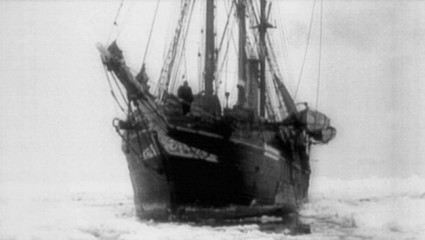
Ernest Shackleton’s ship Endurance trapped in the Medway ice, from South (1919)

It was an interesting year for novel musical accompaniment to silents: we had silent film with guitars at the New York Guitar Festival; and with accordions at Vienna’s Akkordeon festival. But musical event of the year had to be Neil Brand’s symphonic score for Alfred Hitchcock’s Blackmail (1929), given its UK premiere in November.

Noteworthy festivals (beyond the hardy annuals of Pordenone, Bologna, Cinecon etc) included the huge programme of early ‘short’ films at the International Short Film Festival at Oberhausen in April/May; and an equally epic survey of Suffragette films in Berlin in September; while the British Silent Film Festival soldierly on bravely despite the unexpected intervention of an Icelandic volcano.

On the conference side of things, major events were the Domitor conference, Beyond the Screen: Institutions, Networks and Publics of Early Cinema, held in Toronto in June; the Sixth International Women and Film History Conference, held in Bologna also in June; and Charlie in the Heartland: An International Charlie Chaplin Conference, held in Zanesville, Ohio in October.

It wasn’t a great year for silent films on British TV (when is it ever?), but the eccentric Paul Merton’s Weird and Wonderful World of Early Cinema at least generated a lot of debate, while in the US sound pioneer Eugene Lauste was the subject of PBS’s History Detectives. Paul Merton was also involved in an unfortunate spat with the Slapstick festival in Bristol in January over who did or did not invite Merton to headline the festival.

The art of the silent film carried on into today with the feature film Louis (about Louis Armstrong’s childhood), and the silent documentary feature How I Filmed the War. Of the various online modern silent shorts featured over the year, the Bioscope’s favourite was Aardman Animation’s microscopic stop-frame animation film Dot.

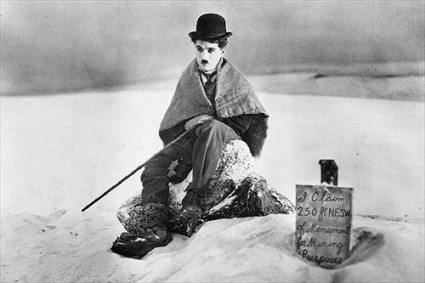
Charlie Chaplin contemplates the sad collapse of Southeastern railways, after just a few flakes of snow, from The Gold Rush

What else happened? Oscar Micheaux made it onto a stamp. We marked the centenary of the British newsreel in June. In October Louise Brooks’ journals were opened by George Eastman House, after twenty-five years under lock and key. Lobster Films discovered that it is possible to view some Georges Méliès films in 3D.

And, finally, there have been a few favourite Bioscope posts (i.e. favourites of mine) that I’ll give you the opportunity to visit again: a survey of lost films; an exhaustively researched three-part post on Alfred Dreyfus and film; the history of the first Japanese dramatic film told through a postcard; and Derek Mahon’s poetic tribute to Robert Flaherty.

It’s been quite a year, but what I haven’t covered here is books, largely because the Bioscope has been a bit neglectful when it comes to noting new publications. So that can be the subject of another post, timed for when you’ll be looking for just the right thing on which to spend those Christmas book tokens. Just as soon as we can clear the snow from our front doors.

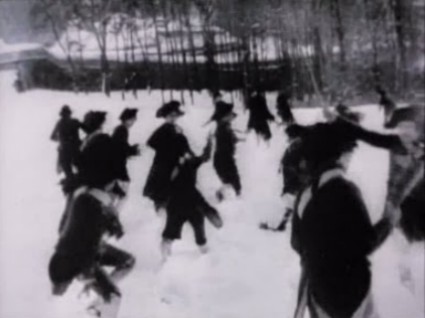
And one more snowy silent – Abel Gance’s Napoléon recreates the current scene outside Rochester castle, from http://annhardingstreasures.blogspot.com

Sounds of Britain – and beyond

Beau Geste (1926), from http://www.ronaldcolman.com

The 2011 British Silent Film Festival will be taking place 7-10 April 2011 at the Barbican Cinema, London. As was the case in 2009, the festival will run in conjunction with ‘The Sounds of Early Cinema in Britain’ conference, previously trailed on the Bioscope. The title of the festival will be Going to the Movies: Music, Sound and the British Silent Film. However, as one may judge from the programme highlights advertised so far, the festival is continuing the trend of the past few years of stretching beyond the confines of British silent cinema to look further afield – which I think is a good thing.

Here’s the descriptive blurb:

Music and sound in silent film will be our key themes during the four days of the 2011 British Silent Film Festival. A packed programme of rare silent films will explore how filmmakers communicated sound to cinema audiences through music and visual clues, what it was like to be in the audience of the ‘silent movies’ and how the British industry geared up for the talkies. Accompanied by the world’s best silent film musicians the programme will feature special events, presentations by special guests and unique archive film from the BFI, the Imperial War Museum and other collections.

Highlights will include

  • The Annual Rachael Low Lecture
    Delivered by Matthew Sweet, broadcaster and author of Shepperton Babylon, on stars, stardom and scandal in British silent cinema
  • Topical Budget is 100!
    Celebrating 100 years since the birth of the British newsreel with highlights from the Topical Budget series
  • ‘Only the Screen Was Silent’
    Luke McKernan, moving image archivist from the British Library, will talk about the experience of cinemagoers from the silent days using oral history material from the British Library and BFI
  • Cinema on the Fronts
    Toby Haggith will screen highlights from the Imperial War Museum collection showing how cinema addressed soldiers at the Front and their families back on the Home Front during the Great War
  • Radio on Film
    Bryony Dixon will present a selection of films looking at silent cinemas fascination with the birth of radio including radio Europa, Romance of the Postal Telegraphy, ‘I’ Got a Sweetie on the Radio’, Mr Smith Wakes Up, Bonzo Broadcasted and Wireless Whirl
  • In Sound and Silence
    Tony Fletcher presents a programme of popular classical music, opera and dance in the 1920’s and the various experiments in synchronous sound that recorded these performances
  • Transports of Delight
    A family programme of vehicular fun featuring trains, planes, automobiles and silent comedy
  • New Discoveries in British Silent Film
    Including Cecil Hepworth’s Helen of Four Gates (1921) starring Alma Taylor, rediscovered almost ninety years after it was believed destroyed and Walter Forde’s 1928 comedy What Next?
  • From Silent to Sound
    An illustrated presentation from Robert Murphy and Geoff Brown on the how British cinema made the transition from silent to sound cinema
  • Genre Film and Genre Music
    Neil Brand and Phil Carli discuss why high staccato strings means murder in cinema and how various musical themes developed during the silent period
  • Beau Geste (1926)
    Hollywood director Herbert Brenon’s adaptation of the best-selling British adventure story about the Foreign Legion starring the quintessentially English Ronald Colman
  • Twinkletoes (1926)
    US director Charles Brabin’s take on the British music hall starring Hollywood’s favourite flapper Colleen Moore
  • Lonesome (1928)
    Paul Fejos’s brilliant part-talkie where dialogue was introduced as a novelty in this story of two lonely people trying to find love in New York. The film features a fantastic jazz-fuelled parade in Coney Island
  • Morozko (1925)
    Yu Zhelyabuzhsky’s rarely seen Soviet fantasy about a stepdaughter who is driven out to face the spirit of winter is here presented with its original music score rediscovered and reconstructed for orchestra. Presented in conjunction with Sounds of Early Cinema Conference
  • I Was Born But … (1932)
    Ozu’s classic family comedy marks the very end of the silent period. As one of the greatest silent films ever made, it is screened here to celebrate the artistic excellence which the silent cinema had achieved

The Festival is organised in partnership with the British Film Institute. The conference is funded by the Arts and Humanities Research Council as part of its ‘Beyond Text’ programme, and organised in conjunction with Royal Holloway, University of London and the University of Edinburgh.

Well, that looks like an interesting mixture of usual suspects and unexpected suspects. Among the usuals, my contribution will hopefully be a bit more than just me talking about the experiences of filmgoers during the silent era – I plan to be putting together an entertainment of some sort. Anyway, riches a-plenty, and it’s always good news to learn that the festival has managed to survive another year – no mean feat in these straitened times.

More information will appear in due course on the British Silent Film Festival website.

Slapstick is back

http://www.slapstick.org.uk

Here comes 2011, and first off the blocks will be the seventh edition of the annual Slapstick festival, held in Bristol. The festival has developed into a celebration of visual comedy in general by bringing together silent slapstick with British television and radio comedians of today (not that radio excels in visual comedy, but it all fits somehow). This year the presenters include Bill Oddie, Ian Lavender, Barry Cryer, Tim Brooke-Taylor, Neil Innes, Shappi Khorsandi and Chris Serle. Kevin Brownlow turns up presenting ‘Unknown Chaplin’ material, while the silent performers featured include Chaplin, Keaton and Langdon. And there is also a welcome tribute to one of Bristol’s finest, the Aardman Animation studios’ children TV series Shaun the Sheep, which the Bioscope should have championed long before now as a truly great example of the art of silent comedy happily carried on into the 21st century (and who would have guessed that Sir Christopher Frayling was a fan? Good on him).

Here’s the full programme:

THURSDAY 27 JANUARY

5.40pm Watershed
UNKNOWN CHAPLIN with KEVIN BROWNLOW
Academy Award winning film historian Kevin Brownlow introduces a selection of the rarest and least known footage of Charlie Chaplin as the festival opens with the first of four events dedicated to the ‘Little Tramp’.

8.00pm Colston Hall
Neil Innes: A People’s Guide to World Domination
The very welcome return of Slapstick Festival supporter and patron, Rutle and Bonzo front man Neil Innes as he brings his new solo show to Colston Hall for one night only on the opening night of Bristol’s Seventh Slapstick Festival. Neil performs a wry, poignant, humorous and topical one-man show, spiced with anecdotes of his life and times in the worlds of media and show business. Neil’s solo shows tickle the emotions with a potent mix of fine musicianship and enlightened lyricism, packed with sharp observations celebrating the absurdities of modern existence. Join us for a unique musical experience in the company of the self proclaimed ‘Ego Warrior’ and ‘Seventh Python’

FRIDAY 28 JANUARY

2pm Arnolfini
CLARA BOW in MANTRAP (Dir Victor Fleming; USA, 126 mins)
Clara Bow wasn’t just the ‘IT’ girl of a generation, she was also a fine actress and comedienne. Here in one of her funniest films, Bow plays the sexy wife of an old Canadian backwoodsman who becomes attracted to a young, rich and famous divorce lawyer who comes to town on vacation.

4pm Watershed
SLAPSTICK INTERNATIONAL (U) with live piano accompaniment
In a continuation of Slapstick’s tradition of sharing the best new silent comedy finds, three superb films discovered by the Giornate Cinema Muto for Italy’s Pordenone Silent Film Festival: W.C. Fields, making his silent screen debut, in THE POOL SHARKS; the same wise-cracker in the early sound short, THE GOLF SPECIALIST, plus a delightful silent from Russian, CHESS FEVER. Introduced by Pordenone’s director David Robinson, with John Sweeney on piano and Chris Serle as host.

7.30pm Colston Hall
SLAPSTICK SILENT COMEDY GALA
with Bill Oddie, Ian Lavender, Barry Cryer and Neil Innes; the Jazz Train orchestra; the European Silent Screen Virtuosi and Paul McGann

Four living comedy icons introduce a four-film salute to the best-loved past masters of silent humour, showing here on a giant screen with music from the 25-piece jazz combo, Jazz Train, and the European Silent Screen Virtuosi. Plus a ukulele tribute to Chaplin and an appearance by Paul McGann. £20 (£16 conc); £6 under 12s.

SATURDAY 29 JANUARY

9.30am Colston Hall
HOMAGE TO CHAPLIN (U, Germany, 50 mins)
A rare chance to see a fine visual tribute to Charlie Chaplin, made in association with, and performed by students from, a German school for young people who are deaf. Showing here with a live piano accompaniment by Guenter Buchwald.

11am Colston Hall
HARRY LANGDON: BEST COMEDY SHORTS with Graeme Garden
Baby-faced Harry Langdon used a subtler form of visual comedy than that which became known as ‘slapstick’ but his talent made him a worthy rival of those who became better known. Here, Graeme Garden, of The Goodies and the I’M SORRY I HAVEN’T A CLUE panel explains why he’s a Langdon champion and introduces some of the comic’s brightest and funniest shorts. With live music.

2pm Arnolfini
CHAPLIN: THE CIRCUS + a new animation CIRCUS DRAWINGS
Too often overshadowed by his more legendary comedies, THE CIRCUS boasts Chaplin’s most brilliant gags, including a Hall of Mirrors chase and climaxing with a de-trousering by monkeys on the high wire! Showing here with the UK premiere of a new short by the triple Oscar-winning animator, Richard Williams, based on his 1950s drawings of a circus in Spain.

4pm Bristol Old Vic
CELEBRATING BUSTER KEATON with IAN LAVENDER
DAD’S ARMY and EASTENDERS star Ian Lavender makes his first Slapstick visit appearance to share his long-held passion for Buster Keaton – his chosen subject on a recent Celebrity Mastermind – before revealing and screening his all time favourite short by ‘the great stone face’ and then introducing SHERLOCK JUNIOR (PG, 1924, 45 mins) in which Keaton plays an aspiring detective wrongly accused of a crime by the family of the girl he loves. With live accompaniment by the five-piece European Silent Screen Virtuosi.

8pm Bristol Old Vic
BARRY CRYER’S TOP COMEDY MOMENTS with ROB BRYD0N
The man who has probably worked with &/or written for more UK comics than anyone else on the planet shares his favourite moments and memories with another bright star of British comedy, Rob Brydon. Together, they’ll be telling tales and showing clips celebrating almost 100 years of film and tv humour – from Harold Lloyd and Buster Keaton, via Morecambe & Wise and David ‘Del Boy’ Jason to today.

SUNDAY 30 JANUARY

9.30am Colston Hall
REDISCOVERIES & REVELATIONS
Amazingly, 2010 saw the rediscovery of not one but two unknown Chaplin films, a lost Charley Chase, and the recovery of films featuring Laurel & Hardy, Harry Langdon and British stars, Walter Forde and Pimple. Join silent comedy expert David Wyatt as he brings these gems and others to the screen again, concluding with the UK premiere of Stan Laurel’s restored Monty Python-like classic WHEN KNIGHTS WERE COLD (1923).

11am Colston Hall
MARTY! with TIM BROOKE-TAYLOR and CHRIS SERLE
Writer, actor and wit Tim Brooke-Taylor shares his memories of working with the instantly-recognisable but often overlooked bug-eyed funny man Marty Feldman in his pre-Hollywood days. With clips of some of Marty’s best visual gags from shows like the seminal AT LAST THE 1948 SHOW and the BAFTA award-winning MARTY to illustrate and Chris Serle as host.

2pm Arnolfini
LECTURE: SLAPSTICK & THE CITY: Silent Comedy and the Metropolitan Playground plus HEAVEN’S SAKE and music from The Slapstick Boys
Dr Alex Clayton, Lecturer in Screen Studies at the University of Bristol, looks at how early slapstick films used urban architecture – including statues, giant clocks, escalators and industrial machines – to create some of their most vivid and comic sequences. With illustrative clips and, to follow, a Harold Lloyd comedy (U, 1926, 58 mins) set in the ‘Big Apple’, with a live accompaniment.

2pm Watershed
IT’S… SHAUN THE SHEEP
Eighty years on from the end of the silent film era, silent comedy is alive and well and regaining massive new audiences and global success in the guise of the Wallace and Gromit spin-off character Shaun the Sheep’. Here, Aardman Animation’s Creative Director Richard Goleszowski, chats with Sir Christopher Frayling about Shaun’s inspirations, development and popularity, using extracts from the shows and original models.

4pm Bristol Old Vic
CHAPLIN: THE GREAT DICTATOR with SHAPPI KHORSANDI
When comedian and author Shappi Khorsandi was invited to add an item to BBC Radio 4’s THE MUSEUM OF CURIOSITY, she chose Charlie Chaplin and revealed that his THE GREAT DICTATOR is her all-time favourite film. Here, she explains why she is so drawn to this satire on dictatorship, Fascism, and racism before iintroducing the film (PG, 1940, 120 mins) in which Chaplin plays both the Hitleresque Adenoid Hynkel and his look-alike, a poor Jewish barber. £10-£5

8pm Watershed
MARTY: THE YOUNG FRANKENSTEIN with TIM BROOKE-TAYLOR
To close Slapstick 2011, Tim Brooke-Taylor introduces the Frankenstein spoofathon which catapulted his comedy colleague Marty Feldman to international stardom. Here, Feldman plays Eye-Gore in a piece of inspired lunacy which also stars Mel Brooks and Gene Wilder. Dir: Mel Brooks, USA, 1974, 105 mins.

All the necessary information, with booking details and information on past festivals, can be found on the Slapstick site.

Pordenone diary 2010 – complete

Scenes from the Pordenone silent film festival – clockwise from top left: Kevin Brownlow accepting an award, audience in the Verdi, festival director David Robinson, Pordenone street, festival goers outside the Verdi, theatre seating

The Bioscope has now published its daily diary for all eight days of the 2010 Giornate del Cinema Muto (Pordenone Silent Film Festival). For convenience’s sake, here are the links to each day with the main films covered in each report. The major themes of the festival were Japanese films from the Shochiku studio, three Soviet careers (Abram Room, Lev Push and Mikhail Kalatozov) and French clowns (1907-1914).

Day one (2 October)
Introduction to the festival, Japanese Girls at the Harbour

Day two (3 October)
Seven Seas, Rituaes e festas Bororo, Mutter Krausens Fahrt ins Glück, Striking a New Note, Drifters, Battleship Potemkin

Day three (4 October)
Love Be With Humanity, French Clowns (Boireau), The Nail in the Boot, The Masks of Mer, Le Miracle des Loups

Day four (5 October)
French Clowns (Boireau), Salt for Svanetia, Ginga, A Thief Catcher, Upstream, Chess Fever

Day five (6 October)
Bed and Sofa, Madagascan films of 1898, Corrick Collection, No Rastro do Eldorado, Marizza, Rien Que Les Heures, La Folie des Vaillants

Day six (7 October)
Blind Justice, Shingun, Death Bay, The Great Art of Light and Shadow

Day seven (8 October)
Why Do You Cry Youngsters?, Giuli, Corrick Collection, Die Waffen der Jugend, Robin Hood

Day eight (9 October)
Young Master at University, Moana, A Hero of Tokyo, French Clowns, The Ghost that Never Returns, Wings, final thoughts

Interested in the Bioscope’s reports on the Pordenone silent film festival for 2007-2009? Links to these can be found on the Series page (under Pordenone).

Pordenone diary 2010 – day eight

Verdi theatre, Pordenone, with book fair in the background

And so we come to our final report on the 2010 Pordenone silent film festival. The Bioscope’s editor was on the plane home by this point, but happily our cub reporter The Mysterious X was on the spot to brings this account of day eight’s offering (Saturday, October 9th).


The final day; always a source of mixed feelings. On the one hand, that end-of-a-holiday sensation, saying goodbye to friends both Italian and international that we may not see for another year; on the other that the next day represents a return to normality, the chance of a proper breakfast, your own comfy bed, and more than five hours sleep per night.

But a change of venue this morning – The Verdi being prepared, and the orchestra rehearsed, for the evening show – and we all take the pleasant stroll up the Via Garibaldi to Cinemazero, Pordenone’s arthouse cinema, for the morning. Smaller, more modern, just about enough room for the audience numbers, plenty of legroom if you do get a seat. No pianos this year; we have a morning of silents in their sound versions.

Starting with Daigaku No Wakadama (Young Master at University) (Japan 1933); the notes don’t reveal whether the synchronised music score is from a later reissue print or whether we are already in a transitional period in Japanese terms. The film itself seems transitional though; as in the other Shochiku films we’ve seen this week, there is a tangible sense of a nation sat on the cusp between tradition and modernity, East and West … and not entirely comfortably. The Young Master of the title is a star player of the university rugby team; so we’re western and modern right away; except the rugby club is run along the lines of an officers’ mess in Victorian India; arcane rules of behaviour, regimented discipline, strictly hierarchical … so we’re ripped out of that feeling immediately. The Young Master is also heir to his father’s wholesalery, run on ultra-traditional lines; Father does not approve of rugby, is unsure of the benefits of university versus commercial experience, while the Young Master is not overkeen on inheriting such a rigid existence quite yet; he is, within the constraints of his environment, a practical joker and an apprentice playboy. In such a spirit, he invites young Hoshichuyo, an apprentice Geisha in love with his father’s clerk, to watch a training session incognito … but she is recognised when his sister arrives, goes into hiding in his changing room locker, whereupon she is discovered. She is banished … and so is he, from the rugby club. Further complications ensue (the clerk is betrothed to the sister, and so on) which need to be sorted out before The Young Master can be reinstated in time to play in The Big Game.

So it has the structure of a farce comedy, but is (I assumed anyway) a breezy romantic drama more than a laughfest; it did have comical moments, particularly during the climactic game when we see the legs of a downed player whip out of frame, as he is unceremoniously dragged off while the scrum is being set … it’s possible the political manoeuverings of the rugby club leaders were intended as satirical comedy, if it didn’t register as such with me. It was certainly more light-hearted than other examples we had seen this week, and a good start to the day. Incidentally, the film also featured a nicely anachronistic piece of set-dressing; in the apartment of one of the characters, I think that of the clerk, were a couple of Hollywood talkie posters; a French-language one-sheet for All Quiet on The Western Front, and another for an early Cary Grant film, The Eagle and the Hawk. So, if anyone ever asks you if Cary Grant was ever in a silent film, you can now respond “Only in Japan” …

Moana, from MoMA

The second offering I wasn’t planning on seeing; and as it was getting lively in the Cinemazero I decided to catch five minutes while standing at the edge, before getting some sunshine. Robert Flaherty’s Moana (USA 1926) was being presented with a soundtrack compiled in the ’80’s by Robert’s daughter Monica, who had been in Samoa as a very young girl during the filming; she had taken great pains in recording the sounds of Samoa, and recreating the speech of the on-screen participants, fifty years after the event; the ethics, the anthropological niceties of these efforts I’ll leave to others better qualified, but I can see why she would have wanted to make one of her father’s less well known projects more approachable for modern audiences. This was also being presented as a work-in-progress; I understand no viewable film print exists of this project at the moment; that is, however, the plan; we were watching a DVD being played off a laptop. I understand that this all went horribly wrong for a while after I exited … the feedback I got was not overwhelmingly positive on a number of points.

Back in again for the final film from the Shochiku strand: Tokyo No Eiyu (A Hero Of Tokyo) (Japan 1935), and again, a transitional dialogue-free film with a musical soundtrack. Directed by Shimizu, as were many of the films shown on the first days of the festival, this reverted to the template of a dark, tragedic exploration of the moral codes and hierarchies within Japanese society of the thirties. We meet a widowed businessman with a young son; feeling that he cannot devote enough time to his upbringing he remarries (for convenience, it seems) a widowed mother of two other children. After some initial sibling friction is played out, Father does a bunk; his business was selling shares in dodgy stocks, and he’d been found out. This leaves the mother with no income and no means to support herself, her two children plus this new stepson; she does what a woman has to do in a Shochiku film; she joins the sex trade, surreptitiously, unknown by all her family …

Fast forward fifteen years or so; her daughter is on the point of marrying into a ‘good’ family; they enquire into the family history, and the truth emerges. As does the father, up to his old tricks … at which point SHE feels the need to apologise to HIM for the shame …

At least in this film the outrage of the director towards the status quo is made obvious to a modern audience; this is a sharper critique than the preceding, far longer, films: more pointed, and to the point. The performances, of Mitsuko Yoshikawa as the woman trodden down by the societal rules, debasing herself to keep her family together; and of Yukichi Iwata as the bewildered, then angry son, are superb. While I wouldn’t recommend this film to anyone in terms of entertainment, it
was for me the best of this strand. The bad news is, I’m told, that nearly all of the extant Japanese silents have been shown at Pordenone now; unless there are new discoveries … that’s our lot.

Privideniye, Kotoroye ne Vozvrashchayetsya (The Ghost that Never Returns), from blog.nova-cinema.org

Back down the Via Garibaldi to the Posta for lunch … creature of habit that I am … before the afternoon’s offering, Abram Room’s Privideniye, Kotoroye ne Vozvrashchayetsya (The Ghost that Never Returns) (USSR 1930). It’s a stunning film, a tour de force combination of avant garde elements within an adventure film format – with a more than a dash of revolutionary propaganda, naturally. Our hero is a political prisoner in an unnamed South American country. Sentenced to vegetate in a semi-surrealist prison, a message is got to him that a strike is being planned in the oilfields by his colleagues on the outside; meanwhile his once-a-decade one day’s parole is imminent; the catch is that if the parole’s rules are broken, an armed guard is handily placed to execute summary justice. It becomes a series of battles of wits; between the prison authorities and the prisoner, then individually between the prisoner and his guard, as he jumps a train and treks across a desert wasteland towards home, the oilfields … and freedom ??? It’s utterly unlike any other Soviet film I’ve seen … aside from its politics … it has elements of the Soviet avant garde, but equally hints of Expressionism and Hollywood … a really interesting blend of styles that suited its subject matter, and made it more persuasive than most Soviet propaganda, I would imagine. Certainly more entertaining …

The final presentation of the French Clowns followed; Tartinette to Zizi … I saw a couple, not impressed again, to be honest … a lot of work must have been put into researching these films, and getting the prints here … but the presentation of them in large chunks in alphabetical order chased away all but the most ardent devotee … and lost the films the opportunity of making new converts. A great shame.

So out to the Posta for one last appointment with a Spritz Aperol, to find that the usually milling Saturday evening crowd had been augmented by people admiring a vintage car display, half a dozen beautifully restored thirties vehicles lined up, and, for a fortunate few, giving little joyrides around the town. I don’t think I’ve ever seen so much joy on one man’s face as when Phil Carli returned from his …

Charles ‘Buddy’ Rogers and Clara Bow in Wings (1927), from http://www.nytimes.com

And so to the finale, perhaps even a climax; the full live orchestral presentation of William Wellman’s Wings (USA 1927), featuring the Photoplay print, and the Orchestra Mitteleuropea conducted by Mark Fitz-Gerald playing the Carl Davis score. It’s one of his finest, I think, that great March as the main theme, some nice leitmotifs reappearing throughout as appropriate … very effective.

And, what with all the sound effects of the battle sequences having to come from the orchestra, I would imagine a nightmare to play. Well, Ladies and Gentlemen, they nailed it. It’s a powerful film – not just the legendary flying sequences, or the breathtaking battlefront climax … but the subtle underplaying of emotions, too … sometimes Clara and Buddy go slightly over but Arlen, and particularly Henry B. Walthall convey the suppressed emotion just beneath the surface to great effect.

But it is famous for those war sequences, and deservedly so; on the big screen you get to see so much more of it; on a small screen you don’t see the aircraft growing from the smallest dot to ambush the pontoon bridge, or the staff car … you don’t quite see the battlefield extending right to the horizons … and you’re involved, you’re in the air, or in the mud, with them. And did the shot of the white crosses covering the whole landscape inform the similar shot in Attenborough’s Oh! What A Lovely War? I would just hesitate from calling it the perfect WW1 film; for that we would need a little more Gary Cooper, a little less El Brendel, a good deal fewer animated bubbles in Paris … with the latter, a nice idea that was way overused … actually, that applies to El too. And I struggle to quite see how anyone with Clara living next door would pursue the rather more watery charms of Jobyna Ralston. However much an advantage being from The City conferred. But this is nitpicking; you sit back, let the film and the orchestra take you to a time past; either WWI, or the days in the twenties when such presentations were daily occurrences in the larger cities … it was a terrific way to end the Giornate of 2010.

The Verdi at night

Was it a classic year? Not quite, I feel, though there were, as always, cinematic experiences to cherish, lessons to learn, doors opened to unsuspected areas of interest; films that would surprise, or delight, or shock, but seldom leave without further thought. And certainly films that you will be unlikely to have a second chance of seeing, as here, as they were designed to be seen.

I’m very aware that I haven’t mentioned many of the musicians’ performances; this was entirely down to a happy event chez Sosin (many congratulations, Donald and Joanna) which meant that after his (superb) show with Jean Darling on the Wednesday he hotfooted it back home, and the remainder of the Giornate stalwarts shared out the films between them – and naturally, I failed to take notes as to who ended up playing for which film. Needless to say Messrs Brand, Buchwald, Carli, Horne, and Sweeney were all playing at the top of their game despite there being some challenging films in the programme. The Book Fair was much reduced, perched on the third floor of The Verdi, but I got hold of the one DVD I was after (Cento Anni Fa, the Bologna-compiled set of Suffragette films) so I was happy.

The social side, of course, was as good as ever, new friendships made, old friendships renewed; the Giornate staff and volunteers helpful and patient, the locals as welcoming and understanding (and as amused by our attempts at Italian ) as ever, the food and drink … I look forward to what goodies are to be pulled from the bag for us next year, the 30th renewal of the World’s most important silent film festival. I hope to see you there …


Huge thanks once again to The Mysterious X, who has donned the domino, cast a cloak about their person, and slipped away mysteriously as ever into the inky dark night. I would concur with X’s assessment of the festival – not quite a classic, but funding constraints had their effect upon the programme. We missed the variety that would have been there with another strand of programming (such as the Leo McCarey shorts which were promised early on); with just the one screen available, maybe the Japanese films (some of which were very long) took up a bit too much space. But that’s only by comparison with earlier festivals. The riches on offer were real riches, and there were major discoveries every day. I was particularly encouraged by the new faces I saw the festival – students from Italy and the USA especially – which suggests that the festival is not just showing the same films to the same crowd but continues to reach out to those who need to discover silents for the first time. Tell that to your funders, guys – you are doing the right things.

Pordenone diary 2010 – day one
Pordenone diary 2010 – day two
Pordenone diary 2010 – day three
Pordenone diary 2010 – day four
Pordenone diary 2010 – day five
Pordenone diary 2010 – day six
Pordenone diary 2010 – day seven

From Kinetoscope to Kinoscope

70 Oxford Street, London, today (from Google Street View) and in October 1894, from The Westminster Budget, 26 October 1894

If you travel eastwards down London’s Oxford Street, keeping to the north side of the road, you will come across an electronics shop of unprepossessing frontage, currently named McDonald’s. It claims to be the oldest electronics shop in Oxford Street, but it tells you nothing about its place in film history. Because it was here – at 70 Oxford Street – that the first public exhibition of motion picture film took place in the UK. On 17 October 1894 the Continental Commerce Company exhibited the Edison Kinetoscope, a peepshow device showing short films, no more than a minute long, which people could see by peering down through a viewer at a tiny image. No photograph exists of this Kinetoscope parlour (as they were called), but a drawing in a newspaper gives us some idea of the layout and clientele. We know that there were ten machines available, and that among the films on show were Blacksmith’s Shop, Cock Fight, Annabelle Serpentine Dance, The Bar Room, Carmencita, Wrestling Match, and Barber Shop.

Edison’s Carmencita (1894), one of the films featured at the first public film exhibition in the UK

Strictly speaking we’re talking about two different 70 Oxford Streets, since the original building is long gone. Around the time of the centenary of cinema (1995/96) we tried to get a plaque put on the building that now stands there, but the owners weren’t interested, so the plaque was put up nearby at no. 76. Sadly the owners of 76 showed a similar lack of respect for cinema history, and the plaque has now gone. Kinetoscopes themselves didn’t last too long, either. It was obvious to budding film entrepreneurs that films would be a greater attraction on a screen, not least because this would attract a greater number of paying customers, and within fifteen months (in the UK) projected film on a screen was a commercial reality, and the Kinetoscope’s era was over.

Wind forward 116 years and the Kinetoscope is making a sort of a comeback. The biennial Fashion in Film Festival takes place in London 1-12 December and among the side attractions, running 15 November-14 December is Kinoscope Parlour, a project supported by Film London’s Digital Film Archive Fund, which is bringing back something like the Kinetoscope experience to London. Here’s how Film London describes it:

Twelve different locations in the run-up to, and throughout, the festival will host a contemporary re-imagining of the Kinetoscope – presenting a selection of feature films made by the pioneers of early cinema, as well as archive footage that will reveal hidden layers of local cinema history. The six units, specially designed for the project, will be placed in key locations in the capital’s outer boroughs from 15 November, before the Kinoscope Parlour is re-located to London’s central boroughs for the course of the festival. For four weeks, passers-by will be able to transport themselves back to a bygone era through the magic of the moving image.

Between 15-28 November the Kinoscope will be found at these London sites: Castle Green in Dagenham, CREST charity shop in Walthamstow, Kilburn Library, Lewisham Library, Queen’s Market in Upton Park and Wolves Lane Nursery in Wood Green. Between 29 November-14 December it will be located at BFI Southbank, The Horse Hospital in Bloomsbury, Somerset House, the Victoria and Albert Museum, Viktor Wynd’s Little Shop of Horrors (Hackney) and The Wapping Project. Further details including a map are on the Fashion Film Festival site.

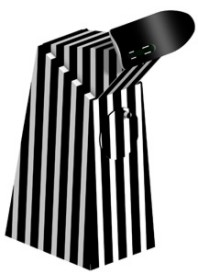
It won’t be too difficult to spot the Kinoscopes as they are strikingly designed in black and white stripes by designer Mark Garside. There are six of them, one for each location, unlike the original parlour idea where ten were arrayed together in rows. The original Kinetoscopes were coin-operated; the Kinoscopes are free and you have to turn a wheel to view the films, which through “cutting-edge digital technology” allows you to control the speed of the films. The films themselves are a mixture of productions from Georges Méliès, the Lumière brothers, Thomas Edison (the only one of the films originally designed for showing in a peepshow), Gaston Velle, Segundo de Chomón, Robert Paul, Ferdinand Zecca and Alice Guy-Blaché, with an emphasis on “dress manipulations and magical transformations” to tie in with the fashion on film theme. Additionally there will be archive film of London’s cinema history up to the 1930s. The full list of films, indicating which ones will be available at which locations (you won’t get to see them all on the one Kinoscope) is also on the festival website.

Silent films also feature heavily in Fashion Film Festival itself, under the thematic title of ‘Birds of Paradise’. Early films are paired with experimental films on Kenneth Anger, Jack Smith, Ron Rice, José Rodriguez-Soltero, Steven Arnold at Tate Modern; the Barbican is showing diva Lyda Borelli in Rapsodia Satanica (1915-17), Germaine Dulac’s La Princesse Mandane (1928); and Michael Curtiz’s Red Heels (Das Speilzeug von Paris / La Poupée de Paris) (1925) and The Golden Butterfly (Der Goldene Schmetterling); while BFI Southbank has a panel event The Gossamer Wings of Early Cinema, and is showing Cecil B. De Mille’s Male and Female (1919) and The Affairs of Anatol (1919), the Nazimova films The Red Lantern (1919) and Salomé (1923), Josephine Baker in La Revue des Revues (1927), E.A. Dupont’s Moulin Rouge (1928), Alexandre Volkoff’s Secrets of the East (Geheimnisse des Orients / Shéhérazade) (1928) and Jean Durand and Berthe Dagmar’s The Island of Love (l’Île d’amour) (1928). Fashion or no fashion, it’s an impressive line-up of silents, most of them rarely shown.

Finally, over 1-12 December, Somerset House is hosting Hemline: the Moving Screen, an artwork by Jason Bruges Studio on belle époque dancer and film performer Loïe Fuller, which they describe as “a light sculpture that uses three-dimensional volume as a ‘moving screen’ to approximate the swirling movements of fabric in a serpentine dance”.

Dates and booking details for all these screenings and events are on the festival website.

Pordenone diary 2010 – day seven

Donald Sosin rehearsing before a screening at the Giornate del Cinema Muto, Pordenone

We’ve reached the penultimate report of the 2010 Giornate del Cinema Muto, and while I was strolling about the streets and blustery sea-front of Trieste, our anonymous reporter, known only as The Mysterious X, was on the spot at Pordenone to provide this account of the goings-on of Friday 8 October:


A quick scurry from the hotel, via the cafe for a quick espresso doppio, and to grab a bottle of mineral water for the cinema; for starting at 9.00am, we had the latest instalment from the Shochiko strand of the Giornate, Wakamono Yo Naze Naku Ka (Japan 1930) (Why Do You Cry Youngsters?).

By this stage of the Giornate we had discerned that Shochiku specialised in contemporary dramas of 30’s Japanese life, and particularly the culture clashes generated by modern western influences, seemingly largely from Hollywood, with the more traditional Japanese moral codes. And with a pacing that could be described as languid … and this film was no exception to the established trend. But intriguingly, the clash here, although along generational lines within a family, does not happen in quite the expected way. We meet the family – widowed father, son and daughter, happy and traditional in
outlook; until the father decides to remarry … his new, somewhat younger bride is a Modern Girl, with Modern Outlook and Modern Interests … a panning shot of the spines of the books she has brought to the house reveal titles of works of sexual psychology, shocking to the late teenaged children … Freudian, indeed. After episodes of increasing friction, the children flee the nest and set up house in a poorer neighbourhood, next to a family whose father is in the process of selling his pretty daughter into the sex trade.

All beautifully staged, and shot (although the picture quality is occasionally marred by print damage; not nitrate decomp I don’t think, but many of the Japanese films this week displayed the same type of damage, the effect it has is of watching a film through a sooty snowstorm) but the themes were becoming familiar; in a way these films were becoming as interesting in the anthropological sense, as we learned through the week how the dress codes worked, the significance of whether a suit or kimono was being worn to work, whether the suited man would change into kimono at home or not, which clothing denoted which level of the strict hierarchy in the Japanese sex trade, from Geisha, to dance hostess, to club
girl, to streetwalker … because representatives from the industry appeared in nearly all the films we saw. Not mentioning the curious – to western eyes of 2010 – 1930’s Japanese ideas of private and public morality. What constituted a happy or just ending in a Shochiku film seldom matched our modern Hollywood sensibilities. But, hey, we come here to learn … and the length and pacing of these films encourages the audience to think as we watch.

Mie Yamashita, who had played exceptionally beautifully to the Japanese films all week, had returned home by this point, so bravely stepping into the pit for this 3¼ hour marathon was our very own Stephen Horne, flute at hand, performing beautifully as ever, his style (and his partial use of the flute) certainly suiting Japanese silents.

Out into the noonday sun; as interested as I am in early cinema, I didn’t fancy half an hour of medical films, recording injuries, conditions and experiments in treatment, just before lunch [shame – Ed.]…

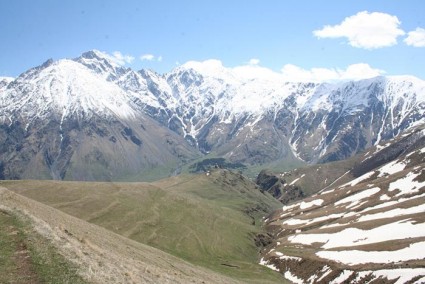
It’s been a bit of a challenge finding illustrations for this post, so I’ve given up looking for film stills and here’s a modern-day photograph of a harsh Caucasian landscape instead …

But back straight after, for Giuli (USSR/Georgia 1927) a Georgian rural drama directed by Lev Push and Nikolai Shengelaya, and set in the wild rocky Caucasus, where semi-nomadic clans survive by sheep-herding, and live with their own strict codes of behaviour, and feuds simmer deeply. Giuli is the daughter of an elderly shepherd, who promises her in marriage to the local (and equally elderly) clan chief … whereas she is in love with a more lowly, but virile, handsome etc. shepherd.

If the plot is hackneyed, and pretty much interchangeable with films about any society and at most times, this film was unmissable due to the spectacular cinematography of director-to-be Kalatazov, the use of the harsh Caucasian landscape, and the equally rocky and craggy
faces of the cast; the elderly males crevassed with wrinkles, the younger men with the most incredible aquiline profiles, spectacular moustaches and jutting chins, but with the humanity of the central performances giving heart to the film. All told a welcome antidote to the propagandistic films of the Soviet era, which personally leave me quite cold.

One of the highlights of the last few Giornates has been the series of films, discovered in Tasmania and preserved by the Australian national film archive, representing the repertoire of the Edwardian-era Corrick family’s touring cinema show, a mixture of self-made films, and those imported from Europe and the US. This latest batch – and we are promised that there is more to come – were every bit as interesting as those shown in previous years.

The programme started with the state funeral of New Zealand Premier Richard Seddon, the man who managed to keep New Zealand politically independent from Australia, and a huge figure in New Zealand’s politics. Shot by a local cameraman in the style of state funeral films everywhere, this also gave a tantalising glimpse of Edwardian Wellington as the cortege passes. Next up was what appeared to be a film recording a vaudeville stage act; Bicyclette Presentee En Liberte (1906) featured, in a proscenium setting, two gentlemen – twins, possibly – and their performing bicycle; that is, the bicycle performed while the men watched, one assumes by wires, but if so, very well hidden. There followed a short moral tale, The Waif and The Statue (UK 1907) directed by Walter Booth; a homeless starving girl is rejected at a church door; she shelters from the snow under a statue of Hope – which magically comes to life and finds her a benefactor to give her a safe home. Similar in style to some Edison films I’ve seen, the special effects are very well handled, and nicely played in a tableau-like manner … I wouldn’t be at all surprised to find that this started life as a lantern-slide series. Back to France, and Chasse De Sanglier (Wild Boar Hunt) (France 1904) a seemingly heavily staged representation of hunting wild boar with dogs … Le Diner Du 9 (Dinner on the Ninth) (France 1909) was more amusing – a comedy of manners – which had the luxury of 10 minutes to develop in – where the confusion over dinner dates combined with the need to keep face, means the lead character (played by Charles Prince) ends up having three dinners that night … and in houses where the host was not expecting a guest. Nicely subtle, and not at all broad, very little that could be described as slapstick; quite sophisticated for an ’09 film comedy, possibly betraying its origins as a stage play of the era. Deux Braves Coeurs (Two Brave Men) (France 1909) was in contrast a less sophisticated mini-melodrama of civil war and self-sacrifice; following that were two similar films of a river-borne procession in Burma, filmed and distributed by Charles Urban; and Edwin S. Porter’s Life of a Cowboy (1906) which, apart from a final sequence that seemed to come from another drama entirely, was seemingly a filmed version of sketches and scenes performed by a Wild West Show of the time; if you read the posters or adverts of the shows from the era, then every little vignette – Rowdies making a greenhorn dance, Indians attacking a stagecoach, lasso tricks … all present and correct, and no interlinking plot whatsoever. Les Fleurs Animées (France 1906) was another extravaganza of hand-colouring and special effects from Pathé and the works of Segundo De Chomon; here anthropomorphic flowers take revenge on a man responsible for the destruction of a flower bed.
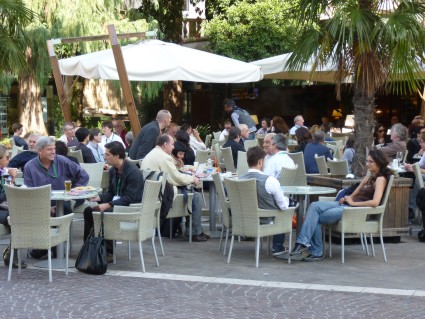
Festival-goers at the Posta café doing what festival-goers like to do best

The programme finished with a film not from The Corrick Collection, but a new discovery by and from a private archive in London; Those Jersey Cowpunchers (US 1911) – or rather, and unfortunately, the first reel of two – is a comedy from Nestor, one of the real Hollywood pioneer outfits, and supposedly based on their experiences in trying to make westerns; in the film, the Billiken company head west from their New Jersey studio to make use of western locations and personnel, only to find there are no real cowboys left … they are all in the movies now; they wire back to base, to send some Eastern actors to play the roles; said actors are just applying their awful ‘Indian’ make ups when reel one finishes … it may just be that we are thus cheated of a delicious satire on early Hollywood racial stereotyping … we may never know …

After a quick break, another new discovery being introduced to the World … Die Waffen der Jugend (Germany 1912), and much anticipated as this three-reel comedy was the directorial debut of Robert ‘Caligari’ Wiene; and it really didn’t disappoint; the youth of the title is a headstrong, tomboyish daughter of a middle-class father who can no longer cope with her; he packs her off to boarding school where she remains a handful; a midnight mandolin recital is one thing, but getting into a fight with a fellow inmate and drawing a clasp knife from her stocking top … is another. Eventually she makes her escape in the traditional sheet-rope manner, and wanders the streets of the local town … wherein she draws the attentions of two criminal beggars, squatting in a dingy basement. They induce her to come with them, and keep her prisoner … which is their big mistake. In a Stockholm-syndrome-in-reverse scenario, in an effort to please her, the criminals smarten themselves up, clean up the basement, and eventually when she is found by the police and reunited with Father, decide to go straight and, much to their own horror, accept a job offer from him. A delightful, energetic and downright funny film; highly accomplished for a directorial debut, and with a superb performance from Gertrud Grabner as the beggars’ teenage nemesis; if IMDb is to be believed, this was the second – and final – film of her career … the internet fails to reveal what became of her. In its small understated way, one of the films of this year’s Giornate.

Skipping a modern documentary on Kalatozov, the director of The Cranes Are Flying but also masterful silent-era cinematographer for an extended dinner break, and brace myself for the evening events; the prizegivings, and sponsors speeches, before the spectacle that is Doug Fairbanks’ Robin Hood. The speeches from the sponsors and local dignitaries were succinct, and made welcome noises about their continued support, financial and moral, for the continuance of the Giornate; times are harder in Italy than in some other countries, and events on the level of Pordenone and Bologna do not come cheaply; I trust these people do actually realise how much they are doing for film culture in Europe and the World, and how grateful we are that they continue to support the events. Inevitably, given the brevity of the above, the presentation of the Prix Jean Mitry did drag on a bit; a shame as the recipients, André Gaudreault and Riccardo Redi are deserved recipients, and made good speeches; it was their introductions to the audience by the presenters that were overlong, and not entirely necessary; surely a written tribute and career overview could have been printed in the catalogue instead? A quick presentation to the Haghefilm/Selznick School Fellowship recipient Karin Carlson, was followed by the two films she had restored; two 1910 Essanay one-reel comedies, Mulcahy’s Raid and A College Chicken; both sprightly films, surviving in excellent picture quality if possibly missing some frames, Mulcahy’s Raid is the tale of a stereotypical Irish American cop enlisting passing actors to round up an illegal gambling den; A College Chicken was the tale of a stolen chicken passing through various hands before ending up as a contraband dorm feast at a co-ed private school. A little amuse-bouche for the main course to follow.
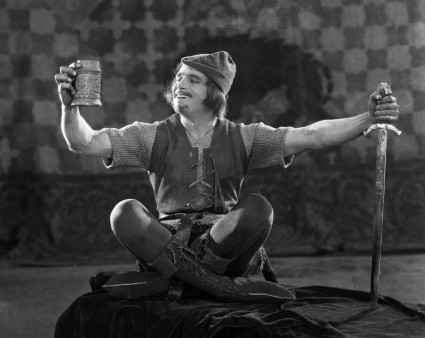
Douglas Fairbanks in Robin Hood (1922)

Robin Hood (USA 1922); starring Douglas Fairbanks. On paper, what could possibly be a greater combination of star and vehicle? And yet … it doesn’t quite live up to its potential. It’s beautifully shot, the grandeur of the sets is stunning, the stunts are phenomenal, Doug is Doug .. .but we do have to wade through some stodge to get to the meat. It’s a full hour before we reach Sherwood Forest; the Merry Men are in place, there is none of the delineations of their characters that we get in the Errol Flynn version … but a load of exposition on how much King Richard and Maid Marian are in love with Robin Hood … honestly, sections could be retitled as a bisexual love triangle. Which would make an interesting film, but it was not what we were as an audience turning up for, in 2010 any more than 1922.

Even the spectacular sets were underutilised; is it me being fanciful speculating that the makers of the later Flynn version saw the former version’s immense spiral staircase and wondered why a duel wasn’t being fought there? The Rathbone/Flynn duel was iconic, the set for it was built in ’22 … but with no fight. If it sounds like I’m criticising a 1922 film for not being a 1938 film, perhaps you’re right; but I do find it surprising that Doug Fairbanks, of all people, could lose sight of what made his earlier films so captivating and so popular, and blow the opportunity the subject afforded. At 2¼ hours, the film is 45 minutes too long, and while in ’22 there could be an excuse for thinking longer = better, it needed someone taking Fairbanks aside – and it must have been him making the artistic decisions – and suggesting heavy cuts. Fairbanks did, I think, learn the lesson … his later adventures are far more taut and packed with action … but the definitive telling of the tale, using lessons learnt from the ’22 film, would be in three-strip
Technicolor and not tinted and toned.

The final show, more French clowns, letters O-S – yes, they were being shown alphabetically by character name all week – started
around an hour after the scheduled time, around ten to midnight; sadly, this was also the showcase for the aspirants from the Piano
Masterclasses that had been running all week. Obviously this was not deliberate, but neither was it fair … I believe some thought has to be
given to avoiding a future repetition, as it was simply too late in the day for most of the potential audience. I know it was for me.


Thanks once again, Mysterious. Some food for thought there. I did actually return from Trieste for the Corrick film show because it included one (not two as billed) of Charles Urban’s films of Burma from 1903, part of a series of films shot by H.M. Lomas for Urban none of which was known to survive before now. Unfortunately it hasn’t proved possible as yet to match the film (which shows a succession of richly-decorated boats, some of them bearing Western tourists, being rowed along a wide river) to any title from the Urban catalogue.

The final day’s report will follow soon.

Pordenone diary 2010 – day one
Pordenone diary 2010 – day two
Pordenone diary 2010 – day three
Pordenone diary 2010 – day four
Pordenone diary 2010 – day five
Pordenone diary 2010 – day six
Pordenone diary 2010 – day eight

Pordenone diary 2010 – day six

Pordenone at night

Thursday 7 October loomed, and your scribe was packing his bags. I had decided that five days in Pordenone at the Giornate del Cinema Muto was enough for me this year, and I was heading off to spend a couple of days in beautiful Trieste. But I could not do so without having set in place plans to ensure that the Bioscope could provide its habitual comprehensive coverage of the festival. You may remember that last year, when I didn’t attend the Giornate, the Bioscope reports were written by an anonymous reporter, subsequently dubbed The Mysterious X. Happily X was at the festival this year and just as keen to pick up the quill pen once again, while just as insistent on maintaining his anonymity. And, by a remarkale coincidence, the first film he reports on is a Benjamin Christensen masterpiece, the film the great director made after producing The Mysterious X … spooky, eh?


Bright and early – well, early – to the Verdi for a film I had anticipated since seeing it had been programmed; Hævnens Nat (Denmark 1916) (Blind Justice) an early feature directed by Benjamin Christensen; Pordenone in the past has given me a taste for Scandinavian silents; on the whole, the lighting and camera techniques seem to me, to have been way in advance of the rest of the world … and one sequence in particular in this thriller demonstrated that to me yet again.

After a strange prologue where we see the director demonstrating an illuminated model of the house where the main action of the film is to take place, we’re into the action; Strongman John is on the run, for a crime he didn’t commit and with his very young son; hiding out in a barn, he decides to try and steal milk from the main house, but is discovered by the young daughter of the family; he explains the situation, and persuades her not to betray him … but the awakened father forces the story out of her, John is captured while vowing revenge, and jailed …

Hævnens Nat (1916), with director Benjamin Christensen playing Strongman John, from http://www.dfi.dk

Fifteen years later, John has suffered physically and psychologically inside the prison, but is now out; naively, even unknowingly, he falls in with a gang of burglars intent on robbing the same house … fifteen years on, the girl is married and now the mistress of the house with a young family … in his confused state, John starts to exact his revenge, not knowing that one of the children is his now-adopted son …

The setting of the film – an ornately reproduced and highly realistic mansion, as introduced proudly at the start – almost becomes a character within it; while light and airy during the day, it seems both claustrophobic and yet flimsily undefendable as night falls and menace lurks. The bravura sequence occurs at the point where the invader spies the young woman through the keyhole; we see it from his point of view, the young girl vignetted, deep focus, within the ornate Edwardian escutcheon, the layers of the lock’s mechanism visible; she senses the viewer’s presence and moves out of shot … seconds later the keyhole cover is slid across our view from her side of the door. We cut to a view of the room’s interior … the woman seemingly
paralysed with fear; the camera slowly tracks back, initially revealing the french windows we are looking through … and then the silhouetted shape of the hulking intruder, seeing the same thing … and those french windows look so fragile now …

It’s a powerful shot now; through the use of imaginative sets, superb lighting and a dramatic camera move, the audience is utterly involved in the menace at work … in the voyeuristic sense, and in the complete powerlessness of our situation as an audience, let alone the situation of the girl in the room … it would be impressive in a film made ten or
twenty years later; stunning in a film of 1916. I won’t reveal the ending; that would spoil things for you if you have yet to see the film; if not screening near you, it’s available on DVD from the Danish Film Institute with a Neil Brand piano score.

Shingun (1930), from http://www.cinetecadelfriuli.org/gcm

Straight on into the next film in the Shochiku strand of Japanese dramas, Shingun (Japan 1930) (Marching On) … in the programme billed as being the Japanese near-equivalent, and inspired by, Wings and The Big Parade … well, up to a point … it starts delightfully; a farmer’s boy, obsessed with his balsa-and-paper flying models and with dreams of real aircraft, develops a friendship with the daughter of the local squire, who introduces the lad to her pilot brother and his flying officer friends; through hard work, and despite the handicap of a lowly class status, he eventually succeeds in qualifying as a pilot and joining the air force. So far, so good, a peacetime Wings story, a cute cross-class nascent love story developing through fine performances by the two leads; Denmei Suzuki and Kinuyo Tanaka were becoming old friends to us by now … the pairing obviously a prized asset to the studio. But right at this point the film takes the most sinister turn, particularly with the hindsight of history. “Is War Likely??” asks a title (I may be paraphrasing, but not wildly) “Yes, Japan has suffered enough indignities” and so we march into the final third of the film …

Well, from here, The Big Parade or Wings, it ain’t. The film-makers might well have seen them, but failed to learn much from them in how to construct either feasible aerial or battlefield sequences. Unlike Wings, the aerial sequences are constructed from a combination of appalling model work – honestly, they look like they were shot using the boy’s balsa models from the start of the film – and laughably bad back projection, as the gunner from a doomed plane passes vital strategic information to another by wing walking and handing it to his opposite number … our farmboy hero. Inevitably, this second plane, piloted by the girl’s brother, is brought down into the battlefield – full of shellfire but little else – but look! A convenient Harley Davidson and sidecar for our hero to requisition, and to load his wounded friend into … after a few minutes bouncing around the field – if the pilot wasn’t seriously injured before, he would be now – they get caught in an explosion, and the bike wrecked … but look!! A convenient horse, grazing in a contented manner, but about to get a rude shock as two airmen clamber on board to complete their getaway … except more shrapnel comes their way, and the horse is abandoned … but look!!! A convenient artillery tractor, abandoned in full working order, it seems, and our heroes complete their escape to safety at around 1½ miles per hour … the strategic information is delivered to the relevant Colonel, the battle is heroically won, etc. Which would be fairly hilarious, except for the nagging thought that the massive amount of military hardware on and personnel on screen, supplied by the Japanese army, are rehearsals for the invasion of Manchuria that would happen within the year. If a silent film with such a nationalistic propaganda theme existed from, say, Germany in 1938, would it be shown with such alacrity? I wonder … anyway, it could have been a great film; it started with real charm, but it did seem as if the film was kidnapped by a propaganda ministry two-thirds of the way through.

The film screened after lunch, Bukhta Merti (USSR 1926) (Death Bay), was an Abram Room-directed film set in the Russian Navy at the time of the Russian Civil War, and described by Ian Christie in the catalogue as a “Propagandist adventure story” … well, I had just sat through one of those, so I gave it a rest, and decided a Spritz Aperol in the Italian sunshine, and a bit of a natter with like-minded people held more appeal. These things happen on the Thursdays, I find … shamingly, I enjoyed the chatting so much that I decided to forego the Jonathan Dennis lecture, given by former Channel Four supremo Jeremy Isaacs, and the man who green-lit Kevin Brownlow’s Hollywood series; for which the world remains grateful; on the basis that he had given a talk locally and recently, so I felt no desire to hear it again; a mistake, as this was a totally different event, and took the form (I was told subsequently) of an extended tribute to Kevin Brownlow, David Gill, and the making of Hollywood; that I would loved to have seen. A mistake on my part … these things, too, happen on Thursdays …

But no missing the night’s big event; the farewell performance of Laura Minici Zotti and her magic lantern show La Grande Arte della Luce e dell’Ombra (The Great Art of Light and Shadow), culled from the enormous collection she has established at her museum in Padua, the Museo del Precinema; the transportation of priceless fragile glass slides no longer being a good idea; Madame Zotti acts as lanternist herself (resplendent in a late-Victorian blue-black shot-silk evening dress, bustle and all) while a lecturer read from the stage; the Verdi had been heavily adapted to enable the lantern to display on the cinema screen, which looked fine from where I was sat, but I did wonder quite how much some people saw from their positions, what with the Verdi’s sightlines.

The show was terrific; the slides spectacular, particularly those examples where, by use of fades, daytime scenes transform to night as we watch; not to mention special slides designed to hold live insects, and live small fish, swimming across the screen … extraordinary. The stalwart of every magic lantern show I’ve ever seen seem to be the kaleidoscopic slides … here they were spellbinding; we really were getting the highlights of the collection. If there was one slight personal disappointment, it was that it was presented very much as a history lecture … which is fine as an approach, obviously; but I was hoping for a recreation of a big magic lantern show of the era, and that wasn’t quite what we saw. But what we saw was unforgettable too.

There was then a fair gap in the programme as the Verdi was turned back into its cinema format, ready for the late screening of more of the 1910’s French comedy shorts … so I took in some air, honestly meaning to take in the second half of the set which included some Max Linder … and possibly the 1hr 37m Shochiku drama Kinkanshoku (Japan 1934) (Eclipse) due to start at 11.20pm … but I failed you. I feel deeply ashamed …


No shame, please, Mysterious. I haven’t made it to a late screening at Pordenone for years now. Many thanks for an attentive and illuminating account. The report on Friday’s offerings will follow soon (hopefully with just as many eye-catching ellipses, semi-colons and classy use of words like ‘escutcheon’).

Pordenone diary 2010 – day one
Pordenone diary 2010 – day two
Pordenone diary 2010 – day three
Pordenone diary 2010 – day four
Pordenone diary 2010 – day five
Pordenone diary 2010 – day seven
Pordenone diary 2010 – day eight