Pordenone diary 2009 – day eight

pordenone_bicycles

And so we come to day eight and the final day of the Pordenone Silent Film Festival, Saturday 10 October. As before, the report comes from our anonymous correspondent, who was loyally on call for the entire festival. Here’s how things came to a close …


It’s the final day already … how did that happen? The mixed feelings are intensified, the dread of going back to reality, and more of those goodbyes to the dispersing clan, against a sense of relief that there isn’t a Day 9, and we can catch up on much-needed sleep. It’s the end of a holiday, with all that entails.

The films. First up is a programme of early cinema, starting with 15 minutes of short films and fragments from Italy’s pioneer Italo Pacchioni, a good mix of actualities and home-produced comedies, the highlight being the funeral procession of Giuseppe Verdi, in 1901. Then some classics from the US; The Dream of a Rarebit Fiend (USA 1906), a truncated The “Teddy” Bears (USA 1907), lacking the violent ending, both by Edwin S. Porter for Edison; Bronco Billy’s Christmas Dinner (USA 1911), a brief tale of Yuletide redemption, featuring an exceptional sequence of an out-of-control stagecoach tearing down a dusty track, partly from the POV of the roof luggage. After this came The Aerial Wire (USA 1914), an episode from The Perils of Pauline, which fulfilled its brief as a serial episode, full of action and not giving the audience enough time to analyse the unlikeliness of the plot; and a decided change of pace, Winsor McCay’s The Sinking of The Lusitania (USA 1918), the first time I had seen this masterpiece in its entirety. Naturally the film is propagandist, but it still retains the power to affect … and the animation is astonishing.
masterofthehouse

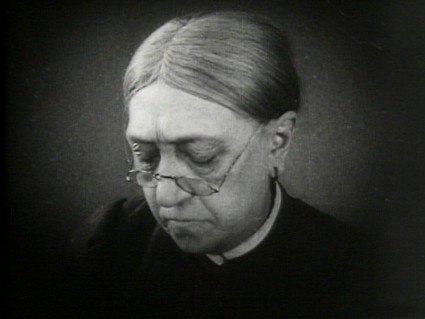
Mathilde Nielsen in The Master of the House, from http://www.dvdbeaver.com

Ignorance display time; the next film up is Dreyer’s The Master of the House / Du Skal Aere Din Hustru (Denmark 1925) which, not having seen or having read about I had ignored as a potential DVD buy, as some Dreyer had left me cold on the small screen. Despite the Ibsenish title (and the catalogue notes that gave no clues as to what to expect) it’s a marital comedy, albeit with a fairly relentlessly miserable first reel, establishing the main character as being an appallingly selfish husband and father, before he is brought to realisation and redemption by the combined might of his mother-in-law and in particular his elderly family nurse. In the latter role, Mathilde Nielsen gives the most stunning, pitch-perfect performance as the iron-willed but wise retainer who teaches her now-middle-aged former charge one last life lesson. Utterly believable, highly affecting, and drily amusing. For me one of the highlights of the week … the Dreyer comedy, alongside the Soviet comedy. And that’s why we come, we learn so much; mainly about the dangers of preconceptions and received wisdoms.

And so to the last batch of Sherlockiana; starting with Unos Banke E Fuxe (Czechoslovakia 1923), intended I think as a sort of farce/spoof featuring an utterly ineffectual detective named Sherlock Holmes II; the film is stolen by the future Anny Ondra; she is the object of an elopement-gone-wrong which mutates into the kidnapping of her banker father. Someone I know uses the phrase ‘historically interesting’ as a euphemism in cases like these; films that you should see, but don’t actually work as films … it was photographed well enough; the camerawork was by a young Otto Heller, the DP on Michael Powell’s Peeping Tom nearly forty years later … perhaps the Czech sense of humour doesn’t travel. So ‘historically interesting’ it is.

There followed two newsreel items, of Arthur Conan Doyle in person; en famille in 1922, and solo, and with sound, from 1928 but released later. Whatever you feel about his obsession with spiritualism, the main subject of the interview, he comes across as a really warm, avuncular human being.

And suitably, to round off this excellent thread, The Final Problem from The Last Adventures of Sherlock Holmes (GB 1923) – the Reichenbach Falls story, here relocated to Cheddar Gorge, scenically and dramatically filmed; suitably, Guenther Buchwald and Donald Sosin used the theme music from the Jeremy Brett-starring ’85 TV version as their starting point – this story would not be filmed again in the decades between Eille Norwood and Jeremy Brett. A fitting climax; this is a worried Holmes, feeling Moriarty’s presence everywhere and with a pervading sense of doom. It does also demonstrate Norwood’s not-always-explored acting range … he’s an underrated actor, more than just a personification of Paget’s illustrations.

Die Gezeichneten (Denmark 1922) is another Dreyer-directed film, but very different to this morning’s fun; this is a tale of anti-semitism and the political background to early 20thC pogroms in Russia; even now this film has the power to shock; still violent, still powerful, and bravura filmmaking.

And so to the final gala, with newly-abbreviated formalities, prizes having been awarded at an earlier separate ceremony – the Prix Jean Mitry shared between Mlles Méliès and Linder, for their continuing work in keeping their family heritages alive for all of us. So, we thanked again the sponsors, the city of Pordenone and the region, all of whom support and subsidise our continuing obsession, and those that make the whole festival work, the support staff behind the scenes that we rarely even see, let alone get to know. And onwards; Alice’s Wild West Show (USA 1924) one of Disney’s series combining fantasy animation with Our Gang-style live action antics … good fun, 85 years on, and shown to commemorate the passing of its star, Virginia Davis, this year.

Fun being the operative word with the main course, the Ukelele Orchestra of Great Britain’s silent film show Ukelescope, not a show designed to be taken too seriously, but as an entertainment; a mixture of songs, tunes, and spoken word illustrating films not otherwise seen by the general public now; advertisements, scientific films, instructional films, cinemagazine articles and assorted shorts. Unchanged since I saw it in the UK, I think the show would have benefitted from both an Italian translator, and a louder vocal mix; so much is verbal, so much was lost to many. However, the audience responded well to both the musicianship and the films; a huge ovation at the end. Highlight possibly the marriage between Old London Street Scenes (GB 1903) with the music hall song ‘In the Old Town Tonight’, terrific footage with a moving song. That and Will Evans The Musical Eccentric (GB 1899) performing to GrandMaster Flash & Melle Mel’s classic White Lines (as performed on ukeleles, naturally).

And so there we were, at 10.45pm in the cool Italian night air, ignoring the scrum for free local wines in the theatre mezzanine (and one last programme of early short films that looked familiar on paper) so we retreated to the bar for the post-mortem, the catching ups, the leavetakings, the expression of personal thanks to the staff we do know for all their efforts. I can’t work out quite how that took 6½ hours, but I ended up reaching my bed precisely 2 hours before my alarm call. Pordenone, motto ‘Sleep Is For Wimps’. See you all next year if we’re spared.
pordenone_building

Post- festival reflections; apart from ‘I’m getting too old for this’ that is? It was, as it always seems to be, a superbly run and well curated festival, if perhaps not a classic year; there was a feeling abroad early on that some of the films, particularly from the Albatros thread, were overlong and underwhelming, but I think things definitely improved in the second half of the week; that the Canon Revisited thread had definitely been a success, and particularly welcomed by the large numbers of younger silent film enthusiasts, who had not had the chance to see them on the big screen, if at all; that the Sherlock Holmes and others thread had been very good indeed, and that the occasionally-maligned Stoll productions had stood up very well indeed; that the musicians had played out of their skins all week; that the recognition of the work being done by and for the British Silent Film Festival was overdue – but very welcome. And finally, although it is a very large festival by silent festival standards, it is also one of the friendliest; old hands do go out of their way to accommodate and welcome the new hands into what may seem to be a clique; the staff at the Festival and all the local bars and restaurants do their utmost to break down language and comprehension barriers, and go out of their way to be helpful. I cannot recommend it more highly.


Well said, and thank you Mysterious X for such a sterling effort. Those of us who should have been there now feel as though we had. See you there in reality next year.

Report on day one
Report on day two
Report on day three
Report on day four
Report on day five
Report on day six
Report on day seven

Pordenone diary 2009 – day seven

verdi_walls

We’re back at Pordenone for the report on day six of the Giornate del Cinema Muto, as recounted by our eagle-eyed correspondent, the Mysterious X (known as X to his friends, Mysterious to his mum). It’s Friday 9 October, and it’s another early morning start.


9.00am and the latest from a multi-year project to restore and re-evaluate the silent work of director Hans Steinhof; at Pordenone and other festivals I have all of these, and I have to say, with the possible exception of Alleycat, this newly (and not quite completely) restored film, The Three Kings/Ein Madel und Drei Clowns (GB/Germany 1928) is the most successful and satisfying work. This was one of Steinhof’s Anglo-German co-productions, and was released in three distinct versions, British, German and French; this restoration, as each surviving element was missing footage, is a compilation of all three most resembling the German edition, although each version is being restored. This is a tale of three brothers, whose clown act is a star attraction in The Tower Circus in Blackpool. The film (this German version at least, apparently not the British cut) starts with a stunning aerial shot of Blackpool and never lets up; slickly paced, well cast, with Henry Edwards, Warren William, John Hamilton as the three very different brothers and Clifford MacLaglen and Evelyn Holt as the lion-tamer and his ex, who will impact on the brothers; and with wonderful location footage of Blackpool at play – though the studio work was filmed in Germany. The climax of the film is a circus fire – in a sequence as yet incompletely tinted – and possibly incorrectly in places – in which the film’s writer, Henry Edwards, is visibly doing his own stunts; his sleeved arm heavily ablaze at one point. Altogether an engaging film, and very entertaining; hopefully this long-forgotten ensemble-cast film will become better known through repeated screenings. A double-bill with the 1990’s Blackpool-set Funny Bones would be very interesting …

maxims

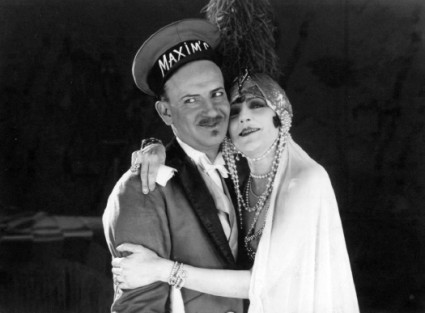
Le Chasseur de Chez Maxim’s, from the Pordenone catalogue

Next, another comedy from Albatros starring Nicolas Rimsky; Le Chasseur de Chez Maxim’s (France 1927), a story filmed many times over the years, is a true French farce; the owner of a French stately pile works nights as the doorman-cum-fixer at Maxim’s, a gambling and dancing club for the Parisian elite – until the inevitable happens and his two worlds collide. In many ways this could have been a classic; many fine situations worked to great effect, in particular a hunt sequence worthy of Jacques Tati; but too many, too much, making the film way too long at 2h 10m. Had the makers removed a couple of extraneous sequences we would have finished with a greater film. But Rimsky was superb … we just needed a smaller dose.

After lunch, more from the Sherlock strand, starting with one of the Bonzo cartoon series, Detective Bonzo and The Black Hand Gang (GB 1925) in which Our Hero foils an anarchist gang plotting to kidnap a top jockey before Derby Day. One of the best of the 26 Bonzos, it perhaps needed a bit more than the 20fps for full impact … but always nice to see a Bonzo on the big screen. Next was an episode of a series new to me, Inscrutable Drew, Investigator; The Moon Diamond (GB 1926) from Fu Manchu director A.E. Coleby. A fairly standard plot regarding the seemingly impossible theft of a jewel, it was not one of the action-packed items we had been treated to here … it was somewhat stodgily paced, and the direction wasn’t sparkling either. There followed one of his Fu Manchu episodes, The Knocking on the Door (GB 1923) which did indeed rattle with pace and thrills, if you overlook the casual racism that inhabits all of the Fu Manchu tales. The catalogue notes, by the thread’s curator Jay Weissberg, put forward the idea that Coleby was at his best when free to indulge in the sensational elements of serial film-making; on the evidence of these two episodes, I wouldn’t disagree. There followed La Mano Accusatrice (Italy 1913) a thriller that wasn’t doing it for me; but you have to bear in mind that at the tail-end of the week the cumulative effect of lack of sleep is increasing – it might be great with a fresh pair of eyes.

Either way, out I went for 30 minutes of caffeine and sun to clear my head for the second Shaw film of the week, a newly-struck print of the previously (until the British Silent Film Festival in June) neglected adaptation of an equally neglected H.G. Wells novel, The Wheels of Chance (GB 1922). Filmed, as is seemingly usual with Shaw, largely on location with strong emphasis on pictorialism. Wheels of Chance is a comedy with a plot borrowed from a melodrama, with George K. Arthur, back from Shaw’s Kipps, as a draper’s assistant on a cycling tour foiling the machinations of a foreign-named cad – Bechamel – trying to elope, also by bicycle, with a naive suburban girl thereby trapping her into compromising situations in Home Counties pub/hotels, while her mother and her entourage set off in pursuit. Charming but never cloying, the happy ending here is not the unlikely riding off into the sunset – socially impossible in those times – but a recognition by all parties of the lessons learned; she is less naive, and she and her elders have learned respect for their ‘social inferior’; he gains self-respect, and has had his horizons broadened just a little bit. The print seemed just a bit on the dark side, but not so dark as to spoil the effect of the photography; it’s a well-made film, with its heart in the right place, and those evocative shots of 1920s Surrey and Hampshire, with the perfect soundtrack provided by Shaw enthusiast and expert Phil Carli. I feel the need for a location tour … a day by car, perhaps a long weekend by bicycle …

Final film of the day for me was L’Ile Enchantée (France 1926), a somewhat strange film combining two seemingly unrelated film cliches; a Corsican bandit engaged in a family vendetta, while defending his family castle from destruction for a hydro-electric project for the local steelworks. The image of the Valentinoesquely-garbed bandit – educated and with full medical training, incidentally – waving his ancient percussion-cap shotgun around 1920s Bessemer ovens was distinctly odd – if beautifully lit and shot. Just to complicate matters, our bandit hero falls for the (female) steelworks manager, around the time he saves the life of the pursuing local police chief’s daughter, through a medical intervention. All heightened stuff, then, stunningly shot in the Corsican hills and the aforementioned steelworks – in Normandy. Tosh, but quality tosh, and helped immensely by the feature film debut of Pordenone masterclass aspirant pianist Cyrus Gabrysch. The word, from them that know these things, is that he could be a bit special. He certainly impressed at this film.

jaccuse2

J’Accuse

Then came the anti-war leviathan that is Abel Gance’s J’Accuse (France 1919) freshly restored to approaching its full original length – 3 1/4 hours at the 16fps requested by the festival. I made my excuses, as I will be seeing Stephen Horne, who performed here, playing to it at one of the UK outings in November – The Watershed, Bristol, or The Barbican or BFI Southbank in London, when I will hopefully be in a better state to fully appreciate it – though it will be screened at 18fps there. The speed as ever the source of great debate here; at the J’Accuse Collegium session it was revealed that the Nederlands Filmmuseum recommended 18fps to all the venues, but Pordenone felt differently; the consensus of those who saw it this night was that the speed looked about right, and that it was felt that the projection speed may have been increased towards the end – an overall speed of 17fps, some felt; I’ll reserve my own judgement until I’ve seen it in the UK at 18fps.


Ah, run ’em all at 24fps and you’ll be able to pack in another house. Anyway, our next diary post will be our last report from this year’s Pordenone silent film festival, with early films, Sherlockiana, Dreyer, ukeleles and some final thoughts.

Report on day one
Report on day two
Report on day three
Report on day four
Report on day five
Report on day six
Report on day eight

Pordenone diary 2009 – day six

pordenonestreet

We’re on the day six of the 2009 Pordenone silent film festival, with our intrepid reporter The Mysterious X once again turning his feverishly scribbled notes into a finely-honed account for our delight and posterity’s great benefit. So here goes with Thursday 8 October’s offerings:


Thursday already … and Pordenone regulars know what to expect – a gloomy feeling, as the end of the Giornate is in sight, and the nagging idea that we all have to return to the real world soon … and for those who could only make it for half a week, and opted for the first half, those goodbyes, perhaps for another year, have started. But put those thoughts to the back of the mind, and plough on …

And the potentially long day starts with Justice d’Abord (France 1921) from the Ermolieff Studio, before it became Albatros; and at last a chance to see the great Ivan Mozhukhin, their greatest star; he plays an implacable State Prosecutor tackling an espionage ring, only to find that his artists model girlfriend may be involved – and has to prosecute her. Can a Russian ending be far away? The print seems slightly abridged, or missing some footage, but it is still a very watchable film, if not up to the later great Mozhukhin-starring classics. Immediately we see why Mozhukhin was so successful … he elevates another melodramatic plot into something greater; you cannot take your eyes off him on the screen. I do feel the Albatros thread has been weakened by the lack of the great Mozhukhin vehicles; not programmed because his films were shown a few years back, in a Mozhukhin tribute at Sacile (where the Pordenone festival was located for a number of years. Ed.). Understandable, but even one would have been nice; I would travel a long way to see Kean again.

This was followed by Nocturne (France 1927) , another Albatros, a short film made at the same time and with the same leads as Carmen, apparently at the crew’s hotel. Beautifully shot, and beautifully acted one-act tragedy, but even so a bit langourous after the previous film; it did also feature some very subtle piano work from Touve Ratovondrahety.

More Sherlocks; starting with The Sleuth (USA 1925) , a solo outing for Stan Laurel, one of his film spoofs made for Joe Rock. Here, as a detective who struggles with those interlinked nails puzzles, he infiltrates a household to solve a crime; as the maid. I think you can see where that is heading …

A Scandal in Bohemia (GB 1921), I think is the best Elvey/Norwood episode I’ve yet seen, helped by the tale, of a less-than-great success, with Holmes revealed as being less than perfect; and here, he is beaten for once, by the beautiful and engaging Irene Adair, renamed from the stories where she was Irene Adler. Too Germanic for 1921 Britain? Told very wittily, and with a lightness of touch Elvey is not always credited with.

Der Gestreifte Domino (Germany 1915) was well plotted, with a mix-up at a post office resulting in detective Stuart Webb stumbling on a conspiracy … but once more, the film moves at a very leisurely pace compared to the British series.

rhodesia

‘Chief’ Kentani in The Rose of Rhodesia

After lunch, the much-anticipated The Rose of Rhodesia (South Africa 1918) the recently restored Harold Shaw feature set in Rhodesia but filmed on location in South Africa. I’m delighted to say it stands up to all the hopes; the attitudes of the characters are notably liberal for the day, the characterisation of the native roles and their relationships with the white settlers is shown to be that of mutual respect, by and large; the intertitles don’t always reflect this, but as the print was for a German-language release they don’t necessarily entirely match the originals. The photography is superb – astonishing considering what must have been trying conditions; the acting, particularly that of Edna Flugrath, Mrs Shaw, subtle, and, as we have come to expect from Shaw’s films, the use of locations is spectacular. One flaw is the plot, pretty throwaway, and come the climax it is pretty much thrown away; again the caveat is that the existing print is the equivalent of two reels shorter than the version seen at its premiere, so some exposition may well be lost, if not an entire subplot. (See the Bioscope’s review of the film here, with link to a streamed copy of the film).

On Strike (USA 1920) is a delightful Mutt and Jeff cartoon, wherein our heroes see producer Budd Fisher’s regal lifestyle in a (live action) newsreel; they threaten to strike for better terms, their bluff is called, and they’re sacked. But Hey, how hard can this animation lark be? Mutt and Jeff set up their own animation studio – the basics of the process shown – and the end result of their efforts is another Mutt and Jeff….but drawn and plotted as if by a ten year old … very neatly done, the cartoon within the cartoon. The end product goes down badly with the preview audience, so they creep back to Fisher and the status quo restored.

L’Heureuse Mort (France 1924); a French farce on the subject of celebrity death; a once-respected but now-struggling playwright is swept overboard from a friend’s yacht; by the time he makes it back to land and civilisation he finds himself being mourned; the newspaper obituaries falling over each other in their race to elevate him to the pantheon of French literature; he arrives home to see his own memorial service, and to reveal his survival to his mourning wife. Not keen on seeing himself relegated to hack playwright again, he hatches a plot with his ‘widow’, to arrive and live as his own Senegal-based brother, while producing fresh works to be ‘discovered posthumously’ in the home. Until his real brother arrives … Nicolas Rimsky, as the author and his brother puts in a top performance delineating both men with subtle differences … very neat, and very funny, and still topical on the celebrity front.

After the special Harold Shaw Collegium, which discussed both his work and career, and the case of Rose of Rhodesia in particular, but which annoyingly clashed with a Holmes programme including a 1912 French version of The Musgrave Ritual, I fell into a particularly good dinner and conversation; so skipped Der Furst von Pappenheim (Germany 1927), a gender-based comedy, and subsequently didn’t feel up to Gunnar Hedes Saga (Sweden 1923), a Mauritz Stiller-directed adaptation of the novel by Nobel laureate Selma Lagerlof. By all accounts, by those who made it, one of the highlights of the week, but given a start time of approaching 11.00 pm. Hopefully I’ll get a second chance one day … Pordenone can have its frustrations.


Now I can remember A Scandal in Bohemia from a long time back, when I noted it as being something rather exceptional. It’s good to have that memory confirmed as a sound one. Next up, day seven where we will visit the Tower Circus in Blackpool, Maxim’s in Paris, the hills of Corsica, and the Home Counties of England – by bicycle.

Report on day one
Report on day two
Report on day three
Report on day four
Report on day five
Report on day seven
Report on day eight

Pordenone diary 2009 – day five

verdi_wall

We continue with the daily reports from the Pordenone silent film festival supplied by The Mysterious X (which I have decided is a suitable name for our determinedly anonymous reporter), having reached Wednesday 7 October. And it was a day that started off with what undoubtedly would have been your editor’s highlight of the week, had he only been there. Alas, alas.


Firstly, may I add my apologies to John Sweeney, and indeed Donald Sosin, for misattributing the piano work on Monday … I did double-check at the time, and than forgot to write it down … fatal.

It’s an early start for fans of the crime thriller, but well worth it … because the very first film was the utterly splendid A Canine Sherlock Holmes (UK 1912) preserved and presented by the Nederlands Filmmuseum; around 3/4 parody, yet also partly in the tradition of Rescued By Rover, our hero here is a fairly nondescript-looking terrier, rejoicing under the name of Spot (in the catalogue named as Spot The Urbanora Dog, which raises hopes that there be more films starring the little chap … Mr Editor?) (Alas no, but the world’s archivists must go and hunt for some as a matter of urgency. Ed.). He has an aristocratic detective owner, but there is no mistaking who is decidedly the brains of the outfit; I really want to describe the detecting, the trailing of the thieves and the ruse employed by Spot to gain entry to the hideout, but this is a film you will want to see without too much in the way of pre-formed ideas … so let me say that Spot is the most accomplished canine actor I’ve seen since Eddie in Frasier

spot

Urbanora poster for A Canine Sherlock Holmes, from the Giornate del Cinema Muto catalogue

The Mystery of Dr Fu Manchu episode today was The Clue of The Pigtail (UK 1923) which rattled along efficiently and featured a decent stunt; a three or four-storey dive into a Thames dock somewhere off ‘Chinatown’ … cue re-use of Stoll’s Chinatown sets, interiors and exteriors, from The Sign of Four. The ersatz Holmes adventure, William Voss, Der Milliondieb (Germany 1916) was interesting, with a good plot about automata, impersonation and fraud, but exceedingly leisurely pacing within the film – langourous shots, loose editing – all but wrecked any pleasure. It may be unfair to compare films made seven years apart in this era, but after the Stoll serial, this did drag.

From Albatros, or rather their predecessor company Ermolieff, came Le Quinzieme Prelude De Chopin (France 1922) a film with a lot to interest outside of a pretty melodramatic plot, though that was handled well by Tourjansky, who made it seem just about believable … the film invests the Chopin piece of the title with near-magical powers to both calm but yet also bring people out of depressions … equally beloved by the cuckolded father of the family in the film, and the disabled young man next door. The playing for the film by Mauro Colombis was simply superb, borrowing heavily from Chopin as you would expect. The more unexpected treats within the film, early on before the family unit collapses, are extended sequences of home cinema evenings, with (well-faked) Chaplin comedies being projected by a hand-cranked Pathe (possibly 28mm?), later inspiring some creditable Chaplin impersonations, improvised by the young boy of the house.

My first Collegium session of the week was on the subject of colour restoration techniques, hosted by Haghefilm; I’m not any sort of technician so some of this went over my head, but it is heartening that work continues to be done to try and improve both digital and traditional restoration techniques; and that there may be mileage in combining Desmet toning with traditional dye tinting … which means there would be no need to use the potentially dangerous chemicals used in traditional toning, and yet could give more subtle, and closer to the original, effects than Desmet tinting and toning which can seem overcoloured. I think I’ve got that right … hopefully someone will inform me if I’ve got that wrong.

torres

Back into the Verdi for the programme of short British films with the theme of sound and music; some experimental sound on disc films, some just about music. Based heavily on the programme curated by Tony Fletcher for the British Silent Film Festival at the Barbican in London this June, it included some real gems … the highlights being the combining of anthropoplogical film with cylinder recordings both made on the same expedition to the Torres Strait peoples in 1898 (left); a short actuality of children dancing what seemed to be a clog morris to a street barrel-organ; Seymour Hicks and Ellaline Terris in a series of song and dance showcases; a proto-bouncing-ball film for The Tincan Fusiliers, and my personal favourite, a circa-1911 Hepwix Vivaphone – a film made to accompany a pre-existing disc – Are We Downhearted? No! a song that would be reworked in the trenches of WW1 but here in its original form, performed (well, mimed to) by a cast of Hepworth stalwarts with real verve and energy.

I ducked Rotaie (Italy 1929) from the Canon thread; needless to say everyone who saw it rated it very highly … but returned for La Dame Masquée (France 1924), from Albatros – described in the catalogue notes as misogynistic, I read it slightly differently; to me, only the heroine had any redeeming features; all the men were venal, cheats, blackmailers or whatever, the Aunt figure no better; the Uncle weak and vacillating until stirred into action in the final reel of what had by then become a superior episode of Dr Fu Manchu … but it held the attention, and the freshly-arrived Neil Brand probably improved the experience no end.

dergolem

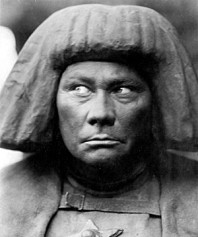
After dinner a special event; a performance of Betty Olivero’s score, for a quintet, for Der Golem (Germany 1920) conducted by Guenter Buchwald; it employs a string quartet plus clarinets to evoke both the medieval ghetto and the palace seen onscreen; a klezmer palette for the ghetto, courtly dances for the palace … beautifully played, and the players richly deserved the sustained applause. It’s a very strange film though, and despite repeated viewings I can’t help but think that, though within it there are a series of iconic and influential images, it doesn’t quite succeed as an entity … too uneven in tone? Maybe it’s just me.

The last film of the day was a city symphony film, Etudes Sur Paris (France 1928) by André Sauvage, which I declined for a quick couple of glasses and a relatively early night …


And so we bid farewell to day five of the Giornate del Cinema Muto. Stay tuned for what will unquestionably be day six, coming up soon.

<a hrefReport on day one
Report on day two
Report on day three
Report on day four
Report on day six
Report on day seven
Report on day eight

Pordenone diary 2009 – day four

pordenone_street

It’s time once more to leaf backwards through the calendar to Tuesday 6 October and day four of the Giornate del Cinema Muto, best known as the Pordenone Silent Film Festival. And once again we are in the hands of our tantalisingly anonymous guest reporter, who does at least let slip his or her national identity in this latest report. Read on…


Five hours of sleep later, and back into the fray again; firstly a couple of Rediscoveries and Restorations; an abbreviated print, but a rare sighting of silent Japanese popular cinema, Kurotegumi Sukeroku (Japan 1929) recovered from a 16mm ‘Digest’ print by the Tokyo Film Preservation Society, a small group of enthusiasts gleaning films from private collections in Japan and rescuing them from total oblivion. At roughly one third its original length, plot and characterisation has rather gone by the board, but you do get the feel of more authentic, yet still idealised, Samurai behaviour than we generally see, before the suberbly choreographed sword battle at the climax. As someone who grew up with pre-wire-work Samurai-based TV shows like The Water Margin, this was a real pleasure.

The other film was Eine Versunkene Welt (Austria 1922), a very early film from future saviour of the British film industry, Alexander Korda, starring the actress who would become Maria Corda, from an adaptation from Lajos Biro, another refugee-to-be from their native Hungary. Another tale of an aristocrat marrying a dancer and being disinherited, although apparently based on a factual cause celebre, it was a bit staid and dull, although Maria did show flashes of why she would get a Hollywood career, however brief. In its favour, it did have some wit, and some good use of the shipboard location. Not the greatest work these names would be linked to, but it’s instructive to see the apprentice pieces by such important figures.

polanegri

Pola Negri in Wenn Das Herz in Hass Ergluht, from the Pordenone catalogue

More Divas; Wenn Das Herz in Hass Ergluht (Denmark 1918) was a welcome and rare chance to see a Pola Negri film; we see the iconic stills, Marion Davies or others impersonating her, but not often do we see the original in action. And she is impressive. Wenn Das Herz is a Pola Negri vehicle, designed to show off her dancing talent in her role as a circus snake dancer destined for the big time, despite the efforts of the circus owner, and her ex-boyfriend, a villainous turn from Hans Schlettow, that nice Devonian farmer from A Cottage on Dartmoor. The former needs her act to prop up his failing business, the decond wants her back from the aristocrat backing her ascent in the showbiz ranks. This film had the lot; lust, deception, gambling, framed aristocrats, matters of honour and interspecies wrestling. I won’t disclose the ending as it should remain as big a surprise as it was to us … the sound of jaws hitting the Verdi floor was quite audible.

Amore Senza Stima (Italy 1912) is a tale of marital deception starring the fetching Francesca Bertini; she seemed a bit underutilised as ‘The Betrayed Woman’ and I’ve seen the theme handled better; however the camerawork and the use of light and shade were outstanding for the year.

After a lunchbreak catching up on notes, one from the Rediscoveries / Restorations strand; a spanking print of an Ossi Oswalda comedy, Die Kleine Vom Variete (Denmark 1926) another variation of the ‘marry that actress and I’ll disown you’ theme so popular this week; Ossi obviously has great fun as a cross-dressing (as a cowboy) cabaret knife thrower secretly married to the heir of an uncle’s fortune; Uncle has other ideas … like the ward of an extremely respectable business acquaintance. There is a superb sequence introducing said ward; remember the group exercise sequence in Diary of a Lost Girl?? Louise Brooks and the others to the rhythm of a gong??? Well, here the ward is at some kind of progressive finishing school; we have a group full of Louise Brooks’ exercising to a sax-heavy jazz band … you would swear someone was satirizing Pabst, but this was three years earlier … Ossi is a lively, sparky charismatic presence on screen, known as ‘Germany’s Mary Pickford’ but actually more like Betty Balfour in appearance and verve; the film is a farce comedy with good supporting players, and a real delight in a festival a bit lightweight in comedy thus far.

The one annoyance was emerging from it to find that it had clashed with the one show I had wanted to see in the Ridotto, and which I had overlooked in my rush for a seat in the Verdi; Jean Darling in conversation with a rejuvenated David Wyatt; with clips and so forth. I had seen them do similar shows before, but they are always a delight, and every time some new angle, some new information, comes from the mind of one of the very last people bearing witness to the business end of silent Hollywood; and such, apparently, was the case here. Aaargh.

More Sherlock and co.’s … a perennial favourite in Britain is The Peril Of The Fleet (UK 1909), a precursor of nearly every other spy thriller ever made; the plot, the hunt, the tracking, the ‘saved in the nick of time’, the world safe for the time being (or the fleet at anchor, in this case, gorgeously depicted in a sea-borne tracking shot past the sterns of Agammemnon, and her sister ships). That all said, it does creak a tad, and there were one or two giggles at some points; we’re so much more educated in the genre, I suppose. But this is its beginning, and the actuality-style footage is superb … followed by the Maurice Elvey/Eille Norwood The Sign Of Four (UK 1923), with its wonderful climactic chase by road and river from Twickenham to Barking via every landmark a capital tourist guide could think of … it’s a decent thriller, well handled as usual by the prolific Elvey, and I actually prefer this version to the more-familiar-to-most Jeremy Brett take from the eighties; much of the detection is explained in a lengthy flashback, but then that is the structure many of Conan Doyle’s tales take – and which make them apparently so difficult to successfully adapt, despite their fame.

Rediscoveries; Monkeys’ Moon (1929), a pleasant, well-executed but slight film about two Capuchins enjoying an evening in their owner’s moonlit garden, from the avant garde crowd (Kenneth Macpherson et al) who gave us journal Close Up. Nice enough, and with technically very good close-up photography, but not about to bring Hollywood down around its ears … this was followed by another personal revelation. I confess to having blindspots in certain areas, and one such is Soviet cinema. The Russian avant garde I can admire to a point, but … it leaves me cold. This, though, was a very different Soviet film.

trubnaya

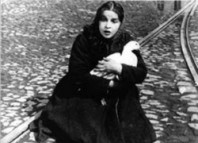
Dom Na Trubnoi (USSR 1928) (The House on Trubnaya Square) is a quite wonderful film; starting as if it was going to be a straight city symphony film: nice photography, dawn sun glinting off the tram tracks in freshly-washed cobbles, and so on; but it gradually fragments into a visual anarchy until the film is paused; and the narrating intertitle remembers he’s forgotten to tell us why the peasant girl who has rescued the goose and is apparently at the mercy of the speeding tram is there in the first place … so we go back to her beginning out in the sticks, until her story can catch up to the point where we last saw her … by the time of the film’s end, we have had a mild dig at the workers (social co-operation not apparently extending to cleaning arrangements in the tenement), their living conditions, the petit-bourgeouis, agitprop theatre – before delivering a message that union membership may be quite desirable and delivering the happy ending Russian cinema is not known for. In amongst all that, it delivered real laughter and huge applause in the Verdi. Lovely print too … film of the festival at this point, and it has overtaken Chess Fever as my favourite Soviet comedy of all time. But then I have only seen the two; I hope you don’t mind me displaying my ignorance here. Rumour has it that it may be available on DVD in France?? I must check when I get home … (It’s available from Bach Films. Ed.)

chaplincartoon

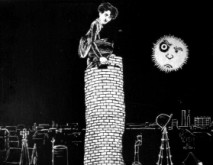
After dinner, a compilation show of gems from the Yugoslavian archive, celebrating their sixty years. Many of local origin, as you would expect; but including their imports from over the decades. Some early travelogues of Serbia were followed by a 1909 short L’Ostaggio, an Italian film of loyalty and bravery rewarded, in a classical setting but adapted from a Schiller poem; a 1903 art-nude film from Germany, featuring statuesque nudes posing on a giant turntable, rotating as we view … a 1909 Edison Hansel and Gretel starring Mary Fuller; but the most effective, and most affecting was a late silent, Sa Verom U Boga (Serbia 1932) (In God We Trust), a rural Serbian take on The Big Parade … low key, acted seemingly authentically acted (you suspect a large percentage of the cast are cleverly-cast amateurs) and very moving. The programme finished with two as-yet unidentified animations featuring Chaplin’s Tramp as the main character. Obviously both from the same hand, seemingly from the late 10’s early 20’s, nothing is apparently known of their provenance, and feature no identification apart from locally produced (and crude) title cards, and a flourishing hand signing ‘ZIP’ at the end of one. Very nicely animated, with Chaplin captured brilliantly, using the cut-out animation technique against chalk-board style background art. The consensus, in our little group at least, was that they could well be British; the English-language shopfronts don’t prove much, but twice Charlie is confronted by a very well detailed British police sergeant – unlike his films, then all US-set, – the technique is right for Britain, as we seemed to favour cut-out over Winsor McCay style drawn animation; and it did seem in places vaguely reminiscent of Dudley Buxton … so who is/was Zip ??? The Yugoslavian Film Archive would like to know …

Last up, a couple more films featuring Francesca Bertini, from the Divas thread … but I was fading fast, so forewent the pleasure … and talked animation and Chaplin around the bar instead.


Quite a day, and there’s more to follow in day five, when we shall sing with Hepworth, shiver to the Golem, thrill to Fu Manchu, and cheer the heroics of perhaps the finest name an animal star could ever boast – Spot the Urbanora Dog. Don’t miss it.

Report on day one
Report on day two
Report on day three
Report on day five
Report on day six
Report on day seven
Report on day eight

Pordenone diary 2009 – day three

verdi_windows

It’s Monday 5 October 2009, and again the Bioscope’s man of mystery rises early, takes up the notepad and pen and dutifully arrives the moment doors open on the Pordenone silent film festival to catch day three’s varied offerings. Here’s our correspondent’s report:


9.00am already??

Graziella (France 1925) is a Film D’Art adaptation of an epic poem of lost love; set in a fishing town in late 18th C Italy, it boasted stunning photography of the coast and villages around Naples, which seemingly had changed little in the intervening 150 years; it used the local faces realistically, and only the lead actress Nina Vanna seemed a little out of place. The storm sequence is superbly handled, and was vaguely reminiscent of the more famous tank-work featured in Napoleon, and utterly believable. The story, quite slight, is of two aristocratic and somewhat patronising Frenchmen slumming it in Naples until they find work as fishermen – as an experiment – and love. The ending, which I won’t reveal, comes entirely out of nowhere – possibly the source poem by Lamartine gives some earlier clue – but a film well worth watching for many differing reasons, and not necessarily the plot.

tencommandments

At 79 minutes, Graziella was a mere appetiser to the main course; 2 hrs 39 mins of The Ten Commandments (USA 1923); shown as part of the ‘Canon Revisited’ thread, whereby films are screened, and perhaps reappraised, that may be considered warhorses by the older generation of cineastes but have actually been seldom if ever seen by those under 40 … and as a relative (ten years or so) newcomer to all this, people like me. It is a leviathan of a film, but you can only admire the craft, the imagery, and the ambition of Cecil B. De Mille, that calls a fully staged biblical mini-epic ‘The Prologue’ to the contemporary tale of building graft that follows. As all the stills and clips I had ever seen of this film had only ever referred to The Prologue – specifically The Flight From Egypt, that I had always assumed it was a full scale biblical epic, and the modern sequences came as a big surprise. In the bar afterwards, it seemed I was not the only one…..so chalk one point for the idea of The Canon Revisited thread. The film itself – the main part, if you like – features low-key but very decent acting, and written with some wit; the overt moralising tempered and the pill sugared with the use of humour and the more New Testament message coming from the Good Son contrasting with the amorality of the Bad Son, and the Old Testament brandishing by the Mother, and of course the Exodus-based Prologue. It certainly doesn’t drag, but it does feel entirely like two different films …

After lunch; Le Chant De L’Amour Triomphant France 1923) another Tourjansky-directed film from Albatros, this time an adaptation of a Turgenev poem of love, betrayal and cod-oriental mysticism. It started as a standard tale of chivalry and honour around a love rivalry, before turning a deal darker (and vaguely more absurd) with the introduction of a ‘Hindu’ mystic. Not one of Albatros’ finest hour and a bits, not a film I would want to sit through again.

That was followed by the first of the ‘Divas’ thread, this show dedicated to the mighty Asta Nielsen; here represented by three fragments and rarities; unedited footage of Asta modelling the most hideous evening wear; fragments of Steuermann Holk (Germany 1920), a nautical drama co-starring Paul Wegener, and a truncated (by about 1200 ft) export print of Die Geliebte Roswolskys (Germany 1921) a drama of what we would now call celebrity culture, again with Wegener. Asta is a struggling dancer/actress who becomes famous through the (inaccurate) public perception, fuelled by the media, of who she is sleeping with … couldn’t happen now … unfortunately the print, rescued from a South American copy, bore all the hallmarks of being abridged for that market; I couldn’t decide, and nor could others, whether the perceived incoherence was the fault of the film as it stands, or the development of ‘Nodding Syndrome’ which we all seemed to get during this one .. .which has the effect of random editing anyway. Either way, it seemed a shame that we weren’t getting to see Asta at her best advantage. The catalogue did make it clear that this was a round-up of fragments and mis-identified films, and contrasting the Divas in similar roles, but an opportunity was missed, I feel, for one great film each to show us quite why Asta, and her contemporaries featured in the thread, were regarded as Divas in the first place.

Livelier by far were the further adventures in the Holmes strand; a 1910 Danish entry, Sherlock Holmes I Bondefangerklor wherein Holmes solves the case of a tourist drugged and mugged in a dockside cafe; always nice to see an Edwardian car chase, but this was Holmes in name only; a dockside mugging being a long way from the aristocratic intrigues we’re used to. The Old Man In The Corner: The Kensington Mystery (UK 1924) is the first episode of a Stoll series based on tales from the Baroness Orczy; it’s a fairly standard tale of murder for inheritance, but told in flashback by the solver of the crime, the eponymous hero of the seres; an ageing murder hobbyist who lurks in courts studying human nature; and he is telling the tale to an eager lady journalist in the local cafe, for the price of a cup of tea. Finally, The Amazing Partnership (UK 1921), a feature this time from Stoll, about a female private detective, masquerading as the owner of a secretarial agency, taking on a male business partner to help solve a string of jewel robberies. A good cast from the Stoll stable – Gladys Mason is our heroine, Milton Rosmer is the two-fisted action hero; Harry Agar Lyons, of course, runs the suburban safe-house where Teddy Arundell is trying to escape justice. It’s a neat little film, with a nice touch where the kidnap of Gladys is achieved from a theatre stage door in broad daylight, by Harry’s ruse of setting up film cameras, and holding back the gathering crowd as if a serial episode is being shot; when Gladys is bundled into the back seat of the car, the bystanders are applauding …

carmen

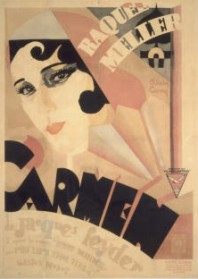
Settling down in pace again for 2h 44m of Carmen (France 1926) directed by Jacques Feyder for Albatros. Although we had been shown many fine films already, this was, for me, the first masterpiece of the week. Goregeously shot on location in Navarre and Castile, and superbly cast; Raquel Meller was a Spanish actress I had not heard of, but she WAS Carmen; seemingly not acting at all – like Louise Brooks in Germany, say – she was utterly believable as the sexy gypsy that men fall madly in love with, and yet would not want to be up against her in a fight. Louis Lerch as Don Jose transforms from callow youth to half-mad criminal fugitive well; the supporting character actors are equally good and are given time to develop three dimensions. Could not fault the film, though some thought it overlong, I didn’t personally. The music this night was again from the very talented Touve Ratovondrahety – though this time I felt he had all his knobs turned right up to eleven and my ears were ringing at the finish.

In total contrast, there followed an offering from the Jugoslavian Film Archive – three examples of silent underground porn films from – it is believed – 1920’s-1940’s. After a serious warning as to what to expect – and the option to exit the Cinema – from Festival Director David Robinson, we were launched into some quite grainy medium-hard core, accompanied by Günther Buchwald and I believe John Sweeney – my notes are skimpy here (it was Donald Sosin. Ed.) – as if we were having tea at the Savoy, 1910. Porn has never sounded quite so classy. There were some disappointed comments from some audience members as to the picture quality (names available on application to the Bioscope, price five guineas (Oh yeah? Ed.)) but for me it added an authentic flavour, as if we were peering through a smoky haze and an alcoholic fug at a 9.5mm set-up in a backroom somewhere in 1930. The print quality was the only aspect that left anything to the imagination, by the way.


Well, if that was Monday, then what follows next will unquestionably be Tuesday, where we can promise you (courtesy of our stubbornly anonymous reporter) more divas, more Holmes, a Japanese rediscovery, an avant garde diversion and a Pola Negri film with the sound of dropping jaws hitting the cinema floor …

Report on day one
Report on day two
Report on day four
Report on day five
Report on day six
Report on day seven
Report on day eight

Pordenone diary 2009 – day two

pordenone_sign

It’s time for day two of our daily account of this year’s Pordenone silent film festival. We’re back at Sunday 4 October, with an on-the-spot report from our tantalisingly anonymous but highly knowledgeable correspondent, whose dedication to the cause meant a rigorous 9.00am-til-late routine. What, not even just the one day bunking off to go to Venice?


9.00am starts every day from here on; time for a snatched breakfast, a double espresso and to grab a bottle of mineral water for use inside the Verdi – and to help down any paracetemol if you’re still suffering from the red wine the night before …

Today the opening offering is the latest selection from the Corrick Collection, the preserved repertoire of the pre-WW1 Australian travelling show family; highlights included a Pathé comedy, J’ai Perdu Mon Lorgnon (France 1906), about a myopic man blundering around town, having lost his specs; a 1905 documentary, Metallurgie au Creusot (France 1905), on an iron foundry which featured excellent use of tinting and hand colouring, especially the scene where red-hot strips of extruded metal snaked across the foundry floor. Similarly decorated were two Pathé fairy tales, La Belle au Bois Dormant (Sleeping Beauty) (1902) and La Poule aux Oeufs D’Or (France 1905) both of which wore their panto roots on their sleeves. A Walter Booth animation Comedy Cartoons (UK 1907), starts as a ‘lightning sketch’ film but becomes something more ambitious; the caricatures fade out and photographs of the subjects fade in, come to life and interact with the artist. Towards the end it gets increasingly surreal until finally a sick man’s head is split open and the things ailing him removed; bottles of champagne, cigars … and he is reassembled … distinctly Terry Gilliam territory.

Next we were into the thread investigating Sherlock Holmes and his contemporaries; starting with a charming Percy Stow, Bobby the Boy Scout (UK 1909); wherein Bobby solves a jewel robbery from under the nose of the local police, but is captured by the thieves; he escapes by hiding under a greatcoat hanging on the doormounted coatpeg, Harold Lloyd-style; as the door swings open, he has outflanked the kidnappers and locks them in his cell in his place, summoning the police … who as per usual, have been portrayed as buffoons throughout.

This was followed by more conventional fare, a self-contained episode from the Stoll 1923 serial The Mystery of Dr Fu Manchu, The Fiery Hand; all the Sherlockian elements of course; disguises, traps, genius antagonists, plus a sadistic torture/execution to finish; it rollicked along like a serial episode should.

The German Der Hund Von Baskerville (Germany 1914) was less successful, a very strange film; coming in at just over the hour, it dispenses entirely with the plot of the novel, and barely replaces it with another; as a result, it’s a very leisurely hour in an alternate Holmes universe where Watson has all but vanished, and the good peasantry of Devon run around Schloss Baskerville in kilts, in fear of a hound likely to try and lick you to death. I don’t like celebrating a film’s entertainment value for its unwitting humour, but here, no option I’m afraid.

The programme notes were damning with faint praise for the next film, La Vie Merveilleuse De Bernadette (France 1929) and as hagiography – literally in this case – is not my favourite genre, I gave it a miss. The consensus of those that did see it was that the film was an efficiently effective and well made piece of propaganda.

Back in for Ce Cochon De Morin (France 1923), a film made by Tourjansky for Albatros. A strange comedy about a man trying to restore his reputation after a drunken sexual attack on a female train passenger. Hmmmmm. Couldn’t really get too sympathetic, frankly. A waste of the talented Nicolas Rimsky in the lead, who would have better vehicles …

More tasteful was the double-bill presented to engage the skills of a couple of local children’s orchestras; Chaplin’s A Night In The Show and Keaton’s Playhouse. Interestingly Chaplin’s anarchy came over really well – the kids seemed to have more fun with it, and the occasional stray note – if it was – matched the onscreen chaos perhaps better than a professional unit would have done.

Sorry – dodged Rudolph Valentino in The Eagle (USA 1925) on the basis that I had already seen it a couple of times and I was quite likely to get the chance to see it again; by all accounts a lovely print, but there were some technical glitches in its projection – for some reason the Verdi projection team were struggling this week.

Daddy (1923) was shown as a tribute to Cesare Gravina, but it’s an unashamed vehicle for Jackie Coogan; corn, but beautifully presented and well acted prime corn. Musically one of the highlights thus far, as Phil Carli at the piano and Günther Buchwald on violin enriched the experience way beyond the sentimental melodrama onscreen, about three generations of violinists, and elevated it to something far more memorable. If you have seen The Rag Man with Coogan and Max Davidson, it’s very much along those lines.

Harmonies De Paris (France 1928) with music by Touve Radovondrahety, was an extra 30 minutes I didn’t feel like; I’m not a huge fan of late 20’s city symphonies on the whole, but judging by the reports I should have seen it; a good film, and for Touve a bit of a triumph. These things happen …


Stayed tuned for the report on day three, when we shall learn of more Holmesiana, the parting of the Red Sea, and a night at the opera…

Report on day one
Report on day three
Report on day four
Report on day five
Report on day six
Report on day seven
Report on day eight

Australia’s Silent Film Festival

thegeneral

The General

The 2009 Australia’s Silent Film Festival takes place 15,18, 24 and 25 October at the Dixson Room and Metcalfe Auditorium, both at the State Library of Macquarie Street, Sydney, NSW. This is the programme:

Thu-15/10/09

7:00 PM to 9:30 PM
The Mark Of Zorro – 1920 (USA)
State Library of NSW the Dixson Room Macquarie Street Sydney
Starring Douglas Fairbanks, Snr
Directed by Fred Niblo
Tickets: $30/$15 concession
Film: digital presentation
Duration: 107 minutes
Live music: accompanist Ms Sharolyn Kimmorley and Ian Bloxsom, Australia’s Percussionist Extraordinaire
Presenter: Dr Stephen Juan

Sun-18/10/09

10:30 AM to 11:15 AM
The Return of The General and The Rail Rodder
State Library of NSW the Dixson Room Macquarie Street Sydney
(Short films to introduce Buster Keaton’s The General)
Admission free
Film: digital presentation
Duration: 35 minutes

11:30 AM to 1:30 PM
The General – 1927 (USA)
State Library of NSW the Dixson Room Macquarie Street Sydney
“A short introduction will be given by Orson Welles, preeminent figure of world cinema.”
Starring Buster Keaton
Tickets: $25/$15 Concession
Film: digital presentation
Duration: 75 minutes
Live music: accompanist Professor Robert Constable
Presenter: Bruce Elder, Senior Entertainment Writer with the Sydney Morning Herald

2:15 PM to 4:30 PM
The Story of the Kelly Gang – 1906 (Australia) and The Sentimental Bloke – 1919 (Australia)
State Library of NSW the Dixson Room Macquarie Street Sydney
Tickets: $25/$15 concession
Film: digital presentation
Duration: 100 minutes
Live music: accompanist Professor Robert Constable
Presenter: Bruce Elder, Senior Entertainment Writer with the Sydney Morning Herald

Sat-24/10/09

10:15 AM to 12:30 PM
Destiny – 1921 (Germany) Der Müde Tod
State Library of NSW the Dixson Room Macquarie Street Sydney
Starring Lil Dagover, Rudolph Klein-Rogge
Directed by Fritz Lang
Tickets: $25/$15 concession
Film: digital presentation
Duration: 114 minutes
Live music: accompanist Mauro Colombis
Presenter: Klaus Krischok, Director, Goethe-Institut Australien

1:00 PM to 2:30 PM
Comedies for Kids (and the young at heart)
State Library of NSW the Dixson Room Macquarie Street Sydney
Tickets: $25/$15 concession
Film: digital presentation
Duration: 87 minutes
Live music: accompanist Mauro Colombis
Presenter: Eddie Cockrell

3:00 PM to 5:15 PM
Seventh Heaven – 1927 (USA)
State Library of NSW the Dixson Room Macquarie Street Sydney
Starring Janet Gaynor and Charles Farrell
Directed by Frank Borzage
Tickets: $25/$15 concession
Film: digital presentation
Duration: 113 minutes
Live music: accompanist Mauro Colombis
Presenter: Eddie Cockrell

Sun-25/10/09

10:15 AM to 11:45 AM
Man with a Movie Camera – 1929 (USSR)
State Library of NSW the Metcalfe Auditorium Macquarie Street Sydney
Director: Dziga Vertov
Camera: Mikhael Kaufman
Editor: Elsaveta Svilova
Tickets: $15/$10 concession
Film: digital presentation with soundtrack
Duration: 68 minutes
Presenter: Dr Karen Pearlman, Head of Screen Studies; Australian Film, Television and Radio School

12:15 PM to 2:30 PM
Flesh and the Devil – 1927 (USA)
State Library of NSW the Metcalfe Auditorium Macquarie Street Sydney
Starring John Gilbert, Greta Garbo and Lars Hanson
Directed by Clarence Brown
Tickets: $15/$10 concession
Film: digital presentation with soundtrack
Duration: 113 minutes
Presenter: Jason Di Rosso

3:30 PM to 5:00 PM
Georges Méliès: First Wizard of Cinema – 1896-1912 (France). A selection of his fantastic magic films and imaginary journeys.
State Library of NSW the Metcalfe Auditorium Macquarie Street Sydney
Tickets: $25/$15 concession
Film: digital presentation
Duration: 75 minutes
Live music: accompanist Mauro Colombis
Presenter: Ruth Hessey

Further details on the films being shown, plus booking details and so forth, can be found on the festival site. Each year the festival inducts Australian pioneer silent film figures into a Hall of Fame. This year’s inductees are Annette Kellerman and Snub Pollard, biographies of both of whom can be found on the site.

London on the move

underground

Underground

The programme for the London Film Festival has been announced, and though there’s not much in the way of silents on offer, it’s well worth noting what there is.

For the past two years the LFF has featured a programme of archive films on London, plus a London-themed silent feature, for exhibition in Trafalgar Square. This year the feature film is Anthony Asquith’s Underground (1928), an expressionist brew of love, treachery and murder set in and around London’s underground railways, starring Brian Aherne and Elissa Landi. That screens on Friday 23 October, while on Thursday 22 there is London Moves Me, a programme of archive film on the theme of London and transport. The programme includes cycling in 1896, trams in 1901, boats in 1905, canoes in 1922, barges in 1924, underground trains in 1929, and much more. The indispensible Neil Brand will accompany on piano. The Trafalgar Square shows are free, and just the sight of seeing crowds of commuters, tourists, the curious and the dedicated gathered on the steps to witness silent films beneath Nelson’s Column is an experience to savour.

(Correction: Underground is screening at the Queen Elizabeth’s Hall. Shame.)

laila2

Laila

The LFF has an archive film section, which features the pick of the restorations and star selections from recent archive film festivals. The silent to look out for is the Norwegian Laila (1929), which was the hit of the Pordenone festival in 2008, enthusiatically reviewed by the Bioscope at the time. I warmly recommend this engrossing, dramatic, human and beautifully photographed masterpiece, screening on October 29. It is everything that a silent film can be.

The other silent offering is J’Accuse (1919), a new, colour-tinted restoration by the Nederlands Film Museum, in collaboration with Lobster Films, of Abel Gance’s epic anti-war statement.

Mary Pickford silent film festival

mybestgirl

Charles ‘Buddy’ Rogers and Mary Pickford in My Best Girl (1926), from http://www.etcinfo.net

Encinitas, Cardiff CA is hosting a Mary Pickford silent film festival. The festival takes place in the La Paloma Theatre, 6-8 November. There are four features with four shorts, each accompanied by Robert Israel on the piano. Here’s the programme:

Friday, November 6, 7 pm

WILLFUL PEGGY | 1910. 17 minutes.
Short: Pickford plays a feisty peasant girl married off to a stuffy lord. On the eve of the ceremony, Peggy ditches her new spouse and runs off for a night of frivolity with an “inappropriate” group of revelers. Pickford was said to have declared Peggy her favorite character.

MY BEST GIRL | 1926. 80 minutes
Feature: Joe Merrill, son of a millionaire, poses as Joe Grant and takes a job in the stockroom of one of his father’s dime stores to prove he can succeed on his own. He meets poor stock room girl, Maggie Johnson, and they fall headfirst in love. Unfortunately, Joe’s mother has plans for Joe to marry a high society girl. Maggie, meanwhile, has family issues of her own to solve. Truly one of Pickford’s finest films and a fan favorite, MY BEST GIRL is a romantic comedy tested by the ages. It doesn’t hurt that Pickford and costar Buddy Rodgers fell in love in this film. Their on screen chemistry is astounding. The resulting marriage lasted forty years.

Saturday, November 7, 2 pm

TRICK THAT FAILED | 1909. 13 minutes
Short: In this rarely seen but much admired short, Pickford plays an aspiring artist with two beaus. She refuses to accept the affections of either until she succeeds in selling her art. The rich beau sends agents to buy up Pickford’s paintings, but she discovers the ruse and sends him packing. Pickford’s first husband, Owen Moore, appears in one of the scenes.

POOR LITTLE RICH GIRL | 1917. 80 minutes.
Feature: Considered the best of her “little girl films” Pickford was twent four when she played the part of eleven year Gwendolyn. Barely five feet tall herself, the illusion of her small stature was enhanced by large set pieces and a very tall cast. Gwendolyn’s family is rich, but her parents ignore her. Her governess tries repeatedly to reign in the free spirited child. When a family crisis sets off a series of wild events, all must rethink their priorities. Although remade more than once, Pickford’s version of the poor little rich girl easily sets the standard for excellence.

Saturday, November 7, 7 pm

THE NEW YORK HAT | 1909. 15 minutes
Short: Directed by D.W. Griffith, THE NEW YORK HAT features an all star cast that includes a young and handsome Lionel Barrymore, Pickford’s brother, Jack, and the beautiful Gish sisters. Pastor Barrymore buys the sad Pickford a New York hat at the bequest her dying mother. At the sight of the extravagant headpiece, the town gossips immediately circulate false rumors. Pickford’s harsh father then rips the hat to shreds before his daughter’s eyes. When the Pastor hears of the town’s cruelty, he chastises all. The short ends up with Barrymore proposing to Pickford.

THE LITTLE AMERICAN | 1917. 80 minutes
Feature: At the onset of World War I, Angela Moore finds herself with both a French and German suitor. She travels to Europe in pursuit of her German beau, only to have her passenger liner sunk by a u-boat. Following her rescue, she wanders to the family castle where Prussian bombs begin to fall. In short order, Angela converts her threatened family castle into an army hospital, enlists herself as nurse and spy – to aid her French boyfriend – then finds herself overrun with German soldiers intent on raping her and her female servants. She is rescued by her German beau who betrays his ranks and soon enough faces a firing squad with the accused Angela tightly encircled in his arms. An Allied bombing strafe intervenes. The end finds the love pair being shipped back to America. THE LITTLE AMERICAN proceeds at a dizzying pace; its scenes of war and mayhem to be copied by directors for decades to come. It’s no surprise Cecil B. DeMille of THE GREATEST SHOW ON EARTH and the TEN COMMANDMENTS fame directed this saga. Filmed less than ten years after the actual sinking of the Titanic, his depictions of a great passenger liner’s destruction are striking in their imagination and daring.

Sunday, November 8, 6 pm

THEY WOULD ELOPE | 1909. 17 minutes
Short: Harry and Bessie love each other with all their hearts. Thinking the bride’s father disapproves, the pair plan a poorly conceived elopement. All ends well in this madcap comedy, but not before mayhem and fate’s resistance give the lovebirds a good run for their money.

SPARROWS | 1926. 80 minutes.
Feature: This beautifully restored SPARROWS is shown in conjunction with the Library of Congress and will be introduced by the curator of the Pickford Collection, Christel Schmidt. It is a rare opportunity to view one of the greatest of silent films featuring one of its biggest stars. Produced at the end of Pickford’s silent film career, SPARROWS is considered by most to be her finest film. A departure from the typical sunny Mary Pickford story, SPARROWS is rife with Dickensian undertones. Evil Mr. Grimes keeps a rag tag group of orphans on his farm deep in the swamps. He forces the children to work, starves and mistreats them in numerous ways. They are watched over by the eldest, Molly. Things go awry when a gang in league with Grimes kidnaps a rich infant with the intent of ransoming her. When the police close in, Grimes panics and plans to throw the infant into the swamp. Molly has had enough and decides to lead the children out of the dangerous swamp to a better life.

The festival will be introduced by Hugh Munro Neely, director of Mary Pickford: A Life on Film. Further details, including directions and ticket information, are available from the Encinitas Theatre Consortium site.