Iamhist in Copenhagen

If it’s Tuesday it must be Copenhagen. Yes, your jet-setting scribe had no sooner returned from Bologna then he was off on his professional travels once again, this time to attend the Iamhist conference (Iamhist being the International Association for Media and History), on the engrossing theme of ‘media and cultural memory’. Some of it will touch on silent film subjects, some of it will relate to general film history, and other bits probably won’t have all that much relevance at all but, heck, we’ll report on them anyway. It’s all knowledge.

So, as before, I’ll be doing live blogging on the conference with my trusty Blackberry, updating what will be daily posts with relevant stuff as it happens. So expect posts on Wednesday, Thursday and Friday. Information on the conference, with the provisional programme, is here.

I hope you’ll enjoy following it all.

100 silent films

Who can resist a list? Everyone loves to take part in top ten lists of this or top 100s of that, pitting personal preference against the canon. Debates on which are the top silent films, be they box office (a contentious areas given the unreliability of data from the silent era), most popular or most esteemed. The Silent Era website maintains a top 100 silent films based on votes supplied by visitors to the site. It comes across as a mixture of popularity and critical esteem, and the top ten (as of today, but they haven’t changed much in ages) has a stale familiarity about it:

1. The General (USA 1926), d. Buster Keaton and Clyde Bruckman
2. Metropolis (Germany 1927), d. Fritz Lang
3. Sunrise (USA 1927), d. F.W. Murnau
4. City Lights (USA 1931), d. Charles Chaplin
5. Nosferatu (Germany 1922), d. F.W. Murnau
6. The Gold Rush (USA 1925), d. Charles Chaplin
7. La passion et la mort de Jeanne d’Arc (France 1928), d. Carl Theodor Dreyer
8. Das Cabinet des Dr. Caligari (Germany 1920), d. Robert Wiene
9. Bronenosets ‘Potyomkin’ (USSR 1925), d. Sergei M. Eisenstein
10. Greed (USA 1924), d. Erich von Stroheim

All great films, and all films that you would recommend to anyone first getting interested in silent films and wanting to know what to see. But there is no surprise.

Very different is 100 Silent Films, by Bryony Dixon, just published by Palgrave Macmillan/BFI, and one of a series of books recommending 100 moving image titles in a variety of genres. Dixon points out in her introduction that silent film is not a genre – it is the first thirty or so years of cinema and embraces almost all genres – and also makes it clear that her 100 films and not the 100 best, but rather 100 titles which represent the breadth as well as the greatness of the type.

It’s certainly an idiosyncratic list of films, each of which is described across a couple of pages, and arranged alphabetically by title to avoid any sense of a top 100. These are silent films to see because it will be an adventure to do so. There are the familiar warhorses, of course – all bar one of the top ten above are represented (City Lights is the casualty) – but what one notices far more are the choices that delight or intrigue: Ernst Lubitsch’s The Oyster Princess (Germany 1919), William Wellman’s Beggars of Life (USA 1928), Sun Yu’s Daybreak (China 1933), Lois Weber and Phillips Smalley’s Suspense (USA 1913), Yakov Protazanov’s The Queen of Spades (Russia 1916), Tomu Uchida’s Policeman (Japan 1933), Joris Ivens’ Rain (Netherlands 1929), or Henri Frescourt’s Monte Cristo (France 1929).

Dixon is a strong advocate of British silent film, and fifteen of the titles were produced in Britain, which might raise an eyebrow or two. But it’s hard to disagree much with the choices, from James Williamson’s iconic The Big Swallow (1901), to Alfred Hitchcock’s Blackmail (1929), Arthur Robison’s The Informer (1929), Anthony Asquith’s A Cottage on Dartmoor (1929) or Walter Summer’s overlooked masterpiece of drama-documentary The Battles of Coronel and Falkland Islands (1927).

Alfred Butterworth & Sons, leaving the works, Glebe Mills, Hollinwood (Mitchell & Kenyon 1901)

Dixon is keen to demonstrate the full breadth of of silent film, so there is a lot more here than the traditional feature film. She includes advertising films (The Spirit of his Forefathers, c. 1900), newsreels (Topical Budget 93-1 The Derby, 1913 – the ‘suffragette’ derby), and actualities, such as Mitchell & Kenyon’s Alfred Butterworth & Sons, leaving the works, Glebe Mills, Hollinwood (1901). There are assorted magical early cinema titles from Gaston Velle, Albert Capellani and Georges Méliès (Voyage à travers l’impossible rather than Voyages dans la lune). And there are examples of the avant garde (Manhatta), documentary (Drifters), propaganda (The Battle of the Somme), animation (Winsor McCay’s How a Mosqutio Operates) and even natural history (Oliver Pike’s Les hôtes de l’air). There’s even one token modern silent, Guy Maddin’s delirious The Heart of the World (Canada 2000).

And so on. What makes the book successful, however, is not really its eclecticism and disdain for established classics (though one senses one or two titles have been included because the publishers insisted upon it). Rather it is the unpretentious, informal style of writing. Dixon knows her subject deeply, but writes as much for the person just starting to explore the field as the afficionado. Jargon is largely banned. It almost reads like a blog. The emphasis is on availability (there are few titles here that aren’t to be found on DVD or online somewhere) and the reader is soon totting up a list of must-see-soon or must-buy-soon titles (I know I have).

In short we have as good an introductory guide to silent film as you might hope to find, one calculated to please the newcomer and the expert. No one will agree with all of Dixon’s choices, but no one will be the poorer for seeking out each one of them. It’s just the pocket-book guide needed to accompany the resurgence of interest in silent film we’ve witnessed in the past few years.

Now if you’d asked me to name 100 silent films, well…

European Film Gateway

Carl Dreyer’s Der Var Engang (1922), available in extract form via the European Film Gateway

And so, after reporting for the past two days on a symposium on film archives in the digital age held to mark the launch of the European Film Gateway, it’s time to introduce the Gateway itself.

The European Film Gateway, or EFG, is a European Union-funded intiative which aims to provide a gateway to European film heritage in digital form. The EFG doesn’t hold any such digital content itself, nor has it paid for for any films or other artefacts to be digitised to serve the EFG. It simply points to content that is already out there, on the websites of individual archives, bringing scattered information into one place for the benefit of you and me.

There are sixteen contributing archives (along with other partners), though fourteen are currently listed on the site: Cinecittà Luce (Rome), Cinemateca Portuguesa – Museu do Cinema (Lisbon), Det Danske Filminstitut (Copenhagen), Deutsches Filminstitut – DIF e.V. (Frankfurt), EYE Film Instituut Nederland (Amsterdam), Filmarchiv Austria (Vienna), Kansallinen audiovisuaalinen arkisto (Helsinki), La Cinémathèque française (Paris), Lichtspiel – Kinemathek Bern (Berne), Lietuvos Centrinis Valstybės Archyvas (Vilnius), Magyar Nemzeti Filmarchívum (Budapest), Národní filmový archiv (Prague), Nasjonalbiblioteket (Oslo), Tainiothiki tis Ellados (Athens). Not quite every member state of the European Union is represented, and the UK is conspicuous by its absence, though I understand that the Imperial War Museum will be contributing at a further stage in the EFG’s development. The leading contributors so far are Italy’s Archivio Luce, the Danish Film Archive, and the Deutsches Filminstitut.

What you get is, as of this moment, access to 391,229 digital objects, compising 23,390 videos, 357,452 images and 10,387 texts. Films are primarily non-fiction (newsreels, documentaries etc), but some fiction films can be found; the extensive range of images covers a extensive range of cinema history (most names that I typed in brought up something); and the documents include newspaper cuttings, scripts, censorship records, digitised books and so on.

Searching is a bit on the basic side. There is no advance search option, so there is no way that I’ve been able to discover that lets you search every film dating before 1930, for example, or all the documents from one particular archive. However, once you have searched for something, there are opportunities to refine your search by archive, medium, date period, or language, so it’s best to search for something, then explore the records thereafter. Frustratingly there is no option to refine searches by genre (say if you wanted to find fiction films only).

However, you can play a trick on the Gateway by searching for “a”, which brings up just about every record. Refining this by film as medium and dates 1900-1929 reveals that there are at least 687 films from the silent period available to view. These include 524 from Det Danske Filminstitut, 91 from Luce, 38 from Tainiothiki tis Ellados, 20 from Filmarchiv Austria, 12 from Národní filmový archiv, and 2 from Lichtspiel – Kinemathek Bern. All of these films can be found on their respective archives’ websites, some in extract form only. Do note that, though most of the site in English, you will be confronted with Greek, Czech or other foreign language only sections of the site.

Search results on the EFG for ‘Asta Nielsen’

Many of the films and other digital objects are gathered in to collections, which usefully you are allowed to browse. Here are the descriptions from the EFG of some of the collections that relate to our area of silent film:

Cinecittà Luce: Documentary and Short Film Collection 1920-1990
3,000 items from a unique collection of cinematographic non-fiction and fiction works, since the silent film era to our days, black and white and colored, short and long, featuring titles of different topics from history to culture, by a myriad of directors, including, among them the first works of great masters like Rossellini, Antonioni, Comencini, De Seta, and other famous names of Italian filmmaking.

Det Danske Filminstitut: Early Documentary and Fiction Films and Trailers
The collection of the Danish Film Institute available on EFG contains a number of early documentary films, which display the life and look of the Danish society in the period of 1906 to 1940. Among the 300 films are straight depictions of modern production equipment and trade, as well as more propagandistic titles and news items. The over 50 early fiction films available are a raw collection of short films that give an impression of what early audiences were entertained by. In addition, around 700 teaser previews of the films available in the Danish Film Institute’s educational distribution can be found on EFG. The latter collection contains current films that are chosen mainly for their value in education and general audience informative qualities.

Det Danske Filminstitut: The Films by Cinema Pioneer Peter Elfelt
The 77 films by Danish cinema pioneer Peter Elfelt (1866-1931) are not only interesting from a cinematic point of view but they are also unique contemporary documents. As royal court photographer, Elfelt had access to the most important people and events at his time, which is reflected by his films, focusing on Denmark’s high society.

Deutsches Filminstitut: Costume and Set Designers’ Collections
More than 200 set designs and 900 film costume designs, sketches and notes by distinguished German (film) architects Otto Hunte, Walter Reimann and Hans Poelzig and costume designers such as Ali Hubert, Helga Kischkat-Reuter and Irms Pauli can now be accessed via the EFG. Many of the design sketches represent milestones in their field, e.g. the set designs for “Metropolis” (1925/26) or “Der Golem wie er in die Welt kam” (1920).

La Cinémathèque française: Magic Lantern Slides Collection
The Cinémathèque française’s collection of magic lantern slides illustrates the pre-cinema era and contains some of the finest and most well-preserved slides still in existence. A selection of around 1,500 of these hand-painted and photographic unique artworks from France, Great Britain, Germany and the USA covering the 18th century until the 1920s is available on EFG.

La Cinémathèque française: Photos of the Triangle Film Corporation
The Triangle Film Corporation existed from 1915 to 1918. Employing directors such as D.W. Griffiths, Thomas Ince and Mack Sennet it was on of the largest American production companies at its time. By means of around 1,400 photos of the John E. Allen – Triangle Collection, the history of the company can be retraced.

La Cinémathèque française: The Digital Library Collection
La Cinémathèque française has a precious book collection which retraces the long adventure of the prehistory of the cinema and photographic and film techniques. The approximately 280 books of this collection date back to the 17th century and can be found on EFG.

La Cinémathèque française: The Étienne-Jules Marey Collection
The scientist Étienne-Jules Marey (1830 – 1904) used photographic methods to study the movement of human and animal throughout his life. La cinémathèque offers access to around 400 photos from the estate of Étienne-Jules Marey via EFG.

La Cinémathèque française: The Muybridge Collection
With the serialisation of photos Eadward Muybridge was one of the first who created the impression of moving images. EFG gives access to about 700 images that emanate from the estate of Muybridge.

Magyar Nemzeti Filmarchívum: Photo Collection
The selection of around 1,000 film stills covers the period from the beginnings of Hungarian cinema to 1947 and includes early films of world famous directors such as Alexander Korda and Michael Curtiz.

Magyar Nemzeti Filmarchívum: Poster Collection
Magyar Nemzeti Filmarchívum contributes aprox. 1,200 film posters, which provide an overview of the Hungarian poster art from the beginnings of Hungarian cinema in 1900 to the 1990s.

Národní filmový archiv: Documentary and Feature Films
The National Czech Film Archive makes eight feature films from the Czech silent film era from 1898 to 1920 available via EFG. An overview of the history of the Czech documentary film provides the collection “Czech Documentary Films”. Up to 200 films from 1898 to 1928 can be viewed on EFG.

Nasjonalbiblioteket: Selected Films
For EFG the Nasjonalbiblioteket gives access to a selection of approx. 350 film works, many of them representing Norwegian cinema from 1900 to 1935. The collection also includes historic advertising films from the 1920s to the 1950s as well as documentary films about Oslo.

Not every film included on the EFG falls into one of these collections (for example, the coy early sex films of Austrian production company Saturn), and as is so often the case with these sorts of resources it helps if you know what you are looking for is going to be there somewhere, because the searching tools don’t always help you completely. But it must be pointed out that the EFG is in a beta phase, with plenty of bugs let to be ironed out. Better functionality, and more content (including some arriving in August) are promised.

The EFG is essentially a feeder site for the European digital library concept, Europeana, previously written about on the Bioscope. There the films and film-related content will be searchable alongside many other kinds of digital objects (the EFG content does not appear to be on Europeana as yet). The EFG has a sister project, EU Screen, which is doing the same job for European television content (no UK content again – are we trying to tell them something?).

The European Film Gateway represents only a tiny fraction of European moving image content, digital or otherwise, and no one can say how it will develop. But it has established a structure for encompassing moving image data from very varied film archive catalogues, through which they hope to be able to point to more and more content, if more archives will take up its all to contribute. And Europeana will certainly continue, gradually biding its time, persuading more and more libraries and archives that it is their European duty to supply ever more content to the giant digital soup. Lucky us.

There is, by the way, a separate European Film Gateway project site, which has more background information on the project itself.

Going digital

http://www.europeanfilmgateway.eu

Well folks, the Bioscope is on its travels once more. I’m heading off to speak at a symposium with the heady title of “Film Archives and Their Users in the ‘Second Century’ – Risks and Benefits of the Transition to Digital“. The event is being held to mark the launch of the European Film Gateway, a major undertaking which I’ll be reporting on in detail on my return.

The event is taking place in Bologna, Italy, alongside the Il Cinema Ritrovato festival of archive films. The symposium is looking at

the consequences of the transition from analogue to digital by looking at the self-perception of the archives, their relationship with their users as well as the implications of this paradigm shift for their daily work.

In other words, whither the film archives now that the digital world is upon us? My talk may be familiar if there’s anyone in the audience who read the Bioscope, because it is going to be based on an old post here, Alice – random but cool, an analysis of the remarkable popularity of the 1903 film Alice in Wonderland when the BFI issued it on YouTube in February 2010 – since which time it has gained over one million views and a fascinating array of comments. Well, they’re my words, and they say what I want to say, so why not re-use them?

There is a good line-up of speakers, including Nicola Mazzanti, Thomas Christensen (Danish Film Institute), Manuela Padoan (Gaumont-Pathé Archives) and Georg Eckes (Deutsches Filminstitut and the European Film Gateway). What I am going to try to do is report on the symposium while I’m there, through a mixture of tweets (using my personal @lukemckernan address) and live aditions to this blog post – if the technology will let me do so this time. If it all fails, then no matter because I’ll just report in the regular way when I get back. The symposium takes place 30 June-1 July.

29 June 2011
OK, we’re here in Bologna, finding tweeting a bit of a problem, but hopefully we can produce a live symposium report by adding to the blog post. The symposium starts tomorrow, close by the Cinema Lumiere, where the Il Cinema Ritrovato festival is running. I’ve been down there to say hello to a few folks – it’s eighteen years since I was last here. A great festival, but it’s too darn hot for this pale Englishman. Two days will be enough.

30 June 2011
09.45 – So here I am, seated in a blessedly cool auditorium, headphone translation at the ready, all to learn about where film archives think they are going in a digital age. Hope my talk is provocative enough. But how will it come over in translation? Some of the YouTube teenspeak I’ll be citing is tough enough in English …

11.15 – A couple of high-powered presentations to kick things off. Giovanna Fossati from EYE Film Institute on new models film archiving – the freezer for all things analogue, the cloud for digital preservation, the virtual Steenbeck for the ‘haptic’ online film experience, curatorship by curators and the crowd.

She emphasized that film as a medium is on its way out, something stressed strongly by Nicola Mazzanti, with headlines from a forthcoming EU report (‘Digital Agenda for European Film Heritage’). Cinema is digital now, film will cease to be an exhibition medium within a year, scanners for film-to-digital are on their way out so we have to digitise now. If no action is taken we will lose the analogue past and have no means to preserve the digital future. The cost for the 1,100 features and 1,400 shorts made in Europe per year? 290M euros per year, approx the same as the annual budget of a large European opera house.

11.45 – Also Mazzanti pointed out necessity of legal deposit and said only Netherlands and UK among the member states don’t have it. Hmm, I detect pressure about to be applied …

12.00 – Thomas Christensen from the Danish Film Institute suggests fewer F-15 fighters rather than opera houses would be preferable. Analogue film collections to be a unique, treasured resource to be digitised on demand. Scholars don’t much go to film archives any more – they’ll seek out what they find online. Archives must make authentic digital cinema quality elements, especially for orphan and out-of-copyright films.

So much emphasis on ‘film’ heritage and the film experience when film itself is disappearing. But what about TV, nonfiction film, web video? Why this fixation on the feature film? The culture is changing, not just the medium.

13.45 – Sitting in the shade at lunchtime. Hot but not too hot, after thunderstorms last night. I’m on at 14.00, talking about users – largely absent from the discussions so far. Why do we leave our users out of the equation so often? Do they want us to preserve everything? How much do we film archivists know? But equally how dangerous will things be if we leave it all to the crowd?

14.35 – Well that shook them up a bit.

[Update: the text is available on my personal site, here]

16.45 – Some papers on use of archive content for TV and research projects given in Italian, then David Walsh from the Imperial War Museum speaking drolly on the theme “Digitise your film, sell it online, make lots of money – simple isn’t it?” Unfortunately he’s not able to tell us if it is making money for them, yet. They have been making 750,000 euros in footage sales p.a. by the traditional route. But what happens if even an archive like the IWM, which has the rights to 80% of its collection, can’t make money online?

17.05 – Talk on the Charlie Chaplin Archive, a database with documents you can only access at Bologna. All very interesting, but this symposium is supposed to be about discussing the issues for film archives at a time of great change. A bit too much of archives reporting on their projects. Archivist aren’t necessarily the right people to talk about archives. Discuss.

18.40 – OK, that’s it for today. Interesting presentation on Italian home movies archive which seems to have done everything right. Not sure if the organisers have quite got the debate they hoped for. But we get the European Film Gateway presentations tomorrow, which may open up more. The full Bioscope guide will follow in due course.

See you tomorrow, same place.

1 July 2011
Day two dawns in sultry Bologna. It’s the European Film Gateway presentations, so we can expect enthusiasm and idealism a-plenty. There will be introductions to the project overall, then archives from individual member states will talk about their contributions – Italy, Austria, Germany, Denmark, Norway, Czech Republic, Lithuania … with the conspicuous absence of eurosceptic UK.

10.05 – Film archivists, like policemen, are looking so much younger nowadays.

10.25 – Georg Eckes introduces the EFG. Funded by the EC, 16 archives plus 5 partners contributing. A digital showcase. Mostly nonfiction film. Users are 10 times more likely to click on a video item than a text item. But still only 2% of Europeana objects are audiovisual.

80% of EFG is images, 10% video, 10% text. Strong emphasis on early (out of copyright) film. Plea for archives to be consistent with metadata to make the work of gateways easier. Interesting power games underpin some of this. If your data isn’t harvestable it stays under your control.

Uses film metaphor, showing delightful Danish film of aviator Ellehammer in 1907 only just getting off the ground. Early days for EFG before it truly flies.

10.45 – Europeana presentation. Single, direct and multilingual access poin to European cultural heritage. Reflecting the diversity of Europe. 1500+ participating institutions. 90 direct providers. 16M items so far, aiming for 30M by 2015. 22,000 visits a day. That’s not terribly impressive. Does anyone care that much about Europe and its diversity?

11.20 – Europeana chap explains that it has been marketed more to providers than users so far, and that the individual sites get many more views than that. Fair enough, but this may be more about power politics than users. Europeana is biding its time. This is all so heartening really – all of these institutions competing to bring us more and more stuff in ever easier and more useful ways. How nice of them.

11.40 – Archivio Luce says that its footage sales figures are double those revealed by the IWM. 4000 hours of content. They own 99% of their collection. No 1 contributor to EFG. Touch of machismo here.

12.10 – Audience wakes up for presentation on silent erotic films made by Saturn films in Austria. Some tasteful nude bathing in 1906.

12.20 – Now products of association of amateur Swiss filmmakers. Presenters declines to show low res EFG versions and says he’d rather show 16mm!

12.50 – Fairly joyless presentation on Lithuanian documentaries topped by 5 mins clip of sand dunes. Norwegian polar films coming up, rather more to my taste. Amundsen heads out for the South Pole once again. It’ll be available on the EFG from August.

13.00 – Denmark’s first filmmaker, Peter Elfelt. Majority of his 250 films survive, 60 or so available via EFG. 700 Danish films + 1000 clips + 50000 stills on EFG, with no onscreen spoiler. Despite the great variety, the most sought after content remains sex films. It could be a bit depressing to be a Danish film archivist.

Interesting questions afterwards raising difference between EFG and commercial services like Netflix. But the public archives are never going to be able to win that game. They complement it.

13.35 – We finish with Czech film censorship documents, the Collate repository. Covers documents from CZ, Austria and Germany for 20s and 30s. Looks interesting. To be explored, later.

14.45 – Chatted afterwards with EFG’s Georg Eckes. More content is on its way, but thereafter EFG ticks along – on surprisingly little money – with care of the content in the hands of the archives. Not all moving image content on Europeana has to be filtered via EFG or its TV sidekick EU Screen.

And now it’s homeward bound. A worthwhile two days, some of it to do with silents, and hopefully the rest isn’t without interest. It all connects.

I’ve been blogging by phone while not being able to see how the results look. Hope they’re credible, legible and don’t leave me liable.

See you back in Blighty.

Union search

http://unionsearch.bfi.org.uk

In 2007 the UK government’s Department of Culture Media and Sport (DCMS) announced a £25M investment in screen heritage. The Strategy for UK Screen Heritage (later Screen Heritage UK) was a vote of confidence in the UK’s public sector moving image archives, predicated on the belief that strategic investment in those archives would pay off in terms of public value, short term and long term. The money was administered by the now defunct UK Film Council, and the beneficiaries were the BFI National Archive (which received the lion’s share of the money) and a number of English regional film archives. There were four elements to the original programme:

  • Securing the National Collection
    Capital works to extend and improve BFI storage facilities with appropriate conditions to safeguard the collection.
  • Revitalising the Regions
    Nomination of key collections in the English Regions, leading to improved plans for their preservation and access.
  • Delivering Digital Access
    Extending online access to the Nation’s screen heritage, through collection cross-searching and digitisation.
  • Demonstrating Educational Value
    Identifying, developing and evaluating effective use of screen heritage material within learning environments.

In practive the ‘demonstrating educational value’ element got absorbed by the others, but the remaining programmes strands have been pursued with vigour over the past four years, despite a reduction in the original award thanks to government spending cuts, and we are close to seeing the public results.

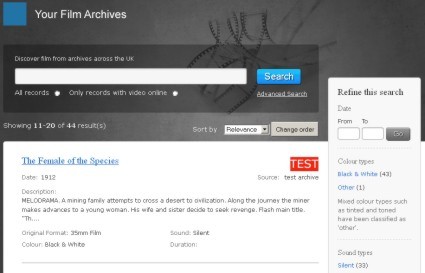
One of outcomes has gone live, though it hasn’t been announced as yet, and it remains in a test of beta phase. But it is out there, and it is of particular interest to us. It’s another example of the federated databases that we have been highlighting of late, and it is the Union Search.

Strictly speaking its proper name is Your Film Archives, but that’s such an awful name that you can’t see it outlasting the beta phase. Union Search has been its working title, Union Search is what is written into the URL, and Union Search is what we will call it.

Union Search brings together the catalogues of seven film archives, with more partner archives promised: the BFI National Archive, Yorkshire Film Archive, Northern Region Film and Television Archive, Screen Archive South East, the North West Film Archive, the Wessex Film and Sound Archive, and Amber Films. It is a concatenation of catalogue records, not the films themselves, though it is possible to restrict searches to content that is viewable online, for which you are taken to the relevant film on the relevant film archive’s own website or other video platform. But for the most part this is about finding out who holds what.

This is a major step forward. The BFI’s own database is a tremendous resource, probably richer in information on film and television (especially for the silent era) than any other database out there, with the possible exception of the IMDb. We have been holding off from writing a review of it because there are some significant changes to be made to its structure, which we await. But what has been frustrating is that it is a database of film and television programmes that the BFI knows about, not just those that it holds, but it doesn’t tell you which those films are. The version at the BFI physical Library does; the online version doesn’t. If you know a thing or two about how the BFI organises its information, you can sometimes work out from the database whether it holds a film or not, but most people are reduced to guesswork.

Union Search is an online database of the BFI’s holdings alone. It’s not every film yet – there are 62,000 films listed under BFI (of which 4,500 are silent) but the BFI has over 800,000 titles all told, including many more silents than those 4,500, so we’re still dealing with a sample (there 260,000 titles under something ‘Test’ archive option which represents a greater amount BFI content, but none of these links now lead you to an actual catalogue entry). But it is an easy guide to what exists, including an outline indication of what formats are held, searchable by keyword, name, title, date, colour or b/w, sound or silent.

And then we get all the other archive catalogues as well. Archives such as the Yorkshire Film Archive or the North West Archive hold largely amateur and non-fiction films of relevance to the regions they represent. For silent films, that means another 7,000 titles on top of the 4,500 held by the BFI, from newsreels to home movies. 193 silent films all told are available to view online (go to advanced search, click on “only records with video online” and check the “silent” tick box beneath). Each catalogue entry gives you title, a short description (there are some shotlists available), format held, date, basic credits, keywords (a very haphazard selection – there don’t seem to be many trained cataloguers producing film catalogues nowadays), genre, sound or silent (or mute), colour or b/w, length and ID number. There is useful faceted searching, so type in any term and down the right-hand column it will tell you how many of your results come from which archive, which are silent or sound, and so on. And you can narrow your search down to a single archive, or combination of archives.

It must be stressed that Union Search, or Your Film Archives, is still in test mode. There are plenty of rough edges, from the lack of anywhere to click back to the home page after conducting a search, to the large number of false ‘test’ records. It presents very much simplified content, because when matching up disparate databases you are necessarily constrained by common denominators. It may also be storing up huge problems for the archives as researchers learn of titles that archives hold and demand immediate access – but to make all of the one-and-half million or so films and programmes held in the UK’s public sector archives available to all would cost a whole lot more than £25M. We must take these things one step at a time.

So, treat Union Search as a test site, with the expectation of not everything being there, or necessarily exactly as you might want it to be described. But to have the archives working together like this, creating a networked catalogue greater than the sum of their individual parts – that is quite something. And what can be built on this platform in time will be something more.

We’ll review it again when it goes public properly. Go explore (with all the caveats as noted above).

Bioscope Newsreel no. 26

Bali

Busy times, people, busy times. For assorted reasons the Bioscope Newsreel failed to hit the presses last week, but here we are again with a round-up of some of the week’s news in silent film.

Saving Lawrence
We have already written here at some length about Lowell Thomas’ film lecture, With Allenby in Palestine and Lawrence in Arabia (1919), which made T.E. Lawrence world famous. Now the National Film Preservation Fund has included the ‘film’ (much of it is slides) among the 64 to which it has awarded preservation grants. The award goes to Marist College in the USA, which holds Thomas’ personal collection. Read more.

Charlie in Bali
The Guardian reports on the discovery, announced by the Association Chaplin, of a fifty pages of dialogue for a potential talkie the Chaplin considered in 1932, entitled Bali (after the Indonesian island) and intended as a satire on colonialism. It came at a time when Chaplin was worried about the change in his art that had to come with the talkies. Kate Guyonvarch, the association’s director, is quoted as saying: “I had always assumed that when Chaplin had finished City Lights, he just had a long holiday. I now realise that this was a crucial crisis point in his life.” Read more.

Eric Campbell’s roots
The Scotsman reports with sorrow that Eric Campbell, Charlie Chaplin’s regular comic foil, was not a Scotsman from Dunoon as has been generally thought, but in fact English and hailed from Cheshire. Sadly, the commemorative plaque to Campbell that Dunoon put up in the mid-1990s is now to be taken down, and what of the subtitle of Kevin Macdonald’s documentary film, Chaplin’s Goliath: In Search of Scotland’s Forgotten Star? Read more.

100 Silent Films
Latest in a series of books devoted to films and nice round numbers published by the BFI and Palgrave is Bryony Dixon’s 100 Silent Films, published today. It is a strong indication of the growing popularity of silent films, and should be good for a debate or two once we see which films have made it into the golden 100 and which not. Expect a Bioscope review soon. Read more.

‘Til next time!

It’s a miracle!

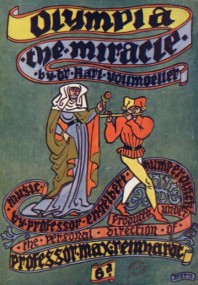
A newspaper illustration of the Olympia stage production of The Miracle

A few years ago – specifically in 2008 and 2009 – you may recall that we ran the Bioscope Festival of Lost Films. It was a droll conceit, using a blog to put on a festival of silent films that no longer existed. We described the films as if we were watching them (and yet not watching them), in London venues that once were cinemas but are no more, and with silent film musicians of the past to accompany said films. Regular Bioscopists got into the swing of things, even commenting on details of the clothes they had worn for the evening. All in all, it was a fun thing to research and write. You can find links to all of the films shown as part of the 2008 and 2009 festival on the Series page.

However, we pulled the plug on the festival thereafter, for three reasons. One, the festival took up too much time to research. Two, we received several requests from readers for information on these films, which they had imagined were lost and who couldn’t quite grasp what the concept of a lost film festival was supposed to imply. Thirdly, we learned after the 2009 festival that one of the films had in all probability survived. Great news for film; not such great news for a lost film festival, so we decided enough was enough.

We then waited for official notice of the film having been discovered before telling you about it, only to have discovered today that the news has been out for a quite a while now. Tsk tsk – the Bioscope should do better than that. So, belatedly, it is a pleasure to be able to tell you that Das Mirakel (Germany 1912) is not a lost film. It is held by the CNC film archive in France, and was screened last year as part of a Lubitsch retrospective (Ernest Lubitsch appears in a minor role in the film) and was reviewed – in French – on that excellent blog, Ann Harding’s Treasures. Alas, she reports that while the film is in prime condition, the direction is amateurish and the performances absurdly histrionic. This is both a surprise, given that the film was based on production by one of the greats of 20th Century visual theatre Max Reinhardt, while also not a surprise at all given the film’s peculiar production history.

As we related in the original post about the film, Das Mirakel came about when the British theatrical impresario C.B. Cochran was looking for an entertainment on a suitably grand scale to fill the vast arena of London’s Olympia. Cochran had seen Max Reinhardt’s production in Germany of Oedipus Rex and invited the great producer to devise a new epic production that would make best use of Olympia.

Reinhardt initially thought of recreating the Delhi Durbar ceremonies, held in India to mark the coronation of King George V in 1911. But instead he latched upon the idea of staging a medieval legend of a nun who escapes from her convent with a knight, experiencing assorted adventures and dangers, while at the convent a statue of the Virgin Mary miraculously comes to life and undertakes the nun’s duties. The major spectacle was provided by the drama’s cathedral setting, not to mention 1,000 performers, 2,000 costumes, 500 choristers, 25 horses, an orchestra of 2,000 and assorted examples of ingenious stage mechanics (see programme, left, from http://www.vam.ac.uk/users/node/9028). Given the distance between the audience and the action, the drama was presented in dumbshow (apart from the choir). The drama was written by Karl Vollmöller, with music composed by Engelbert Humperdink.

The Miracle, as it was known, was every bit the stage sensation that Cochran hoped it would be, with London audiences being overawed by its dramatic scale and its sentimental religosity when it opened over Christmas 1911. But where things get odd is when it comes to the film – or rather films – made of The Miracle. A film of The Miracle apears to have been an afterthought – a quick cash-in on the stage production’s popularity, at a time before Reinhardt gave any serious consideration of the possibilities of cinema (he would of course go on to produce a the classic Warners 1935 film A Midsummer Night’s Dream). It was originally reported that the film was to be made in London, but production instead moved to Austria, with producer Joseph Menchen and scenarist Michel Carré who was probably also the film’s director. Max Reinhardt himself seems to have had little to do with the film’s actual production. The oddness came with the camera operators and leading actress. The operators were the brothers William and Harold Jeapes, owner and chief cameraman at the Topical Budget newsreel. How they got the call to make the film is a mystery, but it was a hurried appointment, as William Jeapes later recounted:

In the first place, I may say that my own connection with the undertaking commenced just about twenty-four hours before I actually entered upon it, so you can imagine that there wasn’t much time for preparation. I received and accepted the request that I should take on the business, grabbed camera, films and baggage; caught the first train that was available, and, in almost less time than it takes to tell (as the novelists say) I was starting on the first preliminaries with Professor Reinhardt and M. Michel Carré (who adapted the play for the camera), near Vienna.

I left London on September 21st, and I returned on October 15th. During that time we were working regularly from the early morning until about 3 o’clock in the afternoon, at which hour it was necessary for the company to start back for Vienna, where ‘The Miracle’ was being played nightly – at the Rotunda. We did nothing on Sundays.

Jeapes and Jeapes were able newsreel operators, but were the last people you would have thought of to film a dramatic production, still less one so dependent on plausible illusion and a sense of scale. Odder still was that the key part of the Nun did not go to anyone from Reinhardt’s German production of the play, but instead went to an English actress without any film pedigree (or much of a stage one), Florence Winston. And she was Mrs William Jeapes. Other performers included Maria Carmi as The Madonna, Douglas Payne as The Knight, Ernst Matray as Spielmann, and somewhere in the background Ernst Lubitsch. All in all, a rum do.

As we wrote in 2009, the film received mixed reviews. Variety was dumbstruck, finding the film to be one of the wonders of its age:

The ‘Miracle’, reproduced from the wonderful Reinhardt pantomime of the same name presented at the London Olympia, is probably the finest exhibition of the “Celluloid drama” ever conceived. In some respects it is superior to the original pantomime spectacle, in that the paths of the performers – or characters – may be followed more minutely and with greater detail than is possible in the original, due to the possibility of showing the scenic progression with the unfolding of the plot … The whole presentment is remarkably impressive in general effect, the pictures so beautifully to resemble natural colors, the scenes so plentifully interspersed with captions announcing the progress of the tale, and finally the awakening to a realization that it was all a ghastly, enervating “dream”, is extraordinarily vivid. No spoken play could be more so.

The film’s lavish presentaton at special venues, with coloured print, a cathedral-like proscenium, organ, large choir and even incense wafting over the audience appears to have blinded some reviewers to the film’s actual shortcomings. The Bioscope (our favourite film trade paper) was more clear-sighted:

The whole play seems to have been adapted for the camera with only the most cursory regard for the latter’s possibilities and limitations. It has been forgotten that a scene viewed through an artifical glass lens is a very different thing from the same scene viewed in actuality by the naked eye … In the scenes showing the cathedral’s interior the stage is too deep, with the result that the players are constantly out of proportion with each other, and swell from midgets to giants in a fashion which is almost ludicrous as they move “down stage”.

Confusingly, there was a rival Miracle film, produced in Germany at the same time, which claimed that it was based on the legend rather than Vollmöller’s drama, to get round any copyright claim. It was also called Das Mirakel or Alte Legende – Eine Das Marienwunder, but in the UK it was marketed as Sister Beatrix. Produced by Continental-Kunstfilm GmbH in 1912, it was written and directed by Mime Misu, and is – we are fairly confident in stating – a lost film.

You can find details of the extant Das Mirakel on the CNC database. They credit the direction to Michael Carré and Max Reinhardt, but we doubt that Reinhardt had much to do with the film beyond initial negotiations (William Jeapes does at least note Reinhardt’s presence in Austria at the time of filming). Ann Harding’s Treasures’ review describes watching the hour-long film today as sheer torture, with acting styles of the flailing arm variety, no sense of composition or narrative, and a camera bolted to the floor simply recording theatre. She notes that a very much better film from the same source material exists, Jacques de Baroncelli’s La Légende de Soeur Béatrix (1923).

For all that, it would be good to have a chance to see Das Mirakel one day, just to get a sense of what so moved the variety reviewer. All it would need is a cathedral setting, an organ, a fair-sized choir and some incense. And every lost film found must be a cause for rejoicing, even if the story behind the film is of somewhat greater interest than the film itself. It is good to hae been wrong.

Motion picture studio directories

Actress Hope Hampton, from the frontispiece to the Motion Picture Studio Directory and Trade Annual for 1921

As we have noted before now, the plethora of online resources for family history that exist can be a particularly useful aid for early film research. Now the leading genealogy web service, Ancestry, has returned the compliment by making two American motion picture directories available on its site, for searching by those who subscribe to its services. The two volumess are the Motion Picture Studio Directory and Trade Annual for 1919 and 1921, which Ancestry has converted into database form, with this opening description:

Two directories to the actors, directors, producers, and technicians of the motion picture industry for the years 1919 and 1921 are contained in this database. Each directory has a biographical section with information about the listed individuals such as their name, birth date and place, a brief career bio sometimes including educational history, a physical description (for the actors) or special skills description (for production crew), and membership in clubs, unions, or other organizations. Many entries include addresses and some photographic portraits are featured. All are listed in an index at the back of each directory.

Section divisions for the directories are as follows: actors, actresses, child parts, directors, assistant directors, scenario editors and writers, cinematographers, studio managers, publicity men, laboratory and property men, and film cutters. The actors’ and actress’ sections are further sub-divided into leads, ingénues, characters, comedians, and heavies (villains). Biographical entries, besides the above listed information, also note films the individual has worked on and other important or relevant experience such as the bio of cinematographer Herbert Oswald Carleton which specifically mentions his early career as a mechanic and inventor as well as his patented invention, the Duplex Printing Machine.

Each person entry on the Ancestry database comprises: Surname, Birth date and place, Career summary, Description of physical appearance (actors) or other skills (technicians and crew), and Membership in clubs or societies. This is very handy for those searching for names across Ancestry’s gigantic database of genealogical information who require all such information to be in one place. However, it should be noted that the Motion Picture Studio Directory and Trade Annual for 1921 is freely availably online in word-searchable form from the Internet Archive, which also makes available Charles Donald Fox and Milton Silver’s Who’s Who on the Screen (1920) which the Bioscope has introduced before now and portraits with text from which are reproduced on the Bioscope’s Flickr site.

Sample page from the 1921 Motion Picture Studio Directory and Trade Annual

So it’s always worth checking twice with these things, and you can find summaries of Who’s Who on the Screen and now the Motion Picture Studio Directory and Trade Annual for 1921 in the ever-growing Bioscope Library.

Searching the BUFVC

http://beta.bufvc.ac.uk

We are mentioning with increasing frequency the existence of federated databases; that is, databases of databases, which allow you to search across multiple databases through a single search option. Sometimes they get called gateways or portals, but they are essentially all doing the same thing. We have already mentioned Connected Histories, JISC MediaHub, Canadiana and Europeana. There are others of major status in the pipeline which we will be covering at the appropriate time. But today we are looking at the BUFVC federated search environment aka All BUFVC.

The British Universities Film & Video Council is a small organisation that achieves big things. It exists to support the use of moving images and sound in UK higher education, and does so chiefly through a combination of information, online databases and a television and radio off-air recording service for educational users. Snappily known as the BUFVC, it used to employ your scribe not so long ago, so this may not be an entirely dispassionate review, but they do damn fine work with all the right principles – and this is a damn fine resource that they have created.

The federated search environment (a terrible phrase, friends) brings together nine databases and 13 million records. The databases include TRILT (a huge database of programme information on all UK TV and radio since 2001 and further records back to 1995), a database of some 30,000 educational titles aailable on DVD and tape, News on Screen (data on 180,000 British newsreels and cinemagazines from 1910 onwards), Shakespeare on Film, Television and Radio (7,000 records), TVTiP (television listings for the UK’s ITV channel 1955-1985), This Week (records for the ITV documentary series 1956-1982), and three independent local radio databases with associated recordings. As the publicity blurb puts it:

The search environment will transform moving image and sound resource discovery by replacing the need for researchers to locate databases and collections through multiple channels. It will enable creative discovery of content by opening up collections and connecting users with resources they were not previously aware of.

Before you get too excited, not all of this is accessible to everyone. Someone of the resources have been paid for with UK higher education monies and are accessible via password to UK HE institutions only, while TRILT is only available to BUFVC members, apart from the two most recent weeks’ programme data. Other records provide catalogue data, and then link to the film or sound recordings themselves, but you have to be in the UK HE club to access those. But that’s the BUFVC’s business to serve UK universities, and it’s highly commendable that they can still make so much of the catalogue data, and a great many digitised documents, available to all.

So there is a huge amount to discover for everyone. And here it does just about everything right that you would want to see from such a resource. Enter any search term and and result come up with title, short descriptions and some cheery icons which let you know database they come from, what genre type (e.g. radio, newsreel), what medium (e.g. film, sound) and whether any digital content is available online (subject to your particularl status). Individual records provide further information, depending on the nature of the original database. You can used the Advanced Search to refine searches by date, date range, medium, collection, availability, and genre. You can rate records, trace your preious searches, order search results by relevance, date or title, and results can be exported in XML format, as text or in citation format. There is first-rate faceting (i.e. letting you know how many of your search results break down into particular categories, and it even offers serendipitious related searches. What fun.

Search results for ‘charlie chaplin’

So what is there for the silent film researcher? The easiest thing to do is to used the adanced search and narrow search results to 1896-1929. You’ll find some 35,000 newsreel records and 500 Shakespeare records. The former are records of almost every British newsreel and film magazine released over that period, covering a huge variety of social and political stories as well as many items specifically relating to cinema subjects (17 newsreels on Chaplin, 20 for Pickford, 14 for Fairbanks). The BUFVC doesn’t hold the films, but the records will tell you who does (and link you to online copies including the freely-available titles held by British Pathe). The Shakespeare records are (hopefully) every title from the silent era relating to the Bard, a hugely useful resurce in itself, again with information on where extant copies may be found. But take away the date limiters and there is more to be found, among TV and radio programmes and DVD releases. 129 search results for Chaplin overall should give you an idea of the range.

The BUFVC federated search environment (it’s still a dreadful name, but I understand the idea is to have it appear on their front page so that the search facility effectively beomes the BUFVC online) is the result of a collaborative project between the BUFVC and Royal Holloway, University of London, and was funded by the Arts and Humanities Research Council. It was funded as part of something called the Digital Equipment and Database enhancement for Impact programme, and it is designed to create impact. Nine databases are too many to be offering separately – users will know about one or two, but ignore the others. They won’t be able to ignore this. It also establishes a platform onto which other databases could be added in time, enriching discovery all the more.

Go explore.

Parlons cinéma

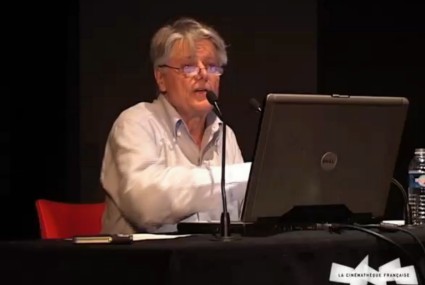
Maurice Gianati speaking on Alice Guy at the Cinémathèque Française

How’s your French? Regular Bioscopist Frank Kessler has kind sent me a listing of video on silent cinema and pre-cinema subjects which are available on the Cinémathèque Française website as part of its ‘Parlons cinéma‘ series. This is a series of videos (all in French) recording talks, conferences, debates, interviews and such like held at the Cinémathèque. They are knowledgeable and well-presented, with clips and PowerPoint slides interspersed among the talking heads.

This is list of some of the talks that fall within our area, covering such subjects as the Phantasmagoria, Alice Guy, Emile Reynaud, the phonograph in France, and introductions to Sergei Eisenstein and Laurel and Hardy:

From the little I’ve sampled, these are people who take their cinema seriously, and who can say that they’ve really tried cinema until they’ve tried it in French?

Aller explorer.