The death of celluloid

Five seconds on the death of cinema as we have known it. As the filmmakers say (in a statement which takes longer to read than the film takes to view):

In this terrible job market with bleak prospects, in a world where film projection is getting replaced by slick machine-operated digital projection, in a culture where black-and-white silent film is all but lost to the winds of time … one doofus with a tie and a poignancy-starved cineaste found magic together. But then everything caught on fire.

One of a long series of 5-second films made by 5secondfilms.com.

Scores of scores

A music score likely to have accompanied the British film The Guns of Loos (1928), from Colman Getty (via The Guardian)

Last week the discovery was announced of a quite extraordinary treasure trove of silent film music scores. Lurking the the basement of Birmingham (UK) city council’s music library has been found a collection of some 500 music scores designed for accompanying silent films. Anyone who knows about the paucity of surviving silent films scoes generally, particularly in Britain, is going to be stunned at such an announcement. Ten or twenty would have been exciting – 500 is just jaw-dropping.

However, it appears that the vast majority are not scores for specific films but rather scores for generic scenes, which were far more usual for standard silent film accompaniment. They have titles or descriptions such as ‘grave situation’, ‘mysterious shadows’, ‘in the church’, ‘supreme peril’ and ‘angry crowd scenes’. They were used by jobbing musical directors who would tour cinemas with their sheaf of scores, ready to match music to the films required. This gives us quite a different picture to the only commonly thought of, where a musical director would be attached to one cinema. The Birmingham collection identifies a number of such directors, among them Louis Benson, H.T. Saunders, Harry T. Ramsden and and the splendidly-named Purcell Le Roi, and while some were connected with just the one cinema or area, others hit the road to organise small orchestral music for silent wherever they would be paid to do so. They would usually be the musical leads – and not always violin or piano, as the collection makes clear.

There is a piece in The Guardian which gives a short account of the collection, but the Bioscope has turned to celebrated silent film pianist Neil Brand, who has briefly examined the collection, and who has kindly provided us with his first impressions of the collection:

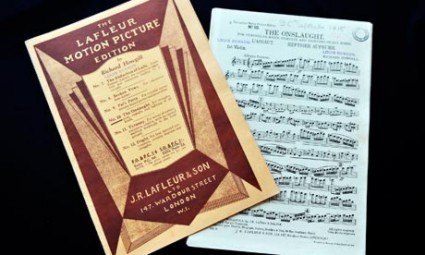
There is nothing particularly surprising, ground-breaking or game-changing in what they’ve got – what is new, to my mind, is the extraordinarily broad light it throws on what cinemagoers between 1914 and 1929 actually heard. All the pieces, British, French and American (roughly a third of each), are uniquely written for cinema use, published by commercially operating music publishers and are nearly all in sets of parts for a band of 7-11 players (a ‘salon orchestra’ as it was known). They all have generic titles (‘Bizarre March’, ‘The Onslaught’, ‘Emotional Waltz’, ‘Desert Monotony'(!)) or numbers, and often suggestions for their use (‘for Eastern pictures’, ‘For Pathetic or Tragic scenes’, ‘Fire or Torture scenes’ etc etc). There are a few owners names or rubber stamps and these are what particularly interest me – the Sherlock Holmes stuff begins with these; Louis Benson, who owned at least a quarter of the material we looked at, was obviously a jobbing musical director and as we looked through ‘his’ music sets I noticed visual cues written in pencil, not on the piano part as one would expect, but on the cello part. Only one cue, each time, which made me suspect that Louis hired himself out as MD to different orchestras for a specific film (which film we couldn’t guess from the sketchy pencil notes) which he then conducted / synchronised from the cello. I’ve always assumed the piano always led a band but cello also makes sense – easier to remove the hands from the instrument, less distracting when the instrument stopped playing and the bow doubled as a big, obvious baton for beating time or conducting.

This is the sort of very new inference one can make from this huge collection – Harry T. Ramsden of 12 Monteith Rd Glasgow, the biggest donor of material, had hundreds of pieces from ABC Dramatic and Carl Fischer Publications which would allow him to instantly provide a compiled score for any film – when you look at some of the music the pages have been turned so many times they have been taped up all round, edges and spines, until they are virtually cardboard – those are the pieces he used all the time – obviously he either really liked them or they fitted the bill in a huge number of contexts. And Purcell Le Roi, solo violinist, could provide his own music sets as well as his expertise, thus begging two questions – were these music sets with either easy or virtuosic violin parts, and was his name really Percy King?

We weren’t able to make more than a cursory sweep through the material but we did find one piece that could be linked directly to an actual film – Richard Howgill, later a music director and producer for the BBC, wrote a generic piece called The Onslaught, published by Lafleur Motion Picture Edition in 1928. On the violin part for this piece in the Birmingham set is scribbled ’25th September 1915′. That is the date of the start of the Battle of Loos, and in 1928 a movie called The Guns of Loos was a huge success throughout Britain – the movie exists in the archive (I’ve played it) and I’ll just bet that intertitle appears in it.

Some of the music is to get its first run through in eight years this Tuesday, when pianist Ben Dawson will plays some at a free pre-concert event at the City of Birmingham Symphony Orchestra’s film music festival. Then, we understand, the collection is likely to disappear for a time while the Birmingham music library transfers to a new building.

However, I don’t think we will have heard the last of this collection, and if I can get more information that I am able to share with you, I will.

Bioscope Newsreel no. 27

Frame grab from the trailer for Martin Scorsese’s Hugo

Some weeks we’re not sure what to put in the Bioscope newsreel, and some weeks we’re just overwhelmed with how alive our dead medium continues to be. And that’s when we’ve set aside the news, already reported, of the first appearance on American screens of the full restored Napoléon with Carl Davis score, next year. So, after a gap of a few weeks while we were away on our travels, here’s some of the news in silent films now.

Hugo trailer
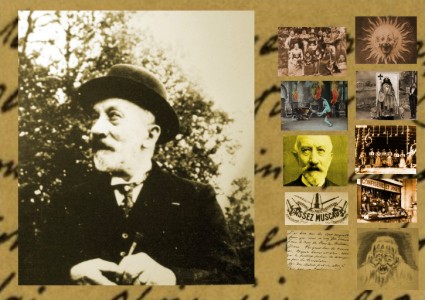
Martin Scorsese, as you may know, is making a film of Brian Selznick’s children’s novel, The Invention of Hugh Cabret, in which Georges Méliès is a central character. During production the film has been known as Hugo Cabret, but clearly that was too much for Disney’s marketing people, and now it’s just known as Hugo. The first trailer is out, and – guess what – it looks like a Disney children’s film. But some enticing recreations of Georges Méliès’ film and stage productions, as the image above shows, should draw us in to see when the time comes. Read more.

Silent film scores galore
An extraordinary treasure trove of silent film scores has been unearthed by Birmingham city council (in the UK) in its music library. There are around 500 scores in a collection which has lain in a basement for decades. Chiefly examples of generic scores for stock scenes (chases, mystery scenes, people in peril etc.), many are scores for small orchestras of between seven and eleven players. They appear to have been collected by touring musical directors, who went from cinema to cinema rather than work for just the one venue. We will have more on this amazing discovery and its importance for silent film history in due course. Read more.

Theodore Roszak RIP
The social critic, academic and novelist Theodore Roszak has died. Best known for coining the phrase ‘counter culture’ in his 1968 work The Making of a Counter Culture, he was also an ardent film fan and wrote one of the best of all film-themed novels, Flicker, a dark and imaginatively far-fetched work which revolves around the mysterious figure of Max Castle, B-movie horror film maker in the 1940s and reveals an extraordinary alternate history of Hollywood from the silent period onwards. Read more.

San Francisco silents
The San Francisco Silent Film Festival is running as we type. Highlights include a solo electric guitar acompaniment by Giovanni Spinelli to Sunrise: A Story of Two Humans (there’s an extract from a documentary on the scoring of the film here), He Who Gets Slapped, I Was Born But…, Marlene Dietrich in The Woman Men Yearn For, and the ubiquitous The Great White Silence. Read more.

Paintings of cinemas
One of the blogs the Bioscope likes to read when it feels the need to stir the brain cells a bit is Nick Redfern’s thought-provoking Research into Film. Normally his subject is analytical studies of films, but he has put up a delightful post exhibiting paintings of cinemas and their audiences by contemporary artists. Do take a look. Read more.

‘Til next time!

Napoléon in the USA

The composer Carl Davis has announced on his website that the full restoration of Abel Gance’s Napoléon (1927), with his symphonic score, will receive its US premiere in March 2012. As Davis notes, “a 32 year odyssey has been achieved”, since there has been a battle between rival restorations and scores of the film, with a re-edited version with score by the late Carmine Coppola (father of Francis Ford Coppola) that was exhibited in the USA in 1981 effectively keeping out the full Kevin Brownlow restoration, with all of the material he has found since 1981 (now 332 minutes in total), and Carl Davis score.

Without knowing any of the details, clearly peace has broken out (might Kevin and Francis had a chat about things when they each were awarded honorary Academy Awards last year?). There is a triumphalist trailer for the film on the TCM site which states that, courtesy of the San Francisco Silent Film Festival (and American Zoetrope, and The Film Preserve, and Photoplay Productions, and the BFI) the film will screen at the Paramount Theatre, Oakland, San Francisco, with the music played by the Oakland East Bay Symphony. There will be four performances only.

We will add more information as and when we find it.

Meanwhile, start queuing now …

The O’Kalem collection

A while ago we told you about Blazing the Trail, a new documentary by Peter Flynn about the American film company Kalem and the films it and associated companies made in Ireland 1910-1915. Now the documentary and eight surviving ‘O’Kalem’ films have been issued on a double DVD set by the Irish Film Institute and BIFF Productions. The O’Kalem Collection 1910-1915 comprises The Lad from Old Ireland (2 versions) (1910), Rory O’ More (1911), The Colleen Bawn (1911), You Remember Ellen (1912), His Mother (2 versions) (1912), For Ireland’s Sake (1914), Come Back to Erin (incomplete) (1914), Bold Emmett, Ireland’s Martyr (1915) and the feature-length documentary Blazing the Trail. The second DVD also contains an O’Kalem image gallery. Some of the films have replacement English titles as they only survive in foreign-titled versions. There is piano and violin accompaniment.

O’Kalem was the nickname given to the Kalem filmmakers who made these tales of romance, rebellion and escape, which overturned all the crude stereotypes of stage Irish which had featured in films to that date. They were innovative in being American fiction film productions shot overseas, making handsome use of Kerry locations, and A Lad from Old Ireland was the first fiction film made in Ireland. O’Kalem means more than just the Kalem company itself. Its leading lights Sidney Olcott and Gene Gauntier stayed on in Ireland and filmed as the Gene Gauntier Feature Players (Come Back to Erin and For Ireland’s Sake) and the Olcott alone as Sid Films (Bold Emmett, Ireland’s Martyr). This is an important collection, for what it represents of Irish and early American cinema, and for the charming, fresh quality of the films. It has been lovingly put together and is warmly recommended (the delightful Blazing the Trail we have already praised – together they make make the ideal package).

And there’s more. Should you be so charmed by the films that you wish to visit Ireland, then an O’Kalem trail will await you. Last Monday Ireland’s Minister for Arts, Jimmy Deenihan launched the O’Kalem Film Trail, a tourist trail in Kerry which takes you through the two twons most associated with the filming, Beaufort and Killarney. The ten stops are:

  • The Beaufort Bridge
  • The Beaufort Bar (where the film company stayed)
  • The O’Sullivan Field
  • The Churchtown graveyard and St Mary’s Church
  • The River Laune
  • The Gap of Dunloe
  • Muckross Lake and the Colleen Bawn Rock
  • Muckross Abbey
  • Dinis Cottage
  • Torc Waterfall

A 20-page booklet has also been produced. One fervently hopes that there will be American tourists heading over to Ireland in search of their roots who come home clutching a DVD of early cinema titles. All in all, enterprise has been shown to match that of the original O’Kalems.

The O’Kalem Collection: 1910-1915 is available from the Irish Film Insitute as a multi-region NTSC 2-DVD set, price 21.99 euros, including postage and packing.

Méliès at the crossroads

http://www.melies.eu

As noted in our interview with Matthew Solomon, later this month there is to be a conference on Georges Méliès, news of which I hadn’t picked up on before now. It is to take place 25 July-August 2011 at Cerisy-la-Salle in France. Méliès, carrefour des attractions has been organised by André Gaudreault and Laurent le Forestier, with the support of the Méliès family. It seeks to re-examine Georges Méliès’ position in early cinema history, whether as a precursor of subsequent developments in narrative cinema, spectacle, science fiction etc, or whether he is better understood as a product of the social, economic and legal practices of his time.

The conference will comprise a mixture of academic papers and screenings. The only information available on its contents is in French, which will be the dominant language at the conference, but here is the line-up of speakers and papers:

Lundi 25 juillet
Après-midi:
ACCUEIL DES PARTICIPANTS

Soirée:
Présentation du Centre, du colloque et des participants

Mardi 26 juillet
Matin:
André GAUDREAULT: La cinématographie-attraction chez Méliès: une conception durable
Laurent LE FORESTIER: Le point de vue du monsieur de L’Orchestre: la place des “films” de Méliès dans les programmes de spectacles

Après-midi:
Patrick DÉSILE: Trucs de théâtre et trucs de cinéma. Essai d’inventaire et d’interprétation
Réjane HAMUS-VALLÉE: La sauce et le poisson: pour une esthétique de l’effet mélièsien

Lectures de lettres, par Elisabeth SERMAN et Sylvain SOLUSTRI, présentées par Jacques MALTHÊTE

Soirée:
Projection de films

Mercredi 27 juillet
Matin:
Jacques MALTHÊTE: L’appentis sorcier de Montreuil-sous-Bois
Jean-Pierre SIROIS-TRAHAN: La scène réfractée au travers de la lentille de Georges Méliès

Après-midi:
Jean-Pierre BERTHOMÉ: Les décors de Méliès
Martin BARNIER: Le son féerique de Méliès

Présentation des publications récentes

Soirée:
Projection de films

Jeudi 28 juillet
Matin:
Matthew SOLOMON: Méliès, Incohérent
Frédéric TABET: Méliès, le magicien et les magiciens

Après-midi:
DÉTENTE

Vendredi 29 juillet
Matin:
Laurent GUIDO: Entre performance scénique et ciné-chorégraphie, les avatars de la danse chez Méliès
Priska MORRISSEY: Femmes-papillons et diables en collants: les costumes des vues de Georges Méliès

Après-midi:
Giusy PISANO & Caroline RENOUARD: Méliès et la lanterne magique
Rae Beth GORDON: Voir double: le fondu enchaîné et le regard sidéré du spectateur

Soirée:
Lectures de lettres, par Elisabeth SERMAN et Sylvain SOLUSTRI, présentées par Jacques MALTHÊTE
Spectacle de magie, par Frédéric TABET

Samedi 30 juillet
Matin:
Frank KESSLER & Sabine LENK: Méliès et la série culturelle de la féerie
Stéphane TRALONGO: Georges Méliès et les faiseurs de féeries. Pour une histoire des échanges entre théâtre et cinématographe

Après-midi:
Caroline CHIK: Arrêt de caméra et photographie animée
Pierre CHEMARTIN & Dominique NOUJEIM: Méliès et Cohl: transformations, métamorphoses et disparitions

Soirée:
Spectacle de magie, par Sylvain SOLUSTRI

Dimanche 31 juillet
Matin:
Elena DAGRADA: Entre astronomie et astrologie, ou de l’anthropomorphisation des astres
Nicolas DULAC: Méliès et les fictions de la science

Après-midi:
Viva PACI: Les visions d’un scientifique récalcitrant
Wanda STRAUVEN: Une lecture média-archéologique de l’œuvre de Georges Méliès (ou: Méliès, un praticien SM?)

Soirée:
Projection de films

Lundi 1er août
Matin:
Philippe GAUTHIER & Santiago HIDALGO: Georges Méliès dans l’historiographie des premiers temps
François ALBERA: Synthèse du colloque

Après-midi:
DÉPARTS

The conference site has abstracts for each of the papers (in French).

There is further information, also in French, at something else that is new to me – what is billing itself as the official Georges Méliès site (www.melies.eu). On quick inspection it contains a biography, a rudimentary filmography (without catalogue numbers), a family tree (handy), links and entertaining associated information (including a listing of the remarkable number of French streets named after Méliès – can any other filmmaker have been so recognised?), bibliography, news and images.

The site has been put together by Pauline Duclaud-Lacoste Méliès, who (the family tree tells us) is Méliès’ great-great-granddaughter. It isn’t anywhere near the great, comprehensive and useful website that an artist of Méliès’ standing ought to have by now, but it’s maybe a little better than what has gone before. If only there was as much attention paid to Méliès by our website builders as there has been by France’s road builders.

The Bioscope interviews … Matthew Solomon

Matthew Solomon

We’re going introduce a new feature here at the Bioscope. It’s our first interview, and it’s intended to be the start of series of interviews with people involved in one way or another with silent film and related areas.

Our debut interviewee is Matthew Solomon. Solomon is Associate Professor in the Department of Screen Arts and Cultures at the University of Michigan. He is the author of the award-winning Disappearing Tricks: Silent Film, Houdini, and the New Magic of the Twentieth Century (University of Illinois Press, 2010) and the editor of the recent Fantastic Voyages of the Cinematic Imagination: Georges Méliès’s Trip to the Moon (SUNY Press, 2011), which focusses on that single film from 1903. The interview covers Fantastic Voyages, Le voyage dans la lune/A Trip to the Moon itself, magic in cinema, and man of the moment Georges Méliès.

TB: How did the book Fantastic Voyages come about?

MS: About the time I was finishing the first draft of the manuscript of Disappearing Tricks, I realized there was a lot to say about Méliès that had nothing to do with magic. Editing an anthology seemed like a good way to explore that further while also keeping busy during the long stretches of time when the process of publishing Disappearing Tricks was out of my hands. I also wanted to see if a single early film could be a viable subject for a book-length treatment. I like reading and teaching books that look closely at one specific film, but I had never seen such a book written about a film made before 1914. I knew I’d need a lot of help and luckily a number of people whose work I admire were willing to be part of the book and make it what it is.

TB: Please describe the book for the readers of the Bioscope.

MS: The contributors to Fantastic Voyages closely analyze A Trip to the Moon from a number of different perspectives while exploring its connections to countless other works in many different media. While the book relates the film to Méliès’s oeuvre and firmly anchors it within the historical contexts of the turn-of-the-twentieth-century, it also tries to open it up to other kinds of relationships and contexts that might suggest why A Trip to the Moon has had such a long and varied ‘afterlife’, one that continues right up to the present day. It is a highly international volume, with contributors from some eight different countries. The appendix includes a dossier of primary-source documents, including two previously un-translated essays by Méliès, and the book is published with a critical edition DVD.

TB: How did the DVD extra come about?

MS: Two of the big issues that emerged for me in researching the book were the ways that truncated prints and projection speed have shaped our understanding of A Trip to the Moon. What I found was that the film has been seen throughout much of its history in versions that were missing part or all of the last two scenes. And even though Méliès’s catalogs specify a running time of sixteen minutes, which comes out to about 14 frames per second, all available versions of the film had been transferred at a much higher frame rate, which speeds the action up by close to 100% in some cases and results in a frenetic pace that was likely never intended. I wanted to make a complete version of A Trip to the Moon available at the specified speed and I got that opportunity when the book was being prepared to go to press. Charlie Johnston, a film editor with Lost Planet New York, got interested in the project and made creation of the DVD possible. We began by scanning a reconstructed 35mm print generously loaned from the collections of Film Preservation Associates by David Shepard. Simultaneously, Nico de Klerk discovered a previously unknown color-tinted and German-titled version of A Trip to the Moon in Amsterdam. The Eye Film Institute scanned the print and consented to have it included. Musical accompaniment was by Martin Marks, who recorded a 1903 score he had discovered in London, and Donald Sosin, whose original music for the tinted version ended up being one of the highlights of the disc.

TB: There are many different interpretations of A Trip to the Moon in Fantastic Voyages. Which one surprised you most?

MS: I was surprised by at least one thing in each of the essays — an overlooked detail, a new understanding, a previously unmentioned connection, or a relevant contemporary work. Those surprises were one of the pleasures of working with such a knowledgeable and smart group of collaborators, whose contributions demonstrate that maybe we didn’t know A Trip to the Moon as well as we thought we did.

The iconic moment when the lunar capsule lands in the Moon’s eye, from A Trip to the Moon/Le voyage dans la lune

TB: Why was A Trip to the Moon so popular in 1903?

MS: One defining feature of A Trip to the Moon which made it so popular was the way it drew upon so many things circulating in the culture around 1902-1903 that would have been familiar to audiences: the Jules Verne book, of course, the Offenbach operetta, a ride that was the hit of the 1901 Buffalo World’s Fair, as well as countless other works discussed in the book. It was also a compelling storyline and a virtuoso display of the most current visual effects by the undisputed master of the trick film. Méliès was a gifted synthesizer and this film is evidence of his ability to combine diverse elements into a coherent and engaging spectacle.

TB: Why is A Trip to the Moon so important today? Why has it lasted?

MS: On one hand, A Trip to the Moon is important today because it is part of the canon — a film that gets viewed and taught as a historically important work. This is itself the result of a process that began with its rediscovery at the end of the 1920s, one which I explore in my introduction to the book. On the other hand, A Trip to the Moon continues to be an important film because it resists singular interpretation and instead lends itself to constant reinvention. When it was first rediscovered, it retroactively became a surrealist film, just as it retroactively became an early work of science fiction when that genre proliferated a few decades later. More recently, as Viva Paci points out in the last chapter of the book, Méliès’s aesthetic has been readily appropriated in music videos that give new life to A Trip to the Moon. It is a film that seems to have aged well, becoming fresh and relevant in different ways over the years.

TB: Why was there such a strong relationship between magic and illusion and early cinema?

MS: Magicians were one of the first professional groups to really recognize the potential of the cinematograph and to begin to exploit some of its possibilities. Méliès was among these turn-of-the-century magicians, of course, and he remained committed to the core principles of magic, as I discuss in Disappearing Tricks. Viewers as well as filmmakers understood film as an illusion partly since moving pictures were often screened as part of magic shows. This is just how A Trip to the Moon was first presented to viewers in Paris in September 1902 at Méliès’s magic theatre. A major draw of the film would have been its trick shots—the moon’s approach, the dream sequence, the exploding Selenites, the underwater shots—all of which were cutting-edge visual effects at the time.

TB: Are the films of Georges Méliès still ‘magical’ today?

MS: I contend they are. Méliès’s films still have the capacity to deceive us: we know that what we’re seeing is an illusion, that we’re being tricked, but we may not know just how it was done — which is not all that different from how the films were received in 1902. For many years, one of Méliès’s primary tricks went by the name of the ‘stop-camera effect’, even though Jacques Malthête pointed out thirty years ago that all these tricks involved editing as well as simply stopping and restarting of the camera. Méliès actually cut, or edited, his films to create the appearances, disappearances, and immediate transformations we see. Yet, this crucial part of the operation, the ‘substitution splice’ as it is sometimes called, often seems to have gone undetected. Likewise, by looking closely at A Trip to the Moon, one discovers that several scenes that appear to be simple straightforward long takes are actually made up of separate shots that were very carefully choreographed and seamlessly matched together. The magician of Montreuil can still trick us, more than a hundred years later.

A captive Selenite on earth, from the final scene of A Trip to the Moon

TB: Is A Trip to the Moon really a satire on imperialism, as is argued in the book? Aren’t we a little guilty of imposing our idea of how films work onto a film which audiences would have read very differently in 1903?

MS: A Trip to the Moon is a lot of things, and a satire is one of them. The last two scenes, which are missing from so many prints (including most now circulating on the Internet) really make this clear. The medal ceremony with all of the posturing by the explorers, who have been so inept and violent; the captured Selenite on a leash that is beaten with a stick until it dances for the cheering crowd; and the statue of the conqueror Barbenfouillis with his foot firmly planted on the head of an unhappy vanquished moon: all that points to a highly ironic take on exploration and, with it, imperialism. We have to remember that Méliès was a political cartoonist as well as an illusionist before he started making films. The ‘magician of Montreuil’ was not nearly as innocuous as he has been made out to be in retrospect. I certainly wouldn’t claim that movies are viewed in the same way today as they were in 1902 or 1903, but contemporary audiences may in fact be less attentive to detail than the viewers of Méliès’s time, who were in the habit of reading and interpreting images dense with meaning like political caricatures much more carefully than most of us do today. During the 1890s, for example, commentators on Lumière films drew attention to leaves fluttering in the wind in the background, but this detail passes unnoticed today. If you slow down A Trip to the Moon to 14 frames per second, as we did on the DVD, and really look carefully at what is happening onscreen, you notice there’s a whole lot more to it than a compelling story and a clever series of visual effects.

TB: 2011 is turning out to be a remarkable year for Georges Méliès, with the colour restoration, the Hugo Cabret film to come – and of course your book. And we have had exhibitions and the Flicker Alley DVD releases. Why is there so much interest in Méliès just now?

MS: Yes, Méliès is getting a lot of attention right now — just in time for the 150th anniversary of his birth. The cluster of Méliès events in 2011 may be partly coincidence. I know that restoration of the hand-colored print of A Trip to the Moon discovered in Spain has been in the works for more than a decade and might well have appeared sooner, just as the film adaptation of Brian Selznick’s wonderful book perhaps could have been produced earlier. In addition to Fantastic Voyages, you might also note the Méliès conference taking place later this month in Cerisy-la-Salle. But most importantly, the level of interest in Méliès would not be what it is now if not for the long-awaited entry of his work into the public domain a year-and-a-half ago, which more or less coincided with the release of the Flicker Alley DVDs. The timing has worked in favor of Méliès’s legacy: given his preference for the short form and his skill in staging virtual onscreen environments, Méliès’s work seems more prescient than ever right now.

TB: Fantastic Voyages seems to suggest that film studies is no longer enough if we are to appreciate such a film as A Trip to the Moon? Is film studies changing, or does it need to change?

MS: I hope the book demonstrates the value of treating cinema as a part of a much broader set of cultural practices while remaining attentive to the specifics of individual films. This is something that historians of early cinema have become accustomed to doing because so much contextual and intertextual knowledge is sometimes needed simply to make sense of the films. Film studies has become more inclusive and interdisciplinary, I think, and we can see some of the ways the field has changed by comparing the essays in Fantastic Voyages to accounts of A Trip to the Moon in earlier books, where it was often mentioned only as a forerunner of narrative cinema. Although I certainly wouldn’t deny this, such a narrow view centered on storytelling seems rather impoverished when one considers the true richness of the film and the diverse contexts that helped to generate it.

TB: What is your next project going to be?

MS: I’m working on a study of Méliès that examines his work as it cut across the various media in which he worked during his career, including (but not limited to) caricature, cinema and theater. While Méliès was undoubtedly a multi-media auteur, I’m ultimately less interested in his singular genius and vision than in using archival research and close examinations of his work to explore the ways that images and performances were staged, politicized, manipulated, commodified, circulated and exchanged in particularly modern ways during the late-nineteenth and early-twentieth centuries.

TB: Thank you.

Media and cultural memory – day three

I have two definitions of history which I keep coming back to in my mind.

1. History is what was known once but has been forgotten.

2. History is the present’s interpretation of the past.

Time and again historical questions, interpretations and hypotheses involve trying to recover something that was common knowledge. Equally, history can only be seen through our ever-changing eyes. The history we understand now is not what those tomorrow will understand.

All of which makes the idea of history and cultural memory a bit nebulous. If history is about forgetfulness and re-interpretation, then remembrance has little to with it, and the memories of others are theirs alone.

But we press on.

Day three of the Iamhist conference on the above theme, and the last day for me, though conference and events continue to Sunday. Nothing among the 9am parallel sessions immediately grabs me, but I think I’ll go for New Media, New Memory – three papers piquantly bringing together pirate radio, the Bible, and the Tea Party.

10.20 – Efficient paper from David Dault on ideologically-biased Bible commentaries (e.g. explaining that the invitation to share all your goods is not an invitation to communism) which seemed to belong to a different conference entirely.

Chirpy paper by A.W. Badenoch on pirate radio, mostly a critique of The Boat that Rocked for misremembering Radio Caroline. Do films ever remember anything correctly? What is a correct memory anyway?

Katy Scrogin on the Tea Party’s use of new media to disremember. Depressing account of ideology run riot. History as the past reinterpreted by the present in extremis. Or a denial of any sort of history at all. I guess their belief in interpretation overriding historical fact makes them cultural theorists of a kind.

You fear that the media have failed, because fundamentally they cannot communicate truth. But rather they ably reflect human fallibility.

I need to escape into the past. I need a paper on newsreels.

12.25 – Somewhat disappointing paper on Swedish newsreels which announced work to come rather than work done. Lively paper by Scott Anthony on iconography of Imperial Airways, though not quite sure how it connects with memory.

Jo Fox gave authoritative, clear paper on the self-myth making of the British documentary movement, revisiting their 1930s’ work as an ideal for engaging with the working man and helping to change society. They were driven to myth and overstatement because they were arguing their case in the face of a sceptical comissioning body (Ministry of Information) which was probably more interested in results. Did they really believe documentary would be fundamental to building post-war Britain? Such vanity.

13.15 – Now this is going to be fun – keynote from Richard Howells on the Titanic and modern memory. Just what’s needed at this stage of things – a star turn.

17.50 – An entertaining deconstruction of all things Titanic, pointing out that in historical terms its sinking is little more than a footnote, but in mythological terms it retains huge importance. The myth-building began almost as soon as it sank (witness the fakery in newsreel from the time), and has changed according to need, from early patriotic interpretation, to nationalist (the Nazi film version), to liberated Rose in James Cameron’s avowedly historically accurate version.

We learned lots about Titanic merchandise, including teatowels, sinking bathpugs, and cheese. Our ‘memories’ (there are no surviving survivors) are all so post-modern, it’s too easy to forget that there was a real tragedy, with real people dying.

From multimedia myth to memories of cinemagoing, using evidence from the time or derived after the event though interviews. I chaired a session with microhistories from Guy Barefoot (Leicester), Lies Van de Vijver (Ghent) and Kathleen Lotze (Antwerp), all fine examples of what sometimes gets called the new cinema history – empirical evidence, databases, sociological questions, films as something seen by people. Right up the Bioscope’s street.

17.20 – I’m now journeying back to find that street once more. Maybe more thoughts later.

20.20 (UK time) – Back home (Gatwick is starting to feel like home). Do I have any more thoughts? Cultural memory is a con, at least where history of the usual sort is concerned. Like personal memory, it’s about what a society wants to have happened rather than what did. Of course history is all about interpretation in any case, but not the interpretation by society. History is made by historians – by people who know what they are doing. That’s why bodies like Iamhist are important and why conferences such as this are important. They are essential means for discovering the truth. It is good to explore cultural myths and memories, but the truth is our anchor.

And now I’m going settle down with my newspaper and read all about the sorry end of The News of the World.

Good night.

Media and cultural memory – day two

And here we are on day two of the Iamhist conference, on the theme of Media and cultural memory. First up is a parallel session on Memory and World War I, right up my street and I’m chairing it. Best to put down the Blackberry – it won’t look so good.

10.55 – Three interesting papers on memory and World War I, each in its way looking at how the visual archive has served as commemorative evidence. Sheena Scott on fleeting images of disabled soldiers in French cinema of 1920s/30s. Are there so few because the French repressed it or because it didn’t appeal to a filmgoing public? There is nothing like Lucky Star in the US.

Roel vande Winkel on With Our Troops on the Yser (1928/29), war footage repurposed by Flemish nationalists for propagandist ends, with emphasis of gruesome death that you wouldn’t get in commercial cinema.

Leen Engelen on the interesting theme of picture postcards of Edith Cavell and Belgian-born heroine, also executed by the Germans, Gabrielle Page. Statues as one form of visual commemoration turned into another, postcards.

11.20 – Another session, another war – now it’s WW2. Brian Petersen on Danish resistance movies – made after the war, fairly obviously. Particularly Three Years After (1948) on a disillusioned former resistance fighter. A commercial flop for telling audiences what they did not wish to hear.

Wendy Burke on heroes and villains in Dutch war-themed films 1962-1986. Refreshing to have someone from one country speaking about another. It would be interesting to have a rule for film conferences saying that no one can give a paper about their home nation. What new things we might learn.

Here film moves from ideas of goed (good, noble) and fout (bad, collaborationist) to the grey area where many actually lived. Yet there were no Dutch films about the war 1951-61 and only two in the 1960s. The Silent Raid (1962) has all Dutch working collaboratively for the resistance. Long wait til Soldier of Orange (1977) which shows a more complex picture of resistance and collaboration. Some have to collaborate to avoid worse for themselves or loved ones. It took over 30 years for Dutch film to face up to such truths. We can accept more the further we are away from it, in place and time. Inevitably.

Ilse Raaijmakers on commemoration of the war in Dutch newspapers. Dutch had no recent experience of war so had to learn for new the art of commemoration. They established a national liberation day which no one much followed, so they stopped it being a public holiday in 1954, at which point everyone (insofar as newspapers can mean everyone) protested. So newspapers drove it to become a national holiday again in 1955.

13.05 – Things going well so far. So many pitfalls with the theme of memory, let alone the yawning vagueness of cultural memory, but Iamhist types know how to steer through such territory.

13.20 – Now for keynote from Christine Becker, winner of Iamhist book prize for It’s the Pictures that Got Small, a really excellent work on film stars keeping their careers going on US 1950s TV. Yours truly was one of the judges so I know. Do read it. Wise, revelatory, comprehensively researched and a pleasure to read.

Gee, she talks even more quickly than I do when giving papers. And she’s speeding up …

Entertaining account of the research process focussing on the perils and pleasures of using interview material. Eternal watchfulness needed, but sometimes people do actually speak the verifiable truth. Also the challenges of dealing with those who didn’t want to remember.

A good talk. Sort of a masterclass on conducting research and turning it into publication. I think it will have inspired an audience member or two.

14.30 – Now three papers on new media history. First up, Berber Hagedoorn on Dutch multi-platform TV and history. Focus on rescreening of archival TV – catch-up, online archives, open media platforms (YouTube) etc.

Example of In Europehttp://ineuropa.nl – TV series, website, virtual atlas, blog, radio broadcasts, user contributions. TV keeps the memories alive, archives on their own don’t. Discuss.

Nice, optimistic paper.

14.50 – Krisitan Handberg offers us the phrase “digital yesterland”. Who will thank him?

Agh, Yesterland exists – it’s a virtual theme park.

The retro boom of today. An obsession with the past beyond the domain of history. Is there more to the past than history? I must ponder this.

Retro is always a gesture, never total recall. It’s us playing with the past.

Perhaps we look so much to the past because we no longer look to the future.

15.15 – Sian Barber on EU Screen, the TV equivalent to European Film Gateway reported on last week. Aims to offer 35,000 open access items from European TV. That’s what 5M euros buys you. I’m greatly impressed by these ambitious, idealistic, rigorous projects, but I don’t know who they are for. Has anyone asked for a selective portal to European archival TV? Is this creating a shared heritage that doesn’t exist, or does it exist only we haven’t thought about it much, or will it now have to exist because we have created a platform for it?

16.20 – How politely the Danes are addressing us all in English. At the end of paper sessions they ask questions of one another in a foreign tongue when in their own land.

16.25 – Danish filmmaker Neils Vest introduces his documentary about Copenhagen’s squatters’ ‘free city’ Christiania.

To live outside the law you must be honest, as the great man sang.

18.55 – Hmm, the free life looks like it has about as much hassle as the unfree one, and they sing such terrible songs. Now by a canal listening to Danish trad jazz band play ‘It don’t mean a thing if you ain’t got that swing’. And now it’s time for supper and society.

Cheerio.
Media and cultural memory – day one

So here we are on day one of the Iamhist conference, being held at the University of Copenhagen, on the theme of ‘media and cultural memory’. It’s so broad a theme that practically anything could be made to fit somehow, so long as it covers the media and history – for what is history but cultural memory in any case?

09.45 – Sitting on a bench on the immaculately clean and clean-cut university campus, glorious weather abounding. Have breakfasted with fellow inmates at the comically plain hotel (rooms just above prison cell status, but not much). Now for a Iamhist council meeting, once I have grasped the cryptic directions given to me.

14.10 – The council was what council meetings have a tendency to be. Now after lunch in the sunshine we are looking to kick off the conference with formal introductions, just as soon as the chaos in the registration queue is sorted out … and we’re ready.

14.15 – The dean of faculty of humanities hasn’t heard of Nordisk. So much for Danish cultural memory …

14.25 – Roundtable on memory and museums with Thomas Christensen (Danish Film Institute), Raye Farr (US Holocaust Memorial Museum), Suzanne Bardgett (Imperial War Museum).

15.25 – Christensen economically gives same presentation as he did in Bologna. The mechanics of sustaining film archives in a digital age. What is a digital object/original? “History can only be truly trusted if the primary documents survive unaltered”. That’s subtle – you can write history with digital surrogates, but our archives and museums must preserve the originals, or we have no history worth writing.

That’s sort of right. But film archiving is all about copying. I guess it’s that we must always be able to determine provenance – the memory of what the object (now digital) once was.

15.45 – Much discussion of importance of capturing first person testimony, but I wonder if our compulsion for collecting oral history is greater than the actual wish we have to consult this. Ultimately the only memories we have are our own.

16.45 – Parallel session on radio and sound history, and Foucault gets his first mention. It won’t be the last.

16.20 – And now Derrida. The speaker asks Whither spectrality? Whither transindividualtion? Search me. I have Archive Fever on my bookshelves but I don’t know of any archivist who has read it.

16.40 – LARM audiovisual research project, which is generating one million hours of Danish radio. Wow. Might there be a case for having too much memory? Recordings from 1931 onwards. Aims to stream sounds to researchers to their own computers and mobiles. 3.35M euros project grant.

Power of radio to give illusion of proximity to an event. How are they overcoming the copyright issues? (It’s for HE users only, and covered by licence) And how extensively do they expect it to be used?

17.05 – Third speaker from this same project on how to deal methodologically with radio recordings that no longer exist. When secondary sources (scripts etc) become primary sources.

Intriguing observation – analogue archives offer potentially infinite information, digital archives are closer to a finite amount of information.

Fascinating project. I hope it gets the use to match its potential. Researchers struggle so much with audio archives – more so than film. It’s the curse of the time-based medium, it takes time to listen to it.

17.45 – Looking forward to this – Stephen Badsey on Media, Memory, and the Transformation of First World War History. Keynote given in memory of the late Phil Taylor, a great historian of media and propaganda.

20.55 – It was a terrific talk from Steve Badsey (ex IWM and Sandhurst, now at Wolverhampton). On military history v cultural history, and pretty withering about the latter. Essentially military historians have revised all the sentimental ideas about WWI (the pity of war, lions led by donkeys etc), but until recently cultural historians have been more interested in the myth than the reality, while the popular idea remains rooted in poets and O What a Lovely War.

It’s rare to hear a talk which would go down as effectively with a general audience as with an academic one. Some gems I noted down:

  • Think of all those who did well out of the war: Hollywood producers, Irish nationalists, British women over 30 (who got the vote)
  • There were two Western Fronts – the one of literary/cultural theory, and the one of military history
  • Not everyone appreciates the fact as yet that you can be interested in military history and yet not be a murderous psychopath
  • For many soldiers their frontline experience was better than they knew at home, and with the risk of violent death possibly less

Also he spoke about the increased appreciation of visual media (including film) as evidence, a heartening trend that has grown as access has grown. We archivists just have to keep on making more available.

Good chats over dinner about access to scholarly journals online, repairs to the Little Mermaid, Foyle’s War, the necessity of having Journey’s End on DVD, and the possibility of newsreel footage proving that the Titanic never sank …

More on the morrow in another post.