London was dangerous

It’s been a while since I posted any memoir evidence of going to the cinema in the silent era, a particular research topic of mine. This quotation from V.S. Pritchett’s memoir A Cab at the Door: An Autobiography: Early Years (London: Chatto & Windus, 1968) also serves as further evidence of the term Bioscope, and of the early cinema practice of spraying the surprisingly compliant audiences of the time with disinfectant:

London was dangerous. We had a girl to help my mother for a few weeks and her mind, like the mind of the one at Ealing, was brimming with crime. She took me to the Camberwell Bioscope to see a film of murder and explosions called The Anarchist’s Son, in which men with rifles in their hands crawled up a hill and shot at each other. When the shed in which one of them was living, blew up, the film turned silent, soft blood red and the lady pianist in front of the screen struck up a dramatic chord. In the Bioscope men walked about squirting the audience with a delicious scent like hair lotion that prickled our heads.

The Pritchett family lived in a street off Coldharbour Lane in London. The cinema he is referring to is possibly Burgoyne’s American Bioscope, at 213 Rye Lane, Peckham. The date is around 1910, when he would have been ten years old. Pritchett of course went on to become a renowned short story writer and essayist.

Teenagers

Teenage

http://www.amazon.co.uk

Sometimes some of the most interesting writing on early cinema isn’t found under the heading ‘cinema’. A case in point is Jon Savage’s new book, Teenage: The Creation of Youth 1875-1945. It’s a history of the invention of teenagers before there were teenagers, as it were. Most social histories explore the phenomenon post-1945 – Savage looks at how we got to that point by looking at the growing power and influence of adolescents, partiularly American, from the late Victorian period, not least through the pleasures that they pursued. So he has a lot to say about the cinema of the teens and 1920s (making good use of Kevin Brownlow’s Behind the Mask of Innocence), for which the audience was, we must remember, significanly young (up to 50% of the early cinema audience were children or adolescents, according to some estimates). He places the cinema as a particular pleasure of the teenaged within his larger thesis about America as a young society, giving early cinema a social context beyond the boundaries used found in a film studies book. Or at least that’s what I gleaned from half an hour’s read in Waterstone’s…

There’s an interesting review by Libby Purves in The Times which highlights the cinema aspects of the book. Jon Savage is of course the author of the definite book on punk, England’s Dreaming.

Ways to Strength and Beauty

A new biography of Leni Riefenstahl by Steven Bach – Leni: The Life and Work of Leni Riefenstahl – contains the remarkable discovery that she made her film debut in the once celebrated 1925 German sports documentary Ways to Strength and Beauty (Wege Zu Kraft und Schönheit). This proto-Nazi film, a celebration of physical culture interlaced with scenes of classical humbug was highly popular in its day, probably on account of its several scenes of nudity. The film, directed by Wilhelm Prager, has long been seen as a pecursor of Riefenstahl’s Olympia (her brilliant film of the 1936 Olympic Games) but it was not known (or at least not proven) that she appeared in Prager’s film, in various cod-classical scenes. It can’t be entirely unknown, since Riefenstahl is credited on the IMDB entry for the film, but I think it is the first time solid evidence (a credited photograph) has been found to support the rumour.

Caligari, Urban and the Kelly Gang

bbk-01_400.jpg

I have just come from a special screening at the amazing new Centre for Research and Visual Media at Birbeck. The design is based on the renowned angular sets for The Cabinet of Dr Caligari (1919); ingeniously fitted into a limited space, yet strangely in harmony with the Georgian frontages of Bloomsbury that surround it. The reason for attending was the launch of the new London Screen Study Collection, a planned accessible reference library holding viewing copies of moving image material made about and in London, housed at Birkbeck.

To start the launch off we were shown the recently rediscovered Living London (1904), ten minutes of an original forty-minute film showing familiar sights and scenes from London. The film is sensational. So very little footage survives showing the London of 100 years ago, and suddenly here are sequences full of animation and character showing Covent Garden, the Strand, the City, Trafalgar Square, St James’s Park, and a Thames teeming with river craft, all in 1904. The film was made by the Charles Urban Trading Company, and includes a sequence showing sandwich board men advertising Charles Urban‘s ‘Urbanora’ film shows. It is a proto-documentary in Urban’s best style, alive with movement, sharply edited, and giving equal attention to monuments and people.

The film was discovered by Professor Ian Christie at the National Film and Sound Archive in Australia. How it got there is quite a story in itself. It was exhibited across Australia in 1904/05 by showmen John and Nevin Tait, who did so well out of presenting the film to Australians keen to see images of the old country, that it enabled them to go into film production themselves and to produce The Story of the Kelly Gang (1906): Australia’s, and indeed the world’s first feature film.

We were only shown a videotape. The film proper will undergo restoration as part of a larger collection, and should hopefully receive a proper ‘premiere’ at the Pordenone Silent Film Festival in 2008.

The Devil in the Studio

The Devil in the Studio‘ is an article by Professor Lynda Nead of Birkbeck College, London, which has just been published in the Tate’s online journal Tate etc. The essay covers the depiction of artists in films 1896-1910. Lynda Nead has been coming up with some of the most interesting new ideas and contextualisation in early film studies around at the moment. The essay has a lot to say about how the young art of film engaged with and challenged the elder statesman that was fine art (a theme recently the subject of comment on this blog). “The young upstart surpassed the illusionistic capacities of the traditional arts and flaunted its special effects to ridicule the artist.” Food for thought.

Fatty Arbuckle and Virginia Rappe

virginiarappe1.jpgarbuckle-roscoe-fatty_11.jpg

There’s a fascinating report on the Alternative Film Guide blog on the Fatty Arbuckle manslaughter case.

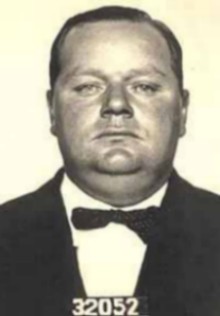
Film researcher Joan Myers has been re-investigating the notorious case of 1921, when the hugely popular film comedian Roscoe ‘Fatty’ Arbuckle was accused first of the rape and then of the manslaughter of minor actress and model Virginia Rappe, after an archetypal Hollywood ‘wild party’. Arbuckle was eventually acquitted, after a lurid trial, but his reputation was left in ruins, and his career as a star comedian was over. The case has been pored over for decades, and one might think that little remains to be discovered, but Joan Myers has found much new material, simply by looking more at the Virginia Rappe side of the story. She is still researching and writing, so the interview with her doesn’t give too much away, but there’s more than enough there to realise that we have not heard the last of Arbuckle trial.

Motion Pictures 1912-1939

motionpictures.jpg

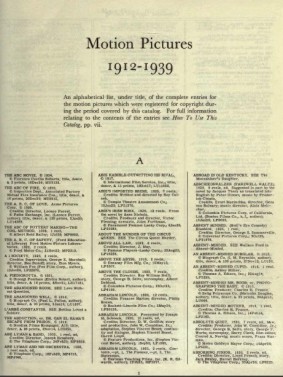
Good grief. Rick Prelinger, of the Prelinger Archive, the sainted digitiser of so many good things now made freely available online, has just made the Library of Congress Motion Picture Catalogs available for download from The Internet Archive. Four volumes have been put up, in PDF and uncorrected but word-searchable text versions, covering 1913 to 1969, with the 1894-1912 volume in preparation. For our purposes, this includes all 1,256 pages of the 1912-1939 volume, which is sensational news for anyone interested in the study of silent film.

The Library of Congress Catalogs of Copyright Entries list all motion pictures registered for copyright in the USA (i.e. films not just made in the USA but shown in the USA). The entries give title, year, company, length, date of registration, and sometimes some credits. The printed volumes have long been the first port of call for anyone seriously engaged in identifying films from the silent period, but they have been restricted to a handful of research libraries. Suddenly they are available to all. The PDF is a huge size (157MB), but there is a 9MB text file of the word-searchable uncorrected OCR, and already there is talk of it being converted into a database. Wow.

The Bioscope Library

I’ve started a new page to The Bioscope. On the top menu you will now see Library. I’m going to use this to gather together those documents available in their entirety online somewhere which will be highlighted first as posts, and then transferred to the Library. All are freely available from downloading from their respective sources.

A number of these documents will come from Project Gutenberg, which is the free electronic books resource which is one of the glories of the Internet. The silent film researcher might suppose that its out-of-copyright material does not extend beyond the nineteenth century, but there is in fact a substantial amount of material of interest, if you know where to look (using the Full Text option under Advanced Search is recommended). These two key books from our period are available, and have been added to the Library:

1) Vachel Lindsay, The Art of the Moving Picture (New York: Macmillan, 1915 [1922 revision]

The American poet Vachel Linday (1879-1931) wrote this celebrated study of the motion picture as an art form at a time when such a notion was generally considered ludicrous, though the grander works of D.W. Griffith were starting to change minds. It is an extraordinary work, categorising film by such grand phrases as Sculpture-in-Motion, Painting-in-Motion, Architecture-in-Motion and The Motion Picture of Fairy Splendour. It aims at the visionary, and recognises the importance of the medium in its time. It is often as foolish as it is insightful, and it has not worn well as a work of serious study, but its enthusiasm is unstoppable. It is also rich in information on films, performers and scenes that impressed themselves on Lindsay’s hyperactive imagination. It is available in ebook form as HTML (404KB) or plain text (180KB).

2) Hugo Münsterberg, The Photoplay: A Psychological Study (New York/London: D. Appleton & Co., 1916)

Hugo Münsterberg (1863-1916) was Professor of Experimental Psychology at Harvard University. His short book The Photoplay: A Psychological Study is regarded as being the first serious work of film theory, a text which remains a key text for the study beyond its purely hisorical interest. Münsterberg was interested in the psychology and the aesthetics of motion pictures (chiefly fiction films), which he rooted in human thought processes and emotions. He argues for the legitimacy of film as one of the arts (a highly controversial position at the time) by arguing for the special ways in which it transforms the world through the act of transferring it onto the screen. It is stimulating read, and has a fascination simply for the details it gives of the cinema-going process and his responses to specific films. It is available in ebook form as HTML (289KB) or plain text (274KB).

Terra Media

chronomedia.jpg

A key aspect of The Bioscope’s mission is to highlight resources for the study of silent film, particularly those not well known or obvious.

A model example is Terra Media. This is a one-man marvel of information on the history of media, beautifully arranged, and filled with riches. Its centrepiece is Chronomedia, a detailed chonology of media history year-by-year. As the site says, “Chronomedia is designed to become the most comprehensive and accurate timeline of developments in communications media ever compiled. By integrating references to all audio-visual media—film and cinema, radio and television, cable and satellite, interactive (multi)media, photography, telegraphy, telephony and even printing and publishing—it becomes easier to see the parallel developments and interactions that have formed the media scene we know today.” The year-search option alone is a joy to see, individual entries are to the point, and it is all very satisfactorily cross-indexed, linked and illustrated.

There are other sections on quotations, the history of television as public performance, the quest for home video, a reference section, and a fascinating section on British media legislation. There are further sections on statistics (including early British cinema circuits) and contemporary documents (none covering the silent era). The site continues to grow, and is just such a pleasure to use. Its editor is David Fisher, whose day job is editor of the media news and market research journal Screen Digest. Take a look.

Rock with the silents

Also appearing at the San Francisco International Film Festival is the frankly bizarre combination of 70’s new wave odd ball Jonathan Richman providing a score for Sjöström’s The Phantom Carriage. It appears that it was one of several silents shown to Richman, who then picked it as the one he wanted to provide a score for. It’s hard to imagine a more unlikely combination of composer and film, but who knows?

I’ve previously expressed wariness over the fondness for some modern rock and jazz musicians to provide scores for silent film, simply because the the films are too often used as inspiration for often incongruous musical expression, placing the musician first rather than the film, as it should be. Certainly there have been some dire vanity projects, but also some felicitious comings-together of modern sounds and silent film form, and the attention they bring to the medium is always welcome.

I guess the trend started with Giorgio Moroder’s renowned/notorious score to Metropolis. I’ve mentioned jazz musician Dave Douglas’ take on Fatty Arbuckle, and Gary Lucas‘ bravura guitar score for Der Golem. John Cale turned up at Pordenone in 1994 and provided a score for The Unknown. Joby Talbot of Divine Comedy provided a score for Hitchcock’s The Lodger. Jazz guitarist Bill Frisell (another personal favourite) has produced two CDs inspired by Buster’s Keaton’s Go West and The High Sign/One Week. Any more examples, anyone?