A Continuous Now

The Bioscope

Every now and again I pursue the etymology of the word Bioscope. It’s a word which has enjoyed multiple applications over the years, and which has been applied to cinemas, cameras, projectors, fairground shows, a film journal, microscopes, a theme park in France, and of course a blog.

As has already been reported, it was first used by a religious writer, Granville Penn, whose The Bioscope; or Dial of Life (1812) you can download from the Internet Archive. The reason for returning to this is that I have now a copy of the image of the bioscope which accompanies Penn’s text. And, indeed, the bioscope was originally a dial, which came with the book, but on a separate card. The dial was marked from nought to seventy, representing the various stages of life, with eternity waiting before and after. The card came with a movable pointer (which seems remarkably modern as a sort of publishing gimmick). The idea was that the reader would place the pointer as whatever his or her age might be, and contemplate what was to come. Penn wanted his readers to avoid being lulled into the beief ‘that life is a continuous now’. Which is, if you think of it, a prescient description of the illusion that motion pictures create. Penn would have hated them.

Shorpy

Marvel Rea, Ford Sterling and Alice Maison

The above image shows Marvel Rea (left), Ford Sterling and Alice Maison in a Mack Sennett Studios publicity photograph c.1919. It’s just been published on one of my favoutie sites, Shorpy, which describes itself as the “100-year-old photo blog”. Essentially it’s a collection of random photographic images from bygone ages (many of them more recent than 100 years ago), derived from a wide variety of sources (contributed by users), and posted simply for love of the beauty of old photographs. It hasn’t much to do with silent cinema, except for the occasional image like this, but it’s a sister art and many of the images inhabit the same world (and evoke the same feelings) as films of the silent age. So take a look, and sign up for your daily feed of haunting, surprising and generally beautiful images from days gone by.

(Shorpy was a very young coal miner, images of whom from a century ago helped inspire the site)

Motion Pictures – Not for Theaters

Motion Pictures - Not for Theaters

Now this is important. The Prelinger Archives are digitising the whole of the American journal The Educational Screen, and putting it up on the Internet Archive, volume by volume, 1922 to 1962. The journal reported on the educational film in America, and is an important source for learning about the non-theatrical film business and the rise of 16mm.

But its particular importance comes because between 1938 and 1944 The Educational Screen published Arthur Edwin Krows’ vast history of the non-theatrical film, Motion Pictures – Not for Theaters. It was published one chapter at a time, issue by issue, though it was never completed. It would probably never have found a publisher as a book, being of such length, rambling in style, and specialised in theme, but it is a fabulous store of information on filmmakers, films and film businesses working to make films that instructed, advertised, propagandised or educated, which simply cannot be found anywhere else. Sometimes the history is dubious, or too bound up with anecdote, and relevant information on people is often scattered across the chapters (the word-searchable text files supplied on the Internet Archive will be a huge help).

Caveats aside, it has a huge amount of information on the silent era, from the 1890s onwards, including such key figures as Charles Urban, Lyman Howes, Burton Holmes, Percy Smith, George Kleine, Jean Comandon, Max Fleischer, Joseph De Frene, James A. Fitzpatrick and Alexander Victor. Once again Rick Prelinger has done scholarship a marvellous service.

Science is Fiction

The new BFI DVD of the surreally beautiful films of scientific filmmaker Jean Painlevé, Science is Fiction, looks marvellous just by itself, but for lovers of early scientific films (there are a handful of us) the DVD also includes Percy Smith‘s The Birth of a Flower (1910) and The Strength and Agility of Insects (1911, though this is actually the retitled The Balancing Bluebottle from 1908), with its cork-juggling flies.

As you were with British Pathe

What is going on with the British Pathe website? Having written one post on the early fiction films to be found there and another on the newsreels, I had to write a third pointing out that the free low resolution downloads were no longer available (but could be found on the ITN site), and that high resolution copies for which you had to pay were all that were available. But now the free download films – all 3,500 hours of them – are back on the British Pathe site. I think the only advice must be to download while you can.

San Francisco Silent Film Festival

A Cottage on Dartmoor

The San Francisco Silent Film Festival takes place 13-15 July, and the programme has been announced. Here are the main features:

Friday, July 13
THE STUDENT PRINCE IN OLD HEIDELBERG (1927)

Saturday, July 14
HAL ROACH: KING OF COMEDY (1924-29)
THE VALLEY OF GIANTS (1927)
MACISTE (1915)
CAMILLE (1921)
BEGGARS OF LIFE (1928)

Sunday, July 15
MORE AMAZING TALES FROM THE ARCHIVES
RETOUR DE FLAMME (SAVED FROM THE FLAMES) (1900-28)
MISS LULU BETT (1921)
A COTTAGE ON DARTMOOR (1929)
THE GODLESS GIRL (1929)

The festival site has details of the individual programmes, including special introductions and musical accompaniment. There is information on purchasing tickets, hotels, and even a raffle.

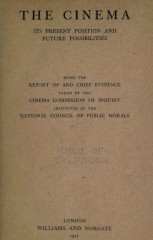
The Cinema: Its Present Position and Future Possibilities

The Cinema

There are so many interesting and valuable texts in the silent cinema field being added to the Internet Archive, but this latest addition to the Bioscope Library is perhaps the most exciting and important yet.

The Cinema: Its Present Position and Future Possibilities (1917) is a report and summary of evidence taken by the Cinema Commission Inquiry, instituted by the National Council of Public Morals. Essentially, it is a thorough investigation into the cinema in Britain and what its effects might be on the viewing public. As the introduction states, the National Council on Public Morals was “deeply concerned with the influence of the cinematograph, especially upon young people, with the possibilities of its development and with its adaptation to national educational purposes”. In other words, many in authority were alarmed at the popularity of cinema among those it deemed dangerously impressionable, and they wanted better to understand it, and to establish greater control over it. But they also wanted to find out what was best about it, and to replace hearsay with evidence.

The Commission was led by the Lord Bishop of Birmingham, and comprised assorted religious, educational and political figures, representatives from the film trade, T.P. O’Connor from the British Board of Film Censors, and others, including Dr Marie Stopes representing the Incorporated Society of Authors, Playwrights and Composers. The Commision sat from January to July 1917. Its terms of reference were:

  • To institute an inquiry into the physical, social, educational, and moral influences of the cinema, with special reference to young people; and into
  • The present position and future development of the cinematograph, with special reference to its social and educational value and possibilities;
  • To investigate the nature and extent of the complaints which have been made against cinematograph exhibitions;
  • To report to the National Council the evidence taken, together with its findings and recommendations, which the Council will publish.

The detailed report that was published is an unmatched treasure trove not only of opinions, fears, hopes and prejudices regarding the cinema and its audience, but of evidence relating to the production and exhibition of films in Britain at this time. Those supplying evidence included Cecil Hepworth, J. Brooke Wilkinson, A.E. Newbould, Gavazzi King and F.R. Goodwin, all key figures from the film industry, teachers, policemen, magistrates, social workers, and children.

The report is of importance in three areas in particular. First, for what it reveals of attitudes – positive as negative – towards the cinema from society’s moral guardians, for which there is much fascinating verbatim evidence, in the questions they ask as well as in the answers received. There are many questions about the supposed corrupting influence of cinema, and some heartening replies, such as this from J.W. Bunn, a headmaster from Islington:

A considerable number of people look upon the attendance of children at cinematograph entertainments with dislike if not with horror, and are apparently inclined to accuse the picture shows of being the main cause of juvenile misdemeanours. I do not agree with this view, and am firmly convinced that there is great exaggeration committed by this class. In my opinion these people are always to be found on the side of opposition of popular and cheap amusements for the working classes. The picture show is undoubtedly very popular with the women and children of the working class, but then it is still new enough to be a novelty, and it must be remembered that no other form of entertainment has ever offered to the poor the same value in variety and comfort for a very small outlay.

Secondly, there is invaluable statistical evidence provided by the film trade, including numbers of cinemas nationally, seats occupied, prices, investment in the cinema industry and the amount of film in distribution. Much of this data is unique to the report.

Lastly, there is the evidence from the school children about their cinema-going habits. Probably uniquely for this period in British film, we have the words of the audience members themselves. Here’s a revealing exchange between the Chairman and four boys from Bethnal Green (two aged eleven, two thirteen):

Q. What do you like best at the cinema ?
A. All about thieves.
Q. The next best?
A. Charlie Chaplin.
Q. And you?
A. Mysteries; and then Charlie Chaplin.
Q. And you?
A. Mysteries, and Charlie Chaplin.
Q. What do you mean by mysteries?
A. Where stolen goods are hidden away in vaults so that the police can’t get them.
Q. And you?
A. Cowboys; and then Charlie Chaplin second.
Q. When you have seen these pieces showing thieving and people catching the thief, has it ever made you wish to go and do the same thing?
A. Yes.
Q. Do you think the fellow who steals, then, a fine man?
A. No.
Q. But you would like to do it yourself?
A. Yes.
Q. Do you like the adventure or what?
A. I like the adventure.
Q. You have no desire, then, to steal in order to get things for yourself, but you like the dashing about and getting up drain-pipes and that sort of thing?
A. Yes.
Q. And you?
A. No, I don’t like that, I should not like to do that.
Q. Do you like pictures where you see flowers growing?
A. No.
Q. Do you like ships coming in and bringing things from distant lands?
(One boy replied ” No,” and the other three ” Yes.”)
Q. You like to have a consistent programme of detective stories and Charlie Chaplin, and you don’t want any more?
A. Yes.
Q. Do you sit amongst the girls?
A. Sometimes.
Q. What do you pay?
A. Id. and 2d.
Q. Do you ever have to sit on the ground?
A. No, we always have a seat.
Q. Have you ever seen the boys behave roughly to the girls?
A. Yes.
Q. What do they do?
A. Aim orange peel at them.
Q. Do they pull the girls about?
A. Yes, their hair.
Q. And do the girls pull back again?
A. No; they seem to enjoy it.

The Report was generally favourable towards the film industry, which was delighted to receive such vindication of its work. The Report recommended the implementation of a system of official censorship, superseding that of local authorities, but this was not implemented.

It’s a marvellous document, and I strongly recommend it to anyone interested in early British film or the social history of film. It’s available for download from the Internet Archive in DjVu (28MB), PDF (69MB), black-and-white PDF (21MB), and TXT (1.3MB) formats (the latter essential for word searching).

Slapsticon

Slapsticon

The programme has been announced for Slapsticon, the annual festival of silent and early sound film comedy, to be held at Arlington, Virginia, July 19-22.

Comedians featured include Laurel and Hardy (Way Out West), Harry Langdon (Luck of the Foolish), Harold Lloyd (A Jazzed Honeymoon), Larry Semon (Spuds), Mabel Normand (Hello Mabel), Leon Errol, Ford Sterling, Fatty Arbuckle, Billy Bevan, Monty Banks, Max Davidson, Charley Chase, Lupino Lane, Ben Turpin, Wallace Beery, and many more (Poodles Hanneford, anyone?). Pick of the bunch, on title alone, must be Mr and Mrs Sidney Drew in A Case of Eugenics (1915)… Britain’s own Pimple and Will Hay (Oh Mr Porter) also put in an appearance.

There’s travel, accommodation and registration information on the site.

Media and imperialism

mediaimperialism.jpg

The Iamhist (International Association for Media and History) conference takes place 18-21 July, at the University of Amsterdam. The theme of the conference is Media and Imperialism: Press, Photography, Film, Radio and Television in the Era of Modern Imperialism. There are several speakers covering early cinema themes: Yvonne Zimmermann, ‘Views and Perspectives of Economic Imperialism in Swiss Corporate Films 1910-1960’; Garth Jowett, ‘The “Ungawa” Effect: Images of Tarzan in the Colonial and Post-Colonial World, 1915-2007; Martin Loiperdinger, ‘The Lantern, the Empire, Army and Navy’; Teresa Castro, ‘Imperialism and Early Cinema’s Mapping Impulse’; Simon Popple, ‘Cinema and the Boer War: Imperial Narratives for the Screen’; Guido Convents, ‘The Rich Visual Heritage of Belgian Imperialism’; James Burns, ‘Black History in the Early Cinema: the Reception of Jack Johnson and D.W. Griffith in the African Diaspora’; and yours truly speaking on the compelling topic of ‘Classifying Empire’.

Further programme details, registration and acommodation details from the conference website.

It’s all done with mirrors (well, glass actually)


Now here’s an interesting thing. The new pop video for Paul McCartney’s Dance Tonight, just published on YouTube, has been directed by Michel (Eternal Sunshine of the Spotless Mind) Gondry, and stars Mackenzie Crook and Natalie Portman. And it’s quite a jolly tune with a mandolin. So far so inconsequential, but what is of interest here is that the video employs the Pepper’s Ghost trick, which is of great importance in ‘pre-cinema’ history. Pepper’s Ghost was a clever Victorian stage effect (devised by ‘Professor’ John Henry Pepper) employing glass, mirrors (sometimes) and lighting to make objects – usually ‘ghosts’ – seem to appear on stage. It holds an important place between the Phantasmagoria magic lantern show and the cinema. The trick was achieved by placing a figure off stage, and so lighting it that the light-waves bounced of an angled sheet of glass to create the illusion of the figure appearing in ghostly fashion on a stage. Like so:

Pepper’s Ghost

The McCartney video employs glass in much the same way to produce its ghostly effects. One would suspect that it was all done in post-production rather than ‘in the camera’, but production footage on dazeddigital.com would seem to suggest that they did indeed use glass (not mirrors). It could have been done a whole lot more easily with post-production trickery, but it was clearly done for the delight of the filmmakers – and the publicity.

Pepper’s Ghost inspired the appearance of ghostly figures in many early cinema trick films, though the process itself was not employed directly in films – with one exception, an obscure process called Kinoplastikon. More on that another day…