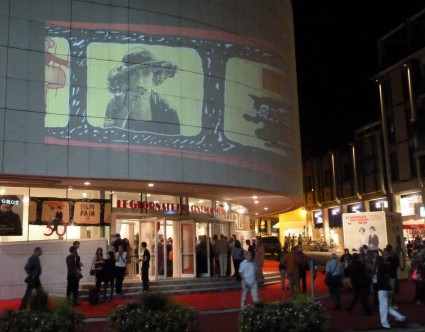
Archive fever

http://beta.worldcat.org/archivegrid

Time for another research resource, and this looks like a major one. ArchiveGrid, still in beta form, aims to be a gateway to the world’s archives. It has been created by OCLC, the library organisation behind WorldCat (“the world’s largest library catalog”). Much as WorldCat turns the catalogues of the world’s libraries into one giant catalogue, so ArchiveGrid wants to become the single place from which the researcher may discover anything held in an archive, anywhere.

OK, so it’s some way off such an ambition just yet, being largely composed of American archives, and they are collection descriptions rather than individual items (I think we’re going to have a long wait for that to happen). Each record gives you the name of the contributing institution, the title of the particular collection (each institution may have several collections, of course), the collection description, contact details (a link to the institution’s website), and catalogue record (including unique OCLC identifier) or finding aid. Searches can be narrowed by institution or location, there is a selection of topics to guide you through the collections. And by typing in your postal code you can see on a Google map which participating archives are in your area.

So, what can we find on silent films? The answer is plenty. Our standard test term, ‘kinetoscope’, brings up the Raff and Gammon papers at Harvard University – Baker Library, a typescript study of Thomas Edison by Rose Lombard in Harvard University – Theodore Roosevelt Collection, and the Library of Congress’ Inventing Entertainment website, which Pennsylvania State University Libraries has cited as a resource. ‘Cinematograph’ produces 38 hits, from the Paul Rotha papers at UCLA to the United Artists Corporation Records at Wisconsin Historical Society Library and Archives. ‘Silent film’ brings up 260 records: examples include the silent film music collection at the University of Colorado, Boulder; Lillian Gish papers at Bowling Green State University – Center for Archival Collections; and the Cecil B. DeMille Archives at Brigham Young University – L. Tom Perry Special Collections.

Much of this sort of information has been available in printed directories, but not, I think, in so extensive and freely available an online resource as this (ArchiveGrid has had an earlier existence as a subscription service, which didn’t get enough subscribers). Clearly it is a huge boon for research of every kind. It is mostly written archives, but not exclusively so; while some of the archival objects might be more naturally classified as books, so that you wonder how WorldCat and ArchiveGrid might be brought together in some way, at some glorious future point.

There are other directories of archives out there. UK researchers should be familiar with the National Archives’ National Register of Archives and the Access 2 Archives search resource, but perhaps not all know the university archives service Archives Hub, or AIM25 for archives in the London area. We have previously higlighted the Canadian Discovery Portal, and sung the praises of Australia’s Trove portal. Regrettably the UNESCO Archives Portal for archives worldwide is no longer accessible online.

New to me is Archives Portal Europe, a pilot service for opening up European archives, which doesn’t appear to have a great deal on film, and what can be found seems eccentric or marginal, though its multilingual nature is likely to hiding more than I realise (try the search terms ‘cinema’ or ‘kino’ for an idea of the range of content).

Directories of film archives are another matter, and should be the subject of another post. Meanwhile ArchiveGrid is a particularly exciting development, and likely to spark off plenty of new research projects. Go explore.

Film

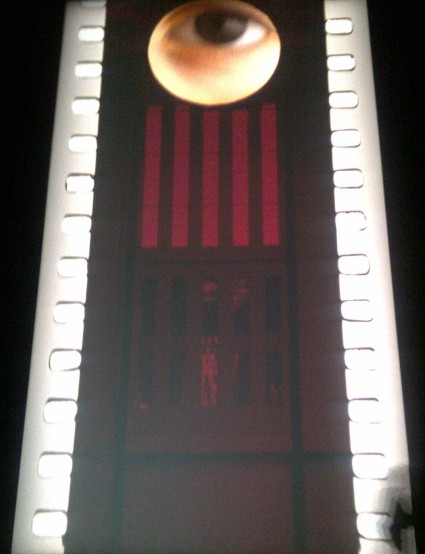
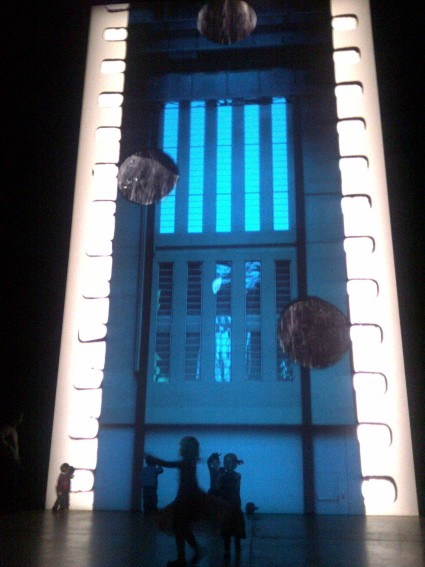
Tacita Dean’s artwork Film, projected in the Turbine Hall, Tate Modern, London

Will film die? Seen in one way, it never will: our cinematic history exists on celluloid and as long as there are viable film cameras and film, someone will be shooting it. Seen another way, film is already dead … what we see today is the after-life of a medium that has become increasingly marginalized in production and distribution of films and TV. Just as the last film camera was sold without headlines or fireworks, the end of film as a significant production and distribution medium will, one day soon, arrive, without fanfare.

Anyone with an interest in cinema can hardly have failed to pick up on the news that, apparently, film is dead. An article by Debra Kaufman for Creative Cow, ‘Film Fading to Black‘, from which the above quote comes, has had a huge impact, with many writing obituary columns for the medium in the face of the inexorable rise of digital. Kaufman’s specific impetus was the news that three major producers of film cameras, ARRI, Panavision and Aaton, have each over the past year decided to cease production of film cameras.

Kaufman’s article is not quite as brutal as the headlines might suggest. ARRI and the rest might not be producing new film cameras, but it is pointed out that there are plenty of film cameras out there already, which are presumably being kept to good use. There is no indication yet that Kodak and Fuji, the major producers of film stock, are to cease production, even though the demand for release prints is falling and the profit margins shrinking. 50% of American cinemas may now be digital, but that’s still 50% that aren’t, even if digital screens are being added at a rate of some 750 a month. Film archives still see film as the best preservation medium for film itself, with cold storage solutions for a medium already proven to last 100 years preferable to the huge uncertainties around digital, given the rapid obsolesence of file formats and technologies. Film hasn’t quite come to the end of the road yet.

But the end is in sight, isn’t it? Whatever the claims those of a traditional frame of mind make for the special visual qualities of film, it is on its way out. Nothing lasts forever, and film is after all just a carrier of images. If a more efficient, more flexible and – let’s face it – more appealing medium as far as the general public is concerned turns up, namely digital, then we bow to historical inevitability. Moving images may not ever look quite the same, as digital’s cleaness, brightness and rather antiseptic effect override film’s more textured and subtle qualities (though cinematographers are increasingly championing digital as new cameras promise deeper, richer qualities), but who in the end will notice? Things change, because things always change.

Certainly future audiences won’t miss anything in the switch from film to digital, and that’s not just because they will lack our experience of seeing film but because people change just the same as technologies change. They will grow up at ease with something else. So it is a rather odd experience that is provided at the moment by the installation Film at Tate Modern, which bemoans the disappearance of analogue. Film is an artwork by Tacita Dean. It takes the form of a giant projection (portrait shaped) on the far wall of the Turbine Hall at Tate Modern. Dean has devised the work as an expression of her concern at the threat to analogue film. It was shot, edited and is projected on film, and boasts an impressive list of production credits that is testimony to the craftmanship of film – grading, neg cutting, hand tinting, printing. As the exhibition notes state:

This is not a case of clinging to outmoded technology for nostalgia’s sake. As any practitioner will testify, digital and analogue formats are markedly different. The constraints and disciplines of working with a medium are essential to shaping the finished product. Photochemical film has its own distinctive texture and qualities, capturing light, colour, movement and depth in ways that digital cannot.

The eleven-minute film is abstract in form, being a succession of still and moving images bordered by perforations like a strip of film held vertically (as though passing through a projector). Images of buildings, trees, plants, water, circles, landscapes, rocks, but not people (apart from a fleeting figure passing by some stairs, and at one point a toe) play against and are overlaid with one another, someone with strong colour tinting reminiscent of the work of Len Lye. At a couple of points an eye appears in a circular frame that would appear to be a reference to G.A. Smith’s 1900 film Grandma’s Reading Glass, a key film in early film form. In most cases the images seem private to the artist and do not lend themselves to any particular interpretation except film itself.

It’s hypnotic stuff, but though plenty of people are watching it and children played happily in the light at the based of the screen, who among them really cares about film’s demise? Where are the lines of protestors outside cinemas, demanding that they see film as film? Where are the queues of unhappy customers returning their plasma screens to the shops, saying that the film experience is so much better? In truth, it’s not an issue that is going to concern anyone other than the afficionado and the specialist – and film/cinema is not the preserve of either of those. It is a popular medium, and the populace likes digital.

But that doesn’t mean the death of film, even after its main commercial life as over. Just as vinyl has survived the introduction of CD and audio files, so film is going to become the preserve of the select. Archives will still depend on it, though the rising costs of an increasingly rare medium (and rare skills able to maintain it) will mean higher access costs – if we want to see those films when they come out of cold storage so many years from now, we will have to pay handsomely for the privilege. Film buffs will still value it, and will collect prints and technologies required to show prints. They will sustain an aesthetic and cultural appreciation of film, and what will be exciting is when that appreciation is taken up by those who have grown up with digital but nevertheless look for something more in film. And artists, such as Tacita Dean, will continue to value it, for as long as it is available to them, for its plastic and particular qualities. Film is a canvas, after all.

The gloriously analogue Lomokino Movie Maker

And the first steps towards the second life of film as being made. I am greatful to Stephen Herbert for alerting me to the existence of Lomokino. Lomokino is a 35mm film camera for amateurs. Advertising itself as ‘gloriously analogue’, the camera allows you to shoot just 144 frames of film (curiously reminiscent of Twitter’s 140 characters) – and silent film at that. You need to find a lab able to process the film for you (which may prove tricky), then you can view your film via a LomoKinoScope viewer, or else scan it frame by frame, convert using iMovie, Windows Movie Maker or the like, and upload it to the Lomography site on Vimeo.

I’ve no idea whether this Austrian-based business is going to succeed, but its website certainly goes into a great deal of detail about how to make and present such films, with a large number of sample videos. There is a great range of cameras, film stock, accessories and bundles available on its online shop (including, I am intrigued to see, a Kinemacolor bundle). Do take a look – it feels like a cult in the making.

Sample Lomokino films

So film lives on, for the time being. It is important to the appreciation of silent cinema, because the entire genre (modern silents excepted) was produced using celluloid, whereas the history of sound cinema may run for centuries yet, of which just a few decades involved film as its primary medium. Yet silent cinema can also be rescued from historical oblivion by digital, given a new look and a new life, and that’s a cause for celebration. Silent films have a life beyond their temporary carriers. That they can change with the times is the best sign we have for their continued survival, and appreciation.

Festival time

The Pleasure Garden, from http://festival.london2012.com

2012 will of course see the Olympic Games in London, and the nation is cranking itself up in readiness. One of the things we’ve been promised was called the Cultural Olympiad, and was designed to be a jamboree of art and culture for all those people who don’t like sport. The name ‘Cultural Olympiad’ was awful, and the whole thing was staggering along badly, enthusing no one, until it was given a sharp kick by a new head (Ruth McKenzie), and now we have the London 2012 Festival officially announced, a nationwide festival of ambition, imagination and great variety – though still for people who don’t much like sport.

Well, this is all very good, and though I’m one of those who stubbornly thinks the Olympic Games is about sport, if we have a show or two thrown in, well who’s going to complain? And among the rich offering announced so far, which range from a World Shakespeare Festival to plans to have all the bells of the United Kingdom ring at the same time (in the name of art), there is going to be a place for silent film. From 1 June to 31 August there will be The Genius of Hitchcock, which will feature three of Hitchcock’s nine surviving silent feature films screened at venues across London, with new scores. A while ago the British Film Institute announced its Rescue the Hitchcock 9 preservation appeal, and while one has a nagging feeling that, of all the silent films out there, those made by Hitchcock have been quite well looked after so far and aren’t in any iminent peril, nevertheless is nice that they are getting the attention and being presented to new audiences. The Lodger, with a score by Nitin Sawhney, will be screening at the Barbican on 21 July; The Pleasure Garden, with a score by Daniel Patrick Cohen, at Wilton’s Music Hall on 28-29 June; while the venue, date and composer for Blackmail have yet to be announced. (By the way, someone should tell the Festival people that the still they have for Blackmail is actually Hitchcock’s The Manxman …)

Doubtless the Bioscope will have a few Olympic-themed posts in 2012, if only an update to our Silent Olympics post on the history of the Games’ coverage on film during the silent era, as new films have been discovered since we wrote the post in 2008.

But while we are celebrating this new festival, let’s also be thinking of festivals we won’t have the pleasure of experiencing. The Bird’s Eye View festival of women’s film, which has had a strong commitment towards programming silent films, has had a 90% cut in its funding for 2012, and consequently isn’t taking place next year. It hopes to return in 2013, and is continuing other activities, including its current Sound & Silents touring programme of films with new score by female composers. But it’s a sad loss.

Pordenone round-up

It’s taken three weeks, but we have now published the Bioscope’s diary for all eight days of the Pordenone Silent Film Festival, or Giornate del Cinema Muto. The festival ran from 1-8 October 2011, and below are links to each day’s report, with some of the main films featured in those reports:

  • Day oneGantsirluni, Un Amore Selvaggio, Più che la morte
  • Day twoAsphalt, Mantrap, Die Sklavenkönigin (Moon of Israel)
  • Day threeAmerikanka, Chyortovo Koleso (The Devil’s Wheel), Japanese animation
  • Day fourThe Lady of the Dugout, Oblomok Imperii (Fragments of an Empire), La Voyage dans la lune, Shinel (The Overcoat)
  • Day fiveHintertreppe (Backstairs), The Force that through the Green Fire Fuels the Flower, The Circus, Khabarda (Out of the Way)
  • Day sixThe Great White Silence, Eliso, Fiaker Nr. 13, The Canadian
  • Day sevenCenere, Salomy Jane, The White Shadow
  • Day eightDas Spielzeug Von Paris (The Plaything of Paris), South, The Wind

There are other reports out there on the festival. Particularly recommended is the filmgoing diary of Finnish film programmer Antti Alanen, who gives full credits, catalogue descriptions and his own observations on every film he sees at Pordenone (and anywhere else for that matter). Other reports can be found on Silent London, Bristol Silents (c/o James Harrison), Jan-Christopher Horak on the Soviet films at the festival, while Reto Kromer reproduces all of his tweets from the festival here.

You can find details of every film show in sumptuous detail on the 2011 catalogue, helpfully divided up online section by section. There are also the Giornate’s Flickr photostream and its YouTube channel (interviews and the like rather than films shown). There is also the festival Twitter account, very active during the festival.

For details of all films shown at the festival 1982-2010, see the Giornate’s online database; while for past Bioscope reports on the festival, going back to 2007, visit the Series section of this blog.

Finally, you can see more pictures from this year’s festival on the Bioscope’s own Flickr photostream.

Next year’s festival runs 6-13 October 2012.

Pordenone diary 2011 – day eight

Waiting for the show to begin

The sun sets on another Giornate del Cinema Muto. Eight days of silent films from every corner of the globe, touching every subject and embracing every style imaginable. Our final day’s report once again comes from the Bioscope’s reporter à clef, The Mysterious X.


And so we arrive at the final day of the Giornate 2011. A bittersweet day, as inevitably there are mixed feelings as we prepare ourselves for all the goodbyes, to our fellow delegates, new friends and old, the people who work behind the scenes, and the good people of Pordenone who make us feel so welcome … and sigh a little sigh of relief that there isn’t a Day 9, and we can start to make up for the lack of sleep of the past week or so.

The last Saturday is the odd day out at Pordenone; the morning screenings are held at Cinemazero, Pordenone’s arthouse cinema half a mile up the Via Garibaldi from our usual hangouts, while the orchestra for the closing gala rehearses. The programme up there tends to be synchronised-score or early sound films that round off threads that have been running all week; so the offer this year was a couple of Italian-American films made for the New York Italian audience in the early 30s, and the remainder of the Shostakovich/FEKS material, taking the story up to Skazka O Glupom Myshonke (The Story of the Silly Little Mouse) (USSR 1940), a 1940 animation that Shostakovich scored, or rather, was animated to his music.

Well, it was a glorious day, the sky was the purest azure, the air clear … so I sat ouside the Posta and wrote up my notes while sampling their fine coffee; saving what remained of my energy for what promised to be a long night. Sorry. I’m sure the films were wonderful …

After a light lunch, a special screening of South – Sir Ernest Shackleton’s Glorious Epic Of The Antarctic (UK 1919), Frank Hurley’s masterpiece of documentary, avant la lettre. A film familiar to many of us, this screening was enhanced by both the subtle work of Stephen Horne and material from Shackleton’s expedition memoir, read by distinguished British actor Paul McGann. Cleverly handled, the readings were spare when the film grows intertitle-heavy, more expansive when useful in commenting on the images; carefully not overlapping either the appearance of titles onscreen or duplicating their information. It worked very well, Stephen and Paul barely visible onstage, but spectrally unlit and almost in the wings; their contribution definitely added to the film. While it would have been different to the original lecture presentations of the 1910s, it gave a sense of how they might have been; the low-key theatricality of the presentation respectful to the material, and adding to it.

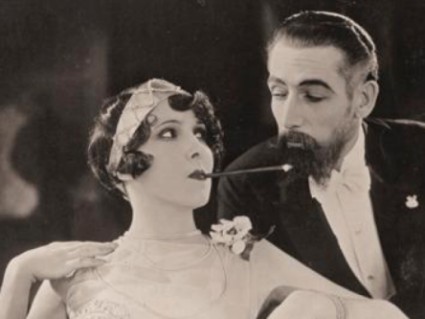
Lili Damita and Georges Trevillein Das Spielzeug Von Paris, from http://filmarchiv.at

A very quick break, then the best of the early Disneys we saw, his modern retelling of Cinderella (USA 1922) which was great fun … and then Das Spielzeug Von Paris (The Plaything of Paris) (Austria 1925) from the Kertesz strand. As promised in the trailer previously screened, this was a pretty racy trip through the life and loves of Parisienne cabaret star Célimène, a young Lili Damita; adored by all Paris, but particularly by a dripping wet (and promised to another) young English diplomat, and a positively ancient French aristocrat playboy, who seems to view her as simply the latest addition to his collection. But then, at least in part, the film is all about possession. The aristocrat gives the impression he wants to hang her on the wall to be admired like a painting; the Englishman wants both to put her on a pedestal and take her on fishing holidays … but she belongs to Paris, as much as Paris belongs to her … this is not the ending that we see in Moulin Rouge, for example, where the showqueen goes back onstage and performs through the tears as Real Life has failed her … here, Célimène goes back to her cabaret stardom because … she wants to. It’s her Real Life, and she likes it that way. And eventually the Englishman understands that … the aristocrat always knew.

Lili Damita was a revelation here. Not always convincing in Fiacre No. 13 as the cabbie’s adopted daughter, here she was in her element; an-ex dancer herself, she was fabulous performing in the cabaret sequences, and was having great fun in the backstage sequences, being worshipped by the various suitors; and it seemed to be Lili in the howling gale, drenched in road mud, with the car coming full tilt at her … all told, a cracking film, with glamour, dance sequences, comedy, a few thrills … no great insight into the human condition, perhaps, but highly entertaining.

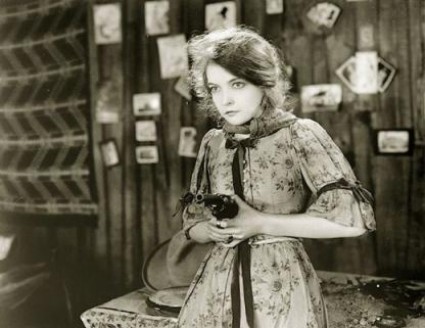
Lilian Gish in The Wind

I also missed – accidentally this time – two more Italian films from the 1910s, thinking the screenings had finished before the main event; The Wind (USA 1928) with Carl Davis conducting his own score for the Mitteleuropa Orchestra. Not having been around for the original Thames Silents presentations in the eighties, it’s always a treat to see these films and scores revived; Wings was a highlight of last year’s Giornate, and The Wind was, for me, this year. Somewhere in this room here I might have a VHS off-air from the last time British TV deigned to show the Photoplay print with this score … but nothing ever compares to seeing and hearing these presentations live.

The score for The Wind is slightly unusual among Davis’ work as it – as dictated by the film – is as suffused with musical and sound effects, as the film is with the visualisation of the incessant gale. You don’t get the lavishly orchestrated melodies that inhabit many of his scores, but it’s absolutely right for the film. And what a powerful film it is. Gish – who introduced the film herself via a tape made for the film’s previous Giornate outing in 1986 – is acting her socks off as the always vulnerable, but increasingly disturbed – and disturbing – young woman stuck in the middle of nowhere with a husband she doesn’t know. Opposite her is the superb, impassive Lars Hanson, like a rock being beaten by the waves of Gish’s performance. It’s heightened stuff, and with lesser performers could have tipped over into the ridiculous … but this is Gish and Hanson, and you get totally absorbed into the film. Wonderful.

And then the final programme … a smashing collection of films-about-filmgoing that really deserved to be shown at a more audience-friendly time of 10.30 pm on the last Saturday …

Al Cinematografo, Guardate … E Non Toccate (At the Cinema – Look, Don’t Touch) (Italy 1912) is a comedy where a predatory Ernesto Vaser tries to play footsie with a female audience member, and it all goes predictably wrong in the dark; Lost And Won (USA 1911) a slight drama where two forcibly seperated sweethearts are reunited when the boy, his fortune now made, sees her starring in a film … Amour et Science (France 1912) was a short sci-fi drama about a television experiment going horribly wrong; At The Hour of Three (UK 1912) was a rather fine drama, and early example of the ‘Filmed alibi’ situation; a man is accused of murder, but a chance appearance of him at a parade filmed for a newsreel, at the time of the murder, is spotted by his love … nicely made, it has the bonus for us Brits of footage taken inside the Clarendon Studios at Croydon, and a cinema at Selhurst designed to look like a victorian country cottage, bay windows, window boxes … Arthème, Opérateur (France 1913) didn’t make much of an impact; I can’t honestly remember a thing about it … Mutt and Jeff at the Movies (US 1920) finished the show off, with our animated heroes doing their best at running a picture house …

So, there we all are, the last straggling survivors of the Giornate 2011, milling around outside the Verdi at gone midnight, not sure where to go or what to do … what can you do in the early hours of a Sunday morning in Italy? Find a wine bar, talk films, drink wine, laugh a lot. At least I got to bed by 4 am this year …

Overall, in retrospect, it was a good year; the local populace were as welcoming and hospitable as always; we missed the Ciervo, a restaurant opposite the Verdi known for its good food and lightning service, now relocated to the ground floor of a hotel just far enough away to be slightly inconvenient, but the many others took up the strain; the staff at the Posta were as hardworking and patient with us as ever, and the gentlemen in local politics and sponsoring companies seemed pleased to continue to dip into their various purses to help the Giornate continue. Fingers crossed, the way the world is at the moment. The staff and volunteers of the Giornate itself cannot be thanked enough; nothing ever seems too much trouble … the ushers in the Verdi were attentive, but failed to stop a couple of people coming a cropper in the obstacle course that is the Verdi’s auditorium. Blame the architects, though …

On the film side; there were some real highlights, some real personal discoveries, and no real clunkers; some were of course, not as good as others; the early Kertesz films were disappointing, with only his later silent films redeeming him; but historically interesting’ I suppose. The overall programme was rather dominated by Soviet cinema; the wonderful Georgian programme I would not have missed for the world, the FEKS/Shostakovich strand was more variable, shall we say, and Fragments of an Empire, in the Canon Revisited strand, a real highlight. But quite a lot of Russia for one week. And the music, all week, was simply superb, the standard being raised every year, it seems. I’ve said it before, here last year, probably, but the golden age of silent film music? We’re living in it. Congratulations to everyone involved. Now to start reserving flights for next year …


And thank you TMX for four days of fine reporting, enabling us once again to offer a comprehensive record of the Giornate del Cinema Muto to add to the archives. It was a fine festival, a little top-heavy with USSR offering for some tastes, but without a dull day, and with many highpoints, revelations and re-evaluations. My vote for films of the festival goes to Lady of the Dugout (which I knew before), The Soldier’s Courtship (which more than lived up to expectations) and Nihon Nankyoku Tanken (Japanese polar exploration, full of revelations), but I agree that Fragments of a Empire was an extraordinary piece of work. Hearty congratulations to all who continue to put on the festival with such professionalism, dedication and invention.

‘Til next time.

Pordenone diary 2011 – day one
Pordenone diary 2011 – day two
Pordenone diary 2011 – day three
Pordenone diary 2011 – day four
Pordenone diary 2011 – day five
Pordenone diary 2011 – day six
Pordenone diary 2011 – day seven

Voicing the silents

Jason Singh in rehearsal for his vocal accompaniment to Drifters (1929)

On November 6th the Cornerhouse in Manchester will be presenting an unusual form of silent film accompaniment. “Human beatboxer and sound artist” Jason Singh will be accompanying a screening of John Grierson’s silent documentary film Drifters (1929) using his voice alone – with a fair bit of processing, sampling and pre-recorded vocal sounds. The result, to judge from the video clip, sounds like it could be really effective. Drifters is certainly an imaginative choice – and with its poetic, modernistic treatment of an activity (herring fisheries) steeped in tradition, it could be an astute one.

How often have silent films been accompanied by the human voice? Not too often, I think. I’m just back from a weekend at Athy in Ireland, where the annual Shackleton Autumn School (a gathering of polar exploration enthusiasts in the town of the great Antarctic explorer’s birth) is held. I introduced a screening of the BFI’s restoration of The Great White Silence (1924), which documents Shackleton’s great rival Captain Scott’s failed attempt to be the first to reach the South Pole.

The restoration has gained great acclaim, not least in these pages, but I was none too complimentary about the music/soundscape by Simon Fisher Turner, which I thought used the film as decoration to an experiment in sound textures rather than being a proper accompaniment. Well, seeing the film again, I was wrong. The version of the score on DVD (lacking the strings that featured at the live premiere) is often spookily effective electronica, which brings out the film’s otherworldly qualities. The electronic sounds do lack variety after a while, but Turner spices things up with jolting introductions of contemporary gramophone recordings, and most powerfully a solo voice singing ‘Abide with Me’ over the still images and model shots recording the Scott party’s fatal return from the Pole. The unaccompanied voice had a powerful effect on the audience; a real coup de théâtre.

I have seen or heard silents accompanied by most things – piano, organ, acoustic guitar, electric guitar, orchestra, brass band, harp, electronica, percussion, rock band, violin, accordion, jazz band, recorders, player piano, turntables, silence – but only this once with the human voice alone. However, in the comments to a recent Bioscope post on those times in the silent era when silent film were shown without music, Maria Velez records the existence of a vocal quartet at the La Scala cinema in Glasgow during the first months of the First World War, which seems not only to have sung between films but during them as well.

Was this unique, or does anyone know of any other such examples from the period – or from the presentation of silents today? There were plenty of examples from the silent era of the use of voices behind or to the side of the screen, for singers (recorded or live) accompanying song films, of which there were a huge number in the pre-WWI period; and there were reciters of dramatic works, such as Eric Williams undertook in some British venues in the 1910s. And I’ve seen songs introduced as part of silent film screenings, such as the memorable performance of the ‘Internationale’ during Mutter Krausens Fahrt ins Glück at Pordenone last year. Pianist Donald Sosin‘s silent film accompaniments have included songs sung by his wife Joanna Seaton. But voices or voice used as musical accompaniment in a non-song context? Anyone? Or any examples of unusual forms of musical accompaniment to silents beyond those that I’ve listed?

There’s a news piece on Jason Singh and Drifters at Wired, and further information on the Cornerhouse website.

The impact of silent film

http://sms.cam.ac.uk/institution/CRASSH

Just a short note to alert you to the existence of a video made of a talk Kevin Brownlow gave to the Centre for Research in the Arts, Social Sciences and Humanities at the University of Cambridge on 20 October 2011. Entitled ‘The Impact of Silent Film‘, it is a lecture with film clips and runs for 93 minutes.

When I saw the title I wondered whether Kevin had been cajoled into delivering some bold piece of socio-economic analysis which would seek to prove to government that watching a silent film a day will make each one of us healtheir, wealthier and wiser (and who’s to say if that might not be true?). But instead it is an account of silent films as the progenitor and pinnacle of motion picture art (“every visual advance, except CGI, was invented before talkies”), demonstrating innovation from “single-shot films of 1893 to the monumental epics of the 1920s”. It is illustrated with clips from his celebrated Hollywood series (albeit filmed from the screen in the Cambridge lecture theatre) and shows that his great belief in the medium continues completely unshaken.

Pordenone diary 2011 – day seven

The Teatro Verdi night-time slideshow advertising The White Shadow

It’s Friday October 7th, and we’re on day seven of the Giornate del Cinema Muto aka the Pordenone Silent Film Festival. Once again our anonymous reporter, The Mysterious X, picks up his pen and uncompromisingly tells us like it is. Take it away, X.


Already the looming end-of-a-holiday feeling, as we gather once more at 9.00am …

First a trailer for the Kertesz film Das Spielzug von Paris (The Plaything of Paris) (Austria 1925); at least it was billed as such; we got so many shots of the female lead Lily Damita wearing the legal minimum – and as much jewellery as fabric – I began to suspect it may have been a compilation of censor trimmings. How representative the trailer was, we would find out the next day.

Der Junge Medardus (The Boy Medardus) (Austria 1923) was a Kertesz-directed costume melodrama set during the Napoleonic era; with French aristocracy exiled in Austria maintaining futile dynastic ambitions, while Austria awaits a French invasion.

After Fiacre 13 I had renewed hopes of the Kertesz strand, but they were soon dashed; the lead characters – apart perhaps from his Napoleon – seemed to have walked straight off the stage, and much of the film followed suit. When Kertesz opened the film out to a military street parade, or to the battle proper, the film breathed … but not for long enough. The switchback hate/love/hate/love relationship between the supposedly vengeful son and the French aristocratic target/lover/target/lover may have worked over the apparently five-hour length of the Schnitzler play, but it needed better actors than we had, to make it anything other than ludicrous in 1hr 20 mins …

Eleonora Duse in Cenere (Italy 1916), from Wikipedia

I made a last-minute decision NOT to take a very early lunch and stayed for Cenere (Italy 1916) a melodramatically-plotted film about a young man, abandoned as a child, searching for his mother; the main selling point being that this was the sole film appearance of Victorian theatrical legend Eleanora Duse. It was a good film, if somewhat underwritten, and had some really beautiful location settings – but Duse was spellbinding. In early shots, where she is the young mother, the 58-year-old Duse wears a rural bonnet that obscures her face entirely; she acts physically only, but with restraint. Later, when she is playing closer to her own age, that restraint remains – there are large gestures, but used sparingly and only at the peak dramatic moments…but her face; her face is that of an aged medieval saint, it carries her age and her life upon it, her emotions lurking beneath, barely registering. Utterly unstagelike, utterly (for this period) unItalian; utterly perfect and a real revelation. That the film flopped and she returned to the stage was the real tragedy; she could have rewritten screen acting history if this was anything to go by.

After lunch, Salomy Jane (USA 1914) from the Treasures of The West thread … and another cracker. Made by the short-lived California Motion Picture Corp in the redwood forests, it’s the equal of any feature I’ve seen from this early in the 20th Century; a tale of infighting and rough justice amongst the ’49ers, it starred latina opera star Beatriz Michelena as Salomy Jane, and Bristol-born House Peters as the man she desires … as the film is now available I won’t go into huge detail beyond recommending it (and the rest of the set), but it’s refreshing and salutary to see how unlike the stereotyped Western adventure the early films were … before the dead hand of ’30’s serial production and the cliches took a stranglehold.

Tariel Mklavdis Mkvlelobis Saqme (The Case of Tariel Mklavadvis) (Georgia SSR 1925) – another Georgian feature, and an adaptation of a late-Victorian tale of death and revenge; told in flashback from a courtroom, each part of the action being testimony from a different witness, prosecution or defence, in a case where a Georgian playboy prince – or serial rapist to be more accurate – is kiled by the widower of one of his victims. It’s the widower on trial.

Well constructed, well acted, and as usual, with powerful use of location settings … and yet another impressive entry in the Georgian strand year 2 … though few enjoyed the extended dream/premonition sequence where a vulture disembowels a live dove. Slowly.

Blazing The Trail: The O’Kalems In Ireland (USA 2011) A new documentary on the Kalem Company, and in particular the Sidney Olcott/Gene Gauntier troupe that operated in Ireland in the years before WW1. Well made, with good interviews, archive footage and heavy use of Gene Gauntier’s unpublished memoirs, it made interesting points about how the Irish diaspora changed American culture in the 1880’s-1910’s period; and how Irish-Americans became increasingly psychologically detached from the real Ireland, but increasingly engaged with the romantic Ireland. This was a trap Olcott himself fell into, the film implies; Gauntier herself wrote that – eventually – they “Made allowances for Irish imagination” in the stories of unceasing cruel oppression – while Olcott continued to film those tales … and there were times where one felt that the Irish-American makers of the documentary were in danger of falling into that same trap. (Correction – the filmmakers are Irish. See also comments)

Of course, dreadful things happened in Victorian-era Ireland, but some hint of the complexities of the relationship, quite why the authorities were so concerned about the IRA of 1914, or an acknowledgement of the long-lasting and damaging legacy of the Irish-American mythologising that Olcott was part of, would have been welcome. Otherwise, it’s just half the story.

Betty Compson in The White Shadow (UK 1924)

The scene of more controversy after the dinner break; the first chance for us to see what remains of The White Shadow (UK 1924), rather hyped in the world media as being an Alfred Hitchcock film, whereas the director was the then much acclaimed, and now much maligned, Graham Cutts. This controversy is quietly reflected in the catalogue; unusually there are two essays on the film within; one as per the media story, which only mentions Cutts in an unflattering quotation from an American writer and Hitchcock expert – who may or may not have seen any of Cutts’ other excellent films lacking Hitch’s involvement; and a welcome contrasting piece written with obvious diligence by Geoff Brown, detailing Cutts’ place at the front rank at the time, and the production difficulties he faced. When quoting a journalist’s eye-witness account of Cutts shooting a scene, there is the waspish aside “Hitchcock, it seems, was busy elsewhere that day.” Which does beg a question or two I don’t have an answer for; what exactly is the evidence for Hitch’s omnipresence, now engraved in the film’s credits, aside from the Master of Suspense (and Self-Publicity) saying so in an interview forty years later? Anything more contemporaneous with events? And, if he was so talented and indispensible to the studio, why was it a further two years before Michael Balcon allowed him to helm his own film?

Anyway, all a distraction from the film itself; what survives is three reels-worth of an American release print bearing “Selznick” branded title cards. It starts very promisingly indeed; after the modern titles, we meet rich, smooth American Clive Brook and English rose Betty Compson on board ship heading to England; a nicely understated scene, well and charmingly acted. Cut – a chunk had gone at this point, whole minutes I think; whether from Anno Domini or the scissors of Mr Selznick’s minions isn’t too clear – and we’re already in Devon, and Clive is already getting confused by the Compson twins. In an effective scene at the house, the Compson twin we have met onboard arrives to surprise her fighting parents and her less vivacious twin; I assume it was done in the time-honoured fashion of spilt-screen double exposure, and it was highly effective, and technically excellent. Much that follows is a mixture of randomly-surviving footage and modern titles filling in the complex tale from period synopses. If ever there was a film that didn’t need incomplete survival, this was it – and it’s hard to judge the performances as we are not always sure if we are watching the twin we think we are, or the other one pretending to be her. Clive looks permanently baffled, but then so were we, and the indications are, that this may also have been the case when the film was new. But what survives does so nicely, the print with its delicate tinting retains top photographic quality, and whatever one may think of the hype, we must be grateful to those in New Zealand who preserved, identified and then made available the remains for us all to see.

The other part of this main event was a screening of Borderline (UK 1930), officially British, but made in Switzerland by the group of ex-pat intellectuals who published Close-Up, the magazine that seemed to spend much of its energy decrying the British film industry and its product, and whose malign influence is still detectable in 2012, when mainstream British productions of the silent era are dismissed unviewed. The catalogue notes failed to dispel the notion that it was likely to be pretentious nonsense, so I chose to leave – I was noticeably far from alone in that – and had a rather wonderful, relaxed dinner with good friends of a similar disposition. (It’s a lot better than you might think.- Ed.) Which meant that I also missed, regrettably, an Italian 1913 comedy about adultery in an Italian cinema which sounded fabulous from its catalogue entry. Thus we are made to pay for our prejudices …


Some forthright opinions there from the Mysterious one, which you might like to comment on, be it the myth of Ireland or the myth of Hitch. It sounds to have been quite a day, though I’m heartily glad I missed the vulture.

Just the more day to go now …

Pordenone diary 2011 – day one
Pordenone diary 2011 – day two
Pordenone diary 2011 – day three
Pordenone diary 2011 – day four
Pordenone diary 2011 – day five
Pordenone diary 2011 – day six
Pordenone diary 2011 – day eight

Pordenone diary 2011 – day six

Image of Buster Keaton from the Giornate del Cinema Muto’s trailer, animated by Richard Williams

We have reached day six of our reports on the 2011 Pordenone silent film festival (Thursday October 6th for those of you taking notes), and our undercover reporter The Mysterious X is showing no signs of flagging as he enters the Teatro Verdi once more…


Crumbs, Thursday already … in at 9.00am for a Disney short, Tommy Tucker’s Tooth (USA 1922) a semi-animated children’s instructional on dental hygiene. Neatly done, but the main point of interest now is that the healthily-grown kid with the good teeth of 1922 would today be being filmed at an obesity clinic, with a stern voiceover …

Then Klostret I Sendomir (The Secret of the Monastery) (Sweden 1920), a Victor Sjöström costume drama, part of The Canon Revisited strand. An elderly penitent monk tells a pair of guests the tale of the monastery’s foundation, by an Earl who discovers the betrayal of his wife’s adultery with her own cousin, and that his beloved son was not actually his. Confronting her, she initially deflects the affair onto her maid, before being given a choice; either she kills the kid, or she dies. Unexpectedly, she goes to do just that, but the Earl stops her at the last second; not doing so was her last chance of redemption, she is told, and she is duly despatched with the same dagger she was going to use. The son (who had already survived an earlier attempt at defenestration by the Earl) is taken to a woodcutter with some funds, and we are told the Earl sells up and founds the monastery. There is then a twist ending, that you can see coming from about five minutes from the start of the film.

It’s a competent enough film, but not vintage Sjöström. The actresses playing the countess and her maid were excellent, and stole the film despite – or perhaps because – they were playing irredeemable characters.

Tragedy of a different kind followed; the newly restored The Great White Silence (UK 1924) presented with live piano from Gabriel Thibaudeau, as opposed to the modern and not uncontroversial score on the BFI release (which I think is fine, personally). Gabriel, class act that he is, did a fabulous job on it.

Herbert Ponting’s documentary account of the doomed 1910-12 Scott Antarctic expedition looks stunning on the big screen – and despite being out commercially it drew a large and appreciative house. And the end is no less affecting for knowing it all in advance. It’s only now I’m wondering quite how the endtitles with their “Dulce et Decorum est” message would have played to the 1924 audiences, then fully aware of the futility of WW1, and not just the carnage.

Sound film!!! Sound on film at that … but from 1922, and Denmark, the experiments of pioneer Sven Berglund (Tonaufnahmen Berglund), who had demonstrated synchronised sound-on-film using two strips of 35mm the year before.

These were presented visually, multiple vertical lines varying in thickness with the volume, I assumed, looking like something from Len Lye; while the sound, read by laser in a lab and re-recorded on to the now-standard format, played out. As the film progressed we hear distant voices, distant music, until eventually, and very clearly, we get an English (American?) male voice reciting The Lord’s Prayer. For ’22, very impressive.

As was an unscheduled re-screening of Le Voyage dans la lune (France 1902) with a more traditional piano accompaniment from Donald Sosin. Yep, that was much more like it. (Take your word for it. – Ed.)
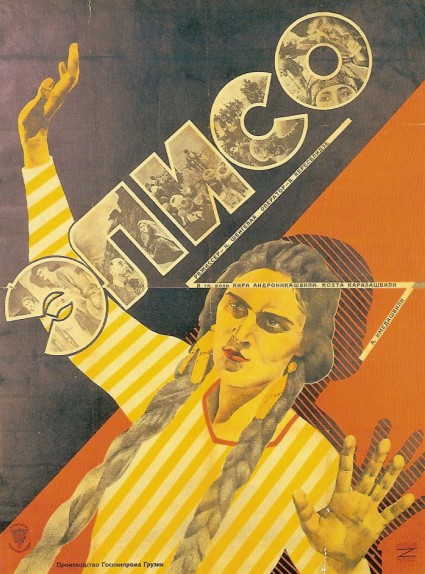
Poster for Eliso(USSR 1928), from http://www.cinematurkey.com

After lunch, and in for Eliso (Georgia SSR 1928), the day’s Georgian film; and the best of all of a very good bunch. Set again amongst the peoples of the high, remote mountains, but this time during the Tsarist era, this was a tale of love against religious divides, of cultural identity (positively – this was two years before Khabarda) as well as an element of “This is how bad it used to be”.

During a period of Russian expansionism a Moslem Chechen village is being deported en masse to Turkey to make way for Kazakhs; the scion of a nearby Christian village, in love with a Moslem girl, offers to help; the decision was a corrupt one. After a neat swordplay sequence worthy of Doug Sr. himself, our hero forces the general to cancel the deportation – but it has already started, after an ambitious couple tricked the village, into signing a petition for deportation thinking they were doing the opposite. The hero’s Moslem girlfriend is sent back from the caravan to burn their old village, to deprive the Kazakhs of its free use, nearly killing him in the process, as he was searching for her there. Back with the villagers, a woman dies in childbirth; this starts a a state of mourning, exacerbated by their miserable situation. Then a remarkable thing, and a remarkable sequence, happens. The village leader, elderly but striking and dignified, starts to dance: I read it as as a moment of supreme defiance; we have lost everything except what we can carry, and our culture, our identity. And we dance.

Slowly, very slowly, the tearing of hair stops. They watch him. A musician starts playing; hands are clapped; more dancers start. Gradually – five minutes perhaps – it becomes the most exhilarating dance sequence you’ve ever seen, young and old, male and female, hand-held camera roaming amongst them, the pace of the editing accelerating until the climax of sub-second flashed images. It actually surpasses the famous Coalhole sequence in Kean. All credit to the musicians; Günter Buchwald, Romano Todesco and Frank Bockius roared away, absolutely nailing the sequence. Please, someone, book this combination again; the topicality of the film, and the power the musicians bring to it, would wow any festival.

And straight into the second programme of Japanese animation; generally excellent, but not quite reaching the heights of Programme 1 … it mainly concerned the work of Noburi Ofuji, who used the cut-out technique applied to Chiyugami, the traditional Japanese printed paper, to create his comic characters. Pioneering, quirky and fun, also using sound-on-disc in the late silent period (or possibly animating to pre-existing records, I was none too clear) but they didn’t grab me as deeply. Others, from Ogino, were abstract patterns animated; very reminiscent of European avant-garde animation art of the thirties, the colour examples were, for want of a better word, particularly trippy. The final item was a 1937 Kodascope ‘How it’s Made’ short, Shiksai Manga No Dekiru Made (Japan 1937) showing cel animation in Japan. A good end to a fascinating strand … potentially the last Japanese strand as little remains that hasn’t been seen here over the years.

Despite my interest in early aviation I skipped the one-hour documentary on Santos-Dumont’s 50-second Mutoscope reel of him and Charles Rolls together, Santos Dumont Pré-cinesta? (Brazil 2010) … I expect Mr Urbanora to be aghast at such negligence, given his equal interest in the subject. (I am shocked. And saddened.- Ed.)

Evening, and a Disney, Jack the Giant Killer (USA 1923), before Fiaker nr. 13 (Fiacre No. 13) (Austria/Germany 1926), a Michael Kertesz/Curtiz film set in Paris despite its Austrian/German co-production status. This was a film with real charm, easily the best of the strand, and much more the sort of film to get you noticed by Hollywood; a melodramatic tale of the abandoned baby, daughter of a millionaire who doesn’t know she exists, but has been trying to find her now-dead mother. The girl grows up as the daughter of the horse-cab driver who found her. Apart from the charm, it features wonderful performances from the character actors, great atmosphere and excellent use of the Paris locations – it was highly reminiscent of Feyder classics like Crainquebille – my highest praise.

Thomas Meighan (right) in The Canadian (USA 1926), from http://www.silentfilmstillarchive.com

The last film was a real treat too; from perennially underrated William Beaudine, The Canadian (USA 1926); a drama, but with seriously good comic elements within. Set in the broad wheatfields of Alberta, its subject is the problems and practicalities of marriage in small disparate communities, where your nearest neighbour may be a day’s ride away. Thomas Meighan, his name above the title, is the foreman at a friend’s spread, but although he has his own smallholding sorted out, it’s not quite ready.

The farmer has a sister, coming over to live with him having lost the last of her English family; she is unused to both the more basic farm life, and to doing anything practical; when called upon to help out in the kitchen, she is not just clueless, but can’t help giving the impression that it’s all rather beneath her. After clashes – epic, and with some killer lines – with the sister-in-law played by the wonderful Dale Fuller, with the harvest in, and the foreman announcing his departure, she takes a surprising step; the sister offers to be his wife if he will take her away. They marry, and the tone of the film changes utterly. It becomes The Wind – without the wind. The parallels are extraordinary – and this is two years before the Sjöström classic. Here, the physical rejection of the husband is followed (we assume) by a rape perpetrated by the husband rather than a third party; there is a similar comic-relief cowhand, here played by a nearly young Charles Winninger; there is a crisis where hubby rides to the rescue in both films; and a similar Damascene conversion in the wives’ attitude when both farmers have raised funds to send them away.

The Canadian beat The Wind to the screen; one wonders which source novel was published first … and then we remember that The Wind‘s happy ending is not in the novel at all. The acting in The Canadian is solid, believable, but doesn’t have the grandeur of Gish and Hanson; but highly recommended if you’re interested in the prolific career of William Beaudine, who made great films in all sorts of genres, and yet doesn’t receive very much attention.


Sterling stuff once again from our sharp-eyed reporter. Look out soon for the report on day seven (the penultimate day), when we shall discover Lily Damita wearing not much more except jewellery, Eleonora Duse in a bonnet, Gene Gauniter in Ireland, and not one but two Betty Compsons.

Pordenone diary 2011 – day one
Pordenone diary 2011 – day two
Pordenone diary 2011 – day three
Pordenone diary 2011 – day four
Pordenone diary 2011 – day five
Pordenone diary 2011 – day seven
Pordenone diary 2011 – day eight

World Day for Audiovisual Heritage

http://www.girona.cat/sgdap/cat/patrimoni_audiovisual

October 27th is designated World Day for Audiovisual Heritage by UNESCO. Had we enterprise enough and time, the Bioscope would have produced its own celebration of this event, but instead (and what is much better) let us point you to an exceptional resource produced for this day by the Museu del Cinema in Girona and Girona City Council through the Centre for Image Research and Diffusion (CRDI), with the collaboration of the International Council on Archives.

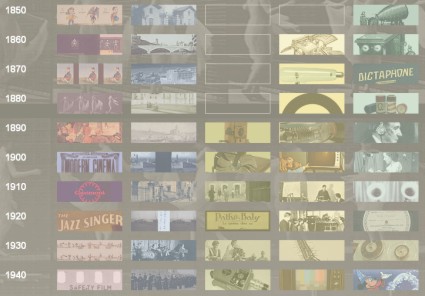
It is an online, interactive ‘poster’, entitled Audiovisual Heritage that provides a chronology of the historical development of the audio-visual media of cinema, photography, television, video and sound recording. Arranged by horizontally by decades and vertically by theme, it is a well-researched, well-illustrated, and compulsively browsable resource. Click on any box and a potted history pops up, with further illustrations, including some video demonstrations (also available through the Museu del Cinema’s YouTube channel). You can then explore that theme further by clicking through page arrows, or else return to the main arrow. The poster is available in Spanish, Catalan, English and French.

For a list of World Day for Audiovisual Heritage events taking place worldwide, visit www.pia.gov.ph/wdavh2011. For the Bioscope’s own account of the Museu del Cinema from earlier this year, click here.