The Rose of Rhodesia

rose-of-rhodesia

Chief Kentani (left) and Prince Yumi in The Rose of Rhodesia, from Screening the Past

A while ago we wrote a piece on the peripatetic American film director Harold Shaw, who – in between periods in America, Britain and Russia – for a short period (1916-1919) produced films in South Africa. Shaw made three films in the country – De Voortrekkers, The Rose of Rhodesia and Thoroughbreds All (a fourth, Symbol of Sacrifice, was started by Shaw but completed by other hands). The first was an Afrikaner nationalist epic of the Battle of Blood River; the third (a lost film) was a racing horse comedy.

The Rose of Rhodesia (1918) has been attracting a lot of interest lately, following its happy rediscovery by the Nederlands Filmmuseum. The process of critical rediscovery has led to a special issue of the always commendable Australian online journal Screening the Past dedicated to the film. There are pieces by the two foremost experts in filmmaking in Africa at this period, Neil Parsons and James Burns, which provide rich detail on the background to the film’s production and personalities, Parson concentrating on the production history and Burns on Bioscope audiences in South Africa at the time (Bioscope was – and I believe remains – the common name for a cinema in South Africa). There are other essays on its racial politics, political and literary perspectives and position in cinema history, and a rich selection of background materials including reproductions of original press notices and advertisements.

rose1

Prince Yumi (Mofti), Edna Flugrath (Rose Randall) and M.A. Wetherell (Jack Morel), exchanging a white rose

But what it is particularly notable is that Screening the Past is delivering the entire restored film itself (streaming only), courtesy of the Filmmuseum [this link no longer works – see note below]. 81 minutes long, with German intertitles (an English translation is supplied) and inventive soundtrack by Matti Bye, the film is a revelation. What commentary the film had received before its rediscovery (chiefly Thelma Gutsche’s 1972 great history The History and Social Significance of Motion Pictures in South Africa 1895-1940) dismissed it as an amateurish failure which was roundly dismissed by local audiences. It is hard to match the recorded disappointment of South African audiences with the remarkable, engrossing film we see now (which is some 20 minutes shorter than the film as originally produced) which more than merits the attention given it by Screening the Past. Indeed, as Shaw had fallen out bitterly with Isidore Schlesinger, film producer and owner of practically all of the South African distribution and exhibition business, one suspects that the film’s reception was sabotaged.

The story concerns, at least initially, the theft of a diamond from a Rhodesian mining concern. The diamond is called ‘the rose of Rhodesia’, but Shaw develop this into a deeper metaphor, as Rose is the name of a gold prospector’s daughter (played by Edna Flugrath, Harold Shaw’s wife), who falls in love with Fred Winter, the overseer who has stolen the diamond, before transferring her affections to a missionary’s son, Jack Morel, played by M.A. Wetherell. Jack is friendly with Mofti, son of the chieftan Ushakapilla, and a white rose is exchanged as a symbol of their friendship. Ushakapilla is planning an uprising against white rule, and expects his reluctant son to adopt the cause, but after Mofti’s accidental death and news that his people’s ancestral lands has been granted to them by the “great white Chief”, Ushakapilla relents. Rose retuns the diamond to the mining corporation (it had been found by one of Ushakapilla’s men), and the reward money enables she and Jack to marry.

mofti

Prince Yumi, as Mofti

The Rose of Rhodesia is distinguished in particular by its portrayal of Africans. The African parts were taken by members of the M’fengu people, with Ushakapilla played by ‘Chief’ Kentani (probably a local headman) and Mofti by ‘Prince’ Yumi (possibly a migrant worker or student). The portrayals are sympathetic and convincing, and the friendship between Mofti and Jack Morel affecting and unforced. The theme of African discontent over loss of lands reflects genuine feelings of the time, and the potential for uprising was one that greatly exercised white authorities at the time (to the degree that the film could never have been made in Rhodesia itself, where the authorities greatly feared cinema’s subversive potential, and was instead filmed at Sea Point studio in Cape Town and by the spectacular Bawa Falls in Eastern Cape – none of the film was made in Rhodesia). It may be felt that the films shies away from what seems to be its initial interest – to depict African versus white tensions – by playing it safe with a story of diamond stealing. Interestingly this was even commented upon at the time by the British trade paper The Kinematograph Weekly:

At the start the impression is given that there is to be strong drama founded on a conflict between the interests of the natives and those of imperialism. But, in reality, the “native question” does not develop. The producers have carefully avoided the danger of giving offence to either partisan side … [and] have left a story rather devoid of “punch”.

But viewing the film now one is struck by how readily the diamond plot is set to one side, and how inter-racial relations become the film’s real interest. Local sensibilities undoubtedly stayed Shaw’s hand, but the theme of the importance of mutual trust and respect demanded of black and white is not diluted at all. Such a progressive view of Africans would not appear again in South African cinema for many years thereafter.

The Rose of Rhodesia was written and directed by Harold Shaw for Harold Shaw Film Productions. It was photographed by the American Ernest G. Palmer and Briton Henry Howse (like Shaw a much-travelled figure whose career included filming for the Salvation Army and in the Arctic). It was first shown on 23 March 1918 in Cape Town, and in Britain on 28 October 1919. It is unclear how widely it may have been seen in Britain (it gained some trade press coverage, reproduced in Screening the Past), while it it a mystery how a print turned up with German titles as no record has been found of its exhibition in any German-speaking territory. Its story is a fascinating one, while its quality as a film is unexpected and most welcome. I warmly recommend seeing the film, and engrossing yourselves in its history.

The Rose of Rhodesia is a late addition to the programme at this year’s Pordenone silent film festival.

Update (March 2017): Screening the Past has changed its website, and the above links to issue 25 of the journal and the film no longer work. These are the changed links:

Film: http://tlweb.latrobe.edu.au/humanities/screeningthepast/25/rose-of-rhodesia/rose-of-rhodesia.html

Issue: http://tlweb.latrobe.edu.au/humanities/screeningthepast/current/issue-25.html

The virtual cinematheque

jaman

http://www.jaman.com

I’m not sure how long it’s been around, but there’s a new video-on-demand site that’s worth noting. Jaman offers a wide range of video content from a variety of distributors, covering such fields as Bollywood, classics, comedy, drama, documentary, horror, kung fu, sports etc., also categorised in various ways: collections, staff picks, most popular etc. Films are most for rent; that is, payment (£1.99 is the usual figure) for a seven-day viewing, online or downloaded. Some titles are available for purchase (download). However, there are a number of free titles (supported by advertising), among these being the silent films on offer. From what I can discover (there isn’t a ‘silent’ keyword you can search) the films are Nosferatu and Buster Keaton’s Go West, Battling Butler, Sherlock Jr., College, Seven Chances and Steamboat Bill Jr. The source of all the silent titles is a company called Echelon, and they come with a variety of music scores (organ, small band etc).

Jaman comes with the usual array of web 2.0 features: comments, ratings, community features, personalisation and so forth. It’s a very impressive presentation (interesting to see that the BFI has cottoned on to it quickly and has put up a number of its own leading productions – Distant Voices, Still Lives, The Draughtsman’s Contract etc), though do note that owing to licensing issues different titles are available in different territories. Some real gems lie among the sound films on offer, by the way (for this UK viewer at least): The Third Man, Stagecoach, The Blue Angel, Bucket of Blood, Ivan Passer’s Born to Win, Satyajit Ray’s sublime Home and the World

auteurs

http://www.theauteurs.com

Jaman is not the only video-on-demand service out there specialising in indie/art house content. The Martin Scorsese-backed The Auteurs, launched at Cannes this year, is a ‘virtual cinematheque’ of world cinema with an amazing range of titles that is genuinely connoiseurs’ stuff. Again most require payment (£3 is the usual price), and again different titles are available in different territories. There are free films as well (you have to register with the site to see any of them, unlike Jaman), though no silents are included among these. The silent films that you can pay to see are Birth of a Nation, Intolerance, Der Golem, Der Letze Mann, The Lost World, Battleship Potemkin, Strike, Faust, The Fall of the Romanov Dynasty, Metropolis, Storm over Asia and Spione. The Auteurs (the dreadful name is the only bad thing about it) comes with excellent background notes, curated programmes, a forum and so forth. Unlike Jaman, where the print quality is variable, The Auteurs prides itself on top-notch presentation, and the few I’ve seen so far certainly live up to that.

Go explore.

The Australian connection

muttandjeff

Mutt and Jeff: On Strike (1920), from The Film Connection

News of the successful outcome of an archival repatriation project. The Film Connection is a joint project between the National Film Preservation Foundation in America and the National Film and Sound Archive of Australia to bring American films no longer held in America back to American audiences. Through this collaboration, a number of short American silents that survive only in Australia have been preserved, digitised, and six of them made available online. The six are:

  • The Prospector (Essanay 1912)
  • U.S. Navy Documentary (1915?)
  • A Trip through Japan with the YWCA (The Benjamin Brodsky Moving Picture Co. c.1919)
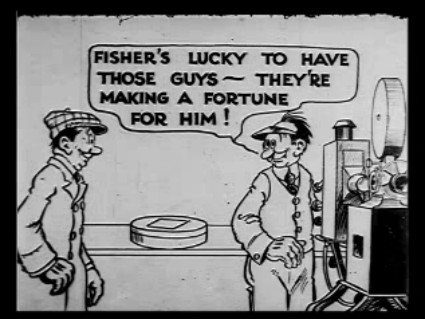
  • Mutt and Jeff: On Strike (Bud Fisher Films Corporation 1920)
  • The Sin Woman Trailer (George Backer Film 1922?) [trailer for 1917 film]
  • Pathé News, No. 15? (Pathé News 1922)

The six films can be viewed and downloaded from the National Film Preservation Foundation site here, together with useful background information on each title, and you can read all about the project here. One of the films, the Mutt and Jeff cartoon On Strike, will feature at this year’s Pordenone silent film festival.

Revisiting Pathé

nouvelleluttes

Georges Méliès’ Nouvelle Luttes Extravagantes (1900), from http://www.britishpathe.com

In the early, far-off days of the Bioscope I wrote two posts on the British Pathe collection of newsreels, 3,500 hours of freely-available digitised newsreels covering the period 1896-1970. One post was on the newsreels, the other on the early silent fiction films which lurk on the site, if you know where to look.

The site is still very much active, but after British Pathe was bought by private equity interests recently (the previous owner was the Daily Mail and General Trust) the site has undergone a revamp and has become that much easier for researchers to use. Previously you had to register to use the site, and to view any film you had to fill in personal details and then you could download a low resolution version. It was a somewhat laborious business, and in the new version (for which British Pathé has regained the acute accent on the e) the films are no longer downloadable Window Media files but are instantly accessible streaming files in Flash, without any of the form filling-in. Of course, it’s a little disappointing to not be able to take copies away, and it is disappointing also that the frame stills library has been removed, but the ease of access is a real boon.

The site is a marvellous resource for discovering silent film, and the life and times of the silent era. To remind you about what you can expect to find on the site, I’m going to reproduce some of my original 2007 posts. So, firstly, there’s searching for non-fiction material:

In 2002 British Pathe, owners of the Pathé newsreel library, put up the whole of its collection, thanks to a grant from the New Opportunities Fund’s NOF-Digitise programme. It was a controversial decision, because a commercial company was being given public money to do what some felt the company might have done for itself, but others welcomed a new kind of public-private initiative. The result for the public was 3,500 hours of newsreel footage from 1896 to 1970, available for free as low resolution downloads. Later 12,000,000 still images were added, key frames generated as part of the digitisation process. It was, and remains, one of the most remarkable resources on the net, and a major source for those interested in silent film.

Charles Pathé established the Société Pathé Frères, for the manufacture of phonographs and cinematographs, in 1896. A British agency was formed in 1902, and its first newsreel (which was the first in Britain), Pathé’s Animated Gazette, was launched in June 1910. This soon became Pathé Gazette, a name it retained until 1946, when it was renamed Pathé News, which continued until 1970. These newsreels were issued twice a week, every week, in British cinemas, and were a standard feature of the cinema programme in silent and sound eras.

Pathé also issued other films. It created the cinemagazine Pathé Pictorial in 1918, which ran until 1969. Eve’s Film Review, a cinemagazine for women, was established in 1921 and ran to 1933, while Pathétone Weekly ran 1930-1941. There were other film series and one-off documentaries.

All of this and more is on the site. Pathé were distributors of others’ films, some of which turn up unexpectedly on the site. For example, there are some of the delightful Secrets of Nature natural history films made by Percy Smith in the 1920s. There are also actuality films from before 1910 which Pathé seems to have picked up along the way, though not all of them are Pathé productions by any means – for example, assorted films from the Anglo-Boer War of 1899-1902.

For the silent period, researchers should note that the collection is not complete. For the First World War and before (what British Pathe calls Old Negatives) the surviving archive is patchy, and the cataloguing records less certain with dates. For the 1920s, the record is substantially complete – indeed, there is unissued and unused material as well as the standard newsreels. These of course show events great and small throughout the decade, with an emphasis on sport, celebrity, spectacle and human interest. Look out in particular for the women’s magazine Eve’s Film Review, a delightful series with an emphasis on “fashion, fun and fancy”. For silent film fans, there are newsreels of Chaplin, Valentino, Pickford, Fairbanks etc. There are all sorts of surprise film history discoveries to be made, such as a Pathé Pictorial on feature film production in Japan in the 1920s.

Then there are the fiction films:

Pathé somehow picked up assorted pre-First World War films, some though not all made by its French parent company, and these got digitised alongside the newsreels and are available on the site. There is no index to these fiction films, so below is a list of some of the ones that I have been able to find, with descriptions and some attempts at identifying them, as few are given correct titles or dates:

(the first title given is that on the British Pathe database – enter this in the search box to find the film)

THE FATAL SNEEZE = comedy in which a man suffers from an increasingly violent sneeze. This is That Fatal Sneeze (GB Hepworth 1907).

THE RUNAWAY HORSE = comedy in which a runaway horse causes chaos. This is a famous comedy of its time, Le Cheval Emballé (FR Pathé 1907).

FLYPAPER COMEDY = This is a French comedy with Max Linder, in which Max has flypaper sticking to him which he then finds sticks to everything else.

THE FANTASTIC DIVER = early trick film in which a man dives into a river fully clothed then returns by reverse action in a swimsuit.

THE RUNAWAY GLOBE = Italian? comedy in which a giant globe intended for a restaurant runs away down a street and is chased by a group of people before being sucked up by the sun, only to be spat out again.

THE MAGIC SAC [sic] = French trick film in which an old man hits people with a sack and makes them disappear.

MYSTERIOUS WRESTLERS = French trick film where two wrestlers pull one another to bits. This is a brilliant George Méliès trick film, Nouvelle Luttes Extravagantes (FR Star-Film 1900).

ATTEMPTED NOBBLING OF THE DERBY FAVOURITE = section from a British racing drama, made by Cricks and Sharp in 1905.

THE POCKET BOXERS = trick film in which two men place two miniature boxers on a table and watch them fight.

ESCAPED PRISONER RETURNS HOME = guards wait while prisoner bids a tearful farewell to his sick wife. This must be a James Williamson film, perhaps The Deserter (GB 1904).

LETTER TO HER PARENTS = extract from a drama at which elderly parents are upset at a message they receive.

ASKING FATHER FOR DAUGHTER’S HAND = scenes from a film where a fiancée has to prove himself to the father.

HAVING FUN WITH POLICEMEN = British comedy in which two legs stick out of a hole in an ice-covered pond, placed there by boys to trick a policeman.

POINT DUTY = a policeman is run over by a car and put back together again. This is How to Stop a Motor Car (GB Hepworth 1902).

THE MOTOR SKATER = comedy where man buys a pair of motorised skates and causes chaos.

RUNAWAY CYCLIST = comedy where man buys a bicycle and causes chaos (as can be seen, this was a common theme for comedies of the period).

FIRE = mixture of actuality film of a fire brigade and a dramatised fire rescue. This is Fire! (GB Williamson 1901).

HAMLET = scene with Hamlet and his father’s ghost, using trick photography, from Sir Johnston Forbes-Robertson’s production of Hamlet, a feature-length film (GB Hepworth 1913).

THE DECOY LETTER = early, rudimentary Western, where a soldier lures away an innkeeper with a decoy letter and attempts to assault his wife.

THE VILLAGE FIRE = comedy fire brigade film. This is The Village Fire Brigade (GB Williamson 1907).

THE RUNAWAY CAR = French comedy in which three men try to ride a bicycle and then a car.

RESCUED BY ROVER = a dog finds a kidnapped baby. This is of course the famous Rescued by Rover (GB Hepworth 1905).

One other point. British Pathe used to be managed by ITN Source and available from that company’s website as well, but the licensing deal has come to an end and all of the Pathé films have been removed from the ITN site.

Silents from Sulphur Springs

clownesse

Georges Méliès’ La Clownesse fantôme (1902)

The Bioscope returns from its travels in Ireland and Wales (about which you will learn something in due course) to report once more on what’s been happening in the world of early and silent cinema. Kicking things off, the Sulphur Springs Collection of Pre-Nickelodeon Films is a collection of early American films recently published online. The collection is part of the G. William Jones Film and Video Collection (formerly the Southwest Film/Video Archive) held by Southern Methodist University (SMU), Dallas, Texas. Twenty-nine of the thirty-three films, dating 1898-1906, have been published as part of SMU’s Central University Libraries (CUL) Digital Collections.

Below is a list the films being made available. Highlights include a Lubin imitation of Edison’s Life of an American Fireman (Lubin was notorious for borrowing other companies’ good ideas), several Edison panoramic films of the San Francisco earthquake of 1906, an atavistic chase film Tracked By Bloodhounds, or A Lynching in Cripple Creek (the victim is not black), and the otherwise lost Georges Méliès film, La Clownesse fantôme.

1. A Shocking Accident (Lubin, 1904)
2. [Couple Feeding Barnyard Fowl] (unidentified, 1903)
3. Earthquake ruins new Majestic Theater and City Hall (Edison,1906)
4. Epopée napoléonienne: Crossing Mt. St. Bernard (Pathé Frères, 1903-04)
5. [Feeding Fowl on a Country Path] (unidentified, no date)
6. [Gymnastics] (unidentified, no date)
7. Inexhaustible Cab (Lubin, 1901)
8. Japs Loading and Firing a Gun on Battleship ‘Asam’ (Edison, 1904?)
9. La Clownesse fantôme (The Shadow-Girl) (Star Films, 1902)
10. Le Laveur de devantures (The window cleaner) (Pathé Frères, 1903)
11. Life Of An American Fireman (Lubin, 1905)
12. Love in a Railroad Train (Lubin, 1902)
13. The Maniac Barber (American Mutoscope and Biograph Co., 1899)
14. Panorama City Hall, Van Ness Ave., and College of St. Ignatius (Edison, 1906)
15. Panorama Nob Hill and ruins of millionaire residences (Edison,1906)
16. Panorama notorious ‘Barbary Coast’ (Edison, 1906)
17. Panorama ruins, aristocratic apartments (Edison, 1906)
18. [Pillow Fight Scene] (unidentified, no date)
19. Ruins of Chinatown (Edison, 1906)
20. S.S. ‘Coptic’ (Edison, 1898)
21. The Counterfeiters (Lubin, 1905)
22. The Farmer’s Troubles in a Hotel (Lubin, 1902)
23. The Fight on the Bridge for Supremacy (Lubin, 1904)
24. The Golf Girls and the Tramp (Edison, 1902)
25. The Goose Takes a Trolley Ride (Lubin, 1903)
26. Tracked By Bloodhounds, or A Lynching in Cripple Creek (Selig, 1904)
27. [Trio of Acrobats] (unidentified, 1901)
28. Two Rubes at the Theater (Lubin, 1901)
29. Vertical panorama City Hall and surroundings (Edison, 1906)

The films are available in QuickTime format, and each is catalogued in much hyperlinked detail. The image quality is fine, and the original films look in good conditions, with just some touches of nitrate decomposition here and there. The website provides this statement regarding usage:

The files in this collection are protected by copyright law. No commercial reproduction or distribution of these files is permitted without the written permission of Southern Methodist University, Central University Libraries. These files may be freely used for educational purposes, provided they are not altered in any way, and Southern Methodist University is cited.

So now you know. It’s an excellent collection, ranging from single-shot actualities to multi-shot narratives, informative, coherent and illuminating. You can find out more about the collection, with background on all of the films, including the four not included online)) in Rick Worland, ‘The Sulphur Springs, Texas early films discovery‘, Journal of Film Preservation 51 (1995), pp. 56-64, available in PDF format from the FIAF site. It will get added to the Bioscope’s list of video sources. Go explore.

From the regions

scrapofpaper

The over-the-top sequence from A Scrap of Paper, from http://www.yfaonline.com

If most people think of film archives, then they think of the national collections such as the BFI National Archive, Cinémathèque Française, Library of Congress etc, or else broadcasters such as the BBC. What few consider, even within the film business, is the next tier down of collection, the regional film archives which represent a particular and special part of a country’s moving image heritage. In the UK we are fortunate in having a vibrant regional film archive network, operating (with measly funding) within the public sector, each representing one or other of the English political regions. So there is the East Anglian Film Archive, the Northern Region Film and Television Archive, the South West Film and Television Archive, the North West Film Archive, and so on. What is also seldom appreciated is that these archives generally have unique silent film holdings.

One of these archives, the Yorkshire Film Archive, is the immediate reason for this post, because it has just launched Yorkshire Film Archive Online, a really first-rate showcase of regional film. There are documentaries, amateur films, industrials, newsreels, advertising films, educational films, and dramas, all devoted to the Yorkshire region, all freely available and contained within an expertly designed site brim for of background information, all the search options you could wish for, options to add comments, and a really fine selection of films. This includes a number of silents (aside from those amateur films of later decades which were shot silent). The earliest shows Queen Victoria visiting Sheffield in 1897, the truly heroic Egg Harvest – Cliff Climbing at Flamborough (1908), the joyous local celebration that is Easter at Shipley Glen (1912) and a touching and surprisingly downbeat A Scrap of Paper, made in Hull to support those who had lost loved ones during the War,or who had been disabled. The film shows a father writing his last letter home, before he goes over the top and is seen lying dead in no-man’s land in the film’s final shot. (The site dates the film as 1914-18 but the tone of the titles suggest it was made just after the war).

Yorkshire Film Archive Online demonstrates what a dynamic film culture existed from the earliest years outside London. It is a model resource, but the YFA is not the only English regional archive with silent film on show. The Media Archive for Central England, based in Leicester, lists sixty-three titles between 1899 and 1930 in its catalogue, starting with an Anglo-Boer War recreation, and continuing with a rich variety of mostly local newsreels, some with online clips, such as The Meet of the Quorn Hounds, at Kirby Gate (1912) and Leicester Poor Boys’ and Girls’ Summer Camp at Mablethorpe (c.1920).

littledorrit

Joan Morgan and Langhorn Burton in Little Dorrit (1920), from http://sasesearch.brighton.ac.uk

Screen Archive South East, based in Brighton, is strongly aware of the part its region played in the early years of filmmaking in Britain. Its Screen Search catalogue describes over 900 films, many of them viewable online, and several from the silent era. under the theme ‘Early film in the South East‘ you can find Speer Films’ dynamic bank robbery thriller, The Motor Bandits (1912), a clip from the twenty minutes that survive of the Progress Film Company of Shoreham’s Little Dorrit (1920), starring the late Joan Morgan, and the illustrator and occasional filmmaker Harry Furniss in Winchelsea and its Surroundings. A Day with Harry Furniss and his Sketchbook (c.1920).

Screen Search also has travel films, home movies, documentaries, newsreels and productions by local cine-clubs. Look out too for films made in the 1930s by the twins John and William Barnes, the former of whom went on to become the author of the five-volume The Beginnings of the Cinema in England series of film histories.

The Wessex Film and Sound Archive, a partner archive to Screen Archive South East, cover the middle southern region of England. It has an online catalogue and a few sample clips, notably a 1905 example from Portsmouth filmmaker Alfred West‘s famous patriotic programme, Our Navy.

matinee

Children’s Matinee, showing children outside the Vaudeville cinema in Colchester, 3 October 1914, part of the East Anglian Film Archive collection, from http://www.movinghistory.ac.uk

There is more to be seen and learned about the regional archives on the Moving History site, which is a guide to the national and regional public sector film archives of the UK, and has a wide selection of sample clips, arranged by theme and by archive. Films from the English regional archives can also be found as part of the BBC’s Nation on Film website. There is a lot more to these archives than silents, of course, and the majority of clips to be found on their sites will be of later periods, particularly from when the home movie boom took off in the 1930s.

Finally, if you want to learn more about the operations and ethos of the RFAs, visit the Film Archive Forum site, the body that represents the interests of the UK’s public sector moving image archives (see its map of the UK’s archives here). Film is so much more than many think it is – beyond the entertainment cinema there is a whole culture of films made locally, for reasons both personal and professional, which document twentieth century lives in uniquely resonant form. What the films sometimes lack in polish they gain in their powerful connection to the people, for in seeing them we see ourselves. Do explore.

Library of Congress on YouTube

Imperial Japanese Dance, Edison Manufacturing Company, 1894, featuring the Sarashe Sisters

The Library of Congress has launched a YouTube channel. Starting with just seventy videos (but with more promised), the channel is divded into seven playlists: 2008 National Book Festival author presentations, the Books and Beyond author series, Journeys and Crossings (a series of curator discussions), Westinghouse industrial films from 1904, scholar discussions from the John W. Kluge Center, and early Edison films.

Those familiar with the LoC’s American Memory service will know that it has been serving the Westinghouse and Edison content since the late 1990s, but there are new digitisations, with High Quality option. The channel is part of a programme of new media initiatives recently announced by the LoC, which includes releasing content through Apple iTunes and its Flickr still image project. As said, more is promised – at present there are twenty-one videos of the Westinghouse industrial works in 1904, and twenty Edison films from 1891 to 1894.

Mashing Edison

Let us return to our occasional mash-up series, where we look at how some creative people have taken silent footage and blended it with modern music or other found sounds. Each of the examples here demonstrates creative use of Edison films made freely available for download and personal use by the Library of Congress through American Memory and the Open Video Project. This first example, Grandpa Can Dance!, created by pixiecherries (a.k.a. Bernie Lee), is a model piece of work, as it mashes up open content from American Memory and for the music from the Internet Archive. The two films used are Foxy Grandpa and Polly in a Little Hilarity (1902) and The Boys Think They Have One Over on Foxy Grandpa but he Fools Them (1902), while the music comes from zefrank. Firstly, it is a fine piece of creative work, with the unlikely heavy beat music fitting in well with the old-time dancing to create something delightfully strange. Added to this, he provides background information as intertitles throughout, showing interest in and respect for the performers. An education, in every sense.

More of Bernie Lee’s mashup work can be found at http://wj4u.com.

Girl on Fire takes the 1898 Edison film, Turkish Dance, Ella Lola, from American Memory, filmed in the Black Maria studio. mediapetros has treated with visual effects, fire noises and indeterminate live sounds and snatches of what seem to be airport announcements, ending with a church organ and singing. The result is hypnotic and enigmatic. Ella Lola, though billed at the time as “a sensational dancer from the East”, in fact hailed from Boston.

Our third example is Love in an Elevator, which I take to be the name of the song by Aerosmith which has been laid over the Edison film Charity Ball (1897) (available from American Memory), featuring James T. Kelly and Dorothy Kent of the Waite’s Comedy Company, performing in the Black Maria studio. As in so many examples of films being placed alongside music which was not composed with it in mind, our brains seek out common points of reference, points of action matching points in the music. (Note that the film, which was probably shot at 30fps, has been transferred at too slow a speed). But the music, grim as it may be to my sensitive ears, does fit peculiarly well. And look out for that wild leap at the end. Let’s be seeing those moves at the dance halls soon.

And finally, thiscompost takes things a little further in this multi-screen presentation of a Serpentine Dance. There are two dancers shown. The first is not identifiable, though it is an Edison Kinetoscope film of a serpentine dance. The second is Annabelle, who is wearing butterfly wings, which is Annabelle Butterfly Dance (1894 or 1895 – there were multiple versions made). The film ends with the return of the first dancer. The music is a Nick Drake B-side played backwards and then forwards. Annabelle Whitford was the most filmed of the variety performers who appeared before the Edison Kinetograph in these earliest years. She was a follower of Loïe Fuller, and went on to join the Ziegfeld Follies. Here her presence (and that of the unidentified dancer) is reduced to mysterious icon, echoing the multiple presences she enjoyed on film peepshows and screens across the world as the motion picture first spread across the world.

Things European

1903 amateur film by Julius Neubronner of a Kronberg bank employee, Moren, performing a number of dances and female impersonations in Neubronner’s garden, from the Deutsches Filminstitut

I’ve written before about filmarchives online, the European-funded project providing integrated access to filmographic and technical information on selected films from archives across Europe. When we last visited the subject (May 2007), there were some 4,000 films (predominantly non-fiction) documented, from five partner archives: Deutsche Filminstitut, the British Film Institute, La Cineteca di Bologna, the DEFA-Foundation and Národní Filmový Archiv Prague.

A year and a half on, and there are now eighteen institutions taking part, of which those contributing content are the British Film Institute, Cinémathèque Royale de Belgique, Cineteca del Comune di Bologna, DEFA Stiftung, Deutsches Filminstitut, Fondazione Cineteca Italiana, IWF Knowledge and Media, LICHTSPIEL / Kinemathek Bern, Magyar Nemzeti Filmarchívum, Národní Filmový Archiv and Tainiothiki tis Ellados. All the participating archives are part of MIDAS (Moving Image Database for Access and Re-use of European film collections), a project funded by the European Union’s MEDIA pogramme to encourage more efficient distribution of historic content in European film collections. The target is 20,000 records to be published by the end of 2008. Individual records come with rich cataloguing details and – rare for online film archive initiatives – technical information on the film elements held.

A selection of films (74 and rising) has been made available for viewing online, the majority of which are early non-fiction titles (a lot of them Mitchell and Kenyon productions from Britain and the ‘amateur’ efforts of Julius Neubronner from Germany). The same films can be found on the project’s YouTube channel. There are plenty of genuinely fascinating gems in there, with a clear emphasis on historic film’s documentary qualities.

While we’re on the subject of European film archive initiatives, it’s worth noting the European Film Gateway, a recently-announced three-year project planning to develop an online portal, “providing direct access to about 790,000 digital objects including films, photos, posters, drawings, sound material and text documents”. Film archives from across Europe (but not Britain) are participating. The project is funded by the European eContentplus programme, and the results will eventually be linked to the Europeana, a planned European digital library, museum and archive. More on this project once it’s properly underway.

You’ll already know about European Film Treasures, also funded by the MEDIA programme, which is delivering a library of historic titles from collections across Europe (including Britain this time), silent and sound.

Go explore.

Quebec and Québec

F. Guy Bradford (left), Joe Rosenthal (right) and the Living Canada travelling company, c.1903 (Cinémathèque québécoise)

Another day, another site goes up with unique silent film content, richly contextualised. Truly the online world is our archive. This time it is Le cinéma au Québec au temps du muet/Cinema in Quebec in Silent Era, an impeccably bilingual site giving us the history of early cinema in Quebec, Canada.

Quebec has a distinctive early film history. It is a tale coloured by its geography, its French heritage, local regulations, audiences and enthusiasms, and by snow. Particularly, it is a tale shaped by the dedicated efforts of a hardy band of pioneers, such as James Freer, Henry de Grandsaignes d’Hauterives and Léo-Ernest Ouimet. It is a tale of travelling cameramen (Joe Rosenthal, William Paley) and travelling exhibitors (F. Guy Bradford), an adventurous cinema with a spirit of newness and discovery about it.

The site has been put together with impressive thoroughness and local pride. There are extensive, knowledgable texts on such themes as the history of cinema in the area, biographies, audiences, film companies, sponsorship (the Canadian Pacific Railway made much use of film to promote its activites), censorship and travelling cinema. There are twenty or so films, available in low and high bandwidth, mostly non-fiction, including such titles as Skiing at Quebec (Edison 1902), Mes espérances en 1908 (Ouimet 1908), The Building of a Transcontinental Railway in Canada (Butcher 1909), Put Yourself in their Place (Vitagraph 1912 – fiction film set in Quebec) and the sobering Forty Thousand Feet of Rejected Film Destroyed by Ontario Censor Board (James and Sons 1916). All have musical accompaniment by Canada’s own Gabriel Thibaudeau.

There are also three lively ‘interactive journeys’ which you can take through the ‘Rural Milieu (1897-1905)’, ‘Working-Class Milieu (1906-1914)’ and ‘Middle-Class Milieu (1915-1930)’, which is an interesting way in which to divide up cinema history. Plus you will find documents, photographs, further background texts (some in French, some in English, some in both), and educational activities and a good, eclectic set of links (where you may learn that The Bioscope is ‘Plus qu’un blogue’ – merci beaucoup). An historical timeline is also offered, though I’ve not been able to make the link work. All in all, an exceptional piece of work, lovingly constructed, with discoveries a-plenty to be made.

The site is a collaborative effort between GRAFICS, the Bibliothèque et Archives nationales du Québec and the Cinémathèque québécoise. Acknowledgments to Bruce Calvert on the indispensible silent film forum Nitrateville for information on this site.