The glamour of restoration

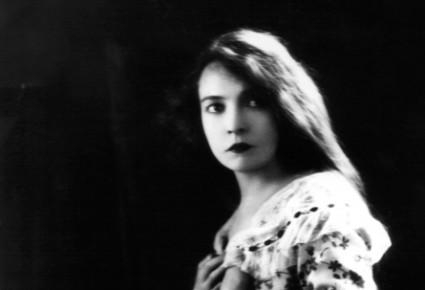
Miles Mander and Madeleine Carroll in The First Born (1928), from http://www.bfi.org.uk/lff

Silent film restorations, they seem to be everywhere at the moment, pitched ever more as gorgeous attractions whose time has come. They have (re)premieres, they are presented as works restored to life, as somehow belonging as much to our time as the time in which they were made. Maybe it’s the tinting and toning, maybe it’s the orchestral scores, maybe it’s just the hype – but they have glamour.

It is certainly striking to see a silent film restoration among one of the star attractions in the London Film Festival programme, and a British silent that few will have heard of to boot. The First Born (1928) is a film well worthy of the honour, however; indeed it is a rather better film than the festival blurb might suggest, whose attempts to sell it to a modern audience include comparisons with the TV series Downton Abbey and an invitation to consider how far the action on the screen mirrors the private lives of its stars. There are better reasons to see it than those – it is sophisticated, subtle, mature in theme and and bold in technique, perhaps what Mauritz Stiller might have made had he been in Britain rather than Sweden. It was directed by Miles Mander, and stars he and Madeleine Carroll in a tale of marital disharmony. The BFI’s copy of the film has long suffered from a missing ending, but additional footage has been uncovered to complete what should now gain the acclaim it deserves as a masterpiece. Stephen Horne has produced a new score, and it screens at the LFF on October 20th.

The LFF has a regular ‘Treasures from the Archives’ section, showing the pick of the world’s film restorations, and the silent selections this year are Clarence Brown’s The Goose Woman (USA 1925); Mikhail Kalatosov’s visually extraordinary The Nail in the Boot (USSR 1931) paired with Lois Weber’s powerful tale of urban poverty, Shoes (USA 1916); and a selection from the Wonderful London series of travelogues from 1924, made by Frank Miller and Harry B. Parkinson, a hack director of humblest ambition who just for this series found the technique to match the theme and produced some hauntingly simple vignettes of London life. Well worth catching.

Another restoration grabbing our attention, not least through the strategy of a stylish web presentation, including the above trailer, is Ernst Lubistch’s The Loves of Pharoah (Das Weib des Pharao) (Germany 1922). Those who associate Lubitsch solely with sly, visually witty social comedies, and going to find The Loves of Pharoah something of a shock. It is a grand epic of the old school, with scenery-chewing performances from Emil Jannings and Paul Wegener, and literally a cast of thousands for some spectacular crowd scenes. Though it has its silly side, and not much of a story for one will care about, it is a film to see for the handling of scale and just a sense, now and then, that maybe Ancient Egypt was exactly like this. It was the last film Lubitsch made in Germany before he went over to the United States and he truly went to town, building what looks like an entire Egyptian city (complete with full-sized Sphinx) on the outskirts of Berlin.

For years the film has existed only in an incomplete form, but the bringing together of prints in the USA (George Eastman House) and Russia has allowed the reconstruction of almost the entire film, complete with the original score by Eduard Künneke. The digital restoration has been undertaken by Alpha-Omega, who previously worked on the digital restoration of Metropolis. The film will have its German premiere at the Neues Museum in Berlin on 17 September, with a TV broadcast on ARTE on 26 September. The US premiere will be at the Egyptian Theater on Hollywood Boulevard in Los Angeles on 18 October, and a DVD and Blu-Ray release will then follow. More information is available, in English and German, on the Alpha-Omega site.

A third restoration doing the rounds, and with not just a trailer but a website to champion its importance is Mania, or, to give it its full title, Mania: The History of a Cigarette Factory Worker (Mania: Die Geschichte einer Zigarettenarbeiterin) (Germany 1918), Mania being the central character’s name. The great appeal here is that the film stars Pola Negri, the Polish vamp, shortly on her way to Hollywood to add a dash of pre-Garbo European glamour and mystique to American screens.

The film has been restored by the Filmoteka Narodowa in Poland and had a screening last night in Paris and has other lined up in Madrid, London (the Barbican on 13 October), Kiev and Berlin, with orchestral score, details of which are on the website. The trailer hasn’t been cut together all that well, but more than enough reason to see it is supplied by an enthusiastic account of the film in The Guardian. It was written by Pamela Hutchinson of the highly commendable Silent London blog, and is nicely observant when it comes to pinpointing Negri’s talent and appeal.

Bioscope Newsreel no. 29

Part of DVD cover for Metropolis, from Ain’t it Cool News

We’re publishing a little infrequently at present, both the regular posts and the newsreel, but the main thing is that we’re still publishing. Here’s a round-up of some of the recent silent news and events coming up.

Morodor’s Metropolis
The silent film version that many love to hate, while for others it is the version that was a welcome introduction to silents, is to come out on Blu-Ray. Electro-disco composer Giorgio Moroder’s score for Metropolis came out in 1984, and was controversial both for presenting a cut-down version (80mins) and for throwing pop songs on top of it (Freddy Mercury sings “Love Kills”, Pat Benatar sings “Here’s my Heart” – yep, it’s the 1980s). It’s become something of a cult favourite and now Kino are bringing it out theatrically in October and on Blu-Ray late 2011 or early 2012. Read more.

One-minute wonders
The Toronto Urban Film Festival (known as TUFF) brings new one-minute silent films, entered in competition, to be seen by 1.3 million daily commuters on the ONESTOP TTC subway platform screens. This year the guest judge for the festival is Atom Egoyan. It runs 9-18 September, and there are examples of some of the truly ingenious and creative videos submitted on the festival site. Read more.

Silents in New Zealand
A silent film festival offering more traditional fare is New Zealnd’s annual Opitiki Silent Film Festival, which this year takes place 2-4 September. The emphasis is on comedy and rugby, and there haven’t been too many silent rugby film programmes, to my recollection. The festival features Lloyf, Langdon, Keaton, Pollard and more, plus a one-hour silent film compilation All Blacks which features “footage of the 1905 Originals NZ touring team plus the 1924/1925 Invincibles”. Read more.

Où est Max?
Once again the Cine-Tourist website beats all competition in the cine-blogosphere with an engrossing (if very long) post, handsomely illustrated, on Max Linder, the films he shot in the streets of Vincennes, and what the locality says about him. None of these films can ever be called accidental in their choice of geography, because everything that we see makes the film that plays before us. Read more.

More journals online
More and more silent film journals are appearing on the Internet Archive, courtesy of Bruce Long of the Taylorology site and David Pierce of the Media History Digital Library. Long has added nine issues of Picture-Play for 1922-23 and one of Screenland for 1923; Pierce has added extra volumes of Moving Picture World for 1913, all of 1914, most of 1915, and three months each of 1916 and 1918. Copious thanks to both. Another Pierce upload is going to be the subject of a special post. Read more (Pierce) and more (Long)

‘Til next time!

Brides of Sulu

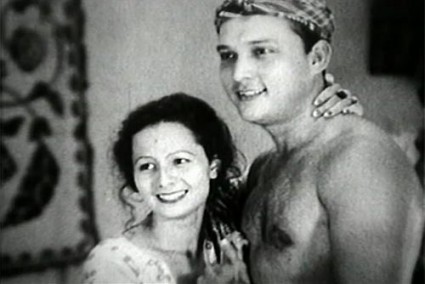
Adelina Moreno and Eduardo de Castro in Brides of Sulu, from http://www.gmanews.tv

A lot of us will know the commonly accepted figure of 80% of all films from the silent era as being considered lost. The figures varies for different territories, however (and whether you are counting fiction films only or all kinds of production). For America there is an estimated a survival rate of 7-12% for each year of the teens (feature films only), moving to 15-25% for the 1920s, but for China the figure is 95% loss, and for Japan the figure is between 95% and 99% loss. For the Philippines the figure is even worse – 100% loss of all native silent film production. Or at least that was what was thought. But silent films can lurk in some surprising places.

Brides of Sulu is an obscure American B-movie, made anywhere between 1933 and 1937 according to assorted sources. It’s included in the American Film Institute’s catalogue for the 1930s. The film tell of two lovers from the Philippine islands, one a Mohammedan princess (Venita), the other a pagan pearl diver (Assam). To escape her aranged marriage to a local chief, the couple flee to a remote island only to be pursued by her tribe, determined to kill Assam. It was filmed in the Philippines, though there is apparently no written account there of its production, and has an American narration (the country was still a colony of the USA at this time). The film was directed by one John Nelson, of whom nothing else (according to IMDb) is known, and stars two Phillipines film actors, Adelina Moreno and Eduardo de Castro, as well as local Moro tribesmen.

Now Brides of Sulu is to feature at Manila’s International Silent Film Festival, because recent scholarship indicates that the film was made out of one, if not two, Philippine silents. According to the Society of Filipino Archivists for Film:

There were two late silent-era Filipino films made in 1931 about the Moros of Sulu – Princess Tarhata (Araw Movies) and The Moro Pirate (Malayan Movies). The first was produced by the forgotten cinematographer Jose Domingo Badilla, while the latter was produced and directed by Jose Nepomuceno, acknowledged as the Father of the Philippine movie industry. Tarhata‘s lead actress is Adelina Moreno, while main actor of Moro Pirate is Eduardo de Castro …

… Coincidentally, both Moreno and De Castro, are the main starring actors in Brides of Sulu. The film also looks like it has two separate parts- the dramatically acted scenes and the documentary portions. Which raises the the intriguing possibility- is Brides the mutant offspring of the re-cutting and reconstitution of two earlier local films via the editing room? Then dubbed in English and re-editorialized for U.S. release with the intention of making it look like an American production so it would be easier to sell abroad? And who is director John Nelson? … Why are his initials the same as those of Jose Nepomuceno’s? So is the nationality of the film American or Filipino?

For the exciting conclusion, please attend the opening of the 5th International Silent Film Festival on Aug. 26 at the Shangri-la Mall Cinema …

Well, given that they promise an exciting conclusion, and given that the film is to screen at a silent film festival, I think we are safe in declaring that the Philippines has found one, or maybe two, films from its silent heritage, the first such films known to survive. Brides of Sulu has circulated on assorted obscure video labels for many years, and you can view the whole film on YouTube.

Extract from Brides of Sulu, in which Assam (Eduardo de Castro) faces up to Datu Tamboyan, father of Benita (Adelina Moreno)

Viewing the film undoubtedly suggests a silent film cannibalised by some opportunistic American producer with some actuality footage and narration to make an exotic B-movie release. Maybe Jose Nepomuceno, a revered figure in Philippine film history who directed their first fiction film, Dalagang Bukid, in 1919, is ‘John Nelson’, though there doesn’t seem much reason why this should be. No doubt all will be revealed at the International Silent Film Festival, which is now in its fifth year. The festival takes place 26-28 August at the Shang Cineplex (Cinema 2), Shangri-La Plaza, Mandaluyong Manila. Brides of Sulu will be screened with musical accoompaniment by Armor Rapista and the Panday Pandikal Cultural Troupe, which suggests that they will be dropping the American narration, which will be no bad thing. Other films screening at the festival are Nosferatu (Germany 1922), Akeyuku Sora (The Dawning Sky) (Japan 1929), L’Inferno (Dante’s Inferno) (Italy 1911), The Greek Miracle (Greece 1921) and Pilar Guerra (Spain 1926) – an impressive eclectic selection.

When certain information is reported on the provenance of Brides of Sulu, we will report it. Meanwhile, you can discover more about Jose Nepomuceno in a thesis by Nadi Tofighian of Stockholm University, The role of Jose Nepomuceno in the Philippine society: What language did his silent films speak? (2006), which shows what a rich history early Philippine filmmaking can boast, even without the films themselves to refer to.

Summer silents

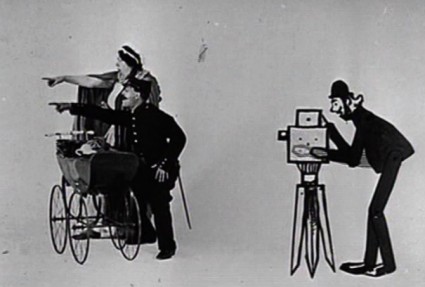
Emile Cohl’s Rien n’est impossible à l’homme (1910), showing at Italy’s Strade del Cinema

Time has been creeping on, as time will, and a number of silent film festivals are imminent without much time to deal with them one by one. Some have also left it terribly late before revealing any information on what they are showing. So here’s a quick round-up on what’s happening silent-wise around the world over the next couple of months:

August

Strade del Cinema
A festival of silent film and music held at Aosta, Italy. This year’s festival is taking place on 5-12 August 2011 and includes Gli ultimi giorni di Pompei (1913), a retrospective of Keystone Chaplins, I Fauno ((1917), and solid Bioscope favourite jazz trumpeter Dave Douglas and ensemble playing to the animation films of Emile Cohl.

Jornada Brasileira de Cinema Silencioso
The silent film festival held in São Paulo, Brazil starts on 5 August and runs to the 14th, but they still haven’t published any programme information on their website …

Capitolfest
Central New York’s annual summer classic and silent movie festival is taking place 12-14 August 2011. There’s a special focus on Janet Gaynor, and among the silent features on offer there’s A Ship Comes In (1928), Geared to Go (1924), North of 36 (1924) and Harold Teen (1928).

Bonner Sommerkino
Germany’s premiere silent film festival is held in Bonn, this year 11-21 August 2011. We mentioned it in our previous post, but just a reminder that it includes The Circle (1924), Les ombres qui passent (1924), Von Morgens bis Mitternachts (1920) and Bolivia’s Wara Wara (1930).

September

Cinecon
The annual classic film festival held in Hollywood takes place 1-5 September 2011. Among the titles announced so far are East Side, West Side (1927), Raymond Griffith in Hands Up! (1926), Nazimova in the newly-restored Stronger than Death (1920) and Marion Davies in Beauty’s Worth (1922).

Mykkäelokuvafestivaalit (Forssa Silent Film Festival)
Globe-trotting summer silent film followers may prefer cooler climes, in which case there’s the annual silent film festival in Forssa, Finland, held 2-3 September 2011. Highlights include Victor Sjöström’s Ingeborg Holm (1913), Mauritz Stiller’s Herr Arnes pengar (1920), Carl Th. Dreyer’s Prästankan (1920) and Benjamin Christensen’s Häxan (1922).

Australia's Silent Film Festival
This year’s festival will be held in Sydney as a series of events across September-November 2011. Films include The Lodger (1927), Bed and Sofa (1927) and Lucky Star (1929).

Cinesation
Silent and early sound film festival held in Massillon, Ohio, USA. Dates for the next festival are 22-25 September 2011. Promised titles include newly-restored 1920 serial The Phantom Foe, Bebe Daniels in Feel My Pulse (1928), William S. Hart in The White Oak (1921), Lord Jim (1925) and Oliver Thomas in Betty Takes a Hand (1918).

Bioscope Newsreel no. 28

Bébé victime d’une erreur? The supposed Gaumont film filmed outside the Pathé studios at 30 rue Louis Besquel, Vincennes, Paris (location today inset)

Just time to rush out a hastily-cobbled together edition of the Bioscope Newsreel for you, picking up on a few of the things happening in the silent world that have caught our eye over the past couple of weeks.

A life in the movies
The Guardian has published a profile of Kevin Brownlow, asking why a man who has won an Oscar for a lifetime dedicated to preserving the art of silent film isn’t better known in his own country. Read more.

Locating the General
On July 20 John Bengston, author of Silent Echoes and other books on the locations behind classic silent comedies, gave a presentation before the Academy of Motion Pictures Arts & Sciences on the locations used by Buster Keaton for The General. The Academy has published his compelling and superbly researched PowerPoint slides, with Bengston’s commentary, on its site. Read more.

Gaumont mystery
On that truly engrossing and mysterious site The Cine-Tourist, Roland-François Lack has posed an intriguing question. He has examined closely the film credited as Bébé victime d’une erreur judiciaire, an extract from which appears on the recent Gaumont boxed DVD set Le Cinéma premier, 1897-1913. But this supposed Gaumont film was sot outside the Pathé studios, as his meticulous visual evidence makes clear. What is going on? Can you solve the mystery? You may certainly enjoy the detective work. Read more.

Bonner Sommerkino
Germany’s silent film festival takes place 11-21 August and the programme has been published (in German). Among the highlights are Frank Borzage’s The Circle (US 1924), Mosjoukine in Les ombres qui passent (France 1924), the astonishing unreleased (except in Japan) experimental German film Von Morgens bis Mitternachts (Germany 1920), Shingun (1930) – Japan’s answer to Wings, and Bolivia’s sole surviving silent feature film Wara Wara (1930). Read more.

One in the eye for Murdoch
Yes, we can bring in the News International scandal which has so engrossed the British media, because there is a tangential silent film angle. When someone rejoicing in the name of Johnnie Marbles interrupted the Culture Media ans Sport select committee’s investigation into the phone hacking scandal by placing a foam pie in Rupert Murdoch’s face, he was acting in a tradition that goes back to the custard pies beloved of silent cinema and beyond. The BBC News site investigates the history. Read more.

‘Til next time!

Pordenone 2011

The Wind

The Giornate del Cinema Muto, or Pordenone Silent Film Festival, has announced details of its programme for 1-8 October 2011. It has the look of another classic year, with some eye-catching special presentations and discoveries to tempt us acros to Italy once more. Here are details from the publicity materials available so far:

People of Italy’s Golden Age
To celebrate three decades of rediscovery and restorations of the national cinema, and Italy’s 150th unification anniversary, we present “People of Italy’s Golden Age”, with programmes devoted both to superstars and to less-known personalities, including Francesca Bertini, Pina Menichelli, Nino Oxilia, Febo Mari and the galaxy of clowns of the first decade – Cretinetti, Polidor, Kri-Kri, Robinet and friends.

It’s good to see Italian silent cinema celebrated at an Italian silent film festival – you can sometimes forget when in front of the screen at Pordenone that you are in Italy, though the festival has a tradition of celebrating Italian comedians of the era (a great favourite of festival director David Robinson).

Shostakovich and the Factory of the Eccentric Actor
Focuses on the association of the composer and the film-makers Grigori Kozintsev and Leonid Trauberg, which began with the unparalleled marriage of music and image in New Babylon and Odna. This is a rare opportunity to see all the surviving work of the Factory of the Eccentric Actor (FEKS), unique in Soviet cinema for its vitality, originality and audacity. The Giornate will also show Shostakovich’s two “cartoon operas”, the banned and never-completed Story of the Priest and his Servant Balda and The Story of the Silly Little Mouse.

New Babylon will provide the festival’s gala opening show. Although New Babylon has often been performed before, this performance can be claimed as definitive. After the debacles of the first performances, Shostakovich’s score was lost for
45 years, until 1975, when Gennadi Rozhdestvensky found a set of orchestral parts in the Lenin Library, Moscow, and adapted a suite from the score. Subsequently other, fuller copies of the original orchestral parts became available; but it was not until this century, thanks to the work of the Paris-based Shostakovich Centre, that the most complete versions of the score, as well as Shostakovich’s own much-corrected manuscript (the original of which is in the Glinka Museum, Moscow) became freely available. Mark Fitz-Gerald, who began his studies of the score twenty years ago, has been able to extensively revise his work in preparing the new Naxos recording, and with assistance from another fine Shostakovich scholar, Pierre-Alain Biget, has brought the score and its synchronisation to a new level, at which Shostakovich’s genius can finally be fully appreciated. A second film in the FEKS programme, The Overcoat, after Gogol, will be accompanied by a new score for quartet by Maud Nelissen.

More films from the vast and largely unexplored treasury of Soviet silent films can be seen in a presentation of Georgian cinema, including the remaining two films from the oeuvre of Lev Push – a gifted director, prevented from direction after 1930, whose name was virtually unknown until last year’s Giornate.

Last year at the Giornate we were treated to Lev Push’s visually vivid Giuli (1927) and Gypsy Blood (1928). The music for New Babylon will be performed by FVG Mitteleuropa Orchestra, conducted by Mark Fitz-Gerald.

Kertész before Curtiz
Remembered as one of the great names of classic Hollywood (his films included Casablanca, The Adventures of Robin Hood, Mildred Pierce) it is often forgotten that Michael Curtiz enjoyed a prolific 14-year career in Europe before arriving in America. Few of the 48 films he made in his native Hungary, as Mihály Kertész, survive; the Giornate will show the newly rediscovered A Tolonc (The Expulsion, 1914), which already exemplifies his exceptional gift for narrative, pace and character. In Austria, now Michael Kertesz, he made 17 films, which have been generally overlooked by film historians, perhaps because Kertesz’ intention was primarily commercial entertainment – art was an incidental asset. The Giornate’s selection from the Austrian era will include Der Junge Medardus, from the novel by Artur Schnitzler, who collaborated on the script, and Das Spielzeug von Paris, Einspänner nr 13 and Der Goldene Schmetterling – all starring the gifted Lili Damita (who was briefly married to Kertesz) and exemplifying Kertesz’ special qualities of eroticism and sharp social satire.

Definitely one for the cineaste completists, particularly for the rediscovery of A Tolonc, not least because pitifully few Hungarian silents have survived overall.

The Canon Revisited
The popular “Canon Revisted” series this year includes an orchestral show, with Günter Buchwald conducting Chaplin’s own accompaniment to The Circus. Other “Canon” titles include Marcel l’Herbier’s Eldorado, Joe May’s Asphalt and Friedrich Ermler’s Fragment of an Empire.

On the Giornate site they add Merry-Go-Round (1923), the film from which Erich von Stroheim was fired and replaced by Rupert Julian, and Kenneth Macpherson’s experimental work Borderline (1930), starring Paul Robeson.

Early and Transitional Cinema
A dramatic rediscovery featured in the Early and Transitional Cinema series is Robert William Paul’s 1896 The Soldier’s Courtship, which has been regarded as a key work in film history, as the first British fiction film – and indeed one of the world’s first fiction films. Believed lost for almost all its 115 years, a fine print recently surfaced in the Roman archive of Centro Sperimentale di Cinematografia and will be premiered at the 2011 Giornate. Also in this series are two more programmes from the Corrick Collection, and a centenary programme which explores the exceptional narrative qualities of the films of the American Thanhouser Company.

The rediscovery of The Soldier’s Courtship is stunning news. It is a title that has been referred to as important more or less for as long as there have been histories of British film, but all we have ever had to refer to were a catalogue description and a single still. The film was made in April 1896 on the roof of the Alhambra Theatre, Leicester Square in London, where Robert Paul‘s Animatograph projector was a featured attraction. The film featured music hall star Fred Storey, Julie Seale and Paul’s wife Ellen, and is generally considered to be the first British film fiction film. Such as its popularity that Paul re-shot the film in 1897, but it appears that the Rome discovery is the 1896 original. Well, well.

Early Westerns
A small but selective programme to celebrate the American National Film Preservation Foundation’s DVD issues of early Westerns will include screenings of W.S. Van Dyke’s Lady of the Dugout (1918), Victor Fleming’s Mantrap (1926) and the little-known Salomy Jane (1914), directed by Lucius Henderson and William Nigh.

Other highlights of this year’s Giornate: a special series to commemorate the centenary of the great polar expeditions of 1911-12; Japanese silent animation film; the recently re-assembled full series of Walt Disney’s 1922 Laugh-o-Grams; and a special selection of early films depicting the experience of going to the cinema drawn from the collections of EYE, Amsterdam.

The closing show will be a full orchestral performance of Victor Sjostrom’s The Wind (1928), with Carl Davis conducting his own score.

As with New Babylon, the orchestra for The Wind will be the FVG Mitteleuropa Orchestra.

Information on registration, accommodation and travel is here. Those who have not attended before need to fill out a registration request form. Old hands should now be receiving registration details by email – let the festival know if you haven’t head from them by the end of this month.

This all has the look of a classic Pordenone, and there’s more to be announced in due course. Will you want to be anywhere else the first week in October?

Bioscope Newsreel no. 27

Frame grab from the trailer for Martin Scorsese’s Hugo

Some weeks we’re not sure what to put in the Bioscope newsreel, and some weeks we’re just overwhelmed with how alive our dead medium continues to be. And that’s when we’ve set aside the news, already reported, of the first appearance on American screens of the full restored Napoléon with Carl Davis score, next year. So, after a gap of a few weeks while we were away on our travels, here’s some of the news in silent films now.

Hugo trailer
Martin Scorsese, as you may know, is making a film of Brian Selznick’s children’s novel, The Invention of Hugh Cabret, in which Georges Méliès is a central character. During production the film has been known as Hugo Cabret, but clearly that was too much for Disney’s marketing people, and now it’s just known as Hugo. The first trailer is out, and – guess what – it looks like a Disney children’s film. But some enticing recreations of Georges Méliès’ film and stage productions, as the image above shows, should draw us in to see when the time comes. Read more.

Silent film scores galore
An extraordinary treasure trove of silent film scores has been unearthed by Birmingham city council (in the UK) in its music library. There are around 500 scores in a collection which has lain in a basement for decades. Chiefly examples of generic scores for stock scenes (chases, mystery scenes, people in peril etc.), many are scores for small orchestras of between seven and eleven players. They appear to have been collected by touring musical directors, who went from cinema to cinema rather than work for just the one venue. We will have more on this amazing discovery and its importance for silent film history in due course. Read more.

Theodore Roszak RIP
The social critic, academic and novelist Theodore Roszak has died. Best known for coining the phrase ‘counter culture’ in his 1968 work The Making of a Counter Culture, he was also an ardent film fan and wrote one of the best of all film-themed novels, Flicker, a dark and imaginatively far-fetched work which revolves around the mysterious figure of Max Castle, B-movie horror film maker in the 1940s and reveals an extraordinary alternate history of Hollywood from the silent period onwards. Read more.

San Francisco silents
The San Francisco Silent Film Festival is running as we type. Highlights include a solo electric guitar acompaniment by Giovanni Spinelli to Sunrise: A Story of Two Humans (there’s an extract from a documentary on the scoring of the film here), He Who Gets Slapped, I Was Born But…, Marlene Dietrich in The Woman Men Yearn For, and the ubiquitous The Great White Silence. Read more.

Paintings of cinemas
One of the blogs the Bioscope likes to read when it feels the need to stir the brain cells a bit is Nick Redfern’s thought-provoking Research into Film. Normally his subject is analytical studies of films, but he has put up a delightful post exhibiting paintings of cinemas and their audiences by contemporary artists. Do take a look. Read more.

‘Til next time!

Broncho Billy silent film festival

The 14th annual Broncho Billy Silent Film Festival takes place at the Niles Edison Theater, 37417 Niles Boulevard, Fremont, California, 24-26 June. The festival schedule has been published, with highlights including Mack Sennett Studios, serial heroines Helen Holmes and Helen Gibson, and the ubiquitous Baby Peggy.

Here’s the outline programme:

FRIDAY Evening, June 24

6:30 to 7:30 PM Meet and Greet
Come and meet our guests and friends and have a light snack before our first show

8:00 PM Evening Main Program
Introduced by Robert S. Birchard
Manhandled – Gloria Swanson (1924)
The Golf Nut – short: Billy Bevan, Vernon Dent (1927)
When a Man’s a Prince – Ben Turpin, Madeline Hurlock (1926)
Bruce Loeb at the piano

SATURDAY June 25
Tours of Niles will be available in late morning (optional) – getting you back in time for the afternoon show.

SATURDAY Early Afternoon, June 25
12:30 PM Film Program – Focus on Mack Sennett Studios
Hosts Brent Walker, author of Mack’s Fun Factory and Richard Roberts, comedy film historian
Comrades – Mack Sennett (1911 Biograph)
The Water Nymph – Mabel Normand (1912 Keystone)
Shot in the Excitement – Al St. John, Alice Howell (1914 Keystone)
The Home Breakers – Mack Swain, Chester Conklin (1915 Keystone)
The Waiter’s Ball – Roscoe “Fatty” Arbuckle, Al St. John (1916 Keystone)
Whose Baby? – Gloria Swanson, Bobby Vernon (1917 Keystone)
Phil Carli at the piano

SUNDAY June 26
A Train ride through Niles Canyon will be available mid-morning (optional, at an additional low cost) – getting you back in time for the afternoon show.

SUNDAY Afternoon, June 26
12:30 PM Film Program – Women in Action: The Two Helens
Hosts Shirley Freitas Great Granddaughter of Helen Holmes & Larry Telles, author and silent film serial historian
Webs of Steel – Helen Holmes, director/husband J. P. McGowan (1925, Morris R. Schlank)
Ghost of the Canyon – short: Helen Gibson (1920, Capital)
David Drazin at the piano

SUNDAY Late Afternoon, June 26
3:30 PM Film Program
A BABY PEGGY FEATURE FILM
Introduced by Diana Serra Cary

The Family Secret – Baby Peggy, Gladys Hulette, Edward Earle, Frank Currier. (1924, Universal)
David Drazin at the piano

Ticket details, transport and accommodation information are all on the festival site.

Chaplin in Babylon

Last year saw the appearance of a new silent film festival, the StummfilmLIVEfestival put on by the Babylon Kino cinema in Berlin, a 1929 cinema with original Art Deco screen and refurbished original organ. That first festival was a bold statement of intent, with an impressive ten-day line-up of classic silents. The Babylon Kino has made good on its promise to make the festival an annual event, and to keep up the eye-catching programming standard.

And so, from 15 July to 7 August 2011 the second StummfilmLIVEfestival will feature the complete film works of Charlie Chaplin – 80 films in twenty-four days (the filmographers among you might like to comment on whether there are precisely eighty films in Chaplin’s silent filmography). A full programme has not been published as yet, but there will be ten main screenings of the silent features with orchestral accompaniment by the Neues Kammerorchester Potsdam, conducted by Timothy Brock, on these dates:

15 Jul – The Gold Rush
16 Jul – City Lights
17 Jul – The Gold Rush
22 Jul – Modern Times
23 Jul – The Circus
24 Jul – The Kid
30 Jul – City Lights
31 Jul – A Woman of Paris
06 Aug – The Gold Rush
07 Aug – The Chaplin Review

Other musical accompaniment will be provided by Neil Brand, and Geraldine Chaplin is the guest of honour. As the Babylon website notes (in German only), eighty years ago, on 9 March 1931 Chaplin visited Berlin to promote his new film City Lights, so this is a sort of anniversary coming home for Chaplin. Tickets can now be booked for the orchestral screenings, and there are further details – in German only – on the festival site.

Bioscope Newsreel no. 24

Jean Dujardin and Uggy share the acting honours in The Artist

Things are still unsettled here at New Bioscope Towers, what with so much stuff still in boxes and electrical matters needing to be sorted out, but your scribe will for a while rest upon a handy packing case and record for you some of the news items from the world of silents this week (and the week before).

Best film dog
As many of you will know now, the modern day silent film The Artist did not win the Palm d’Or at Cannes, though it was a close run thing. Jean Dujardin did pick up the award for best actor, but probably a little closer to the Bioscope’s heart was the announcement of the Palm Dog – an unofficial award for the best performance by a dog in a film shown at Cannes – which went to Uggy, a Jack Russell member of the cast of The Artist. Uggy’s performance has been variously described as “stunning”, “stand out” and “the finest in the 11 year history of the Palm Dog”. Read more.

The world remembers part 1
UNESCO’s Memory of the World programme highlights important documentary heritage artefacts from around the world, and as we have reported before now, a few films have been included so far. Newly inscribed on the register is the important Desmet collection of films, company documents, posters and film stills from the 1910s, submitted by the EYE Film Institute in Amsterdam(formerly the Nederlands Filmmuseum). Also inscribed in 2011, by the Russian Federation, is Tolstoy’s Personal Library and Manuscripts, Photo and Film Collection. I wasn’t aware Tolstoy had a personal film collection – as we have noted before, he was no lover of the medium. We will have to find out more. Read more.

The world remembers part 2
But there are also national registers, and new to the UK Memory of the World register is the extraordinary Mitchell & Kenyon collection of some 800 films from the Edwardian era, mostly actualties depicting lives in English and Irish working towns. Congratulations to the BFI National Archive which cares for the collection and successfully argued for the collection’s inclusion on the UK register (along with the GPO Film Unit collection of the 1930s). Read more.

Tuff times ahead
Toronto’s annual festial of modern, one-minute long silent films is open for entries once more. Describing itself as ‘the world’s only true “underground” film festival’, films submitted and selected get to reach over 1.3 million daily commuters who ride the Toronto subway system. The event takes place 9-18 September 2011 and this year’s guest judge is Atom Egoyan. The deadline for submissions is 15 July. You can see past award winners on TUFF’s Vimeo site – and the standard is high. Read more.

The genius of Buster
A thoughtful and observant article by Jana Prikyl on Buster Keaton has been published in The New York Review of Books to coincide with the screening of twelve feature-length and twelve short films by Buster Keaton, at Film Forum, New York City, 23 May – 8 August 2011. The essay covers Kino’s recent DVD and Blu-Ray releases, the Brownlow/Gill documentary A Hard Act to Follow, Kevin W. Sweeney’s Buster Keaton: Interviews, and James L. Neibaur’s The Fall of Buster Keaton: His Films for M-G-M, Educational Pictures, and Columbia. Read more.

‘Til next time!