Remembrance of bioscopes past

Every now and again I trace the etymology and use of the word ‘bioscope‘. Here ‘s a passage from Marcel Proust’s A la recherche du temps perdu, from the Overture to the first book, Swann’s Way:

These shifting and confused gusts of memory never lasted for more than a few seconds; it often happened that, in my spell of uncertainty as to where I was, I did not distinguish the successive theories of which that uncertainty was composed any more than, when we watch a horse running, we isolate the successive positions of its body as they appear upon a bioscope.

That’s the C.K. Scott Moncrieff translation, though the Terence Kilmartin one is much the same. It’s interesting to view this with knowledge of Muybridge‘s sequence photographs of a horse galloping (which Proust must have known about) which broke up motion into isolated images, whereas Proust sees the way that film captures motion as now hiding the same mystery. Has anyone written about Muybridge and Proust?

While we’re here, just a little further down the chapter, there is this renowned passage on the magic lantern, a little lengthy, but worth quoting in full (again, from the Scott Moncrieff translation):

At Combray, as every afternoon ended, long before the time when I should have to go up to bed, and to lie there, unsleeping, far from my mother and grandmother, my bedroom became the fixed point on which my melancholy and anxious thoughts were centred. Some one had had the happy idea of giving me, to distract me on evenings when I seemed abnormally wretched, a magic lantern, which used to be set on top of my lamp while we waited for dinner-time to come: in the manner of the master-builders and glass-painters of gothic days it substituted for the opaqueness of my walls an impalpable iridescence, supernatural phenomena of many colours, in which legends were depicted, as on a shifting and transitory window. But my sorrows were only increased, because this change of lighting destroyed, as nothing else could have done, the customary impression I had formed of my room, thanks to which the room itself, but for the torture of having to go to bed in it, had become quite endurable. For now I no longer recognised it, and I became uneasy, as though I were in a room in some hotel or furnished lodging, in a place where I had just arrived, by train, for the first time.

Riding at a jerky trot, Golo, his mind filled with an infamous design, issued from the little three-cornered forest which dyed dark-green the slope of a convenient hill, and advanced by leaps and bounds towards the castle of poor Geneviève de Brabant. This castle was cut off short by a curved line which was in fact the circumference of one of the transparent ovals in the slides which were pushed into position through a slot in the lantern. It was only the wing of a castle, and in front of it stretched a moor on which Geneviève stood, lost in contemplation, wearing a blue girdle. The castle and the moor were yellow, but I could tell their colour without waiting to see them, for before the slides made their appearance the old-gold sonorous name of Brabant had given me an unmistakable clue. Golo stopped for a moment and listened sadly to the little speech read aloud by my great-aunt, which he seemed perfectly to understand, for he modified his attitude with a docility not devoid of a degree of majesty, so as to conform to the indications given in the text; then he rode away at the same jerky trot. And nothing could arrest his slow progress. If the lantern were moved I could still distinguish Golo’s horse advancing across the window-curtains, swelling out with their curves and diving into their folds. The body of Golo himself, being of the same supernatural substance as his steed’s, overcame all material obstacles—everything that seemed to bar his way—by taking each as it might be a skeleton and embodying it in himself: the door-handle, for instance, over which, adapting itself at once, would float invincibly his red cloak or his pale face, never losing its nobility or its melancholy, never shewing any sign of trouble at such a transubstantiation.

And, indeed, I found plenty of charm in these bright projections, which seemed to have come straight out of a Merovingian past, and to shed around me the reflections of such ancient history. But I cannot express the discomfort I felt at such an intrusion of mystery and beauty into a room which I had succeeded in filling with my own personality until I thought no more of the room than of myself. The anaesthetic effect of custom being destroyed, I would begin to think and to feel very melancholy things. The door-handle of my room, which was different to me from all the other doorhandles in the world, inasmuch as it seemed to open of its own accord and without my having to turn it, so unconscious had its manipulation become; lo and behold, it was now an astral body for Golo. And as soon as the dinner-bell rang I would run down to the dining-room, where the big hanging lamp, ignorant of Golo and Bluebeard but well acquainted with my family and the dish of stewed beef, shed the same light as on every other evening; and I would fall into the arms of my mother, whom the misfortunes of Geneviève de Brabant had made all the dearer to me, just as the crimes of Golo had driven me to a more than ordinarily scrupulous examination of my own conscience.

I know much has been written about Proust and the magic lantern, but does anyone know if he is writing about a specific set of lantern slides, and do these survive?
Product placement

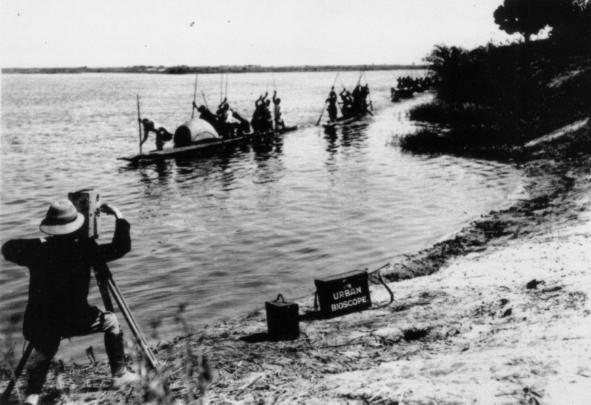
drefrenes1.jpg

This photograph shows Joseph De Frenes, cameraman for the Charles Urban Trading Company, filming in Africa around 1908. De Frenes is using a hand-cranked Urban Bioscope camera, and the camera case with the product’s name is placed prominently in this publicity photograph for use in the company’s catalogues and promotional literature. De Frenes was an Austrian who filmed with three of the most notable creators of travel films in the early period of cinema: Burton Holmes, Lyman Howe and Charles Urban. He was Urban’s head cameraman when they made the celebrated Kinemacolor film of the 1911 Delhi Durbar ceremonies. After the First World War he established his own film business, which ran successfully for decades.

The Bioscope, or dial of life, explained

The book which gave us the word ‘bioscope’ is available to download for free from the Internet Archive. The full title of Granville Penn’s 1812 religious tract is The bioscope, or dial of life, explained. To which is added, a translation of St. Paulinus’s Epistle to Celantia, on the rule of Christian life: and an elementary view of general chronology; with a perpetual solar and lunar calendar. It’s available in DjVu (9MB), PDF (21MB) or plain text (340KB) formats. For further information on Penn’s definition of the term, see the post from 6 February 2007.

Playground rhyme

This playground rhyme was (is?) sung by South African children:

Skinny-malinky long legs
Big banana feet
Went to the bioscope
And fell through the seat.

Bioscope is still the name for a cinema in South Africa.

Microscopes

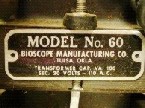
microscope.jpg

Bioscope is a brand name for microscopes produced by the Bioscope Manufacturing Company of Tulsa, Oklahoma. The firm in particular produced microscopes for use in the home, either as individual items (the popular Model “20” and Model “60” makes) or as part of children’s science sets. The firm is no longer in operation. The term ‘bioscope’ is used for other current microscope makes, such as the BioScope ATF (Atomic Force Microscope) for nano-bio research, and the Bioscope CD-ROM software simulation of a microscope.

Some of them are quite shocking

bioscope.jpg

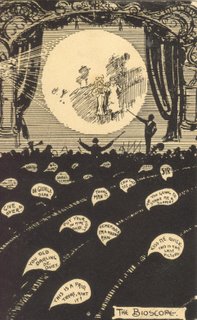
Back to the history of the word Bioscope. This postcard dates from 1904. It portrays a bioscope show, with lecturer, orchestra, and speech bubble comments from the audience. The comments include: “Remember I’m a married man,” “Kiss me quick, this is the last picture,” and “Can they see us?” On the back of the postcard, there is the handwritten comment, “This one is rather amusing I think. Don’t you? They are quite the latest style here. Some of them are quite shocking.” The postcard was sent from Dover. Interestingly, the image on the screen is a circular one, indicating that the artist was confused by the difference between motion pictures (which were square) and magic lantern slides (which did sometimes feature circular images).

The Bioscope

magazine.jpg

More on the word Bioscope.

The Bioscope was a British film trade journal, published weekly between September 1908 and May 1932. It provided news on the activities of the British film production, distribution and exhibition busineses, ‘reviewed’ new films (for the early years these are little more than plot descriptions supplied by film companies), reported on exhibition around the country, and published practical articles and interviews. Thanks to the complete run held at the British Film Institute library, The Bioscope has given huge impetus to the study of silent British film, being cited in countless books and articles, most notably in Rachael Low’s The History of the British Film series. Also published under the Bioscope name were the Bioscope Annual and Trades Directory (from 1910 onwards) and individual guides such as The Modern Bioscope Operator (1910). It was originally published by Ganes Ltd.

The Bioscope (continued)

Bioscope is a term for a film projector. Its first use in a moving image context precedes projected film. Hermann Hecht’s monumental Pre-Cinema History: An Encyclopaedia and Annotated Bibliography of the Moving Image Before 1896 records an 1852 reference to the stéréo-fantastique or Bioscope of Jules Dubosq, a combination either of the Phenakistoscope (Plateau’s spinning disk with images on its edge which when its mirror reflection was viewed through slots gave an illusion of motion) with the stereoscope, or the Zoetrope (using the same principle as the phenakistoscope but with the images on the inside of a drum) and the stereoscope. The effect was to produce moving, stereoscopic pictures.

On the cusp of projected film, in 1892 the Frenchman Georges Demenÿ patented a motion picture device he named the Phonoscope, which projected brief images from rotating glass discs. When the Phonoscope was marketed by Gaumont from the end of 1895, it was renamed a Bioscope. Also at the end of 1895 the German Max Skladanowsky named his projector a Bioskop, and gave the the first commercial presentation of projected film in Europe with it at the Berlin Wintergarten theatre on 1 November 1895.

In 1896 the American Charles Urban developed a projector with the engineer Walter Isaacs, which he named a Bioscope. When Urban moved to Britain in 1897 he brought the Bioscope with him. He built a successful business on the back of the Bioscope projector and the use of Bioscope as a brand, to the extent that for a while the word became synonymous with cinema itself. A version of the Bioscope c.1900 is illustrated in this site’s header.

More on the history and etymology of the Bioscope to follow…

The Bagman’s Bioscope

The word ‘bioscope’ next appears (see post on February 6th) in the title of William Bayley’s 1825 publication The Bagman’s Bioscope, an enertaining collection of anecdotes, stories, homilies and histories, described in the book’s subtitle as presenting Various Views of Man and Manners, Being the Points in Conversation in Commercial Room; Collected for the Use of Johnny Newcomes on the Road. A bagman was a travelling salesman. It was therefore presented as a handy collection of yarns for someone on the road to use. The use of the word ‘bioscope’ is not elaborated upon, so by this date it was presumably already understood to have a general sense of something that offered a view of life.

A view of life

Why call this site The Bioscope? Well, the Bioscope was the name of a camera and a projector (both a brand name and generic), it was the name for fairground film shows and for early cinemas (it still is the name for a cinema in South Africa), and it was the name of a British film trade journal. So it covers the taking, projecting, exhibiting and documentation of early film. There are several other uses of the word, and I’m starting up a Bioscope category to trace the etymology, usage and meanings of the word.

So, to begin at the beginning: Bioscope. The word is constructed from the Greek (bios, life; skopeein, to look at), and the Oxford English Dictionary gives its traditional definition as ‘a view of life or survey of life’. The word was coined by Granville Penn in his 1812 Christian tract The Bioscope, or Dial of Life. Penn’s book included a separate card on which was illustrated a dial marked from nought to seventy, marking the ages of man from childhood to decay in decades, with eternity waiting before and after. A pointer was attached for the reader to mark out his current age, and hence to contemplate the lessons in Penn’s book on the allotted span of human life and to avoid the belief ‘that life is a continuous now’. This dial was the Bioscope, and just as a horoscope was a measure of the heavens at the hour of birth, so the Bioscope was the ‘general measure of human life’.

Meanings a-plenty already.