The last bioscopewallah

salim

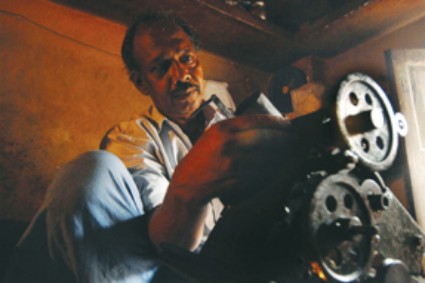
Mohammad Salim with his 100-year-old projector, from http://www.littleindia.com

We have written here before on the tradition of the travelling bioscope in India, film shows put on by men journeying from town to town with projector in a hand cart, some of whom work with equipment dating back to the early cinema period.

The subject has interested a number of filmmakers. There is K.M. Madhusudhanan’s feature film Bioscope, The Bioscopewallah by Prashant Kadam, Megha B. Lakhani’s Prakash Travelling Cinema (available in two parts on YouTube), Andrej Fidyk’s Battu’s Bioscope, Vrinda Kapoor and Nitesh Bhatia’s Baarah Mann Ki Dhoban and Salim Baba by Americans Tim Sternberg and Francisco Bello, which was nominated for an Oscar in 2008.

An article by Nilanjana Bhowmick on the man featured in that last film has turned up on Little India (an Indian newspaper published in the USA). Entitled ‘The last bioscopewallah’, its subject is Mohammed Salim, who tours Kolkata with his 100-year-old projector (apparently Japanese in origin) on a cart, accompanied by his reluctant son. It’s an evocative piece of writing, depicting a decades-old form of street entertainment that just about hangs on in the age of the iPod and the DVD, sustained by the belief of the bioscopewallah in the magic of literally bringing cinema to the people. These are a few choice paragraphs:

Bioscopewallah……bioscopewallah ayah….aao, dekho,nai purani filme sirf ek rupiya. (Here comes the Bioscopewallah, come and watch new and old films for just Re 1).

The throw-back cry from the 1960s and 1970s of Indian street vendors trying to lure children and adults to the magic of movies in a box still reverberates in the serpentine bylanes of Kolkata, mingled with the smell of moss and decay. The cry might not have the same verve, nor perhaps does it elicit the earlier enthusiasm. But it still attracts curious onlookers who crowd around as the last bioscopewallah of Kolkata sets up his shop near a school or a movie theater.

Children rush to his cart, clutching a rupee coin in their hands. Some older people might still remember the voyeuristic feeling of peek-a-boo cinema under the shade of the ominously grave-looking black cloth, but most have either forgotten or never experienced the charm of the movie in the wooden box.

Mohammad Salim, with his 100-year-old projector, is a relic from a forgotten era. He roams the streets of Kolkata, letting people experience in short bursts the often surreal world of the bioscope.

Salim’s voice has become weaker with age, but the enthusiasm remains undimmed. He is the thin string that binds Kolkata with its glorious past to the beginning of cinema — the Royal Bioscope Company, India’s first bioscope company. Salim is not only oblivious to the legacy he has carried on his shoulders for decades now, but he is equally nonchalant about his brush with international fame, which includes an Oscar nominated documentary on his life. He only understands his bioscope and beyond it everything else pales.

Salim’s journey on the Kolkata streets with his bioscope began more than 40 years ago. In his late fifties, he laboriously pushes along his archaic projector on a hand driven cart. These days often he is accompanied by one of his unwilling sons, for whom the bioscope holds no magic. Sometimes he is mistaken for an ice cream vendor, most times he is ignored. In this digital age, the wooden bioscope holds no attraction and Salim cuts a lone figure as he wanders from one street to another. However, as he sets shop and Bollywood music and dialogs burst forth from his bioscope, a small crowd gathers around him; a crowd that wants to lose itself in the garish, colorful, melodramatic and musical world of Bollywood movies. The glamour, thrill, drama and dreams of Bollywood are packed into three-four minutes of trailers that transport the viewer into a makeshift world of the movies — short lived, but an escape from the real world nevertheless …

… In the 1960s and 1970s the call of the bioscopewallah was eagerly awaited in the neighborhoods of Kolkata. However in this age of television and computers, the bioscope is as antiquated as the term itself. Salim recalls the golden days when his father’s bioscope ruled the roost: “When my father used to call out, people used to come rushing out of their houses, especially children and women. They used to stand in the balcony for hours in order to catch the bioscopewallah.”

Salim started with his father when aged just twelve. In those days there were many other bioscopewallahs, all of whom showed only silent films. To keep up with the times, Salim has had to adapt to sound, showing scraps of films that highlight songs, dances and fights.

Salim survives in an age dominated by iPods and DVDs by updating his equipment to keep pace with the modern age. His passion with the bioscope led him to experiment with it and add new features. The original bioscope had no provision for sound so Salim, realizing he will lose his audiences if he failed to add it to his trailers, acquired sound.

“I love my projector and the fact that this small box contains all the wonders of a cinema hall. And I told myself, there must be a way to put sound too! I went to the cinema halls and asked people about how they put the sound on the lip movements. We tried to replicate that in my projector and succeeded. It was because I went with the times that I have been able to keep this alive. If there was no sound, no one would have watched it anymore.” …

… The era of the bioscope will likely end with Salim. His sons are not interested in carrying forward the tradition of their father and grandfather. They are young men who have come of age in the digital era of mobile phones and computer games.

Salim is philosophical about his plight and the future of his craft. He insists he is not driven by money, otherwise he would have sold the projector — an antique piece — by now. “I have had offers from abroad to sell my bioscope, I have said no. It is the heritage of my country, why should I sell it to another country?”

It’s a delightful piece well worth reading in its entirety. Not exactly silent films, but definitely in their spirit.

The Bioscope Bibliography of Silent Cinema

bookshelf1

I’d like to invite you to take part in an interesting project. For some while now I’ve been thinking about using the Bioscope, and the collective knowledge of its readers, to produce a research resource of some kind that would benefit the silent film studies community.

And so I’m announcing the creation of the Bioscope Bibliography of Silent Cinema. The aim is to create as comprehensive a bibliography as possible for early and silent cinema, using the catalogue of the British Library. The Library (my esteemed employer) recently published an experimental version of its online catalogue which allows registered users to tag, comment upon and sort records, and export data to annotation programmes. The aspect that interests me in particular is the tagging. This enables you to mark any titles in the catalogue with a keyword of your choosing. This facility hasn’t been used much as yet, but to me it seems a marvellous opportunity for creating catalogues. All one needs to do is to establish a keyword, assign it to every title that comes under that category, and you have your own catalogue. If it is a major subject, such as silent cinema, then you could make it a collective endeavour, benefitting from the shared wisdom of an intelligent crowd. Hence this project.

This is only open to those with British Library reader’s passes. The test catalogue can be consulted by all, but only those who sign in (with your reader number and password) can add tags. The tag I have created is “silent cinema”. All you have to do is select a book title from the catalogue; on the right-hand side of the record (see example below), under Tagging, you will see the instruction Assign/Remove Tags. Click on this and a box pops up inviting you to add a tag. You type in “silent cinema”, click on Save, and it’s done ((once you have done so, for the next title you click on, the tag will appear as a check-box automatically). The beauty of the system is that anyone can use the same keyword, so a team of people can be involved.

searchbetabluk

http://searchbeta.bl.uk

The British Library doesn’t have every book on silent film, but it has most. Moreover, this new version of the catalogue includes journals and newspapers (titles, that is, not individual issues), theses and music scores, with other media to follow in due course, such as manuscripts and sound recordings. I’ve no idea how long this bibliography might be eventually (a few thousand titles, certainly), but what the catalogue programme does is to break down the titles under any subject (such as “silent cinema”) by author, publisher, decade, material type, language or narrower subject, which aids searching and encourages discovery.

I have tagged some 430 records already, and you can see the results here: silent cinema.

Now I hope there may be some of you out there who will be willing to take part. Obviously some management is required. I have started to tag all the books indexed under ‘silent film’, but there are a great many that are not traceable that way. The books of the silent era themselves were not titled or classified as ‘silent film ‘ or ‘silent cinema’, and for the earlier years they may have been classified under photography, or theatre. Hidden or obscure titles can be brought to the surface in this way. One can select titles that one knows; one can select by author, or keyword. What I suggest is that anyone who is interested should get in touch, either via the comments to this post or through www.lukemckernan.com, and say which area you’d like to cover. It could be an author, a sub-subject area, a language of publication, a country, or whatever. I can then keep a record of what has been done.

Some rules to follow: make sure you tag every example of a title (the BL sometimes has more than one copy of a book); in choosing titles you should make sure they are relevant to silent cinema (and its antecedents), but you can include works that are not wholly about silent cinema (e.g. cinema histories); you must keep to the tag exactly as written (“silent cinema”); don’t interfere with anyone else’s tags. You can include novels (how useful it will be just to have a list of the literature of silent cinema), indeed anything that relates to silent cinema in one form another, published at any time. I haven’t attempted to define what silent cinema is. If in doubt, include it.

bookshelf2

And then what will be do with such a work? Well, it will become – if enough people contribute to it – an invaluable research tool for all of us. It won’t just list all of the silent cinema books we can identify, but it will classify and sub-divide them. It will enable easy searching of themes. It will reveal titles that won’t turn up in conventional catalogues. It will open up new areas of study as different media that cover silent cinema are brought together. It will grow as new titles are published. And additional features and means to manipulate the data will emerge as the British Library further develops the functionality of its catalogue. One could even imagine other libraries, when have have similar catalogue functions, also being mined for silent cinema subjects and some glorious joint catalogue being created.

This will be a long job. I’ll be taking on the bulk of it, and I’m not expecting anyone to volunteer for a massive amount of tagging. You could simply select a dozen or so titles. Just let me know that you are interested, so that the project can be monitored. Remember, only those British Library reader passes can take part – but everyone can benefit from the results.

Let me know what you think.

The Bioscope twitters

twitter

Well, it may be a spurious trend, but if it’s the way the world is speaking (at least a part of it), then the Bioscope is going to follow. So this is to announce the creation of the Bioscope’s very own Twitter presence. If you don’t know what Twitter is, it’s a micro-blogging service in which you are restricted to messages of no more than 140 characters (called tweets).

The way I’ve set it up is that every post made on the main blog will now also appear on the Twitter feed (i.e. the first few words followed by a hyperlink), while I’ll be using the feed to add short news items and musings on early and silent cinema, as the mood takes me. The most recent of these you can see on the Twitter RSS feed on the column to your right. It’s an experiment – it may augment the service, or it may not, in which case I’ll dump it. We’ll just have to see.

To follow the feed, go to www.twitter.com/thebioscope.

Albert Kahn atteint dix mille

‘Twas not so long ago when The Bioscope was delighted to have reached its first 10,000 visits. Now on post, 2007’s Searching for Albert Kahn, pushed on by a recent burst of activity no doubt inspired by a rescreening somewhere, has just passed the 10,000 mark all on its own. I hope one or two in search of Edwardian colour have stayed on to discover the complementary delights of the early and silent film world.

A bit of an unmakeover

OK, I admit it – the re-design was a mistake. I was swept off my feet by the new theme at WordPress which seemed to offer the chance to spruce up the site, which had been looking a bit samey. Or so I thought. But it was too tricksy in style, and worse was that it messed up the information on the right-hand column when viewed with some older versions of browsers. So I’ve returned to ‘Contempt’ (such is name of the WordPress theme), which does the job best, though I’ve kept the new banner. Because I like it.

As you were then.

A bit of a makeover

After two years’ existence, it felt like it was time for The Bioscope to have a bit of a makeover. So, as you can see, we have abandoned the practical but plain ‘Contempt’ theme that WordPress kindly provides for those like me lacking in the skills to design our own, and we have adopted the ‘Vigilance’ theme, together with a new banner.

I hope the new style helps a little with readability and accessibility. I’ve trimmed some of the categories and so forth for extra clarity, and there are improved features such as selections under Categories or under search enquiries coming up as a list of posts rather than the post in full, which should aid searching and browsing. There may need to be some further tweaking along the way, and I have plans for new features – and will need to find space for them. Anyway, I hope things look fresher, and that you’ll keep on reading The Bioscope.

200,000!

lolcat

http://icanhascheezburger.com

Hello, 200,000th visitor, whoever you may have been. OK, so that’s not a huge number by some standards, and the Bioscope stills lurks at no. 142,599 on the Technorati blog league table. And doubtless if we were to feature a few more pictures of comic cats, rather than concentrate quite so rigidly on the research aspects of early and silent cinema, then maybe we might be expanding the audience a little. But I’m rather pleased with the audience we have, and grateful to all who keep reading here.

Next stop, half a million. If I can just drum up a few more Chaplin-impersonating cats, and learn to loosen up the spelling a little…

Bioscope centenary

I cannot let September 2008 pass without noting a modest centenary, which is that of the original Bioscope. On 18 September 1908 The Bioscope, the British film trade journal was first published, having its roots in two earlier magazines, The Amusement World and The Novelty News. It continued as a weekly until 4 May 1932. For most of that period it was published by Ganes Ltd, and edited by John Cabourn. It took its name from what was then a common term for the new venues for exhibiting motion pictures (i.e. cinemas), but which was also known as a type of film projector and a term for fairground film shows. It was a redolent and versatile term, describing both its subject it the widest terms and its own view on the world.

The Bioscope reported on British and world film production and exhibition, reporting the latest news and studio gossip, reviewing films, reporting on technology, interviewing leading figures in the industry, and keeping a sharp eye on the business side of film. For the film historian, it is one of the key primary sources for the study of silent film – certainly in Britain, and with much of great value for film from other nations as well. It was a major source for Rachael Low’s The History of the British Film series, and has been cited in countless studies since, not least on account of the British Film Institute’s library having a complete run.

In recognition of this Bioscope’s honourable forebear, I am going to start up a new series, at least once a month reproducing texts from The Bioscope of 100 years ago. Whether this Bioscope will last another twenty-four years seems unlikely (how long will blogs last?), but we’ll trace how The Bioscope reported on the rise of the cinema business from 1908 for as long as it does.

No more ads

Good news – WordPress have finally introduced a No Ads feature, which should mean that anyone coming to this site from a Google search won’t find Google Ads appearing at the top of a post, something which offended me greatly. No longer sullied, the Bioscope presses on.