I had an idea to devote August to a particular theme here at the Bioscope, namely catalogues and databases, but problems with some resources I’ve been testing have put that on the back-burner for the time being. Instead, it looks like Asian cinema is becoming our hot topic. If you follow the comments to the recent post on digitised newspapers from Singapore you will find a rich array of information on early Asian cinema studies from two expert scholars in the field, Stephen Bottomore and Stephen Hughes.
It is Stephen Hughes who has alerted us to the existence of BioScope: South Asian Screen Studies, a new journal which will be including early film subjects within its remit, as an essay in its first number indicates, Sudhir Mahadevan’s “Traveling Showmen, Makeshift Cinemas: The Bioscopewallah and Early Cinema History in India”. If you follow the Asian cinema category here at this Bioscope you will find a number of posts which cover bioscopewallahs or Indian touring film showmen, some of whom are still operating original silent-era projectors. The term comes from the Bioscope projector first marketed in the USA and the the UK by Charles Urban in the late 1890s/early 1900s, which proved so popular that it spread worldwide not just as a projector but as the name of where you saw films (the term is still common as a place where you see films in South Africa). UK fairground film shows were called bioscopes, many of the first UK cinemas were referred to as bioscopes, and one of the leading British film trade journals of the period was called The Bioscope. Anyway, a warm welcome to a well-named journal, which is operating in a grand tradition.
And then there’s more. On 25 August, at the Nehru Centre in London, there is a launch event for a year-long project (funded by the Heritage Lottery Fund) on the linkages between silent cinema in India and Britain, entitled Lifting the Curtain: Niranjan Pal & Indo-British Collaboration in Cinema in the UK (1902-29). This project is being managed by the South Asian Cinema Foundation (SACF) and began this May. The project main subject is screenwriter, director and playwright Niranjan Pal, who wrote the Anglo-Indo-German silent features The Light of Asia (1925), Shiraz (1928) and A Throw of Dice (1929, now available on DVD), before becoming chief scenarist at Bombay Talkies in 1934.
The Nehru Centre event will feature film clips and presentations on early cinema, filmmakers, filmmaking and film exhibition in Britain and India, together with information the various film sources that are available for students keen to conduct research in this area – a key aim of the project. The project is supported by the British Film Institute and the British Library, and among the speakers is the BL’s moving image curator, Luke McKernan i.e. me, talking about Charles Urban and the filming in Kinemacolor of the 1911 Delhi Durbar.
More information from the Nehru Centre (scroll down to 25 August) and the SACF site.
Apologies for a somewhat intermittent service at the moment. The broadband supply to Bioscope Towers is behaving a little erratically, and posting is proving a little difficult. But the finest of engineers are on the case (I am assured), so we must hope for normal service to be resumed soon.
The Bioscope scribes are currently toiling away at a long post which is taking ages to research (regulars may not realise that every post is first written out in long-hand with quills pens wielded by white-haired amanuenses working to the roughest of outline sketches, who then hand the parchment to a team of owl-eyed fact-checkers who lurk deep within the bowels of Bioscope Towers, seldom seeing the light of day. Only then is the hallowed text handed to yours truly, who heartlessly ignores most of it and instead types down whatever comes into his head).
While we wait, and while I head off to a conference and other such business for a couple of days, here’s a modern silent to entertain you, recommended by Bioscope regular Frederica. But is it a modern silent, or is it closer to a Tom and Jerry cartoon? Or should we look upon Tom and Jerry cartoons as model examples of silent filmmaking (Spike the dog aside)? You decide – or just enjoy a particularly ingenious and rib-tickling piece of modern animation.
Here’s an interview from the Japanese Times with Midori Sawato, best-known of the small band of voice artists who keep alive the art of the benshi. There are around ten modern benshi in Japan, who continue the tradition of adding live narration to silent films, which was the standard manner in which silent films were exhibited in Japan up to the late 1930s, when – at its peak – there were some 7,000 such benshi in employment. The benshi would be positioned alongside the screen and take on the multiple roles, accompanied by live music, and putting their particular personality onto the film entertainment. Sawato gives around 100 such shows per year.
Sawato has been featured here before, as she is main voice artist featured on Digital Meme’s Talking Silents series of Japanese silents with benshi narration, reported on here. In the interview (which takes a couple of minutes before she gets to silent films) she describes how she was working in publishing in 1972 when she went to a silent film narrated by master benshi Shunsui Matsuda, one of a number of celebrated benshi still active. She became so engrossed by the art that she became his apprentice, making her debut with Chaplin’s The Rink. One of the interesting aspects of the interview is the realisation that benshi narrate for non-Japanese silents as well as Japanese – which is of course how it was during the silent era.
The interview covers how she learned the art (mostly by listening), how she conveys different characters, and her thoughts about the importance of silent film as a means to preserve history and culture. There’s also the oblique admission that she continues to perform to the films despite relatively small audiences, believing that it is good work to be doing whether the audience be large or small. It’s a noble activity.
The video serves as my means to introduce The Bioscope on YouTube. I’ve set up a channel, or playlist, on YouTube which lists almost all of the videos featured on The Bioscope since its inception in February 2007. I say almost all, because some videos have been taken down since then, and some have come from other sites (such as Vimeo). But it’s most of them, and I think they make interesting browsing. I’ll continue to add each new video to the channel as they are featured on the blog. The Bioscope on YouTube is now a link on the right-hand column of this site, alongside our other satellite sites, The Bioscope on Flickr (images featured on or associated with the blog), The Bioscope Bibliography of Silent Cinema (selected from the British Library catalogue, still ongoing), The Bioscope on Twitter (a feed from blog posts only), and Urbanora’s Modern Silents (another YouTube playlist, with some overlaps with the new channel).
I trouble not, nor fret,
But have unbounded hope,
With me there’s no regret,
Whilst I’ve my Bioscope.
Whatever comes or goes,
There’s nothing makes me mope;
I feel I have no foes,
When I’ve a Bioscope.
What cares may come, through fate,
I with them all will cope,
They trouble not my pate,
Whilst I’ve my Bioscope.
Warwick. Without apologies to the others
True doubtless for the projector that Warwick marketed, but hopefully no less true for this blog (which is shaping up to enjoy its highest ever monthly viewing figures, for which much thanks to all).
(And for those who are concerned about these things, our logo shows a Warwick Bioscope projector c.1900)
Bioscope is a word with many meanings (which is why it was chosen for the title of this blog). Bioscope can mean a view of life (its original dictionary definition), a cinematograph camera, a projector, a fairground film show, a cinema, a make of microscope, a film trade journal, and a science-based visitor attraction in France. The term was commonly used for a place to see films in the early years of the twentieth-century, and that term persisted in some countries, notably India and South Africa. What I hadn’t know before now is that it also also adopted in Tibet – albeit in the local pronunciation, beskop. I have just come across two detailed and fascinating articles on the history of film in Tibet, ‘The Happy Light Bioscope Theatre & Other Stories’, written by Jamyang Norbu for the Tibetan news website Pahyul.com. Part one is here, and part two is here. It can also be read on Jamyang’s Shadow Tibet blog. He has quite a story to tell.
Film had come to Tibet by 1920. Jamyang tells us that when the “first (invited) British mission reached Lhasa” the head of the mission, Charles Bell, was entertained by Tsarong Dasang Dadul, commander-in-chief of the Tibetan army, with some film shows held in his private screening room. Tsarong operated the projector himself. Jamyang doesn’t say what the films were, but reasons that it was probably one of only two projectors in Tibet. The Dalai Lama is likely to have had the other one.
Tibetans however were not unaccustomed to screen entertainments. Jamyang traces the history of puppet shows with special visual effects and the magic lantern shows exhibited by British visitors at the turn of the centiury. But after 1920 subsequent British political missions brought film projectors with them. Jamyang says that Frederick Bailey (political agent and spy) showed newsreels in Lhasa in 1924, including King George V opening parliament, while in 1933 Derek Williamson showed Charlie Chaplin and Felix the Cat films to the 13th Dalai Lama. His wife Peggy, in her memoirs recalled:
In Lhasa, Charlie Chaplin was the great favourite; we had one of his films called The Adventurer, in which he played an escaped convict. The Tibetans renamed this film ‘Kuma’ (The Thief) and everyone wanted to see, including His Holiness, who laughed heartily throughout the performance.
Tibetans called Chaplin ‘Chumping’, from Charlie the Champion, the word entering the language. Rin Tin Tin was another great favourite. The cinema came to be known as beskop, adapted from bioscope, though now Tibetans use the term ‘lok-nyen’, a translation of the Chinese ‘dian-ying’ (electric shadows). Jamyang stresses that there is little evidence of Tibetans having viewed the cinema superstitously. The first cinema in Lhasa may have opened before 1934, managed by two Muslim brothers named Radhu, Muhammad Ashgar and Sirajuddin, though the details are uncertain. It seated around a hundred, with a balcony for twenty or thirty paying higher prices, from which a Muslim translator would narrate the story to the Tibetan audience.
Much of the evidence for all this comes from accounts written by British political mission members and explorers. The Austrian adventurer Heinrich Harrer, author of the celebrated Seven Years in Tibet, wrote that talkies were being shown in Lhasa by the mid-1930s. Sir Basil Gould, who headed the British mission of 1936, reported that:
Monks were amongst the most ardent of our cinema clientele. There is nothing which Tibetans like better than to see themselves and their acquaintances in a frame or on the screen.
Gould was among those who supplied that need, because as well as bringing projectors with them the British brought cine cameras.
Extract from Sir Basil Gould’s films of Tibet (1940), from the BFI’s YouTube channel
The first film shot in Tibet was probably film taken by J.B.N. Noel, cinematographer with the 1922 British Everest exhibition, whose footage is included in the documentary feature Climbing Mt Everest (1922). It is included in a new BFI National Archive touring programme, The Search for Shangri-La: Tibet on Film 1922-1950. The bulk of the programme is (silent) home movie footage shot by British missions and explorers iin the 1920s, ’30s and ’40s. They include the botanist George Sherriff, the aforementioned Frederick Bailey and the Williamsons, Charls Bell (on his return to Tibet in 1934) and Sir Basil Gould, who brought a cameraman with him to Lhasa, Frederick Spencer Chapman. These films feature ceremonies, landscapes and Tibetan flora and fauna. Shot for the most part in colour they form an extraordinary archive of Tibetan life before the Chinese takeover, and were used in the 2008 BBC television series The Lost World of Tibet (now available on DVD).
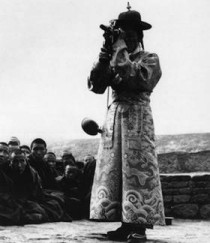
The first Tibetan filmmaker may have been Tsarong Dasang Dadul, who acquired a camera at some time after the projector with which he entertained Charles Bell in 1920. Actuality films were made by Tsarong’s son Dundul Namgyal, while Tsarong himself filmed Anglo-Tibetan football matches outside Lhasa in 1936. Heinrich Harrer reports that the young 14th Dalai Lama was a keen filmmaker and knew how to dismantle a projector and put it back together again. Jamyang Norbu writes that another filmmaker in the 1940s was Tibetan official Jigme Taring (shown at the top of this post) who filmed festivals and street life in Lhasa, and the 14th Dalai Lama’s official tour of Sera, Drepung and Ganden.
Jamyang goes to to write about films and cinema exhibition following the Chinese occupation, including Tibetan fiction films (the first is believed to have been made in the mid-1970s). He also writes about his personal experience of exhibiting world cinema classics to Tibetan students in the 1980s, including Nosferatu (1922). It’s a fascinating history, showing how film was not just the harbinger of modernity for Tibet but how it fitted into (and documented) established traditions. Film was never simply about the shock of the new; it complemented the old as well, and was shaped by every society that encountered it.
The Search for Shangri-La tours Britain until May 2010 – details of screenings are here; while the Everest films of J.B.L. Noel will feature at this year’s British Silent Film Festival in April.
For some while now I’ve thought that it would be a good idea to have some sort of image gallery to go alongside the Bioscope. It wouldn’t really work as part of the blog itself, so instead I have established a set of images as part of my Flickr account and called it The Bioscope, surprise surprise.
It’s got 445 images there so far. Most of them come from two sources. One are illustrations taken from David S. Hulfish, Cyclopedia of Motion-Picture Work (1914), which is freely available in PDF form on the Internet Archive; the other is Charles Donald Fox and Milton Silver (eds.), Who’s Who on the Screen (1920), again available from the Internet Archive (and included in the Bioscope Library). In both cases I have copied and pasted images (for the later book with their descriptions as well), so the image quality isn’t high but I hope in this form they will serve as a handy reference source. Some may remember that the Who’s Who on the Screen images were originally made available on the Screen Research site that I launched a year or so ago and which I unceremoniously dumped last month. They have all been moved to the Flickr set.
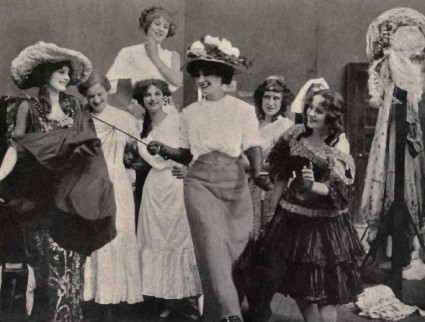
The Niece and the Chorus Lady (Edison 1911), from David S. Hulfish, Cyclopedia of Motion-Picture Work (1914)
Additionally, I have added some photographs taken by myself, relating to the Pordenone silent film festival and Kinemacolor, some images from a silent era directory whose title I have mislaid (for the time being), and a few oddments like cinema postcards. I am no collector, and there are others who have made far more interesting silent film images available on Flickr (memo to self: must write post on these soon). But what I will do from now on is add images in full size from Bioscope posts where I have had to reduce them to fit the blog, where it is legitimate to do so.
There is now a link for the Bioscope Flickr set on the right-hand side under ‘Other Bioscope Sites’. The other Bioscope associate sites are the Bioscope Bibliography of Silent Cinema (records extracted from the British Library catalogue), the Bioscope on Twitter (a feed from the blog – I don’t add any additional material as tweets, at present) and Urbanora’s Modern Silents, a collection of modern silent videos on my YouTube site. So the Bioscope grows and grows.
Most popular search terms – bioscope, albert kahn, kinetoscope, louise brooks, emile cohl, loie fuller
Thank you to everyone who reads the Bioscope. It seems to be of use to some. We’ll keep going.
Update
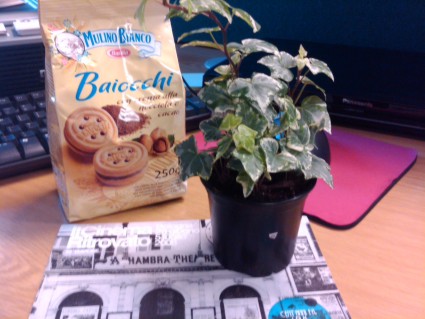
Bioscopist and Cineteca Bologna researcher Mariann Lewinsky was sufficiently moved by news of the Bioscope’s birthday that she promised a cake. In the end, the cake transmogrified into a plant and a packet of biscuits. Many thanks – here they are:
I’ve been undertaking a reorganisation of my YouTube acount. I’ve not uploaded any videos of my own as yet, but I gather together favourites, and I’ve started to organise these into groups, or playlists – curating YouTube, if you will. One of these playlists is on the modern silent film, and you may have already noticed on the right-hand column that listd among ‘other Bioscope sites’ is now Urbanora’s modern silents. This brings together all the examples of modern silent films that I’ve mentioned or featured on the Bioscope (where they are available on YouTube, that is), including mashups and the like which take original silents and play with them by cutting them to modern music, and so on. You can still follow what the Bioscope has said about the genre of the modern silent by clicking on the category Modern Silents, but the YouTube playlist gathers all the clips together in one place. I hope it’s useful – and do suggest new examples. I’ll be adding to it on a regular basis from now on.
There are some videos there that I’ve not yet written about. One that’s new is the engaging Fine Dining, made by Dean Mermell, descibed as “A homeless waif stumbles upon a parallel hobo universe, an exagerated world that mirrors our own, with surrealistic accuracy” and shot on 35mm in colour with hand-cranked camera. For other examples of Dean Mermell’s creative and stylishly visual silent films, see the engaging romantic fantasy Modern Life (“a contemporary silent film that tells the story of a young couple whose now is slipping away, and some peculiar things that happen each night while they sleep”) and the playfully Expressionist Violin (“The town sweeper has a secret life, a new talent, and a very strange lover”), or visit his Storyfarm site, where he has the Storyfarm Silent Theatre.
The Bioscope is setting down the quill pen for a while and heading off to discover mountains and lakes and such like. It will return refreshed (hopefully) and armed with new ideas (assuredly) with which to entertain and inform you a week from now.






 The Bioscope