The Edison Motion Picture Myth

Thomas Edison W.K-L. Dickson

The latest addition to the Bioscope Library is something of a surprise, since it is a comparatively recent publication to be found on the Internet Archive. It’s Gordon Hendricks’ The Edison Motion Picture Myth (1961), a notable if idiosyncratic contribution to early film history.

Gordon Hendricks was a determinedly independent film historian who was driven to investigate the history of Edison’s development of the motion picture to overturn the “morass of well-embroidered legend” which existed at that time for the beginnings of American film, especially in the biographies of Thomas Edison. Hendricks wanted also to champion his own hero, William Kennedy-Laurie Dickson, Edison’s chief technician on the motion picture project.

The book is a meticulous exploration of the history of the Edison experiments 1888-1894 which led to the Kinetoscope peepshow viewer, the Kineotgraph camera, and the world’s first successful motion picture films. Hendricks made an intensive trawl through the archives at the Edison National Historical Site, overturning myth after myth, and producing solid information which has been gratefully turned to by succeeding film historians, but it has to be said the book is not an easy read. Hendricks aranges his information in tortuous fashion, swamping the reader with bewildering detail. As Charles Musser puts it, “the caustic historiography … verged on the impenetrable”. But Hendricks achieved his aim, and Dickson’s pre-eminent role as the inventor of motion pictures is widely accepted by historians (though some challenge the focus on personalities in considering the business of ‘invention’).

If that description of the book doesn’t quite whet the appetite of the non-specialist, there are several good sources online for finding out more about Edison, Dickson, and the invention of American film.

The Who’s Who of Victorian Cinema site has biographies of Thomas Edison and W.K-L. Dickson as well as a wealth of associated information.

The Edison National Historic Site has extensive information on all parts of Edison career. The Edisonia section has information on the archives, sound clips, Kinetoscope films, a large number of photographs, and a listing of all 1,093 of Edison’s patents.

The Library of Congress’ American Memory site has a section, Inventing Entertainment, with a large number of early Edison films and sound recordings all freely available for viewing and downloading. See such classics as Dickson Greeting (1891, arguably the first film ever made, illustrated below), Edison Kinetoscopic Record of a Sneeze (1894), Corbett and Courtney Before the Kinetograph (1894) and The Execution of Mary, Queen of Scots (1895).

Dickson Greeting

The Thomas A. Edison Papers is one of the great research resources on the net. The project they are undertaking is to edit over five million documents. The online edition has 180,000 document images and a searchable database of 121,000 documents and 19,250 names. The seaching mechanism is a bit on the elaborate side, but it’s more than worth it – for example, take a look at over 300 letters written between Edison and Dickson.

And if you don’t like all this revisionist stuff, why not visit the Edison Birthplace Museum, and be reassured that Edison invented it all.

Finally, the book to read is Charles Musser’s filmography de luxe, Edison Motion Pictures, 1890-1900 (1997).

Gordon Hendricks also wrote Beginnings of the Biograph (1964) The Kinetoscope (1966) and Eadweard Muybridge (1975), all of them rich in reliable, painstakingly uncovered evidence. The Edison Motion Picture Myth is available to download from the Internet Archive (note the mispelling of ‘Edison’ in the title, by the way) in DjVu (13MB), PDF (16MB) and TXT (589KB) formats.

Silent cinema in Ulster

Picture House

The Ulster Folk & Transport Museum, in Cultra, Co. Down, is known for its exhibitions on the way of life of the people of Northern Ireland, including not just artefacts but sometimes relocated original buildings. Current activity at the museum is seeing the installation of a traditional hardware shop, a draper’s shop, a dispensary, and a cinema. True to form, the cinema originally operated in the upstairs of a barn in the town of Gilford, in the 1920s. It has now been rebuilt in its entirety at Cultra, and the intention will be to operate it as a cinema once more.

There a BBC northern Ireland report on the story here and a Northern Ireland Executive press release here. The latter fascinatingly gives the costs of installing the Gilford Silent Cinema:

EU Programme for Peace and Reconciliation (NITB) £541,441
Department of Culture, Arts and Leisure £432,269
Heritage Lottery Fund £177,900
Foundation for Sport and the Arts £34,500
Total £1,186,110

Which seems like quite a lot of money. But, as the Northern Ireland Museums Minister said,

“In today’s world children instantly understand the technology behind DVDs, television and film. The learning spaces in the cinema will play a key role in helping them understand film production in days gone by. This can only benefit everyone and contribute to a better and more tolerant society.”

Well, amen to that.

Edition Filmmuseum

Nathan der Weise

Edition Filmmuseum is a joint project of film archives and cultural institutions in the German-speaking part of Europe. Its intention is to publish “film works of artistic, cultural and historical value in DVD editions that both utilise the possibilities of digital media and meet the quality demands of the archival profession.” Essentially this means a set of DVDs of archive film treasures, professionally presented, which would not normally get a public release. All of the DVDs come with English subtitles (and some with other languages too).

There is a ‘silent’ strand within Edition Filmmuseum, which includes these titles:

Blade af Satans Bog / Leaves Out of the Book of Satan (Denmark 1920)
Carl Dreyer’s vision of Satan walking the earth, tempting men to do evil.

Anders als die Andern / Different from the Others (Germany 1919)
One of the first gay-themed films in cinema history, directed by Richard Oswald and starring Conrad Veidt.

Blind Husbands (USA 1919)
Erich von Stroheim’s directorial debut.

Die elf Teufel (The Eleven Devils) & König der Mittelstürmer (King of the Centre Forwards) (Germany 1927)
Two football-themed feature films, both from 1927.

Ella Bergmann-Michel: Dokumentarische Filme 1931-1933
Five documentary films by artist, photographer, and filmmaker Ella Bergmann-Michel.

Friedrich Schiller – Eine Dichterjugend (The Poet as a Young Man) (Germany 1923)
Curt Goetz’s biopic of the poet Schiller’s adolescence.

Crazy Cinématographe. Europäisches Jahrmarktkino 1896-1916
Already trailed by The Bioscope, this is a compilation of early films shown across Europe in fairgrounds. A separate post will cover its remarkable contents.

Nathan der Weise (Germany 1922)
Manfred Noa’s appeal for religious tolerance, set in 12th-century Jerusalem.

Alfred Lind: The Flying Circus & The Bear Tamer (Denmark 1912)
Two dramas directed by Alfred Lind.

And there is more (see the Danish Film Classics strand), and more releases to follow.

This is a superb initiative. Edition Filmmuseum DVDs will be available at the Cinema Ritrovato in Bologna (June 30 – July 7) and at the International Silent Film Festival Bonner Sommerkino in Bonn (August 9 – August 19), and can be ordered from the website. And the website is in English as well as German.

filmarchives online

filmarchives online is a new, European-funded project to provide integrated access to moving image collections. The project is in its early stages, but the site is already offering records for 4,000 films (predominantly non-fiction) from five partner archives: the Deutsche Filminstitut – DIF e.V., the British Film Institute (BFI), La Cineteca di Bologna, the DEFA-Foundation and Národní Filmový Archiv Prague (NFA). Eleven more archives are expected to participate in 2007, with a target of 20,000 records online by the end of 2007. The site and database are available in four languages (English, French, German, Czech).

The search function is still in development, but you can search on silent films alone. Many are Topical Budget newsreel items and Mitchell and Kenyon actualities from the BFI. The emphasis is on technical records as opposed to filmographic data, though some records have credits and descriptions. This is quite a departure, as film archives traditionally have been cautious about revealing information on the film elements that they hold. As a potential union catalogue for European film collections this is clearly a project to keep an eye on.

The Wonderful World of Albert Kahn

Fringe-maker

Autochrome of a fringe-maker in Galway, Ireland during May 1913 © Musée Albert Kahn

The BBC4 Edwardians season has just shown part one of a nine-part series on the remarkable Albert Kahn collection of early colour photographs and actuality films, taken from Kahn’s Archives de la Planete. Kahn was a millionaire Parisian banker who decided to create a visual record of the world in the early twentieth century using the new Autochrome photograph process invited by the Lumière brothers (also inventors of the Cinématographe, of course). He sent photographers to over 50 countries. They took more than 72,000 colour pictures and around 100 hours of (monochrome) film footage, recording sights and scenes across the world in an unprecedented documentary exercise.

The first four parts are being shown under the slightly misleading title of The Edwardians in Colour. The remaining five parts will feature in a future set of programmes on the 1920s.

Update: For background information on Albert Kahn, and links to various sources, see the Seaching for Albert Kahn post on this blog.

Restoring Norman Studios

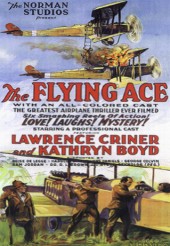
The Flying Ace

A project is underway to restore the Norman Studios in Jacksonville, Florida, as the Jacksonville Silent Film Museum at Norman Studios. The Norman Studios, run by Richard Norman, are most notable in silent film history for being where a number of feature films and shorts with all-black cast and crews were made during the 1920s. Only one title now survives, The Flying Ace (1926).

The studio complex still remains. A project to restore it begins next month and is due for completion in 2008. There’s background history on filming at Norman Studios and Jacksonville in general on the planned museum’s website, plus some terrific posters. The history of early black cinema has been much investigated of late, particularly the work of Oscar Micheaux, and the handful of surviving films given public screenings. The key source for finding out more is Pearl Bowser, Jane Gaines and Charles Musser’s Oscar Micheaux and His Circle: African-American Filmmaking and Race Cinema of the Silent Era (2001).

U.S. Government Enters Film Industry

The U.S. Government began its entrance into the motion picture industry as early (if not earlier) as 1908. Early on, Government agencies such as the Department of Agriculture, the U.S. Army Signal Corps, the Bureau of Reclamation and others began their foray into this arena. In the beginning, Government offices relied on outside commercial studios for their productions, but early on they realized in order to control costs, maintain creative control and eventually set up their own distribution systems, it was in their best interests to set up their own production units.

The Department of Agriculture began producing films officially as a motion picture unit late in 1913. They had even purchased processing equipment and cameras and had the first Government motion picture lab initially hidden away in an 8 x 12 room as it had yet to be funded. In 1917 the U.S. Signal Corps began training soldiers in cinematography at Columbia University in New York. The U.S. Reclamation Service (Department of the Interior) began filming in 1908-09 using the medium to document their efforts in irrigation in the Midwest. The list goes on and on: the Bureau of War Risk Insurance , the National Forest Service, Bureau of Mines, etc. all utilized this medium in an effort to educate and inform the masses. It is a long neglected segment of film history which is well worth a new look.

Caligari, Urban and the Kelly Gang

bbk-01_400.jpg

I have just come from a special screening at the amazing new Centre for Research and Visual Media at Birbeck. The design is based on the renowned angular sets for The Cabinet of Dr Caligari (1919); ingeniously fitted into a limited space, yet strangely in harmony with the Georgian frontages of Bloomsbury that surround it. The reason for attending was the launch of the new London Screen Study Collection, a planned accessible reference library holding viewing copies of moving image material made about and in London, housed at Birkbeck.

To start the launch off we were shown the recently rediscovered Living London (1904), ten minutes of an original forty-minute film showing familiar sights and scenes from London. The film is sensational. So very little footage survives showing the London of 100 years ago, and suddenly here are sequences full of animation and character showing Covent Garden, the Strand, the City, Trafalgar Square, St James’s Park, and a Thames teeming with river craft, all in 1904. The film was made by the Charles Urban Trading Company, and includes a sequence showing sandwich board men advertising Charles Urban‘s ‘Urbanora’ film shows. It is a proto-documentary in Urban’s best style, alive with movement, sharply edited, and giving equal attention to monuments and people.

The film was discovered by Professor Ian Christie at the National Film and Sound Archive in Australia. How it got there is quite a story in itself. It was exhibited across Australia in 1904/05 by showmen John and Nevin Tait, who did so well out of presenting the film to Australians keen to see images of the old country, that it enabled them to go into film production themselves and to produce The Story of the Kelly Gang (1906): Australia’s, and indeed the world’s first feature film.

We were only shown a videotape. The film proper will undergo restoration as part of a larger collection, and should hopefully receive a proper ‘premiere’ at the Pordenone Silent Film Festival in 2008.

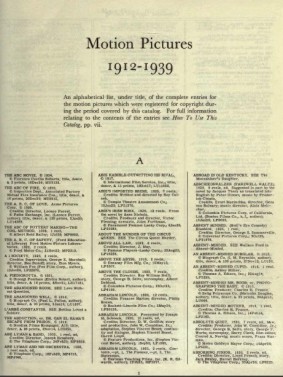
Motion Pictures 1912-1939

motionpictures.jpg

Good grief. Rick Prelinger, of the Prelinger Archive, the sainted digitiser of so many good things now made freely available online, has just made the Library of Congress Motion Picture Catalogs available for download from The Internet Archive. Four volumes have been put up, in PDF and uncorrected but word-searchable text versions, covering 1913 to 1969, with the 1894-1912 volume in preparation. For our purposes, this includes all 1,256 pages of the 1912-1939 volume, which is sensational news for anyone interested in the study of silent film.

The Library of Congress Catalogs of Copyright Entries list all motion pictures registered for copyright in the USA (i.e. films not just made in the USA but shown in the USA). The entries give title, year, company, length, date of registration, and sometimes some credits. The printed volumes have long been the first port of call for anyone seriously engaged in identifying films from the silent period, but they have been restricted to a handful of research libraries. Suddenly they are available to all. The PDF is a huge size (157MB), but there is a 9MB text file of the word-searchable uncorrected OCR, and already there is talk of it being converted into a database. Wow.