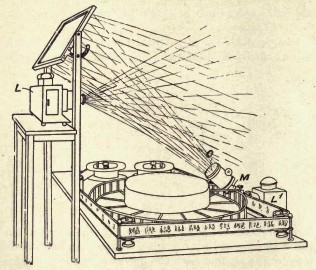
Another addition to the Bioscope Library. Henry Hopwood (1866-1919) was Custodian in the Library of the Patent Office in Chancery Lane, London. His Living Pictures is a comprehensive history and handbook on the technology of the new science of motion pictures, published first in 1899 and then in a revised edition by his colleague R.B. Foster in 1915. It is a thorough, knowledgable account of the subject, based around patent applications, but expressed in an engaging and sometimes philosophical style which makes it a pleasure to read today. It still used as a standard reference source.The 1915 revision is available for downloading from the Intenet Archive in DjVu (16MB), PDF (45MB) and TXT (570KB) formats.
Author Archives: urbanora
The Wonderful World of Albert Kahn
Autochrome of a fringe-maker in Galway, Ireland during May 1913 © Musée Albert Kahn
The BBC4 Edwardians season has just shown part one of a nine-part series on the remarkable Albert Kahn collection of early colour photographs and actuality films, taken from Kahn’s Archives de la Planete. Kahn was a millionaire Parisian banker who decided to create a visual record of the world in the early twentieth century using the new Autochrome photograph process invited by the Lumière brothers (also inventors of the Cinématographe, of course). He sent photographers to over 50 countries. They took more than 72,000 colour pictures and around 100 hours of (monochrome) film footage, recording sights and scenes across the world in an unprecedented documentary exercise.
The first four parts are being shown under the slightly misleading title of The Edwardians in Colour. The remaining five parts will feature in a future set of programmes on the 1920s.
Update: For background information on Albert Kahn, and links to various sources, see the Seaching for Albert Kahn post on this blog.
Tom Fletcher remembers
Posting that item on Norman Studios and the black cinema of the silent era reminded me of a passage in a book that I’ve been waiting for the opportunity to tell someone about. Tom Fletcher’s The Tom Fletcher Story: 100 Years of the Negro in Show Business (1954) is a classic memoir that has been much-plundered by musical theatre historians, but I don’t know how many film historians know of this passage which records the experience of two black actors at the Edison film company in the early 1900s:
When the flickers, or moving pictures, were developed along around 1900, my partner, Al Bailey, and I got leading comedy parts. The studio was on 22nd Street, between Broadway and Fourth Avenue. I was the talent scout for the colored people. There were no “types,” just colored men, women and children. Bailey and I did parts in the pictures that today would pay no less than four figures weekly, but we didn’t take it seriously. To us it was just something that would never get any place.
You never heard the words “lights,” “action,” “camera,” “roll ’em,” or “cut” which are so common today. There were no script writers, no make-up artists, just one man, everybody called him Mr. Porter, and I never took time to find out his first name, who placed you in your positions and gave you your actions, lit the scene and then turned the camera. His assistant was a fellow named Gilroy whom everyone called Gil. When we went on location it was to North Asbury Park, about the best place around New York for the purpose. The trees, gardens and farms gave just the right atmosphere.
At the end of each day Gilroy would hand me the money to pay off. I am not quite sure but I think it was three dollars a day for each of the people. Bailey and I got eight dollars each. We all considered it a lot of fun with pay. Vaudeville, private parties, music and show business kept me too busy to pay any real attention to the moving picture business.
Porter is of course Edwin S. Porter; Gilroy is his assistant William J. Gilroy. Fletcher’s less than awe-struck view of the early film business is illuminating, and shows how for most stage performers the new medium was a minor curiosity with little bearing on their professional lives except that the extra money was welcome. Is this a unique memoir for black performers in film at such an early date? I don’t know.
I first found the passage in Thomas L. Riis, Just Before Jazz: Black Musical Theater in New York, 1890 to 1915 (1989), which is an excellent, instructive history in itself, with wonderful illustrations.
It doesn’t show Edison films such as Tom Fletcher appeared in, but the Black Film Center/Archive site has some QuickTime clips of African-American performers (and some white actors in blackface) from the 1890s. The Uncle Tom Cabin’s & American Culture site has a huge range of information about the many expressions of Harriet Beecher Stowe’s novel, including the history behind the 1903 Edison film Uncle Tom’s Cabin, with QuickTime video clips of this and subsequent film versions from the silent era. The lead parts in the 1903 film are played by white actors in black face; the black performers are all extras.
Pordenone Collegium
An invitation has been published for students to attend the Collegium at this year’s silent film festival at Pordenone, Italy, which takes place 6-13 October. There are twelve spaces available, an applicants should notmally be aged under 30 and pursuing education in cinema in one form or other. The aim of the Collegium is the engage the students in a programme of activity that takes full advantage of the expertise of archivists, musicians and film historians on hand at the world’s premiere silent film festival . Those attending are given free hotel accommodation and breakfast during the week, but are responsible for their own travel arrangements, meals, and all other expenses.
There are further details on the festival website. The deadline for applications is 27 May. Papers from previous Collegiums (Collegia?) can be found on the Film Intelligence site (talking of which, it’s high time that site got updated).
Restoring Norman Studios
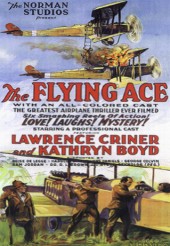
A project is underway to restore the Norman Studios in Jacksonville, Florida, as the Jacksonville Silent Film Museum at Norman Studios. The Norman Studios, run by Richard Norman, are most notable in silent film history for being where a number of feature films and shorts with all-black cast and crews were made during the 1920s. Only one title now survives, The Flying Ace (1926).
The studio complex still remains. A project to restore it begins next month and is due for completion in 2008. There’s background history on filming at Norman Studios and Jacksonville in general on the planned museum’s website, plus some terrific posters. The history of early black cinema has been much investigated of late, particularly the work of Oscar Micheaux, and the handful of surviving films given public screenings. The key source for finding out more is Pearl Bowser, Jane Gaines and Charles Musser’s Oscar Micheaux and His Circle: African-American Filmmaking and Race Cinema of the Silent Era (2001).
Paul Merton on tour
[Note: This is the 2008 tour – for the 2009 tour dates, click here]
These are the dates I’ve traced for Paul Merton’s Silent Clowns show, which will be touring the country later this year when his book Silent Comedy is published. The links are to booking details at each of the venues. I’ll add more if I find them (there are 22 dates in all). Neil Brand will be providing the piano accompaniment.
10 November – Warwick Arts Centre
11 November – The Anvil, Basingstoke
13 November – Cambridge Corn Exchange
14 November – St David’s Hall, Cardiff
16 November – Assembly Hall, Tunbridge Wells
17 November – Cheltenham Town Hall
18 November – Hackney Empire, London
20 November – The Royal Centre, Nottingham
21 November – Bournemouth International Centre
23 November – St George’s Hall, Bradford
24 November – Buxton Opera House
25 November – The Hexagon, Reading
27 November – Plymouth Pavilions
28 November – Royal and Derngate, Northampton
30 November – De Montfort Hall, Loughborough
1 December – The Lowry, Salford
2 December – Royal Liverpool Philharmonic
3 December – Villa Marina, Douglas, Isle of Man
5 December – Portsmouth Guidhall
7 December – Perth Theatre and Concert Hall
8 December – Caird Hall, Dundee
9 December – Aberdeen Music Hall
As the blurb says, “The funniest silent comedians of the 1920’s on a big, big screen with live accompaniment from the wonderful Neil Brand. Paul introduces a selection of clips from stars such as Charlie Chaplin, Buster Keaton, Harold Lloyd, Roscoe Arbuckle and Charley Chase. Finishing fantastically with a complete showing of a silent comedy masterpiece. Guaranteed to rock the house with laughter.”
Update: The list of dates above is now complete. Download the promo leaflet here (PDF).
Chapliniana
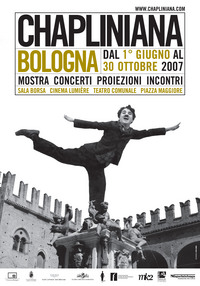
The Cineteca di Bologna in Italy is hosting Chapliniana between 1 June and 30 October 2007. This major celebration of Chaplin’s life and work will comprise an exhibition, Chaplin e l’Immagine (Chaplin in Pictures), at the Sala Borsa, Bologna; live orchestral screenings of The Chaplin Revue, City Lights, The Kid, Modern Times, The Gold Rush, The Circus and A Woman of Paris to be performed in Piazza Maggiore and the Teatro Communale during the summer evenings; and the majority of Chaplin’s films will be screened during this period, particularly during the Cinema Ritrovato film festival June 30-7 July 2007. The Cineteca is also working on the Chaplin Archive Database, which is logging the cataloguing, digitisation and preservation of the huge Charlie Chaplin paper archive.
There’s a Chapliniana site registered but nothing is on it as yet. 2007 is the thirtieth anniversary of Chaplin’s death, and a major revival of interest in his work and socio-cultural significance seems to be underway.
Update: The Chapliniana site is now active, and full of details, all of it in Italian.
Don’t forget…
The British Silent Cinema Festival starts tomorrow at the Broadway in Nottingham, and runs until Sunday. See you there on Saturday…
The Persistence of Vision
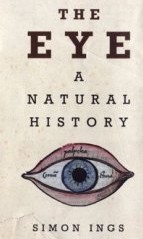
I’m currently reading The Eye: A Natural History (2007) by Simon Ings. It’s the story of the eye, of how we see, what we think we see, and how the eye fits into human history and the history of evolution.
This might not seem hugely relevant to the study of silent cinema, but it is. The study of motion pictures needs to take in the practialities (biological as well as psychological) of visual reception, and the study of early cinema is especially relevant because it embraces that extraordinary shift in perception when we were first offered seemingly wholly realistic images in motion as means both to be entertained and to learn about our world. It’s about the apprehension of truth and reality, and a basic grounding in optics wouldn’t go amiss.
The one thing most people know about film and optics is “the persistence of vision”: the visual trick by which we are supposed to be able to “see” motion pictures. This wholly fallacious explanation for why we can see films has been accepted as gospel for decades, and can be found in any number of film text books, yet it is quite wrong. There is certainly a phenomenon which is the persistence of vision, but it does not explain how cinema gives its impression of motion, or continuity. As Ings succinctly puts it:
…’persistence of vision’… is simply the eye’s inability to tell a steady light from one that flickers faster than fifty times a second…
Optical toys such as the Phenakistiscope and the Zoetrope exploited this propensity of the eye to be fooled by a rapid, intermittent procession of images, but the persistence of vision would in fact prevent our seeing motion on film, were it not for other forces at work: fusion, and something called the phi phenomenon, which also explain how we are able to see real movement. Again, as Ings explains it:
Humans are foragers; we take a more than usual interest in what things are. But even our eyes are tuned, first and foremost, to motion. In 1875 the Viennese physiologist Sigmund Exner showed that two brief, stationary flashes, provided they are not too far away from each other, are seen as a single object in motion. This habit of fusing stationary dots into moving objects makes a great deal of sense in nature, where prey and predators disappear and reppear constantly, as they move through grass, run behind trees, and peer around rocks. But the power of the phenomenon (called the phi phenomenon) will perhaps best be demonstrated the moment you set this book down and turn on the television. Every film and television programme ever made depends on phi. Both display images quickly enough for our eyes to read them as a single moving image.
It is not because one image persists and then is replaced by another, but because we cannot see that there is a space between those images that explains why we see ‘motion pictures’. And we can appreciate movies because, evolutionarily speaking, we’re all hunters or hunted.
Sigmund Exner I’ve not come across in any history of our understanding of how we see films, but he sounds to have been a remarkable person. As well as a major figure in our understanding of optics, he was the founding father of the world’s first sound archive, the Phonogrammarchiv in Vienna, founded in 1899 and still going strong.
Not all film histories have got it wrong over the persistence of vision. There are sensible accounts in Jacques Aumont’s The Image, Brian Winston’s Technologies of Seeing, and Michael Chanan’s The Dream that Kicks. There’s a helpful explanation of why the persistence of vision notion is a fallacy, written by Stephen Herbert, on the excellent Grand Illusions site.
Ings’ book is a first-rate work of popular science, made all the more readable by someone who is a novelist as well as a scientist. It also has good stuff on how we see colour, which has relevance for early films as well, but I haven’t got to that chapter yet. A further post will follow when I have…
O living pictures of the dead
Having posted that item on Geoffrey Malins’ book How I Filmed the War on his experiences of filming The Battle of the Somme, I thought it would be good to share with you this poem by that sturdy defender of Empire, Sir Henry Newbolt, which is his response to seeing the film. The title of the poem is The War Films, and it was written in 1917. Not everyone who saw the actuality films from the Western Front may have reacted it quite so religiose fashion, but it does indicate how profoundly moved many were by the sight, how the films triggered a profound sense of the great sacrifice being made by the troops. And it does have two particularly haunting opening lines:
O living pictures of the dead,
O songs without a sound,
O fellowship whose phantom tread
Hallows a phantom ground —
How in a gleam have these revealed
The faith we had not found.We have sought God in a cloudy Heaven,
We have passed by God on earth:
His seven sins and his sorrows seven,
His wayworn mood and mirth,
Like a ragged cloak have hid from us
The secret of his birth.Brother of men, when now I see
The lads go forth in line,
Thou knowest my heart is hungry in me
As for thy bread and wine;
Thou knowest my heart is bowed in me
To take their death for mine.
More poems may follow in future posts, but meanwhile I strongly recommend Philip French and Ken Wlaschin’s Faber Book of Movie Verse (1993), which has many poems about silent cinema stars and cinema-going, both contemporary and written in retrospect.