
Social fears and moral panics

A call for papers has been issued for the next IAMHIST conference, due to be held in Aberystwyth, Wales, 8-11 July 2009, and incorporating the 3rd Gregynog Media History Conference. IAMHIST, or the International Association for Media and History, is an organisation comprising scholars, filmmakers, archivists and broadcasters interested in the intertwined themes of history and film (and television, and radio, and related media). It holds a conference every two years, and in 2009 the theme is to be ‘Social Fears and Moral Panics’ – certainly something with great potential for those engaged with the silent film era. Here’s how they describe it:

The aim of the conference is to explore both the role of the media in addressing, highlighting or perpetuating social fears, and the mass media itself as a perceived moral agent and/or threat. Topics to address might thus include questions of media content and/or language; concerns about public intrusion; censorship and the freedom of information; the reporting of crimes or disasters; invasion and security fears in times of peace or war; religious, cultural and/or linguistic fears; fears relating to youth or children, or to minority groups; fears relating to particular behaviours, pursuits or leisure activities; ‘golden ageism’.

We welcome paper proposals that address the theme in both contemporary and/or historical perspective; proposals which engage with the theme comparatively (both geographically and temporally); and proposals which engage with theoretical approaches, including the social theory of moral panic.

We also welcome proposals on their work in progress from postgraduate and early-career scholars in the field of media history, including on topics that may not be on the conference theme.

Proposals for complete panels (three themed papers) are welcome, as well as individual paper submissions. Papers presented at the conference should be 25-30 minutes in length and should use illustrative material (for instance film clips) wherever possible.

Abstracts of no more than 300 words per paper should be sent to Dr Sian Nicholas by 14 November 2008 at iamhist2009@aber.ac.uk c/o Department of History and Welsh History, Aberystwyth University, Penglais, Aberystwyth, Ceredigion SY23 3DY, Wales UK.

The conference is being organised by IAMHIST, in association with the Centre for Media History and Departments of History and Welsh History, and Theatre, Film and Television, Aberystwyth University, the Department of Media and Communications, Swansea University, and the journals Historical Journal of Film, Radio and Television and Media History, with the support of the National Screen and Sound Archive of Wales, National Library of Wales, Aberystwyth.

For further details, see the call for papers on the Aberyswyth University web site. For further information on IAMHIST and its many activities and interest, visit www.iamhist.org. And for the Bioscope’s take on last year’s conference, held in Amsterdam, on empires and such like, go here.

Incidentally, you do wish those planning such events took a look at the calendar (even the Bioscope’s calendar) first. There are now three conferences on history and the visual media taking place in Britain in July 2009 – the others are Visual Empires at the University of Sheffield, and Colour and the Moving Image at the University of Bristol. Come on somebody – show a little consideration, please.
Just like it was in the olden days

http://www.silentfilmfest.org.nz

Another day, another silent film festival. This time its New Zealand, and it’s the Silent Film Festival at Opitiki (‘Cinema – just like it was in the olden days’), which runs 5-6 September. Taking place in Opotiki’s Art Deco theatre, the festival encourages attendees to dress up in period style and travel in vintage cars. Piano accompaniment will be provided by Nick Giles-Palmer, and the films are accompanied by period shorts and newsreels courtesy of the New Zealand Film Archive.

Here’s the programme:

The Mark of Zorro 1920 ~ 93mins
In old Spanish California, the oppressive colonial government is opposed by Zorro, masked champion of the people, who appears out of nowhere with flashing sword and an athletic sense of humour, scarring the faces of evildoers with his Mark ‘Z’. Meanwhile, beautiful Lolita is courted by villainous Captain Ramon, rich but effete Don Diego… and dashing Zorro, who is never seen at the same time as Don Diego. As Zorro continues to evade pursuit, Ramon puts the damsel in distress…

Fairbanks’ prodigious athletic prowess and tremendous enthusiasm made the original movie a great success and enormous sets gave him plenty of room to swash and buckle in. His astonishing acrobatics amaze even modern audiences, particularly in the film’s climax.

Saturday 6th Sept ~ 7.30pm ~ Main Theatre ~ $14

It – starring Clara Bow 1927 ~ 77mins
Clara Bow, one of the most adorable actresses to grace the silent screen, stars in this delightful romantic comedy. As Betty Lou Spence a shopgirl at Waltham’s Department Store, she falls for her boss, the handsome Cyrus Waltham, Jr. and decides that he is to be her husband. With the help of his friend Monty and her own ‘It’ factor, Betty tries to win the man of her dreams.

Clara Bow’s vitality and sexiness defined the liberated woman of the 1920s and she became one of Hollywood’s brightest lights. Clara was known as The ‘It’ Girl. As well as representing sex-appeal, ‘It’ symbolized the tremendous progress women were making in society. Her dynamic performance as the cute, bubbly, down-to-earth Betty makes this film one of the most charming and entertaining silents as well as providing an interesting slice of history.

Saturday 6th Sept ~ 2pm ~ Main Theatre ~ $14

Venus of the South Seas 1927 ~ 77mins
Visited infrequently by the supply schooner ‘The Southern Cross’ lies the little island of Manea. The owner of the island has made a fortune in copra and pearl but more precious than all these treasures is his adored daughter – Shona, the most skilful diver in the South Seas. Romance blossoms when a yacht anchors in the mystic moonlit harbour and Shona swims out to meet it. A pearl pirate attempts to steal the pearls but is foiled by the young man Shona falls in love with.

Annette Kellerman, who plays Shona, was a champion diver and swimmer who made headlines in 1907 when she was arrested in Boston for wearing a one-piece bathing suit. The exterior scenes were filmed in Nelson, the interior in Christchurch.

Friday 5th Sept ~ 7.30pm ~ Main Theatre ~ $14

Intolerance 1916~3.5hr Spectacular!
Intolerance and its terrible effects are examined in four eras, spanning several hundreds of years and cultures. Themes of intolerance, man’s inhumanity to man, hypocrisy, bigotry, religious hatred, persecution, discrimination and injustice achieved in all eras by entrenched political, social and religious systems, create a spectacular and dramatic epic.

Director D.W. Griffith’s ambitious silent film masterpiece is one of the milestones and landmarks in cinematic history.

Saturday 6th Sept ~ 9.30am ~ Little Theatre
Includes buffet lunch.

Films of Opotiki
From the New Zealand Film Archives – a fascinating historical record of small town NZ.

A special compilation of films made by local electrician & projectionist John Wilkinson, between 1950-1974, forms most of this presentation. A fascinating record of Opotiki life they include films of the Opotiki port and the arrival of MV Waiotahi, dramatic scenes of thermal activity on White Island in 1956, terrible flood devastation in Opotiki and the clean-ups. Street parades, school kids in fancy dress and on floats, marching girls and Opotiki High performing the haka…and more. Another home movie by Ester and Deryk Rogers documents the cultivation of kumara at Maraenui in the 50’s. The programme begins with local personality, Epi Shalfoon, and His Melody Boys (1930) jazz band playing ‘E Puritai Tama e’.

By popular request, the programme concludes with the award winning short film, Two Cars One Night, (2003) made by Taika Waititi, which was filmed in the Te Kaha pub car park.

Friday 5th Sept ~ 1pm ~ Main Theatre ~ $14

Buster Keaton in ‘The Goat’ 1921 ~ 27mins
Madcap chases and hilarious displays of physical agility are the highlights of this frenetic Buster Keaton short. Dumb luck sets some policemen on his trail – after a series of innovative escapes, he gets mistaken for a murderer with a price on his head, which means the people that aren’t chasing him are fleeing from him. Nonstop laughter.

&

Harold Lloyd in ‘Sailor-Made Man’ 1921 ~ 46mins
Comedy great, Harold Lloyd, plays baseball-mad twerp ‘Speedy’ Swift. When his girl’s father insists that, before he will agree to Speedy marrying his daughter, he must first prove that he can do something more worthwhile than act the playboy, he joins the navy, just like that! Classic slapstick feature-length movie, especially in the final scenes.

Both showing together (total time: 75mins)
Fri 7th Sept – 11am and 4.30pm
Sat 8th Sept – 4.30pm
Sun 7th Sept – 11am, 1pm and 3pm

More details on booking, timetable, and a gallery showing how people have got into the spirit of things in past festivals can all be found on the site.

Welcome to Newsfilm Online

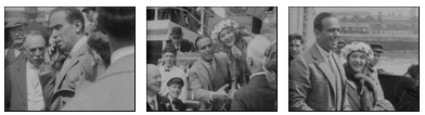
Southampton: Arrival of Mary Pickford & Douglas Fairbanks, Gaumont Graphic, 21 June 1920, from http://www.nfo.ac.uk

Quietly launched this week (with an official launch due in October) is Newsfilm Online. This is 3,000 hours of UK cinema newsreel and television news content, dating 1910s-2000s, all of it taken from the collection of ITN Source. ITN is the UK’s largest commercial footage library, (if you don’t count the BBC as such), and doesn’t just own ITN news programmes, such as News at Ten and Channel 4 News, but most of the UK’s newsreel archives (Pathe, Paramount, Gaumont, Universal). The 3,000 hours (about 2% of the ITN news collection) have been digitised and made available for free downloading and re-use, so long as you are a member of a subscribing UK institution of higher or further education. Sadly that’s going to leave out a lot of you, but the project was funded by the Joint Information Systems Committee, which exists to support UK HE/FE (as we call it in the trade), and the conditions under which the newsfilms were digitised stipulated that they would be available to HE/FE users only.

But despair not, because although you may not be able to see the films, the catalogue records are searchable and browsable by all. And for the silent era, there are 1,241 news stories from the 1910s and 5,091 from the 1920s, making this a marvellously rich resource for historical study, even without the films themselves – not least because you get thumbnail images, like those of Doug and Mary illustrated above. It’s supposed to be every example of the Gaumont Graphic newsreel held by ITN, and shopws how alert the newsreels were to the stories, concerns, fads and personalities of their era. The thumbnails alone excitingly bring the 1910s and 20s back to vivid, varied life.

Remarkably, the publication of Newsfilm Online means that the majority of British newsreels (I’d guess between 80-85%), 1910-1979, are now digitised, encoded and available on the Web in one form or another, albeit with restricted access in some cases (the Paramount and Universal newsreels are the big gaps). That’s a sensational thing to be able to report, achieved in little over five years by a mixture of public money (around £3.5M, at a rough guess, though the £2M that Newsfilm Online cost was for TV news as well as its Gaumont newsreels) and private (no idea how much). The four main sources (with the silent newsreels that they include) are:

  • British Pathe – including Pathe Gazette, Eve’s Film Review, freely available (low resolution)
  • British Movietone News – Movietone itself was a sound newsreel, but the site include a rag-bag collection of silent actualities, freely available (low and middling resolution)
  • Newsfilm Online – includes Gaumont Graphic, movies available to subscribing UK educational institutions only
  • Screenonline – the BFI online ‘encyclopedia’ has many examples of the Topical Budget newsreel, movies available to UK schools, colleges and libraries only

What a fantastic achievement. Having played a small part in making NfO (as we call it in the trade) happen, I’m just a little bit chuffed to see it published at last. For a record of most British newsreel stories in one place, I warmly recommend the British Universities Newsreel Database (still has some gaps to fill for silent newsreels), which also lists other digitised newsreel collections around the world (Australia, France, Germany, Italy, Sweden – America, alas, lags seriously behind).

Let’s have every newsreel around the world available online – it can be done; it would delight and benefit so many if it could be done.

Forssa festival

http://www.forssasilentmovie.com

Rejoicing in the challenging (to the non-Nordic tongue) but magnificent name Mykkäelokuvafestivaalit, but having the more manageable alternative title of Forssa International Film Festival, this Finnish festival of silent films returns to Forssa 29-30 August. Now in its ninth year, the festival brings together an international programme of classics and rarities, usually with an element of local film as well.

There’s no background information on the site in English (as yet), but here’s the programme:

29 August
17:00 Nuori Luotsi
19:30 Speedy
22:00 The Lost World

30 August
12:00 The Kid Brother
14:30 Chaplin programme: The Floorwalker, The Cure, The Adventurer
17:00 Tarzan of the Apes
19:00 Girl Shy
22:00 Faust

The site includes a page on Harold Lloyd and, usefully, details of programmes from previous years.

The Factory of Gestures

http://www.factoryofgestures.com

I learned of this intriguing project courtesy of a recent post by David Bordwell. The Factory of Gestures is an audio-visual research project, led by Oksana Bulgakowa, investigating body language in film – particularly as evidenced in silent Russian and Soviet fiction film. The DVD that has come out of the project describes it thus:

The Factory of Gestures investigates the metamorphoses of the body language in Russian and Soviet society through the 20th century as evidenced by documentary and fiction films, private and professional photography, visual arts and theatre.

The thesis is that the disruption of social and cultural practices caused by advent of the new technologies of photography, film and the mass distribution of images was particularly acute in Russia. Those media now provide striking evidence of a ‘radical change in the gestural code’ in the transference to Soviet society. Bulgakowa argues:

The abolition of gestural restraints was interpreted as the liberation of natural man: bad manners were re-evaluated as socially acceptable behavior, some body techniques that had been contained within the private space – like washing or calisthenics – were now accepted in the public sphere, and some gestures from the public sphere were transplanted to very private settings.

That sounds like an intriguing reversal of the ‘civilizing process’ famously identified by sociologist Norbert Elias. One will need to see the DVD in full to understand the argument, but there are two engrossing extracts provided on the project website, one on eating, the other on walking. Whatever the thesis, this sort of lateral approach to film, looking at the evidence it can provide of social forms beyond the original intentions of the filmmakers, is always welcome. As films age and their stories retreat in the ways they may entertain or convince, so the historians take over and such works are seen either for their position in the story of the medium or as providing unwitting evidence of the practices of the past.

The films quoted on the DVD date from 1908 to 1994. The silent films cited are not all Russian/Soviet and include Silent Witnesses (1914), The 1002nd Ruse (1915), Stella Maris (1918), Das Cabinet des Doctor Caligari (1919), The Extraordinary Adventures of Mr West in the Land of the Bolsheviks (1924), Strike (1925), Battleship Potemkin (1925), Aelita (1925), Chess Fever (1925), It (1927), Mother (1927), The Kiss of Mary Pickford (1927) and Die Büchse der Pandora (1929). The DVD commentary is in English and Russian, it’s 160mins long and is all-regions. It can be ordered from the website and is priced 24,95 €. The project website itself has more information, summing up the project’s ambitions thus:

Film proposed utopian, sometimes contradictory models of the new body behavior that should be imitated in reality. A new society striving to free itself from old rituals was developing a new design of clothing and living spaces, new standards of perception, and a new body language for a new anthropological type: homo soveticus, a specific version of a man of modernity.

A new anthropological type? Can film reveal so much? Such claims may beg as many questions as they hope to answer, but it is good that someone is looking, challenging the medium all the time to reveal more.