The beskop in Tibet

Jigme Taring

Bioscope is a word with many meanings (which is why it was chosen for the title of this blog). Bioscope can mean a view of life (its original dictionary definition), a cinematograph camera, a projector, a fairground film show, a cinema, a make of microscope, a film trade journal, and a science-based visitor attraction in France. The term was commonly used for a place to see films in the early years of the twentieth-century, and that term persisted in some countries, notably India and South Africa. What I hadn’t know before now is that it also also adopted in Tibet – albeit in the local pronunciation, beskop. I have just come across two detailed and fascinating articles on the history of film in Tibet, ‘The Happy Light Bioscope Theatre & Other Stories’, written by Jamyang Norbu for the Tibetan news website Pahyul.com. Part one is here, and part two is here. It can also be read on Jamyang’s Shadow Tibet blog. He has quite a story to tell.

Film had come to Tibet by 1920. Jamyang tells us that when the “first (invited) British mission reached Lhasa” the head of the mission, Charles Bell, was entertained by Tsarong Dasang Dadul, commander-in-chief of the Tibetan army, with some film shows held in his private screening room. Tsarong operated the projector himself. Jamyang doesn’t say what the films were, but reasons that it was probably one of only two projectors in Tibet. The Dalai Lama is likely to have had the other one.

Tibetans however were not unaccustomed to screen entertainments. Jamyang traces the history of puppet shows with special visual effects and the magic lantern shows exhibited by British visitors at the turn of the centiury. But after 1920 subsequent British political missions brought film projectors with them. Jamyang says that Frederick Bailey (political agent and spy) showed newsreels in Lhasa in 1924, including King George V opening parliament, while in 1933 Derek Williamson showed Charlie Chaplin and Felix the Cat films to the 13th Dalai Lama. His wife Peggy, in her memoirs recalled:

In Lhasa, Charlie Chaplin was the great favourite; we had one of his films called The Adventurer, in which he played an escaped convict. The Tibetans renamed this film ‘Kuma’ (The Thief) and everyone wanted to see, including His Holiness, who laughed heartily throughout the performance.

Tibetans called Chaplin ‘Chumping’, from Charlie the Champion, the word entering the language. Rin Tin Tin was another great favourite. The cinema came to be known as beskop, adapted from bioscope, though now Tibetans use the term ‘lok-nyen’, a translation of the Chinese ‘dian-ying’ (electric shadows). Jamyang stresses that there is little evidence of Tibetans having viewed the cinema superstitously. The first cinema in Lhasa may have opened before 1934, managed by two Muslim brothers named Radhu, Muhammad Ashgar and Sirajuddin, though the details are uncertain. It seated around a hundred, with a balcony for twenty or thirty paying higher prices, from which a Muslim translator would narrate the story to the Tibetan audience.

Much of the evidence for all this comes from accounts written by British political mission members and explorers. The Austrian adventurer Heinrich Harrer, author of the celebrated Seven Years in Tibet, wrote that talkies were being shown in Lhasa by the mid-1930s. Sir Basil Gould, who headed the British mission of 1936, reported that:

Monks were amongst the most ardent of our cinema clientele. There is nothing which Tibetans like better than to see themselves and their acquaintances in a frame or on the screen.

Gould was among those who supplied that need, because as well as bringing projectors with them the British brought cine cameras.

Extract from Sir Basil Gould’s films of Tibet (1940), from the BFI’s YouTube channel

The first film shot in Tibet was probably film taken by J.B.N. Noel, cinematographer with the 1922 British Everest exhibition, whose footage is included in the documentary feature Climbing Mt Everest (1922). It is included in a new BFI National Archive touring programme, The Search for Shangri-La: Tibet on Film 1922-1950. The bulk of the programme is (silent) home movie footage shot by British missions and explorers iin the 1920s, ’30s and ’40s. They include the botanist George Sherriff, the aforementioned Frederick Bailey and the Williamsons, Charls Bell (on his return to Tibet in 1934) and Sir Basil Gould, who brought a cameraman with him to Lhasa, Frederick Spencer Chapman. These films feature ceremonies, landscapes and Tibetan flora and fauna. Shot for the most part in colour they form an extraordinary archive of Tibetan life before the Chinese takeover, and were used in the 2008 BBC television series The Lost World of Tibet (now available on DVD).

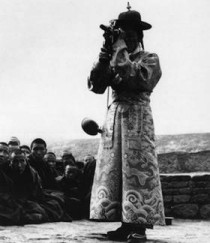
The first Tibetan filmmaker may have been Tsarong Dasang Dadul, who acquired a camera at some time after the projector with which he entertained Charles Bell in 1920. Actuality films were made by Tsarong’s son Dundul Namgyal, while Tsarong himself filmed Anglo-Tibetan football matches outside Lhasa in 1936. Heinrich Harrer reports that the young 14th Dalai Lama was a keen filmmaker and knew how to dismantle a projector and put it back together again. Jamyang Norbu writes that another filmmaker in the 1940s was Tibetan official Jigme Taring (shown at the top of this post) who filmed festivals and street life in Lhasa, and the 14th Dalai Lama’s official tour of Sera, Drepung and Ganden.

Jamyang goes to to write about films and cinema exhibition following the Chinese occupation, including Tibetan fiction films (the first is believed to have been made in the mid-1970s). He also writes about his personal experience of exhibiting world cinema classics to Tibetan students in the 1980s, including Nosferatu (1922). It’s a fascinating history, showing how film was not just the harbinger of modernity for Tibet but how it fitted into (and documented) established traditions. Film was never simply about the shock of the new; it complemented the old as well, and was shaped by every society that encountered it.

The Search for Shangri-La tours Britain until May 2010 – details of screenings are here; while the Everest films of J.B.L. Noel will feature at this year’s British Silent Film Festival in April.

A war film

From time to time the Bioscope lifts its eyes from the screen, looks wistfully out of the window, and turns its mind to poetry. And when it does so it adds another poem to the select list of those works which touch upon the subject of silent film.

I’m ashamed to say that ‘A War Film’ is a poem that is new to me, though I now discover that it is a much-anthologised and popular work. It was written by Teresa Hooley (1888-1973), a British poet from Derbyshire who in private life went under the name of Mrs Frank Butler. The fascination behind ‘A War Film’ is her reaction to seeing a film of the First World War, and then trying to determine which film it was:

I saw,
With a catch of the breath and the heart’s uplifting,
Sorrow and pride, the “week’s great draw” –
The Mons Retreat;
The “Old Contemptibles” who fought, and died,
The horror and the anguish and the glory.
As in a dream,
Still hearing machine-guns rattle and shells scream,
I came out into the street.

When the day was done,
My little son
Wondered at bath-time why I kissed him so,
Naked upon my knee.
How could he know
The sudden terror that assaulted me? …
The body I had borne
Nine moons beneath my heart,
A part of me …
If, someday,
It should be taken away
To war. Tortured. Torn.
Slain.
Rotting in No Man’s Land, out in the rain –
My little son …
Yet all those men had mothers, every one.

How should he know
Why I kissed and kissed and kissed him, crooning his name?
He thought that I was daft.
He thought it was a game,
And laughed, and laughed.

The event to which she refers, the British retreat from Mons in Belgium, took place in August-September 1914. However, there was no film made about the retreat at the time, as officially-sanctioned films of the war were not being produced at this date, and in any case no film at this date or later in the war would have included the word ‘retreat’ in its title. So commentators have speculated that the film could be The Battle of the Somme, made in 1916, or one of the other British official war films. However it would seem unlikely that the poet would confused Mons with the Somme, and a more likely candidate is the 1926 film Mons, made by British Instructional Films. BIF produced a series of dramatised documentaries in the 1920s which recreated key conflicts from the First World War. The films (all feature-length bar the first) were The Battle of Jutland (1921), Armageddon (1923), Zeebrugge (1924), Ypres (1925), Mons (1926) and The Battles of Coronel and Falkland Islands (1927). They were all produced by H. (Harry) Bruce Woolfe, generally with Army or Admirality assistance, and combined official actuality films of the war with recreations, models and animated maps. The films gained the remarkable triple of popular, critical and official acclaim, and while they were characterised by a certain amount of dogged literalism, the best sequences merit comparison with the Soviet documentaries of the twenties. Many a dramatised scene from them has ended up being used in television documentaries which take the scenes to show actual warfare. Mons itself was directed by Walter Summers and was given the re-issue title of The Retreat from Mons, which adds further credence to the theory that it was the film that triggered the poem.

It is unclear when Hooley wrote ‘A War Film’, though it was first published in 1927 in her volume Songs of all Seasons, which again suggests the 1926 film is the right one. That would make her reaction to the film one of the fear of another war that would engulf her child rather than a war that was then raging. Its tone is in any case a retrospective one – few on the home front thought of corpses rotting in No Man’s Land in 1914. Such grim visions came to haunt the public only as the war dragged on and as the enormity of the sacrifice made shook society in the years immediately after the war.

It would take cinema a while before it felt able to depict the war in terms of futility. Ironically, Mons the film was a sober minded drama-documentary with more of a mind to demonstrate military procedure and heroic achievement than to make its audience think of the horror and anguish. Hooley’s poem was perhaps inspired not so much by the film she saw as by the memories it triggered. It was a silent film, after all – no machine-guns rattled and no shells screamed. Hooley saw the film in her mind, while a plainer account unspooled itself on the screen.

Mons is held by the BFI National Archive and in incomplete form by the Imperial War Museum. You can get an idea of the BIF style, however, by seeing Ypres, which is available to view from the British Pathe website (the link is to reel one of seven on the site).

City Girl

http://www.eurekavideo.co.uk

We can still count the number of Blu-Ray silent film releases on the fingers of one hand, so the arrival of number five is an event. It’s F.W. Murnau’s City Girl (1930), now released by Eureka Video. City Girl was Murnau’s last silent, released after Sunrise and the now lost 4 Devils. It is set in the wheatfields of Minnesota, and covers the trials of newly-wedded life for a farmer’s son (Charles Farrell) and a Chicago waitress (Mary Duncan) among the mistrustful farming community.

The Blu-Ray only release is the 1080p high-definition 20th Century Fox restoration of the silent version of the film, with a new score, composed and arranged in 2008 by Christopher Caliendo. There is a full-length audio commentary by David Kalat and a 28-page illustrated booklet with an essay by Adrian Danks.

And what are the other fingers on the hand? As reported on in an earlier post, we already have The General (from Kino Lorber), Sunrise (from Eureka), a selection of early Oz films as extras to The Wizard of Oz (1939) (from Warner Home video), and the unlikely The Story of Petroleum (1923) which is an extra on the Blu-Ray release of There Will be Blood. Releases are promised for this year which will take us up to two hands’ worth: Battleship Potemkin (from a Swedish supplier), and Our Hospitality, Sherlock Jr. and the complete Metropolis (all from Kino Lorber).

The Bioscope on Flickr

For some while now I’ve thought that it would be a good idea to have some sort of image gallery to go alongside the Bioscope. It wouldn’t really work as part of the blog itself, so instead I have established a set of images as part of my Flickr account and called it The Bioscope, surprise surprise.

It’s got 445 images there so far. Most of them come from two sources. One are illustrations taken from David S. Hulfish, Cyclopedia of Motion-Picture Work (1914), which is freely available in PDF form on the Internet Archive; the other is Charles Donald Fox and Milton Silver (eds.), Who’s Who on the Screen (1920), again available from the Internet Archive (and included in the Bioscope Library). In both cases I have copied and pasted images (for the later book with their descriptions as well), so the image quality isn’t high but I hope in this form they will serve as a handy reference source. Some may remember that the Who’s Who on the Screen images were originally made available on the Screen Research site that I launched a year or so ago and which I unceremoniously dumped last month. They have all been moved to the Flickr set.

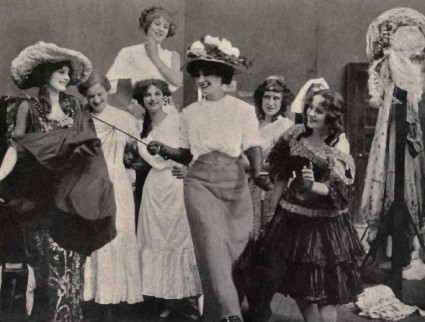
The Niece and the Chorus Lady (Edison 1911), from David S. Hulfish, Cyclopedia of Motion-Picture Work (1914)

Additionally, I have added some photographs taken by myself, relating to the Pordenone silent film festival and Kinemacolor, some images from a silent era directory whose title I have mislaid (for the time being), and a few oddments like cinema postcards. I am no collector, and there are others who have made far more interesting silent film images available on Flickr (memo to self: must write post on these soon). But what I will do from now on is add images in full size from Bioscope posts where I have had to reduce them to fit the blog, where it is legitimate to do so.

There is now a link for the Bioscope Flickr set on the right-hand side under ‘Other Bioscope Sites’. The other Bioscope associate sites are the Bioscope Bibliography of Silent Cinema (records extracted from the British Library catalogue), the Bioscope on Twitter (a feed from the blog – I don’t add any additional material as tweets, at present) and Urbanora’s Modern Silents, a collection of modern silent videos on my YouTube site. So the Bioscope grows and grows.

Black Francis and The Golem

Part 18 of The Golem, from http://www.youtube.com/user/blackfrancisnet

In 2008 Black Francis, frontman for alternative rock band The Pixies, performed his score (with songs) for Paul Wegener’s Der Golem (1920) at the Castro Theatre as part of the San Francisco International Film Festival. He has now released the score as a deluxe boxed set, available for sale from his website, blackfrancis.net. The boxed set features two CDs of the score as performed live at the Castro, two CDs of the score recorded in the studio, a DVD of the film with the score, a book with Francis’ music and handwritten notes, plus photographs. The whole set is limited to 500 copies, numbered and autographed by the man himself, and one suspects that they won’t last long on the shelves.

But you needn’t miss out, because at the same time Francis has made the entire film with score available on his YouTube channel, divided up into 26 sections, plus a making of video. Not all may like to see silent films acompanied by songs, but it doesn’t happen every time, and this looks (from what the Bioscope has sampled so far) to be a strongly-felt response to the film’s imagery and its romantic yearnings. It certainly is interesting to contrast it with experimental rock guitarist Gary Lucas’ take on Der Golem, available in extract form on YouTube. I think I prefer the latter, because it is led by the imagery rather than having the images decorating songs, but it all goes to show that the silent film medium is alive and kicking in all sorts of directions.

Killruddery returns

http://killrudderyarts.com

The Killruddery Film Festival has announced its 2010 programme. This excellent venture, now in its fourth year, is held in the delightful location of Killruddery House in Co. Wicklow, Ireland, close by Bray and a short journey from Dublin. To date the festival has been dedicated to silent films, but for this year they have introduced some sound films to what looks a well-rounded and effective programme. The theme of the festival, which runs 11-14 March, is Celebrating Lost, Overlooked & Forgotten Cinema. One might argue that not all of the titles on show fall into those categories, but every film screening is new to someone in the audience, so there are discoveries come what may. Here’s the line-up:

Thursday 11th March

Down Wicklow Way @ 6.15pm
Programme from the IFI Irish Film Archive, presented by Sunniva O’Flynn. With live musical accompaniment by Josh Johnston

A Cottage on Dartmoor (UK 1929 d. Anthony Asquith) @ 8.15pm
Introduced by Kevin Brownlow. With live musical accompaniment by Stephen Horne

Friday 12th March

Los Angeles Plays Itself (US 2003 d. Thom Anderssen) @ 2pm
With live musical accompaniment by Stephen Horne

Back Down Wicklow Way @ 6pm
More archive films presented by Sunniva O’Flynn

The New World (US 2005 d. Terence Malick) @ 7pm

Lucky Star (US 1929 d. Frank Borzage) @ 8pm

The Parallax View (US 1974 d. Alan Pakula) @ 10pm

Saturday 13th March

A Future Past @ 12am
Programme of science-fiction films presented Andrew Legge, including High Treason (UK 1929 d. Maurice Elvey)

Children’s Shorts Programme @ 12.30am

Poil de Carrotte (France 1925 d. Julien Duvivier) @ 2pm

Sita Sings the Blues (US 1008 d. Nina Paley) @ 2.15pm

Talk: On the developing art of the video essay @ 4pm
Given by video artist Matt Zoller Seitz

City Girl (US 1930 d. F.W. Murnau) @ 4.15pm
Introduced by Kevin Brownlow

Chang (US 1927 d. Merian C. Copper /Ernest Schoedsack) @ 6pm
With live musical accompaniment by Stephen Horne. Introduced by Kevin Brownlow

Seven Days to Noon (UK 1950 d. John and Roy Boulting) @ 6.15pm
Presented by John Boorman

I Know Where I’m Going (UK 1945 d. Michael Powell and Emeric Pressburger) @ 8.30pm

Sunday 14th March

Talk: Unknown Chaplin @ 12pm
Illustrated lecture given by Kevin Brownlow

Britannica & other stories @ 1pm
Programme of artists’ films, including the work of John Latham

Ingeborg Holm (Sweden 1917 d. Victor Sjostrom) @ 2.15pm
Introduced by Charles Barr, with live music accompaniment by Stephen Horne

Budawanny (Ireland 1987 d. Bob Quinn) @ 4pm
Modern silent film about a young priest (played by Donal McCann) who becomes romantically entangled with his housekeeper

Red Dust (US 1932 d. Victor Fleming) @ 4.15pm
Introduced by Kevin Brownlow

The Patsy (US 1928 d. King Vidor) @ 6pm
Introduced by Kevin Brownlow, with live musical accompaniment by
Josh Johnston

Goddess/Devi (India 1960 d. Satyajit Ray) @ 6.15pm
Presented by Rebecca Miller

The Wind (US 1928 d. Victor Sjostrom) @ 8pm
With live musical accompaniment by Stephen Horne

Now that’s what I call an eclectic programme. Tickets are now on sale (you pay for individual screenings), and full details can be found on the festival site. Hope it does well.

The new Metropolis

Metropolis being screened in front of the Brandenburg Gate in an icy Berlin, from the Arte live video stream

Today saw the premiere of the restored version of Metropolis, complete with the previously missing sequences discovered in a version held in Argentina. The film has been restored by the Friedrich-Wilhelm-Murnau-Stiftung (the Murnau Foundation) in cooperation with ZDF and Arte, and the Deutsche Kinemathek, and with the Museo del Cine Pablo C. Ducros Hicken (Buenos Aires). It was given its first screenings simultaneously at the Alte Oper, Frankfurt am Main, and at the Friedrichstadtpalast, Berlin as part of the 60th Berlin International Film Festival. The film was also shown for free for the general public on a big screen in front of the Brandenburg Gate, with a live video stream (at some distance from the screen) of the Friedrichstadtpalast event, delivered by French TV channel Arte.

The film was presented with a newly adapted music score based on the original Gottfried Huppertz score of 1927. In Berlin the Rundfunk-Sinfonieorchester Berlin played under the direction of Frank Strobel, in Frankfurt the Staatsorchester Braunschweig was conducted by Helmut Imig. The missing sequences amount to some 25mins of screening time, though the Argentine film is a 16mm dupe neg and in poor condition.

The story has been told many times now (including on the Bioscope), but briefly to recap: when originally released Metropolis, though now one of the most iconic and revered of all silent films, was a bit of a flop. The film was drastically cut soon after its premiere to try and make it more appealing to audiences, but as is so often the case in these instances, dramatic logic suffered. Almost a quarter of its original length was lost. The film at its original length of 4189 metres (or 147mins at 25fps) was therefore only seen for a short while (until May 1927 in Berlin); thereafter a cut version of around 113 mins was all that could be seen. The most recent restoration of the film before this one, that overseen by Enno Patalas in 2001, runs at 118 mins. In 2008, Paula Félix-Didier, new curator of the Museo del Cine in Buenos Aires, learned of a curiously long screening of a print of Metropolis at a cinema club some years before, a print which had come to Argentina in 1928 and eventually a dupe neg found its way to Museo del Cine in 1992. Félix-Didier located the film, recognised its significance, the news went excitedly around the world, and now we have the results. The restored film runs for 147mins (it doesn’t say at what speed).

Design by Eric Kettelhut from the Deutsche Kinemathek exhibition on Metropolis

There is a website devoted to the restored film, put together by the Friedrich-Wilhelm-Murnau-Stiftung, with information on the film’s history, its restoration and the premieres, with a helpful set of FAQs (in English and German), which include these notes on what the new sequences show:

The METROPOLIS version 1927/2010 differs significantly from all the versions known so far. Although the plot of the film keeps its well-known framework the structure of the plot changes: It becomes more harmonic and more comprehensible. Especially the minor characters that Fritz Lang gives room emerge again. Two newly found scenes give Georgy, Josaphat and The Thin Man back their own profiles that through the cuts were almost downgraded to extras.

The now included sequences like Georg’s car ride through Metropolis as well as Freder and The Thin Man’s visiting with Josaphat turn out to be siginificant for the plot. But also the relationship between the inventor Rotwang and Joh Fredersen, the ruler over Metropolis, as well as the reason for their rivalry become clear through the current restoration: Finally one can see the famous scene “Chamber of Hel”, the departed woman loved by both rivals, from which up to now only one still and several descriptions existed.

Arte has a special feature on the film and a documentary on its restoration (Voyage à Metropolis), including a video clip from the restoration showing a sequence with Fritz Rasp and Alfred Abel in a taxi and a delightful sequence with lifts (the video is available in embedded form but can’t be embedded into a WordPress blog, curses). Other videos have interviews with those involved in the restoration, and there is a photo gallery and features on actress Brigitte Helm and director Fritz Lang. There’s an AFP news report on YouTube which has interviews and fleeting clips (embedding not allowed, sigh). The Deutsche Kinemathek in Berlin has an exhibition on Metropolis and its restoration which runs until April 25th.

The Bioscope saw about an hour of the live video stream, but as the image at the top of this post indicates, although of excellent quality it wasn’t the ideal way to experience the film (indeed it was as interesting or even more so for the people-watching experience, as people indifferently trudged by in the cold as high melodrama unfolded on the screen). However, judging as best one could from the live stream, and the video clips online, the new sequences have been cleaned up as well as one could have hoped for, and the transitions from 35mm to blow-up from the digitally restored 16mm do not jar at all. It looks to be a very professional piece of work.

Finally, and as an antidote to the hype, you might care to take a look at H.G. Wells’ notorious 1927 review of the film. He didn’t much care for it:

I have recently seen the silliest film. I do not believe it would be possible to make one sillier. And as this film sets out to display the way the world is going … It is called Metropolis, it comes from the great Ufa studios in Germany, and the public is given to understand that it has been produced at enormous cost. It gives in one eddying concentration almost every possible foolishness, cliché, platitude, and muddlement about mechanical progress and progress in general served up with a sauce of sentimentality that is all its own…

And then he really lays into it. Yes it’s a folly, but it’s a magnificent folly, and it’s now a coherent magnificent folly. A theatrical print of the restored film is expected to be available in the autumn 2010, with Transit Film, Munich in charge of sales. A DVD release from the Murnau Foundation is expected at the end of 2010.

The world before you

J.B.L. Noel, cinematographer for The Epic of Everest (1924), from http://britishsilents.wordpress.com

No doubt taking its title from Charles Urban’s slogan “We put the world before you”, the British Silent Festival has announced the theme of its upcoming festival as being ‘The World Before You’: Exploration, Science and Nature in British Silent Film.

The festival is being held 15-18 April 2010 at the Phoenix Square Cinema, Leicester (home of the very first British Silent Film Festival, several moons ago). This, the thirteenth such festival, will focus on the relationship between the natural world and cinema before 1930, and will include films about the following:

  • science and nature
  • exploration and discovery of polar regions, mountains, jungles and oceans
  • early ethnography
  • natural phenomena, climate and weather
  • the British coast, maritime activities and natural history on film

The festival organisers promise us a four-day packed programme filled with many rare and re-discovered films, presentations and social events. All films will have live musical accompaniment from a star-studded array of the finest silent cinema musicians.

The festival has moved from its strictly British focus of past years to cast a wider net, and this year highlights will include screenings of The Lost World (US 1925), Drifters (UK 1929), The Bridal Party of Hardanger (Norway 1926), the Dodge Brothers performing to Beggars of Life (US 1928), Damian Coldwell’s new score for Tol’able David (US 1921) with more new music for The Battle of the Ancre and the Advance of the Tanks (UK 1917) and Ernest Shackleton’s epic South (UK 1919). Special presentations will include Everest on Film, The Perilous Life of the Wildlife Cameraman, Around the British Coast in Film, and the Race to the South Pole: Britain and Norway (so I hope that includes the film that exists of Amundsen’s team as well has Herbert Ponting’s record of Scott’s doomed party).

Full programme and timetable information are promised shortly. For bookings contact Phoenix Square Box Office (+44) 0116 242 2800. Ticket prices (which include lunch each day and tea/coffee) are Festival 4 day pass £95 (£70 concession) or Festival 1 day pass £45 (£30 concession).

Accommodation is available at the discounted rate of £45 pp per night (including breakfast) at the Ibis Hotel, Leicester. Please telephone the Hotel directly and quote ‘Phoenix Square’. The address is Ibis Hotel Leicester, St George’s Way, Constitution Hill, Leicester LE1 1PL tel. 0116 248 7200.

For any information contact the Festival Directors Laraine Porter (lporter [at] dmu.ac.uk) or Bryony Dixon (bryony.dixon [at] bfi.org.uk), or visit http://britishsilents.wordpress.com.

From the deep

http://www.kurzfilmtage.de

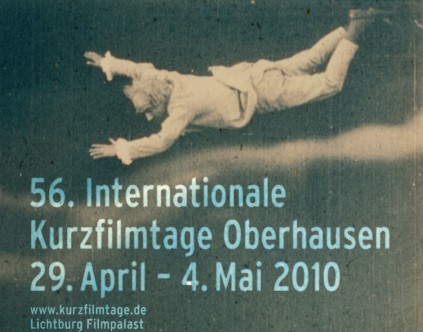
From the Deep: The Great Experiment 1898-1918 is being billed as the biggest ever programme of early films in Germany (i.e. early films overall, not just those made in Germany). It’s been put together by curators Mariann Lewinsky and Eric de Kuyper as part of the 56th International Short Film Festival at Oberhausen, Germany, 29 April-4 May 2010. This is how the festival website describes the theme:

This programme invites audiences to discover and experience early cinema as a forgotten but very topical production and presentation practice and a real alternative to today’s cinema and museum. Out of the depths of the days before 1918, a wild short film continent is pulled up to the surface of the present day. Early cinema developed participatory and hybrid forms of presentation that seem eerily modern. With no access restrictions at all in its first years, cinema up to 1910 was a public space shared by all age groups and classes, and created the first worldwide web: for the first time in history, people in far-flung regions of the world were able to watch identical shows.

The individual programmes illustrate the versatility of these experiments, which run the gamut from applied colour processes that may involve pure experimentation with coloured light or the illuminated fountains at Versailles, to the discovery of the possibilities of space and movement, all the way to the eager dismantling of authority in the countless films featuring rebellious servants or bad girls and boys who go unpunished. Tribute is paid to both the innovation productions by the era’s world-market leader, Pathé-frères, as well as to works by its rivals Gaumont, Lux and Star-Film, or the Italian competition with its comic series like “Cretinetti”.

The festival will bring together more than one hundred films, as well as discussions and other related events. As festival director Lars Henrik Gass puts it:

These are productions from an age when all films were short films, when movie theatres were the first public space shared by all age groups and classes, the first worldwide web in a way: for the first time in history, people in far flung regions of the world were able to watch the same shows. It was an exhibition practice which for us is also a continuation of our research into an imaginary Kinomuseum, where museum is re-invented by cinema.

Accreditation for this particular contribution to the imaginary Kinomuseum is open until April 6th, and further details (though no list of films as yet) can be found on the festival website (in English and German).

All of which leaves us with one small question. If all of the films of this period were short, were they really short at all?

Motography

‘An odd type of theatre front’: illustration from Motion Picture Making and Exhibiting

One of the indications of the speculative, exploratory nature of early cinema is the uncertainty felt at the time over what it or its products were to be called. Living pictures? Animated photography? Cinema? Kinema? Kinematography? Motion pictures? Moving pictures? Photoplays? Bioscope? It’s worth bearing in mind such terms when searching for early cinema subjects in digitised book and newspaper sources (alongside such other handy terms as kinetoscope, biograph, electric theatre etc.). One term you might not think to use is ‘motography’. I’m not sure how long the lifespan was of this word, but for a short period it was used by some seeking for a distinctive, all-encompassing term for the new art – indeed it was the title of an American film journal of this period (it ran 1909-1918 and was originally called The Nickelodeon).

The term was certainly favoured by John B. Rathbun, author of Motion Picture Making and Exhibiting: A comprehensive volume treating the principles of motography; the making of motion pictures; the scenario; the motion picture theater; the projector; the conduct of film exhibiting; methods of coloring films; talking pictures, etc. (1914), the latest volume to go into the Bioscope Library.

John B. Rathbun was a technical writer (and an associate editor of Motography, which helps explains his attachment to the term). His book is yet another of those all-purpose guides to the new industry of motion pictures, a blend of potted history, social history, technical explanation and marvelment at the rise of this extraordinary business and the huge sums that it was starting to earn. As indicated by its subtitle, Rathbun’s book takes us through the principles, production processes and exhibition of motion pictures up to 1914. It is addressed to a reader with a general interest in the phenomenon, though it sometimes forgets this.

The book starts with the familiar pre-history of the medium, from Zoetropes to Muybridge to Edison to motion picture projection. The principles of the taking and projecting of films are covered, with practical information on film stock itself, including development, printing and colour tinting. Film production follows, covering both studio and non-fiction work, then the almost obligatory chapter on the mysteries of scenario writing with suggestions on how to sell your scenario to the studios. If the lay reader did not fancy his or her chances as a scriptwriter, then they might consider opening a motion picture theatre as the best way to make money out of this new business, and advice follows on setting up a cinema, putting together the programme (with handy advice on dealing with different ages of film reels), advertising the show, an interesting discussion on whether to include vaudeville acts or not, and operating profitable sidelines.

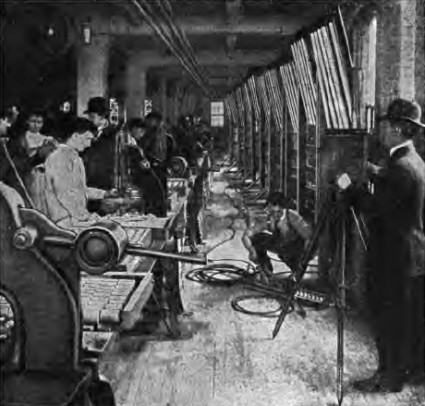
The filming of an ‘industrial’, with Cooper-Hewitt mercury vapour lamps on the right, from Motion Picture Making and Exhibiting

A long chapter on the technicalities of projection seems to belong to another book, and might have been enough to scare off one or two would-be speculators. Rathbun follows this with guidelines on local censorship laws and regulations, then rounds off matters with an interesting chapter on colour (covering stencil colour, the Friese-Greene process, Kinemacolor and Gaumont Chronochrome), stereoscopy and synchronised sound films.

Motion Picture Making and Exhibiting is rather muddled in the guidelines it provides, as it is unsure at what level or precisely to whom it is directing its advice. Buyers at the time might have been less than satisfied, but for us now it has plenty of handy information on how the industry was perceived and some useful data and social observations relating to the exhibition sector. There are illustrations of studio interiors, laboratories, wardrobe rooms, camera operators, cinema floor plans, projection booths and so on, to add to its value as a reference source. It’s available from the Internet Archive, and into the Bioscope Library it goes.