Doing women’s film history

http://wfh.wikidot.com

Here’s news of an international conference taking place in April 2011 organised by the AHRC-funded Women’s Film History Network – UK/Ireland which is certain to attract some papers covering the silent film era, where there has been so much research activity of late.

Doing Women’s Film History: Reframing Cinema History

13-15 April 2011

Centre for Research in Media and Cultural Studies
University of Sunderland

This international conference will bring together researchers in women’s film history, archivists, collections managers and contemporary women practitioners. It will explore current developments in researching women’s participation in film production, distribution, exhibition, criticism and film-going in different parts of the world and in all periods. It will ask what the discovery and documentation of women’s past activity in and around cinema implies for the writing of film history in general and will consider how the history of post-1970s women’s filmmaking is to be resourced and developed. The conference will seek to address issues such as:

  • women’s film historiography: filling gaps in existing film history or changing film history?
  • impact of gender-oriented research methods & sources for the histories of male and female workers
  • gender in the archives, catalogues and collections
  • impact of women on cinema as audiences, campaigners, fans
  • relationship between feminism, women’s and gender histories
  • crossing the silent/sound history divide
  • women’s film history after second wave feminism
  • national/international/transnational connections and interactions
  • creation of canons, exhibition & programming practices, curricula and teaching
  • relation of women’s film history then and women’s film practice now

The Conference will also report on and seek feedback on three Workshops that will have preceded it in order to involve wider participation in developing the future of the Network.

A call for papers will follow more detailed planning in early June. In the meantime, for more information about the Network please visit the Network wiki and the Conference Development pages where you can post any suggestions and comments via linked page headings.

Memory of the world

Roald Amundsen and his Norwegian team reach the South Pole. From http://unesco.no/generelt/english/norwegian-documentary-heritage

In the report on the British Silent Film Festival I covered the Amundsen polar films. What I didn’t mention is that the films have been included in UNESCO’s Memory of the World programme. It seems worthwhile just taking a look at Memory of the World and identifying those silent films which are registered on it.

UNESCO’s Memory of the World is an ongoing programme of identification and commemoration of key artefacts held in archives that are important to the world’s documentary heritage. The objective of the programme is described thus:

The vision of the Memory of the World Programme is that the world’s documentary heritage belongs to all, should be fully preserved and protected for all and, with due recognition of cultural mores and practicalities, should be permanently accessible to all without hindrance.

It has these three main mission statements:

  • To facilitate preservation, by the most appropriate techniques, of the world’s documentary heritage.
  • To assist universal access to documentary heritage.
  • To increase awareness worldwide of the existence and significance of documentary heritage.

In practice the Memory of the World means a register of the world’s archival gems. Archives, museums and libraries vie with one another for the honour of having their prized items listed on on the register (though nominations are by country, not by institution). There’s no monetary gain involved: merely glory, plus all the strength and worldwide recognition that comes from UNESCO’s backing. Consequently it is quite an achievement for the silent films and film collections that have made it to the register, although together they present a rather uneven picture of what is most precious about the world’s early film heritage.

These are the silent films (with their nomination details) currently on the register, alongside such world treasures as the Bayeux tapestry, the diaries of Anne Frank, Magna Carta and Criminal Court Case No. 253/1963 (State Versus N Mandela and Others).

METROPOLIS – Sicherungsstück Nr. 1: Negative of the restored and reconstructed version 2001

Documentary heritage submitted by Germany and recommended for inclusion in the Memory of the World Register in 2001.

Fritz Lang’s motion picture METROPOLIS (1927) is without doubt famous testimony of German silent film art, a testimony that made history. The combination of motion picture and architecture: this is above all and still METROPOLIS, the film which was shot by Fritz Lang in the Babelsberg Film Studios in 1925/1926, which, due to its immense expenditure, caused the UFA, the largest German film group, to run into financial difficulties, which then had a glittering première in Berlin in January 1927, and an unparalleled success all over the world ever since – and which became the symbol of a (film-) architectural model of the future.

Substantially shortened and changed almost immediately after the première in Berlin, only one (though fragmentary) of the initially three original negatives of METROPOLIS has been left in the possession of the German Federal Archives, as well as master copies of the lost original negatives in a few archives abroad.

As a result of intense investigations on the initiative of the Friedrich Wilhelm Murnau Foundation, a new reconstruction has been produced. It was first shown in February 2001, on the occasion of the Berlin Film Festival. Considering that the result this time is again not the original version of METROPOLIS, but “only” a synthetic version made of the fragments handed down, it comes, however, as close to the original piece of work as possible. With this reconstruction project a new digitized “original” negative has been produced to provide more independence and better copying quality in the future. This reconstructed version of METROPOLIS is proposed for nomination here.

Lumière Films

Documentary heritage submitted by France and recommended for inclusion in the Memory of the World Register in 2005.

The collection nominated for inclusion in the Memory of the World Register comprises all the original films (negatives and positives) known as the Lumière films (i.e. having round perforations) and listed in the catalogue of 1,423 titles produced at the factory of the brothers Louis and Auguste Lumière. Since 18 films have been lost, the collection comprises the original films of the 1,405 Lumière titles that have been identified and restored.

Roald Amundsen’s South Pole Expedition (1910-1912)

Documentary heritage submitted by Norway and recommended for inclusion in the Memory of the World Register in 2005.

Roald Amundsen and his 4-man team reached the South Pole, with the help of polar dogs, on 14 December 1911. The expedition, and particularly the dog-sled journey to the Pole, is described as daring and with an exceptionally good logistic planning and execution.

The Antarctic and the Arctic Polar Regions, for several centuries, were regarded as the final frontiers for mankind to conquer, and the North and South Poles were for a long period of time the great goals to attain within geographic discovery.

The discoveries in the polar areas contributed, not least in Norway but also internationally, to greater consciousness of, and political interest in, questions concerning sovereignty and rights in these sea and land areas.

The original film material of Roald Amundsen’s South Pole Expedition documents a great historic achievement, outside the borders of the civilized world and in an extreme climatic environment.

In his time, Roald Amundsen (1872 – 1928) contributed, through several expeditions and together with his teams, to new knowledge within several aspects of polar research. First and foremost, however, he is remembered as a master of the classic polar expedition’s planning and execution.

The film collection is unique, as it documents the important events of this first expedition to reach the South Pole. Though the material is incomplete, it is made up of original sequences, filmed between 1910 and 1912, consisting of negative film and first and second-generation print material.

The Battle of the Somme

Documentary heritage submitted by United Kingdom and recommended for inclusion in the Memory of the World Register in 2005.

The 1916 film The Battle of the Somme is uniquely significant both as the compelling documentary record of one of the key battles of the First World War (and indeed one which has come to typify many aspects of this landmark in 20th Century history) and as the first feature-length documentary film record of combat produced anywhere in the world. In the latter role, the film played a major part in establishing the methodology of documentary and propaganda film, and initiated debate on a number of issues relating to the ethical treatment of “factual” film which continue to be relevant to this day. Seen by many millions of British civilians within the first month of distribution, The Battle of the Somme was recognized at the time as a phenomenon that allowed the civilian home-front audience to share the experiences of the front-line soldier, thus helping both to create and to reflect the concept of Total War. Seen later by mass audiences in allied and neutral countries, including Russia and the United States, it coloured the way in which the war and British participation in it were perceived around the world at the time and subsequently, and it is the source a number of iconic images of combat on the Western Front in the First World War which remain in almost daily use ninety years later …

Finally, it has importance as one of the foundation stones of the film collection of the Imperial War Museum, an institution that may claim to be among the oldest film archives in the world.

The Story of the Kelly Gang (1906)

Documentary heritage submitted by Australia and recommended for inclusion in the Memory of the World Register in 2007.

Just as Fritz Lang’s Metropolis (1927) is testimony to German silent film art, The Story of the Kelly Gang (1906) symbolises both the birth of the Australian film industry and the emergence of an Australian identity. Even more significantly it heralds the emergence of the feature film format.

The Story of the Kelly Gang, directed by Charles Tait in 1906, is the first full-length narrative feature film produced anywhere in the world. Only fragments of the original production of more than one hour are known to exist and are preserved at the National Film and Sound Archive, Canberra. The original poster and publicity booklet provide confirmation of those fragments’ authenticity and together this material represents the unique and irreplacable beginning of feature film culture.

What is striking is just how much film is represented on the register so far. As well as the above, from the sound era there is Luis Buñuel’s Los Olvidados (1950), Norman McClaren’s animation film Neighbours (1952), The Wizard of Oz (1939), the Ingmar Bergman Archives, and the John Marshall Ju/’hoan Bushman Film and Video Collection – though one might query the documentary value of some of these choices. The prominence of film can be seen by looking an individual countries: there have been five items registered by the UK – the Hereford Mappa Mundi, Magna Carta, the Registry of Slaves of the British Caribbean 1817-1834 (submitted by the UK and Caribbean nations), the Appeal of 18 June 1940 (a radio broadcast, submitted by the UK and France), and The Battle of the Somme.

Not everyone would argue that The Battle of the Somme should be among the UK’s top five archival treasures (though I would), and its presence there is due in part to the strong arguments made in its favour by its host archive, the IWM – but nevertheless film is there on the register, again and again. It is not only heartening, but it adds significant strength to the arguments of archives that need to argue the case for the preservation of film as a medium equal to any other. Celluloid is the equal of vellum.

The individual records for the films listed above are worth checking out because there is a link to the nomination forms, which give much supporting information (in English and French) on the films’ preservation and current status. There are also some photographs.

But if you were picking five examples of silent film heritage to represent the world’s documentary heritage, would you have picked those five – or what would you argue should be included?

Finally, the restored Roald Amundsen’s South Pole Expedition film is to be made available on DVD from the Norwegian Film Institute on May 6th – details here.

The show goes on

Among all the hurdles that the valiant British Silent Film Festival has had to face over the past thirteen years as it has fought to keep going, one that its organisers cannot have imagined would ever be a problem is volcanoes. Quite a few millennia have passed since Leicester was last troubled by volanic eruptions, but perhaps it was appropriate that The Lost World was screened at the festival to remind us of climactic conditions when dinosaurs last ruled the earth.

So yes, the cloud of volanic ash currently spreading itself over Europe and taking us all back to a pre-aeroplane age of clear skies, parochial occupations and holidays at home affected the British Silent Film Festival too. Phil Carli, who flew over from America to play piano ended up stranded in Dublin, and a group of Norwegians intending to present a specially prepared programme of polar films remained firmly in Norway, while the films themselves were uploaded then downloaded to the festival overnight in a process that took several hours. So somehow the show went on, and many congratulations to those who fought to ensure that it did. The theme of the festival was exploration, science and nature, and it took a spirit of adventure and some science to overcome what nature decided to throw at us.

British Silent Film Festival audience settling down to witness With Allenby in Palestine and Lawrence in Arabia

I was only there for the one day, and the event continues until tomorrow, so this isn’t a festival report. I will just note the two main presentations on the Friday, for the record (and if anyone wants to add their impressions of the rest of the festival to the comments, please do). First was the work-in-progress show devised and presented by Neil Brand and myself, a partial recreation of With Allenby in Palestine and Lawrence in Arabia. This was the title of a multimedia show presented by the American journalist Lowell Thomas over 1919-1920 (described in detail in an earlier post) which brought ‘Lawrence of Arabia’ to popular attention.

Thomas’ original show was a mixture of music, photographic slides (many of them coloured) and film clips. We used our edited version of an original script held by Marist College Archives in the USA, original images taken by Thomas’ photographer Harry Chase from the collections of Marist and the Imperial War Museum, and a few clips from Chase’s films – showing Arab forces, T.E. Lawrence himself with Emir Feisal and Lowell Thomas, an scenes of motorised transport in the Arab army camp – also from the IWM. Neil read out Thomas’ original words in an easy-going American accent intended to emulate Thomas’ own delivery, while I introduced and manned the laptop, as the whole show was delivered by that magic lantern de nos jours, PowerPoint.

Did it work? I hope so. It was a 40-minute extract from what was originally a two-hour show, and it was presented in a rough-and-ready low-res manner because it was done in a huge hurry and on a budget of nil – thanks to the kind co-operation of Marist and the IWM. There seem to be two lessons to be drawn here. One is the importance of Thomas’ show in building up the Lawrence legend. All the Lawrence biographies acknowledge the importance of With Allenby in Palestine and Larence in Arabia in creating popular enthusiasm for Lawrence and the Arab revolt. But the chance to experience this key work has never been there before, as its component parts lay scattered. A full-scale restoration of the show would seem to be a more than worthwhile exercise, though some sort of balance in the presentation needs to be struck between the show as it actually was and the need for contextualisation, since much of what Thomas told was factually dubious or least over-romanticised.

The second lesson of the show is to realise the importance of the multimedia show at that time. There were numerous other examples of shows which combined live presenter with film, still images and music, in a form that we might now describe as televisual. The Victorian tradition of the lecturer with his magic lantern carried on long into the silent era, with films simply being added to the mix. Adventurers, propagandists and entertainers could combine multimedia with their own personal charisma to create complex entertainments whose importance as popular entertainments is not always fully recognised. Film archives restore films, other archives collect photographs or documents, but ‘restoration’ seldom entails bringing all these elements together. At the festival we saw the films of Roald Amundsen (covered below), which were originally part of a lecture show that combined these with photographs and Amundsen himself as presenter. Herbert Ponting, Scott’s photographer, did likewise, and Ernest Shackleton was inspired by Lowell Thomas’ example to lecture himself to the films and photographs taken of his 1914-16 Antarctic expedition taken by Frank Hurley. Thomas and Harry Chase went on to produce ‘travelogues’ of India and Afghanistan. The Shackleton expedition film South (1919) was shown during the festival, but were Shackleton’s lecture script ever to turn up there would be a strong imperative for a new kind of restoration, once which combined film, images and someone able to project Shackleton’s commanding personality as presenter, proud of his achievements yet night after night forced to lecture to audiences before images of his expedition’s failure – all so he might recover the expedition’s costs.

An extract from A Dash to the North Pole (1909), a Charles Urban production showing footage taken 1903-04 by Anthony Fiala of the Ziegler North Pole expedition, re-released in 1909 to capitalise on the polar fever of 1909 when Robery Peary supposedly reached the North Pole and Shackleton came within 112 miles of the South Pole

All of which leads us to the other main event of the day, The Race to the Pole – a programme of Arctic and Antarctic film from the so-called heroic age of polar exploration, which was to have been presented by Jan-Anders Diesen from University of Lillehammer in Norway, but thanks to the Eyjafjallajoekull eruption (remember that name) was presented by Festival organiser Bryony Dixon instead. Happily Bryony knows quite a bit about polar film, having overseen the restoration of Herbert Ponting’s The Great White South (1924), due to be premiered at this year’s London Film Festival, and it was a relaxed, assured and informative presentation in trying circumstances.

The Bioscope has been contemplating a series of posts on polar exploration films for some while now, and I won’t go into detail about the films now, but we did see sequences from Anthony Fiala’s expedition to the Arctic of 1903-04 (illustrated above), the Wellman polar expedition of 1906 (sadly without seeing the balloon with which Wellman hoped – and failed – to make it to the North Pole), a sneak preview of the BFI’s restoration of the Scott/Ponting film with quite astonishing colour tinting and toning likely to cause a sensation when it gets unveiled in full in November, and film of Shackleton’s funeral on South Georgia from the expedition film Southwards on the Quest (1922), an expedition sadly curtailed by its leader’s death by heart attack on the journey out.

But the highlight was the sixteen minutes of film taken of Roald Amundsen’s successful Norwegian expedition to the South Pole – the man who won the race. Few know that Amundsen took a cinematograph with him. It was operated by Kristian Prestrud, and the films show Amundsen’s ship the Fram, life on board and at the Framheim base camp, whales and penguins, and some singularly evocative shots of dog teams leading their sledges and drivers away into the distance. As said, the films were presented to audiences (in Britain and Norway) in the form of a lecture show, intercut with photographs and Amundsen’s own commentary. It would have been the next best thing to being there – and considerably warmer.

The show goes on today and tomorrow, and hopefully next year and many years after that. Congratulations to all on keeping things going despite acts of God and man, finding a space not only for British silents but increasingly for other silents from around the world, and with a commendable emphasis on imaginative presentation and unearthing less obvious material. Long may it continue.

Lives in Film no. 2: T.E. Lawrence

I am currently working on a project with Neil Brand to recreate, at least in part, a multimedia show of considerable importance to the popular understanding of one theatre of the First World War, and one man in particular. With Allenby in Palestine and Lawrence in Arabia was the creation of the American journalist Lowell Thomas, who journeyed to Europe on a propaganda mission to uncover stories that would encourage American support for the war. Not satisfied with what he found on the Western front, Thomas moved to Palestine, where General Allenby’s war against the Turks promised a less sullied, more symbolic conflict. And it was there, in Jerusalem in March 1918 that Thomas met the man who was to make his fortune, and whose own fame he was to play a major part in securing.

Thomas famously said of Thomas Edward Lawrence (1888-1935) that he had “a genius for backing into the limelight”. The shy archaeologist working for British intelligence who was instrumental in organising the Arab revolt was simultaneously repelled by and fascinated by fame. This post will not attempt to tell the story of T.E. Lawrence, which is amply documented elsewhere, but it will cover the handful of occasions on which the man who shied away from publicity, to the point where he took on an assumed name and a humble occupation after the war, nevertheless appeared before motion picture cameras. By my calculation he was filmed on five occasions, each for a brief moment only, yet each iconic in its own way. Unlike the many photographs of Lawrence that exist, which seem filled with mystery and contradiction, the films of him capture his ordinariness in extraordinary circumstances.

General Allenby’s Entry into Jerusalem
The first two films of Lawrence to be made were two shots from the same newsreel film taken on 11 December 1917. On 9 December Jerusalem fell to the Allied forces led by General Edmund Allenby, the great hero of the hour. There was obviously huge symbolic significance for Western audiences in seeing Jerusalem being freed from centuries of occupation by the Ottoman Empire. Two days after the city’s capture, Allenby organised a march on foot into the city (intended as a humble gesture to contrast with the Kaiser’s earlier choice to drive into the city). A proclamation was then read out promising respect for all religions.

Taking part in the ceremonies was T.E. Lawrence. He was dressed in British uniform, and appears twice in the official film of the events. The film was made by Harold Jeapes, cameramen for the War Office Official Topical Budget – which changed its names to Pictorial News (Official) when the newsreel was released on 23 February 1918. Jeapes was assisted by a second cameraman, probably the official photographer George Westmoreland. Lawrence was, of course, quite unknown to the outside world at this point, and marches past anonymously as part of the column following Allenby into the city. (Unfortunately I’m not able to illustrate this)
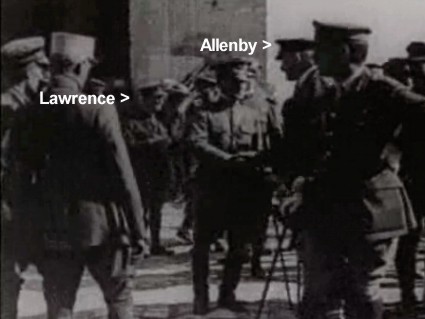
Allenby and Lawrence shown in the newsreel film General Allenby’s Entry into Jerusalem; frame still taken from a compilation film British WWI Film on the Mideast and other Naval Operations, from www.realmilitaryflix.com/public/481.cfm

But the second shot of him in the film is more mysterious. It shows Allenby in conversation with someone, but the figures standing around part, and the small figure of Lawrence emerges, glancing coyly at the camera, almost as if to say you don’t know who I am – but one day you will do. So far as I have been able to tell (and it’s a film I have studied over many years), Lawrence does not appear in that part of the film where the proclamation is read, though it is very likely that he is somewhere among the crowd listening to Allenby’s significant words being read out.

With Allenby in Palestine and Lawrence in Arabia
It was just over two months later, in March 1918, when Lowell Thomas turned up in Jerusalem and asked to see the young officer whose exploits were the subject of marvelled rumour. Thomas was accompanied by Harry Chase, a seasoned photographer also equipped with a motion picture camera, with whom he had been recording Allenby’s campaign, mostly in retrospect.

Lawrence recognised Thomas as the journalist in search of a good story that he was, but also as a reasonable man. He saw that Thomas’ mission could be used to help promote the little-known Arab revolt, but also that he would need to keep Thomas at arms’ length to protect his much-valued privacy. This is borne out in the photographic and cinematographic record. Lawrence permitted Chase to take a number of photographs of himself in Arab dress, both in Jerusalem and outside his tent in Aqaba. Thomas had persuaded Lawrence of the need to have several photographs, on account of the illustrated show that he had in mind. But Thomas only spent a couple of days close to Lawrence, and the film record bears this out.

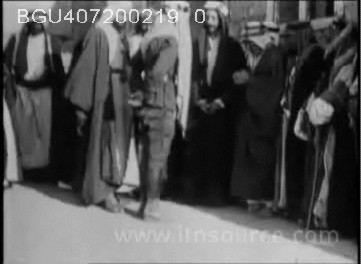
Emir Faisal (bearded) in centre, with Lowell Thomas to his right and a hunched Lawrence (in Arab dress) to his left, translating Thomas’ words. Filmed by Harry Chase. From www.itnsource.com/shotlist//BHC_RTV/1935/05/23/BGU407200219

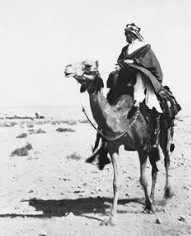
Lawrence turns up just twice in the films that Chase took. In the first sequence, he is seen in Arab dress amongst a group of Bedouin warriors in an urban setting. Emir Faisal, the future King Faisal I of Iraq (the Alec Guinness character in David Lean’s film) is the central figure. Lawrence is barely visible to the side until Thomas himself walks and speaks to Faisal, at which point Lawrence comes forward to act as interpreter. In the second sequence, Lawrence and Faisal drives past the camera in an army truck, neither distinguishable unless one has prior knowledge. [Doubt has been cast on whether it is Lawrence and Faisal in this shot – see comments]

It is not much of a documentary record, but Lawrence could not have imagined how Thomas’ genius would turn his relatively slender material into a show that would be viewed by millions. Putting together all that he gathered from the various war fronts into a series of shows which he put on in New York in March 1919, Thomas found that his Arabia and Palestine material was easily the most popular. A British impresario, Percy Burton, saw the show, and brought Thomas and Chase (who served as projectionist) over to London, where With Allenby in Palestine opened at the Royal Opera House in the unpromising month of August.

Within days the show – which Thomas labelled a ‘travelogue’ – had become With Allenby in Palestine and Lawrence in Arabia and was the talk of the town. Londoners were charmed by Thomas’ easy-going narrative style (he presented every screening, two a day of a two-hour show) and enthralled by the romance of Lawrence’s exploits. As Thomas told them, here was “one of the most picturesque personalities of modern times, a man who will be blazoned on the romantic pages of history with Raleigh, Drake, Clive and Gordon”.

Lawrence (left) and Faisal in army truck, filmed by Harry Chase. From www.itnsource.com/shotlist//BHC_RTV/1935/05/23/BGU407200219 [See comments – this is not thought to show Lawrence]

It wasn’t exactly historical truth, but it was exactly what audiences wanted. An estimated one million people saw it during its London run (it also played at the Royal Albert Hall, the Philharmonic Hall and the Queen’s Hall) and four million world-wide. The show was a combination of prologue, musical interludes (organ music and the band of the Welsh guards), Thomas’ narration, photographic slides (many of them hand-coloured) and films. It established the romantic legend of Lawrence of Arabia, enshrined in Thomas’ book of that name published in 1924, in the short documentary film of the same title in 1927, and on to the David Lean feature film, which builds on the image of Lawrence created by Lowell Thomas (who is portrayed in the film as Jackson Bentley, played by Arthur Kennedy).

Versailles peace treaty
This is a speculative one. Lawrence attended the Versailles peace conference negotiations as part of Faisal’s delegation between January and May 1919. Some twenty years ago I was watching a television programme on the First World War when an archive film sequence was shown of the Versailles conference. A group of men walked past the camera in the palace grounds, and one of them – I swear – was T.E. Lawrence. I’ve searched high and low for this sequence ever since and never found it (and I can’t remember what the programme was) but I’m certain I saw him. Perhaps someone out there could confirm this or otherwise for me.
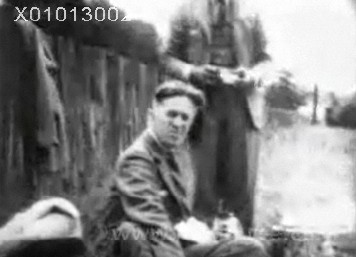
Lawrence at a picnic with publisher Frank N. Doubleday, at some point in the late-1920s/early-30s. From www.itnsource.com/shotlist//BHC_FoxMovietone/1930/01/01/X01013002

The Doubleday ‘home movie’
Following Versailles and a short period serving as an advisor to the Colonial Office, Lawrence turned his back on his growing fame by enlisting in the RAF under the name of John Hume Ross. This attempt as disguised was soon rumbled, but he changed name once more, enlisting in the Tank Corps as Private T.E. Shaw, later rejoining the RAF under this name. But while he was hiding from those who pursued him because of his fame, he was also worked to increase that fame by publishing an account of his experiences as The Seven Pillars of Wisdom (1922). The US publisher of this was Frank N. Doubleday, and the next film of Lawrence is a film taken at some point in the late 1920s (or possibly early 1930s) at a picnic and for a photo shoot outside Doubleday’s home (the first sequence feels like a home movie, but the latter looks professional). A somewhat world-weary-looking Lawrence eyes the camera with something that comes half-way between caution and amusement.

Lawrence (shown arrowed) when Aircraftsman Shaw, disembarking from a ship off Plymouth, from Gaumont Graphic newsreel. From www.itnsource.com/shotlist//BHC_RTV/1929/01/01/BGT407140571

Aircraftsman Shaw
Our final film of Lawrence is pure paparazzi. He was pursued by photographers and cameramen throughout the last years of his life, and finally in February 1929 one newsreel cameraman got lucky. There is a Gaumont Graphic newsreel which shows some wobbly, long-distance shot of the then Aircraftsman Shaw disembarking at Plymouth from India, where he had been on a supposedly secret mission. “Despite all precautions Gaumont Graphic cameraman secures exclusive pictures of ‘elusive Lawrence'” boast the intertitles.

T.E. Lawrence died in a motorcycle accident in May 1935, and the several newsreel films on his funeral lauded his achievements and his legend with what little footage they could muster. The Doubleday picnic film, the Shaw footage and the Thomas footage were used (the latter without anyone pointing out which shots showed Lawrence), but not Lawrence’s appearance in the Jerusalem film. This was not spotted until many years later.

Lawrence’s experience with the motion picture camera says a lot about the progress of twentieth-century fame. Lawrence’s time in the limelight came at just that point where cameras were becoming inescapable and the celebrated had to learn not to avoid them but how to live with them. Television made the game of escape impossible, but the newsreel camera was a little more cumbersome, and those who wanted to flee its gaze could do so for a while, or at least be caught only on the sly. Lawrence mastered photography (and still portraiture in general) because he could control the conditions under which still images of him were taken, but the motion picture camera was more dangerous. It showed more than the myth – it could capture the real man, which above all is what Lawrence wanted to hide.

Our partial recreation of With Allenby in Palestine and Lawrence in Arabia features at the British Silent Film Festival at the Leicester Phoenix or Friday 16 April, at 11.15am. It’s being presented as a work in progress, and depending on how well it goes we’ll see if we can take the project further and devise a fuller recreation of Lowell Thomas’ travelogue.

General Allenby’s Entry into Jerusalem (the short newsreel versions – a longer, ten-minute version also exists) can be seen on the BFI’s Screenonline site, accessible to UK libraries, schools and colleges only. The film is held both by the BFI National Archive and the Imperial War Museum.

Shortened versions of the Lawrence sequences filmed by Harry Chase in 1918 can be seen in a 1935 Gaumont-British News item available on the ITN Source site.

The Doubleday picnic film can be seen on ITN Source and used in a 1935 Fox Movietone memorial item with commentary by Lowell Thomas, included in the same clip.

The various Lowell Thomas films of Allenby and Lawrence, in unedited and edited form, are held by the Imperial War Museum.

An almost complete version of Lowell Thomas’ script for With Allenby in Palestine and Lawrence in Arabia is available on the web archives website of Marist College, USA, which holds the Lowell Thomas papers. The script comes from a presentation of the show in Ireland and has several local references. The Marist site also has a selection of Harry Chase’s photographs and a digitised copy of Thomas’ diary.

Lawrence’s official biographer Jeremy Wilson has an excellent blog on Lawrence, which includes this recent post on Lowell Thomas’ 1919-1920 shows. There is also a fascinating thread from the T.E. Lawrence Studies list, managed by Wilson, discussing the relationship between Lowell Thomas and Lawrence.

More silent films journals online – much more

Italian silent film journals Apollon, Cinema Star and Vita Cinematografica

A few weeks ago we gave you a listing of film journals from the silent era which are available online. Some adjustments have been made to the list, with a few more titles added, but I wasn’t expecting the list to grow extensively in the immediate future. And then the Museo Nazionale del Cinema, which had already digitised ten journals available through the Teca Digitale Piemontese site has added a number of other film journals from our period – eighty-three of them. Here they all are:

L’Albo della cinematografia 1915
Apollon 1916, 1920, 1921
L’Argante 1913-1932
L’Arte Cinegrafica 1918-1919
L’Arte cinema-drammatica 1913
l’Arte del cinema 1928-1929
L’Arte del silenzio 1922
L’Arte Muta 1916-1917
La Bottega delle ombre 1926
Il Café chantant 1911-1920
Il capolavoro cinematografico 1926
La Casa di vetro 1924
Cin (Battaglie cinematografiche) 1918
Cin (Cine-gazzeta) 1918
Cine 1917
Cine gazzettino 1926-1931
Cine Sorriso Illustrato 1928-1931
Cine cinema 1926, 1927
La Cine-Fono e la rivista fono-cinematografica 1911-1922
La Cine-gazzetta 1916 to 1918
Cine Romanzo 1929 to 1932
Cinema (Firenze) 1923
Cinema (Napoli) 1913-1914
Cinema Ambrosio 1916, 1925
Cinema Illustrato 1928
Il Cinema Italiano 1926, 1927, 1930
Cinema-star 1926-1927
Cinema-teatro 1928, 1929, 1930
Cinemagraf 1916, 1917
Cinemalia 1927, 1928
La Cinematografia Artistica 1912
La Cinematografia Italiana ed Estera 1910, 1914, 1915, 1916, 1922, 1923
La Cinematografia Italiana 1909
La Cinematografia 1927, 1928
Cinematografo (Roma) 1927, 1928, 1929, 1930, 1931
Cinematografo (Trieste) 1924
Il Cinematografo 1919
Cinemundus 1919
Coltura cinematografica 1920, 1921
La Conquista cinematografica 1921
Contropelo 1917, 1918, 1919, 1920, 1923
Il Corriere Cinematografico 1925, 1926, 1927, 1928, 1929, 1930
Il Corriere del Cinematografo 1921
Cronache d’attualità 1916, 1919, 1921, 1922
La Decima musa 1920
La Domenica del cinema 1929
Echi del cinema 1926
L’Eco del Cinema 1924 to 1930
Excelsior 1916
Fantasma (Napoli-Roma) 1916, 1920, 1923
Fantasma (Roma) 1920
Film 1914, 1915-1920, 1926, 1927
Films Pittaluga 1925, 1926
Firenze cinema 1928
Fortunio 1920
L’Illustrazione Cinematografica 1912, 1914, 1915
Iride (Genova) 1914
L’Italia e Kines 1926
Kinema 1929, 1930
Kines 1928, 1929, 1930, 1931
Lux (Napoli) 1909, 1910
Lux (Roma) 1918, 1920, 1921
Lux e Cine 1910, 1911
Il Mondo a lo schermo 1926
Moto Film 1916, 1917
Pathé-baby 1928, 1929, 1930
In Penombra 1918, 1919
Penombra 1917
Proiezioni luminose 1924, 1925, 1926
La Rivista Cinematografica 1920-1930
Il Romanzo Film 1920, 1921
Sullo schermo 1927, 1928
Lo Schermo 1926, 1927
La Settima Arte
Società Anonima Ambrosio 1907
Sor Capanna 1919
Lo Spettacolo 1919, 1920
La tecnica cinematografica 1914
Theatralia 1925
Il Tirso al cinematografo 1915, 1916
Il Tirso 1914
Triumphilm 1912, 1914
La Vita Cinematografica 1911-1924, 1929, 1930

One’s first reaction is that is surely isn’t possible that so many journals were published in the silent era in Italy alone. But once you take in company journals, alongside fan magazines, art cinema journals, theatre journals which included film in their coverage, trade papers, and regional publications, then it starts to add up. They can be found on the Teca Digitale Piemontese site – just select ‘Selezionare la tipologia del materiale che si intende consultare’ from the top menu, and ‘Museo Nazionle del Cinema’ from the second menu. Click on ‘Ricerca per Ente’, then browse by title or choose a particular title by typing a word in the search box and clicking on Cerca. The individual issues are sorted by year and can be browsed page by page. The viewer requires Java to be installed, and there are assorted tools to enable you to resize, rotate, save and print pages, and so forth.

This is the description of the digitisation project overall on the Museo Nazionale del Cinema site, which gives you an idea of where best to start looking – and how much there is to look forward to still, as they are apparently only a quarter of the way through digitising their entire collection:

The Library conserves an important fund of journals dealing with Italy’s silent films, the second most important after the National Library of Florence. Ranging from the major corporate journals (“La Vita Cinematografica”, “La Cinematografia Italiana ed Estera” etc.) to art magazines (“Apollon,” “L’arte muta”, “In penombra”) and popular periodicals (“Al cinemà”, “Cinema Star”, “Cine Sorriso Illustrato” etc.), the fund numbers over 60,000 pages which will soon be completely available online. The website of the Teca Digitale Piemontese already features approximately 15,000 magazine pages online and offers the possibility of carrying out research through key words from the texts.

Ther sheer number of silent film journals now available online demands something more than a post that tries to encompass them all, and so I have created a new section of the Bioscope Library dedicated to film journals alone. It will take a little while to build up in terms of descriptions for each title, but I’m launching it now. Please do let me know of any other journals that I can add to the list, so that we can make it a comprehensive reference source of value to all. By my calculation there are currently 118 titles (from one or two issues to complete runs) available – but that number will grow.

My grateful thanks to Teresa Antolin for alerting me to the new batch of digitised journals (and to other silent film materials being digitised by the Museo Nazionale del Cinema, which I shall be covering in another post). Teresa manages a number of sites dedicated to silent film, chiefly in Italy (and written in Italian), all interlinked under the In Penombra umbrella:

It’s an amazing body of work, and encouragement to anyone who knows things (in silent film or in any subject) that the best thing is to tell people about it. The tools to do so are just sitting there, free to use and easy to use. Why not have a go?

The ancient world in Malibu

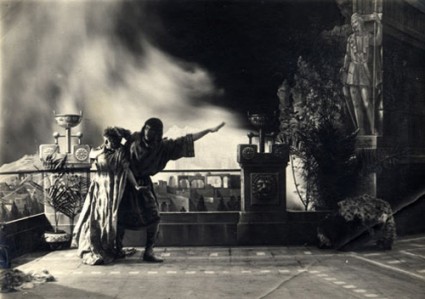
La Caduta di Troia, from http://ritrovatirestauratiinvisibili.blogspot.com

We have reported previously on the screenings of early films under the title of The Ancient World in Silent Cinema which have taken place in the UK – one programme covering Ancient Greece and Rome and a second programme covering the Biblical lands. The screenings are part of a project on the ancient world and cinema organised by Professor Maria Wyke (University College London) and Pantelis Michelakis (University of Bristol).

The screenings have now moved to America. On 10 April 2010, the Getty Villa, Malibu, California will host a programme of Ancient Rome and Greece films, from the collection of the BFI National Archive. Here’s the blurb describing the programme:

In the earliest days of cinema, more than 800 films drew their inspiration from ancient Mediterranean cultures, history, and society. With the exception of a handful now available on DVD or screened at film festivals, most of these works have been largely forgotten. Ranging from historical and mythological epics to burlesques, animated cartoons, documentaries and adaptations of Greek drama, these films all suggest an interest in the ancient world. Today more than 300 of these early films survive in archival collections in 26 countries, and digital technology has created new possibilities to access and transmit early cinema, allowing a reconsideration of silent films as a culturally and aesthetically dynamic medium.

The films will be on 35mm, and will be acompanied by pianist Andrew Earle Simpson, composer and professor of music at the Catholic University of America in Washington, D.C. The films to be shown are:

La Légende de Midas (France, 1910, directed by Louis Feuillade, 12 minutes)

La Caduta di Troia (Italy, 1910, directed by Giovanni Pastrone and Romano Luigi Borgnetto, 29 minutes)

The Private Life of Helen of Troy (United States, 1927, directed by Alexander Korda, 5 minute fragment).

Julius Caesar (United States, 1908, directed by William V. Ranous, 14 minutes)

Cléopatre (France, 1910, directed by Ferdinand Zecca and Henri Andréani, 15 minutes)

A Roman Scandal (United States, 1924, directed by Bud Fisher, 6 minutes)

The programme is shorter than was the case in the UK, where we were treated to an afternoon and evening set of screenings, but I warmly recommend what is certain to be an engrossing programme. I particularly recommend Pastrone’s La Caduta di Troia, a stand-out work by a real filmmaker. Certainly the Ancient Greeks would have recognised its narrative fervour and its respect for heroic ideals.

The aim of the project (which doesn’t have a web page or website, unfortunately) is to investigate in detail a broad range of silent films set in antiquity leading to an online database, conferences and publications and – it is confidently expressed – preservation, digitisation, and exhibition. We will be keeping an eye on developments.

Bienvenue au Festival d’Anères

http://festival.aneres.free.fr

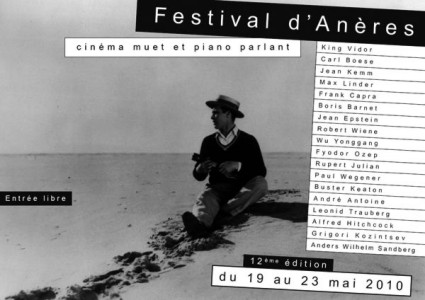
The Festival d’Anères, silent film festival takes place 19-23 May 2010 at Anères in Hautes-Pyrénées department, southern France. The programme has just been announced, and it’s a really excellent one:

Wednesday 19 May

17:00 Son premier film
d. Jean Kemm
with Grock, Pierrette Lugand, Gaston Dubosc
1926 / France / 1h52 / video
Copy: Film Régents (Archives Jacques Haïk)
Music: le groupe Magine – Saxophones: Alexandra Grimal; Voice and effects: Lynn Cassiers; Drums: Mathieu Calleja

21:00 The Phantom of the Opera
d. Rupert Julian
with Lon Chaney, Mary Philbin, Norman Kerry
1925 / USA / 1h32 / video
Copy: Lobster Films
Piano: Roch Havet; Voices: Kova Réa, Marion Dhombres; Voice and guitars: Guillaume Farley

Thursday 20 May

12:00 Seven Years Bad Luck
d. Max Linder
with Max Linder, Alta Allen, Ralph McCullough
1921 / USA / 1h02 / video
Copy: Lobster Films
Piano: Jacques Cambra

14:00 The Three Must-Get-Theres
d. Max Linder
with Max Linder, Bull Montana, Frank Cooke
1922 / USA / 55 minutes / video
Copy: Lobster Films
Music: a group of young musicians under the guidance of Mauro Coceano

17:00 Cœur fidèle
d. Jean Epstein
with Gina Manès, Léon Mathot, Edmond Van Daële
1923 / France / 1h27 / video
Copiy: Pathé / Cinémathèque française (D.R.)
Guitar: Paco El Lobo

19:00 Concert: Manu Galure

21:00 The Lodger: A Story of the London Fog
d. Alfred Hitchcock
with Ivor Novello, Marie Ault, Arthur Chesney, June Tripp
1927 / UK / 1h11 / 35mm
Copy: Carlotta Films
Accordion, trumpet: Virgile Goller; Saxophones: Florent Lalet; Double bass: Guillaume Guérin

Friday 21 May

11:30 Miss Mend (Episode 1)
d. Fédor Ozep and Boris Barnet
with Natalya Glan, Igor Ilyinsky, Vladimir Fogel, Boris Barnet
1926 / USSR / 1h28 / video
Copiy: Lobster Films
Music by Aidje Tafial: trumpet: Xavier Bornens; saxophones, flute: Olivier Py; piano: Roch Havet; double bass: Jeff Pautrat; drums: Aidje Tafial

14:00 The Strong Man
d. Frank Capra
with Harry Langdon, Priscilla Bonner, Gertrude Astor
1926 / USA / 1h15 / 35mm
Copy: Photoplay Productions
Piano: Jacques Cambra

17:00 La Terre
d. André Antoine
with Armand Bour, René Alexandre, Germaine Rouer, Jean Hervé, Émile Mylo, Berthe Bovy
1921 / France / 1h37 / video
Copy: Gaumont Pathé Archives
Violins: Frédéric Norel; clarinet, saxophone, machines: Sylvain Rifflet

19:00 Concert: Kova Réa

21:30 The Vagabond
d. Charlie Chaplin
1916 / USA / 25 min.
Music: Famille Gouffault
+
Novyy Vavilon (New Babylon)
d. Grigori Kozintsev et Leonid Trauberg
with David Gutman, Yelena Kuzmina, Andrei Kostrichkin
1929 / USSR / 1h15 / video
Original music by Dmitri Shostakovitch, arranged by Baudime Jam
Violin 1: Elzbieta Gladys; Violin 2: Survier Flores Lopes; Viola:Baudime Jam; Cello: Jean-Philippe Feiss; clarinet: Béatrice Berne

Saturday 22 May

11:30 Miss Mend (Episode 2)
de Fédor Ozep and Boris Barnet
with Natalya Glan, Igor Ilyinsky, Vladimir Fogel, Boris Barnet
1926 / USSR / 1h28 / video
Copy: Lobster Films
Music by Aidje Tafial: trumpet: Xavier Bornens; saxophones, flute: Olivier Py; piano: Roch Havet; double bass: Jeff Pautrat; drums: Aidje Tafial

14:00 Klovnen
d. Anders Wilhelm Sandberg
with Gösta Ekman, Karina Bell, Maurice de Féraudy
1926 / Denmark / 2h08 / video
Copy: Danish Film Institute
Music: le groupe Magine: saxophones: Alexandra Grimal; Voice and effects: Lynn Cassiers; Drums: Mathieu Calleja

17:00 Die Königin vom Moulin Rouge
d. Robert Wiene
with Mady Christians, André Roanne, Livio Pavanelli
1926 / Austria / 1h27 / video
Copy: Cinémathèque de Toulouse
Piano: Karol Beffa

19:00 Concert: Aldona

21:30 Der Golem, wie er in die Welt kam
d. Paul Wegener and Carl Boese
with Paul Wegener, Albert Steinrück, Lyda Salmonova
1920 / Germany / 1h26 / 35mm
Copy: Murnau Stiftung / Transit Film
Saxophone: Léonard Le Cloarec; Piano: Bertrand Allagnat; Bass: Antoine Reininger; Drums: Julien Bonnard

Sunday 23 May

11:30 Miss Mend (Episode 3)
d. Fédor Ozep and Boris Barnet
with Natalya Glan, Igor Ilyinsky, Vladimir Fogel, Boris Barnet
1926 / USSR / 1h14 / video
Copy: Lobster Films
Music by Aidje Tafial: trumpet: Xavier Bornens; saxophones, flute: Olivier Py; piano: Roch Havet; double bass: Jeff Pautrat; drums: Aidje Tafial

14:00 The Mystery of the Leaping Fish
d. Christy Cabanne and John Emerson
with Douglas Fairbanks
1916 / USA / 24 min.
Guitar, piano: Quentin Buffier; Flute: Julia Guillonton
+
Go West
d. Buster Keaton
with Buster Keaton, Howard Truesdale, Kathleen Myers
1925 / USA / 1h10 / video
Saxophone: Léonard Le Cloarec; Piano: Bertrand Allagnat; Bass: Antoine Reininger; Drums: Julien Bonnard

17:00 Shennü
d. Wu Yonggang
with Ruan Lingyu, Zhang Zhizhi, Li Keng, Li Junpan
1934 / China / 1h20 / video
Copy: ZZ Productions
Original music by Baudime Jam
Played by quatuor Prima Vista: Violon 1: Elzbieta Gladys; Violon 2: Survier Flores Lopes; Viola: Baudime Jam; Cello: Jean-Philippe Feiss

19:00 The Crowd
d. King Vidor
with Eleanor Boardman, James Murray, Bert Roach
1928 / USA / 1h29 / 35mm
Copy: Photoplay Productions
Piano: Karol Beffa

21:30 – grand ball

A fine programme indeed, and really good to see after tales of the festival having struggled to find sufficient funding to continue. The attention paid to the music accompaniment looks particularly commendable. More details can be found on the festival website (in French), and if any Bioscopist is intending to go, or knows someone who is, it would be good hear what the festival is like.

My Bioscope

My thanks go to Matthew Solomon, author of the recently published Disappearing Tricks: Silent Film, Houdini, and the New Magic of the Twentieth Century for bringing this poem to my attention. The heartfelt piece is from the Warwick Trading Company’s Cinematograph and Bioscope Magazine, May 1906:

I trouble not, nor fret,
But have unbounded hope,
With me there’s no regret,
Whilst I’ve my Bioscope.

Whatever comes or goes,
There’s nothing makes me mope;
I feel I have no foes,
When I’ve a Bioscope.

What cares may come, through fate,
I with them all will cope,
They trouble not my pate,
Whilst I’ve my Bioscope.

Warwick. Without apologies to the others

True doubtless for the projector that Warwick marketed, but hopefully no less true for this blog (which is shaping up to enjoy its highest ever monthly viewing figures, for which much thanks to all).

(And for those who are concerned about these things, our logo shows a Warwick Bioscope projector c.1900)

Paul Merton’s Weird and Wonderful World of Early Cinema

A quick reminder in case those in the UK hadn’t spotted it, but tonight BBC4 is showing Paul’s Merton Weird and Wonderful World of Early Cinema. Merton continues on his mission to reveal the wonders of silent cinema to a general audience by going in search of the origins of screen comedy, revealing a “forgotten world of silent cinema – not in Hollywood, but closer to home in pre-1914 Britain and France”.

Revealing the unknown stars and lost masterpieces, he brings to life the pioneering techniques and optical inventiveness of the virtuosos who mastered a new art form. With a playful eye and comic sense of timing, Merton combines the role of presenter and director to recreate the weird and wonderful world that is early European cinema in a series of cinematic experiments of his own.

It should be interesting to see what is revealed. Such programmes – which are rare enough in themselves – not only open up largely hidden films to new audiences, but should be a lesson to those of us who may know these films well to see them in a fresh light, not least as a television commissioner sees them. The programme will be available on iPlayer for the usual week after transmission, and it would be interested to read people’s thoughts on it.

Merton also takes on early film in his interactive guide Paul Merton on Early British Comedy for the BFI’s Screenonline site. It’s a useful tour of the basics, well-illustrated with clips, covering Early Days, Fantastical Films, Fantasy & Realism, Cars & Robots, Facials, Stars, and Bad Boys & Girls; filmmakers such as James Williamson, Cecil Hepworth, Robert Paul, and Charles Urban; and performers such as Florence Turner, Fred Evans (Pimple) and Little Willy Saunders.

Paul Merton on Early British Comedy

Researching Ireland

Irish Film & TV Research Online is a monument to the passion for national film history. It is a website that serves as a focal point for Irish and Irish-themed film and television of all kinds. It is hosted by Trinity College Dublin, and it is mainly comprised of three searchable databases, each of which has extensive content relevant to the study of silent film (and beyond, of course).

Irish Film & Television Index
The Index documents “all Irish-made cinema and major television productions as well as Irish-themed audio-visual representations produced outside of Ireland.” It’s a bold claim, but it would be a challenge to prove them wrong, as its coverage is extensive – nearly 40,000 titles – and it includes important areas that other national filmographies often ignore, such as newsreels, interest films (and indeed silents). It based on the book publication by Kevin Rockett, The Irish Filmography: Fiction Films 1896-1996 (1996), with additional material chiefly researched by Eugene Finn. The database includes films of uncertainty identity which exist in film archives, as well as films which are now lost. As noted it includes bot Irish production and Irish-themed productions – so the researcher will find plenty of American films included because of their Irish themes and characters. However it doesn’t document the films of Irish filmmakers who operated out of Ireland if their films did not have Irish themes (so Rex Ingram is represented in the Biographies section but not in the Film Index).

There are simple and advance search options, the latter enabling you to refine searches by country, genre, reference, location, years, songs, or date – including date range, so it is possible to isolate films from the silent period (just under 1,000 titles, fiction and non-fiction), though seemingly no way of arranging by date order, which prevents the researcher from getting an idea of chronology and change (unless you seach year-by-year, which is laborious). The records themselves are often extensive, as this record for Kalem’s The Lad from Old Ireland demonstrates:

Title LAD FROM OLD IRELAND, THE
Production company Kalem Co
Country of origin USA
Producer OLCOTT, Sidney
Director OLCOTT, Sidney
Script/Adaptation GAUNTIER, Gene
Photography HOLLISTER, George
Cast Sidney Olcott (Terry O’Connor), Gene Gauntier (Aileen), Arthur Donaldson (priest), J P McGowan, Robert Vignola (men in campaign office on election night), Thomas O’Connor (Murphy, a landlord), Jane Wolfe (Elsie Myron, an American heiress), Laurene Santley, Agnes Mapes.
Colour b&w
Sound sil
Footage 8241009 [it’s not explained what this means]
Release date 1910
Copy IFA, NFTVA, IFA (VHS)
Summary In the rural Ireland location of Rathpacon, County Cork, Terry is working in the fields. Determined to improve his poverty-stricken existence, he decides to emigrate to America. He bids a sad farewell to Aileen, his sweetheart, who is left in the care of her mother, but he promises to return to her. Arriving in New York, Terry works on a building site and eventually rises to become the Tammany Hall mayor of the city. Forgetting about Aileen, he is seen in the company of an American heiress on the night of his electoral victory. However, he finds a letter from Aileen informing him of her family’s desperate economic plight and declaring that they are in danger of being evicted from their home. Returning home, Terry is seen on a ship in mid-ocean conjuring up an image of Aileen. When he arrives at Aileen’s cottage the eviction is in progress. He enters the cottage and confronts the landlord. He thrusts the rent arrears into his hand and sends him out of the house. The following Sunday the banns are read by the priest announcing the forthcoming marriage of Terry and Aileen. (V).
Note USA Rel 23/11/1910; re-issued 1/8/1914. GB distr: Markt & Co. Filmed in Ireland and USA. Farnham, whose names are sometimes given as ‘Al(l)an’ or ‘Farnum’, did not participate in the production of scenes taken in Ireland, as Herbert Reynolds points out, but would likely have been responsible for the New York studio interiors. Unpublished cast members Donaldson, McGowan and Vignola have been identified by Reynolds in the extant film. THE LAD FROM OLD IRELAND is regarded by some as the first American-produced fiction film made outside the USA (Sight and Sound, Oct-Nov 1953:96), though this may have been confused with what is contemporaneously described as ‘the first production ever made on two Continents’ (Bio 12/1/1911:47). It may also be the first fiction film made in Ireland, but see note with A DAUGHTER OF ERIN (USA 1908). The available print, with intertitles in German, ends with the penultimate scene, at the cottage.
Reference Bio 12/1/1911:47; Bio 6/4/1912:v; Bio 21/8/1913:21; Kalem Kalender 1/8/1914:2 (reissue); MPN 10/12/1910:9; MPN 17/12/1910:19; MPN 21/10/1916, Sec 2:109-10; MPW 26/11/1910:1246, 1249; MPW 3/12/1910:1296,1343; MPW 17/12/1910:1405; MPW 1/8/1914:732; NYDM 2/11/1910:29; Var 3/12/1910. AFI Cat 1893-1910:574; Bowser, 1990:153-5; Rockett et al, 1987:7-8.

All reference materials cited below are held at the Tiernan McBride Library of the Irish Film Institute.

Old file record giving film stock details, plot summary, review and subjects references for film (D.C. Swift)

The Bioscope, 12/1/1911:2, plot-synopsis of the film.

Sight and Sound, Dec. 1953:96-8, ‘Ireland’s first films’, article on Sidney Olcott’s contribution to early Irish films (Proionsias O Conluain).

‘Kalem’s Great Trans-Atlantic drama…’, copy of advertisement for the film.
Format 35mm
Distributor Markt & Co
Language English
Production credits p.c/distr: Kalem Co, p/d: Sidney Olcott, c: George Hollister, sc: Gene Gauntier, scenic dsgn: Henry Alien Farnham.
Location Cork, USA
Genre/Category Short Film Drama, Historical Drama
Keywords Migration, Labourers, Politics, Rural Ireland, Evictions, Landlords, Tenants, Priests

However there is no hyperlinking for these results e.g. you can’t click on ‘Kalem’ in this record and go to other films produced by the American company, which is a shame. This is a fine resource for the extensive information it contains, but it is fundamentally a book catalogue with some search functions rather than something fully re-imagined as an electronic database.

Irish Film & Television Biographies
Described as a work in progress, the Biographies database documents conributors to the history of both cinema and television in Ireland and those who have worked on Irish-theme films made outside the country. It is a work in progress, and unfortunately it doesn’t seem to cover anyone from the silent period of film production (e.g. Sidney Olcott, Norman Whitten, John McDonagh).

Irish Film & Television Bibliography
Another work in progress, ths Bibliography lists books, articles in journals, chapters in collections, and selections from specialist magazines. As well as being able to search across the whole database, you can browse by title or author.

The site also contains details of an annual Irish Postgraduate Film Research Seminar and a links page. Irish Film & TV Research Online has been overseen by Professor Kevin Rockett, a noted historian of Irish cinema. He describes the website as a living archive, and additional information and amendments are welcomed. No database should ever be static, but the price of relevance is eternal vigilance, as records have to be maintained and resources hosted. Hopefully Trinity College will continue to support it and researchers as dedicated as Rockett and Finn will always recognise the importance of sustaining it.