Baby face

http://www.feetofmud.com

Harry Langdon’s name is always there when you get asked to name the top-ranking American comedians of the silent era, though he tends to be the name that you come up with last. He was a talented comedian, especially when working with sympathetic directorial and writing talents who could help bring out the best from his baby-face looks and unworldly demeanour that nevertheless had him triumphing over adversity every time. He is an acquired taste, but an oddly captivating presence once you let his films do their work.

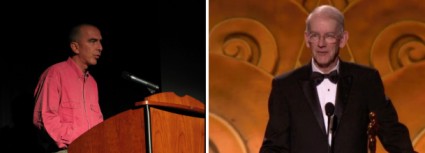
There’s now an excellent website devoted to him, with the fine web address of www.feetof mud.com (derived from the title of one of his Mack Sennett shorts), created by Tim Greer. Simply and clearly laid out, it comprises a filmography (1923-1945); an articles section with biography, short pieces by musician Ben Model, film historian Brent Walker and others, plus contemporary reviews; an extras section with portraits, bibliography, DVDs (unfortunately without links, which would have been helpful), news and more; a links page; and a contact page with information on the author.

The design is engaging, the enthusiasm infectious, and it’s made me determined to check out his films again to remind me of his particular comic gift. Job done.

The siege of Sidney Street

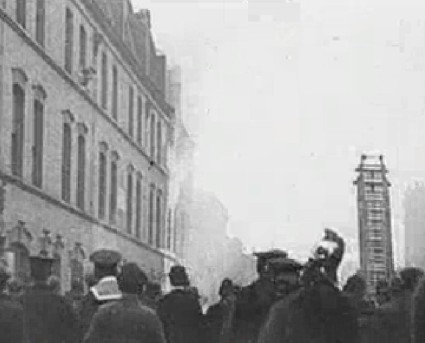
Home Secretary Winston Churchill (in top hat) watching the Siege of Sidney Street, part of the Pathé’s Animated Gazette’s coverage, ‘Battle of London’, from British Pathé. Bioscope regulars will be delighted to note the stray dog in the bottom left-hand corner

On the night of 16 December 1910 a group of Latvian revolutionaries attempted to rob a jeweller’s shop at 119 Houdsditch in the City of London. Their aim was to obtain funds to support revolutionary activity in Russia (and to support themselves), but their efforts to break in were overheard and nine policemen were called to the scene. The Latvians were armed; the policemen were not, and in the ensuing confrontation three of the police were shot dead and two injured.

The public was horrified by what swiftly became known as the Houndsditch Murders, which followed on from the ‘Tottenham Outrage’ of the previous year when two Latvians had shot dead a constable and a child following an interrupted robbery. One of the Houndsditch gang, George Gardstein, had died of his injuries, having been shot accidentally by a confederate, but a huge manhunt built up to track down all of the gang, a number of whom were arrested before two (neither of whom it is now thought were present at the Houndsditch burglary) were tracked down to 100 Sidney Street, Stepney in London’s East End.
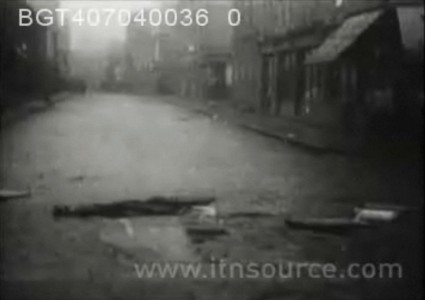
Sidney Street, from the Andrew Pictures coverage. No. 100 is on the far right-hand side of the street, below the number 3 of the ITN Source ID number

The Siege of Sidney Street (or the Battle of Stepney) that was to follow took place 100 years ago on 3 January 1911. It has gained lasting fame for unprecedented scenes that brought armed police and troops onto the streets of London to conduct a siege with desperate revolutionaries, all of which took place before the startled (and undoubtedly thrilled) eyes of the public and the press. Among those recording the events as they happened were five film companies, and it is their story that forms the reason for this centenary post.

The besieged Latvians were Fritz Svaars and William Sokoloff, known as Joseph. They had taken refuge at 100 Sidney Street only for their position to be given away by an informer late in the evening of New Year’s Day. Detectives were sent under cover of darkness to watch over the building while they tried to determine the two men’s movements by contact with a lodger and the informant. Keen not to have the men slip out their grasp, but knowing they would be armed, the police felt they had to act. In the early hours of Tuesday 3 January, armed police were positioned in houses and shops surrounding the block in which contained 100 Sidney Street. By 3.00am there were 200 policemen in place. It was realised that storming the building by its staircase would be foolhardy as the two men would have the advantage by firing down on the police officers, so the adjacent buildings were cleared of other people and the police waited for daylight.

Soldier firing from a shop door, part of the Pathé coverage, from British Pathe

As dawn broke, people started to gather around the police cordon, trying to find out what was happening. The police threw stones at the second-floor window where they believed the two men were hiding. Nothing happened. Then someone threw a brick and smashed a window pane. From the floor below shots fired out and a policeman was hit. A hail of bullets followed as they tried to move the wounded man. The two men were well-armed (they were better munitioned than the police, certainly) and well-positioned. An order was sent to bring in troops from the Tower of London. Scots Guards were sent, on the authority of the Home Secretary, Winston Churchill, who thought upon hearing the news that it would be not interesting if he were to go along and see things for himself.

By this time the press had got wind of the story, and reporters, photographers and newsreel cameramen were arriving on the scene. Five film companies were present: Pathé, Gaumont, Andrews Pictures, Co-operative and the Warwick Trading Company. Pathé (Pathé’s Animated Gazette), Gaumont (Gaumont Graphic) and Warwick (Warwick Bioscope Chronicle) had each recently established a newsreels and were companies with well-established newsfilm credentials. Co-operative specialised in Shakespeare productions, so it is something or a surprise to see them involved, while Andrews Pictures was a small-scale film renter and exhibitor. Presumably any firm who got wind of what was happening and had a camera operator at the ready made the most of the opportunity. Three of the five films taken that day survive: those of Pathé, Gaumont and Andrews.
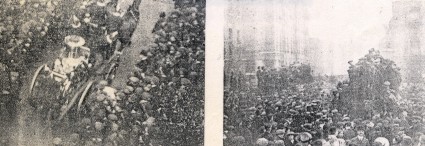
Frame stills from the lost Sidney Street siege films made by Co-operative (left, showing the arrival of a fire engine) and Warwick (showing crowds in the area after the siege), from an article on the siege films in The Bioscope 5 January 1911, p. 9

The troops assumed positions around the building and began firing (it was by now around 11.00am). The barrage of fire from both sides was relentless and was to continue for around two hours. The crowds around the perimeter were now considerable, and policemen had a difficult time holding them back, as the newsreel films make clear. The films showed the heaving crowds, the troops getting into position, policemen armed with rifles, and gunfire coming from the buildings either side of Sidney Street.
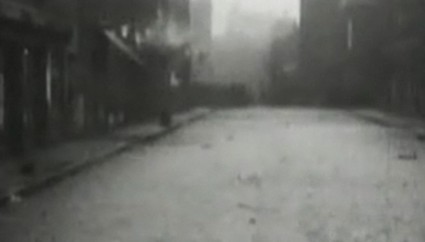
Gaumont’s coverage shows police gunfire from the buildings opposite 100 Sidney Street, from ITN Source

The Home Secretary had not been able to get the better of his curiosity. He arrived by car at midday and positioned himself at the corner of Sidney Street and Lindley Street, peering round to see what was happening. It was an extraordinarily foolhardy action, one which would soon lead to much criticism (and regret on Churchill’s part) but at the time the idea went round that he was directing operations. Pathé’s cameraman gained a huge scoop by obtaining close shots of Churchill (though the story that film was taken of a bullet going through his top hat is quite false). It seems that no other newsreel filmed him – Gaumont certainly did not, as they were positioned on the other side of the street, while Andrews resorted to deceit, declaring that its footage of men looking down at the siege included a rear view shot of Churchill (Churchill did not take up any rooftop position).

Then 100 Sidney Street caught fire. The gunfire ceased momentarily as wisps and plumes of smoke started to pour out of the building, which is vividly shown in the film record. Flames could seen from the windows, then the shooting started up again – not just from the soldiers because, extraordinarily, the men inside were still returning fire. Joseph may have been shot dead at this time (the fire started around 1.00pm), while Fritz Svaars died in the flames when the roof caved in and part of the first floor collapsed. Soldiers fired further volleys, then ceased. No one had escaped from the building and it was clear no one could have survived such an inferno. Fire engines arrived and poured water on the charred remains. As firemen entered the building, part of a wall collapsed and one of them died of his injuries – the third and final death caused by the siege of Sidney Street.

Pathé’s Animated Gazette’s coverage, showing 100 Sidney Street on fire, from British Pathe

The bodies of Fritz Svaars and Joseph were discovered inside, the second only as late as 8.00pm, by which time the newsreel films had been processed, printed and were on show in some London cinemas, scooping much of the press. In the manner of newsreels at this time, the films let the pictures do the talking. Intertitles on the extant films are matter-of-fact and offer little in the way of explanation, though they do employ loaded terms such as ‘assassins’, ‘murderers’ ‘aliens’ and ‘outrage’. The sensational nature of the films was all that was needed. Detailed description and background speculation was for the newspapers; the newsreels had simply to show audiences what the event looked like, to present the moving pictures of what everyone was talking about. The audience themselves would supply the rest.

These were the Houndsditch Murderers, or at least their associates, and most of the public would not have been greatly interested in their affiliations and what drove them to such desperate actions. Their war was not with the British authorities per se, but rather with Tsarist Russia. They (and there were a dozen or so associated with Houndsditch and Sidney Street) were refugees in Britain, which they used as a base for fund-raising and plotting revolution back in Russia. They had strong ideological motivation, and would have been contemptuous of the British police and army as tools of the oppressors. For the popular press they were all anarchists, but most had Social Revolutionary or Marxist affiliations, and had fought in terrible encounters with Tsarist forces, some of them undergoing savage beatings and torture. They believed they would receive similar brutality from the British police should they be caught, which helps explain some of their actions (Fritz Svaars in particular feared that he would break under torture after beatings he had received in Riga a year before). They used robbery to raise funds to support themselves and associates at home, and in some cases for gun-running or the production of propagandist literature.

Most were Jewish, and were part of the wave of refugees driven out of Russia by the pogroms of the late 1800s and the savage reprisals that followed the failed 1905 revolution. Britain had a reputation as a haven for such refugees, though most ended up in the sweatshops of the East End, desperately poor and roundly despised by the rest of society as ‘aliens’. British film contributed to this climate of hostility. Hepworth produced The Aliens’ Invasion (1905), in which English workmen were shown being thrown out of work because of Jewish immigrants accepting low wages; the Precision Film Company produced Anarchy in England (1909), which recreated the Tottenham Outrage; while Clarendon made The Invaders (1909) in which armed foreign spies occupy a British house disguised as Jewish tailors. However, most often films portrayed anarchists as figures of fun, as in Walturdaw’s The Anarchist and his Dog (1908) – he throws his bomb, but the dog retrieves it. The siege of Sidney Street itself was not dramatised at the time, but the basic details contribute to the climactic scenes of Alfred Hitchcock’s The Man Who Knew Too Much (1934) and a close recreation was attempted in Hammer’s The Siege of Sidney Street (1960).

The causes that drove the revolutionaries of 1911 have faded into history, even if terrorism on British shores inspired by overseas conflict and a different set of beliefs has not. But the films remain, and the press reports, and the photographs, and the many picture postcards that were produced, as tragedy was turned into commerce. The films not only show extraordinarily exciting things happening on the streets of London, but they show us an area of London never before visited by the motion picture camera. The wretched, run-down area of Stepney of 1911 would not have attracted cameras in the normal course of events, but humble Sidney Street, its environs and inhabitants gain some sort of fleeting immortality each time we run the films again, before disappearing back into history as the cameras once more turn to focus elsewhere.

Map of the Sidney Street area showing the besieged building (marked with red dot) and main camera positions of Andrews (A), Gaumont (G) and Pathé (P). Map from http://www.jewisheastend.com.

Three of the five newsreels made of the Sidney Street siege exist at the BFI National Archive, with further copies of these at British Pathé and ITN Source. Each runs for two to three minutes in length. Happily versions of all three can be found online:

  • The Battle of London (Pathé)
    Copies held by the BFI National Archive and British Pathé. There are two films on the British Pathé site – one is a dupe of the BFI film, the other is not Pathé’s film at all – it is Andrews’ (see below). The Pathé film, shot mostly from the north end of Sidney Street, shows police and troops taking positions (some shots look like they were staged afterwards), Churchill viewing the scene, the building catching fire (front and rear views), the fire brigade, and crowds in the streets afterwards. The intertitles read: “Battle of London. Houndsditch Assassins at bay, Besieged by soldiers and Armed Police” … “Troops firing at the murderers in Sydney [sic] Street” … “Mr. Winston Churchill, Home Secretary, watching the battle with the chiefs of Police and Detectives” … “The Besieged House catches Fire” … “Removing the bodies of the murdered and injured firemen”
  • The Great East End Anarchist Battle (Gaumont)
    Copies held by the BFI National Archive and ITN Source. The version on the ITN Source begins with the Gaumont film then at 2.43 turns into the Andrews film (see below). The film shows crowds and police to the south end of Sidney Street, police pushing back the crowds, views of either side of Sidney Street with smoke from gunfire, police holding back crowds with difficulty, view of the building on fire from rooftop of building opposite. The Gaumont intertitles on the ITN copy read: [No main title] … “The police pushing back the crowd at the commencement of the firing” … “The fire – and after”.
  • Houndsditch Murderers (Andrews Pictures)
    Copies held by the BFI National Archive, British Pathé and ITN Source. The BFI has two versions, one with English and one with German titles, Anarchistenschlat in London. The version online at ITN follows immediately after the Gaumont film; the version online at British Pathé is listed separately (though not as an Andrews film). The film shows views of Sidney Street from the south end with gunfire and police holding back crowds, rooftop view of the building on fire, further gunfire and police holding back crowds, rear view of men on rooftop (intertitles falsely state that Churchill is one of them), rooftop view of building catching fire and arrival of firemen who aim hoses at the building, a number of firemen scale a ladder. [Note: the ITN version is complete and in the correct order; the British Pathe copy is jumbled and incomplete] The intertitles on the ITN copy read: “Houndsditch Murderers. The Great Aliens Outrage at Mile End Shewing the Actual Scenes” … “Police and Soldiers Firing From Alleyways and Windows” … “Rt. Hon. Winston Churchill Directing Operations” [the German version in the BFI does not have this title] … “The Besieged House In Flames” … “Back View and Detectives Firing On Besieged Building” … “Arrival of Fire Brigades From All Parts of London And Entering House”

The BFI reportedly also has a Pathé’s Animated Gazette newsreel item on the December 1910 funeral of the policemen whose deaths led to the Sidney Street siege, Funeral in London of the Policemen Murdered by Burglars in Houndsditch (1910). (It is not listed on the current catalogue but is given in its 1965 Silent News Films catalogue, cat. no. N.323) [Update: The film exists – see comments]


For further information on the Sidney Street siege, there is one essential source. Donald Rumbelow’s The Houndsditch Murders and the Siege of Sidney Street (1973, revised 1988) is the classic account, outstanding in the dramatic detail and in its understanding of both police procedure and the revolutionaries’ motivations.

The Metropolitan Police Service has a short history of the siege from its point of view on its website. For an anarchist viewpoint, try www.siegememory.net, an interactive documentary on the siege currently in development (do check out the video trailer which claims that the mysterious ‘Peter the Painter’ – one of the ‘anarchist’ gang – is an ancestor of David Beckham).

The Museum of London Docklands currently has a small exhibition showing artefacts from the siege, examples of which can be view here. The exhibition runs until April 2011. The Independent has another image gallery, using exhibition artefacts and pictures from Donald Rumbelow’s collection.

Idiot with a tripod

As you’ll know if you’re a regular in these parts, we’re keen to encourage the silent film of today wherever we can. This effort was made by filmmaker Jamie Stuart in the New York snow, and was shot, edited and then published in just over a day (26-27 December 2010). It has gained praise from Roger Ebert, who compares its technique to Dziga Vertov’s Man with a Movie Camera and says that it ought to be awarded an Oscar.

Well it’s undoubtedly a polished piece of work from someone who who knows what he is doing technically (see Ebert’s interview with Stuart at the end of his post) but personally I think it’s some way off Vertov, not least because it doesn’t actually tell you anything. And it suffers from the curse of too many otherwise elegant pieces of wordless filmmaking to be found all over YouTube and Vimeo in adding a lame electro-music soundtrack which muffles the artistry rather than elevating it. But there’s a good editing rhythm to the video, every shot is telling, and each shot connects well with the next. OK, so it’s quite good. Just not that good.

The lost prince

Prince John in 1913, from Wikipedia

While sorting out some papers I came across a clipping which I’d quite forgotten about. It comes from the British film trade journal The Cinema in 1913 (there’s no more precise date on the copy, alas), and what it reports, though brief, is so striking that I have to pass it on. It tells us that a member of the British royal family apparently wrote a film scenario – for private consumption only – in 1913:

Princess Mary Writes a Scenario
Princess Mary, the only daughter of the King and Queen, has written a short comedy script for the moving pictures. This has been produced privately, and exhibited at Buckingham Palace. Prince John posed for one of the characters.

Princess Mary (later the Countess of Harewood) was then aged 16. The royal family were well aware of motion pictures and had been to see film shows (usually featuring themselves), and as early as October 1896 a privately-comissioned film had been made of Queen Victoria and guests at Balmoral, which survives (the guests included Tsar Nicholas and Tsarina Alexandra of Russia). But to be thinking of making their own dramatic film at such an early date is remarkable, not least for showing an awareness of the new popular entertainment that the commonfolk were flocking in their millions to see. Amateur dramatic films started to be relatively common in the 1920s, but 1913 is very early for such a production, whatever the strata of society.

And then there is the one named cast member. Prince John, the youngest son of King George V and Queen Mary, was a severe epileptic and was kept out of public view. There are photographs, but no motion pictures were ever taken of him – or at least that is what has been assumed. In 1913 he was was 8 years old – he would die in 1919, aged just 14. His story was poignantly told in 2003 in the Stephen Poliakoff television film The Lost Prince. The film showed us the boy viewing royal affairs with an innocent yet quizzical air, needing the love of his parents who instead hid him away on a farm, unable to express the emotions nature ought to have made them feel.

Was Prince John filmed after all? It is not certain this report is correct, of course. It could be merely relaying a rumour. But assuming the film did exist, who made it? (if it was a professional he was discreet about it, because I’ve not come across any such report) – and what happened to it? There is a royal film collection, some of which has long been in the care of the BFI National Archive, but the films in the collection are not of so early a date – at least as far as I know. The film is most likely to be lost, not so much because the royals are likely to lose things (I don’t think they often do), but because surely it would have been uncovered by now. Or it may simply have decomposed.

But someone ought to have a second look, just in case.

Capturing colour

Kinemacolor test film (‘Two Clowns’), filmed c.1906 by G.A. Smith and featuring his wife Laura Bayley

Capturing Colour: Film, Invention and Wonder is an exhibition on the early history of motion picture colour and related media. The exhibition opened on 4 December at Brighton Museum & Art Gallery and runs until 20 March 2011. The exhibition encompasses magic lanterns, early colour photography, chromatropes, kromskops and applied colour films, through to Kinemacolor, Kodachrome and Technicolor, and explores dramas and actualities, Hollywood productions and home movies.

There’s not much to look at on the Museum website, but I can vouch for the presence at the exhibition of some precious examples of very early motion picture colour technology, including a Lee and Turner triple-lens colour projector c.1901 and a Kinemacolor projector from the collection of the National Media Museum, which I saw being packed up for the exhibition a few weeks ago.

There will be a detailed report once I have visited the exhibition (late January, I think). Meanwhile, if you are interested in the history of colour cinematography, the Bioscope produced a series, Colourful Stories, on the first film colour systems, a couple of years ago:

  • Part 1: James Clerk Maxwell and the first colour photograph
  • Part 2: The Kromskop
  • Part 3: The first patent for colour cinematography, in 1897
  • Part 4: The Lee and Turner three-colour system, patented in 1899
  • Part 5: The Brighton School
  • Part 6: Inventing Kinemacolor
  • Part 7: Reviving Kinemacolor
  • Part 8: Hand-painted colour
  • Part 9: The Pathé stencil colour system
  • Part 10: First public exhibition of natural colour motion pictures
  • Part 11: Kinemacolor in America
  • Part 12: Tinting and toning
  • Part 13: The end of Kinemacolor
  • Part 14: Gaumont Chronochrome

I’m well aware that the series is not done yet (Prizmacolor, Kodachrome, Technicolor and more if we’re to complete the story for the silent era). I’ll get round to finishing it one day, I promise…

National Film Registry 2010

Newark Athlete (1891), one of five silent films included among the twenty-five films added to the National Film Registry for 2010

Once again at the end of the year we have the announcement of twenty-five further films added to the National Film Registry. Each year the Librarian of Congress (James H. Billington), with advice from the National Film Preservation Board (and with recommendations made by the public), names twenty-five American films deemed “culturally, historically or aesthetically” significant that are to be added to the National Film Registry, “to be preserved for all time”. The idea is that such films are not selected as the “best” American films of all time, but rather as “works of enduring significance to American culture”.

Five silent films are among the titles chosen for 2010, including two that have been championed in particular by the Bioscope: Preservation of the Sign Language, produced in 1913 in by National Association of the Deaf president George Veditz and one a of a number of films made by the Association at that time (available online from Gallaudet University); and the Miles Brothers’ haunting A Trip Down Market Street (1906), showing San Francisco just before the earthquake struck it. The others are Paul Fejos’ Lonesome (1928), which exists in both silent and sound versions, the William S. Hart western The Bargain (1914), and W.K.L. Dickson and William Heise’s 1891 proto-motion picture film experiment Newark Athlete, the oldest film to be added to the registry so far.

The other films on the 2010 list are Airplane! (1980), All the President’s Men (1976), Cry of Jazz (1959), Electronic Labyrinth: THX 113B 4EB (1967), The Empire Strikes Back (1980), The Exorcist (1973), The Front Page (1931), Grey Gardens (1976), I Am Joaquin (1969), It’s a Gift (1934), Let There Be Light (1945), McCabe & Mrs Miller (1971), Make Way for Tomorrow (1936), Malcolm X (1992), Our Lady of the Sphere (1969), The Pink Panther (1964), Saturday Night Fever (1977), Study of a River (1996), Tarantella (1940), A Tree Grows in Brooklyn (1945).

The full list of films entered on the National Film Registry since 1989 can be found here, while this is the list of all silents (or films with some silent content) on the Registry 1989-2009:

Ben-Hur (1926)
Big Business (1929)
The Big Parade (1925)
The Birth of a Nation (1915)
The Black Pirate (1926)
Blacksmith Scene (1893)
The Blue Bird (1918)
Broken Blossoms (1919)
The Cameraman (1928)
The Cheat (1915)
The Chechahcos (1924)
Civilization (1916)
Clash of the Wolves (1925)
Cops (1922)
A Corner in Wheat (1909)
The Crowd (1928)
The Curse of Quon Gwon (1916-17)
Dickson Experimental Sound Film (1894-95)
The Docks of New York (1928)
Evidence of the Film (1913)
The Exploits of Elaine (1914)
Fall of the House of Usher (1928)
Fatty’s Tintype Tangle (1915)
Flesh and the Devil (1927)
Foolish Wives (1920)
The Four Horsemen of the Apocalypse (1921)
The Freshman (1925)
From the Manger to the Cross (1912)
The General (1927)
Gertie the Dinosaur (1914)
The Gold Rush (1925)
Grass (1925)
The Great Train Robbery (1903)
Greed (1924)
H20 (1929)
Hands Up (1926)
Hell’s Hinges (1926)
Heroes All (1920)
The Immigrant (1917)
In the Land of the Head Hunters (1914)
Intolerance (1916)
It (1927)
The Italian (1915)
Jeffries-Johnson World’s Championship Boxing Contest (1910)
The Kiss (1896)
Lady Helen’s Escapade (1909)
Lady Windermere’s Fan (1925)
Land Beyond the Sunset (1912)
The Last Command (1928)
The Last of the Mohicans (1920)
The Life and Death of 9413 – A Hollywood Extra (1927)
Little Nemo (1911)
The Lost World (1925)
Mabel’s Blunder (1914)
Making of an American (1920)
Manhatta (1921)
Matrimony’s Speed Limit (1913)
Mighty Like a Moose (1926)
Miss Lulu Bett (1922)
Nanook of the North (1922)
One Week (1920)
Pass the Gravy (1928)
Peter Pan (1924)
The Perils of Pauline (1914)
Phantom of the Opera (1925)
The Poor Little Rich Girl (1917)
Power of the Press (1928)
Precious Images (1986)
President McKinley Inauguration Footage (1901)
Princess Nicotine; or The Smoke Fairy (1909)
Regeneration (1915)
The Revenge of Pancho Villa (1930-36)
Rip Van Winkle (1896)
Safety Last (1923)
Salome (1922)
San Francisco Earthquake and Fire, April 18, 1906 (1906)
Seventh Heaven (1927)
Sherlock Jr. (1924)
Show People (1928)
Sky High (1922)
The Son of the Sheik (1926)
Stark Love (1927)
Star Theatre (1901)
The Strong Man (1926)
Sunrise (1927)
Tess of the Storm Country (1914)
There it is (1928)
The Thief of Bagdad (1924)
Tol’able David (1921)
Traffic in Souls (1913)
The Wedding March (1928)
Westinghouse Works, 1904 (1904)
Where Are My Children? (1916)
Wild and Wooly (1917)
The Wind (1928)
Wings (1927)
Within our Gates (1920)

The Library of Congress welcome suggestions from the public, and even provides a helpful list of titles not on the Registry yet but which are under consideration, to help prod your memories. It contains some 225 silent films alone, which suggests that they are not about to run out of ideas just yet.

But what about a world film registry, one which drew attention to world cinema (silents and beyond) and its need for preservation on account of its cultural, historical or aesthetic relevance? We have some films on UNESCO’s Memory of the World register, but that’s not really enough. Isn’t it the sort of thing that FIAF ought to promote?

Charting words

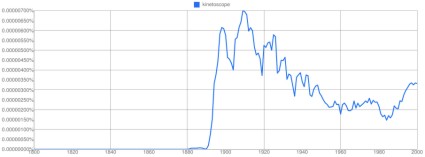
Ngram for Kinetoscope, for the years 1800-2000

Well, the Bioscope is back from its Christmas break, and keen to get the fingertips tapping once more. First up, it’s a new tool from Google Labs which offers interesting ways of analysing silent film subjects (or any other subject, for that matter). The Ngram Viewer uses data taken from the 15 million books and other documents scanned by Google Books to trace the occurence of words or phrases (up to five words) between 1800 and 2000, showing how often they occur each year.

Ngram for Bioscope, showing the first emergence of the word in the early 1800s, then its huge rise in use from 1900 onwards

All you do is enter your search term or phrase, then choose a time period and your language, and you get the results presented as a graph. So, enter the term ‘bioscope’ and you discover that the word first appears in the early 1800s – as indeed it did, having been coined in 1812 by Granville Penn for his religious tract The Bioscope, or Dial of Life. It emerges once again in the late 1890s when it was adopted by a number of early film producers (Charles Urban, Max Skaldanowsky, Georges Demenÿ) as a name for a film projector), its use exploding over the next 15 or 20 years as it became a generic term for cinema. Then it fades as the word ‘cinema’ takes over, only to enjoy a resurgence, probably on account of the increased use of the word as a make of microscope.

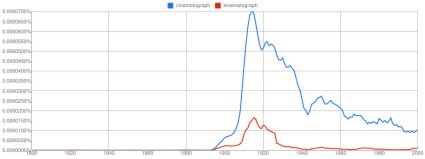
Ngram for Cinematograph (blue) v Kinematograph (red)

Having searched for your term, below the graph you are given the option to search Google Books itself for your term by particular time periods or universally (search under 1800-1913 and sure enough Granville Penn’s book comes up first). You can also compare your term with others, by adding a comma-separated second term into the search box, as shown above with a search for Cinematograph v Kinematograph – with the relevant graphs in different colours. You can compare any number of terms, though there are only five colours available.

Ngram for Chronophotography

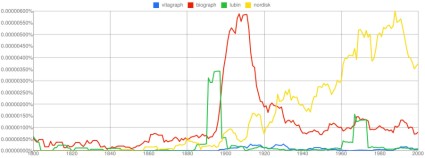
There seem to be any number of interesting applications for this as a tool, even if the results are approximate and erratic. The frequency of appearance of terms in books is not necessarily a reliable guide to their importance, and some terms register no scores at all (e.g. Gaumont, Muybridge, Mary Pickford), presumably because Google Books hasn’t indexed them yet. But there is more than enough there to encourage imaginative searches and to yield interesting discoveries. I’m certainly intrigued to see the rise, fall and rise again of the word ‘chronophotography’ from 1880 to 2000. Look at the perfect curves of adoption for ‘documentary’ or ‘travelogue’, the absence of ‘silent film’ as a phrase until silent films had almost stopped being produced, or try out a comparison of film companies like this one (while remembering that some company names will be common terms which will skew the results):

Ngram comparing Biograph (red), Vitagraph (blue), Lubin (green) and Nordisk (yellow)

Do have a go, and let us know of any interesting Ngrams that you are able to create.

A Christmas Carol

Well it’s time for the Bioscope to set aside the quill pen for a few days as we head off to join the nearest and dearest for Christmas. While I’m gone, here’s a musical interpretation of the 1910 Edison film A Christmas Carol with Marc McDermott as Scrooge, as performed by Vox Lumiere, the American troupe who combine silent film screenings with rock opera, and classical quintet The Definiens Project. Make of it what you will.

A happy Christmas to you all. Be kind and good.

The ballet and the film

Lydia Lopokova dancing alongside herself in ‘Dancing Grace’ from Eve’s Film Review no. 592, issued 6 October 1932 (but probably originally released 1922)

Thanks to an item on The Guardian film blog I have been led to this extraordinary film on the British Pathe website. Entitled ‘Dancing Grace‘, the film shows a ballerina – unidentified on the film, but now known to be Lydia Lopokova – dancing before the camera against a black background. What makes the film so remarkable is the use of slow motion and double exposure techniques to show Lopokova effectively dancing with herself. It is an uncanny foreshadowing of Norman McLaren’s classic dance film Pas de Deux (1968), with its multiple exposures of dancers creating images of extraordinary grace and beauty, only four decades earlier.

In its technique and imagination I can’t think of any film from the silent era that matches it, brief as it is. Who filmed it? The film was just one item among five in an issue of the cinemagazine Eve’s Film Review, which Pathé produced chiefly for women audiences. Much of Eve’s Film Review was shot by newsreel stalwart Ken Gordon, though nothing else in his long career points to artistry such as this.

Norman McLaren’s Pas de Deux, from The National Film Board of Canada

And why was it filmed? The Guardian tells the engrossing story of how Sergei Diaghilev’s Ballets Russes were in London at the end of 1921 and performing at the Alhambra in Leicester Square, where Lopokova appeared in Tchaikovsky’s ballet, ‘The Sleeping Princess’, based on the Sleeping Beauty story. The conductor of the piece, Eugene Goossens, was also conducting at the Royal Opera House, which had been hired out by American film impresario Walter Wanger for the British premiere of The Three Musketeers, starring Douglas Fairbanks. Diaghilev was intrigued by how well Goossens matched music to film, and proposed a film of ‘The Sleeping Princess’ to Wanger, ideally to be filmed in colour, the same as another film Wanger had put on at the Opera House, J. Stuart Blackton’s The Glorious Adventure, filmed in Prizmacolor and starring Lady Diana Manners. According to an article in Dance Research by Lynn Garafola, the painters Augustus John and S.H. Sime were to be involved with the sets. Given Diaghilev’s well-documented distaste for popular culture and his refusal to allow the Ballet Russes to be filmed, it would have been a remarkable change of heart – and, one would like to hope, a film of some considerable beauty.

One-second frame sequences from ‘Dancing Grace’ with Lydia Lopokova

Sadly the colour film of the Ballet Russes was not to be. ‘The Sleeping Princess’ was not a success at the Alhambra and the theatre’s owner Oswald Stoll replaced it with a Norma Talmadge film, while the debt-ridden Diaghilev and his company slunk away to Paris. The Guardian piece then relates how later in 1922 Wanger hired Lopokova and Léonide Massine to dance Stravinsky’s Ragtime as part of a programme at Covent Garden which included Wesley Ruggles’ film Love, starring Louise Glaum.

All of this is illuminating illustration of how film could be mixed up with the other arts, and the growing interest that film had for British high society. Half of the young upper class of London appeared in crowd scenes for The Glorious Adventure, while Lopokova and her economist husband John Maynard Keynes – first attracted to her when he saw ‘The Sleeping Princess’ – were very much a part of the Bloomsbury set (alongside Virginia Woolf, Lytton Strachey, Duncan Grant et al.), well-born, intellectual experimenters in the arts and in ways of living, a number of whom were attracted to the cinema (Virginia Woolf wrote a notable essay ‘The Cinema’, while Keynes was a member of the Film Society, which brought Soviet film classics to Britain for the first time).

There is some confusion over the date of the film. One version of it is held by the BFI National Archive, under the title Eve’s Film Review: Dancing Graces: Studies of Madame Lopokova, dating it as 1922. It is this version which currently features in an exhibition at the Victoria & Albert Museum, Diaghilev and the Golden Age of the Ballets Russes, 1909-1929. However the British Pathe version bears the Eve’s Film Review issue number 592, which the BUFVC’s News on Screen database says dates it as 6 October 1932. Presumably the film was first made in 1922 and then re-used by Pathé ten years later. There is some overlap between the two, but mostly the 1932 version is a continuation of 1922 – but no longer mentions Lopokova’s name. Meanwhile, she enjoyed a further foray into film, when she appeared alongside George Balanchine and Anton Dolin in a ballet sequence for the early British sound film, Dark Red Roses (1929). Clearly Lopokova (and Keynes) had a lasting interest in film, and the worlds of ballet and film were not seen as being completely apart.

This is demonstrated in a famous essay by Anthony Asquith, ‘Ballet and the Film’, published in Caryl Brahms’ Footnotes to the Ballet (1936). Asquith directed two sound films with prominent ballet sequences, Dance Pretty Lady (1932) and The Young Lovers (1954), but his essay mostly concerns the silent film and its relationship with dance. He notes the basic similarity between the two in their most basic form, but argues that

the mime in the earliest films corresponded in function if not in style to that of the more decadent classical ballets.

For Asquith, just as advances in ballet moved the dance from mere display to expression of mood or a character’s state of mind, so the film developed from crude histrionics to greater subtely of expression through the innovation of the close-up and the discovery by D.W. Griffith of a style of mime ‘that bore to life something of the relation that verse or poetical prose bears to ordinary speech’. He follows this interiorisation of style through to The Cabinet of Dr Caligari, a film entirely of the mind since it all takes place inside the head of a madman. At the same time he traces a trend towards greater naturalism in ballets, so that the two art forms, coming from different directions, more or less meet at a point in the 1920s when a ballet film could most profitably be imagined. However, Asquith has his doubts about the silent ballet film:

[F]ilm and ballet have another common element – rhythm. And from the rhythmic point of view the ballet is far more like the sound film than the silent. In a silent film there are two kinds of movement: the movement of people or objects within the limits of a shot, i.e. in a given strip of film photographed without a break, and the movement expressed by the realisation of one shot to another, just as in music there is the rhythmical relation of notes to each other within the limits of a phrase and there is the rhythmical relation of phrase to phrase.

Asquith therefore compares the rhythm of silent film to the rhythm of music, arguing that in each case just the one sense is affected, through the eyes or through the ears respectively. But he then argues that the rhythm of ballet is not one or the other, but ‘the relation of each to each’.

All of which is a somewhat theoretical way of arguing that he wanted his ballet films to have a soundtrack. But ‘Dancing Grace’, even though it runs for no more than a minute and a half, points to a kind of ballet film that the silent film could have made its own. It gets inside the mind of the ballet, revealing its inner workings and not just its outward show.

An earlier Bioscope post has traced something of the history of dance and silent film. Intriguingly it includes another Douglas Fairbanks connection, as one of the three extant silent films of Anna Pavlova is a short fragment showing her dancing ‘Columbine’ on the set of Fairbanks’ The Thief of Bagdad (1924).

Diaghilev and the Golden Age of the Ballets Russes, 1909-1929 runs at the V&A until 9 January 2011 and features the Lopokova ‘Dancing Grace’ film. There is an exhibition blog post which talks about the two versions of the film.

Finally, the BUFVC’s News on Screen database lists another film from 1922, now lost, from the Around the Town cinemagazine, with the description ‘Lopokova in an improptu dance “Inspired by the Sun” on ultra-rapid camera’. Around the Town was made by Gaumont, not Pathé, so did Lopokova make two slow motion ballet films (i.e. requiring an ultra-rapid camera) in 1922? Intriguing.

Saving motion

Paolo Cherchi Usai (left) and Kevin Brownlow

On 19 January 2011 there is to be a notable event held at the Kenneth Clark Lecture Theatre of the Courtauld Institute of Art, Strand, London, by the International Institute for Conservation of Historic and Artistic Works. This august institution is devoted to promoting the knowledge, methods and working standards needed to protect and preserve historic and artistic works from around the world, but as well as the paintings, sculptures, buildings, museum artefacts and such like that are its usual concern, it also considers moving images. As one of its series of ‘Dialogues for the New Century’ is inviting Kevin Brownlow and Paolo Cherchi Usai to debate Saving Motion – the conservation of the moving image.

Here’s how the IIC describes the event:

Motion pictures, the movies, enjoy a position of both mass entertainment and valued products of our creative heritage. From the era of silent films to today’s high budget features, masterpieces abound, as do intimate personal moments and historic documentaries that capture the intangible aspects of what surrounds us.

Moving image heritage makes up a large portion of the world’s memory and both commercial and personal examples are found in every country and in every size and type of institution across the world. Archives, libraries, and museums struggle to conserve these records in a manner that attempts to respect the authenticity and inherent values while assuring and encouraging broad access. As the idea of digitization presents itself as a solution to both preservation and accessibility, questions arise regarding the value of the original footage, the qualities unique to film based material, our stewardship responsibilities to preserve these works in their unique original form, and the essential role and definition of film archives.

Kevin Brownlow and Paolo Cherchi Usai will explore a wide range of issues pertaining to the preservation of moving image heritage (films, video and digital materials) as well as the particular challenges of access. This dialogue between two of the leading pioneers and experts of the preservation of motion pictures will also explore the reasons for an apparent disconnect between those pursuing the preservation of film and the larger conservation community working toward the preservation of heritage in other art forms.

Kevin Brownlow is a filmmaker, film historian, author, and Academy Award recipient, best known for his documentation of the history of silent films. He is the creator of the alternative-history film, It Happened Here and the 1975 film Winstanley. Brownlow has written numerous works on silent and classic films including The Parade’s Gone By (1968). In collaboration with David Gill he produced a number of documentaries on the silent film era, including the 1983 Unknown Chaplin and the 1995 Cinema Europe: the Other Hollywood. His book The Search for Charlie Chaplin was published this year, 2010.

Paolo Cherchi Usai, is director of the Haghefilm Foundation in Amsterdam, cofounder and co-director of the Pordenone Silent Film Festival and of the L. Jeffrey Selznick School of Film Preservation at George Eastman House. He has authored numerous works on film and its preservation including Burning Passions: An Introduction to the Study of Silent Cinema (1994), The Death of Cinema: History, Cultural Memory, and the Digital Dark Age (2001) and co-author of Film Curatorship: Archives, Museums, and the Digital Marketplace (2008).

The event promises to be a fascinating one, with a strong bias toward silent film, and with two of the most prominent, thoughtful and opinionated people in our field addressing an audience of general conservationsists rather than the usual film crowd. In particular the theme of a disconnect between the conservation of film and the conservation of other heritage works promises much. Does the care of film exist in a world of its own, separate from the conservation or preservation of other media, and if so then why so, and is it a good or bad thing? If we could hang films in national galleries or museums might they be better cared for? Or might those who care for other heritage media have something to learn from how film archives manage huge problems with minimal resources while contending with thorny issues such as copyright which do not affect those caring for old masters or archaeological sites?

Previous such dialogues have been made available in transcript form on the ICC site, so if you can’t be there you can still read about it. The event takes place at 19:00 and is free to all.