Quellen zur Filmgeschichte und einiges anderes

I was delighted to find that Herbert Birett’s site Quellen zur Filmgeschichte und einiges anderes is still active. I lost track of it some years ago, when it seemed to have taken down, but it is alive and well under the more memorable web address www.kinematographie.de. Birett is an assiduous chronicler of German film history, whose speciality is filmographies based on censorship files and other forms of official records. His major work is the book Das Filmangebot in Deutschland, a listing of 17,000 films shown in Germany 1895-1911, which he sells for €70, but there is much of his site that he makes freely available.

There is a title list for all German films 1921-1930; Weimer Republic censorship records 1922-1932; a bibiliography of German film monographs to 1914; a listing of German movie journals to 1920s with notes as to their location in libraries; plus other resources for German sound films. It’s in German, but with some helpful short descriptions in English for each section. Birett’s work is exemplary, and the site is a key resource for the specialist.

Popping the question

Well, here’s a romantic little tale from the gossip columns involving Patricia Arquette (film actress) and Thomas Jane (I haven’t a clue), who proposed to her in the following manner as described in the Philadelphia Daily News:

Last week Thomas Jane told Tattle’s Baird Jones at the premiere party for “The Mist” at NYC’s Rosa Mexicano how he popped the question to wife Patricia Arquette.

“My marriage proposal was very simple,” he said. “I cut myself into a Charlie Chaplin film and rented out a silent movie theater in Los Angeles and invited my wife to be on a date to go see a silent film.

“… When we walked in, the theater was dark and you could not see that it was empty. Then I had the projectionist and the owner laughing and trying to make it sound like there were people there.

“About 20 minutes into it, I cut myself into the film with cards. Chaplin swallowed a whistle and in the movie there was a host of a party who gathered everyone around a piano to sing a song with cards. Then they cut to me with cards and each card said, ‘Will’ ‘You’ ‘Marry’ ‘Me’ ‘Patricia.’ I had dressed myself up like a waiter and Patricia (Arquette) was sitting there thinking to herself, ‘Who is this waiter?’

“… Finally it dawned on her what was going on. She shouted ‘Yes’ at the screen, over and over. Then we had the projectionist run it again just for fun. I kept a copy.”

The Chaplin film in question is City Lights, which features the whistle-swallowing gag which takes place during a party. So how did Mr Jane go about this? Did he really get a print of City Lights, then shoot extra scenes to correspond with those from the original film? Was it all digital trickery? How convincing was it? How much did it all cost? What might the Chaplin estate think?

Peter Kobel’s Silent Movies

Silent Movies

http://www.readexpress.com

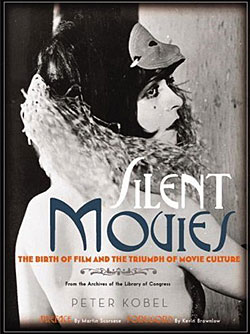
It’s not published in the UK until 6 December, but just in case you were thinking about writing that letter to Santa, you might want to add Peter Kobel’s Silent Movies to the list. This is a deluxe history of the genre, grandolinquently subtitled ‘The Birth of Film and the Triumph of Movie Culture’, and has been five years in the making. It accompanies a Library of Congress touring programme, and it gets a preface by Martin Scorsese (what doesn’t these days?) plus an introduction by Kevin Brownlow, which should be stamp enough of approval for anyone. I’ll post something here once I’ve actually got my hands on a copy, but meanwhile the book has been published in the USA already, and generated a lot of comment. Here are some related links:

The Library of Congress press release for the book.

An interview with Kobel (an arts and entertainment journalist) on readexpress.com.

Richard Schickel’s rather jaundiced review of the book for the Los Angeles Times.

Peter Kobel’s personal site.

From 1896 to 1926 – part 7

We return to the reminiscences of Edward G. Turner of the Walturdaw company, pioneer film distributors. Turner is now talking about their business situation in the 1900s, when they turned to production as well as distribution. As is usual with Turner, what gives him equal pleasure is the mechanical side of the business, here devices for preventing fire, and getting the better of the London County Council.

Prior to our moving to Dane Street, the three partners had not definite duties. We all put our hands to whatever was required of us during the day, and acted as operators at night. We were buyers and sellers of everything in the kinematograph Industry, new or secondhand.

There was one member, however, whose inclinations were photographically inclined, and so we took lease of Wembley Park and erected there something novel in the way of outdoor studios – a revolving platform, which allowed us to put up three sets of scenery at a time, when the wind allowed it, and each could be brought to the camera as required. Further, it was so constructed that we could always get the best of the light and sunshine.

[Ernest] Howard took charge of this department – his lieutenants being J.B. McDowell and E. Bloomfield – these latter were our cameramen.

Albert Bloomfield left Walturdaw in 1908, forming the British & Colonial Kinematograph Company, J.B. McDowell soon joining him. McDowell would go on to achieve lasting fame as a cameraman in the First World War, filming much of the documentary feature The Battle of the Somme (1916). Interestingly, one of the companies he worked for before Walturdaw was the British Mutoscope and Biograph Company, which had a revolving open-air studio (on the Thames embankment) much as Turner describes, dating around 1899.

[J.D.] Walker took over the Film Hire Department, [G.H.J.] Dawson the Entertainment Department, and myself the Sales and Accessory Department. The business thus became sectionalised, each man devoting himself exclusively to his own side of the business, whereas in the past we had been cosmopolitan in this respect. Things grew apace, and we were doing business with all parts of the world.

A Fireproof Spool

One day at Dane Street, the late Mr. Holmes, of Essex Road, who was the chief kinematograph mechanic to Levy Jones, of Horton Square, called to see me, and found me experimenting with a tin box. Instantly he said to me, ‘I see what you are after, I am working on the same thing; suppose we join forces?’

While we were discussing the point, my eye fell on a kinematograph camera film box (in those days the boxes were outside the camera). At once we had solved the problem. Why not make a copy of the camera film box in metal, fit it to the top of the kinema machine, make a similar box for the bottom spool-arm and so get fire-proof spool boxes?

The first pair were made of mahogany, and Mr. Holmes used them pretty regularly. They answered their purpose perfectly. We then had them made in metal and thus came about one of the greatest improvements in the kinema world.

A Lost Fortune

I took the model to Mr. Wrench and asked his advice as to taking out a patent, as I had done previously with the fireproof gate. I shall remember his words as long as I live:

He told me he had taken out over 100 patents on his lanterns, and never made any money out of any of them; other makers copied, and rarely was he able to stop them, except at great expense. Further, non-flam film was bound to be perfected in a month or two (it was always to be a month or two as it is to-day), and when non-flam film did come out, that would solve all our difficulties with the L.C.C., insurance companies and other authorities.

Alas! I took his advice and lost a fortune. The owner of those patents would be rolling in untold wealth to-day, as spool-boxes are compulsory all over the world.

Films, of course, were of cellulose nitrate, and were highly inflammable. ‘Non-flam’, or safety films (cellulose acetate) were often talked about, but in general they lacked the robustness of nitrate. Some safety systems were available around 1908, but cellulose acetate really only found use for narrow gauge systems designed for non-theatrical and amateur use, of which Edison’s 22mm Home Kinetoscope system, introduced in 1912, was the first.

The L.C.C. Butts In

No more was heard of fireproof spool-boxes until the demonstration which was given at the London Hippodrome, on December 17, 1908, when no fewer than ten firms exhibited, before the representatives of the London County Council and insurance bodies, their machines, showing how they had tackled the question of making the machines safe.

Incidentally, I claim to have had a good deal to do with this demonstration. It came about in this way. Passing the Hippodrome about a fortnight previously, I found that a demonstration of fire extinguishing apparatus for kinematographs was being given inside the Hippodrome. I walked in to see what was moving, and discovered that the apparatus was similar to an ordinary water cistern, such as are used in w.c.’s, fitted on four rods and suspended over the machine; this was the ingenious arrangement that the trade had been called together to see.

The apparatus was so arranged that if a piece of film caught fire it released a spring and the water supposed to come down and put the fire out. I, with a number of other exhibitors, saw this absurd apparatus, and laughed it to scorn, but certain members of the County Council were strongly in favour of foisting this wretched thing upon the trade.

The Test that Failed

Mr. Brandon (one of the oldest exhibitors) and myself, stepped into the ring and challenged the efficacy of this absurd invention, and I, as spokesman, asked that a fair test might be given, first to the apparatus which the various makers were selling, and secondly, that the County Council would call us together to demonstrate. The test was to be under the same conditions that we would have if we were actually showing, and this challenge was accepted.

Frank Allen kindly granted us the use of his ring, and on December 7 the demonstration was given, and proved the death knell of the water cistern, for when the film was set fire to by means of the rays from the arc lamp, the wretched invention failed, the water instead of coming down all over the spool and putting the fire out, simply fell over the bottom spool and damaged the film – and let the rest flare away.

All the other machines were tested very severely by the judges, and each came out triumphant. Some of the tests were really severe, inasmuch as they fired the film on the top sprocket, the bottom sprocket, and in the gate, and yet in no instance did the fire enter into the spool cases.

Stay turned for the next episode, when Turner tells us about ‘Flicker Alley’ and discusses the rise of the exclusive.
Theses and dissertations

A few days ago I posted something on Donald Young’s Motion Pictures: A Study in Social Legislation, a 1922 doctoral thesis available from the Internet Archive. I said that it had to be one of very first doctoral theses to be awarded on the subject of film. But was it the first?

Well, The Bioscope is loathe to leave such questions lie unanswered, and it so happens that I knew where to find the answer. In 1979, Raymond Fielding, author of standard books on American newsreels and The March of Time, produced A Bibliography of Theses and Dissertations on the Subject of Film: 1916-1979, published as University Film Association Monograph no. 3. This is a fascinating piece of work. It lists every traceable graduate dissertation and thesis on film from American universities, up to 1979. It lists 1,420 of them. However, it is not until the 1960s that we really start to get academic studies of films and filmmakers as we might expect now. Before then, subjects such as the educational film, sociological studies, and the economic aspects of film are common. Film as a means to learn about other subjects predominates for the early decades.

So, was Donald Young first? No – his was the second doctoral thesis to be awarded, and both of those were preceded by a masters dissertation by one Ray L. Short in 1916, awarded by the University of Iowa. Whatever happened to him? (see comments) Anyway, here are the twelve dissertations and theses that were awarded up to 1930:

  • Ray L. Short, ‘A social study of the motion picture.’ M.A., University of Iowa, 1916
  • Perry Roberts, ‘The social aspect of the motion picture.’ Ph.D, Southern Baptist Theological Seminary, 1920
  • William Breidenbach, ‘Design of a moving picture theater.’ M.A., Ohio State University, 1922
  • Donald Young, ‘Motion pictures: A study in social legislation.’ Ph.D, University of Pennsylvania, 1922
  • Harold Morgan, ‘Wish-fulfillment in drama and motion pictures.’ M.A., University of Wisconsin, 1925
  • H.F. Cummings, ‘Motion pictures in education.’ M.S., Boston University, 1929
  • Margaret Akin, ‘Social valuations of two hundred [and?] three motion pictures.’ M.A., University of Washington, 1930
  • Ralph Cassady, ‘Historical analysis of competitive practices in motion picture production, distribution, and exhibition.’ Ph.D, University of Califonia, Berkeley, 1930
  • Henry Hawley, ‘Distribution as a factor in commercial integration in the motion picture industry.’ D.C.S., Harvard University, 1930
  • Perry Holaday, ‘The effect of motion pictures on the intellectual content of children.’ Ph.D., University of Iowa, 1930
  • E.M. Porter, ‘The curve of retention in moving pictures for young children.’ M.A., Universiy of Iowa, 1930
  • Victor Rapport, ‘The motion picture: A study in commercialized recreation.’ Ph.D, Yale University, 1930

There’s a Ph.D to be undertaken reinvestigating all those. Fielding doesn’t provide a chronological index to his bibliography, but from his index to themes we learn that the first dissertation on Chaplin was in 1949 (the next wasn’t until 1974). The first on D.W. Griffith was in 1961. Buster Keaton was first so recognised in 1970.

But what about British universities, or elsewhere? What was the first British film Ph.D? This time round, I don’t know. Does anyone? (OK, the answer might be found on Index to Theses, but I don’t have a subscription).

Update: Stephen Bottomore has passed on the following information about theses and dissertations that were produced elsewhere, and an American dissertation that precedes that of Ray L. Short. The information is in the comments, but I’m reproducing it here as well:

Some time ago I started updating Fielding’s list for these theses re/from the early era, and found there was even one before Short’s:

Joseph Richard Fulk, “The Motion Picture Show with Special Reference to Its Effects on Morals and Education,” M.A., Univ. of Nebraska, 1912.

In the same year was the first (?) French one: Jean Marchais, “Du Cinématographe Dans ses Rapports Avec le Droit d’Auteur,” Doctorat, Faculté de Droit, Université de Paris, 1912.

Germany’s first (?) came in 1913. I haven’t researched the UK so much, but the first I’ve found is Frances Consitt, “The Use of Films in the Teaching of History,” Leeds, 1931.

Thanks as always, Stephen. I have a copy of Frances Consitt’s work, which was research conducted on behalf of the Historical Association, and which was published formally in 1931. More on what is a fascinating work at another time, perhaps.

Another update: Frank Kessler has just reminded me that the first German doctoral thesis was Emilie Altenloh’s Zur Soziologie des Kino: Die Kino-Unternehmung und die Sozialen Schichten Ihrer Besucher, awarded by the University of Heidelberg in 1913, and published in book form in 1914. This is an exceptional piece of work, a sociological study strikingly modern in method and conclusions. It is based around a questionnaire and interview survey of some 2,400 filmgoers in the medium-sized industrial town of Mannheim during 1912 and 1913. It is in two parts: part one on production; part two on audiences and reception. The latter is available in an English translation by Kathleen Cross, as ‘A Sociology of the Cinema: the Audience’, Screen, vol. 42 no. 3, Autumn 2001, pp. 249-293. It’s a work I should return to at another time. Meanwhile, for those able to read German, the full text is available from the University of Oldenburg site.

And another update: How could I have forgotten? There was a doctoral thesis submitted by George Esdras Bevans, How workingmen spend their time, submitted to Columbia University in 1913, which has already been the subject of a post. Although not directly about the cinema, it does include data about cinema-going in its survey of American working class entertainments.

And a final update: There is one doctoral thesis that beats all the above. The French medical researcher, Jean Comandon, as part of his work on microscopic organisms, such as the syphillis spirochete, employed microcinematography (combining cinematograph with microscope), observations from which which were included in his 1909 thesis De l’usage clinique de l’ultra-microscope en particulier pour la recherche et l’étude des spirochètes. In the same year he was taken on by the Pathé company to make microcinematographical films of organisms for the popular cinema market, and he went on to enjoy a notable career as a scientific filmmaker (including a period in the late 1920s working for Albert Kahn).

Two new titles from Eureka

Last Laugh and Woman in the Moon

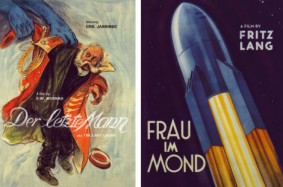
Eureka Entertainment has announced the UK release of two DVDs, F.W. Murnau’s Der letzte Mann (The Last Laugh) and Fritz Lang’s Frau im mond (Woman in the Moon). Both titles will become available on 21 January 2008. Below is some blurb from Eureka for each of the titles:

Der Letzte Mann (1924)

A landmark work in the history of the cinema, Der letzte Mann represents a breakthrough on a number of fronts. Firstly, it introduced a method of purely visual storytelling in which all intertitles and dialogue were jettisoned, setting the stage for a seamless interaction between film-world and viewer. Secondly, it put to use a panoply of technical innovations that continue to point distinct ways forward for cinematic expression nearly a century later. It guides the silent cinema’s melodramatic brio to its lowest abject abyss — before disposing of the tragic arc altogether. The lesson in all this? That a film can be anything it wants to be… but only Der letzte Mann (and a few unforgettable others) were lucky enough to issue forth into the world under the brilliant command of master director F.W. Murnau.

His film depicts the tale of an elderly hotel doorman (played by the inimitable Emil Jannings) whose superiors have come to deem his station as transitory as the revolving doors through which he has ushered guests in and out, day upon day, decade after decade. Reduced to polishing tiles beneath a sink in the gents’ lavatory and towelling the hands of Berlin’s most-vulgar barons, the doorman soon uncovers the ironical underside of old-world hospitality. And then — one day — his fate suddenly changes…

Der letzte Mann (also known as The Last Laugh, although its original title translates to “The Last Man”) inaugurated a new era of mobile camera expression whose handheld aesthetic and sheer plastic fervour predated the various “New Wave” movements of the 1960s and beyond. As the watershed entry in Murnau’s work, its influence can be detected in such later masterpieces as Faust, Sunrise, and Tabu — and in the films of the same Hollywood dream-factory that would offer him a contract shortly after Der letzte Mann‘s release. The Masters of Cinema Series is proud to present the original German domestic version of the work that some consider the greatest silent film ever made.

SPECIAL FEATURES

  • New, progressive encode of the recent, magnificent film restoration
  • Der letzte Mann – The Making Of – documentary by Murnau expert Luciano Berriatúa [41:00]
  • New and improved optional English subtitles (original German intertitles)
  • Lavishly illustrated 36-page booklet with writing by film scholars R. Dixon Smith, Tony Rayns, and Lotte H. Eisner — and more!!!

Frau im mond (1929)

Frau im Mond is: (a) The first feature-length film to portray space-exploration in a serious manner, paying close attention to the science involved in launching a vessel from the surface of the earth to the valleys of the moon. (b) A tri-polar potboiler of a picture that manages to combine espionage tale, serial melodrama, and comic-book sci-fi into a storyline that is by turns delirious, hushed, and deranged. (c) A movie so rife with narrative contradiction and visual ingenuity that it could only be the work of one filmmaker: Fritz Lang.

In this, Lang’s final silent epic, the legendary filmmaker spins a tale involving a wicked cartel of spies who co-opt an experimental mission to the moon in the hope of plundering the satellite’s vast (and highly theoretical) stores of gold. When the crew, helmed by Willy Fritsch and Gerda Maurus (both of whom had previously starred in Lang’s Spione), finally reach their impossible destination, they find themselves stranded in a lunar labyrinth without walls — where emotions run scattershot, and the new goal becomes survival.

A modern Daedalus tale which uncannily foretold Germany’s wartime push into rocket-science, Frau im Mond is as much a warning-sign against human hubris as it is a hopeful depiction of mankind’s potential. The Masters of Cinema Series is proud to present for the first time in the UK the culmination of Fritz Lang’s silent cinema, newly restored to its near-original length.

SPECIAL FEATURES

  • Brand new film restoration by F. W. Murnau-Stiftung
  • Original German intertitles with newly-translated optional English subtitles
  • 36-page booklet which includes a newly revised analysis by Michael E. Grost on the film, and on Fritz Lang’s body of work as a whole — and more!

Moonshine

Moonshine

Moonshine CD cover

Dedicated Bioscope watchers will know that I like a little jazz with my silents, and that earlier this year I reported on seeing American trumpeter Dave Douglas and his Keystone band playing music inspired (obliquely) by the work of Fatty Arbuckle at the Bray Jazz festival in Ireland. Well, blow me down if they haven’t produced a CD of the music, but it’s a live recording from the Bray concert itself, so you can hear me applauding in the background.

The CD is entitled Moonshine, which is of course the title of a 1918 film that Arbuckle made with Buster Keaton, probably best known for its much-imitated gag of having a seemingly endless procession of people pour out of a car. Douglas’ music is not really intended as accompaniment to Arbuckle’s films (it certainly doesn’t work in that way), and is more an expression of ideas inspired by Arbuckle’s work. As Douglas says:

But these pieces weren’t written as soundtracks, more as reflections on great forgotten absurdities like ‘Mabel and Fatty’s Married Life’ and ‘The Rough House.’ The bounce and bubble of those characters begged for a beat – shimmering shadows on the screen hinting at hidden crevices of texture and timbre. The songs reflect the atmosphere of those innocent/zany black and white images, refracted through a 21st century jazz sensibility, interpreted by an eclectic collection of gifted musicians.

Those musicians are Douglas (trumpet), Marcus Strickland (saxophone), Adam Benjamin (keyboards), Brad Jones (double bass), Gene Lake (drums) and DJ Olive (turntables and laptop – yep, its modern jazz, folks).

The CD is released on 27 November, but it seems it is available now as MP3 downloads. There’s more information on the Greenleaf Music site.

Douglas and Keystone have released two other CDs, Keystone and Keystone: Live in Sweden.

I’m seated ten rows back on the right, by the way…

Update: Arbuckle and Keaton’s Moonshine has just been posted on YouTube, with Dave Douglas’ ‘score’. Moonshine only survives in a regrettably fragmentary state, hence the gaps in the narrative and the abruptness of several shots. See what you think…

God kicks our backsides

It’s been a while since we had any poetry on The Bioscope. While browsing through the fine Old Poetry site, I came across by A.S.J. Tessimond (1902-1962), a British Imagist poet whose name, I’m ashamed to say, I’d not come across before now. This poem of his, entitled ‘Chaplin’, dates from 1934. It rather appeals to me:

The sun, a heavy spider, spins in the thirsty sky.
The wind hides under cactus leaves, in doorway corners. Only the wry

Small shadow accompanies Hamlet-Petrouchka’s march – the slight
Wry sniggering shadow in front of the morning, turning at noon, behind towards night.

The plumed cavalcade has passed to tomorrow, is lost again;
But the wisecrack-mask, the quick-flick-fanfare of the cane remain.

Diminuendo of footsteps even is done:
Only remain, Don Quixote, hat, cane, smile and sun.

Goliaths fall to our sling, but craftier fates than these
Lie ambushed – malice of open manholes, strings in the dark and falling trees.

God kicks our backsides, scatters peel on the smoothest stair;
And towering centaurs steal the tulip lips, the aureoled hair,

While we, craned from the gallery, throw our cardboard flowers
And our feet jerk to tunes not played for ours.

Not just Chaplin as beleaguered everyman, but Chaplin as Don Quixote, the person we all might actually be but would never want to be. Now that I like (though it’s a conceit that has occured to others). There are more of Tessimond’s poems on The Filter^ blog.

Pordenone On Screen

This evening BBC World Service radio is broadcasting an item on the Pordenone music masterclasses as part of its On Screen film programme. Every year at the Giornate del Cinema Muto there are masterclasses held on the art of accompanying silent films, in which aspiring silent film musicians work all week with the established musicians who accompany the films during the festival, with audience. It has become one of the most popular features of the festival.

The World Service programme was recorded during the festival, and features Pordenone regulars Donald Sosin, John Sweeney, Gabriel Thibaudeau and Neil Brand. The programme is being broadcast today, Wednesday 14 November at (GMT) 09.30, 19.30 and 23.30 and tomorrow at 02.30. It will then remain available online for a week. The item is 20mins into the 27mins programme.

It’s an encouraging item about the general rise in the popularity of silent cinema of late, and its affirmative tone is in marked contrast to the snide attitude revealed by that recent Today broadcast. I particularly like John Sweeney contrasting silent cinema with sound, arguing that the latter offers no sense of surprise, but the latter’s liveness is like going to the theatre – “if you weren’t there, you missed it”.

Harper’s Magazine

Harper's Magazine

Another day, another digitised historical journal. This time it is the American general interest monthly Harper’s Magazine, which has been going since 1850.

It has puts its archive, 1850-2007 online, arranged in a singularly helpful manner by rows of years, then months within each year. Articles come up with thumbnails images, title, author, hyperlinked keywords (very useful), and some lines of text marked by whatever keyword you may have used. I spotted numerous film references for the pre-1930 period, including eye-catching articles by Arnold Bennett, Homer Croy, George Bernard Shaw and editor William Dean Howells, plus literary references to the medium in short stories by figures such as Rudyard Kipling, Joseph Conrad and Henry James.

It is particularly elegantly expressed, but it does come at a modest price – $16.97, for a year’s subscription of the journal, which also entitles you to a year’s access to the archive site.