The Classic Slum

The Classic Slum

http://www.amazon.co.uk

It’s been a while since we had any memoirs of cinema-going. This, as regulars may know, is a particular research topic of mine, particularly memoirs of those who were children in London before the First World War.

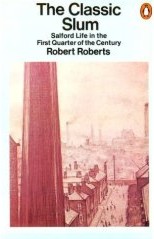
The example below, however, comes from Salford. It comes from a renowned memoir of working class life, Robert Roberts’ The Classic Slum: Salford life in the first quarter of the century (1971). Roberts looks back to his childhood in Edwardian Salford, combining the personal with academic historical research in a uniquely powerful combination. As Roberts says, “few historians are the sons of labourers”, and his account of hard urban poverty hits you with eloquently-expressed authenticity.

The section from The Classic Slum on the cinema is typically evocative and filled with telling observations. He identifies the joyous effect that the cinema had upon its early, working class audiences, but also how it was a boon for women as a legitimised form of entertainment that had none of the social stigma of the pub. He also makes useful observations about seat pricing policies, children reading out intertitles to help out the illiterate, and the genuine educative value of the cinema.

Cinema in the early years of the century burst like a vision into the underman’s existence and, rapidly displacing both concert and theatre, became both his chief source of enjoyment and one of the greatest factors in his cultural development. For us in the village the world suddenly expanded. Many women who had lived in a kind of purdah since marriage (few respectable wives visited public houses) were to be noted now, escorted by their husbands, en route for the ‘pictures’, a strange sight indeed and one that led to much comment at the shop. Street corner gossip groups for a time grew thin and publicans complained angrily that the new fad was ruining trade: men were going to the films and merely calling in at the tavern for an hour before closing time. The disloyalty of it! Children begged, laboured and even thieved for the odd copper that would give them two hours of magic, crushed on a bench before the enchanting screen.

Moralists were not long in condemning cinema as the tap-root of every kind of delinquency. Cinema owners protested virtue: one kept an eight-foot-long poster across his box office: ‘CLEAN AND MORAL PICTURES. Prices – 2d. and 4d.’ In our district the Primitive Methodist chapel, recently bankrupt and closed, blossomed almost overnight into the ‘Kinema’. There during the first weeks would-be patrons of its twopenny seats literally fought each night for entrance and tales of crushed ribs and at least two broken limbs shocked the neighbourhood. In the beginning cinema managers, following the social custom of the theatre, made the error of grading seats, with the most expensive near the screen and the cheapest at the back of the house. For a short time the rabble lolled in comfort along the rear rows while their betters, paying three times as much, suffered cricked necks and eye strain in front. Caste and culture forbade mixing. A sudden change-over one evening, without warning, at all the local cinemas caused much bitterness and class recrimination. By 1913 our borough still retained its four theatres, but already thirteen premises had been licensed under the Cinematograph Act.

Yet silent films for all their joys presented the unlettered with a problem unknown in theatres – the printed word. Often in the early days of cinema, captions broke into the picture with explanations long, sententious and stage-ridden. To bypass this difficulty the short-sighted and illiterate would take children along to act as readers. In this capacity I saw my own first film. When the picture gave place to print on the screen a muddled Greek chorus of children’s voices rose from the benches, piping above the piano music. To hear them crash in unison on a polysyllable became for literate elders an entertainment in itself. At the cinema many an ill-educated adult received cheap and regular instruction with his pleasure, and some eventually picked up enough to dispense with their tutors. Yet in spite of all the aids to culture and learning, unknown fifty years before – compulsory education, free libraries, the spate of cheap print, the miles of postered hoarding, and the cinema, the brightest lure of all – among the lower working class a mass of illiterates, solid and sizeable, still remained.

From 1896 to 1926 – part 8

Let us return once more to the memoirs of Edward G. Turner, British pioneer film distributor, who in 1926 wrote a series of articles for the Kinematograph Weekly on his thirty years in the film business. Turner here describes how the ealy British film business in the late 1900s started to gather in one area of London, soon to be affectionately named ‘Flicker Alley’:

“Flicker Alley”
We had splendid premises at Dane Street, but as the industry grew, it was necessary to have a common centre, where customers from the provinces could make their purchases easily and not have to travel all over London to visit the different firms, and so the trade began to drift west, and Cecil Court, where Gaumont’s had so long been established, became the centre of the trade – so much so that the court lost its proper name and became known as “Flicker Alley”.

We reluctantly decided to go West, and did establish ourselves at 40, Gerrard Street. I always think it was a mistake for the Trade to setle upon the most expensive quarter in London for their offices, showrooms and stores, as our trade demands plenty of space, and the West is very expensive; that is why nearly all of us, even to-day, are cramped for room.

By this time the old showman had given up travelling and had opened permanent kinemas; others had followed, and everywhere the picture Industry was booming, and kinemas were springing up like mushrooms all over the country. This was good for houses like ours, which dealt not only in films and machines, but in all other requisities for the kinema. Those were good days indeed – and profitables ones.

Simon Brown has written an excellent essay on the history of Flicker Alley, which identifies all of the film businesses based there, for the latest issue of Film Studies (issue 10, Spring 2007). This specially-themed issue on cities just so happens to have an essay by me on children’s cinema-going in London before the First World War as well, so all the more reason for the dedicated to seek it out. Cecil Court is now London’s home for second-hand and antiquarian booksellers.

The Exclusive

About this period saw the introduction of the exclusive. Which firm introduced this system I am afraid will never been known definitely. They say great minds think alike, and it is a debatable point as to which was actually the firm, Jury’s, Andrew’s, or ourselves, but all exhibitors will remember our first one, namely: “Fools of Society”, as it brought golden records to their pay-boxes. The idea caught on with the Trade, and so a new era was started in film renting.

About this time we represented nearly all the German film producers, two of the stars being Henny Porten and the great Asta Nielsen, and the time came when we had to leave 40, Gerrard Street for larger and more commodious premises at 46.

This, I think, was in the year 1913, just at the time when the Famous players Producing Company began to put their films on the English market, and we purchased from them the first long Mary Pickford films ever made: “A Good Little Devil” (6,000 ft.), “In the Bishop’s Carriage” (6,000 ft.), and “Caprice” (5,000-6,000 ft.). We originated the phrase “The World’s Sweetheart” for this great little artist.

A bold and most unlikely claim!

About that time also we put the Clarendon Film Co’s big film, “The Great Fire of London”, and Barker’s big creations, “East Lynne” and “Jane Shore”, the latter being one of the most ambitious that any English producer had ever made.

What visions of full houses these names must conjure up to those exhibitors who played them!

(To be continued.)

The ‘exclusive’ film system was a break away from a uniform pricing policy for any kind of film (so much per foot) to the marketing of higher quality films on an exclusive basis, usually determined by territory or time period. The most notorious example was Will Barker’s marketing of his Henry VIII (1911), which he made available to exhibitors for a short period only (six weeks) at high prices, then publicly burned all the prints. No one else pursued such a drastic policy, but the introduction of exclusive hire for quality films caught on quickly, as was an important development for the British film trade, cementing the renting sector of the business, and impressing on everyone for the first time the idea of film as (occasionally) art.

Mary Pickford used to eat roses

Of all the subjects that might have been chosen as the theme for a contemporary popular song, the formation of the United Artists film company must come as one of the least expected. But such is the theme of ‘Mary Pickford’, the new single by Katie Melua. I shall not pass judgement on its musical or lyrical merits – simply to say that it is written by Mike Batt, and tell us in simple words that Mary Pickford, her husband Douglas Fairbanks, Charlie Chaplin and D.W. Griffith got together to form the United Artists Corporation, which indeed they did in 1919. It was the first film company to be formed by film artists, rather than businessmen, and was of course intended to produce and distribute the films of the quartet (as well as others) and retain power and profits for themselves. Famously, Richard A. Rowland of Metro Pictures Corporation, on hearing the news, pronounced that “the lunatics have taken over the asylum”.

The video is constructed as a silent film, and features numerous clips, including newsreel footage of the four founders, The Gaucho, The Black Pirate, The Taming of the Shrew, and even Rescued from an Eagle’s Nest, Griffith’s undistinguished 1907 film acting debut. Chaplin film clips are noticeable by their absence. The video features faux silent titles, including (a nice touch) “Guitar solo”.

Cue an upsurge of interest in Mary Pickford, no doubt. Apparently Pickford did indeed use to eat roses (presumably just the petals) to make herself look more beautiful, as the song tells us. Cue an upsurge in visits to garden centres…

StummFilmMusikTage

Yogoto No Nume

Yogoto No Nume (1933), from http://www.stummfilmmusiktage.de

StummFilmMusikTage, the German silent film festival which makes a special feature of the musical accompaniments, takes place in the Markgrafentheater, Erlangen, 24-27 January 2008. The festival site is in German and English, but the latter does not have the programme details as yet. So here are the details of the films being shown:

Thursday 24 January

Yogoto No Yume (Every Night Dreams) (Japan 1933, d. Mikio Naruse)
Music and performance: Yogo Pausch

Friday 25 January

Potomok Chingis Khana (Storm over Asia) (USSR 1925, d. Vsevolod Pudovkin)
Music: Bernd Schultheis, performed by the Ensemble Kontraste, conductor Frank Strobel

Nani ga kanojo o sô saseta ka (What Made Her Do It?) (Japan 1930, d. Shigeyoshi Suzuki)
Music: Günter Buchwald, performed by the Erlanger Musikinstitut

Saturday 26 January

Kongen af Pelikanien (Pat and Patachon in Pelikanien) (Denmark 1928, d. Lau Lauritzen)
Music and performance: Yogo Pausch

Tabu (USA 1925, d. F.W. Murnau)
Music: Violeta Dinescu, performed by the Ensemble Kontraste, conductor Frank Strobel

Chang (USA 1927, d. Merian C. Cooper)
Music and performance: Günter Buchwald & Ensemble

Sunday 27 January

The Light of Asia (India/Germany 1925, d. Franz Osten)
Music and performance: Om Prakash Pandey (Tabla), Henning Kirmse (Sitar)

The Cameraman (USA 1925, d. Buster Keaton)
Music and performance: Karsten Gnettner, Helmut Nieberle, Bob Rückert

Piccadilly (GB 1928, d. E.A. Dupont)
Music: Frieder Egri, Roman Rothen, performed by Frieder Egri & Ensemble

A strong line-up indeed, and there are introductory presentations to several of the screenings as well. The Markgrafentheater is an attraction in itself, Germany’s oldest Baroque theatre still in use. It was built in 1719, and provides a stunning setting for the annual silent film festival. Advance booking starts on 15 December (details on both English and German versions of the site).

Update: A revised programme has now been published (January 2008). See this updated post for details.

Motion Pictures 1894-1912

The latest edition to the Bioscope Library is Motion Pictures 1894-1912. This is the Library of Congress catalogue of copyrighted works identified as motion pictures by Howard Lamarr Walls. The catalogue was published in 1953, two years after Motion Pictures 1912-1939 (already entered in the Bioscope Library). The volume was not considered to be a part of the Library of Congress’ Catalog of Copyright Entries, Cumulative Series, although it complemented it, because before 1913 films were not copyrighted in the USA as motion pictures but instead as photographs. Hence Walls had to determine which of the copyright records for photographs 1894-1912 were actually motion pictures, which was ultimately a question of individual knowledge rather than official designation. He found around 6,000 titles. Walls became Curator of the Motion Picture Collection at the Library of Congress, and then at the Academy of Motion Picture Arts and Sciences, and his pioneering research was of inestimable value in establishing solid information on the early motion picture in America as a subject of study.

The earliest title is Edison Kinetoscopic Record of A Sneeze, January 7, 1894, which was copyrighted on 9 January 1894. This film, taken by William Kennedy-Laurie Dickson, shows Edison worker Fred Ott sneezing. It was a promotional work rather than a commercial release, being used as illustration in a Harper’s Weekly article. It can be found on the Library of Congress’ excellent American Memory site, from where it has been reproduced for this YouTube clip:

The catalogue is available to download from the Internet Archive, in DjVu (4.9MB), PDF (12MB), b/w PDF (5.8MB) and TXT (621KB) formats).

Studio lots

Apologies for the short break while the Bioscope was taking a rest from the hypnotic screen and buying second-hand books in Hay-on-Wye instead…

Mabel Normand Studio

Mabel Normand Studio, from The Studio Lots

On one of my online travels, I came across the Studio Lots site. This is a collection of contemporary photographs and postcards of studios in Hollywood (and a few other places), with many from the silent era featured. It’s not going to win any design awards, and there are a lot of promises for background texts that haven’t been written as yet. But nevertheless, it’s a very handy selection, and you can see the Hal Roach Studio (8822 Washington Blvd), the Pickford-Fairbanks Studio (7200 Santa Monica Blvd), the Selig Studio (1845 Alessandro) and Culver City (9336 Washington Blvd), among many others. The addresses are useful, and there are backlots and ranches given as well. There’s also a Moving Picture World article from 1917 on the history of motion picture studios in California.

Well worth a wander through.

Non solo dive

Non solo dive

http://www.nonsolodive.com

More information is now available on Non solo dive (Not Only Divas), a conference and retrospective on women and silent Italian cinema. The conference takes place in Bologna, 14-16 December, and here’s the line-up:

Friday, December 14

2.30 PM – Welcoming addresses

3.00 PM-6.30 PM – Session I:

Jane Gaines – Duke University and Columbia University (USA)
Are They Us?: Our Work on Women Working in the International Silent Film Industry
Christine Gledhill – University of Sunderland (UK)
Rethinking Women’s Film History from Britain
Elda Guerra – Associazione Orlando
Beyond Boundaries: The Women’s Movement at the turn of the 20th Century, and the Emergence of a New Subjectivity

Alberto Friedemann – Associazione Fert
Women Entrepreneurs in the Turin Film Industry during the Silent Period
Andrea Palladino – Documentary Filmmaker
The Amazing Story of Frieda Klug: Research Hypothesis for a Documentary about the Origins of Italian Cinema

Discussion

Saturday, December 15

9.30 AM-1.00 PM – Session II:

Cristina Jandelli – University of Florence
“The Sharpest of Them All”: Diana Karenne
Teresa Antolin – Archivio in penombra
Elena and the Men: Francesca Bertini and Film Historiography
Elena Dagrada – State University of Milan
The Temptation of Silence: Eleonora Duse and the Cinema

Elena Mosconi – Catholic University of Milan
Divas and Anti-Divas in Early Italian Cinema: Elettra Raggio and Astrea
Valeria Palumbo – Journalist, L’Europeo
Viper: the Myth of Anna Fougez
Ester De Miro D’Ayeta – University of Genoa
Sewing Celluloid Ribbons: The Obscure Career of Esterina Zuccarone, Editor and Working Woman in Turin

Discussion

3.00 PM-6.30 PM – Session III:

Luca Mazzei – University of Florence
Alone in the Dark. Memories and Narratives of Italian Female Viewers between 1898 and 1916
Silvio Alovisio – University of Turin
The Image of the Spectatrix in the Italian Film Press of the Twenties
Gina Annunziata – University of Siena
Matilde Serao and the Cinema

Roberta Gandolfi – University of Parma
“New Women” of the Italian Theater between Reform and Tradition, Feminism and Modernism
Vittorio Martinelli – Italian Association for Research in Film History
Origins of the Italian Star System
Claudia Gianetto – Museo Nazionale del Cinema
Gigetta Morano: An “Irresistible Force”

Discussion

Sunday, December 16

10.00 AM – 1.00 PM – Session IV:

Kim Tomadjoglou – American Film Institute (USA)
Rethinking the Cinema of Elvira Notari
Irela Nuñez, Franca Farina – Cineteca Nazionale
Women’s Films of the Cineteca Nazionale: Restored and to be Restored
Micaela Veronesi – Italian Association for Research in Film History
A Woman Wants to “Recreate the World”. Umanità, by Elvira Giallanella

Stella Dagna – Museo Nazionale del Cinema
In the Giant’s Shadow. Second Lead Actresses in the Maciste series
Elena D’Amelio – University of Padua
Damned and Beautiful. Powerful Women of the Italian Epic Genre

Discussion

Monica Dall’Asta – University of Bologna
Conclusions

That’s an impressive, specialised but wide-ranging line-up, and to complement it there’s a retrospective of relevant films running 2-15 December at the Cinema Lumière, Bologna. The highlights are two new restorations: Elvira Giallanella’s pacifist film Umanità (1919), restored by the Cineteca Nazionale and the Orlando Association, and Elvira Notari’s ‘A Santanotte (1921), a Neapolitan melodrama, restored by the same institutions in association with George Eastman House. Notari is the subject of Giuliana Bruno’s influential study, Streetwalking on a Ruined Map, and is now something of a cult figure. There are other Notari films on show, a collection of comedienne Lea Giunchi’s short films, Cenere (1916) (the only film of the legendary stage actress Elenora Duse), Francesca Bertini and Gustavo Serena’s Assunta Spina (1915), Giulia Rizzotto’s A Mosca Cieca (1921), and more.

The full conference and retrospective programme is downloadable here (PDF, 212MB, in Italian), and the website www.nonsolodive.com (also in Italian) will be active from 26 November. Clearly, knowing Italian will help, but English translation will be provided throughout the conference.

The rationale behind the event is given in this earlier post.

Women silent filmmakers in Britain

I’ve just uploaded a revised version of my filmography, Women Silent Filmmakers in Britain, onto my personal site. The story behind this was first reported in the Women behind the camera post. Essentially it’s a filmography of women directors, producers, editors, scriptwriters and camera operators active in Britain in the silent. It’s still very much a work in progress, and any comments or corrections are most welcome.

The City of the Future

Carrington Street, Nottingham with 1902 inset

Carrington Street, Nottingham in 2003, with inset from Tram Ride Through Nottingham, Carrington Street (Mitchell & Kenyon, 1902)

An exhibition, The City of the Future, has just opened at the BFI Southbank. It has been created by the psychogeographical filmmaker Patrick Keiller, director of London (1994) and Robinson in Space (1997). Keiller is currently a Research Fellow at the Royal College of Art, where he has been developing his City of the Future research project. His exploration of urban space through archival film has found varied expressions. This multi-screen installation creates a virtual landscape composed of sixty-eight early actuality films from the years 1896-1909, arranged in the BFI Southbank gallery on a network of maps from the period, and displayed over five screens.

Keiller casts a fascinated eye on the mysteries of the urban environment as expressed through archive film which is so much a part of its time and yet can connect with the here and now. Keiller makes particular use of that distinctive genre of the period, the ‘phantom ride’ (which must be such an evocative phrase for him) – journeys filmed at the front or back of moving vehicles. One haunting expression of his vision is Keiller’s simple idea of placing the original film image within a wider frame of the same location filmed today, as illustrated above. The exhibition (which I’ve not seen as yet), also promises visitor interaction:

Visitors are invited to explore this landscape, both by moving among its various screens, and by departing from the sequences displayed on them to create an individual journey using the ‘menu’ functions of a DVD.

The site of Queensbury station in 2004, with inset from Queensbury Tunnel (Riley Brothers, 1898)

The site of Queensbury station in 2004, with inset from Queensbury Tunnel (Riley Brothers, 1898)

The exhibition is open until 3 February 2008. For other expressions of Keiller’s research, a description of The City of the Future and a downloadable ‘database’ (Excel) of titles from the BFI National Archive that he has viewed and identified as relevant to his investigations is on the Visual Arts Data Service website. There is also an account of his project as a ‘case study’ demonstrating the academic use of archive film on the Moving History site.

There’s an interview with Keiller about the exhibition on the Time Out site.

A striking example of phantom ride, A Trip on the Metropolitan Railway (1910), is available from the BFI’s Creative Archive pages. This is a remarkable, prolonged journey filmed from the front of an Underground train on London’s Metropolitan Line, travelling from Baker Street outwards to Uxbridge and Aylesbury. (The original is seventeen minutes long, but the downloadable clip is just under five minutes)

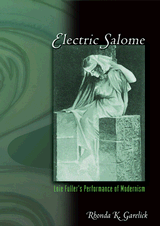
Electric Salome

Electric Salome

Princeton University Press

Electric Salome is the title of a recent book by Rhonda K. Garelick, which is her term to describe Loïe Fuller (1862-1928), one of the key performance artists of the late-19th/early 20th centuries. Fuller was a pioneer of modern dance, who made use of modern stage technologies of lighting and colour to create startling visual effects, particularly through her Serpentine Dance, where her swirling dresses combined with changing colour lighting to create haunting, phantasmagorical effects. She was beloved by artists and poets – Mallarmé, Toulouse-Lautrec, Rodin – and became the subject of early filmmakers.

Loïe Fuller

Loïe Fuller, a 1902 portrait by Frederick Glasier, from http://www.shorpy.com

Garelick’s book is strong on Fuller’s position as a figure of modernism and as a key figure in modern dance. It is, however, disappointingly weak on her early film appearances, reducing mention of these to a misleading footnote. There is much confusion over Fuller’s early film work, as she had many imitators – on stage and on film – and early films of skirt dancers are often mistakenly identified as her (see, for example, the site www.edisonfilm.com, which erroneously claims to show Fuller in a Edison film, though she never made a film for Edison).

For the record, these are the known films that were made of (or by) ‘La Loïe’:

Danse Serpentine (Lumière cat. no. 765, 1896) [extant]
La Loïe Fuller (Pathé, 1901) [extant]
Loïe Fuller (Pathé, 1905, coloured) [extant]
Le Lys de la vie (The Lily of Life) (1920) [extant]
Vision des rêves (1924)
Les Incertitudes de Coppelius (1927)

Le Lys de la vie

Le Lys de la vie (1921), from Bibliothèque nationale de France

Garelick has a little more to say about the later titles (only Le Lys de la vie survives among them). They were made by Fuller and her lover Gabrielle Bloch. The feature-length Le Lys de la vie sounds to be an extraordinary work – based on a story by Queen Marie of Romania, a combination of fairy tale and dance themes telling the story of two princesses competing for the love of a prince, played by René Clair, no less. Fuller herself directed but did not appear in the film, which seems to have been characterised by innovative cinematographic effects (such as incorporating negatives for some ghostly effects) mixed with conventional fairy tale elements.

Garelick tells us less about the other two, lost films. Apparently they were not completed, and were presumably semi-professional productions. It is likely that Fuller did not appear in them either (certainly not as a dancer – she was in her mid-60s, and died in 1928).

Loïe (not Loie as Garelick’s book has it throughout) Fuller was an iconic figure who continues to attract much scholarly interest. There’s a useful set of links about her on the Great Dance Weblog. As indicated above, films exists of her many imitators. She refused to be filmed by Edison, but the Edison studios did make films of other dancers in the 1890s, such as Ruth St Denis, Amy Muller and especially Annabelle, whose several Kinetoscope skirt dance films were clearly in imitation of Fuller and were often mistakenly (deliberately or otherwise) promoted as being films of Fuller herself.

Loie Fuller is a gorgeous-looking site which accompanies the book Traces of Light: Absence and Presence in the Work of Loïe Fuller, by modern Fuller imitator/acolyte Ann Cooper Albright.

Garelick’s book is a fine, insightful study with a strong theoretical basis, but as ever the facts about films are not just scanty but are not recognised as having any importance. The confusion that Fuller’s supposed film appearances created at the time persists, and she exists in those skirt films that survive more often as a guiding spirit than the woman herself.