Charles Dickens, filmmaker

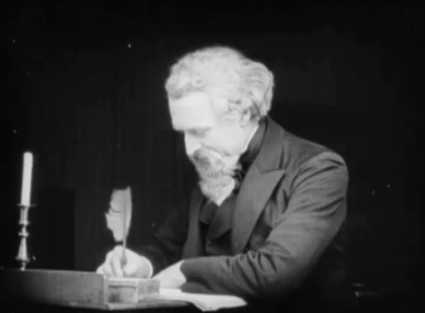
Charles Dickens portrayed in Dickens’ London (UK 1924)

Let Dickens and the whole ancestral array, going back as far as the Greeks and Shakespeare, be superfluous reminders that both Griffith and our cinema prove our origins to be not solely as of Edison and his fellow inventors, but as based on an enormous cultured past; each part of this past in its own moment of world history has moved forward the great art of cinematography.

Sergei Eisenstein

As I write this, in Rochester, Kent, I can look out of my window at the corner of St Margaret Street where, ninety-nine years ago, John Bunny drove past in a carriage, dressed as Mr Pickwick for the turning camera handles of the Vitagraph Company of America. And yesterday and today, on BBC television, we saw a fevered The Mystery of Edwin Drood, much of it filmed fifty yards away in the grounds and centre of Rochester cathedral. Here is the heart of Dickens, and the heart of a grand cinematographic tradition.

Charles Dickens was born two hundred years ago, and his great legacy is being celebrated with books, exhibitions, festivals, conferences, programmes and film seasons. His superabundant influence on cinema and television has been recognised in particular, with a three-month film season at the BFI Southbank underway, an Arena documentary Dickens on Film (with copious examples from the silent cinema) and new television productions of Drood and Great Expectations. Dickens remains something to see.

Dickens was hugely important to the silent cinema, as Eisenstein noted in his famous essay, ‘Dickens, Griffith and the Film Today’, which points out the principle of montage inherent in both Dickens’ novels and D.W. Griffith’s films. Every one of his novels was filmed during the silent era, most more than once. There were specialist Dickens filmmakers, such as Thomas Bentley and A.W. Sandberg. Charlie Chaplin (perhaps the most Dickensian of all filmmakers) loved his works, reading Oliver Twist many times over. It was not just Dickens the novelist who inspired the first filmmakers but Dickens the lover of theatre and the many stage dramatisations of his work. Dickens’s work naturally spilled out of the pages that could not fully contain them onto other dramatic platforms – the stage, the recital, the magic lantern, the cinema. Like all good works of the imagination, they transcend the boundaries of any one medium.

As a contribution to the Dickens bicentenary, and by way of demonstrating his great importance to early film, we have put together a filmography for Dickens and silent cinema. It may be the most extensive yet published; it certainly tries to clear up some of the confusion to be found in listings elsewhere, though there are still problematic corners, and doubtless films still to be identified. It lists both fiction (arranged under the works that inspired them) and non-fiction films, and notes where films still exist (as far as I can discover), and if they are available online or DVD. Where it says afilm is lost, this should not be taken as definitive, as some films will be held privately (noted here as Extant where I have information on these). Please let me know of any errors or omissions.


Barnaby Rudge

  • Dolly Varden (UK 1906) d. Alf Collins p.c. Gaumont
    Cast: not known
    Length: 740ft Archive: Lost
    Note: It is not entirely certain this is based on anything more than the name from Dickens’ novel (Gifford does not list it in his Books and Plays in Films 1896-1915)
  • Dolly Varden (USA 1913) d. Charles Brabin p.c. Edison
    Cast: Mabel Trunnelle, Willis Secord, Robert Brower
    Length: 1000ft Archive: Lost
  • Barnaby Rudge (UK 1915) d. Thomas Bentley p.c. Hepworth
    Cast: Tom Powers (Barnaby Rudge), Violet Hopson (Emma Haredale), Stewart Rome (Maypole Hugh), Chrissie White (Dolly Varden)
    Length: 5325ft Archive: Lost

Bleak House

  • The Death of Poor Joe (UK 1901) d. G.A. Smith p.c. Warwick Trading Company
    Cast: Laura Bayley (Joe), Tom Green (?) (nightwatchman)
    Length: 50ft Archive: BFI
    Note: Apparently based on the character of Jo the Crossing Sweeper [see comments for news of the discovery of this film]
  • Jo, the Crossing Sweeper (UK 1910) d. not known p.c. Walturdaw
    Cast: not known
    Length: 450ft Archive: Lost
  • Jo, the Crossing Sweeper (UK 1918) d. Alexander Butler p.c. Barker
    Cast: Unity More (Jo), Dora de Winton (Lady Dedlock), Andre Beaulieu (Tulkinghorne)
    Length: 5000ft Archive: Lost
  • Bleak House (UK 1920) d. Maurice Elvey p.c. Ideal
    Cast: Constance Collier (Lady Dedlock), Berta Gellardi (Esther Summerson), E. Vivian Reynolds (Tulkinghorne)
    Length: 6400ft Archive: BFI
  • Bleak House (Tense Moments from Great Plays) (UK 1922) d. Harry B. Parkinson p.c. Master
    Cast: Sybil Thorndike (Lady Dedlock), Betty Doyle (Esther)
    Length: 3100ft Archive: Extant (see comments)

The Chimes

  • The Chimes (UK 1914) d. Thomas Bentley p.c. Hepworth
    Cast: Stewart Rome (Richard), Violet Hopson (Meg Veck), Warwick Buckland (Trotty Veck)
    Length: 2500ft Archive: Lost
  • The Chimes (USA 1914) d. Herbert Blaché p.c. US Amusement Corps
    Cast: Tom Terriss (Trotty Veck), Faye Cusick (Meg)
    Length: 5 reels Archive: Lost

Scrooge, or Marley’s Ghost (1901), the earliest surviving Dickens film

A Christmas Carol

  • Scrooge; or, Marley’s Ghost (UK 1901) d. Walter R. Booth p.c. Paul’s Animatograph Works
    Cast: Unknown
    Length: 620ft Archive: BFI Availability: Dickens Before Sound DVD
  • A Christmas Carol (USA 1908) d. not known p.c. Essanay
    Cast: Thomas Ricketts (Scrooge)
    Length: 1000ft Archive: Lost
  • Il sogno dell’usuraio (Italy 1910) d. not known p.c. Cines
    Cast: not known
    Length: 675ft Archive: Lost
    Note: English release title The Dream of Old Scrooge
  • A Christmas Carol (USA 1910) d. J. Searle Dawley (?) p.c. Edison
    Cast: Marc McDermott (Scrooge), Charles Ogle (Bob Cratchit) Viola Dana
    Length: 1000ft Archive: BFI, George Eastman House Availability: A Christmas Past DVD, Internet Archive
  • The Virtue of Rags (USA 1912) d. Theodore Wharton p.c. Essanay
    Cast: Francis X. Bushman, Helen Dunbar, Bryant Washburn
    Length: 1000ft Archive: Lost
    Note: Very loose adaptation of Dickens’ story
  • Scrooge (UK 1913) d. Leedham Bantock p.c. Zenith
    Cast: Seymour Hicks (Scrooge)
    Length: 2500ft Archive: BFI
  • A Christmas Carol (UK 1914) d. Harold Shaw p.c. London
    Cast: Charles Rock (Scrooge), Edna Flugrath (Belle), George Bellamy (Bob Cratchit), Mary Brough (Mrs Cratchit)
    Length: 1340ft Archive: BFI
  • The Right to be Happy (aka Scrooge the Skinflint) (USA 1916) d. Rupert Julian p.c. Bluebird
    Cat: Rupert Julian (Scrooge), John Cook (Bob Cratchit), Claire McDowell (Mrs Cratchit)
    Length: 5 reels Archive: Lost
  • My Little Boy (USA 1917) d. Elsie Jane Wilson p.c. Bluebird
    Cast: Winter Hall (Uncle Oliver), Zoe Rae (Paul), Ella Hall (Clara), Emory Johnson (Fred)
    Length: 5 reels Archive: Lost
    Note: Based on A Christmas Carol and the nursery rhyme ‘Little Boy Blue’
  • Scrooge (Tense Moments with Great Authors) (UK 1922) d. George Wynn p.c. Master
    Cast: H.V. Esmond (Scrooge)
    Length: 1280ft Archive: Extant (see comments)
  • Scrooge (Gems of Literature) (UK 1923) d. Edwin Greenwood p.c. British & Colonial
    Cast: Russell Thorndike (Scrooge), Jack Denton (Bob Cratchit)
    Length: 1600ft Archive: Lost

The Cricket on the Hearth

  • The Cricket on the Hearth (USA 1909) d. D.W. Griffith p.c. Biograph
    Cast: Owen Moore (Edward Plummer), Violet Mersereau (May Fielding), Linda Arvidson (Sister Dorothy)
    Length: 985ft Archive: MOMA, George Eastman House, Library of Congres Availability: Dickens Before Sound DVD
  • The Cricket on the Hearth (USA 1914) d. Lorimer Johnston p.c. American
    Cast: Sydney Ayres, Vivian Rich
    Length: 2000ft Archive: Lost
  • The Cricket on the Hearth (USA 1914) d. Lawrence Marston p.c. Biograph
    Cast: Jack Drumeir, Alan Hale
    Length: 2 reels Archive: George Eastman House, MOMA Available: Grapevine Video DVD-R
  • Sverchok na Pechi (Russia 1915) d. Boris Sushkevich and A. Uralsky p.c. Russian Golden Series
    Cast: Grigori Khmara, Yevgeni Vakhtangov
    Length: 710m Archive: Lost
  • Le grillon du foyer (France 1922) d. Jean Manoussi p.c. Eclipse
    Cast: Charles Boyer, Marchel Vibart, Sabine Landray
    Length: ? Archive: Lost?
  • The Cricket on the Hearth (USA 1923) d. Lorimer Johnston p.c. Paul Gerson
    Cast: Josef Swickard (Caleb Plummer), Fritzi Ridgeway (Bertha Plummer), Paul Gerson (John Perrybingle)
    Length: 7 reels Archive: UCLA (1 reel only) [see also comments]

David Copperfield

  • Love and the Law (USA 1910) d. Edwin S. Porter p.c. Edison
    Cast: Edwin August, Charles J. Brabin
    Length: 1000ft Archive: Lost
  • David Copperfield: part 1; The Early Life of David Copperfield (USA 1911) d. Theodore Marston p.c. Thanhouser
    Cast: Flora Foster (David as a boy), Anna Seer (David’s mother), Marie Eline (Emily as a girl), Frank Crane
    Length: 950ft Archive: Museo Nazionale del Cinema (incomplete?)
  • David Copperfield: part 2; Little Emily and David Copperfield (USA 1911) d. Theodore Marston p.c. Thanhouser
    Cast: Ed Genung (David), Florence La Badie (Emily)
    Length: 950ft Archive: Museo Nazionale del Cinema (incomplete?)
  • David Copperfield: part 3; The Loves of David Copperfield (USA 1911) d. Theodore Marston p.c. Thanhouser
    Cast: d. Ed Genung (David)
    Length: 1000ft Archive: Museo Nazionale del Cinema (incomplete?)
  • Little Emily (UK 1911) d. Frank Powell p.c. Britannia
    Cast: Florence Barker (Emily)
    Length: 1254ft Archive: Lost
  • David Copperfield (UK 1913) d. Thomas Bentley p.c. Hepworth
    Cast: Kenneth Ware (David Copperfield), Eric Desmond (David as a child), Len Bethel (David as a youth), Alma Taylor (Dora), H. Collins (Micawber), Jack Hulcup (Uriah Heep)
    Length: 7500ft Archive: BFI Availability: Dickens Before Sound DVD, 8mins extract
  • David Copperfield (Denmark 1922) d. A.W. Sandberg p.c. Nordisk
    Cast: Gorm Schmidt (David as a adult), Martin Herzberg (David as a boy), Karen Winther (Agnes as a woman), Else Neilsen (Agnes as a girl), Frederik Jensen (Micawber), Karina Bell (Dora), Margarete Schlegel (David’s mother), Rasmus Christiansen (Uriah Heep)
    Length: 3095m Archive: Danish Film Institute Availability: Clips on www.dfi.dk

Dombey and Son

  • Dombey and Son (UK 1917) d. Maurice Elvey p.c. Ideal
    Cast: Norman McKinnel (Paul Dombey), Lilian Braithwaite (Edith Dombey), Hayford Hobbes (Walter Dombey)
    Length: 6800ft Archive: George Eastman House

Store Forventninger (Denmark 1922) directed by A.W. Sandberg, from http://www.dfi.dk

Great Expectations

  • The Boy and the Convict (UK 1909) d. Dave Aylott p.c. Williamson
    Cast: Unknown
    Length: 750ft Archive: BFI Availability: Dickens Before Sound DVD
  • Great Expectations (USA 1917) d. Robert D. Vignola p.c. Famous Players
    Cast: Jack Pickford (Pip), Louise Huff (Estella), Frank Losee (Magwitch), W.W. Black (Joe Gargery), Grace Barton (Miss Havisham)
    Length: 5 reels Archive: Lost
  • Store Forventninger (Denmark 1922) d. A.W. Sandberg p.c. Nordisk
    Cast: Martin Herzberg (young Pip), Harry Komdrup (adult Pip), Marie Dinesn (Miss Havisham), Emil Helsengreen (Magwitch)
    Length: 2527m Achive: Danish Film Institute Availability: Clips on www.dfi.dk

Hard Times

  • Hard Times (UK 1915) d. Thomas Bentley p.c. Transatlantic
    Cast: Bransby Williams (Gradgrind), Leon M. Lion (Tom Gradgrind), Dorothy Bellew (Louisa), Madge Tree (Rachael)
    Length: 4000ft Archive: Lost

Little Dorrit

  • Little Dorrit (USA 1913) d. James Kirkwood p.c. Thanhouser
    Cast: Maude Fealy, Alphonse Ethier, Harry Benham
    Length: 3 reels Archive: Lost
  • Klein Djoorte (Germany 1917) d. Frederic Zelnik p.c. Berliner
    Cast: Lisa Weisse (Djoorte), Karl Beckersachs (Geert), Aenderli Lebius (Batarama)
    Length: 4 reels Archive: Lost
  • Little Dorrit (UK 1920) d. Sidney Morgan p.c. Progress
    Cast: Joan Morgan (Amy Dorrit), Lady Tree (Mrs Clenman), Langhorne Burton (Arthur Clenman)
    Length: 6858ft Archive: Screen Archive South East (20mins only) Availability: SASE website
  • Lille Dorrit (Denmark 1924) d. A.W. Sandberg p.c. Nordisk
    Cast: Karina Bell (Amy Dorrit), Frederik Jensen (William Dorrit), Gunnar Tolnæs (Arthur Clennam)
    Length: 3245m Archive: BFI

Martin Chuzzlewit

  • Martin Chuzzlewit (USA 1912) d. Oscar Apfel and J. Searle Dawley p.c. Edison
    Cast: Guy Hedlund, Harold Shaw, Marion Brooks
    Length: 3 reels Archive: Lost
  • Martin Chuzzlewit (USA 1914) d. Travers Vale p.c. Biograph
    Cast: Alan Hale, Jack Drumeir
    Length: 2 reels Archive: George Eastman House

Mrs Lirriper’s Legacy

  • Mrs Lirriper’s Legacy (USA 1912). d. not known (Van Dyke Brooke?) p.c. Vitagraph
    Cast: Mary Maurice (Mrs Lirriper)
    Length: 1000ft Archive: Lost

Mrs Lirriper’s Lodgers

  • Mrs Lirriper’s Lodgers (USA 1912) d. Van Dyke Brooke p.c. Vitagraph
    Cast: Mary Maurice (Mrs Lirriper), Clara Kimball Young (Mrs Edson), Courtney Foote (Mr Edison), Van Dyke Brooke (Jackman)
    Length: 1000ft Archive: Lost

The Mystery of Edwin Drood

  • The Mystery of Edwin Drood (UK 1909) d. Arthur Gilbert p.c. Gaumont
    Cast: Cooper Willis (Edwin Drood), Nancy Bevington (Rosa Bud)
    Length: 1030ft Archive: Lost
  • [The Mystery of Edwin Drood] (France 1912) d. not known p.c. Film d’Art
    Cast: not known
    Length: 1970ft Archive: Lost
    Note: As a Film d’Art production this would have been made by Pathé, but I have not traced a record of it or an original title in the Pathé catalogue
  • The Mystery of Edwin Drood (USA 1914) d. Herbert Blaché and Tom Terriss p.c. World
    Cast: Tom Terriss (John Jasper), Vinnie Burns (Rosa Bud), Rodney Hickock (Edwin Drood)
    Length: 5 reels Archive: Lost

Thanhouser’s 1912 Nicholas Nickelby, with Harry Benham as Nicholas

Nicholas Nickleby

  • Dotheboys Hall; or, Nicholas Nickleby (UK 1903) d. Alf Collins p.c. Gaumont
    Cast: William Carrington (pupil [Smike?])
    Length: 225ft Archive: BFI
  • A Yorkshire School (USA 1910) d. James H. White p.c. Edison
    Cast: Verner Clarges
    Length: 800ft Archive: Lost
  • Nicholas Nickleby (USA 1912) d. George Nicholls p.c. Thanhouser
    Cast: Harry Benham (Nicholas Nickelby), Mignon Anderson (Madeline Bray), Frances Gibson (Kate Nickelby), David H. Thompson (Squeers), Justus D. Barnes (Ralph Nickleby)
    Length: 2 reels Archive: BFI Availability: Dickens Before Sound DVD, Thanhouser Vimeo channel

The Old Curiosity Shop

  • Little Nell (UK 1906 d. Arthur Gilbert p.c. Gaumont
    Cast: Thomas Nye
    Length: ? Archive: Lost
    Note: Chronophone film designed to be synchronised with disc recording
  • The Old Curiosity Shop (USA 1909) d. not known p.c. Essanay
    Cast: Marcia Moore (Little Nell)
    Length: 1000ft Archive: Lost
  • The Old Curiosity Shop (USA 1911) d. Barry O’Neill p.c. Thanhouser
    Cast: Marie Eline (Little Nell), Frank Hall Crane (Grandfather), Marguerite Snow, Harry Benham
    Length: ? Archive: BFI
  • The Old Curiosity Shop (UK 1912) d. Frank Powell p.c. Britannia
    Cast: Not known
    Length: 990ft Archive: Lost
  • The Old Curiosity Shop (UK 1913) d. Thomas Bentley p.c. Hepworth
    Cast: Mai Deacon (Little Nell), E. Fleton (Quilp), Alma Taylor (Mrs Quilp), Willie West (Dick Swiveller), Warwick Buckland (Grandfather Trent)
    Length: 5300ft Archive: Lost
  • The Old Curiosity Shop (UK 1921) d. Thomas Bentley p.c. Welsh-Pearson
    Cast: Mabel Poulton (Little Nell), William Lug (Grandfather), Pino Conti (Quilp)
    Length: 6587ft Archive: Lost
  • La bottega dell’antiquario (Italy 1921) d. Mario Corsi p.c. G. Salvini
    Cast: Gustavo Salvini, Robert Sortsch-Pla, Egle Valery
    Length: 1987m Archive: Lost

Oliver Twist

  • The Death of Nancy Sykes (USA 1897) d. not known p.c. American Mutoscope
    Cast: Mabel Fenton (Nancy), Charles Ross (Bill Sykes)
    Length: Archive: Lost
  • Mr Bumble’s Courtship (aka Mr Bumble the Beadle) (UK 1898) d. not known p.c. Paul’s Animatograph Works
    Cast: not known
    Length: 60 ft Archive: Lost
  • Oliver Twist (France 1905) d. not known p.c. Gaumont
    Cast: not known
    Length: 750ft Archive: Lost
    Note: Pointer gives 1906 date, Gifford says 1905
  • A Modern Day Fagin (UK 1905) d. not known p.c. Walturdaw
    Cast: not known
    Length: 250ft Archive: Lost
  • The Modern Oliver Twist; or The Life of a Pickpocket (USA 1906) d. not known p.c. Vitagraph
    Cast: not known
    Length: 475ft Archive: Lost
  • Oliver Twist (USA 1909) d. J. Stuart Blackton p.c. Vitagraph
    Cast: Edith Storey (Oliver Twist), Elita Proctor Otis (Nancy), William Humphrey (Fagin)
    Length: 995ft Archive: BFI
  • L’enfance d’Oliver Twist (France 1910) d. Camille de Morlhon p.c. Film d’Art
    Cast: Renée Pré (Oliver Twist), Jean Périer (Fagin), Marie Dornay (Rose)Length: 295m Archive: Lost
  • Storia di un orfano (Italy 1911) d. not known p.c. Cines
    Cast: not known
    Length: 1424ft Archive: Lost
  • Oliver Twist (USA 1912) d. not known p.c. General Film Publicity
    Cast: Nat C. Goodwin (Fagin), Vinnie Burns (Oliver Twist), Mortimer Martine (Bill Sykes), Beatrice Moreland (Nancy), Charles Rogers (Artful Dodger)
    Length: 5 reels Archive: Incomplete print exists (according to Silent Era)
  • Brutality (USA 1912) d. D.W. Griffith p.c. Biograph
    Cast: Walter Miller (young man), Mae Marsh (young woman), Joseph Graybill (victim of anger)
    Length: 2 reels Archive: Library of Congress, MOMA
    Note: Plot features an abusive husband who sees the error of his ways after seeing Bill Sikes in stage production of Oliver Twist
  • Oliver Twist (UK 1912) d. Thomas Bentley p.c. Hepworth
    Cast: Ivy Millais (Oliver), John McMahon (Fagin), Harry Royston (Bill Sykes), Alma Taylor (Nancy), Willie West (Artful Dodger)
    Length: 3700ft Archive: Lost?
    Note: Clips from this film, all that may survive, are included in the travelogue Dickens’ London (UK 1924), held by the BFI
  • The Queen of May (USA 1912) d. not known p.c. Republic Film Company
    Cast: not known
    Length: c.800ft Archive: BFI
    Note: Drama about a poor mother and her daughter, who performs in a stage production of Oliver Twist.
  • A Female Fagin (USA 1913) d. not known p.c. Kalem
    Cast: not known
    Length: 910ft Archive: BFI
    Note: Probably only marginal relationship to Oliver Twist
  • Oliver Twist Sadly Twisted (USA 1915) d. not known p.c. Superba
    Cast: not known
    Length: ? Archive: Lost
    Note: Presumably a parody of some sort
  • Oliver Twist (USA 1916) d. James Young p.c. Lasky
    Cast: Marie Doro (Oliver), Hobart Bosworth (Bill Sykes), Tully Marshall (Fagin), Elsie Jane Wilson (Nancy), Raymond Hatton Artful Doger), W.S. Van Dyke (Charles Dickens)
    Length: 5 reels p.c. Lost
  • Oliver Twisted (UK 1917) d. Fred Evans, Joe Evans p.c. Piccadilly
    Cast: Fred Evans (Pimple)
    Length: 2360ft Archive: Lost
    Note: Probably parodying USA 1916 Oliver Twist
  • Twist Olivér (Hungary 1919) d. Márton Garas p.c. Corvin
    Cast: Tibor Luinszky (Oliver), Sári Almási (Nancy), Gyula Szöreghy (Sikes), László Z. Molnár (Fagin)
    Length: 6 reels Archive: Jugoslovenska Kinoteka (incomplete, 4 reels)
  • Die Geheimnisse von London – Die Tragödie eines Kindes (Germany 1920) d. Richard Oswald p.c. Leyka/Richard Oswald
    Cast: Manci Lubinsky (Percy), Louis Ralph (Jim), Adolph Weisse (Fagin)
    Length: 2137m Archive: Lost?
  • Oliver Twist Jr. (USA 1921) d. Millard Webb p.c. Fox
    Cast: Harold Goodwin (Oliver Twist Jr), Clarence Wilson (Fagin), G. Raymond Nye (Bill Sikes), Scott McKee (Artful Dodger), Irene Hunt (Nancy)
    Length: 5 reels p.c. Lost
  • Nancy (Tense Moments with Great Authors) (UK 1922) d. Harry B. Parkinson p.c. Master
    Cast: Sybil Thorndike (Nancy), Ivan Berlyn (Fagin)
    Length: 1578ft Archive: Lost
  • Fagin (Tense Moments with Great Authors) (UK 1922) d. Harry B. Parkinson p.c. Master
    Cast: Ivan Berlyn (Fagin)
    Length: 1260ft Archive: Lost
  • Oliver Twist (USA 1922) d. Frank Lloyd p.c. Jackie Coogan
    Cast: Jackie Coogan (Oliver), Lon Chaney (Fagin), George Sigmann (Bill Sikes), Gladys Brockwell (Nancy), Joan Standing (Charlotte), Edouard Trebaol (Artful Dodger)
    Length: 7761ft Archive: Film Preservation Associates, LoC, UCLA Available: Dickens Before Sound DVD, Image Entertainment DVD

Our Mutual Friend

  • How Bella Was Won (USA 1911) d. not known p.c. Edison
    Cast: George Soule Spencer
    Length: ? Archive: Lost
  • Eugene Wrayburn (USA 1911) d. not known p.c. Edison
    Cast: Darwin Karr, Richard Ridgeley, Bliss Milford
    Length: 1000ft Archive: Lost
    Note: A third Edison adaptation from Our Mutual Friend, entitled Bella Wilder’s Return is listed by www.dickensandshowbiz.com but the film was never made
  • Vor fælles Ven (Denmark 1921) d. A.W. Sandberg p.c. Nordisk
    Cast: Peter Fjelstrup (Hexam), Karen Caspersen (Lizzie), Peter Malberg (Eugene Wayburn)
    Length: 4664m Archive: Lost

The Pickwick Papers

  • Mr Pickwick’s Christmas at Wardle’s (UK 1901) d. Walter R. Booth p.c. Paul
    Cast: not known
    Length: 140ft Archive: Lost
  • Gabriel Grub, the Surly Sexton (UK 1904) d. James Williamson p.c. Williamson
    Cast: not known
    Length: 400ft Archive: Lost
  • A Knight for a Night (USA 1909) d. not known p.c. Edison
    Cast: not known
    Length: 370ft Archive: Lost
  • Mr Pickwick’s Predicament (USA 1912) d. J. Searle Dawley p.c. Edison
    Cast: Charles Ogle, Mary Fuller, Marc McDermott
    Length: 1000ft Archive: Extant
  • Pickwick Papers: episode 1; The Honourable Event (USA 1913) d. Larry Trimble p.c. Vitagraph
    Cast: John Bunny (Pickwick), James Piror (Mr Tupman), H.P. Owen (Sam Weller)
    Length: 1 reel Archive: BFI Availability: Dickens Before Sound DVD
  • Pickwick Papers: episode 2; The Adventure of Westgate Seminary (USA 1913) d. Larry Trimble p.c. Vitagraph
    Cast: John Bunny (Pickwick), James Prior (Mr Tupman), H.P. Owen (Sam Weller)
    Length: 1 reel Archive: BFI

  • Pickwick Papers: episode 3; The Adventure of the Shooting Party (USA 1913) d. Larry Trimble p.c. Vitagraph
    Cast: John Bunny (Pickwick), Fred Hornby (Winkle), H.P. Owen (Sam Weller)
    Length: 1 reel Archive: Lost?
    Note: The first two episodes (which were also shown together as a two-reeler) were released February 1913, and the third episode in September 1913.
  • Pickwick versus Bardell (Clarendon Speaking Pictures) (UK 1913) d. Wilfred Noy p.c. Clarendon
    Cast: not known
    Length: 1000ft Archive: Lost
    Note: Dramatisation to accompany stage recital
  • Mr Pickwick in a Double-Bedded Room (UK 1913) d. Wilfred Noy p.c. Clarendon
    Cast: not known
    Length: 1000ft Archive: Lost
    Note: Dramatisation to accompany stage recital
  • Mrs Corney Makes the Tea (UK 1913) d. Wilfred Noy p.c. Clarendon
    Cast: not known
    Length: 1000ft Archive: Lost
    Note: Dramatisation to accompany stage recital
  • The Adventures of Mr Pickwick (UK 1921) d. Thomas Bentley p.c. Ideal
    Cast: Fred Volpe (Pickwick), Mary Brough (Mrs Bardell), Ernest Thesiger (Mr Jingle), Hubert Woodward (Sam Weller), Bransby Williams (Sgt Buzfuz)
    Length: 6000ft Archive: Lost

Sketches by Boz

  • Mr Horatio Sparkins (USA 1913) d. not known p.c. Vitagraph
    Cast: Courtenay Foote (Horatio Sparkins), Flora Finch (Teresa Halderton)
    Length: 1000ft Archive: Lost

A Tale of Two Cities

  • A Tale of Two Cities (USA 1908) d. not known p.c. Selig
    Cast: not known
    Length: 1000ft Archive: Lost
  • A Tale of Two Cities (USA 1911) d. William Humphrey p.c. Vitagraph
    Cast: Maurice Costello (Sidney Carton), Norma Talmadge (Lucy Manette)
    Length: 3021ft Archive: BFI, MOMA, UCLA Availability: Grapevine Video DVD-R
  • A Tale of Two Cities (USA 1917) d. Frank Lloyd p.c. Fox
    Cast: William Farnum (Charles Darney / Sydney Carton), Jewel Carmen (Lucie Manete), Charles Clary (Marquis St. Evremonde), Rosita Marstini (Madame De Farge)
    Length: 7 reels Archive: UCLA
  • The Birth of a Soul (USA 1920) d. Edwin L. Hollywood p.c. Vitagraph
    Cast: Harry T. Morey (Philip Grey/Charles Drayton), Jean Paige (Dorothy Barlow)
    Length: 4986ft Archive: Lost
    Note: Loose adaptation in American setting
  • A Tale of Two Cities (Tense Moments with Great Authors) (UK 1922) d. W.C. Rowden p.c. Master
    Cast: J. Fisher White (Dr Manette), Clive Brook (Sidney Carton), Ann Trevor (Lucie Manette)
    Length: 1174ft Archive: Lost
  • The Only Way (UK 1926) d. Herbert Wilcox p.c. Herbert Wilcox
    Cast: John Martin Harvey (Sidney Carton), Madge Stuart (Mimi), Betty Faire (Lucie Manette), J. Fisher White (Dr Manette)
    Length: 10075ft Archive: BFI

Other fiction

  • Leaves from the Books of Charles Dickens (UK 1912) d. not known p.c. Britannia
    Cast: Thomas Bentley (multiple roles)
    Length: 740ft Archive: Cinémathèque Française, Gaumont Pathé Archives
  • Master and Pupil (USA 1912) d. J. Searle Dawley p.c. Edison
    Cast: Harry Furniss (The Master), Mary Fuller (his daughter), Harold Shaw (pupil)
    Length: 1000ft Archive: Lost
    Note: Story about an impoverished artist who illustrates the works of Dickens
  • Dickens Up-to-Date (Syncopated Picture Plays) (UK 1923) d. Bertram Phillips p.c. Bertram Phillips
    Cast: Queenie Thomas
    Length: 1900ft Archive: Lost
    Note: Comedy burlesque

Uncertain titles
Some sources give a Barnaby Rudge (USA 1911) directed by Charles Kent. Kent was working at this time for Vitagraph, and there is no record of such a Vitagraph production. Denis Gifford, in Books and Plays in Films 1896-1915, lists a one-reel Oliver Twist apparently made in Denmark in 1910, but no such production can be found in the online Danish filmography. Some sources list a German Oliver Twist directed by Lupu Pick in 1920, but this appears to have been a production announced but not completed. Magliozzi lists an American 1922 Scrooge held by UCLA, but this is probably the UK title from the Tense Moments with Great Authors series. The 1924 Bonzo cartoon Playing the Dickens in an Old Curiosity Shop (UK 1925) uses only Dickens’ title. The UK 1904 film Mr Pecksniff Fetches the Doctor has no connection with Martin Chuzzlewit.

The Pickwick Coach halts near to the future New Bioscope Towers, from the newsreel Mr Pickwick (Pathé Gazette) (1927), from British Pathe

Non-fiction

  • In Dickens’ Land (France 1913) p.c. Pathé / Travelogue / Archive: Lost [original French title not traced]
  • The Royal City of Canterbury (UK 1915) p.c. Gaumont / Travelogue / 610ft / Archive: BFI
  • Americans Place Wreath on Dickens Tomb at Westminster Abbey (Gaumont Graphic 719) (UK 11-Feb-18) p.c. Gaumont / Newsreel / Archive: Lost?
  • Dickens’ Birth Anniversary (Pathé Gazette) (UK 1918) p.c. Pathé / Newsreel / Archive: British Pathé Available: British Pathé
  • Dickens’ Fair at Botanic Gardens for Home for Blinded Sailors and Soldiers (Gaumont Graphic 783) (UK 23-Feb-18) p.c. Gaumont / Newsreel / Archive: Lost?
  • Homage to Dickens (Pathé Gazette) (UK 1919) p.c. Pathé / Newsreel / Archive: British Pathé Available: British Pathé
  • Dicken’s [sic] Anniversary (Pathé Gazette 641) (UK 12-Feb-20) p.c. Pathé / Newsreel / Archive: British Pathé Available: British Pathé
  • untitled (Around the Town no. 15) (UK 11-Mar-20) p.c. Around the Town / Cinemagazine / Archive: Lost
  • Sir John Martin-Harvey Now Appearing in “The Only Way” (Around the Town no. 105) (UK 01-Dec-21) p.c. Around the Town / Cinemagazine / Archive: Lost
  • Dickens Procession and Confetti Carnival – Southport (Gaumont Graphic 1184) (UK 27-Jul-22) p.c. Gaumont / Newsreel / Archive: Lost?
  • The All-Lancashire Dickens (Pathé Gazette) (UK 1922) p.c. Pathé / Newsreel / Archive: British Pathé Available: British Pathé
  • Dickens Pageant at Camden Town. Famous Author’s Boyhood Home the Scene of Costume Carnival (Gaumont Graphic 1212) (UK 02-Nov-22) p.c. Gaumont / Newsreel/ Archive: Lost?
  • 113th Dickens’ Anniversary (Pathé Gazette 1163) (UK 12-Feb-22) p.c. Pathé / Newsreel / Archive: British Pathé Available: British Pathé
  • Dickens’ London (Wonderful London) (UK 1924) p.c. Graham-Wilcox / Travelogue / Length: 780ft Archive: BFI Available: Dickens Before Sound DVD
  • Within the Sound of Bow Bells (Wonderful London) (UK 1924) p.c. Graham-Wilcox / Travelogue / Length: 839ft / Archive: BFI
  • No. 3 Char-a-banc Tour to Rochester (UK 1924) p.c. London General Omnibus Company / Travelogue / Length: 1066ft / Archive: BFI
  • As in the Days of Dickens (Topical Budget 762-2) (UK 05-Apr-26) p.c. Topical / Newsreel / Archive: BFI
  • Dickens Golden Wedding (Empire News Bulletin 43) (UK 27-Sep-26) p.c. British Pictorial Productions / Newsreel / Archive: Lost?
  • The Golden Wedding of Sir Henry Fielding Dickens and Lady Dickens, 25th September 1926 (UK 1926) / Actuality / Archive: BFI
  • Pickwick Club (Empire News Bulletin 109) (UK 16-May-27) p.c. British Pictorial Productions / Newsreel / Archive: Lost?
  • Frilled Cravats and Flowered Waistcoats (Topical Budget 820-2) (UK 16-May-1927) p.c. Topical Film Company / Newsreel / Archive: BFI
  • Mr Pickwick (Pathé Gazette) (UK 16-May-27) p.c. Pathé / Newsreel / Archive: British Pathé Available: British Pathé
  • Ye Dickens Coach 1827-1927 (unreleased?) (UK 1927) p.c. Gaumont / Newsreel / Archive: ITN Source Available: ITN Source
  • Literature’s Loss (Gaumont Graphic 1756) (UK 19-Jan-28) p.c. Gaumont / Newsreel / Archive: ITN Source Available: ITN Source
  • To the Royal Hop Pole Hotel for Dinner! (Pathé Super Gazette) (UK 30-Jul-28) p.c. Pathé / Newsreel / Archive: British Pathé Available: British Pathé
  • Mr Pickwick and Party (Topical Budget) (UK 30-Jul-28) p.c. Topical Film Company / Newsreel / Archive: BFI
  • Pickwick Centenary at Tewkesbury (unreleased?) (UK 1928) p.c. Gaumont / Newsreel / Archive: ITN Source Available: ITN Source
  • Lorry as a Stage: Dickensian Tabard Players Perform Outside the ‘Old Curiosity Shop’ (Empire News Bulletin) (UK 7-Feb 1929) p.c. British Pictorial Productions / Newsreel / Archive: BFI
  • 1812-1970 – Is Wisions About? (Gaumont Graphic 1868) (UK 14-Feb-29) p.c. Gaumont / Newsreel / Archive: ITN Source Available: ITN Source
  • The Old Curiosity Shop (Pathé Super Gazette) (UK 12-Jun-300 p.c. Pathé / Newsreel / Archive: British Pathé Available: British Pathé


This filmography is indebted to the American Film Index volumes, Denis Gifford’s British Film Catalogue and Books and Plays in Films 1896-1915, Ron Magliozzi’s Treasures from the Film Archives, the Silent Era website’s Progressive Silent Film List, Filmportal, the Danish national filmography, the American Film Institute Catalog for silent films, the Pordenone Silent Film Festival’s Vitagraph Company of America catalogue, the BFI Film & TV Database, News on Screen, the IMDb and other sources. Only when I had exhausted these did I turn to the filmography in Michael Pointer’s Charles Dickens on the Screen. This had two or three titles that had eluded me, a number of film lengths that I hadn’t tracked down, and all in all is a fine piece of research. I commend it to you.

Update (12 February 2012): My thanks to friends at the BFI for some corrections and additions now made to this filmography.

Frederica Sagor Maas RIP

Frederica Sagor Maas, from the front cover to her autobiography

No one cares about a screenwriter. It’s brutal, but it’s true. They toil away at a keyboard for months, then see their precious work mangled and abused in its conversion to the screen. They are unwelcome on the set. Their brightest ideas get attributed to the director, their sharpest lines end up credited to some dumb actor. Frequently they get dropped from the credits entirely, particularly when they have undertaken essential remedial work on someone else’s botched script that needs urgent surgery. No one writes books about them, no one studies them, film history ignores them.

That’s how it is with screenwriters, and how it has always been. It certainly how Frederica Sagor Maas recorded it, one of the pioneers of Hollywood screenwriting who lived more than three times longer than the silent era itself, finally passing away last week at the remarkable age of 111. At the sprightly age of 99 she published a memoir, The Shocking Miss Pilgrim: A Writer in Early Hollywood, having been encouraged to do by Kevin Brownlow. It is no rose-tinted autobiography. She was contemptuous of the film industry and some of its most vaunted figures (Irving Thalberg, Louis B. Mayer), finding Hollywood corrupt, debauched and dishonest. Her cynicism was undoubtedly accentuated by years of seeing the her work and that of her co-writer husband Ernest Maas unacknowledged, plagiarised or rejected. A difficult time in the 1950s being investigated by the FBI for alleged communist sympathies can’t have helped much either.

She was born in 1900, the child of Russian emigrants to the USA, studied journalism at Columbia University, and joined Universal Pictures in New York as an assistant story editor, aged 20. She moved to Hollywood and Preferred Pictures in 1923, later working for Universal Pictures, MGM, Fox and Paramount. Films she wrote included Flesh and the Devil (1926) with Greta Garbo, His Secretary (1925) and The Waning Sex (1926) with Norma Shearer, The Plastic Age (1925) with Clara Bow, and Rolled Stockings (1927) with Louise Brooks. Much of her work (as it appeared on the screen) is now lost, while other work never went acknowledged in the first place.

Work dried up in the sound era, with the film The Shocking Miss Pilgrim (1946), based on a story with serious interest in the issues of women and work by Frederica and her husband, turned into a silly musical rather summing up her film industry experience. So she became an insurance adjuster instead, and said if she’d had her time again she would never have gone into the movies.

Is that true? Probably not. You don’t stick at a business for thirty years without feeling some sort of commitment to it, and the passing of time can sour memories just as it can sugar the memories of others. At any rate, her memoir is of particular value for providing an insight into Hollywood’s silent heyday from the perspective of someone who had experienced the changes of a century and found herself writing for a 21st century audience which likes its histories to have warts. It would have been a different book if written at another time.

There are obituaties for Frederica Sagor Maas in the San Francisco Examiner, Hollywood Reporter and Los Angeles Times. Her passing leaves perhaps just the former child stars Diana Serra Cary (Baby Peggy) and Mickey Rooney as the living survivors of the silent era. Judging from Maas’s view of Hollywood, ‘survivor’ is the appropriate word.

Bioscope Newsreel no. 37

Trailer for Sailcloth

Here we are at the end of a blustery week, and once again we have for you the latest edition of the Bioscope’s infrequent, but never irrelevant, round-up of some of the recent happenings in our world of silent films.

Méliès on Blu-Ray
Georges Méliès’s Le voyage dans la lune / A Trip to the Moon (1902) is to get the Blu-Ray treatment. Lobster Films have just announced that their famous colour restoration of the film is to be the centrepiece of a Blu-Ray release to be issued (in France at least) on 26 April. There aren’t many details as yet, but the disc will include these other Méliès titles: Le Chevalier mystère / The Mysterious Knight (1899), L’antre des esprits / The House of Mystery (1901), Le royaume des fées / Fairyland: A Kingdom of Fairies (1903), Le tonnerre de Jupiter / Jupiter’s Thunderballs (1903), Les cartes vivantes / The Living Playing Cards (1904), and Le chaudron infernal / The Infernal Boiling Pot (1903). Read more.

Poland online
Poland’s minister of culture has announced that (apparently) the entirety of the country’s existing pre-war film archives are to be digitised and made available on the Internet via Europeana, the European Commission’s ambitious digital portal project, just as soon as the relevant copyrights have expired. When this all may be happening has not been said as yet. Read more.

Silents at the Oscars
It may not have escaped your attention that a silent film is being talked about as a favourite for a Academy Award, but what about the other silent film in contention? Sailcloth is a British short film starring John Hurt, made entirely without dialogue, which is in contention for the Oscar for live action short. Do we have a trend emerging here? Read more.

60 seconds of solitude
We could very well have a trend. 60 Seconds of Solitude in the Year Zero is the somewhat portentous title of a collaborative film made in Estonia employing 60 filmmakers from around the world who were each asked to shoot something of one-minute’s length on the theme of the death of cinema, choosing as a motif one of five elements: earth, wind, fire, water, spirit. While you ponder what cinema about the death of cinema actually means, there’s the information that all but two of the films are silent, and in performance the film has been shown with live musical accompaniment. Read more.

What the Dickens
Charles Dickens is enjoying his 200th anniversary, so to speak, and the Bioscope will be joining in with the festivities with a suitable post in due course. Meanwhile, the British Film Institute has kicked off a three-month season of adaptations of the man’s great works, including a number of silents: a programme of pre-1914 shorts, Jackie Coogan in Oliver Twist (1922), Cecil Hepworth’s charming David Copperfield (1913) and John Martin Harvey recreating his famous stage role in The Only Way (1926), an adaptation of A Tale of Two Cities. Read more.

Keep up with the news on silent films every day via our regular news service.

‘Til next time!

Movie title stills

http://annyas.com/screenshots

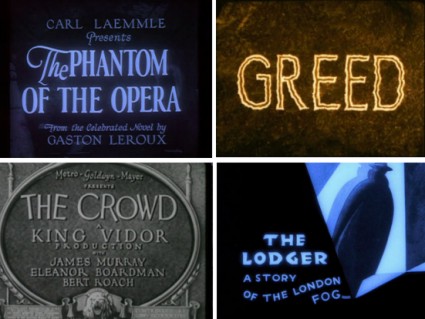
I’ve written here before now (though it’s hard to believe it was three-and-a-half years ago) about the appeal of capturing film title frames grabs as a cataloguing record. The last time was on the occasion of discovering Steven Hill’s Movie Title Screens Page, an heroic enterprise documentating and displaying screen grabs of every film title frame that he can, mostly from VHS and DVD copies, giving title, year, director, image source, aspect ratio and Amazon link. To date he has 7,614 films so recorded, a number of them silents, and he’s still going.

Now I’ve found another site doing the same. The Movie Title Stills Collection does much the same, but is rather more stylishly designed, if not quite as encyclopaedic as Hill’s site – yet. The MTSC is he work of web designer Christian Annyas, and documents movie titles from 1902 to 2011. There’s not as much information at Hill provides – simply image, title, director, year and link to Amazon – but it’s a lot easier to find the silents, with the site being divided up into decades, including 1900-1919 and 1920-1929. There are some curated sections, on such themes as the typography of Jean-Luc Godard (which looks fabulous) and Saul Bass’s title sequences (ditto).

It has to be said that we have got better at film titles as the decades have gone on, so the silent era examples tend towards the functional (with one or two eye-catching exceptions, such as Greed and The Lodger). But the site makes for compulsive browsing, a great way of surveying film history and seeing how the medium has commanded our attention down the years.

Go explore.

The age of innocence

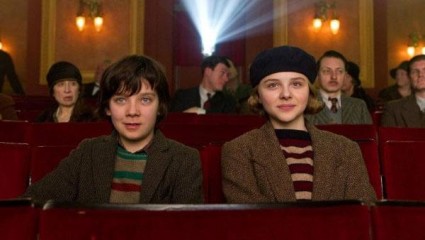
Asa Butterfield (Hugo Cabret) and Chloë Grace Moretz (Isabelle) in Hugo

Two films currently on release have brought the subject of silent films into popular debate. Hugo, directed by Martin Scorsese in 3D, is adaptation of Brian Selznick’s children’s novel, The Invention of Hugo Cabret, set in Paris at the end of the 1920s. The French early filmmaker Georges Méliès, played by Ben Kingsley, is a central character, and the film serves as a celebration of filmmaking and the importance of recognising its pioneers. The Artist, directed by Michael Hazanavicius, recreates the end of the silent film era in the manner of a silent film, telling the tale of how an actress succeeds and an actor fails to meet the challenge of sound.

Both films have met with much acclaim. The purpose of this post is to consider why they have been greeted so enthusiastically, and to see what this may mean for silent film appreciation. The two films have been seen as complementary, though they are very different in technique, in finance (Hugo cost Walt Disney Paramount $170M, The Artist cost $12M), and in target audience. They do share a French background (The Artist is set in Hollywood but is a French production), they take place at the same period, and each shows us films being made and people enjoying watching those films. Both make numerous references to film classics (Safety Last for Hugo, the films of Douglas Fairbanks and rather oddly Citizen Kane and Vertigo for The Artist). Both incorporate archive films supplied by Lobster Films of Paris. Both rely heavily on dogs.

Hugo has been widely interpreted as a work of restoration: restoring an understanding of film, recovering Méliès’ ‘lost’ reputation, and championing the cause of film history overall (Scorsese is the leading figure behind the World Cinema Foundation). Roger Ebert proclaims, “We feel a great artist has been given command of the tools and resources he needs to make a movie about — movies.” For Jay A. Fernandez, the film is about “the transformative power of cinema, its unique ability to connect people, the need to preserve old movies and the truth that an artist’s legacy lives in those who treasure the work.” Philip French states, “The film is a great defence of the cinema as a dream world, a complementary, countervailing, transformative force to the brutalising reality we see all around us.”

Well, lucky the man who gets given $170M to make a film about the importance of cinema history. Disney Paramount wanted an adaptation of Selznick’s much acclaimed book, and Scorsese has been strikingly faithful to it, closely following a rather broken-backed story which begins with the repair of a mysterious automaton, but then turns into a concerted effort by all to bring Méliès back to general acclaim, rescuing him from his toyshop surroundings and his angry denial of his glorious past. Scorsese softens some of the ill-temper that characterises the book (the character of Isabelle is far less argumentative in the film) and builds up the part of the station guard (played by Sacha Baron Cohen) as comic relief. Alas, neither Scorsese nor Cohen have much feeling for slapstick, so Harold Lloyd is invoked but certainly not encapsulated.

But Scorsese’s film also adopts, and extends, the book’s old-fashioned didactic tone. The Invention of Hugo Cabret and Hugo want to teach children a lesson. Reading books is good for you, appreciating old films is good for you, investigating the past is exciting – and good for you. Old people are interesting. Learning is fun.

The tone is that of children’s books of another age, where children are told things that will make them better people, and they are compliant in this. Hugo and Isabelle love being surrounded by old books, then are enthralled to see Méliès’ antediluvian magic films. They behave like no child I know ever behaves, and just as Selznick’s book was the kind of children’s book that adults like to purchase but children seldom read, so Scorsese’s film is a children’s film that offers scant enertainment for its supposed audience, but instead preaches to them – or else to the adults with them.

Of course, the recreation of Méliès’ studio is a marvel, and personally I would have been happy has Scorsese kept himself to a 20-minute evocation of how Méliès’ films were made. Much effort went into making these scenes as authentic as possible, for which all praise to his advisers. For the specialist this is the treat of treats, cinema as time machine taking us back to one of the key points in time and place in film history, so we can believe that, yes, it was like this, because we were there. But did no one think to explain to the young audience why on earth M. Méliès made such odd films with undersea creatures, angels and monsters, and what was so enthralling about them?

The purpose of Hugo is to instruct. Old films are good for us, their history is important to us, and that’s all there is to it. It never says why. I don’t think it is able to say why.

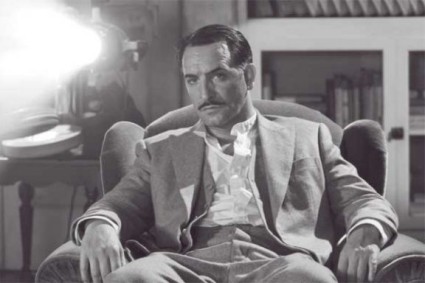
Jean Dujardin (George Valentin) in The Artist

The Artist does not seek to teach; it seeks only to amuse. An entertaining wisp of a film, it tells of a silent film actor, George Valentin (a mixture of Douglas Fairbanks and John Gilbert rather than the Valentino his name might suggest), whose career goes on the slide when the talkies come in. At the same time, an actress, Peppy Miller, whose career began by accident as an extra in one of his films, rises to become a great star of early sound. So it’s Singin’ in the Rain meets A Star is Born.

The film has the boldness of conception that can come with a small budget, and it tells its tale in the manner of a silent film. It has the aspect ratio (1.33:1), late silent film speed (22fps), monochrome glistening like the peak Hollywood productions of the late 1920s in which it is set, and intertitles for the most part aptly employed. More than that, it provides a lesson – far more subtly than Scorsese’s film – in how silent films work on the imagination. The director Hazanavicius emulates many silent film conventions, but not as pastiche, rather as necessary devices for telling a story primarily visually. Pacing, framing, performance, and the use of music to drive the narrative are all noticeably different to that which we are accustomed as cinemagoers today. There are devices such as the close-ups of talking voices that haunt Valentin, and the bravura shot of a three-tier staircase viewed sideways on that belong to the era of silent film and serve as stimulus to the imagination rather than simply displaying a knowledge of silent film techniques. The film shows us things differently. The cleverness lies in how we discover this for ourselves.

The film makes its statement early on, where we see Valentin (played by Jean Dujardin) in one of his films, with musical accompaniment, then the film cuts to the audience applauding. We expect to hear sound, but there is none. The film’s difference is established, and we proceed on a voyage of discovery (not of Hugo‘s blatant and mishandled kind), adjusting to how a film can be made differently. We see films as they might otherwise be, or as they once were.

Such an exercise in technique can only be sustained so far, and after an exceptionally bright and inventive forty-five minutes or so, The Artist picks up on its A Star in Born theme and rather loses its way. It’s not too clear why Valentin refuses to engage with the talkies, but it his stubborness that matters and the film takes up the theme of male pride without offering any depth of understanding. Is this a limitation of the silent technique? Does The Artist venture into areas where silent films would fail to register? William Boyd, in an interesting critique of the film, thinks so:

In a silent film you have, as an actor, a small repertoire of emotions you can employ in a given scene. For example, imagine trying to mime coquettish or yearning, or wrathful or sneering – not so difficult. Now imagine trying to mime mildly cynical, or suppressed embarrassment, or misanthropy, or partial incomprehension. It begins to get very hard. Shades of meaning are lost, complex mixtures of emotion are next to impossible, ambiguity is a no-go area.

Boyd, who has written for silent films (the 2009 TV series 10 Minute Tales) and a novel in which silent films play a major part (The New Confessions), should know the medium quite well, but anyone who has seen enough silents would argue that though they do frequently apply a broad brush, there are infinite gradiations of subtlety in the human face alone, and with judicious titles where necessary, they can do shade and ambiguity handsomely. With The Artist it seems more a failure of plotting – a twist or two wouldn’t have gone amiss. Ultimately films must be about people and the challenges they face, and there is no moral in the story of how silent films were supplanted by sound. The Artist has to be ‘about’ something else, and here it doesn’t really try hard enough.

But the reviews have not concentrated on the moralising but instead on the freshness, indeed optimism that the film exudes (has there ever been a film where those working in film have all seemed such nice people? No wonder the Academy is looking at it so favourably), and what it says about the world we now inhabit and the films we now see. For Mick LaSalle, the film is “really exploring, the death and extinction of a medium that brought the world together, that everyone could experience in the same way, never from the outside, never as a stranger. With delicacy and originality, it laments what went away.” John Farr speaks for many when he writes: “Along with Martin Scorsese’s just-released Hugo, the film taps into a growing wave of longing for the kind of pictures that made this relatively new medium so powerful and popular in the first place.”

And that’s what both movies have achieved, among a jaded audience – a longing for a cinema and a time that once was. One could argue that the silent cinema was not so fresh-faced and idealistic as either film portrays, being as calculating in its effects, as varied in its subject matter, and as driven by the box office as is the case now. There was no age of innocence, just an early age grown comforting through the distance of time. One can also argue that many find in the cinema of today what others imagine only existed in decades gone by (I say this after having seen a 9-year-old transported by the visual magic of Pirates of the Caribbean: At World’s End, a film I found incomprehensible). One might also argue that silent films have been here all along, and why don’t they go to a few more festivals or check out just what’s on DVD and Blu-Ray these days.

Some will now, of course. The best thing the films are likely to bring about is a rediscovery of silent films in new audiences. I think The Artist will achieve this more than will Hugo, whose appeal seems to be to a quite narrow stratum of cinéastes. It doesn’t illuminate these films – it just demands that we revere them. The Artist is a slight film really, and somewhat overpraised (as does happen when Weinstein is carefully managing the hype on the path to the Oscars). But it has strength enough to inspire.

It struck me that the film it might be most interesting to compare it to is the Gorgio Moroder-scored version of Metropolis produced in 1984 and recently released on Blu-Ray. As vulgar a travesty as Metropolis with ’80s pop songs was, it had a certain bold vigour about it. People heard about it, went to see it, and many remember it with affection. It has been noticeable just how many people cite it as the first silent film that they saw and how it inspired them to seek out others. Now another silent film has broken through to popular understanding, and it is going to make some people want to see more. The Artist genuinely speaks with the language of silent film (much as the elephantine Hugo does not), and years from now people will be saying how they went out to discover for themselves that language being expressed again and again.

Not everyone likes The Artist (Richard Schickel hates it), but that’s because they judge it as a film trying to be a silent film when it can’t be, because the silent era is over. But The Artist is not a silent film. It’s an invitation to consider silent films. Each of us may then judge to what degree it has succeeded, but it will have made us think. And that’s what good films do.

National Film Registry 2011

The Cry of the Children

It’s that time of the year once again at the end of the year when we have the announcement of twenty-five further films added to the National Film Registry. Each year the Librarian of Congress (James H. Billington), with advice from the National Film Preservation Board (and with recommendations made by the public), names twenty-five American films deemed “culturally, historically or aesthetically” significant that are to be added to the National Film Registry, “to be preserved for all time”. The idea is that such films are not selected as the “best” American films of all time, but rather as “works of enduring significance to American culture”.

Four silent films are among the titles chosen for 2011: the Thanhouser Film Company’s heartfelt social problem drama The Cry of the Children (1912), the world’s most popular film comedian before Chaplin, John Bunny, in A Cure for Pokeritis (1912), with his regular foil Flora Finch; John Ford’s classic railroad western The Iron Horse (1924); and Charlie Chaplin’s first feature film, The Kid (1921). Here’s how the National Film Registry describes its silent choices:

The Cry of the Children (1912)
Recognized as a key work that both reflected and contributed to the pre-World War I child labor reform movement, the two-reel silent melodrama “The Cry of the Children” takes its title and fatalistic, uncompromising tone of hopelessness from the 1842 poem by Elizabeth Barrett Browning. “The Cry of the Children” was part of a wave of “social problem” films released during the 1910s on such subjects as drugs and alcohol, white slavery, immigrants and women’s suffrage. Some were sensationalist attempts to exploit lurid topics, while others, like “The Cry of the Children,” were realistic exposés that championed social reform and demanded change. Shot partially in a working textile factory, “The Cry of the Children” was recognized by an influential critic of the time as “The boldest, most timely and most effective appeal for the stamping out of the cruelest of all social abuses.”

A Cure for Pokeritis (1912)
Largely forgotten today, actor John Bunny merits significant historical importance as the American film industry’s earliest comic superstar. A stage actor prior to the start of his film career, Bunny starred in over 150 Vitagraph Company productions from 1910 until his death in 1915. Many of his films (affectionately known as “Bunnygraphs”) were gentle “domestic” comedies, in which he portrayed a henpecked husband alongside co-star Flora Finch. “A Cure for Pokeritis” exemplifies the genre, as Finch conspires with similarly displeased wives to break up their husbands’ weekly poker game. When Bunny died in 1915, a New York Times editorial noted that “Thousands who had never heard him speak…recognized him as the living symbol of wholesome merriment.” The paper presciently commented on the importance of preserving motion pictures and sound recordings for future generations: “His loss will be felt all over the country, and the films, which preserve his humorous personality in action, may in time have a new value. It is a subject worthy of reflection, the value of a perfect record of a departed singer’s voice, of the photographic films perpetuating the drolleries of a comedian who developed such extraordinary capacity for acting before the camera.”

The Iron Horse (1924)
John Ford’s epic Western “The Iron Horse” established his reputation as one of Hollywood’s most accomplished directors. Intended by Fox studios to rival Paramount’s 1923 epic “The Covered Wagon,” Ford’s film employed more than 5,000 extras, advertised authenticity in its attention to realistic detail, and provided him with the opportunity to create iconic visual images of the Old West, inspired by such master painters as Frederic Remington and Charles M. Russell. A tale of national unity achieved after the Civil War through the construction of the transcontinental railroad, “The Iron Horse” celebrated the contributions of Irish, Italian and Chinese immigrants although the number of immigrants allowed to enter the country legally was severely restricted at the time of its production. A classic silent film, “The Iron Horse” introduced to American and world audiences a reverential, elegiac mythology that has influenced many subsequent Westerns.

The Kid (1921)
Charles Chaplin’s first full-length feature, the silent classic “The Kid,” is an artful melding of touching drama, social commentary and inventive comedy. The tale of a foundling (Jackie Coogan, soon to be a major child star) taken in by the Little Tramp, “The Kid” represents a high point in Chaplin’s evolving cinematic style, proving he could sustain his artistry beyond the length of his usual short subjects and could deftly elicit a variety of emotions from his audiences by skillfully blending slapstick and pathos.

The other films on the 2011 list are Allures (1961), Bambi (1942), The Big Heat (1953), A Computer Animated Hand (1972), Crisis: Behind A Presidential Commitment (1963), El Mariachi (1992), Faces (1968), Fake Fruit Factory (1986), Forrest Gump (1994), Growing Up Female (1971), Hester Street (1975), I, an Actress (1977), The Lost Weekend (1945), The Negro Soldier (1944), Nicholas Brothers Family Home Movies (1930s-40s) [technically silent, of course], Norma Rae (1979), Porgy and Bess (1959), The Silence of the Lambs (1991), Stand and Deliver (1988), Twentieth Century (1934), War of the Worlds (1953).

The full list of films entered on the National Film Registry since 1989 can be found here, while this is the list of all silents (or films with some silent content) on the Registry 1989-2010:

The Bargain (1914)
Ben-Hur (1926)
Big Business (1929)
The Big Parade (1925)
The Birth of a Nation (1915)
The Black Pirate (1926)
Blacksmith Scene (1893)
The Blue Bird (1918)
Broken Blossoms (1919)
The Cameraman (1928)
The Cheat (1915)
The Chechahcos (1924)
Civilization (1916)
Clash of the Wolves (1925)
Cops (1922)
A Corner in Wheat (1909)
The Crowd (1928)
The Curse of Quon Gwon (1916-17)
Dickson Experimental Sound Film (1894-95)
The Docks of New York (1928)
Evidence of the Film (1913)
The Exploits of Elaine (1914)
Fall of the House of Usher (1928)
Fatty’s Tintype Tangle (1915)
Flesh and the Devil (1927)
Foolish Wives (1920)
The Four Horsemen of the Apocalypse (1921)
The Freshman (1925)
From the Manger to the Cross (1912)
The General (1927)
Gertie the Dinosaur (1914)
The Gold Rush (1925)
Grass (1925)
The Great Train Robbery (1903)
Greed (1924)
H20 (1929)
Hands Up (1926)
Hell’s Hinges (1926)
Heroes All (1920)
The Immigrant (1917)
In the Land of the Head Hunters (1914)
Intolerance (1916)
It (1927)
The Italian (1915)
Jeffries-Johnson World’s Championship Boxing Contest (1910)
The Kiss (1896)
Lady Helen’s Escapade (1909)
Lady Windermere’s Fan (1925)
Land Beyond the Sunset (1912)
The Last Command (1928)
The Last of the Mohicans (1920)
The Life and Death of 9413 – A Hollywood Extra (1927)
Little Nemo (1911)
Lonesome (1928)
The Lost World (1925)
Mabel’s Blunder (1914)
Making of an American (1920)
Manhatta (1921)
Matrimony’s Speed Limit (1913)
Mighty Like a Moose (1926)
Miss Lulu Bett (1922)
Nanook of the North (1922)
Newark Athlete (1891)
One Week (1920)
Pass the Gravy (1928)
Peter Pan (1924)
The Perils of Pauline (1914)
Phantom of the Opera (1925)
The Poor Little Rich Girl (1917)
Power of the Press (1928)
Precious Images (1986)
Preservation of the Sign Language (1913)
President McKinley Inauguration Footage (1901)
Princess Nicotine; or The Smoke Fairy (1909)
Regeneration (1915)
The Revenge of Pancho Villa (1930-36)
Rip Van Winkle (1896)
Safety Last (1923)
Salome (1922)
San Francisco Earthquake and Fire, April 18, 1906 (1906)
Seventh Heaven (1927)
Sherlock Jr. (1924)
Show People (1928)
Sky High (1922)
The Son of the Sheik (1926)
Stark Love (1927)
Star Theatre (1901)
The Strong Man (1926)
Sunrise (1927)
Tess of the Storm Country (1914)
There it is (1928)
The Thief of Bagdad (1924)
Tol’able David (1921)
Traffic in Souls (1913)
A Trip Down Market Street (1906)
The Wedding March (1928)
Westinghouse Works, 1904 (1904)
Where Are My Children? (1916)
Wild and Wooly (1917)
The Wind (1928)
Wings (1927)
Within our Gates (1920)

The Library of Congress welcome suggestions from the public, and even provides a helpful list of titles not on the Registry yet but which are under consideration, to help prod your memories. It contains well over 200 silent films alone, which suggests that they are not about to run out of ideas just yet.

At the risk of repeating ourselves, last year we said that a list of American films worthy of preservation is all very well (and none of these films automatically gets preserved just because it is nominated – it’s an honour, not a financial award), but what about a world film registry? One which drew attention to world cinema (silents and beyond) and its need for preservation on account of its cultural, historical or aesthetic relevance. We have some films now listed on UNESCO’s Memory of the World register, but that’s not really enough. Isn’t it the sort of thing that FIAF ought to promote?

For your diaries

Audience at the Giornate del cinema muto, Pordenone

Well folks, in just a few days it will be 2012, and it is time once again for our annual round-up of what is scheduled to be happening in the silent film world over the next twelve months. You can find further details about the conferences and festivals coming up in the relevant blog sections for these, while our calendar lists all that’s coming up in one handy place. We are considering a reorganiation of the site in the near future, but for the time being those sections remain.

OK, and it will come as a surprise to no one that things kick off with January. The Slapstick festival in Bristol, UK, returns 26-29th, with its traditional mixture of silent comedy classics and present-day TV and radio comedians. StummFilmMusikTage, the annual festival of silent films held in Erlangen, Germany, also takes place in January, though no dates have been given as yet.

February is going to have special interest for the silent film world as the Academy Awards take place on the 26th, and we’ll all be rooting for The Artist just so that we can tell everyone we’ve been backing the right horse all along. The Kansas Silent Film Festival takes place at Topeka, Kansas on 24-25th (no programme announced as yet).

March looks busy, with Cinefest, the annual collectors’ festival at Syracuse, New York, taking place 15-18th – no programme as yet, but bookings begin in January; the Hippodrome Festival of Silent Cinema, Scotland’s first silent film festival now in its second year, to be held in Bo’ness, 16-18th; another relative newcomer, the Toronto Silent Film Festival, to be held 29th March-3rd April; and the twelfth Festival du film muet in Servion Switzerland, 29th March-1st April. With any luck, the Kilruddery Silent Film Festival should be returning this month, held in Bray, Ireland. Finally, there will be the major event of the first US screenings with orchestra of the fully restored Napoléon at the Paramount Theatre, Oakland, CA, 24-25th, 31st and 1st April.

Spring will then be upon us, and April will see the British Silent Film Festival moving venue once again, this time to the Arts Picturehouse, Cambridge, 19th-22nd- though officially both dates and venue remain provisional for now.

Then comes May, when we shall see the classic film convention Cinevent taking place at Columbus, Ohio, though no exact dates as yet. We do have dates for France’s Festival d’Anères, however, still going strong in Hautes-Pyrénées, 23rd-27th – or at least, we hope so, because just at present their website is down.

June will bring us the twelfth international Domitor conference, taking place in early cinema’s spiritual home, Brighton, UK, 25-28th [Update: dates are now 18-22 June], on the theme of ‘Performing New Media, 1890-1915’. There’s going to be something of a dilemma for some, as Bologna’s Il Cinema Ritrovato festival, for many specialists an essential part of their year, runs virtually parallel to Domitor, over 23rd-30th, with special features on Raoul Walsh, Lois Weber and the regular Films from 100 Years Ago all promised so far. 29th June-1st July will see the fifteenth annual Broncho Billy Silent Film Festival, at Fremont, California, marking the centenary of Broncho Billy Anderson coming to Niles.

In July the sun is hot (is it shining? not it’s not). Aside from the sunshine, there will be the Olympic Games in the UK (27th July-12th August), and we’ll endeavour to have suitably Olympic things happening on the Bioscope as well. For those elsewhere, there will be the San Francisco Silent Film Festival taking place 12-15th; or else look out (hopefully) for something eye-catching once again from Babylon Kino’s StummfilmLiveFestival in Berlin this month. In 2011 Slapsticon, the annual silent and early sound film comedy festival traditionally held in Arlington, Virginia, was cancelled – we await news of what will happen this year.

Few silent film events have announced their dates as far ahead as August, though New York’s Capitolfest, scheduled for 10-12th, and Finland’s Mykkäelokuvafestivaalit, or the Forssa Silent Film Festival, is taking place 31st August-1st September. Festivals generally held this month are Strade del Cinema, held at Aosta, Italy; Jornada Brasileira de Cinema Silencioso in São Paulo, Brazil; Bonner Sommerkino, in Bonn, Germany; and the International Silent Film Festival held in Manila, Philippines. No dates or details for any of these as yet.

And then we will find ourselves in September, and ready for a particularly busy month. No dates announced as yet, but we should be getting Cinecon, the annual classic film festival held in Hollywood; New Zealand’s charming Opitiki Silent Film Festival; the Toronto Urban Film Festival of one-minute modern silent films, held in Toronto, Canada; Sydney, Australia’s Australia's Silent Film Festival (though this could turn up at any point between September and December, judging by past form); the Annual Buster Keaton Celebration held in Iola, Kansas, USA; and Cinesation, the silent and early sound film festival held in Massillon, Ohio, USA.

After all that, what might October hold? Why, Pordenone of course. The Giornate del Cinema Muto takes place 6-13th. Nothing else would dare to think even for a moment of clashing with it, and as things stand it has the month to itself.

November and December don’t seem to have anything fixed, though the Bielefelder Film+MusikFest in Germany and Poland’s Festival of Silent Films, held in Krakow and organised by Kino Pod Baranami, generally occur around this time.

If you know of other major silent films events – as opposd to individual screenings or general festivals with some silents included – do let me know. Hopefully there will be more than just the one conference happening in 2012, while the festivals all deserve your patronage. They take a lot of time, effort and money to put on, they are organised by people who believe passionately in the importance of what they do, and festivals remain the place where the real discoveries are made and silent film history is renewed and refreshed. Hope to see you at one or more such events in 2012.

Compliments of the season

It’s Christmas, folks, as you may have noticed, and the Bioscope is closing its doors for a few days while it spends time with the nearest and dearest, trying very hard to be Bob Cratchit and not Ebeneezer Scrooge. I hope you all have a merry Christmas yourselves, and the happiest of new years.

To mark the season, sort of, and by way of tribute to the man whose accomplishments have been so rightly championed all year, here’s Conquest of my Poles, Jean Lambert-wild and Jeremiah McDonald’s droll interpretation/interpolation of Georges Méliès’s À la conquête du pôle (1912). A film with all the visual wit and ingenuity of a Méliès original.

The duo have made other examples of what they call ‘screen calentures‘ in which a bewildered modern figure (McDonald) intrudes upon a silent film landscape, as in the pleasingly clever Keaton and I in which McDonald travels through assorted classic sequences from Keaton’s films.

Or try out My Serpentine, where he joins in with a 1890s hand-coloured serpentine dancer in a joyous fin de siècle knees-up.

Here’s hoping we all have as much fun over the holidays.

Bioscope Newsreel no. 36

Spot the difference

It is hard for any news provider to offer a full service at Christmas time, but even harder for the person trying to document silent films when there is only one story on everyone’s minds. The newsfeeds are choc-a-bloc with reviews of The Artist and thought pieces on what it all means when a silent film gets made in 2011. Part of the same silent mania is Martin Scorsese’s cine-nostalgic Hugo, and it only takes two films on a broadly similar theme for the world to discover a trend and seek to explain it. But we shall do our best to report what is worth reporting. And so we start with …

Silent films after The Artist and Hugo
Daniel Eagen at the Smithsonian’s rather fine Reel Culture blog takes a wry look at the impassioned debates both The Artist and Hugo have caused, viewing with amusement both those instant experts on silents who have hitched onto the bandwagon and the ‘film geeks’ who are agonising over the fine details. What is it that is so different about silent films? Eagen suggests that there probably isn’t anything different at all. Maybe they are just films, much like films of today. Read more.

Toronto Silent Film Festival
The schedule for the Toronto Silent Films Festival (one of the newer festivals out there) has been published. Lined up include Clara Bow in Our Dancing Daughters (1928), Murnau’s Tabu (1931), Rudoph Valentino in Blood and Sand (1922) and E.A. Dupont’s much-cited but not all that often seen Variety (1925). The festival runs 29 March-3 April 2012. Read more.

The birth of promotion
New York Public Library is currently hosting an exhibition on promotional and distibution materials from the silent era, entitled “The Birth of Promotion: Inventing Film Publicity in the Silent-Film Era”. The exhibition runs until January and has a cheerful promotional video. The New York Times has a fine survey of the exhibition and history its documents. Read more.

Life in the air
The San Francisco Silent Film Festival and the Pacific Film Archive in Berkeley are putting on a series of silent films devoted to aviation in its broadest sense. “Dizzy Heights: Silent Cinema and Life in the Air” takes place 23-26 February 2012 and has been imaginatively curated by Patrick Ellis, with such titles as High Treason (UK 1929), A Trip to Mars (Denmark 1918) and rarity The Mystery of the Eiffel Tower (France 1927). Read more.

Keaton in colour
Kino has been doing a great job releasing Buster Keaton’s work on Blu-Ray. Their latest release is Seven Chances (1925), with its Brewster’s Millions-style plot (Buster must marry before 7pm to inherit $7M) and the famous scene when Buster is pursued downhill by an absurd number of boulders. This ‘ultimate edition’ is of especial interest for including the film’s two-colour Technicolor opening sequence. It also comes with the classic shorts Neighbors (1920) and The Balloonatic (1923). Read more.

Now where have I seen that before?
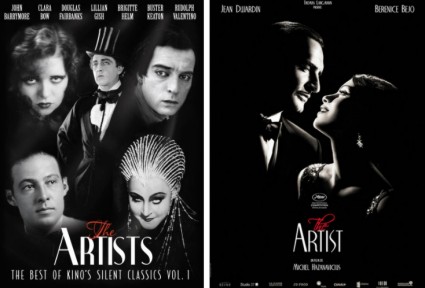
A sixth item for once, and it’s another Kino release, this time a boxed set of some of its silent classics cheekily packaged to look like the poster for for a certain Oscar favourite and entitled The Artists. Full marks to somebody in their marketing team for the sheer nerve of it. Read more.

All these stories and more on our daily news service.

‘Til next time!

Online matters

So far in our end-of-the-year posts, we have looked at some of the leading books published in our field over the year, and some of the top DVD releases. We’ve also reviewed the year in general. Now let us turn to a selection of some of the best in silent-themed videos that have either appeared online this year, or which we have discovered for the first time this year in the course of writing the blog. It’s an entirely personal choice, and limited also to those titles that can be embedded here. But just enjoy.

Variation: The Sunbeam, David W. Griffith, 1912 (2011)

This inspired interpretation by Aitor Gametxo of D.W. Griffith’s The Sunbeam (1912) deconstructs and reconstructs the film according to its spatial logic by showing the different floors and rooms of the tenement in their respective areas of the screen. As my post on the video says, it’s an object lesson in seeing how silent films (or any other kind of film) works.

Raymond Rohauer presents The Sneeze (1970)

I learned about this comic gem through the Nitrateville site. It was made by David Shepard in 1970 and gleefully spoofs the over-presentation of silents from another age (thankfully), pointing the finger not only at notorious collector Raymond Rohauer (who reportedly found the film hilarious) but at the ponderous long introductory titles which some archives (notably MOMA) used to give to silents. The film being given the weighty introduction is Edison’s Kinetoscopic Record of a Sneeze (1894), featuring Fred Ott.

The Force That Through The Green Fire Fuels The Flower (2011)

It’s only a 24-second trailer for what is an eight minute film, but this modern silent by Otto Kylmälä caused a sensation at Pordenone, as the audience saw just what a modern silent can be. Let’s hope it appears in its entirety for all to enjoy before too long.

The Evidence of the Film (1913)

One of the highlight online video collection of the year has been the Thanhouser Vimeo channel. Ned Thanhouser, who works tirelessly to promote the appreciation and preservation of the Thanhouser film company’s surviving work has made all of their surviving films to which he has access available online. Here’s a classic self-referential drama from 1913.

Clog Dancing for the Championship of England (1898)

This was my favourite discovery from the Huntley Film Archives’ YouTube Channel, a joyous 1898 Robert Paul film of the world clog dancing championships, won by James G. Burns, as we learned after family members got in touch. I can’t really say what it is about very early films that delights me so, except that this is the kind of film that delights me in particular. It’s just a happy film.

Rêverie (2011)

A welcome discovery this year was the Silent Stories channel which curates modern silent films of the non-pastiche kind, which is the kind we much prefer. Rêverie by Jaro Minne is a wistful, skilful example of how to tell stories through looks.

Percy Pilcher (1897)

I made my own contribution to YouTube this year, a re-animation of the seven frames that survive (reproduced in a newspaper) of the British aviator Percy Pilcher taking off on his glider for a few seconds on 20 June 1897, discussed in our post on early aviation films. Fleeting it might be, but even seven frames is enough to gain some sense of history brought back to life.

The Bicycle Animation (2011)

A favourite post this year was one on the Phonotrope animations inspired by the work of animator Jim Le Fevre, which re-imagine pre-cinema technologies such as the Zoetrope to create new forms of animation. The video above, by Katy Beveridge, is a title discovered since, which went viral after it was picked up on the Boing Boing site and has now had over a million views. It just goes to show how we all delight in visual illusion.

The Magician (2009)

And then there’s my favourite video discovery of the year. Warm applause to Richcard Hinchcliffe for a witty piece that takes less time to watch than it took to type this sentence. It’s only five seconds long, but has such underlying truth. Watch, sigh, then move on.