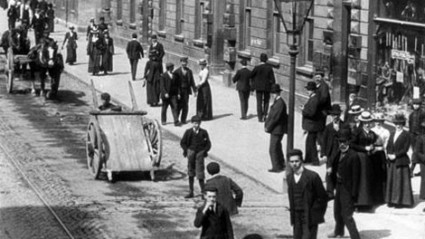
Happy birthday from James and Sagar

http://www.bfi.org.uk/whatson/bfi_southbank

The British Film Institute is seventy-five years old, and it wants the world to know about it. Specifically, it wants people in London next weekend looking for some rewarding way to spend their time to know about it, because it is organising a ‘Birthday Weekender‘ which promises as much fun for the family as film can probably provide.

Part of the celebration are two free shows of the renowned actuality films of Edwardian life made by (Sagar) Mitchell and (James) Kenyon, one on September 27th showing films of Ireland, the other on the 28th showing films of Liverpool, each introduced by Vanessa Toulmin, with music accompaniment by Stephen Horne. Both shows are at 14.00, and if by some chance you have managed to miss the films of Mitchell and Kenyon up til now (what have you been doing?), now is your chance.

Don’t forget also the Best of the British Silent Film Festival, also featuring 26-28 September at the same venue. Turn up on the 26th and see yours truly present an Olympic Games archive film show.

No more ads

Good news – WordPress have finally introduced a No Ads feature, which should mean that anyone coming to this site from a Google search won’t find Google Ads appearing at the top of a post, something which offended me greatly. No longer sullied, the Bioscope presses on.

Hints to newsfilm cameramen

New in at The Bioscope Library is P.D. Hugon’s Hints to Newsfilm Cameramen, a booklet produced in 1915. Hugon was managing editor of the American newsreel Pathé News, having previously worked in the editorial department of the British newsreel Pathé’s Animated Gazette and before that as foreign editor of the London Evening News newspaper. Hugon’s text is a common-sense guide to filming the news, just as newsreels were emerging as a standard feature of every cinema programme.

Hugon’s notes for cameramen cover what to film and how to film it. He discusses what makes pictorial news, which is a different concept to textual news (“The object of motion pictures is to show motion. Only things in which there is motion are worthy of the cameraman’s attention”). He identifies suitable subjects, and emphasises that pictures should always tell their own story. There are basic guidelines to filming the commonest news stories, such as races:

Where speed is the dominant factor turn slowly, about half speed. Failure to do this is unpardonable. Remember then that you must shut down your iris diaphragm so as not to over-expose.

Take all moving objects coming toward the camera, never going away.

Every race must show at least four scenes: beginning, middle, finish, winner; and if possible an extra scene in the middle.

Hugon covers such practical questions as filming in long and close shot, how to film sky, water and silhouettes, managing correct focus, exposure, shutter speeds, handling film and camera, how long shots should be, and has interesting strictures on methods such as panoramic shots.

Panorams. There should never be a panoram, either vertical or horizontal, unless it is absolutely essential to obtain a photographic effect, and in any case the panoram should be, not from the main subject to others, but from others to the main subject, where the attention will finally rest. It is very much better to take two scenes than one panorammed scene. Panoraming is the lazy man’s remedy.

Finally he tells the news cameraman how to dispatch negatives (how to label and seal the can, how to post in by express train etc.), before ending with his golden rule:

Make as good a picture for others as you would like others to make for you.

The guidelines seem particularly directed towards the freelancer hoping to sell footage to the main newsreel companies (his last words are “the money is there waiting for you”). They nevertheless provide a valuable insight into the practicalities and ambitions of early newsreel production. Hints to Newsfilm Cameramen can be found on the British Universities Newsreel Database website, with an introduction and afterword by historian Nicholas Hiley (the afterword discusses how much Hugon’s hints represent reality or an ideal).

Colourful stories no. 14 – À la recherche du chronochrome

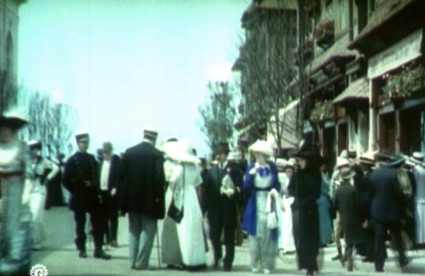
Chronochrome film c.1913, from Les Premiers Pas du Cinéma

Perhaps the most beautiful of all the early colour film systems, whether ‘natural’ or ‘artificial’, was Chronochrome. Though its commercial life was not long, and though it was apparently not seen widely, recent restorations have unveiled a precious colour record of belle époque France, whose dreamy visions have a magical reality about them, capturing an ineffable something of those Proustian times.

Chronochrome was patented by Léon Gaumont in 1911. It was the first working example of the dream of the first motion picture colour inventors, a three-colour additive system in natural colours. Gaumont’s system employed a three-lens camera with red, green and blue filters, through which three images were exposed simultaneously. To get around problems experienced by previous inventors trying to move three frames of film intermittently at high speed (48 frames per second), Gaumont came up with a narrower frame height (14mm). The projector was likewise equipped with three lenses, similarly reduced in height to oblong shapes to reduce fringing.

The result was first exhibited to the Société Français de Photographie on 15 November 1912, and in London at the Coliseum on 16 January 1913. It was also exhibited in New York. Reports show appreciation of the colour, but with some complaints at the lack of brightness (all additive systems have problems in projection because they absorb so much light – a three-colour system that much more so than two-colour Kinemacolor). Accounts in some British histories of Chronochrome being a commercial failure owing to fog having drifted into the variety theatre where it was being showcased may be put down to national rivalry, but Chronochrome seems to have made a relatively modest commercial impact, at least to judge from its relative absence from the literature (Brian Coe has little to say about it, Adrian Klein still less). It had some prestige screenings, particularly in the Gaumont-Palace in Paris, and there were screenings where the colour films were exhibited with synchronised sound using the Gaumont Chronophone. There was also a dedicated cinema at 8, faubourg Montmartre, named Gaumontcolor. But it never rivalled Kinemacolor, nor even Gaumont’s own, artificial stencil colour method. Its greatest limitation was the need for the special projector to show, which naturally limited its exposure. It could be marketed as a high-class treat, but it failed to make any real inroads into a market Kinemacolor had claimed as its own.

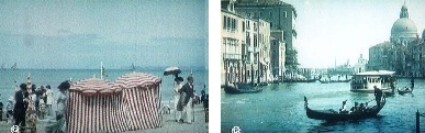
Chronochrome images of Deauville and Venice, from http://www.gaumontpathearchives.com

It has taken modern restorations, which can overcome the original problems in projection by creating synthesized colour prints, to reveal Chronochrome in all its evocative beauty. George Eastman House have some thirty titles, and Gaumont itself (now Gaumont Pathé Archives) has two hours’ worth of the films (the same titles as George Eastman House, maybe?), which it has restored to a richness and delicacy of colour that perhaps the films never enjoyed at the time, subject as they were to the limitations of projection at a ferocious speed and inevitable problems of registration and parallax. Gaumont kept the process going during the First World War, and there is a Chronochrome film of the victory parade in Paris in 1919.

If the above description of Chronochrome tempts you at all, you can view examples of the system on Lobster Films’ 2-DVD set on the early history of sound and colour in cinema, Les Premiers Pas du Cinéma/Discovering Cinema, available from the Projection Box in the UK, from Flicker Alley in the USA, and from Edition Filmmuseum in Germany. Chronochrome films are all actualities, filmed in bright sunlight – static, or semi-static subjects (to avoid the colour fringing exposed by too much movement), taken at Deauville, the Riviera, and in Venice. They capture a lost world.

Recommended reading:
François Garçon, Gaumont: Un siècle de cinéma (1994)

Karine Mauduit and Delphine Warin,’La Couleur dans le fonds Gaumont: le Chronochrome

Picasso & Braque go to the Movies

Martin Scorsese in Picasso & Braque go to the Movies, from http://tiff08.ca

You may remember that last year there was an exhibition at the PaceWildenstein gallery in New York on Picasso, Braque and Early Film in Cubism. It took the interesting if contentious line that Picasso and Braque were enthusiasts for early cinema (for which there is scant actual evidence), and that their experience of early film helped inform their cubist art.

A year on, and a film has appeared, Picasso & Braque Go to the Movies, made by art dealer Arne Glimcher, who was behind the exhibition, and featuring, among other, Martin Scorsese. The sixty-minute documentary features at this month’s Toronto International Film Festival, whose sites provides this blurb on the film:

Anyone with the remotest interest in the relationship between film and the visual arts will want to pay careful attention to this Mavericks presentation. It features heavy hitters from both cultural worlds, brought together by a most intriguing interlocutor. Arne Glimcher is among the great tastemakers of the art world. The artists he represents through his PaceWildenstein Gallery in New York City – including the recently departed Robert Rauschenberg – would alone embody a rich and coherent history of twentieth-century art. Glimcher is also a filmmaker, acting as a producer (The Good Mother) and director (The Mambo Kings) on several significant films.

A decade or so ago, Glimcher asked himself a question: if photography could have had such an impact on Manet and the Impressionists, shouldn’t cinema have had a similar impact on subsequent generations? His thinking turned to the advent of cubism, and especially the groundbreaking paintings of Pablo Picasso and Georges Braque. Soon a major gallery show and book emerged. “Picasso, Braque and Early Film in Cubism” explicitly contrasted film clips from early cinema (especially those of Georges Méliès) with cubist paintings.

Glimcher has now turned that show into an hour-long documentary, featuring today’s leading artists, intellectuals and curators. The result is both great fun and intellectually adventurous. Martin Scorsese, as great a film historian as he is a filmmaker, signed on as a producer, and contributes a personal and fascinating narration. The ever-articulate Chuck Close provides enormous insight as a (celebrated) painter fascinated by how motion and artificiality is captured and transposed onto canvas. And in a tour-de-force series of intellectual connections, master painter and Academy Award®-nominated filmmaker Julian Schnabel reflects on time, stillness, colour, experiential desire and the necessity of colourless boxes.

There a clip from the film on Cinematical, which has Scorsese speculating on how you photograph a dream, accompanied by clips from the Edison Frankenstein on 1910. And this 2007 New YorkTimes article discusses the original exhibition and its ideas. Apparently there’s talk of it being nominated for an Oscar (or Academy Award®, if you will).

Mashing it with the fab four

Let us continue with our examination of those creative meetings of silent films with modern music. Today’s selection takes us that much closer to the borderline of copyright tolerance, and it’s a surprise to find Beatles music still so prevalent on YouTube. So, upholding the spirit of validity in creative re-invention, and before they all get taken down by the strong, protecting arm of Apple Corps, here’s a selection of silent montages imaginatively put to the music of the Beatles (or vice versa). Because the Beatles turn out to have inspired the masher-uppers in a number of imaginative ways.

We start with a relatively conventional fan video, but one very pleasingly done. YouTuber zuebee (who has a taste for adding pop songs to classic film clips) here gives us tribute to Clara Bow by matching clips from It to the Beatles”Honey Pie’: “Oh honey pie my position is tragic / Come and show me the magic / Of your Hollywood song”. It’s an obvious choice of song really, and the lapse into the use of stills is not to my taste, but words, music and image are skilfully blended, and it captures the spirit of the It girl.

So, you have decided to create a mash-up of scenes from Metropolis and the Beatles – which song will you choose? Quite possibly you may not have thought of ‘Birthday’, but Rob Karg did, and the result is a joyous confection, though it’s a shame the image quality is so very poor. It’s a crazy mix that turns the film into a wild celebration for the sake of celebrating wildly.

Metropolis seems to be a popular choice for Beatles fans with a silent film fixation. Try sampling it with ‘I’ve just seen a face’, or this quite peculiar use of ‘Lady Madonna’ with the video creator’s own, intertitled agenda.

Not every silent chosen for such treatment is a familiar one. KeyAliceSun has taken Hans Richter’s 1928 avant garde work Vormittagsspuk and found the ideal accompaniment for it in ‘Happiness is a warm gun’. The song was presumably first chosen because of the film’s central gun imagery, but the song’s fragmented structure and radical style suit the film’s playful experimentation. Lennon would have approved.

KeyAliceSun has also given us The Great Dictator meets ‘Because’. OK, it’s not a silent film, but it is Chaplin and the sequence is shown without dialogue and is purely silent in spirit. It’s the scene where Hynkel plays with the globe (“Because the world is round it turns me on”), and the song matches the scene’s dreamy atmosphere perfectly, so that they seem made for each other.

There are other such examples to discover. ‘I’ve just seen a face’ turns up again, sweetly put to Buster Keaton and Margaret Leahy in The Three Ages, Harold Lloyd’s boy-next-door persona fits well with ‘Act naturally’, while Chaplin eating his boots is put to the somewhat obvious choice of ‘Old Brown Shoe’. And so on.

Back to serious stuff eventually, I promise.

Bioscope Newsreel no. 6

Silents at the LFF
The London Film Festival takes place 15-30 October, and a number of silents are included in the ‘Treasures from the Archives’ strand: Fedor Ozep’s The Living Corpse (1928-29), Douglas Fairbanks in A Modern Musketeer (1917) paired with Max Davidson in the immortal Pass the Gravy (1928), and William Desmond Taylor’s The Soul of Youth (1920). Read more.

London Loves
Part of the London Film Festival is London Loves, a repeat of last year’s hugely successful open-air screenings of silents and archive films in Trafalgar Square. On 23 October Maurice Elvey’s High Treason (1929), paired with Gaston Quiribet’s The Fugitive Futurist (1925), each provide a science fiction vision of London, with live piano accompaniment by Neil Brand. On 24 October, London Loves… is a collection of silent and sound archive films on London, from travelogues to home movies. Read more.

New DVDs from Kino
Kino International has announced two major forthcoming silent DVDs. A ‘restored deluxe edition’ of The Last Laugh is released on 30 September; and a two-disc deluxe release, The General: The Ulimate Edition, in a high-definition video transfer, with a choice of three music scores. It’s released on 11 November 2008. Read more.

Big Bang at the ICA
On 28 September the Institute of Contemporary Arts in London is holding a one-day interactive music workshop and performance with silent films, organised by Big Bang Lab (an initiative formed by composer Sergio López Figueroa). Budding silent musicians are invited to bring along their acoustic instruments (or voices) to a workshop putting music to two contemporary silent works, followed by a programme of silents including Un Chien Andalou. Read more (PDF file).

‘Til next time!

Still going strong

http://www.gaumontpathearchives.com

That post on Grace’s Guide, the directory of British engineering businesses, brought up the subject of Vinten, a company which began making cinematographic equipment before the First World War and is still going strong. Which made me think, which other film businesses from before 1914 (the ‘early cinema’ period) are still going strong today?

Obviously, the major Hollywood studios had their roots in this period. Carl Laemmle formed Universal in 1912, Fox (later a component part of 20th Century-Fox) began in 1912, Paramount in 1914. But the majors of today, conglomerately speaking, are very different beasts to the companies bearing their names in 1914. Of the other leading American producers of that time, Vitagraph was absorbed by Warners in 1925, Lubin (absorbed by Vitagraph) was gone by in 1916, Biograph by 1917, Edison, Essanay and Selig by 1918, Kalem (another absorbed by Vitagraph) in 1919.

So, who is around who is still trading much as they did at the start of motion pictures? Well, obviously the granddaddy of them all is Eastman, provider of the first motion picture film stock and still around trading as Kodak. Also on trhe film stock side, Technicolor, though the name dates from 1915, was effectively founded in 1912 as Kalmus, Comstock & Wescott.

In France, Gaumont (formed in 1895) continues as strongly as it has throughout cinema history. Remarkably, its archive library recently amalgamated with that of its great rival from the early days, Pathé (formed as the Société Pathé Frères in 1896) to form Gaumont Pathé Archives. Pathé itself exists as a producer and distributor, with a confusing history of subsidiary uses of the name.

In Japan, Nikkatsu, formed in 1912 out of a merger of four film companies, thrives as a leading production company. One pre-1914 Japanese producer, Inabata Katsutaro, was the agent for Lumière in Japan in 1897 before moving onto other businesses, leading to the multinational Inabata & Co. of today, which deals in information technology, chemicals, plastics, housing materials and foods.

In Britain, Vinten (founded by William Vinten in 1910) is today a leading supplier of motion picture camera supports. It seems to be the oldest British film business still operating (Butcher’s Film Service, started in 1896, was active as a business until just a few years ago).

The title of the world’s oldest film company is often claimed by Norway’s Nordisk, formed in 1906, is still producing films – and boasts the same familiar polar bear trademark that it has displayed since 1906.

Other names persist, even though they are not the original companies. Thanhouser ceased as a production company in 1918, but Thanhouser Company Film Preservation Inc., maintained by the Thanhouser family, preserves the company’s legacy by encouraging film preservation and releasing Thanhouser films on video and DVD. The Institut Lumière maintains the legacy of the Lumière brothers’ work. A peculiar outfit claims to be the American Mutoscope and Biograph Company (formed 1895), but www.biographcompany.com is no such thing, being a new business which has acquired the old name and has laid claim to its legacy.

Who else persists, in reality or simply as adopted name? There must be others. Do let me know.

Let Google do your digitising for you

As regulars will know, the Bioscope tries to keep track of digitised historical newspaper collections around the world, with an eye to their value for researching early film history. And we’ve told you before about Google’s News Archive Search option which allows you to search across multiple historic news resources, both free and subscription-based.

Now Google is upping the ante considerably by offering newspapers to pay for the digitisation of their collections if the owners will then let Google show the stories for free. Here’s an Associated Press report on the story:

SAN FRANCISCO (AP) — Google Inc. is trying to expand the newspaper section of its online library to include billions of articles published during the past 244 years, hoping the added attraction will lure even more traffic to its leading Internet search engine.

The project announced Monday extends Google’s crusade to make digital copies of content created before the Internet’s advent, so the information can become more accessible and, ultimately, Google can make more money from ads shown on its Web site.

As part of the latest initiative, Google will foot the bill to copy the archives of any newspaper publisher willing to permit the stories to be shown for free on Google’s Web site. The participating publishers will receive an unspecified portion of the revenue generated from the ads displayed next to the stories.

Google is touting the program as a way to give people an easier way to find a rich vein of history. The initiative also is designed to provide a financial boost to newspaper publishers as they try to offset declining revenue from print editions that are losing readers and advertisers to online news sources.

“I believe this could be a turning point for the industry,” said Pierre Little, publisher of the Quebec Chronicle-Telegraph, which touts itself as North America’s oldest newspaper, with editions dating to 1764. “This helps us unlock a bit of an asset that had just been sitting within the organization.”

Besides the Chronicle-Telegraph, other newspapers that have already agreed to allow Google to copy and host their archives include the Pittsburgh Post-Gazette and the St. Petersburg Times in Florida. Google declined to specify how many other papers have signed up or how much the company has budgeted for the project.

Google already has committed to spending tens of millions of dollars to make electronic copies of books and other material kept in dozens of libraries around the world. The book-copying program, launched in 2004, has triggered a lawsuit from group of authors and publishers that alleges it infringes on copyrights — a charge that Google is fighting.

Major newspapers including The New York Times and The Washington Post began to give Google’s search engine access to some of their electronic archives in 2006. But those results frequently displayed only news snippets. Readers often had to pay a fee to see the entire article.

Besides being free, the newspaper archives hosted by Google will be presented in the same way they originally appeared in print, said Adam Smith, Google’s product management director.

Finding the old newspaper stories initially will require searching through Google’s “news” or “news archive” section. The newspaper archives should start showing up on Google’s main results page within the next year, Smith said.

Well, we’ll keep an eye on this, and hope soon to have for you a round-up of all the newspaper collections in past Bioscope posts with update on new collections appearing worldwide.

Images of a forgotten war

http://www.nfb.ca/enclasse/ww1

Images of a Forgotten War is a site hosted by the National Film Board of Canada. The forgotten war in question is the First World War, which you might be forgiven for thinking is not quite as forgotten as some conflicts, but the theme here is in particular the history of the Canadian Expeditionary Force, whose key role in the conflict might not be so well known. The site seeks to redress the failings of collective memory through contemporary, non-fiction motion pictures.

The site comprises some 120 archival films (many of them from the Imperial War Museum), accompanied by photographs, historical essays, and teaching materials. A lot of attention has gone into creating an elegant, properly commemorative site. The films are arranged in five categories: Prologue, Building a Force (subdivided into Mobilization and Training), Wartime (subdivided into Support, Battles, Aviation and Behind the Lines), Postwar Period (subdivided into After the Armistice and Return to Canada), and Epilogue. Those divisions and subdivision may indicate that the site is a little on the elaborate side, and indeed it encourages patience in uncovering the histories it has to tell. Of course you can dip in, but you’ll miss much.

The films are in Flash, up to ten minutes or so long, with longer films are broken up into sections. There are small and full screen options, and each film comes with title, date, running time, production company and synopsis. It concerns me greatly that all titles and intertitles have been replaced by the same words (presumably) in a modern font. This is mistrustful of the medium. One cannot judge accurately the provenance of the films, a matter exacerbated by a failure to indicate which are actual release titles and which supplied titles – because these films are a mixture of commercial releases and archive/library material. In general, the site is not interested in film as film, but in film as a window on the past, and it is noticeable that the accompanying essays have little to say about film (one unfortunately chooses to tell us that “The first feature of a Great War-era movie to strike the modern viewer is the jerkiness of people’s movements, which stems from the low number of frames per second of the film of that time” – how could such a hoary myth be allowed get past?).
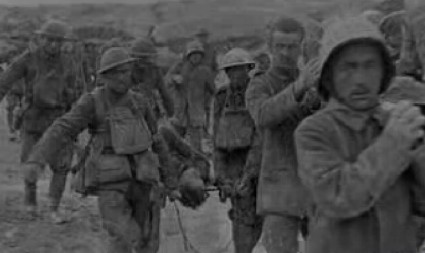
The Battle of Arras (1918), from Images of a Forgotten War

That said, there is a fabulous range of films here, all of it freely available, and most it not to be found elsewhere. It concentrates on the Canadian Expeditionary Force, but there is much film of general interest. The Canadian War Records Office, headed in Britain by Max Aitken (later Lord Beaverbrook) was in the forefront of using film for state information and propaganda, and directly influenced the creation in Britain of the War Office Cinematograph Committee and ultimately the use of film by the Ministry of Information (formed in 1918 and headed by Beaverbrook). These films were produced by official cameramen working under military censorship – propaganda, therefore, but a modest propaganda by latter standards, and one which emphasised the plain ‘objective’ truth of the photographic record to show things as they were.

The films feature classic imagery of the war – not film of fighting as such, but recruitment, trenches, craters, ruined buildings and landscapes, troops on the march and behind the lines, gunfire, explosions, and mud, mud, mud. It is a rich lesson in the methods used to portray actuality in wartime through the film medium of the time. Among the key titles are Sons of the Empire, The Battle of Arras (in thirteen parts), With the Royal Flying Corps and The Royal Visit to the Battlefields of France June 1917. All are shown silent – and (contrary to that essay’s pronouncement) run at the correct speed.

As said, there are photographs, historical essays (focussing on the Canadian experience of the war), ‘other materials’ (diary extracts, letters, book extracts etc.) and teaching materials. The best place to start is the Search option, where you will find all the titles listed, and the option to search across all resources, or narrow down a search by films (i.e. searching across the catalogue data), the essays, visuals, other materials or teaching materials. The Display All option gives you a list of all resources under any one category, and reveals just how much lurks deep within this impressive site. Despite some qualms about the the treatment of the films, and the understanding of film history, this is a most impressive and welcome resource. Go explore.