Lessons from Toledo

There has been quite an on-rush of new material appearing on the Internet Archive, some of it relating to our subject and period, and I’ll be working my way through selected titles and adding them to the Bioscope Library. First up is the Reverend John J. Phelan’s Motion Pictures as a Phase of Commercialized Amusement in Toledo, Ohio (1919). This is another example of a social survey driven by moral concerns rather than social science itself, and the distaste implied by the book’s title is reinforced by these lines from its introduction:

Students of social science are in quite general agreement as to the necessity of community control
of public commercialized amusements.

And yet there is rather more to this study than disdainful suspicion of popular taste for the movies. To begin with, Phelan recognises the virtues, listing these key advantages that motion pictures offered society:

1. The providing of a reasonable-priced and highly entertaining form of amusement.
2. Convenience both as to accessibility and continuous play hours.
3. The promotion of family unity – as seen in attendance of the entire family.
4. The counteraction against the influence of the brothel, saloon, public dance hall and other questionable forms of amusement.
5. A provision for amusement and relaxation.
6. The supplying of information in regard to travel, history and world events.
7. The treatise of high moral and educational themes.
8. The movies as an “art.”

So, while Phelan feels that the movies may appeal to those “who feed their nature upon the abnormal, distorted, suggestive and far too often, vicious things of life”, he feels that they are capable of “moral and educational worth”. But what makes his study valuable for us is that he wants to back up his understanding of motion pictures with empirical data.

Using Toledo as his subject, Phelan tells the number, type, size, location, ownership and function of the different cinemas in his town (there were six in 1919). He tells us of their proximity to other forms of commercialised amusements (saloons, dance halls etc.). We learn of their value, the rental fees charge, and the cost of machinery, fabric, employees, musicians, advertising, lighting and heating. He supplies figures on the composition of audiences, prices of admission, and the construction of cinema programmes. We learn what it cost to invest in the cinema business, the operating expenses and the revenue. This is all very useful data.

Phelan provides evidence of studies conducted at individual schools. There is a long list of suitable educational films, by itself an illuminating guide to how this new branch of the film business was starting to blossom. There is plenty on the moral issues, censorship and the hoped-for attractions of “non-commercialized” amusements valiantly fighting their losing battle against the irresistible attraction of the screen. Intriguingly, Phelan ends each section of the book with a series of questions for other “social studies” students, indicating the sort of things they should be asking of their own territories should they intend to conduct similar surveys.

The book concludes with substantial appendices. These includes a valuable bibliography; examples of relevant legislation; a list of all Ohio cinemas with owners, managers, seating, location and number of employees; sample questionnaires; sample testimony from juvenile courts; and much more. Beyond the moralising, this is study with a great deal of practical information to inform a particular study of American film-going in 1919 – well worth investigating further.

The dead

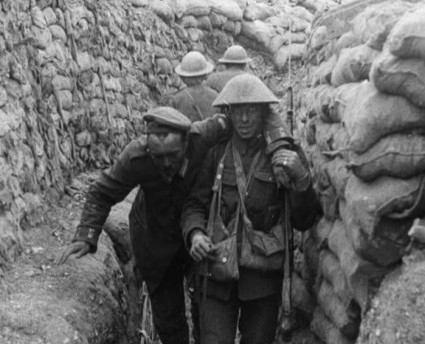
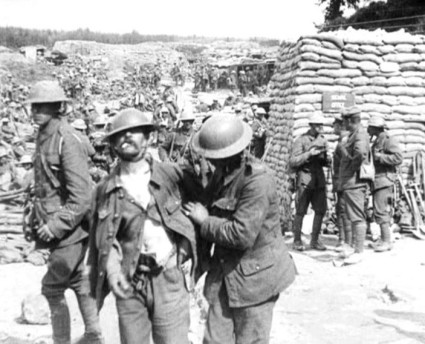
All images in this post are frame grabs from the DVD of The Battle of the Somme (1916)

Is it right to let us see men dying? Yes. Is it a sacrilege? No. If our spirit be purged of curiosity and purified with awe the sight is hallowed. There is no sacrilege if we are fit for the seeing … I say it is regenerative and resurrective for us to see war stripped bare. Heaven knows that we need the supreme katharsis, the ultimate cleansing. We grow indifferent too quickly … These are dreadful sights but their dreadfulness is as wholesome as Tolstoy’s ‘War and Peace’. It shakes the kaleidoscope of war into human reality … I say that these pictures are good for us.

Those words were written by James Douglas in The Star (25 September 1916, p. 2). He was reacting to a screening of the film The Battle of the Somme, a film whose impact upon audiences was unprecedented and – it could be argued – has never been repeated. Douglas, like many commentators, was trying to rationalise what he saw, to express the meaning and to find justification for a film whose stark images of the war that was still raging shocked audiences into a realisation of sacrifice and death. It was the images of death in the film that so disturbed many. If soldiers were not shown being killed (and some apparently were), then every face that stared at the camera was likewise facing death. The audience had been made witness to this, complicit in the soldiers’ fate.

While some called for the film not to be shown, for most it was justified, to the point of becoming almost a moral obligation. Through watching The Battle of the Somme, they gained a sense of the enormity of what troops in their name were undergoing, what the sacrifice (the optimum word) was that army and nation were making. Douglas’ evocation of religious feeling put the film in terms that many would understand. It is not a pure reaction to the film itself – that is not possible. Instead he saw the film through his own thoughts on the meaning of war. Any image, any film, is identified by us through expectations and understandings that are informed by time, place and culture. The Battle of the Somme in 1916 was a different film to The Battle of the Somme in 2008.

This we can now judge through the release of the film for the first time on DVD, produced by the Imperial War Museum, whose archive preserves the film. Alert to the complexities of authenticity, the IWM presents the film in a form that encourages us to question how we see what we see. Firstly, the film (for which no original negative survives) has undergone a digital restoration which has brought out details which were hitherto obscured. Even for those familiar with the film (and all of us must be familiar with it to some extent, given the widespread use of sequences from the film in television documentaries etc.), it is like seeing the film anew. But the major coup is the music. We are given two music tracks. One is a modern score by Laura Rossi, a symphonic work for full orchestra. The other is a recreation by Stephen Horne of a likely original score, taken from a contemporary cue sheet which suggested the sort of musical passages musicians might want to adopt in accompanying the film in 1916.

The latter will amaze many. Jaunty marches and popular airs accompany scenes of troops marching to the killing fields of the Somme, the scenes of battle and their aftermath. What were they thinking of in 1916? It is a complicated question to answer. Partly the musicians of the time were responding to what might have seemed just another war actuality film, which required patriotic accompaniment. But also the audience of the time saw heroism and uplift where we, after almost a century of awful contemplation of the futility of that war, bolstered by poems, novels and films, see something profoundly pitiable. It is with consciousness of such modern expectations, but equally with a sense of being true to the film’s original vision, that Rossi supplies a rich, subtle and binding score that connects 2008 to 1916. Which of these two very different scores will you prefer to listen to, and why? Or might your preferred option be to witness the film in silence?

The digital restoration, which allows us to see so much, is perhaps most striking when it comes to the famous ‘over the top’ sequence. This is the part of the film that will be most familiar. It is shown on television (at least in the UK) every time a shot is needed to evoke the First World War. Troops clamber over the top of a slope, then march slowly over barbed wire away from the camera, a couple of men falling down as they do so, shot dead.

Oh God, they’re dead!

a woman is reported to have exclaimed in a cinema showing the film, and it was this sequence that aroused the greatest comment at the time, the greatest need to explain the film’s significance. But they were not dead. As is now known, the sequence is a fake, set up in a trench mortar battery school some time afterwards, simply because the actual scenes taken of troops going over the top were deemed disappointing. At the time, no one knew of this subterfuge, and as far as reception is concerned, it did not matter. People believed they were witnessing death on screen; and producers and exhibitors felt this to be an acceptable thing to show. Which you may think is extraordinary.

What seldom gets shown on television is the shot that immediately follows the ‘over the top’ sequence in the film. This shows genuine footage of troops going over the top. But we see them only in the far distance. The cameramen (there were just two, J.B. McDowell and Geoffrey Malins, who shot both ‘over the top’ sequences) were greatly restricted in what they could shoot. Their hand-cranked cameras had single 50mm lenses with poor depth of field, they had no telephoto lenses, the orthochromatic film stock was slow, making filming action in the distance or in poor light difficult. But there was also military control and official censorship, each preventing them from filming anything other than officially-sanctioned images. And there was the danger. The most obvious indication of the ‘fake’ nature of the first sequence is that the cameraman would have been in absolute peril of his life had it been genuine. But for the above shot, Malins is a long way off, and far in the distance we can just pick out tiny figures on the horizon – British troops, coming over the top and marching into no-man’s land. Looking closer into the middle ground, the digital restoration now reveals to us a sight not previously detected in the film: a number of troops proceeding leftwards, one or two of whom fall down. Oh God, they’re dead.

Do we want to look that closely? Can they really seem dead when viewed at such a distance? Is the death we seek not in the falling bodies, or even in the corpses seen later in the film, but rather in the eyes of the still living, whose fate awaits them, and who are all dead now of course. That was a line the film historian Denis Gifford would sometimes come out with when we were in the basement theatre at the British Film Institute, watching some collection of British silent shorts. The figures would parade to and fro, some of whom he knew, having interviewed them in the 1960s, but then that sad moment of realisation:

They’re all dead now, of course.

This is a poignancy that seems particularly linked to the non-fiction film. Dramatic films, of whatever age, are attempting to entertain. Either they do or they don’t. But the film of actuality trades on the depiction of life, and then the distance created by time. This was recognised even in 1916. Sir Henry Newbolt wrote a poem inspired by the experience of watching the film, entitled ‘The War Films’, but made memorable by its opening line:

O living pictures of the dead,
O songs without a sound,
O fellowship whose phantom tread
Hallows a phantom ground —
How in a gleam have these revealed
The faith we had not found.

The Battle of the Somme captures the point of loss, the ghosts on the screen, the living pictures of the dead. Of course it is a deeply partial record. It shows no real fighting beyond shellfire, no serious injuries, no pain, little hatred (look for the shove that one British soldier gives to a captured German who stumbles past him). And of course it shows only the Allied point of view (the Germans would respond with their own film, Bei unseren Helden an der Somme, in 1917). But we recognise it for what it is able to show, not for what it leaves out. It is a profoundly memorably expression of the hopes and fears of its age.

The Battle of the Somme was filmed by Malins and McDowell, two experienced newsreel cameramen, who knew well how to capture plain packages of actuality. McDowell was the senior of the two, who ran his own film company (British & Colonial). Malins had been filming on the war front for longer, and is the better known, not least for his somewhat vainglorious memoir, How I Filmed the War (available from The Internet Archive). Malins co-edited the film with Charles Urban, to whom credit should be given for seeing that the footage Malins and McDowell has shot would work best at feature length, rather than as a series of ten-minute shorts which had been the practice up til then. His vision gave the film the presence it needed to capture the audience that it found. The producer was William Jury, and the film was made for the British Topical Committee for War Films, a trade body working under War Office sanction, which would be replaced by the War Office Cinematograph Committee once the film started to enjoy huge success. It has been estimated that it was seen by 20,000,000 people in the UK in six weeks – almost half the population.

The DVD comes with the alternative music scores, commentaries, interviews with archivists and musicians, and five ‘missing’ scenes and fragments. We do not know what the original The Battle of the Somme was like exactly; the version that survives was re-edited, and the footage used in multiple other films, during and after the war. Rather than insert these extra scenes where it is not quite certain they should go, the IWM has chosen to present these (without music) separately. There is a booklet as well, with information on the film’s production, reception, restoration and particularly its music. A website, www.iwm.org.uk/somme-film, will provide viewing notes, additional information, suggestions for further reading and teaching resources. It is a magnificent achievement, one whose influence on research, teaching and the appreciation of First World War history is likely to be considerable. The only possible disappointment is the menu, which simply divides the film into its five parts, where a more detailed use of chapters could have helpfully guided researchers to particular points of action, regiments, location etc.

More will follow. The booklet notes the publication next year of Alastair H. Fraser, Andrew Robertshaw, and Steve Roberts’ Ghosts on the Somme, a book which analyses the film in great detail, overturning some of the traditional understanding of who filmed what, which regiments are shown, and which locations are featured, while confirming that the vast majority of the film is genuine actuality. There is still more to be discovered about The Battle of the Somme. It is a film we will have to return to, again and again.

The DVD is available from the Imperial War Museum Shop (Region 0, PAL, duration 74 mins with 58 mins extras).

A CD of Laura Rossi’s score is available from Virtuosa Records.

On the weekend of 15/16 November 2008 there will be two screenings of the film at the IWM in London, the ‘original’ score on Saturday, the Rossi score (not played live) on the Sunday. Both screenings are free, and start at 14.00.

The Battle of the Somme has been recognised by UNESCO by being accepted for inscription on its Memory of the World register.

C’est une catastrophe

Jean-Luc Godard’s Une catastrophe

In what is quite a coup for the Viennale, Vienna’s film festival, Jean-Luc Godard came out of semi-retirement to make a trailer for the festival, his first film work since 2006. Entitled Une catastrophe, it runs for just sixty-three seconds, but it is hereby claimed for the silent film community because it makes use of Battleship Potemkin and People on Sunday. The film opens with the over-famous Odessa Steps sequence from Potemkin, accompanied probably for the first time by the sounds of a tennis match.

Then, following a shot of an agonised man with a knife (from what film?) and gaudy colour footage of war, we get a slowed-down, stop-start sequences of two lovers from People on Sunday (Menschen am Sonntag), Edgar G. Ulmer, Fred Zinnemann and Billy Wilder’s exquisite 1930 drama with a Berlin documentary background. Throw in some fractured titles, snatches of Schumann’s “Scenes from Childhood”, and an eighteenth century poem in Low German, and you have a mightily rich concoction for your sixty-three seconds.

Love, death, guns, music, language, iconography, montage. Histoire(s) du cinéma, indeed.

100 years ago

Back to our series of pieces from the original film journal The Bioscope, published 100 years ago to the day. Today we consider the dreadful crime of having music at a film show, and on a Sunday too…

The Camden Case

PROPRIETORS FINED FOR INCLUDING MUSIC IN PROGRAM, AND SUNDAY SHOWS BARRED

Some months ago, itwill be remembered, Mr. Robert Arthur, Mr. Walter Gibbons, and Mr. W.H. Terrell were bound over at Clerkenwell Sessions, a jury finding them guilty of having carried on a music-hall entertainment at the Camden Theatre without having a license from the London County Council.

At the Sessions on Tuesday, it was alleged that the terms of the recognisances of the parties had been broken, and notice had been served upon them to attend the court to show why they should not be forfeited.

Mr. Horace Avory said the house was closed after the conviction until Monday 14th September, when without any license being obtained from the L.C.C., the theatre was opened with an animated picture entertainment, along with music. There were also Sunday performances.

The music, counsel argued, was not incidental to or subsidiary to the entertainment, but was independent and substantial. This was shown by the fact that so soon as the selections ceased, the gallery became noisy, and quieted down again when it re-started.

Mr. Muir said his client, Mr. Robert Arthur had absolutely nothing to do with the place at all since the early days of the former proceedings.

Mr. George Elliott did not dispute the facts, but disputed that what was done was an infringement of the Act.

Mr. Barnes, solicitor for the prosecution, said the music was supplied by an electrical orchestral piano. The entertainment would have been a dull one with no music, because the intervals were very long. People joined in the choruses, and sang.

Mr. Muir asked that, as Mr. Arthur had no desire to offend, he might be allowed to go.

Mr. Wallace, K.C.: Certainly.

Mr. Walter Gibbons called on his own behalf, said he was not conscious at any time of having violated his recognisances. The public came to see the bioscope.

Mr. Wallace, K.C., items of the Sunday program as follows:-

The Pneumatic Policeman. (Laughter.)
Ali Baba and the Forty Thieves.
“The Sign of the Cross.”
The Reluctant Dog.
Yachting on the Solent.

Is that a Sunday program?

The Witness: Yes, they are all pictures which no one can object to on a Sunday.

Mr. Wallace, K.C., found that defendants (Messrs. Gibbons and Terrell) had violated their recognisances.

He fined them 40s. each, requiring an undertaking that there should be no music at week-day performances, and no performances at all on Sunday.

Mr. Wallace intimated that he did not think defendants deliberately intended to violate their obligations.

The Bioscope, 30 October 1908

Before the Cinematograph Act of 1910, there was no licensing scheme for moving picture shows in Britain, something which exercised the authorities greatly. The London County Council, which oversaw the licensing of entertainments in the capital, could licence public shows under three categories: music, music and dancing, or stage. Film shows fitted none of these per se, so had to obtain a licence for music or music and dancing if they were not to be in danger of being closed down by the L.C.C for having failed to conform to the Disorderly Houses Act of 1751. Most complied, but quite a number prefered (or had no option but) to risk it, or even in some cases put on film shows without music.

Sunday film shows were another vexed issue for the L.C.C., it being considered that entertainments of any kind on a Sunday were unwelcome, but friviolous and doubtless immoral bioscope shows especially so. Venues liked show films on Sundays, because they drew the crowds, but to keep sweet with the L.C.C. suitably ‘harmless’ programmes were concocted for Sunday shows.

The Cinematograph Act, introduced in January 1910, was established to monitor this mushrooming new public entertainment by establishing a licensing scheme specifically tailored towards it. It was the first piece of legislation in the UK which recognised the film business.

Walter Gibbons (1871-1933) had been in the film exhibition business for a decade by this point. He inherited a music hall empire and in 1910 built the London Palladium as his flagship venue. He would be knighted for his services to British variety theatre, but ended his life bankrupt.

Travellin’ on

There has been steadily increasing interest in the ambulatory nature of much of early cinema. Before films were fixed to a venue, they were frequently to be found on the move. Fairgrounds, a form of entertainment continually on the move, became a regular home for film shows in the late 1890s to early 1900s, and travelling showmen to film shows from town to town. Recent research work has uncovered extensive information on the early ‘travelling cinema’, as the term seems to be. Most notable in this field has been the body of work that followed the discovery of the Mitchell & Kenyon collection of non-fiction films from the Edwardian era, films commissioned by town hall showmen and fairground operators, generally located in the north of England.

A second body of work has looked at what was happening on the European mainland. A conference on travelling cinema in Europe took place in Luxembourg in September 2007, accompanied by the Crazy Cinématographe shows (revived for this year) and DVD release. Now we have the proceedings of the conference published as Travelling Cinema in Europe, edited by Martin Loiperdinger and published by KINtop. Though it has a German publisher, the book is in English. The book provides a diverse look at the commercial heyday of the travelling cinema in the first decade of the twentieth century, with a particular focus on Luxembourg and the Greater Region, with another section looking at non-commercial travelling cinemas from the 1920s onwards. Here’s a chapter listing:

Martin Loiperdinger – Introduction

Travelling Cinema in Europe before the First World War

Vanessa Toulmin – ‘Within the Reach of All’: Tavelling Cinematograph Shows on British Fairgrounds 1896–1914

Matthew Solomon – Fairground Illusions and the Magic of Méliès

Mustafa Özen – Travelling Cinema in Istanbul

Ralf Forster – Easy to Handle and Part of the Novelty: Equipment for Travelling Cinemas in Early Trade Catalogues

Daniel Fritsch – The Paradoxical Austrian Travelling Showmen’s Magazine Die Schwalbe

Joseph Garncarz – The Fairground Cinema: A European Institution

Travelling Cinema in Luxembourg and the Greater Region before the First World War

Uli Jung – Travelling Cinematograph Shows in the Greater Region of Luxembourg: An Overview

Paul Lesch – Travelling Cinematograph Shows in Luxembourg

Brigitte Braun – Marzen’s Travelling Town Hall Cinematograph in the Greater Region of Luxembourg

Non-commercial Travelling Cinema in Europe from the 1890s to the 1960s

Torsten Gärtner – The Church on Wheels: Travelling Magic Lantern Mission in late Victorian England

Thomas Tode – Agit-trains, Agit-steamers, Cinema Trucks: Dziga Vertov and Travelling Cinema in the early 1920s in the Soviet Union

Urszula Biel – German and Polish Agitation through Travelling Cinemas in the 1920s in Upper Silesia

Yvonne Zimmermann – Training and Entertaining Consumers: Travelling Corporate Film Shows in Switzerland

Christian Kuchler – Catholic Travelling Film Shows in West Germany after the Second World War

Epilogue

Claude Bertemes – Cinématographe Reloaded: Notes on the Fairground Cinema Project Crazy Cinématographe

The travelling cinema work can in turn be seen as part of a wider investigation of the relationship of early cinema to society, which is at last taking place. It was not just what they saw, but how they saw it, that matters. There is a growing body of work that is looking the composition of the programme, the location and strategies of venues, the composition of audiences, the location of audiences and their relationship to the entertainments offered to them, the time that they had to devote to such diversions and the value that could be placed on that time, the role of the audience in contributing to the early cinema experience – all of this informs us of early film’s social significance. Without such knowledge, our understanding of the films is barren.

Things European

1903 amateur film by Julius Neubronner of a Kronberg bank employee, Moren, performing a number of dances and female impersonations in Neubronner’s garden, from the Deutsches Filminstitut

I’ve written before about filmarchives online, the European-funded project providing integrated access to filmographic and technical information on selected films from archives across Europe. When we last visited the subject (May 2007), there were some 4,000 films (predominantly non-fiction) documented, from five partner archives: Deutsche Filminstitut, the British Film Institute, La Cineteca di Bologna, the DEFA-Foundation and Národní Filmový Archiv Prague.

A year and a half on, and there are now eighteen institutions taking part, of which those contributing content are the British Film Institute, Cinémathèque Royale de Belgique, Cineteca del Comune di Bologna, DEFA Stiftung, Deutsches Filminstitut, Fondazione Cineteca Italiana, IWF Knowledge and Media, LICHTSPIEL / Kinemathek Bern, Magyar Nemzeti Filmarchívum, Národní Filmový Archiv and Tainiothiki tis Ellados. All the participating archives are part of MIDAS (Moving Image Database for Access and Re-use of European film collections), a project funded by the European Union’s MEDIA pogramme to encourage more efficient distribution of historic content in European film collections. The target is 20,000 records to be published by the end of 2008. Individual records come with rich cataloguing details and – rare for online film archive initiatives – technical information on the film elements held.

A selection of films (74 and rising) has been made available for viewing online, the majority of which are early non-fiction titles (a lot of them Mitchell and Kenyon productions from Britain and the ‘amateur’ efforts of Julius Neubronner from Germany). The same films can be found on the project’s YouTube channel. There are plenty of genuinely fascinating gems in there, with a clear emphasis on historic film’s documentary qualities.

While we’re on the subject of European film archive initiatives, it’s worth noting the European Film Gateway, a recently-announced three-year project planning to develop an online portal, “providing direct access to about 790,000 digital objects including films, photos, posters, drawings, sound material and text documents”. Film archives from across Europe (but not Britain) are participating. The project is funded by the European eContentplus programme, and the results will eventually be linked to the Europeana, a planned European digital library, museum and archive. More on this project once it’s properly underway.

You’ll already know about European Film Treasures, also funded by the MEDIA programme, which is delivering a library of historic titles from collections across Europe (including Britain this time), silent and sound.

Go explore.

Mystery movies

Unidentified film with a 1923 edge code, from The Nitrate Film Interest Group

The Nitrate Film Interest Group is a new interest group set up by the Association of Moving Image Archivists, or AMIA. The group, which describes itself below, is dedicated to promoting understanding about nitrate film and, through its Flickr pages, providing an online space for placing images of unidentified films, inviting comment.

This FLICKR account is to help archives around the world identify unknown films in their collection. We will do our best to post what information is known about each film along with the frame scans. If you are able to provide any information such as title, actor, approximate date, or anything helpful then please leave a comment.

Films that have multiple frame scans have been grouped into sets that can be found along the right side of the screen. By clicking on the set information will appear that applies to all of the frame scans from that reel of film. We suggest that you navigate these photos through their sets so as to see all of the information that is provided.

The Nitrate Film Interest Group is a part of the Association of Moving Image Archivists’ interest groups. Check out AMIA at http://www.amianet.org. The Nitrate Film Interest Group is dedicated to promoting education about nitrate film as well as functioning as a resource for those interested in and working with nitrate film by becoming a major resource for archivists’ needs.

Questions about these scans can be posted to the scan comments. If you have a frame scan of an unidentified film, any questions about the Nitrate Film Interest Group or this account an email can be sent to nitratefilminterestgroup@yahoo.com

To check the frame stills of unidentified film (which include sound films), click on the Photostream link on the Flickr page. If you know something, do add a comment – no one has done as yet.

Pordenone diary 2008 – day seven

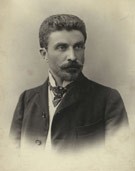
Alexander Shiryaev (1867-1941) is not a name that you will find in any film history. He was a member of the Russian Imperial Ballet at the Mariinsky Theatre, St Petersburg, a protégé of the great choreographer Marius Petipa, a character dancer of great skill (he was too small for the classic leading roles), and a gifted ballet teacher.

It was his teaching that seems to have led Shiryaev to film. Fascinated with human movement and the notation of ballet, Shiryaev began producing sequential drawings of dance steps that documented the minutiae of such movements, work that was inherently cinematic in construction. Shiryaev must have seen the connection, because in 1904 he applied to the theatre management to let him purchase a motion picture camera and film to record the dancers of the ballet. He was turned down – no films were allowed to be made of the dancers of the Imperial Ballet. Undaunted, Shiryaev purchased a camera anyway – a 17.5mm Biokam acquired in London, to be followed by an Ernemann Kino, also employing 17.5mm film. At some point he also had used of a 35mm camera.

Shiryaev took to filming as one who instinctively knew what the medium could do. He understood the camera as he understood dance. Between 1906 and 1909, Shiryaev produced an astonishing body of work – live records of dances, home movies, comedies, trick films, animations and puppet films. None of these was seen in public. They might have disappeared from history entirely, had they not first been narrowly saved from destruction in the 1960s by a friend of Shiryaev’s, Daniil Saveliev, and then discovered again in 1995 by filmmaker Victor Bocharov, who has been their custodian ever since. Bocharov produced a documentary on the collection in 2003, Zapazdavshaya Premiera (Belated Premiere), but the screenings at Pordenone were the true public premiere for the majority of these films, many of which came fresh from the specialist labs of PresTech in London.

The Shiryaev films were shown over a number of days, the programmes including A Belated Premiere and films related to his world, such as Anna Pavlova dancing. But the main programme came on Friday 10 October, and divided up his ouevre into four categories.

Dance films
These were films of Shiryaev and his dancer wife Natalia Matveeva dancing on a sunlit stage at their Ukraine home. As the only films of the Russian ballet greats at this time, they have plain historical value, but they are also a visual delight. The two dance singly or together in a selection of folk-based dances, performed with sparkling zest, and each ending delightfully with the dancer leaving the stage then returning for a bow. The most dazzling are those on 35mm, particularly Shiryaev’s party piece, ‘Fool’s Dance’ from Petipa’s Mlada.

Trick films
Shiryaev was evidently a film-goer himself, and decided to emulate some of the trick films common in the mid-1900s. All were again filmed at his summer home, in the open air. One film where a giant spider came down and settled on a sleeping man was clearly inspired by Georges Méliès’ Une nuit terrible. Another, given the title [Chairs], anticipated Norman McLaren’s Neighbours by some fifty years, with its stop-animation of humans seated on chairs and swapping positions.

Earlier in the week we had seen numerous fleeting home movies of Shiryaev and family (they are some of the earliest surviving home movies anywhere) and various staged comedies made by the family. The marvellous thing to behold was how the boundaries between home movies, comedies and then trick films blurred, all created in the same spirit of joyous performance. The family’s whole lives seemed to be some form of dance.

Paper films
For me, Shiryaev’s paper ‘films’ were his greatest achievement. Before he had a camera (or so it is assumed), he produced animations on paper (45mm wide) which have now been reconstituted on film. One such film with delicate line showed birds in flight, the observant results of which the festival catalogue rightly pointed out connected his quest for reconstituted movement with that of the chronophotographers Eadweard Muybridge and Etienne-Jules Marey. But finest I think was [Cakewalk], a trio of dancers in exquisite, gently swaying unison. Only a minute or so long, but I have never seen a finer piece of animation.
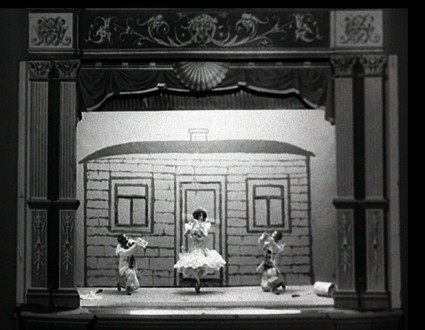
Shiryaev’s puppet animation P’ero-Khudozhniki (Artist Pierrots), from http://www.watershed.co.uk

Puppet films
For David Robinson, the festival’s director and a most enthusiastic advocate of Shiryaev’s work, the stop-frame puppet films he made were his greatest achievement. They were certainly the most astonishing. Years ahead of animation elsewhere in the world (and two or three years ahead of Starewitch), these films used puppet figures in a theatre set to recreate, in meticulous detail, actual ballet dancers. Some of the effects – such a water or paint being thrown, or balls being tossed in the air – were astonishingly accomplished, and simply the co-ordination of several puppets all dancing at the same time would have required prodigious patience and skill. One of the films indeed revealed the animator’s hands to the edge of the frame, moving manically into a mysterious blur.

The puppet films required some concentration on the part of the audience, particularly the 12-minute-long [Harlequin’s Jest], which was in five acts with long titles (supplied by Bocharov) explaining the action. What helped enormously was the music. We know that Shiryaev meant his films to be so accompanied, including the animations, but not what that music was. John Sweeney, one of the festival’s core band of pianists, took on the task of matching music (some from Petipa ballets, some his own) to the films, with Günter Buchwald joining him on violin for [Harlequin’s Jest]. The brilliant results were rightly given loud acclaim by the audience – the musical highlight of the festival.

We will certainly be hearing more about Alexander Shiryaev. The documentary A Belated Premiere gets its British premiere at the Watershed in Bristol on 19 November (nearby Aardman Animation has been involved in supporting the restoration of Shiryaev’s work), and with the restoration of the films as yet incomplete (some we saw only on DVD), it’s a certainty that there will be more on show at Pordenone.

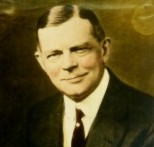
Friday was a day for superlatives. In the morning we had seen more of the Corrick collection of early films collected by a family of entertainers in 1900s Australia. Now, having written my thesis on Charles Urban (right), published a website about him, and taken my blog nom de plume from his company logo, it might be argued that I could be a little biased when it comes to praising his works, but – damn it all – Living London, made by the Charles Urban Trading Company, if it isn’t one of the greatest of all silent films, then it is undoubtedly the greatest film of 1904 [update: the film has now been identified as Urban’s The Streets of London (1906)]. The film is an eleven-minute section from an original forty-minute documentary (no other word will do) depicting London life. Moving approximately eastwards (from Westminster to the City, with a diversion along the Thames), the film shows the metropolis at its imperial zenith, vividly alive, with cameras picking out every detail, high and low (the trouble taken over camera positions was particularly noticeable) – traffic, roadworks, people dancing in the street, workers of every kind, buildings under construction, the river teeming with craft, even in one shot a row of men with sandwich boards advertising Urbanora film shows. The catalogue compared it to Vertov’s Man with a Movie Camera or Ruttmann’s Berlin: Symphony of a Great City, but this was a work of a different kind, a sort of missing link between the single-shot actualities of the early cinema period and the constructed documentary. I can think of few other films that can so thrill with a plain exposition of ‘reality’.

The Corrick collection yielded other gems. Particularly noteworthy were Bashful Mr Brown (1907), a chase comedy made by the Corrick’s themselves; Babylas vient d’hériter diune panthère (1911), pure surrealism from Alfred Machin as an inquisitive leopard is introduced into a bourgeois household; and The Miner’s Daughter (1907), an exercise in beautifully judged pathos from Britain’s James Williamson, in which the title character parts from her father when she marries an artist, and after much grief they are finally brought together by his granddaughter. And it’s a rare early film that combines a mine explosion with scenes inside the Royal Academy.

After the highs of Shiryaev we relaxed in front of Ihr Dunkler Punkt (1929), a typically professional vehicle for Germany’s favourite Briton, Lilian Harvey, who played two identical people, one an ordinary young woman about town, the other a jewel thief, whose lives and lovers get mixed up. A light but cleverly made concoction, in which I most liked the comic turn by the normally sombre Warwick Ward, another Briton who plied his trade in German films.
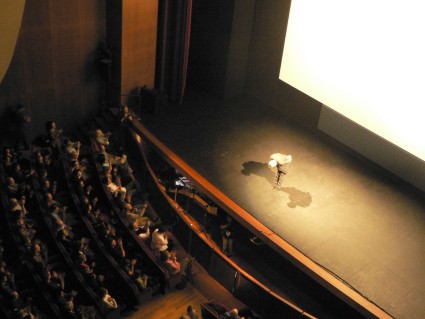
Michael Nyman takes his bow

I was tiring just a little of films by this stage, and chosen not to follow D.W. Griffith into the sound era with Abraham Lincoln (1930). Instead I concluded my Pordenone with the evening screenings of A Propos de Nice (1930) and Kino Pravda no. 21 (1925). A large crowd of Pordenone locals queued up for this, and the theatre was filled up to its third tier. How come? Because Michael Nyman was playing the piano, and Italians, it seems, love his music. Nyman had been due to play at the festival last year, but had to withdraw owing to illness, so did the honourable thing by turning up this year. Despite his star status, Nyman found himself in the pit the same as all the other musicians during the festival, with the result that no one saw him until he emerged for his bow at the end. A Propos de Nice came first, and Nyman’s complexly repetitive music provided the ideal match for Vigo’s cumulative montage of telling images. It was certainly quite different to anything else we heard during the week, a lesson in how we should always be encouraging different musical interpretations of silent films. Particularly striking were sequences with a single bass note pounded with a rapidity that seemed to be testing the piano’s stamina to the limit.

The Kino Pravda, a celebrated example of the series, on the death of Lenin, was less successful. The film itself, with its hectoring, fractured style, combining newsfilm with slogans and animation, probably defies most forms of musical accompaniment, and Nyman’s score churned out circular themes that didn’t much connect with the film. The score lacked the inspiration of A Propos de Nice, and the film ended a few bars before he did, so that he was being applauded while still trying to finish playing. Opinion afterwards was mixed, with some of the musicologists among the Giornate regulars in shock.

And that was it for me. I left early on the Saturday, the last day of the festival, and so missed Griffith’s final film The Struggle (1931) (touchingly paired with a re-showing of his first, The Adventures of Dollie) and the grand finale of Jacques Feyder’s Les Nouveaux Messieurs (1929). This was a fine festival. Few outstanding classics, but so much to interest, stimulate, challenge and excite the imagination. There were welcome innovations, such as the electronic subtitles, and encouraging signs of closer relations between town and festival. The Giornate del Cinema Muto never rests on its laurels, recognising the broad and knowledgable audience that it attracts, and that in a real way Pordenone is silent film today. It sets the agenda; it builds up the canon; it consistently reminds us of how various the silent film was (and continues to be – there were some examples of modern silent shorts, though none that I saw were terribly distinguished). Warm thanks to all who make the festival such a success year after year. We’re so lucky that it’s there.

‘Til next year.

Pordenone diary 2008 – day one
Pordenone diary 2008 – day two
Pordenone diary 2008 – day three
Pordenone diary 2008 – day four
Pordenone diary 2008 – day five
Pordenone diary 2008 – day six

London loves silents

Trafalgar Square screening, 2007

A reminder to anyone in London on 23 or 24 October of the free open-air evening screenings taking place in Trafalgar Square. On the 23rd, starting at 18.30, you can see the British science fiction silent High Treason (1929) – “the British Metropolis” – directed by Maurice Elvey and starring Basil Gill and Benita Hume, with live piano accompaniment by Neil Brand. A fun film to catch, showing a London where we were to be travelling about the city in helicopters, communicating by television, and wearing dodgy fashions. The accompanying short is Gaston Quiribet’s trick film vision of a future London, The Fugitive Futurist (1924).

On the 24th, also at 18.30, there’s a programme of fifteen archive films under the title ‘London Loves’. Among the silents in the programme are the bizarre The Smallest Car in the Largest City in the World (1913), a long-time favourite of those at the BFI National Archive, in which a miniature Cadillac drives sedately down London’s streets; news footage of Charlie Chaplin’s return to London in 1921, with esctatic greetings from the crowds; and an evocative travelogue, London’s Contrasts (1924). The star attraction, however, is going to be Living London (1904), Charles Urban’s truly dazzling documentary portrait of London life, a 10-minute epic only recently rediscovered by the National Film and Sound Archive of Australia and shown earlier this month at the Pordenone silent film festival. It returns to London after 104 years, and on the big screen, in that location, the impact should be tremendous. Among the sound films, look out especially for John Krish’s masterpiece of poignant regret, The Elephant Will Never Forget (1953), on the last trams in London – until they bring them back again, of course. Music will be provided by three musicians, names as yet unpublicised.

The screenings, organised by Film London and the London Film Festival, follow on from last year’s highly successful showing of Blackmail and a programme of archive shorts. It was a magical experience – not just seeing the films in such an extraordinary yet somehow rightful setting, but for the experience of audience watching. Some settled on the steps of the Square and took in every frame; some stopped by for a while to catch the experience before moving on; some paused briefly, on their way to catch a train, puzzled at what on earth was happening. Neil’s music pounded out, down the streets and over the rooftops, filling the evening air, drawing in people from all around to see what strange activity the capital was up to now. Film was bound up with the life of the city. An experience to savour.