Harold Brown RIP

harold_brown

Harold Brown, on left in the 1940s (from the British Film Institute), on the right in 2008 (courtesy of Eve Watson)

You will not find the name of Harold Brown in many film history books, but there are quite a number of film histories that could not have been written without him. Harold, who died on Friday 14 November, essentially invented the art and science of film preservation. Countless films have been preserved either by his hands, or by the hands of those he tutored, or those archives around the world who adopted his methods.

It was in 1935 that Harold Brown (born 1919) started as office boy at the newly-formed British Film Institute, where Ernest Lindgren was setting up the National Film Library. Brown was subsequently to become its first preservation officer. In the early 1930s there were no film archives, or almost none. In that decade the four great national archives that were to become pillars of the film archiving movement were established: the Museum of Modern Art Film Library (New York), the Reichsfilmarchiv (Berlin) and the National Film Library (London) in 1935, the Cinémathèque Française (Paris) in 1936. These archives were established by a dedicated band of pioneer archivists with a passion for the film as art. They were driven in particular by the passing of the silent film era, and the imminent loss of the films of that first period of cinema history, films which were being dumped by the studios who saw no value in a heritage that they could no longer sell to anyone.
mark4

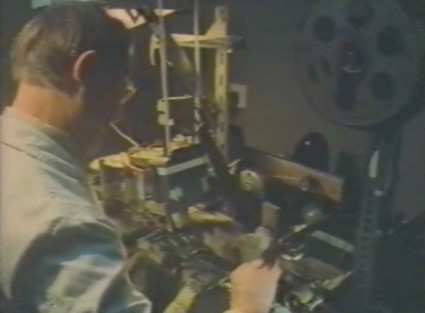
Harold Brown printing a film using the Mark IV

Ernest Lindgren, as Curator of the National Film Library (later the National Film Archive and now the BFI National Archive), laid down principles and Harold Brown came up with the working methods which formed the basis for film preservation. The original film was, as far as possible, inviolate. It needed to be copied, in a form as faithful to the original as possible. Films needed to be treated not only according to their importance but to the extent of, or their potential for, chemical decay. One of Harold’s most notable achievements was the artificial ageing test, which enabled archivists to determine when a film was likely to start deteriorating, and at what time it should be copied. This allowed archives to plan sensibly for the future. A noticeable legacy of Harold’s is the punch holes that you will see occasionally in National Film Archive prints, created so that a circle of film could be put through the ageing test. Another famous Brown creation was the Mark IV, a step printer for dealing with shrunken and non-standard perforation film, built out of bits of toy Meccano, string, rubber bands and parts from a 1905 Gaumont projector.

physical_characteristics

Harold was a self-taught pioneer. His investigations established basic methods for the identification of early film formats, the repair of damaged film, the storage of film, and the treatment of colour film (his work on Douglas Fairbanks’ 1926 film The Black Pirate, in two-colour Technicolor, was an early classic of film restoration). Awarded an MBE in 1967, he carried working at the National Film Archive until 1984, though he continued as a mentor and consultant to film archives internationally, well into retirement. He passed on his knowledge not only in person, but through some key publications. His Basic Film Handling (1985) and Physical Characteristics of Early Films as Aids to Identification (1990) are standard reference guide to the film archiving profession, and the latter is still available from the site of the Federation of International Film Archives (FIAF). Nor was he solely a nitrate era or early film specialist. He stayed abreast of issues in film archiving throughout, and it was he who gave the name ‘vinegar syndrome’ to the phenomenon of the degredation of acetate film which film archives discovered, to their alarm, in the 1980s.

You can see Harold at work in his prime in a 1963 Pathe Pictorial report on the work of the National Film Archive, available from the British Pathe site (just type in ‘film archive’, or click here for the same film from ITN Source). He features towards the end, delicately handling four frames of film, then seen operating the Mark IV. If you can, check out his modest four-page memoir in the FIAF publication This Film is Dangerous: A Celebration of Nitrate Film, edited by Roger Smither. Or you can read about how Brown and Lindgren went about creating a film archive in Penelope Houston’s Keepers of the Frames: The Film Archives (1994). Or read this text by David Francis (Lindgren’s successor as Curator of the National Film Archive) for this year’s Pordenone Silent Film Festival catalogue on Brown’s role overseeing the projection of the 548 films dating 1900-1906 shown at the seminal 1978 FIAF symposium on early film. Or get a copy of the BFI compilation DVD, Early Cinema: Primitives and Pioneers, most of the examples of which are films that Harold took in, preserved, and made available for future generations.

Harold was a wise, methodical, determined and kindly man. I was lucky enough to know him and to exchange information with him on early film formats at my time at the BFI, in the mid-1990s. I was rather awe-struck just to be holding conversations with him, but I found him to be every inch a gentleman. He has been held in reverence by generations of budding film archivists, and even as his pioneering methods have been superseded by more sophisticated technology, and as the film archiving profession now encounters the digital frontier, his understanding of the life – and the after-life – of a film underpins all that a film archive stands for. Gladly would he learn and gladly teach. Thank you, Harold.

Uncle Max

unclemax

Uncle Max Looks After the Baby

There is a long tradition of British televison comedians honouring the silent comedians of the past. As documented on an earlier post, one strand of this began in the 1960s with Bob Monkhouse and Michael Bentine presenting silent comedy films to new audiences. Another strand that began at the same time was televison comedians producing their own silent, or near-silent comedies, among them Ronnie Barker (A Home of Your Own, Futtock’s End, The Picnic, By the Sea), Eric Sykes (The Plank, Rhubarb, It’s Your Move) and Benny Hill (The Waiters, Eddie in August). In recent times, Paul Merton has taken on the Monkhouse/Bentine mantle by inculcating a new generation attracted by his verbal humour into the purely visual humour of his heroes; while following the line set by Barker, Sykes and Hill, Rowan Atkinson has given us Mr Bean, for which we may or may not be grateful.

Now (and for the past couple of years) children in the UK are enjoying silent comedy courtesy of David Schneider, and the television series Uncle Max. This series, produced by Irish company Little Bird Pictures, started out on ITV in 2006 and then transferred to the BBC’s children’s channel, CBBC. It stars Schneider (best known as Steve Coogan’s unhappy sidekick in Knowing Me Knowing You) as the cheerfully accident-prone Uncle Max, a sort of cross between Michael Crawford in Some Mothers Do ‘Ave ‘Em and Mr Bean (without the undercurrent of malice). Episode titles such as Uncle Max Goes to the Dentist, Uncle Max Walks the Dog and Uncle Max Buys some Shoes give you a rough idea what to expect, and in presentation as well as spirit it has real echoes with the minor comedy series of the silent era. It’s obvious humour, but well enough composed for its target audience. And the nephew who endures Uncle Max’s chaotic approach to life is called Luke, something I heartily approve of.

Uncle Max episodes (10 minutes each) turn up on iPlayer when available, and there are trailers on YouTube. Curiously, for reasons of economy the whole series, while set in England, was filmed in South Africa.

With our troops on the Yser

yser

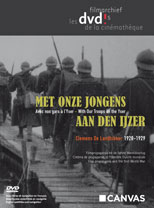
With Our Troops on the Yser, from http://www.ledoux.be/dvd

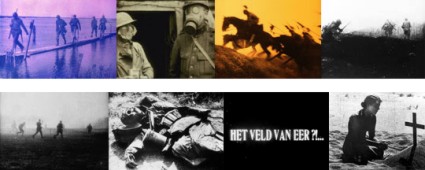
In this month, the ninetieth anniversary of the ending of the First World War, there have been many commeorative events, programmes and publication. The Bioscope has already reported on the Imperial War Museum’s DVD release of The Battle of the Somme. Now comes news of another important film, one originally released ten years after the war, issued on DVD for the first time. The film is With Our Troops on the Yser, a record of the war from the Belgian point of view, though a record of a quite particular kind. Here’s the blurb promoting it:

After four years of horror, the First World War ended on 11 November 1918. Ten years later, a Belgian veteran named Clemens De Landtsheer made With Our Troops on the Yser, a film on the ‘Great War’. The film is neither a triumphant retrospective nor an objective documentary, but a bitter protest in which the hardships of ‘our boys’, the simple soldiers at the front, are central.

As secretary of the ‘Yser Pilgrimage Committee’ De Landtsheer was part of a movement with a political agenda: to promote Flemish nationalism by emphasizing the purportedly disproportionate suffering and abuses endured by Flemish soldiers during the war. To this end, his film combines authentic archival footage from the war with staged images from existing fiction films, as well as a tendentious voice-over commentary. The result is both a unique cinematic experiment and a fascinating historical document, as Daniël Biltereyst (Ghent University) and Roel Vande Winkel (Ghent University – University of Antwerp) explain in the extras on the DVD.

With Our Troops on the Yser was screened more than 400 times in the interwar period. Its success inspired De Landtsheer to found the company Flandria Film. The fascinating story behind De Landtsheer’s film career is also illustrated in the extra documentary on this DVD, accompanied by several Flandria Film productions.

With Our Troops on the Yser was originally released in 1928, but was subsequently revised and augmented several times. The version on this DVD is the definitive colour version of 1933, restored by Noël Desmet (Belgian Royal Film Archive). The soundtrack is based on the original musical recordings used by De Landtsheer to accompany the images. The film can also be viewed with a scholarly audio commentary (in English, French or Dutch) co-written by Leen Engelen (Media & Design Academy), Roel Vande Winkel and Bruno Mestdagh (Royal Film Archive).

yser_dvd

The film runs for 83mins, and comes with Dutch intertitles and English or French subtitles. Bonus features are three other Flandria Films productions by Clemens De Landtsheer: 10th Yser Pilgrimage (1929, 12 mins), Winter Has Come – Ice Festivities at Temse (1933-1934, 5 mins), Jules Van Hevel Tribute (1935, 9 mins); and a 25mins documentary Clemens De Landtsheer, by Daniël Biltereyst, Roel Vande Winkel and Erik Martens. Clearly this a pamphleteering film demanding contextualisation, particularly knowledge of Belgian nationalism, and the understanding of the experience of the war from the Flemish point of view. The commentary is provided by some of the leading lights in film and history today. Well done to all concerned for bringing out this title on DVD and widening our understanding of how film of the war was used and understood, not just during the conflict but in its aftermath. The DVD is Region 0, and is available from the Cinémathèque Royal de Belgique.

First film dogs

beggar

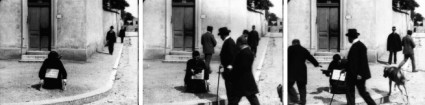
The Lumières’ Le Faux cul-de-jatte (1897), from http://www.davidbordwell.net/blog

David Bordwell recently posted yet another jaw-droppingly good piece on his Observations on film art and Film Art blog, whose consistently high quality makes the rest of us look like mere gossip-mongers. This post, entitled Gradations of emphasis, starring Glenn Ford, examines widescreen cinema (you’ll have to read it to find out what the title means). But there was one aspect of it that caught my eye, something captured drifting across the screen, that reminded me of one of the odder corners of early film down which I like to wander sometimes.

In his survey of lateral staging in film (i.e. action happening within the frame, literally coming in from the sides), Bordwell looks at early film strategies, and reproduces frames from the Lumières’ Le Faux cul-de-jatte (1897), in which a fake amputee begs in the street. He describes the action, until one frame (on the right, above), where a stray dog enters the action from the right. He writes, “The cop comes to the beggar, partially blocking the dog, who takes care of other business. (Not everything in this movie is staged.)” What interests Bordwell is the staged action. What interests me is the dog. Let me explain…

Cinema’s first dog, appearing in Edison’s Athlete with Wand (filmed February 1894) is noticeably at a remove from action and camera (though obedient enough to keep within the frame)

It was when I was presenting a series of programmes at the National Film Theatre on Victorian cinema (i.e. films made before 1901), in 1994, that I first noticed a peculiar phenomenon. As I introduced each short film in the compilation, and pointed out those points of central interest which I had recorded in my notes, I started to notice that the audience’s attention was being frequently been drawn away from the supposed subject and centre of the film’s attention, and instead they were detecting action to the edge of the frame, or crossing the frame, interrupting the action or courageously ignoring it, creating a vital counter-narrative. In short, their attention was irresistibly drawn to stray dogs.

This was a surprising phenomenon, which I exploited at the time for some simple humour, but on mature reflection it seemed that here was a hitherto wholly ignored yet clearly important facet of early cinema, a theme overlooked yet superabundantly obvious once pointed out to the idle observer. The number of stray dogs in early films is considerable, as anyone familiar with the period will readily acknowledge, and their distracting and engrossing qualities seemed to be in urgent need of analysis. Why were stray dogs accepted in early film dramas? What were they doing there? Where did they come from? Were there more such dogs in British films than others? What could their presence tell us about early film practice? How could one construct an overarching vision of early cinema that encompasses the animal and the accidental? Why are there no stray cats? Why, ultimately, were the audience looking in the wrong direction? Were the original audiences similarly distracted? In what sense could it said that such canine interruptions were directed, and by what agency? I resolved to write a paper that would answer these nagging enquiries. It would be called ‘First Film Dogs’.

washingthesweep

I began first by collating the necessary data, and working on a critical theory which would most usefully and succinctly describe the phenomenon. The examples were easy to find: the exuberant Jack Russell which joins in the punishing of a sweep who wanders into a garden and dirties the laundry in James Williamson’s Washing the Sweep (1898, left); the stray dogs wandering over the parade ground amid the marching soldiers in the Boer War actuality Lord Roberts Hoisting the Union Jack at Pretoria (Warwick, 1900), upsetting the solemnity of the situation; dogs wandering casually onto the studio set of early Pathé films; the dog that takes position centre frame in film of a genuine mining tragedy funeral in the middle of the Pathé mining drama Au Pays Noir (1905); actualities such as Funeral of the World’s Greatest Monarch (1910), where King Edward VII’s own dog takes part in the procession, and is then accompanied by a passing stray (such thematic complexity!); the efforts of ‘Monarch’ the Lifeboat Dog to contribute to a life-saving re-enactment performed on the beach in Launch of the Worthing Lifeboat (Biograph, 1899).

comstock

Monarch’s contribution to an actuality which in fact incorporates a dramatic element illustrated the next stage of the theme, where the cinema progressively encroached upon the freedom of the dog, containing the dog within the frame, from Edison’s Laura Comstock’s Bag-Punching Dog (1901, right, though watch the film and see how the dog, Mannie, keeps trying to leap out of the frame only to be drawn back into it); to the passing dogs that enthusiatically take part in early chase films; to the triumph/defeat of Hepworth’s Rescued by Rover (1905), where the dog’s natural motion is contained entirely within the cinematic narrative. Did the sequel to that film, The Dog Outwits the Kidnapper (1905), where Rover gets to drive a car, indicate canine empowerment or slavery? What price the freedom of early cinematic form, when all that results from it in the end is Rin Tin Tin and Lassie?

The critical theory at this stage consisted mostly of a series of such questions, without a key, but I began to work on the concept of ‘canine space’. There was more going on in these early films than first appeared. There was a central performance, or news event, which the original catalogues declared to be the subject matter, but this could not necessarily be what the audience saw, nor was such a dictate bound to be obeyed by those appearing in these films. Anyone familiar with early films will know of the puzzled glances from passers-by that characterise street scenes, of the distracting matter which suggests that the camera operator was not in full command of the subject. In such circumstances, dogs run free. What adds to the fascination, reinforcing one’s belief in the essentially liberated nature of early films, is that stray dogs can be found in studio films of the period. The drama is enacted, the comedy routine performed, and in the background a dog watches, or wanders past, or joins in if it so desires, and this is accepted as part of the total action. ‘Canine space’ is therefore that other space, that world onto which the camera has intruded.

rescuedbyrover

Rover (played by Blair) and Cecil Hepworth in Rescued by Rover (1905)

I never did write the paper. It was intended as a spoof of early film studies, but I couldn’t quite get the humour right. I was scheduled to give the paper at a British silent film festival some years ago, but in the end got up and apologised to the audience and said that the paper was beyond me. But I gave them enough of the argument that it probably affected the rest of the festival, as people starting spotting stray animals in every film, and ever since I’ve had people send me images or information on roving animals which they’ve spotted in some silent or other. A chord was touched.

It’s not a phenomenon entirely restricted to the early cinema (there a renowned stray dog in Joseph Losey’s Accident for instance), but it is a noticeable characteristic of early film which could make one think about the special free nature of film at that time. A cinema where dogs run free is a cinema that has not yet been pinned down, one that lets us look at the edges. You could call it the cinema of distractions. You could theorise about it seriously – there is perhaps some parallel with Roland Barthes’ concept of the ‘punctum’, the oddity in a photograph that shouldn’t really be there but which draws your attention away from what the photograph is ostensibly trying to convey.

Maybe I’ll write the paper one day. Maybe it’s the sort of paper that’s not meant to be written. Maybe we’re always going to be looking at the centre, while at the edges, or wandering across the frame, another kind of story passes by, always eluding us even though it may for a moment catch our eye. I don’t know. Try asking a dog.

Slapstick is here again

slapstick2009

http://www.slapstick.org.uk

Slapstick, Bristol’s silent film comedy festival, returns 22-25 January 2009. At just the time of year when we probably need it most, the Bristol festival (now in its fifth year) will be bringing together a programme of silent comedies with guest star comedians of today. The festival opens with a special gala event at Colston Hall of Buster Keaton’s Our Hospitality (1923), with live music from the Prima Visa Social Club, hosted by Paul Merton, who will introduce a supporting programme of comedy shorts including Laurel and Hardy in Liberty (1929).

Promised guests include Merton, Tim Brooke-Taylor, Graeme Garden, Neil Innes, and the Ukelele Orchestra of Great Britain playing to films from the BFI National Archive. British comedy great Eric Sykes will appear at the Bristol Old Vic on January 25th, in conversation with Phill Jupitus, to talk about his career as a writer and performer, to include a screening of his own classic ‘modern’ silent, The Plank (1967). Other venues will be the Watershed and the Arnolfini.

The remainder of the programme remains to be announced, but you are advised to book early, as this blurb from the festival says:

We are expecting unprecedented demand for these tickets and expect them to sell out quickly. A limited amount of priority tickets have been put aside for Bristol Silents Members and those people who purchase festival passes until 17th November and will be allocated on a first-come, first-served basis.

All Bristol Silents members and delegates will be able to purchase tickets at discounted rates.

We look forward to welcoming you once more to an extraordinary weekend of film, music and laughter in the heart of Bristol and would like to take this opportunity to thanks you for your ongoing support.

More programme news here as it appears.

Any more for Metropolis?

metropolisimage

Metropolis

You will remember the great excitement earlier this year when a 16mm copy of Fritz Lang’s Metropolis turned up in Argentina, with scenes missing from existing 35mm prints. We await the outcome of whatever restoration will eventually bring those scenes to us, but now we hear of more on Metropolis from South America.

A 9.5mm print of the film has turned up in Chile, specifically at the Cinemateca de la Universidad de Chile. A report in the Ecuadorian newspaper El Telégrafo (never let it be said that The Bioscope does not search far and wide in its quest for the best news and information for you) says that the print was uncovered in 2006, though it had been in their vaults for years, but wasn’t immediately recognised as a priority. Now they have sent it to the folk at Murnau-Stiftung, which already has care of the Argentinian material.

We shouldn’t be throwing our hats up in the air over this one, as Pathé-Baby 9.5mm copies for the home market were generally cut-downs from full releases. In any case, no examination has been undertaken of the print, and it will be at least six months before we get any news concerning its contents, as the report states (you can get the drift of it through Google Translate’s English interpretation):

Apareció original de Metrópolis

La cinta en formato 9,5 milímetros de Fritz Lang fue hallada en Chile

Una edición presumiblemente original de la película Metrópolis, realizada por el alemán Fritz Lang en 1926 y uno de los símbolos del cine expresionista, fue descubierta en la Cinemateca de la Universidad de Chile.

La cinta, en formato de 9,5 milímetros, permaneció durante decenios en las bodegas de la Cinemateca y solo en el año 2006 se constató que se trataba de una edición similar a la que se exhibió en Alemania para su estreno comercial, en 1927.

Así lo confirmó al diario La Tercera Luis Horta, restaurador y encargado técnico de la Cinemateca, que precisó que las latas que guardan el filme solo decían Metrópolis en la cubierta.

“Chequeamos y vimos que era una rareza; se trataba de una versión en 9,5 milímetros, formato que está obsoleto, y que tiene una perforación al medio y no al costado como el de 35 milímetros, lo que hace imposible proyectarla”, dijo.

El experto explicó que el descubrimiento no se hizo público de inmediato, (en 2006), porque la Cinemateca tenía como prioridad la recuperación de cintas de los chilenos Raúl Ruiz, Helvio Soto y Miguel Littin.

En todo caso, anunció que la próxima semana la película será enviada a Alemania, a la Fundación Murnau, dueña de los derechos de Metrópolis, para su verificación.

A juicio de Horta, solo en esa fundación podrán determinar si la encontrada en Chile es la edición de 1927, tras un proceso de verificación que durará entre seis meses y un año.

Sostuvo que hasta la década de los 40’s, circuló una edición de 120 minutos realizada por la compañía estadounidense Paramount, pero en 2001 la Fundación Murnau hizo una restauración en base a varias copias y logró agregarle algunas escenas, que aumentaron su duración a 147 minutos.

Sin embargo, recordó que esa versión, estrenada el 10 de enero de 1927, era una reducción hecha por el propio Lang, cuyo original duraba 210 minutos.

Horta manifestó que la película fue olvidada por décadas, porque tras el golpe militar de 1973, época de quema de libros y destrucción de la cultura en Chile, el entonces director de la Cinemateca, Pedro Chaskel, cambió los rótulos de algunas películas para evitar que fueran destruidas por los militares.

My thanks to regular Bioscopist David Pierce for bringing this to my attention, and acknowledgment to DVD Savant where he spotted it.

Pathé treasures

patheposters

http://www.fondation-jeromeseydoux-pathe.com

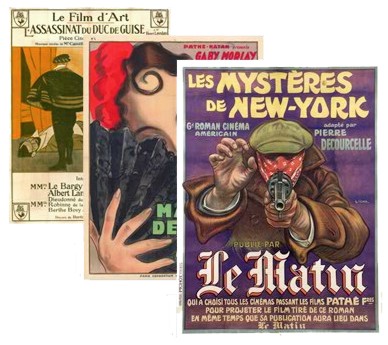
Here’s a real treasure trove. The Fondation Jérôme Seydoux Pathé is an organisation deciated to collecting documents and artefacts (everything, in effect, except the films) relating to Pathé. Their collection, based in Paris, comprises photographs, posters, business documents, cinematograph machinery, books, periodicals, scripts, brochures, designs… seemingly everything connected with the business empire created by Charles Pathé.

Examples of these can be found on their stylish, Flash-driven website, which has background information on each type of collection, and a useful historical timeline from the 1890s to the present day. There is also information on a Pathé filmography which they are producing, building on the herculean work undertaken by Henri Bousquet (who has produced several volumes documenting the output of Pathé in the silent era) and others. The site is, please note, all in French.

pathesearch

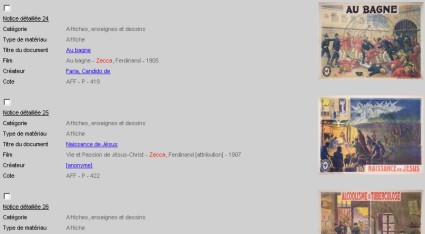
Sample search results from the Fondation Jérôme Seydoux Pathé database

The Fondation has now produced a database of its holdings (accessible from this link or via the Collections section of the site – click on Base de données). The database provides preliminary information on over 25,000 artefacts, designed to assist any researcher prior to their visiting the Fondation in person. It’s easy to use (again, all in French), and a sample search under Ferdinand Zecca (Charles Pathé’s right-hand man in the early days) yields 219 results. Many of the search results come with an associated image, creating a marvellously rich gallery of Pathé history (just look at all the extraordinary posters for the first Pathé productions if you search under Zecca).

Jérôme Seydoux is head of the Pathé and his brother Nicolas Seydoux head of the Gaumont group. Gaumont and Pathé cinemas are now merged (as EuroPalaces), as are the Gaumont-Pathé Archives. You can find the whole complex history the Ketupa site (a useful resource in itself for media ownership history).

My thanks to Mariann Sträuli for alerting to me to this site.

Update (June 2009): The filmography is now available (1896-1913).

Sounds and silents

A call for papers has now been issued for The Sounds of Early Cinema in Britain: Textual, Material and Technological Sources, a conference being held 7-9 June 2009 at the Barbican, London. The conference is being organised as part of the Sounds of Early Cinema in Britain project, which is one of a network of project organised under the Arts & Humanities Research Council‘s Beyond Text programme.

CALL FOR PAPERS

AHRC-Funded Beyond Text Network “The Sounds of Early Cinema in Britain”

The Sounds of Early Cinema in Britain: Textual, Material, Technological Sources

Sunday 7th-Tuesday 9th June 2009

Institute of Musical Research and the Barbican, London, UK

We invite papers from interested parties from all related disciplines to participate in this, the first of four events to establish and develop a research network concerned with the variety of sonic and musical practices of “silent” film exhibition in Britain, interpreted in the broadest possible sense. Explorations of “sources” – of whatever kind – are particularly welcome, as are presentations by archivists, curators, and performers.

Potential topics might include:

  • Sonic and musical practices used alongside the exhibition of early film in Britain
  • The potential sources for understanding these practices
  • Their problems. How we might excavate them
  • The challenges that Britain faces in preserving the existing historical legacy of these sonic and musical practices, instruments, equipment, and spaces
  • Relationship between these practices and those of cinema’s antecedent forms in Britain
  • Distinctive musical practices pursued in Britain, compared to other countries
  • Perspectives from other disciplines, other countries
  • Use of eye-witness memory

Preference will be given to papers with a British focus, though we may be able to accommodate papers that explore the same issues in other national contexts.

Individual Papers: Abstracts of 250 words for individual papers of up to 25-30 minutes should be e-mailed, as a Word attachment, to Mrs Valerie James at music [at] sas.ac.uk. We will also consider shorter presentations of around 15 minutes on specific issues relating to sources. Please include your name and title, institutional affiliation (if any), email address, and postal address.

Round tables: Round table organizers should provide an abstract of 700 words introducing the discussion topic for a 90 minute/2 hour presentation. All panel members must be listed (names and affiliations). The round table organizer is the chairperson and acts as moderator. Proposals should be e-mailed to Mrs Valerie James at music [at] sas.ac.uk as a Word attachment, along with your name and title, institutional affiliation (if any), email address, and postal address.

The deadline for all proposals is 9th January 2009.

Postgraduate scholarships: Postgraduate students working in this, and/or related areas may apply for one of two scholarships (to include basic travel and accommodation, and conference fee and refreshments). Applicants should send the following information to Mrs Valerie James music [at] sas.ac.uk: name, institution where studying, and an outline of their (related) research project.

Should be fun. Start excavating.

Silents in the Hills

wiveliscombe

The Quantocks

Now here’s a commendable thing. The third Wiveliscombe Silent Film Festival (aka Silents in the Hills i.e. the Quantocks) takes place in the small Somerset town on 14-16 November.

The festival opens with Louise Brooks in Diary of a Lost Girl, with musical accompaniment by Devon-based harpist Elizabeth-Jane Baldry (fresh from her star turn at Pordenone). On Saturday 15th they are showing Metropolis, with accompaniment by Reflektor (Jan Kopinski and Steve Iliffe), and on the Sunday there’s Buster Keaton in Sherlock Junior and Lon Chaney Snr in The Phantom of the Opera, accompanied by Alan Eason and Andy McFarlane, guitarist and violinist from D.A.T.A. All films will be shown at the New Hall at Wiveliscombe Primary School, North Street, Wiveliscombe (where a special free show of comedy shorts for the children will be put on before the main Festival begins.)

More details from the festival web page.

100 years ago

100 years ago, The Bioscope was relieved that a certain type of film was certain to be no more:

Indecency’s Decline and Fall

The indecent picture is departing, unwept, unhonoured, and unsung. It has been tried in the balance of public opinion, and has been found wanting. It has been adjudged by the general consent of the public to be “not what we want.” The great majority of manufacturers and showmen have known all along that clean amusement is what is wanted by that section of their patrons which really matters. They have relegated the questionable film to the zone of undesirables, and so, banned by the respectable frequenter of our great picture halls, and uncountenanced by the bulk of manufactuers and dealers simply because they respect public opinion, and themselves recognise the evil which would most assuredly be the result of its constant exhibition. The indecent picture is gradually disappearing. It is mortifying to think that the man whose sole mission on earth seems to be to pull the world down into the mire, should ever have found a place in the bioscope world. But it is gratifying to note that with the steady rise of this form of entertainment into the favour of the populance [sic], there arose men who were ready to give the people real healthy diversion, to minister to the man, not to the beast. The result we all know. It has been the big jump into popularity of the really elevating yet dramatic picture, a huge slump in the output of the low-down manufacturer, and a big increase in the number of patrons who are in search of a good, sensible form of recreation, for themselves and for their children, and who are willing to pay for it. Bioscope entertainments must necessarily have a big hand in the moulding or the marring of a country’s morals, and it behoves us as fellow-workers for the general good of all mankind, to all lend a hand in the work of stamping out this evil altogether and placing those dealers and manufacturers who are inclined to look on it with an encouraging eye, in their proper places – outside the bioscope business.

The Bioscope, 6 November 1908, p. 3.

How indecent did they mean by indecent? Pornographic films of every hue had been produced from practically the start of cinema, but these were really only encountered in ‘smoking concerts’, men’s clubs and brothels. Pathé kept films it described as Scènes grivoises d’un caractère piquant in its catalogue during the early 1900s, and there were companies like Austria’s Saturn Films (examples of whose output can be found on the Europa Film Treasures site) producing coyly erotic films, but these would not have made into the public halls and proto-cinemas of London at this period.

Yet clearly there were shows not reported by the film trade press whose existence threatened the reputation of the industry. Although some research has been done on early pornographic films, little written evidence remains, as might be expected. While one can speculate on what to read between the lines of this editorial piece, what is most striking about it is the sense of responsibility coming out of general popularity. “Bioscope entertainments must necessarily have a big hand in the moulding or the marring of a country’s morals … ” – that’s big claim for what was still a relatively small industry, albeit one just about to mushroom in size to a remarkable degree. The editor of the Bioscope evidently foresaw this, and the anguished debates over motion pictures and morality which were to follow – and which have remained with us, in one form or another, ever since.