The Volta in Trieste

voltaexhibition

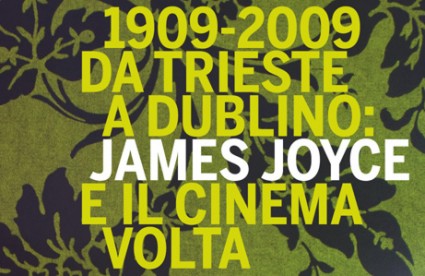
Exhibition on James Joyce, the Volta Cinematograph and Trieste, on show in Trieste

Well, it’s good to be home again. I’ve spent the past week or so in Italy, mostly in the fair city of Trieste for a conference on James Joyce and the cinema. And an excellent conference it was too, with some fine papers identifying the several ways in which Joyce’s work (particularly Ulysses) has affinities with early cinema.

There was yours truly, speaking about Joyce’s brief time as a cinema manager in Dublin; Marco Camerani, Philip Sicker, Carla Marengo Vaglio and Maria di Battista each speaking on aspects of early cinema in Joyce’s work, especially the ‘Circe’ episode in Ulysses, with references to Georges Méliès, Segundo de Chomon, Leopoldo Fregoli and more; and Katy Mullin on the relationship between the erotic in early Edison and Biograph actuality and comedy films and Joyce. Other speakers covered film adaptations of Joyce’s work, making it a very rounded event. I found the arguments convincing and illuminating, particularly regarding the debt Joyce (an avid filmgoer from 1904 onwards as well as a cinema manager, albeit briefly and somewhat ineptly) shows to early cinema in his fiction. The promised book of essays coming out of the conference will be something to look out for.

There was also (and continues to be) an exhibition on Joyce, the Volta and Trieste, entitled ‘Trieste, James Joyce e il Cinema: Storia di Mondi Possibili’, curated by Erik Schneider, who also spoke at the conference on the discoveries he made in the archives about Joyce’s brief foray into cinema management and cinema in Trieste generally. The reason for the Trieste connection is that Joyce – who was living in the city in 1909 as a language teacher – joined up with some local businessmen who ran cinemas in Trieste and Bucharest and offered to help extend their circuit to Ireland by setting up the Volta Cinematograph at 45 Mary Street, Dublin, in December 1909.

Report (in Italian) on the Joyce exhibition and screening of Volta films, from the Trieste Film Festival’s YouTube channel

Joyce was manager on the cinema for a few weeks only before handing over to Lorenzo Novak (the cinema was sold at a loss in June 1910), but enough exists in the archives to reveal a rich history. The above video, from the Trieste Film Festival (which housed a complementary Joyce film season), shows the exhibition, with contributions from assorted brainy Joyceans, plus scenes from an evening of films taken from the BFI National Archive which were known to have been shown at the Volta. You can see me, mercifully briefly, introducing the show (with much habitual hand-waving), Carlo Moser at the piano, and Paolo Venier heroically hand-cranking a Pathé projector for the whole show (with gaps in between each reel as the films were changed, giving the full house a taste of the authentic 1909 cinema experience).

The films shown were:

  • Une Pouponiere a Paris (France 1909) (first shown at the Volta 20 Dec 1909)
  • Francesca da Rimini, or the two brothers (USA 1907) (6-7 Jan 1910)
  • Come Cretinetti paga I debiti (Italy 1909) (17-19 Jan 1910)
  • Il signor Testardo (Italy 1909) (17-19 Jan 1910)
  • A glass of goat’s milk (GB 1909) (3-5 Feb 1910)
  • The Way of the Cross (USA 1909) (14-16 Feb 1910)
  • (Der Kleine Schlaumeier) [original title not known] (France c.1909) (21-23 Feb 1910)
  • (Hunting Crocodiles) (France 1909) (7-9 Mar 1910)
  • Une Conquete (France 1909) (10-12 March 1910)

(Note – some of the films are possibily those shown at the Volta, and are not definite identifications. Le Huguenot (France 1909), which was advertised for the festival, wasn’t shown)

Also shown was Georges Mendel’s 1908 opera film of the sextet from Lucia di Lammermoor (with Enrico Caruso’s voice) as an example of the synchronised sound film Joyce wanted to show at the Volta, but never did.

For me, the most remarkable discovery in the exhibition was Joyce’s own hand-written list of expenses at the Volta for its first three or four weeks, from the collection of Cornell University Library, accompanied by a letter from Pathé in Britain advising him on the choice of projector, lenses, light source and so forth. Joyce’s venture into cinema, though short-lived, generated a significant amount of information on cinema in 1909 to make it worthy of study for those interested in general cinema history. We know the identity many of the films shown, thanks to extensive advertising in the Dublin press; we have the contracts drawn up; we know the initial expenses; we know about the background business in Trieste; we know how the cinema was decorated; we have the names of three or four of the staff (such as Lennie Collinge, the projectionist who lived long into a ripe old age and was interviewed by film historian Liam O’Leary, who first uncovered the Volta history). What we don’t have, alas, is a contemporary photograph of the cinema, interior or exterior.

There is much in the exhibition on early cinema in Trieste itself, which had a remarkable twenty-one cinemas in 1909. There is a history of cinema in Trieste, 1896-1918, written by Dejan Kosanovic, though in Italian only. Another gem from the archives was the advertised programme for Lifka’s Bioscope, a travelling film show which visited Pola in December 1904, when James and Nora Joyce attended the show. Joyce wrote to his brother Stanislaus: “The other evening we went to a bioscope. There were a series of pictures about betrayed Gretchen … Lothario throws her into the river and rushes off, followed by rabble. Nora said ‘O, policeman, catch him'”. I’m working on trying to identify which film moved Nora so. Would you believe Lifka’s Bioscope mostly got its film from Charles Urban…?

Anyway, a stimulating conference, a fine exhibition, and bright winter’s sunshine to delight us all.

james1

Statue of James Joyce by the Canal Grande, Trieste

Off to sunny Italy

flyer-joyce-1

Well, I hope it’s sunny at any rate. The Bioscope is heading for Trieste, Italy for a few days, to speak at a conference on James Joyce and cinema. Then it’s a few days more in Florence. So, as I’m under stern instructions not to go anywhere near a computer for the period, normal service will have to be resumed on January 22nd.

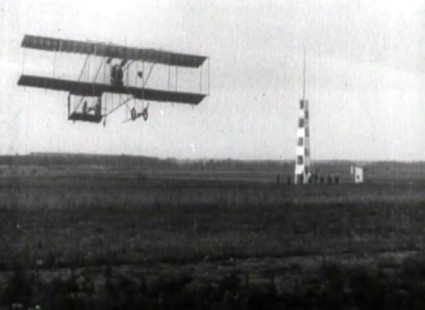
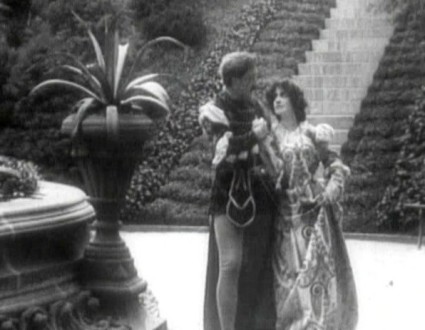
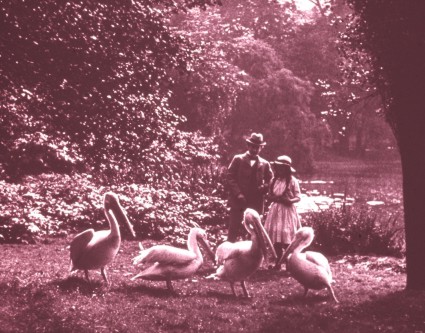
Meanwhile, for your amusement, I’ve included a few frame stills from films that are known to have been shown at the Volta Cinematograph in Dublin, between December 1909 and January 1910, the period when Joyce was either managing the cinema or immediately afterwards (he left Dublin on 2 January). So they are likely to have been films that he saw, indeed programmed. All images are from prints held by the BFI National Archive (via a DVD copy).

pouponniere_a_paris

Une Pouponnière à Paris (Éclair 1909), an interest film about a Paris nursery. The only surviving film from the inaugural programme of the Volta Cinematograph, 20 December 1909.

farman

Aviation Week at Rheims (Pathé 1909), newsfilm about the world’s first aviation meeting (the aviator is Henry Farman). Shown at the Volta 3-5 January 1910.

francesca_de_rimini1

Francesca da Rimini, or The Two Brothers (Vitagraph 1907), classical drama based on Dante, with Florence Turner and Paul Panzer. Shown at the Volta 6-8 January 1910.

come_cretinetti

Come Cretinetti paga i debiti (Itala 1909), special effects comedy starring André Deed as Cretinetti, ingeniously avoiding those to whom he owes money. Shown at the Volta 17-19 January 1910.

signor_testardi

Il signor Testardo (Itala 1909), bizarre comedy about a grotesquely stubborn man, shown at the Volta 17-19 January 1910.

Arrivederci!

There’s no business like show business

The programme from the 2009 StummFilmMusikTage (the German festival of silent film and music) has been announced. The theme for this year’s festival, which takes place on 24 January (apparently just the one day – it was a three-day festival last year) at Erlangen, is There’s no Business Like Showbusiness:

16 Uhr / 4 pm
Filmens Helte (Pat und Patachon, die Filmhelden / Film Heroes)
Dänemark/Denmark 1928, 68 min
Regie/Director: Lau Lauritzen, Sr.
mit/with: Carl Schenstrøm, Harald Madsen, Holger Reenberg, Eli Lehmann
Musik und Ausführung: Miller the Killer con Conny Corretto

18 Uhr / 6 pm
Lesung: Der ewige Tramp /Reading: The Eternal Tramp
Eintritt frei / free entrance

19 Uhr / 7 pm
The Circus (Der Zirkus)
USA 1928, 71 min
Regie/Director: Charles Chaplin
mit/with: Charles Chaplin, Merna Kennedy, Al Ernest Garcia
Musik: Charles Chaplin
Ausführung: Ensemble Kontraste
Leitung: Christian Schumann

21 Uhr / 9 pm
When Silence Sings: Der Filmkomponist Aljoscha Zimmermann im Gespräch/ A Conversation with film composer Aljoscha Zimmermann
Eintritt frei / free entrance

22 Uhr / 10 pm
Varieté (Variety)
D 1925, 112 min
Regie/Director: E.A. Dupont
mit/with: Emil Jannings, Maly Delschaft, Lya De Putti, Warwick Ward
Musik und Ausführung: Aljoscha und Sabrina Zimmermann

Pre-sale tickets are now available (the organisers advise that if you are considering acquiring tickets from outside Germany, please to write to asynchron@stummfilmmusiktage.de to check about reserving tickets).

Lloyd George in London

lifestoryimage

Norman Page (David Lloyd George) and Alma Reville (Megan Lloyd George) in The Life Story of David Lloyd George (1918), from National Screen and Sound Archive of Wales

I’ll have more to say about this event nearer the time, but here’s a general notice that there is to be a screening of The Life Story of David Lloyd George (1918, d. Maurice Elvey) at the British Library on Sunday, 15 February. This key film in British film history tells the story of the Libreral Prime Minister David Lloyd George, focussing on his engagement with the major issues of the day, from his opposition to the Anglo-Boer War, to the introduction of old age pensions, to his activity as Minister for Munitions in the First World War, leading to his appointment as Prime Minister midway through the war.

Two things are particularly remarkable about the film. The one is mystery surrounding its disappearance – the film was never exhibited before the public, and there seems to have been a government pay-off to prevents its screening, after which the film disappeared for decades until its happy rediscovery in 1994. Secondly, there is its exceptional quality, both as ambitious human/political drama, quite unlike anything one might normally expect of a British film from this period, and then the sheer quality of the print, which is a joy to behold. The film has not been shown in London since its premiere (literally so) in 1996, and if you can get to see it I really recommend doing so. It is an epic without histrionics, prosaic and visionary at the same time.

The film will be accompanied by Neil Brand on the piano, and the screening will be introduced by television historian Dan Snow, who happens to be Lloyd George’s great-grandson. The reason for putting off more information at this stage is the happy news that the National Screen and Sound Archive of Wales is publishing its long-promised DVD of the film next month (with Neil Brand score), coinciding with the screening.

The film is being shown as part of the British Library’s Taking Liberties exhibition (on the history of civil liberties in Britain). The screening runs 14.00-17.00 (with interval) at the Conference Centre, British Library,tickets priced £6 (concessions £4). More information on booking here.

As said, more on the background to the film when the DVD comes out. Meanwhile, David Berry’s book, David Lloyd George: The Movie Mystery gives the full history behind an exceptional film.

Footnotes to the Festival

filmcans_banner5

With the festival now over (a little sooner than intended), acknowledgment is due to the various sources used, aside from the standard filmographies and reference guides.

War Brides was the easiest to research, as the best known film among the films. Useful sources included Kevin Brownlow’s The War the West and the Wilderness and Ivan Butler’s Silent Magic, the latter the source of the main image. Maria Craig Wentworth’s original play, with production photos, is on the Internet Archive. Contemporary film reviews were also used. For the accompanying short, Kiddies in the Ruins, see the director George Pearson’s autobiography, Flashback.

The Land of Mystery is the most obscure among the titles selected. The two main sources are Kevin Browlow’s Behind the Mask of Innocence (which has the only known photograph connected with the production) and John M. East’s ‘Neath the Mask, a marvellous account of lesser British theatre and film in the early years of the twentieth century through the life of the author’s grandfather, John East. East was an actor in the film and had vivid memories of the trip to Lithuania. Acknowledgment is also due to the researches of Nicholas Hiley into the British secret service, some of which fed into Brownlow’s work. The information about Lenin seeing the film comes from an essay by the late Rashit Yangirov in Derek Spring and Richard Taylor, Stalinism and Soviet Cinema. A detailed review in The Bioscope (8 July 1920) supplied much information, including a plot summary. The accompanying film, Meyerhold’s The Portrait of Dorian Gray, has been much written about. The main source used was Jay Leyda’s history of Russian and Sovet cinema, Kino.

The essential source for The Jeffries-Sharkey Fight is Dan Streible’s new history of early fight films, Fight Pictures. Also useful is Charles Musser’s The Emergence of Cinema. Information on the fight additionally came from Nat Fleischer and Sam Andre’s absolutely essential A Pictorial History of Boxing. Also used were Fleischer’s The Heavyweight Championship and the International Boxing Hall of Fame’s The Boxing Register. Some images came from the Library of Congress Prints and Photographs Online Catalog.

Das Mirakel took up the most time because of a lack of information in secondary sources, and huge errors in most online sources. I relied chiefly on British film trade press coverage over 1912-13, particularly The Bioscope. The German film database Filmportal is comprehensive and generally very reliable, and supplied most of what I could find on the rival Das Mirakel. Information also came from Charles Graves, The Cochran Story and John Glanfield’s excellent Earls Court and Olympia, which was the source of the illustration from the Olympia stage production of The Miracle.

Information on the cinemas used came from The London Project database, with the descriptions of the cinemas from some of my own researches, augmented by Allen Eyes and Keith Skone’s London’s West End Cinemas.

Grateful acknowledgment to all sources – even to the Internet Movie Database…

With apologies…

filmcans_banner4

It is with humble apologies that I have to report that tonight’s screening at the Bioscope Festival of Lost Films is not going ahead. There have been problems with the film chosen for our last screening, from the sudden likelihood that part of it had survived (which subsequently proved not to be the case), but more seriously that its sober subject matter did not quite suit the air of ironic whimsicality which is the hallmark (we think) of this Festival.

There was a film in reserve (there are many lost silent films, as we know), but your programmer is leading a busy life at the moment and both time and energy have run out. Thought was given to postponing the festival for a day, but the cinema manager has been awkward, and the organist we had hired (a certain Dr Sargent) was demanding ruinous expenses for being kept on for a second evening. All in all, the wiser course of action is to call it a day at four shows, and to return to lost films (perhaps as an occasional series) another time.

To all festivalgoers, you may of course obtain refunds from the festival office, and I hope that no one was put to too great an expense over costume hire. There is just enough left in the kitty (once the organist has been paid off) for us to have our promised end of festival soirée at the Cafe Royal (itself soon to be no more), where we may toast lost films and consider that not only is vita brevis, but sometimes ars is brevis too.

caferoyal

William Orpen, ‘Café Royal London 1912’

Das Mirakel

filmcans_banner21

Germany 1912

Screen adaptation: Michel Carré
Production Company: Ingenieur Jos. Menchen (Berlin)
Producer of stage production: Max Reinhardt
Producer: Joseph Menchen
Author of stage production: Karl Vollmöller
Cinematographers: William Jeapes, Harold Jeapes
Composer of accompanying music: Engelbert Humperdink

Cast: Maria Carmi (The Madonna), Douglas Payne (The Knight), Florence Winston (The Nun), Ernst Matray (Spielmann/The Minstrel), Josef Klein (The King), Agathe Barescu (The Abbess), Theodor Rocholl (The King’s son), Ernst Benzinger (The Robber Count), Marie Von Radgy (The Old Sacristan ), Alfred König (The Lame Man), Ernst Lubitsch

Distributed by Joseph Menchen
1,459 metres (four reels)

It is day four of the Bioscope Festival of Lost Films, and this evening we find ourselves in Oxford Street. We hope that the message got through to festivalgoers that we have had to move from the scheduled Pyke House (which will serve as our venue tomorrow) further down Oxford Street to the larger venue, the Picture House at 161-167. This fine new building seats 760, and some may remember that it was one this spot in 1906 that Hale’s Tours of the World (films exhibited in a mock railway carriage) was first seen in this fair city. Opened in January 1913, the Picture House is held to be one of the most delightful cinemas in London, exquisitely lit and upholstered, with a perfect view guaranteed for every attendee. We needed the extra space to fit in an orchestra and choir, with a most notable conductor – but first we must tell you a little about what you are to see.

max_reinhardt1

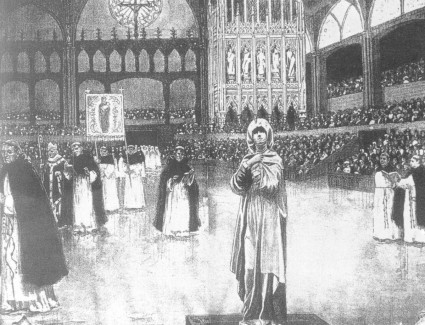
Our film this evening was a legend before it was even a film, so to speak. It is Das Mirakel, to give its German title, or The Miracle as every one of you will know it from the sensational exhibition of the stage version at Olympia in 1911. The producer of that epic piece of dumbshow theatre was Max Reinhardt (left), the Austrian theatrical genius, whose inspired use of lighting, mechanical effects and spectacle (particularly crowds) has so startled audiences across Europe. Like Vselovod Meyerhold, whose work we saw two days ago – but with very different results – Reinhardt’s great desire is to free theatre from the confines of literature and to revel in the space that it offers. The Miracle, a play written by Karl Vollmöller, is extraordinary in the first instance for being silent, told only through dumbshow and the music of the great composer Engelbert Humperdink – and, yes, it is maestro Humperdink who, at extraordinary expense, the festival has brought over from Germany to conduct the orchestra for us tonight, together with a chorus of eighty.

The Miracle retells a medieval legend of a nun who dreams of temptations to be found in the outside world and flees from her convent with a knight. She suffers various adventures and privations, eventually finding herself accused of witchcraft. While she is absent from the convent, her place is taken by a statue of the Virgin Mary, which comes to life and undertakes the nun’s various duties. Upon the penitent nun’s return, the Virgin becomes a statue once more. That we saw the play in London was thanks to that most enterprising of theatrical entrepreneurs, C.B. Cochran, who was looking for an entertainment to fill the vasty space of Olympia. Enthralled by seeing Reinhardt’s Oedipus Rex in Germany, he invited him to come up with an epic production which would make best use of Olympia. Reinhardt’s idea (after toying with the possibility of recreating the Delhi Durbar) was to stage a medieval tale with a cathedral setting. Vollmöller then came up with the play. The huge space at Olympia made it essential that the story be told without words, simply because the audience would be unable to hear them. 1,000 performers and 500 choristers filled out the epic drama, supported by a wonderful array of stage machinery, ingenious theatrical effects and uplifting music.

miracle

Newspaper illustration of the The Miracle at Olympia

The success of that production needs no re-telling here – simply to say that for many it was a theatrical event like no other. What concerns us is the film that followed. A spectacle in dumbshow was an obvious choice for Herr Reinhardt’s first foray into cinema. News that a film was to be made, and that it would be produced in London, first appeared in May 1912. Then there was silence for quite a time, until we learned that the film was to be produced in Austria while the theatre company (including, it is believed, one Ernst Lubitsch, a comic actor of notable promise, we are assured) was based in Vienna. Filming took place in three weeks over September and October. The great surprise to all in the industry was that the film was photographed by a British newsreel manager, William Cecil Jeapes and his brother and fellow newsreel expert, Harold. Now Billy Jeapes is well known in Wardour Street, and manages that popular newsreel Topical Budget. He would be the first person one would call for should a speedy news report be required, but he is not known for his work with dramatic films. And yet, as an interview for The Bioscope that Mr Jeapes kindly provided just a few days ago, he was the person who, as they say, ‘got the call’:

[TB] So, Mr. Jeapes, how was ‘The Miracle’ taken?

[WJ] Well, it’s a rather long story, but I’ll do my best to give you the main points as briefly as possible. In the first place, I may say that my own connection with the undertaking commenced just about twenty-four hours before I actually entered upon it, so you can imagine that there wasn’t much time for preparation. I received and accepted the request that I should take on the business, grabbed camera, films and baggage; caught the first train that was available, and, in almost less time than it takes to tell (as the novelists say) I was starting on the first preliminaries with Professor Reinhardt and M. Michel Carré (who adapted the play for the camera), near Vienna.

I left London on September 21st, and I returned on October 15th. During that time we were working regularly from the early morning until about 3 o’clock in the afternoon, at which hour it was necessary for the company to start back for Vienna, where ‘The Miracle’ was being played nightly – at the Rotunda. We did nothing on Sundays.

[TB] And how, Mr. Jeapes, does the film compare with the original production, as we saw it in London?

[WJ] Favourably, I think I may say, in every particular. It is obvious, of course, that the enormous scenic advantages of the cinematograph have made it possible to present in realistic detail all sorts of incidents which could scarcely be more than hinted at in the arena at Olympia. The character of the production, as a ‘wordless play’, obviates any loss through the absence of speech, and, since the film is being coloured by hand in Paris, the wonderful effects in this respect will be quite as striking as they were when seen in actuality.

You will probably be struck by the continuity of the play in its film version as compared with its episodic nature at Olympia. It will not be necessary to keep our audiences waiting while we ‘change the scenes’ and we have, also, been able to fill up the gaps. Naturally, too, the superior possibilities of the cinematograph in illusion-making have allowed us to treat supernatural incidents with the greatest freedom.

From Mr. Jeapes we learn further that the exteriors were photographed in the grounds of Kreuzenstein Castle and at the cathedral of Perchtoldsdorf, Vienna. It is unclear from his account to what degree, if any, Max Reinhardt actually directed the film, or whether he simply supplied some instructions, and it was Michel Carré (a French film director)who took most responsibility. That Mr. Jeapes had some unusual influence over the production can be deduced from the fact that the part of the Nun is not played by the actress from the theatre company (all other parts are filled that way) but by one Florence Winston, not a known actress at all, but who just happens to be Mrs William Jeapes. It is all very curious.

But what of the film itself? Opinions are mixed on what is being billed as a ‘Lyricscope Play’, to a quite fascinating degree. That normally level-headed American journal Variety has gone into absolute raptures:

The ‘Miracle’, reproduced from the wonderful Reinhardt pantomime of the same name presented at the London Olympia, is probably the finest exhibition of the “Celluloid drama” ever conceived. In some respects it is superior to the original pantomime spectacle, in that the paths of the performers – or characters – may be followed more minutely and with greater detail than is possible in the original, due to the possibility of showing the scenic progression with the unfolding of the plot … The whole presentment is remarkably impressive in general effect, the pictures so beautifully to resemble natural colors, the scenes so plentifully interspersed with captions announcing the progress of the tale, and finally the awakening to a realization that it was all a ghastly, enervating “dream”, is extraordinarily vivid. No spoken play could be more so.

Variety‘s critic was possibly a little overwhelmed by the presentation of the film, which we are emulating today – a cathedral frontage over the proscenium arch, with doors opening to reveal the screen within; incense wafting into the auditorium; the choir entering in vestments and coming upon stage; the use of sound effects; the heavenly music. We hope you will be similarly transported, but we must note a soberer verdict from the British paper, The Bioscope, reviewing the film’s UK premiere in this very cinema. The Bioscope looks beyond the siren charms of theatrical presentation to what is actually presented on the screen:

The whole play seems to have been adapted for the camera with only the most cursory regard for the latter’s possibilities and limitations. It has been forgotten that a scene viewed through an artifical glass lens is a very different thing from the same scene viewed in actuality by the naked eye.

The reviewer chastises the film for failing to adjust the drama to the demands of the camera, and finds the staging maladroit, sometimes to ridiculous effect:

In the scenes showing the cathedral’s interior the stage is too deep, with the result that the players are constantly out of proportion with each other, and swell from midgets to giants in a fashion which is almost ludicrous as they move “down stage”.

Again, how much did Max Reinhardt have to do with the film itself? The Bioscope is uncertain, and we must confess to being unsure ourselves. Herr Reinhardt has not answered our telegrams, and Mr Jeapes has been curiously evasive. At any rate, you must be the judges of what you see on the screen. It is a film that is perhaps more an act of faith than a conventional cinema offering. The incense is not separate from it; it is an essential part of the experience. Also, it is a film that has to live in the imagination: not only is it a lost film, but there is not a single image from the film that we can produce for you. Our researcher recalls seeing some frame stills once, and recalls vasty spaces and isolated figures. But those images too, are now gone…

And then there is the matter of the second Miracle. For a great headache for Reinhardt, Vollmöller, Carré and the film’s American producer Joseph Menchen has been the existence of a rival film, which we are bravely (and uniquely) programming to accompany our main feature. The second Das Mirakel was made in Germany by Continental-Kunstfilm GmbH in 1912. It was written and directed by Mime Misu, a Romanian who came to prominence in German cinema recently following the success of his dramatisation of the tragic storyof the sinking of the ‘Titanic’, In Nacht und Eis (1912). Misu has not only directed the film, but acts in it as well, alongside Lore Giesen and Anton Ernst Rückert.

Its existence has caused much confusion. A court injunction was applied for in this country to prevent the exhibition of the Misu Mirakel (it was registered under that title in Germany) by the Elite Sales Agency when it was announced as opening at the London Pavilion in December 1912, but it seems Elite subverted any charges of copyright infringement by averring that the story was based on legend, not on Vollmöller’s play. Nevertheless, they appear to have been playing things safe by taking the advice of the judge and exhibiting the film under a different title: Sister Beatrix (in Germany it has been exhibited as Alte Legende – Eine Das Marienwunder or Marienwunder – Das Eine alte Legende). Under this title it has been sold to many cinemas across Britain, who have sometimes advertised it as The Miracle, to the great dismay of the ‘true’ film’s producers.

We have not seen the film, and information on its contents is hard to find. The film is 4,000 feet, which means a long evening for you, but such an opportunity to compare these two films in the same venue is unlikely to occur again. Particularly if you also want the orchestra, choir, organ music, sound effects, special effects, cathedral gates opening onto the screen, hand-coloured images, or indeed the incense. This has been a unique evening.

Please join us tomorrow night for our final screening at Pyke House Cinematograph Theatre. It is a sobering and controversial production that we have programmed for our last show, but we hope that all festivalgoers will join us afterwards for an end-of-festival libation or two. A room has been hired at the Café Royal. Never let it be said that we do things by halves here at the Bioscope Festival of Lost Films.

Update (June 2011): There is good news for film, and bad news for a lost film festival – Das Mirakel is no longer a lost film. A print is held by the French CNC film archive at Bois d’Arcy. See the comments below for more information.

The Jeffries-Sharkey Fight

filmcans_banner2

USA 1899

Production Company: American Mutoscope and Biograph Company
Cinematographers: Arthur E. Johnstone, Wallace McCutcheon, F.J. Marion

Distributed by American Mutoscope and Biograph Company
37,000 feet

jeffriessharkey

Welcome to Wonderland! The venue for our screening this evening is something special, and possibly the kind of place outside the experience of some of the gentler members of our festival attendees. We are in Whitechapel, in the heart of London’s East End, and Wonderland is where the working man goes to seek out entertainments after his own heart. Those with long memories may recall when this place was the East London Theatre and put on Yiddish plays for the Russians and Poles newly come to London. Rough were the entertainments and rough the audiences who enjoyed them. Then the place turned to boxing, and under the careful management of Mr Jonas Woolf it became Wonderland, home to boxing bouts, amusement shows, so-called freak shows, and cinematograph entertainments. Up to 2,000 people will squeeze themselves into Wonderland on a boxing night, and it is boxing that we have for you tonight, in this most appropriate of venues.

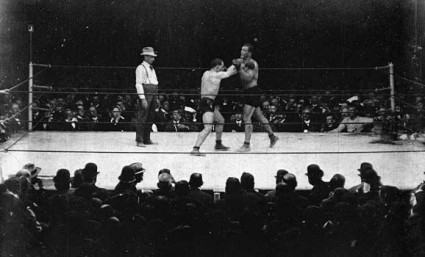
For tonight we bring you The Jeffries-Sharkey Fight. Yes, all twenty-five rounds of the world heavyweight championship bout held at Coney Island on 3 November 1899. But the fight lasted for some two hours you cry, it is not possible for a cinematograph to be so long in 1899. Ah, but it is, though the struggle to achieve so stupendous a record of pugilistic endeavour on the cinematograph was scarcely less tumultuous than the bloody struggle that was the fight itself.

The film is a production of the American Mutoscope and Biograph Company, whose products you may have seen a large-screen entertainments in variety theatres, or as Mutoscopes, those peepshows with cards rotated by a handle that are so popular in some amusement parlours. The company employs a unique 70mm film system, which can only be exhibited by its own projectors, a policy which has encouraged the pirates, as you will learn. However, the quality of the image achieved is extraordinary, and with none of the tiresome flicker that sadly drives some people away from the cinematograph shows. Following the great commercial success enjoyed by the Veriscope Company in filming the world heavyweight championship bout between James J. Corbett and Robert Fitzsimmons in 1897, Biograph secured the rights to film this match between Fitzsimmons’ conqueror, James J. Jeffries, and the challenger Tom Sharkey, a deal secured by Jeffries’ wily manager William Brady – a man acutely aware of the value of a motion picture deal to the boxer of today.

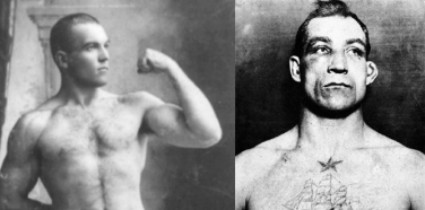
jeffries_sharkey

Jim Jeffries (left) and Tom Sharkey

Yes, Boilermaker Jim versus Sailor Tom, 215lbs and 6′ 2″ against 183lbs and 5′ 8″, a contest that has gone down as one of the most grueling fistic encounters of modern times. Twenty-five rounds would be enough to test the stamina of anyone, but what made this encounter all the tougher was the presence of the motion picture cameras. The fight took place in the Coney Island pavilion, and once a decision was made not to remove the roof (to allow in daylight), it was necessary to film under artificial lights. Mr Dan Streible, the festival’s special consultant, informs us that the Biograph company boasts of employing eleven electricians to operate 400 specially built arc lights and associated feed wires, dynamos etc., while a it was boasted a dozen operators were required to man the four cameras. Over seven miles of cinematograph film were to be taken by the operators (we rather think that there were three of them) who worked in rotation, with the cameras in parallel so that one was operating at any one time while the others were loaded in readiness and a fourth stood by in case of breakdowns.

All those arc lights generated colossal heat. We are reliably informed that the scalps of the fighters were singed, and each suffered from great weight loss as the fight progressed. Add to this the brutality of the fight itself – Sailor Tom suffered two broken ribs – and one realises that one is to experience something extraordinary, a sporting endeavour which the cinematograph did not only record but in doing so affected its outcome. We fondly imagine that the cameras are passive witnesses of what parades before them, but maybe the camera being there necessarily changes what we see, so what kind of reality is it that the cinematograph is recording?

jeffriessharkey_loc

Poster advertising the fight film, from the Library of Congress collection

But enough of such philosophising, we must return to the fight. The result you will know. As tough and able as Sharkey undoubtedly was, able to withstand terrific punishment, Jeffries countered his every sally with fierce left hooks to the jaw and thunderous blows with the right over the heart. All was level, however, until the final five rounds, when the champion began to dominate and the strength had gone out of Sailor Tom’s punches. With an energising glass of champagne offered to him by his trainer before the final round, the Boilermaker entered the ring with renewed vigour comprehensively outbox his opponent and make the judges’ decision an easy one.

Thanks to the effort, expense and ingenuity of the Biograph company, you will be able to see all twenty-five rounds of this unsurpassed sporting encounter, with George Siler, referee for the contest, brought over at notable expense to serve as expert lecturer. He will guide you through the finer points of the scientific display that you will be witnessing. Now some may have heard rumours that the Biograph company were not able to film every second of the fight. Indeed, that is the case. Though the cameras themselves never failed, most unfortunately a fuse blew just as the twenty-fifth and final round was coming to a close. Exasperatingly for the filmmakers, they missed the crucial moment where Jeffries’ glove came off, Sharkey tried to take advantage, the bell rang, and Mr Siler held up Jeffries’ arm in victory. What exactly happened? How greatly we would value seeing the cinematographic record at this very point. It is unclear how the film company has got around this unfortunate lacuna. Some say that a judicious edit has smoothed over the gap; other claim that a re-enactment has been filmed. Mr Siler is saying nothing, and Mr Brady has been equally evasive. We will only be able to judge when we have seen the film ourselves.

biographteam

The American Mutoscope and Biograph Company’s camera team on its special platform

You may also have heard tales of other films made of this fight. Sadly, this is so. Despite the American Mutoscope and Biograph Company’s exclusive agreement with the promoters, other unscrupulous filmmakers who put not a penny towards the filming of the event yet are all to eager to benefit from the struggles of those who did are promoting films of the Jeffries-Sharkey fight. One company, Lubin, as you may know, has specialised in producing dramatised reconstructions of boxing matches, and having copyrighted their re-enactment of Jeffries-Sharkey ahead of Biograph, even had the cheek to sue the legitmate film producers for infringement!

But the greater crime has come from some renegade operators, among them Albert Smith of the Vitagraph company and James H. White of Edison, who smuggled cameras into the crowd, eluding the attentions of the Pinkerton men hired specifically to prevent such piracy, taking full advantage of Biograph’s lighting to produce short films of the bout. Vitagraph’s film is a wretched record of only a small portion of the fight (we have heard that they have attempted to put the film into a loop with the intention of fooling the gullible into thinking them are seeing multiple rounds) with the heads of the crowd obscuring the view. With what great irony is it for a festival of lost films that this pirate film survives, yet all posterity has of the Biograph film – the epic of its age – is a Mutoscope card or two, representing a few inches of a record that, as we know, could be measured in miles. And so, breaking all of the festival’s rules, our accompanying short is a film that does exist. Here is The Battle of Jeffries and Sharkey for Championship of the World (1899), produced by Vitagraph.

An extract from the pirated film of Jeffries-Sharkey taken by Vitagraph (the stills, commentary and music are all obviously later interpolations)

Despite the simulation and piracy, the Biograph company has enjoyed considerable success with The Jeffries-Sharkey Fight. Some say that it has brought in $200,000 at the box office, and if that is probably an exaggeration, it has undoubtedly further cemented the close relationship between the ring and the screen. However, commentators have noted fewer women attending screenings of the film that was the case for the Corbett-Fitzsimmons fight two years ago. Perhaps the novelty value has worn off. In the future, boxing films will be for fight fans only, and we suspect that they will become increasingly marginalised, after having played such a crucial role in building up an audience for motion pictures when they first appeared.

Join us tomorrow night, when we will be in Oxford Street to see a magical tale in dumbshow … or is it two magical tales in dumbshow?

The Land of Mystery

filmcans_banner1

UK 1920

Director/producer: Harold Shaw
Production Company: Harold Shaw Productions
Story: Basil Thomson
Script: Bannister Merwin
Cinematographer: Stanley Rodwell

Cast: Edna Flugrath (Masikowa), Norman Tharp (Lenoff), Fred Morgan (Prince Ivan), Christine Rayner, Harold French, M.R. Morand, Lewis Gilbert, John East, Phyllis Bedells (ballet dancer), Laurent Novikoff (ballet dancer)

Distributed by Laurillard & Grossmith
7,220 feet

land_of_mystery

The only known production photograph of The Land of Mystery, taken in Kovno, Lithuania (from Kevin Brownlow, Behind the Mask of Innocence)

Welcome to day two of the Bioscope Festival of Lost Films. Today we find ourselves in the heart of London’s Soho district, at the Jardin de Paris, a cinema which once had a somewhat insalubrious reputation, but which now attracts a more discerning clientele, and certainly sees a little less of the police than it once did. Manager Felix Haté has even established a school for budding film projectionists at the cinema, which shows commendable enterprise. Our venue seats 250, and you will find it in Ingestre Place, just off Berwick Street. Our music this evening comes courtesy of I. Khudyakov, widely recognised as one of the finest improvising pianists for the cinema in Russia today. As you will see, he is an apt choice.

Our film for you this evening, The Land of Mystery, is adventurous in theme, and quite an adventure was had in its making. It is undeniable that the issue of the hour in 1920 is Soviet Russia, and what the Bolshevik revolution means not just for that indeed mysterious land but the lands that lie beyond it, indeed all of us. The cinema has a duty to inform as it has a desire to entertain, and it is right and proper that a film producer should have attempted to portray for us what has been happening in Russia.

That producer is known to you all. Harold Shaw is an American, an actor with the Edison company who came over to this country shortly before the Great War as a director for films made by the London Film Company. There he made such prestigious and fondly-remembered works as The House of Temperley (1913) and Trilby (1914), before venturing to make films in South Africa. Now back in this country, he tells us that took on the project at the behest no less a personage than Basil Thomson, head of the Criminal Investigation Department of the Metropolitan Police and Director of Intelligence at the Home Office. Mr Thomson’s work during wartime is naturally secret (we know something of catching spies and working with some peculiar organisation called MI5, but that is all), but his distrust of Bolshevism is a matter of record. Mr Shaw is vague on this point, but it seems that the idea for the production came from Thomson, who sees the cinema (which we know to be such a powerful medium of propaganda) as a new means to counter the Bolshevist threat. Hence Harold Shaw found himself with a handsome budget to produce a film based on a story provided by none other than Basil Thomson himself.

ednaflugrath

The story of the film’s production is remarkable. The film company, which included Edna Flugrath (pictured), Mr Shaw’s actress wife (sister of the cinema performers Viola Dana and Shirley Mason, of such renown), first travelled to Berlin, where they became caught in the middle of the Spartacist uprising of January 1919, with people being by shot by troops in the streets. One of the company ill-advisedly took photographs of some of the dead, which led to an uncomfortable delay in the hands of the authorities. The sights of a war-devasted Germany had a sobering effect on the company, who journeyed on by train accompanied by louse-ridden peasants on to Kovno (you may now know it better as Kaunas) in Lithuania, where the film was to be made.

Kovno itself was in ruins, having borne heavy fighting during the war. There was little food, street lighting was shut down owing to scarcity of fuel, and bodies of those who had starved to death were to be found in the streets. Each day a lorry left the town, laden with bodies for mass burial, and members of cast gargled and bathed in disinfectant to ward off disease. Astonishingly, in the middle of such circumstances, they began to film, first in Kovno and then at Alexandrova Elova, where filming was greatly limited owing to the sixteen hours of night. It is hard to believe that they spent some three months working under such conditions. But the resulting realism has startled all who have seen the film, declaring that nothing else like it has been witnessed on the screen before now. The remainder of the film was produced in rather more comfortable circumstances in London.

The film tells the story of Lenoff (played by Douglas Payne), and if you think that sounds a little like Lenin, well that is no accident. He is the son of middle-class parents, and is in love with a peasant girl, Masikova (Miss Flugrath). However, she comes to the attention of Prince Ivan, who sends her to Petrograd to become a dancer. Thwarted in love, Lenoff acquires a deep hatred of the ruling classes and becomes a Bolshevist. He goes into exile; on his return his fervour turns to madness after his mother is shot by Bolshevists without trial for having allegedly displayed Imperialist sympathies. Masikova joins the Imperial Ballet, but manages to escape to England with Ivan following the Bolshevist uprising.

All of this you may witness for yourselves. The film enjoyed a prestigious premiere at the Winter Garden Theatre in July 1920. In attendance were members of parliament, including the Home Secretary, the French ambassador, and some of the finest among London society. The film has had, it must be said, a mixed reception. The realism of some of the scenes, and the privations undergone by the film company, have elicited deserved praise. But disappointment has been expressed that Lenoff is driven not by political urgings but by romantic passion and wounded vanity. ‘The question of Bolshevism is not touched; neither a capitalist nor an industrial worker appears, the characters being exclusively Romanoffs, ballet girls and peasants’, complains the Kinematograph Weekly. Our sister paper The Bioscope feels that Mr Shaw has been hampered by the fear of appearing propagandist, but it praises individual details. It notes in particular the scene where a mad fanatic jumps onto the high altar, declaring ‘there is no God or I should die this minute’; whereupon a soldier shoots him dead. The staging interior of the Imperial Opera House comes in for much praise, and disappointment has been expressed that we do not see more of the two noted ballet dancers, Phyllis Bedells and Laurent Novikoff, so well known to British audiences.

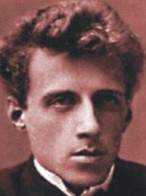
lenin

The most remarkable fact about this remarkable film is that Vladimir Ilyich Lenin has seen it. The head of the Soviet diplomatic mission in London obtained a copy and sent it to the Kremlin. A screening was arranged at the Metropole cinema, apparently without Lenin or his wife, who accompanied him, being aware of the contents of the film beforehand. It was only when the film was halfway through that it stated to dawn on Lenin that the leading figure might be based on him. He is reported to have laughed heartily at the remainder of the film, thought whether he thought it a foolish romance or possibly satire, one can only speculate. If only one could have been there.

meyerhold2

The film we have to accompany our feature is shorter, but but will undoubtedly be acclaimed by posterity as the greater. To contrast with a British view of Russian life, we have a Russian view of British life, The Picture of Dorian Gray (1915). Some may remember that last year’s festival featured the 1913 American version of Oscar Wilde’s story, with Wallace Reid as the doomed Gray. This year, we are showing the version produced by Vsevolod Meyerhold, a genius of the Russian theatre, whose symbolist, experimental ideas have revolutionised what ideas of what the theatre is there to show and how the artist should prepare for it. You may imagine the huge excitement caused when the great Meyerhold decided that he wanted to turn his talents towards the cinema, and did so with gusto. The result, we are informed (for we have not see the film as yet), are startling beyond measure. Maestro Meyerhold has sought to realise the buried potential of the screen. Compositions are in bold blocks of black and white, characters are silhouettes against a phantasmagorical background. There is innovation likewise in the casting; rejecting most performers as inadequate for his purposes, he has cast a woman, Varvara Yanova, as Dorian, and himself as Sir Henry Wooton. Meyerhold, we understand, has not illustrated but rather he has embodied the inner essence of Dorian Gray’s tragedy, through film.

This three-reeler has been acclaimed by all critics who have seen it, and roundly dismissed by the Russian public. It will be interesting to see how festival attendees judge this work – failed entertainment, or visionary insight into the future of cinema. Or you may simply enjoy the Wildean epigrams in the intertitles, which the festival staff have dutifully translated back into the correct English. Our two films this evening are very different in style and artisitic accomplishment, we suspect, but they each demonstrated the compulsion the best among cinema artists feel to bring telling visions to the screen. These are not idle films.

We hope you are enjoying the festival, and that you will join the other festivalgoers after each screening at one or other of the recommend eating houses: Romano’s, Simpson’s, or tonight’s rendezvous, the Rendezvous itself, in Dean Street, just around the corner from here. For those of serious intent where lost films are concerned, you may be interested to learn that out education officer will be providing notes on the research that went into locating the films once the festival is over, and thought is going into possibly organising a touring version of the festival. Lost films are for everyone, not just those in the metropolis.

Do join us tomorrow, where we will be in the East End to witness an elemental battle such as has never been surpassed on the screen. A charabanc will be laid on for festivalgoers, if you would like to assemble outside the Savoy at 7.00pm sharp, price sixpence.

War Brides

filmcans_banner3

USA 1916

Director/producer: Herbert Brenon
Production Company: Herbert Brenon Film Corporation
Cinematographer: J. Roy Hunt
Art director: George Fitch
Film editor: James McKay
Script: Herbert Brenon, Marion Craig Wentworth
Based on the one-act play by Marion Craig Wentworth

Cast: Nazimova (Joan), Charles Hutchinson (George), Charles Bryant (Franz), William Bailey (Eric), Richard S. Barthelmess (Arno), Nila Mac (Amelia), Gertrude Berkeley (The Mother), Alex K. Shannon (The King), Robert Whitworth (Lieutenant Hoffman), Ned Burton (Captain Bragg), Theodora Warfield (Mina), Charles Chailles (A financier)

Distributed by Lewis J. Selznick Enterprises
Eight reels

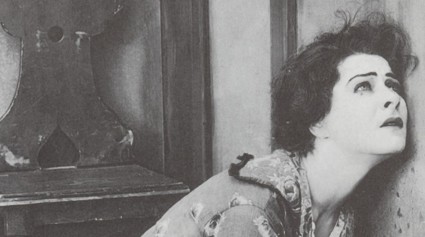
warbrides_cropped

Nazimova, in War Brides

Welcome one, welcome all, to the Bioscope Festival of Lost Films! Over the next five days we will be bringing to you five feature films (with accompanying shorts), selected from around the world, each a silent film now considered lost, untraceable in any of the world’s film archives or private collections.

We are opening with War Brides, Herbert Brenon’s pacifist masterpiece. Our venue is the Theatre de Luxe, in London’s The Strand. This select venue, star of the Electric Theatre circuit, lies adjacent to the Tivoli theatre (itself now no more) and seats 170 in the finest comfort. You will have noticed the luxuries of the foyer, and the special feature of a writing room, with complimentary notepaper, postcards and envelopes at the disposal of patrons. In such a modestly-sized venue, we must have musical accompaniment to match, so we are delighted to welcome as pianist Mr W. Tyacke George, author of that estimable and essential work for the aspiring silent film accompanist, Playing to Pictures (1914), who should certainly know what he is doing.

We are living in a time of war. We are always living in a time of war. The conflict in this case is the Great War, and while at the time of this film’s release Britain has been part of the fighting for two years, the United States has followed President Woodrow Wilson’s policy of neutrality. The British and the Germans have each plied the arts of propaganda to gain American sympathies, and the British have hopes that America will eventually side with it militarily. Some in America are thinking this way, and their call is for ‘preparedness’ should the need to fight arise. Others are appalled by the European folly, and speak out against war in all it forms. Already in 1916 American producers have given us Intolerance and Civilization, and now at the end of the year comes the most acclaimed film the year, and the strongest plea against war that we have yet seen on the screen, War Brides.

It has its basis in a one-act play, of the same title, written by Marion Craig Wentworth, which was such a success in the American theatres in 1915. Its star was that extraordinary Russian actress Alla Nazimova, who has been performing in America since 1905, excelling in Chekhov and Ibsen. Such was the sensation created by War Brides on the stage that producer Lewis J. Selznick persuaded Nazimova (she prefers to be known), for the handsome fee of $1,000 a day, to make her screen debut based on the stage success.

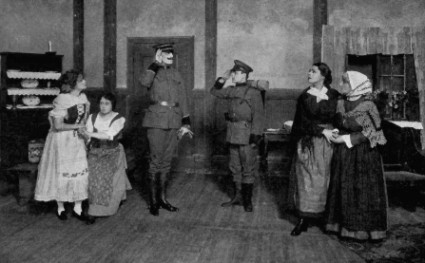
warbridesstage

The 1915 stage production, with Nazimova (as Hedwig, the original name for her character) second from the right

As is the case with many anti-war tales, the setting is an unidentified country which could be anywhere. Four brothers are called up to join a war. They leave behind their mother, sister and the wife of one of them (Joan, the Nazimova character). All four are killed. Joan tries to kills herself, but it persuaded not to do so because of her unborn child. Then the government decrees that all unmarried women must be compelled to marry returning soldiers to ensure a new generation of manpower for the war. Joan leads a protest movement of women against the decree, escaping from imprisonment to confront the king. On being told by him that war never ends, she kills herself and her unborn child.

This is an undeniably powerful theme. Nazimova proves herself as a great a tragic actress on the screen as she is known to be on the stage, managing both to be a symbol and a person at the same time. Gertrude Berkeley, as the mother, joins her from the stage production, as does Charles Bryant, playing one of the sons, who happens to be Nazimova’s husband. Among the actors playing the other sons, we are advised to look out for one Richard Barthelmess, whose first picture this is. A great future is predicted for him.

brenon_nazimova4

Herbert Brenon and Nazimova on the set of War Brides

The director is that talented Irishman Herbert Brenon. We have all admired his previous works, among them Dr Jekyll and Mr Hyde, Ivanhoe, Neptune’s Daughter and Sin, but Mr Brenon calls this his greatest work. Interestingly, we hear rumours that there are those within the British political establishment that agree with him. Can it be true that this producer of an anti-war masterpiece could be persuaded by the British War Office to produce a propagandist epic in favour of the British war effort? We shall await any such developments with the greatest interest.

Critics have been almost unanimous in their praise of War Brides. Few pictures in recent years have received such general acclaim. Yet there have been some adverse comments. The New York Times, while full of praise for Nazimova, who it says, ‘is a good subject for motion photography … she knows how to express herself in terms of the film’, was less enamoured of the film’s attempts to expand itself beyond the stage original.

The first half … in some respects is very bad indeed. It is palpably padded to make a holiday movie, some of the padding consisting of typical movie comedy, and is unnecessarily jerky and artificial. With such pictures as those of the battle of the Somme on view there should be a law against photoplay directors photographing sham martial scenes, or else to force them to make them depict scenes approximating reality. A bogus battle scene is included in “War Brides,” in which the defensive army occupies a system of trenches which rise from the foreground up and up into the background. All that an attacking army would have to do creep up to the edge of the top trenches and roll bombs down upon the helpless enemy, while if those in the trenches wishes to assume the offensive they would have to scale heights as high as the Palisades.

It is as curious to see a newspaper dramatic critic advise us on military strategy as it is to see a Hollywood studio attempt to depict it. As it is, the critic should perhaps read something of the futile Italian military campaign of the war, attempting to attack Austrian troops by scaling mountains while their enemy is securely positioned above them, before dismissing War Brides’ own illustration of military madness. However, it is telling that the critic compares its attempt to portray reality with the actual scenes of conflict in the remarkable films taken by British official cameramen of the battle of the Somme. It is difficult for the dramatic film to compare with the sober reality of conflict as depicted so honestly in The Battle of the Somme, and War Brides is strongest where it shows war’s consequences.

War Brides naturally speaks to the distaff side of the audience. It understands the suffering that war causes. Unlike some other films of pacifist intent, it successfully blends an idealised situation in a mythical land with the realities of home life and individual lives caught up in war’s inhuman machinery. It has touched a chord with audiences who may have found the melodrama or religiosity of Intolerance and Civilization unconvincing. Some states in America have banned the film because of its apparent pacifism, but we hear rumours that were America to join the war then the producers would find it is easy enough, with a judicious explanatory title or two, to make the film seem to promote the Allied point of view, a film not against war but against one side of the war. Thus do we see how powerful, and then how weak, the cinema can be.

To accompany our main film, we are showing Kiddies in the Ruins (UK 1918), George Pearson’s poignant portrait of the plight of French children in war-time. Pearson is an old friend of the Bioscope Festival of Lost Films, his work having appeared in last year’s festival. Here, inspired by a music hall sketch based on cartoons by that eminent French cartoonist Francisque Poulbot, he has shown us the lives and dreams of urchins in a bomb-shattered French city (enterprisingly filmed at Courneuve, near Paris). This touching three-reeler, starring Hugh E. Wright, may lack a little in narrative, but in sensibility alone it is a fine accompaniment to our main feature. We have seen the wretchedness of war, and yet the hopes that may arise even out of the ruins it has created.

Do join us again tomorrow night, when we will moving to the Soho district, and seeing a film of true mystery and daring, not only its in subject matter but in the extraordinary circumstances surrounding its production.