Harishchandrachi Factory

harishchandrachi

http://harishchandrachifactory.com

Early cinema is making a bid for world recognition with the announcement that the film Harishchandrachi Factory has just been nominated as India’s official entry to the 2010 Academy Awards. The film, written, produced and directed by Paresh Mokashi, tells the story of Dhundiraj Govind Phalke, producer of India’s first full-length feature film in 1913, Raja Harishchandra.

Harishchandrachi Factory has a lively website, where you can see clips, stills and learn about the production and D.G. Phalke himself. It tells the romanticised story of how Phalke took the medium that was the plaything of Europeans, Americans and elitist Indians, and gave it to the people, creating the Indian film industry in the process.

phalke

Phalke was the one-man pioneer of Indian dramatic cinema – director, productor, cameraman, editor, actor, and all points in between. He was born in 1870, the son of a Sanskrit scholar, and after studying art and architecture became a photographer, make-up artist and even had a magic act, before established a printing works in in 1908. It was apparently the experience of seeing a filmed life of Christ in Bombay around 1911 that inspired him to establish a native Indian cinema. He travelled to Britain in 1912, puchasing a Williamson camera and gaining instruction in film techniques from Cecil Hepworth.

He formed the Phalke Films Company that same year, and made his first film Raja Harishchandra, in 1913 (Phalke encouraged the belief that his was India’s first dramatic film, but it was preceded by two short dramatic films). The film told the story from Hindu mythology of King Harishchandra, as told in the Ramayana and the Mahabharata. The story tells how the virtuous king sacrifices his kingdom and his family in the pursuit of truth, only to be restored to power through the intervention of the grateful gods. The film was originally 3,700ft long, and around half survives of what is said to be the film at the National Film Archive of India, though some sources state that what survives comes from Phalke’s 1917 remake Satyavadi Raja Harishchandra. The Archive lists eight Phalke films in its collection: Raja Harishchandra, Lanka Dahan (1917), Shree Krishna Janma (1918), Kaliya Mardan (1919), Sinhasta Mela (1921), Tukaram (1921), Brick Laying (1922), Setu Bandhan (1932) and the undated Pithache Panje. Scenes of Phalke at work also exist from a 1917 short Chitrapat Kase Tayar Kartat (How Films are Made).

harishchandra

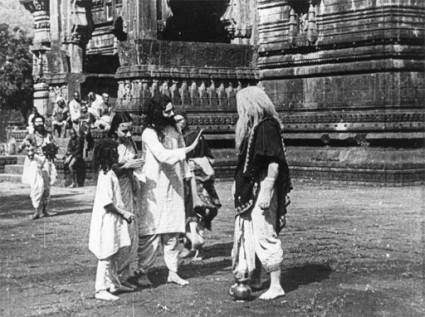
Scene from Raja Harishchandra (either 1913 or 1917 version), from http://en.wikipedia.org/wiki/Raja_Harishchandra

Phalke Films made four more films, then in 1914 Phalke returned to London to established business contacts and obtain fresh production equipment, later setting up Hindustan Cinema Films and going on to make over forty silent features and one talkie. He died in 1944. Harishchandrachi Factory is bound to generate renewed interest in the revered founding father of Indian cinema, whose own history is now almost as much bound up in mythology as the subjects of his pioneering films.

Fit to win

It’s time to go back to the Bioscope Library, and to look at the latest addition, Karl S. Lashley and John B. Watson’s A psychological study of motion pictures in relation to venereal disease campaigns (1922). The study on which the book was based was initiated in 1919, and is said to have been the first large scale research project on the educational effectiveness of educational films, something which greatly exercised minds at the time. Films were self-evidently popular with the masses, and noticeably so with young minds, but could that popularity be converted into lessons for life? Did one actually learn anything from motion pictures? Plenty were saying that you did, but they were chiefly those with a vested interest i.e. film producers themselves. What was needed was controlled studies and verifiable evidence.

In 1919 the United States Interpartmental Social Hygiene Board awarded a grant of $6,000 to the Psychological Laboratory of John Hopkins University for the purpose of “investigating the informational and educative effect upon the public of certain motion-picture films used in various campaigns for the control, repression, and elimination of venereal diseases.” Psychologists Lashley and Watson headed the research and produced the report.

The problem of venereal disease exercised minds hugely at the time. Specifically VD had debilitated so many troops meant for fighting during the First World War that campaigns with official backing arose in Britain and America. In the latter, the campaign operated under the slogan ‘Fit to Fight’, which became the title of a 1917 film, directed by Lieutenant Edward H. Griffith and promoted by the US Public Health Service, which followed the fortunes of five men suitable for military service, four of whom succumb to “bootleggers and prostitutes”. In 1919 the film was revised and extended, and released under the title Fit to Win. The John Hopkins University study provides this synopsis:

The first 1,000 feet of the picture are devoted to the showing of lesions resulting from venereal disease, by photographs of cases and explanatory legends. A story is then introduced. It deals with five young men of diverse education and traditions. They are shown first as civilians, then as drafted and in training. On leave, they are approached by bootleggers and prostitutes. One, Billy Hale, influenced by the memory of his sweetheart, resists temptation. The others are exposed to venereal disease. Of the latter, Kid McCarthy resorts to medical prophylaxis promptly and escapes infection. The others are infected.

Kid McCarthy accuses Billy Hale of being a “mollycoddle,” and a fight ensues in which Kid is defeated. He admits himself beaten and at Billy’s instigation reforms. These two are then held up as examples of physical fitness and are selected for service abroad. The other three, infected, are disqualified for foreign service. One, infected with gonorrhea, is discharged and the others, infected with syphilis, are sent to the hospital for treatment.

The remaining reels were constructed after the signing of the armistice and added as an epilogue to the original picture. Billy is shown returning from France as a captain. Kid McCarthy has been killed, after citation for bravery in action. The youth afflicted with gonorrheal arthritis is shown at home, his father heartbroken over his infection, his mother ignorant of its cause. Billy carries Kid McCarthy’s medal for bravery to McCarthy’s sweetheart. He then meets and sympathizes with the men afflicted with syphilis, telling them that they are now probably completely cured. He then bids farewell to his company, advising them to be wary of prostitutes and to keep morally clean in civilian life. After purchasing a civilian outfit, he visits his sweetheart, and in the final scene they are shown at the altar.

Fit to Win was shown to segregated audiences, and not to children. It aroused considerable controversy, owing to its frankness over the causes of venereal disease, and was banned from exhibition in New York City.

For the purposes of the study, a shortened version of the film was shown – effectively the original Fit to Fight, since the post-Armistice scenes were left out – to 5,000 people, divided up into different groups. There was a Medical Group (around forty physicians and nurses), an Executive and Clerical Group, a Literary Club Group, a mixed audience (250 people from a village in Pennsylvania), a Car Men Group (railway employees in NYC), a Merchant Sailor Group, and a Soldier Group.

The study describes the film, the methodology and the statistical analysis in great detail. They were interested to discover what the levels of understanding were among the different types of audience, then how much and what kind of information might be imparted to each by a film, and what the effect of a single film over a programme of films or other kinds of information might be. Lashley and Watson had no interest in promoting the film for its own sake, and their conclusions are refreshingly frank. The medical group, they reported, “was frankly bored throughout the picture”, finding it exaggerated and falsely dramatic. The mixed audience displayed mixed responses, from ribald laughter to expressions of embarassment, reactions which in turn worried the investigators. The car men “reacted rather strongly to the suggestive parts of the picture”. The seamen showed an unexpected intelligent interest in the film. The soliders were under orders to stay silent, and did so apart from laughter at the bawdy house scene.

Unltimately, the study’s findings were inconclusive. On the film’s informational effect, it was discovered that audiences gained general impressions rather than accurate knowledge, and that while many came away with some basic facts acquired, others still displayed confusion over causes and details. On the film’s emotional effect, it was found to engender horror in most of those who saw it, but precision of influence was difficult to identify, and for many “the appeal of sympathy for the innocently infected is greater than of fear of disease”. However, in answer to the worries of censorious authorities who sought to prevent the film’s exhibition, they noted:

The picture does not produce any sexual excitement in the majority of the men. The replies to questionnaires, comments of the audience, and data gained from interviews with men after the performance all indicate that there is, instead, a temporary inhibition of sex impulses.

Fit to Fight and Fit to Win are lost films; not even a still appears to survive. The study provides such meticulous detail, however (down to the number of seconds in which audiences were exposed to various examples of syphilitic infection) that one has a very clear idea of the film’s contents, strengths and limitations. In the end it finds, a little surprisingly, that such a film’s appeal to the emotions that little value in changing hearts and minds, but that it could impart some basic information which could then be built upon by other educational means. So they judge the film before them, but do not call for better films, which might have provided the way forward that they were seeking.

A psychological study of motion pictures in relation to venereal disease campaigns is available from the Internet Archive in PDF (2.46MB), full text (209KB) and DjVu (1.49MB) formats.

Cinema she wrote

almareville

There has been, in recent years, a growing interest in women filmmakers in the silent period. Early cinema offered greater opportunities for women (in some countries, that is) to make a mark in the film business than would be the case for decades thereafter, and if the number of women directors was few (Alice Guy, Nell Shipman, Lois Weber, Esfir Shub and Germaine Dulac are among the most notable names), once you look more widely to production, scriptwriting, editing, lab work, criticism, continuinty, cinema management, projection, and acting of course, the numbers begin to grow.

It is with an enthusiastic spirit of investigation and a determination to reblanace early film history that international and national projects have been launched. Internationally, there is Duke University’s Women Film Pioneers project, led by Professor Jane Gaines. And here in Blighty there is Women in Silent British Cinema. This is a lively project which has a team of researchers pursuing a fascinatingly varied group of names, from the reasonably well known (Alma Reville, Blanche McIntosh, Mary Field) to the tantalisingly obscure. Anyone interested to help join in should get in touch through the website – there are many names left demanding assiduous detective work to rescue them from obscurity.

Next up for the project is a study day taking place at the BFI Southbank in London on 7 November, entitled Women and Silent Britain 2: Writers. The day will consider all aspects of writing for the screen by women involved in the British cinema industry of the silent era, whether as screenwriters, critics, columnists, publicists, or authors of source novels and plays. The day will feature the results of new research on critic Nerina Shute, novelist and director Elinor Glyn, and the prolific screenwrier Lydia Hayward.

The day will consist of screenings from the BFI National Archive, talks and workshops, followed by Adrian Brunel’s rarely screened silent classic The Constant Nymph (1928), based on the play of a novel by Margaret Kennedy and Basil Dean and adapted for the screen by Alma Reville (pictured above, with husband Alfred Hitchcock).

The study day will include contributions from Christine Gledhill, Jane Gaines (Duke University), Drake Stuseman (editor Framework), Alexis Wheedon (University of Bedfordshore), Laurence Napper (Kings College, University of London), Claire Watson (UEA), Matthew Sweet (journalist and broadcaster), Amy Sargeant (Warwick University) and Nathalie Morris and Bryony Dixon of the BFI.

Tickets are £15 (concs £10) including the evening screening. The day takes place in NFT3, 10.00-17.00. For further details email nathalie.morris [at] bfi.org.uk

The last bioscopewallah

salim

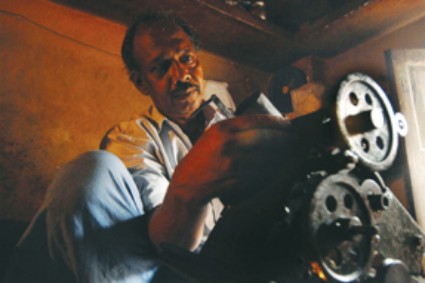
Mohammad Salim with his 100-year-old projector, from http://www.littleindia.com

We have written here before on the tradition of the travelling bioscope in India, film shows put on by men journeying from town to town with projector in a hand cart, some of whom work with equipment dating back to the early cinema period.

The subject has interested a number of filmmakers. There is K.M. Madhusudhanan’s feature film Bioscope, The Bioscopewallah by Prashant Kadam, Megha B. Lakhani’s Prakash Travelling Cinema (available in two parts on YouTube), Andrej Fidyk’s Battu’s Bioscope, Vrinda Kapoor and Nitesh Bhatia’s Baarah Mann Ki Dhoban and Salim Baba by Americans Tim Sternberg and Francisco Bello, which was nominated for an Oscar in 2008.

An article by Nilanjana Bhowmick on the man featured in that last film has turned up on Little India (an Indian newspaper published in the USA). Entitled ‘The last bioscopewallah’, its subject is Mohammed Salim, who tours Kolkata with his 100-year-old projector (apparently Japanese in origin) on a cart, accompanied by his reluctant son. It’s an evocative piece of writing, depicting a decades-old form of street entertainment that just about hangs on in the age of the iPod and the DVD, sustained by the belief of the bioscopewallah in the magic of literally bringing cinema to the people. These are a few choice paragraphs:

Bioscopewallah……bioscopewallah ayah….aao, dekho,nai purani filme sirf ek rupiya. (Here comes the Bioscopewallah, come and watch new and old films for just Re 1).

The throw-back cry from the 1960s and 1970s of Indian street vendors trying to lure children and adults to the magic of movies in a box still reverberates in the serpentine bylanes of Kolkata, mingled with the smell of moss and decay. The cry might not have the same verve, nor perhaps does it elicit the earlier enthusiasm. But it still attracts curious onlookers who crowd around as the last bioscopewallah of Kolkata sets up his shop near a school or a movie theater.

Children rush to his cart, clutching a rupee coin in their hands. Some older people might still remember the voyeuristic feeling of peek-a-boo cinema under the shade of the ominously grave-looking black cloth, but most have either forgotten or never experienced the charm of the movie in the wooden box.

Mohammad Salim, with his 100-year-old projector, is a relic from a forgotten era. He roams the streets of Kolkata, letting people experience in short bursts the often surreal world of the bioscope.

Salim’s voice has become weaker with age, but the enthusiasm remains undimmed. He is the thin string that binds Kolkata with its glorious past to the beginning of cinema — the Royal Bioscope Company, India’s first bioscope company. Salim is not only oblivious to the legacy he has carried on his shoulders for decades now, but he is equally nonchalant about his brush with international fame, which includes an Oscar nominated documentary on his life. He only understands his bioscope and beyond it everything else pales.

Salim’s journey on the Kolkata streets with his bioscope began more than 40 years ago. In his late fifties, he laboriously pushes along his archaic projector on a hand driven cart. These days often he is accompanied by one of his unwilling sons, for whom the bioscope holds no magic. Sometimes he is mistaken for an ice cream vendor, most times he is ignored. In this digital age, the wooden bioscope holds no attraction and Salim cuts a lone figure as he wanders from one street to another. However, as he sets shop and Bollywood music and dialogs burst forth from his bioscope, a small crowd gathers around him; a crowd that wants to lose itself in the garish, colorful, melodramatic and musical world of Bollywood movies. The glamour, thrill, drama and dreams of Bollywood are packed into three-four minutes of trailers that transport the viewer into a makeshift world of the movies — short lived, but an escape from the real world nevertheless …

… In the 1960s and 1970s the call of the bioscopewallah was eagerly awaited in the neighborhoods of Kolkata. However in this age of television and computers, the bioscope is as antiquated as the term itself. Salim recalls the golden days when his father’s bioscope ruled the roost: “When my father used to call out, people used to come rushing out of their houses, especially children and women. They used to stand in the balcony for hours in order to catch the bioscopewallah.”

Salim started with his father when aged just twelve. In those days there were many other bioscopewallahs, all of whom showed only silent films. To keep up with the times, Salim has had to adapt to sound, showing scraps of films that highlight songs, dances and fights.

Salim survives in an age dominated by iPods and DVDs by updating his equipment to keep pace with the modern age. His passion with the bioscope led him to experiment with it and add new features. The original bioscope had no provision for sound so Salim, realizing he will lose his audiences if he failed to add it to his trailers, acquired sound.

“I love my projector and the fact that this small box contains all the wonders of a cinema hall. And I told myself, there must be a way to put sound too! I went to the cinema halls and asked people about how they put the sound on the lip movements. We tried to replicate that in my projector and succeeded. It was because I went with the times that I have been able to keep this alive. If there was no sound, no one would have watched it anymore.” …

… The era of the bioscope will likely end with Salim. His sons are not interested in carrying forward the tradition of their father and grandfather. They are young men who have come of age in the digital era of mobile phones and computer games.

Salim is philosophical about his plight and the future of his craft. He insists he is not driven by money, otherwise he would have sold the projector — an antique piece — by now. “I have had offers from abroad to sell my bioscope, I have said no. It is the heritage of my country, why should I sell it to another country?”

It’s a delightful piece well worth reading in its entirety. Not exactly silent films, but definitely in their spirit.

London on the move

underground

Underground

The programme for the London Film Festival has been announced, and though there’s not much in the way of silents on offer, it’s well worth noting what there is.

For the past two years the LFF has featured a programme of archive films on London, plus a London-themed silent feature, for exhibition in Trafalgar Square. This year the feature film is Anthony Asquith’s Underground (1928), an expressionist brew of love, treachery and murder set in and around London’s underground railways, starring Brian Aherne and Elissa Landi. That screens on Friday 23 October, while on Thursday 22 there is London Moves Me, a programme of archive film on the theme of London and transport. The programme includes cycling in 1896, trams in 1901, boats in 1905, canoes in 1922, barges in 1924, underground trains in 1929, and much more. The indispensible Neil Brand will accompany on piano. The Trafalgar Square shows are free, and just the sight of seeing crowds of commuters, tourists, the curious and the dedicated gathered on the steps to witness silent films beneath Nelson’s Column is an experience to savour.

(Correction: Underground is screening at the Queen Elizabeth’s Hall. Shame.)

laila2

Laila

The LFF has an archive film section, which features the pick of the restorations and star selections from recent archive film festivals. The silent to look out for is the Norwegian Laila (1929), which was the hit of the Pordenone festival in 2008, enthusiatically reviewed by the Bioscope at the time. I warmly recommend this engrossing, dramatic, human and beautifully photographed masterpiece, screening on October 29. It is everything that a silent film can be.

The other silent offering is J’Accuse (1919), a new, colour-tinted restoration by the Nederlands Film Museum, in collaboration with Lobster Films, of Abel Gance’s epic anti-war statement.

Mary Pickford silent film festival

mybestgirl

Charles ‘Buddy’ Rogers and Mary Pickford in My Best Girl (1926), from http://www.etcinfo.net

Encinitas, Cardiff CA is hosting a Mary Pickford silent film festival. The festival takes place in the La Paloma Theatre, 6-8 November. There are four features with four shorts, each accompanied by Robert Israel on the piano. Here’s the programme:

Friday, November 6, 7 pm

WILLFUL PEGGY | 1910. 17 minutes.
Short: Pickford plays a feisty peasant girl married off to a stuffy lord. On the eve of the ceremony, Peggy ditches her new spouse and runs off for a night of frivolity with an “inappropriate” group of revelers. Pickford was said to have declared Peggy her favorite character.

MY BEST GIRL | 1926. 80 minutes
Feature: Joe Merrill, son of a millionaire, poses as Joe Grant and takes a job in the stockroom of one of his father’s dime stores to prove he can succeed on his own. He meets poor stock room girl, Maggie Johnson, and they fall headfirst in love. Unfortunately, Joe’s mother has plans for Joe to marry a high society girl. Maggie, meanwhile, has family issues of her own to solve. Truly one of Pickford’s finest films and a fan favorite, MY BEST GIRL is a romantic comedy tested by the ages. It doesn’t hurt that Pickford and costar Buddy Rodgers fell in love in this film. Their on screen chemistry is astounding. The resulting marriage lasted forty years.

Saturday, November 7, 2 pm

TRICK THAT FAILED | 1909. 13 minutes
Short: In this rarely seen but much admired short, Pickford plays an aspiring artist with two beaus. She refuses to accept the affections of either until she succeeds in selling her art. The rich beau sends agents to buy up Pickford’s paintings, but she discovers the ruse and sends him packing. Pickford’s first husband, Owen Moore, appears in one of the scenes.

POOR LITTLE RICH GIRL | 1917. 80 minutes.
Feature: Considered the best of her “little girl films” Pickford was twent four when she played the part of eleven year Gwendolyn. Barely five feet tall herself, the illusion of her small stature was enhanced by large set pieces and a very tall cast. Gwendolyn’s family is rich, but her parents ignore her. Her governess tries repeatedly to reign in the free spirited child. When a family crisis sets off a series of wild events, all must rethink their priorities. Although remade more than once, Pickford’s version of the poor little rich girl easily sets the standard for excellence.

Saturday, November 7, 7 pm

THE NEW YORK HAT | 1909. 15 minutes
Short: Directed by D.W. Griffith, THE NEW YORK HAT features an all star cast that includes a young and handsome Lionel Barrymore, Pickford’s brother, Jack, and the beautiful Gish sisters. Pastor Barrymore buys the sad Pickford a New York hat at the bequest her dying mother. At the sight of the extravagant headpiece, the town gossips immediately circulate false rumors. Pickford’s harsh father then rips the hat to shreds before his daughter’s eyes. When the Pastor hears of the town’s cruelty, he chastises all. The short ends up with Barrymore proposing to Pickford.

THE LITTLE AMERICAN | 1917. 80 minutes
Feature: At the onset of World War I, Angela Moore finds herself with both a French and German suitor. She travels to Europe in pursuit of her German beau, only to have her passenger liner sunk by a u-boat. Following her rescue, she wanders to the family castle where Prussian bombs begin to fall. In short order, Angela converts her threatened family castle into an army hospital, enlists herself as nurse and spy – to aid her French boyfriend – then finds herself overrun with German soldiers intent on raping her and her female servants. She is rescued by her German beau who betrays his ranks and soon enough faces a firing squad with the accused Angela tightly encircled in his arms. An Allied bombing strafe intervenes. The end finds the love pair being shipped back to America. THE LITTLE AMERICAN proceeds at a dizzying pace; its scenes of war and mayhem to be copied by directors for decades to come. It’s no surprise Cecil B. DeMille of THE GREATEST SHOW ON EARTH and the TEN COMMANDMENTS fame directed this saga. Filmed less than ten years after the actual sinking of the Titanic, his depictions of a great passenger liner’s destruction are striking in their imagination and daring.

Sunday, November 8, 6 pm

THEY WOULD ELOPE | 1909. 17 minutes
Short: Harry and Bessie love each other with all their hearts. Thinking the bride’s father disapproves, the pair plan a poorly conceived elopement. All ends well in this madcap comedy, but not before mayhem and fate’s resistance give the lovebirds a good run for their money.

SPARROWS | 1926. 80 minutes.
Feature: This beautifully restored SPARROWS is shown in conjunction with the Library of Congress and will be introduced by the curator of the Pickford Collection, Christel Schmidt. It is a rare opportunity to view one of the greatest of silent films featuring one of its biggest stars. Produced at the end of Pickford’s silent film career, SPARROWS is considered by most to be her finest film. A departure from the typical sunny Mary Pickford story, SPARROWS is rife with Dickensian undertones. Evil Mr. Grimes keeps a rag tag group of orphans on his farm deep in the swamps. He forces the children to work, starves and mistreats them in numerous ways. They are watched over by the eldest, Molly. Things go awry when a gang in league with Grimes kidnaps a rich infant with the intent of ransoming her. When the police close in, Grimes panics and plans to throw the infant into the swamp. Molly has had enough and decides to lead the children out of the dangerous swamp to a better life.

The festival will be introduced by Hugh Munro Neely, director of Mary Pickford: A Life on Film. Further details, including directions and ticket information, are available from the Encinitas Theatre Consortium site.

Albert Kahn at last on DVD

kahndvd

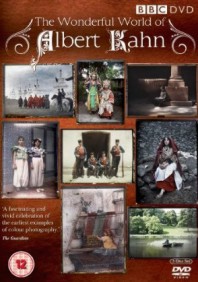
Regular visitors to this blog will know all about The Wonderful World of Albert Kahn, the BBC television series which highlighted the astonishing collection of Autochrome photographs and motion picture records of life around the world in the early years of the twentieth century, created by French millionaire philanthropist Albert Kahn. You may also know that there has been immense frustration for the many fans of the series that no DVD release has been made available, supposdly for licensing reasons, except for a colossally expensive version intended for the educational market.

Now prayers have been answered. The series has made it to DVD. The Wonderful World of Albert Kahn has been released by 2 entertain (the video distributor part-owned by BBC Worldwide). The 3-disc DVD set (PAL, region 2) is in nine episodes, running 462 mins (500 mins says the BBC shop). The series shows beautifully-composed scenes from around the world: China, Brazil, the United States, Ireland, France, Mongolia, Norway, Vietnam and much more, from the mid-1900s, through the First World War and into the 1920s. Kahn’s team of photographers chiefly took still photographs, using the complex Autochrome process (invented by the Lumière brothers) with its hauntingly beautiful results, but they produced monochrome motion picture records as well, capturing distant lands and cultures on the brink of disappearing into history, and unconstrained by the need to convert the material into form that would be acceptable to the commercial cinema.

It’s unclear to what degree the DVD represents the original BBC series, which was shown in nine one-hour parts, the first five broadcast on BBC4 on April 2007 under the title The Edwardians in Colour (subtitled The Wonderful World of Albert Kahn); the remaining four as The Twenties in Colour in November 2007. The BBC Active educational version is 9×50 mins. Amazon and the BBC Shop site say that there are ten parts, but the British Board of Film Classification registers the release as being in nine parts, and this seems more likely. Anyway, the DVD set is now available, having been released on 7 September.

If you want to find out more about Kahn and his Archives de la Planète project, visit the Searching for Albert Kahn post on this blog.

Keaton and the war

BusterWWI

The 17th Annual Buster Keaton Celebration takes place 25-26 September, at Iola, Kansas. Each festival takes an aspect of Keaton’s life or career and explores its contexts, through talks, screenings and special presentations. This year the theme is the First World War, and this is the programme:

Buster Keaton and Company

WWI, Dark Comedy, and Film
The 17th Annual Buster Keaton Celebration

Sept 25-26, 2009, Iola, KS

All activities are held at the Bowlus Fine Arts Center in Iola, Kansas. Free. (donations are very much appreciated– especially this year)

Program subject to change.

Friday, Sept 25, 2009

9:30 am Registration

9:50 am Welcome and Remarks by Susan Raines, Executive Director, Bowlus Fine Arts Center

Emcee Frank Scheide, Prof of Communication, University of Arkansas, Fayetteville

10:00 am — The National WWI Museum, a video segment from the series Sunflower Journeys, produced by KTWU Ch 11, Topeka

10:10 am — Dave Murray
World War I: Causes and Effects

11:00 am — Break

11:10 am — Doran Cart, Curator WWI Museum, Kansas City, MO
Lights, Camera, and Real Action: The U.S. Army Signal Corps Motion Picture and Still Photographers’ Work, 1917-1919

12:00 am — Lunch Break

1:30 pm — John Tibbetts, Ph.D., Professor of Film, University of Kansas
The Worm’s Eye View: A Presentation Concerning the 1919 Film, Yankee Doodle in Berlin

2:20 pm — Lisa K. Stein, Ph.D., Ohio University-Zanesville
Tommy’s New Tune: Warner Brothers’ The Better ‘Ole (1926) and Redefining American Patriotism

3:10 pm — Break

3:25 pm — Screening of The Moving Picture Boys in the Great War (1975), produced by David Shepard
War Story (2001)
Introduced by David Shepard

5:30 pm — Dinner Break

7:30 pm — Evening program
It Happened to You
Shoulder Arms (1918) starring Charlie Chaplin
The Bond (1918) starring Charlie Chaplin
All Night Long (1924) starring Harry Langdon
The Bellboy (1918) starring Fatty Arbuckle and Buster Keaton
Back Stage (1919) starring Fatty Arbuckle and Buster Keaton
with live musical accompaniment by Marvin Faulwell

Saturday, Sept 26, 2009

8:30 am — Registration

9:00 am — Welcome and Remarks by Susan Raines, Executive director, Bowlus Fine Arts Center

Emcee Bill Shaffer, KTWU Ch 11, Topeka

9:20 am — Jim Barkley, Educational Coordinator, WW I Museum, Kansas City, MO
Educational Opportunities at the National WWI Museum

9:40 am — Screening of My Career at the Rear, a documentary by Matha Jett on Buster Keaton’s WWI career

10:00 am — David Macleod, Keaton historian and founder of Blinking Buzzards Society (UK)
Buster and War

10:50 am — Break

11:00 am — Robert Arkus, Film Historian and Archivist
The Liberty Loan Drive, Newsreels and Slapstick
Comics Go to War: Screening of seldom seen footage
plus rare Keaton on video

12:00 — Lunch Break

1:00 pm — Welcome and Introductions

1:10 pm — Leslie Midkiff Debauche, Ph,D., University of Wisconsin — Stevens Point
Buster Keaton Fights the Great War

2:00 pm — Frank Scheide, Ph.D., University of Arkansas, Fayetteville
Charles and Penny Chilton’s Oh What a Lovely War

2:50 pm — Break

3:00 pm — Screening of Yankee Doodle in Berlin (1919), Mack Sennett, with live musical accompaniment by Marvin Faulwell
Introduced by David Shepard

4:00 pm — Break

4:10 pm — Screening of Doughboys (1933) — Buster Keaton Sound Feature

5:35 pm — Dinner Break

7:30 pm — An Evening of Screenings
General Nuisance (1941), Buster Keaton Columbia sound short.
plus short clips and tributes.
Special Presentation, The Last American Surviving WWI Veteran, a 2008 interview with Mr. Frank Buckles by Martha Jett, Documentary Filmmaker and Keaton Biographer.
The Better ‘Ole (1926), starring Syd Chaplin, with live musical accompaniment by Marvin Fauwell

And for those who want to learn more about what Keaton called ‘My Career in the Rear’, Martha R. Jett has written about his personal war experience in ‘Buster Keaton in World War I‘ for http://www.worldwar1.com.

The Rose of Rhodesia

rose-of-rhodesia

Chief Kentani (left) and Prince Yumi in The Rose of Rhodesia, from Screening the Past

A while ago we wrote a piece on the peripatetic American film director Harold Shaw, who – in between periods in America, Britain and Russia – for a short period (1916-1919) produced films in South Africa. Shaw made three films in the country – De Voortrekkers, The Rose of Rhodesia and Thoroughbreds All (a fourth, Symbol of Sacrifice, was started by Shaw but completed by other hands). The first was an Afrikaner nationalist epic of the Battle of Blood River; the third (a lost film) was a racing horse comedy.

The Rose of Rhodesia (1918) has been attracting a lot of interest lately, following its happy rediscovery by the Nederlands Filmmuseum. The process of critical rediscovery has led to a special issue of the always commendable Australian online journal Screening the Past dedicated to the film. There are pieces by the two foremost experts in filmmaking in Africa at this period, Neil Parsons and James Burns, which provide rich detail on the background to the film’s production and personalities, Parson concentrating on the production history and Burns on Bioscope audiences in South Africa at the time (Bioscope was – and I believe remains – the common name for a cinema in South Africa). There are other essays on its racial politics, political and literary perspectives and position in cinema history, and a rich selection of background materials including reproductions of original press notices and advertisements.

rose1

Prince Yumi (Mofti), Edna Flugrath (Rose Randall) and M.A. Wetherell (Jack Morel), exchanging a white rose

But what it is particularly notable is that Screening the Past is delivering the entire restored film itself (streaming only), courtesy of the Filmmuseum [this link no longer works – see note below]. 81 minutes long, with German intertitles (an English translation is supplied) and inventive soundtrack by Matti Bye, the film is a revelation. What commentary the film had received before its rediscovery (chiefly Thelma Gutsche’s 1972 great history The History and Social Significance of Motion Pictures in South Africa 1895-1940) dismissed it as an amateurish failure which was roundly dismissed by local audiences. It is hard to match the recorded disappointment of South African audiences with the remarkable, engrossing film we see now (which is some 20 minutes shorter than the film as originally produced) which more than merits the attention given it by Screening the Past. Indeed, as Shaw had fallen out bitterly with Isidore Schlesinger, film producer and owner of practically all of the South African distribution and exhibition business, one suspects that the film’s reception was sabotaged.

The story concerns, at least initially, the theft of a diamond from a Rhodesian mining concern. The diamond is called ‘the rose of Rhodesia’, but Shaw develop this into a deeper metaphor, as Rose is the name of a gold prospector’s daughter (played by Edna Flugrath, Harold Shaw’s wife), who falls in love with Fred Winter, the overseer who has stolen the diamond, before transferring her affections to a missionary’s son, Jack Morel, played by M.A. Wetherell. Jack is friendly with Mofti, son of the chieftan Ushakapilla, and a white rose is exchanged as a symbol of their friendship. Ushakapilla is planning an uprising against white rule, and expects his reluctant son to adopt the cause, but after Mofti’s accidental death and news that his people’s ancestral lands has been granted to them by the “great white Chief”, Ushakapilla relents. Rose retuns the diamond to the mining corporation (it had been found by one of Ushakapilla’s men), and the reward money enables she and Jack to marry.

mofti

Prince Yumi, as Mofti

The Rose of Rhodesia is distinguished in particular by its portrayal of Africans. The African parts were taken by members of the M’fengu people, with Ushakapilla played by ‘Chief’ Kentani (probably a local headman) and Mofti by ‘Prince’ Yumi (possibly a migrant worker or student). The portrayals are sympathetic and convincing, and the friendship between Mofti and Jack Morel affecting and unforced. The theme of African discontent over loss of lands reflects genuine feelings of the time, and the potential for uprising was one that greatly exercised white authorities at the time (to the degree that the film could never have been made in Rhodesia itself, where the authorities greatly feared cinema’s subversive potential, and was instead filmed at Sea Point studio in Cape Town and by the spectacular Bawa Falls in Eastern Cape – none of the film was made in Rhodesia). It may be felt that the films shies away from what seems to be its initial interest – to depict African versus white tensions – by playing it safe with a story of diamond stealing. Interestingly this was even commented upon at the time by the British trade paper The Kinematograph Weekly:

At the start the impression is given that there is to be strong drama founded on a conflict between the interests of the natives and those of imperialism. But, in reality, the “native question” does not develop. The producers have carefully avoided the danger of giving offence to either partisan side … [and] have left a story rather devoid of “punch”.

But viewing the film now one is struck by how readily the diamond plot is set to one side, and how inter-racial relations become the film’s real interest. Local sensibilities undoubtedly stayed Shaw’s hand, but the theme of the importance of mutual trust and respect demanded of black and white is not diluted at all. Such a progressive view of Africans would not appear again in South African cinema for many years thereafter.

The Rose of Rhodesia was written and directed by Harold Shaw for Harold Shaw Film Productions. It was photographed by the American Ernest G. Palmer and Briton Henry Howse (like Shaw a much-travelled figure whose career included filming for the Salvation Army and in the Arctic). It was first shown on 23 March 1918 in Cape Town, and in Britain on 28 October 1919. It is unclear how widely it may have been seen in Britain (it gained some trade press coverage, reproduced in Screening the Past), while it it a mystery how a print turned up with German titles as no record has been found of its exhibition in any German-speaking territory. Its story is a fascinating one, while its quality as a film is unexpected and most welcome. I warmly recommend seeing the film, and engrossing yourselves in its history.

The Rose of Rhodesia is a late addition to the programme at this year’s Pordenone silent film festival.

Update (March 2017): Screening the Past has changed its website, and the above links to issue 25 of the journal and the film no longer work. These are the changed links:

Film: http://tlweb.latrobe.edu.au/humanities/screeningthepast/25/rose-of-rhodesia/rose-of-rhodesia.html

Issue: http://tlweb.latrobe.edu.au/humanities/screeningthepast/current/issue-25.html

Cockney Cherokees on the sky-line

shootingstars

Annette Benson and Brian Aherne in Shooting Stars (1928)

Recently on the Nitrateville silent film discussion forum, someone posted a link to a spaghetti western site which had a filmography of European westerns, going back to 1906. All very interesting, and a reminder that from the earliest years of cinema countries around the world tried to produce their own versions of the genre that seemed quintessentially American, the western.

But the filmography, though useful, is nowhere near complete. Particularly for the silent era there are huge gaps, which become clear when one looks at the British silent western alone. The spaghetti western filmographer may possibly have thought that Britain did not count as part of Europe, but equally may not have thought that such a thing as the British western existed. But exist it did, and its strange history will now unfold…


British cinema is what it is because of its relation to American cinema. For reasons economic, artistic and linguistic, British film makers have always had an uneasy relationship with American filmmaking, half envious, half slavish, playing along with the game to a set of rules not quite understood. A minor, but diverting illustration of this is the British western. With only a few exceptions British westerns can be divided up into three categories: straight attempts at westerns, adaptations of the western milieu to British Empire settings, and parodies.

Western novels were popular in Britain even before the arrival of the movies, as well as the frontier novels of James Fenimore Cooper and Longfellow’s poem Hiawatha, and the visits to the country of Buffalo Bill Cody and his Wild West show had created a romantic enthusiasm for the western myths and values in many in Britain at the turn of the century. The first British films to reflect this interest were a music hall sketch starring the legendary Dan Leno and Herbert Campbell as ‘Indian braves’, Burlesque Attack on a Settler’s Camp (1900), and a grotesque short comedy, The Indian Chief and the Seidlitz Powder (1901), in which the Chief (sporting a peculiar head-dress) enters a store, swallows the contents of a bottle of aperient powder, inflates and explodes. A copy of this latter oddity survives, unlike the great majority of the thirty or so westerns made in Britain between 1901 and 1915, all of them one- or two-reelers. Lost, for instance, is the next film on a roughly western theme to be made, Joe Rosenthal’s Hiawatha (1903), made during a visit to Canada and enacted by members of the Ojibwa people. Rosenthal also made Indians Gambling for Furs – is it War or Peace? at the same time.

Such curiosities aside, the key period for the production of British westerns was to be 1908 to 1913, when American films were becoming an increasing economic threat and began to demonstrate an evident hold on British audiences that British films seemed to lack. Had they but known it, British film makers had played their part in the creation of the American western, as it is probable if not absolutely proven that the Sheffield Photo Company’s exciting chase dramas of 1903, A Daring Daylight Burglary and The Robbery of the Mail Coach in particular, made a great impact in America and were a strong influence on The Great Train Robbery, the archetypal western. The latter film, with its highwayman protagonist, indicated a possible route for British films to follow if they were to challenge the Americans on their own ground. Various producers were indeed to film stories of the medieval outlaw Robin Hood and the eighteenth century highwayman Dick Turpin, but somehow the historical trappings had a lack of conviction, and it was not until the 1950s and the television series The Adventures of Robin Hood that the British came up with the depiction of a native myth that could match equivalent American western product for local popularity. A halfway solution came the following year with the Charles Urban Trading Company’s Robbery of a Mail Convoy by Bandits (1904), which located its thrills in Australia, the robbery being perpetrated by bushrangers. British film makers seeking to recreate Western thrills would turn again to the colonies in later years.

British westerns began to appear in some numbers from 1908. The chief producers were the American Charles Urban, the most cosmopolitan film maker in the British film industry, who might have been expected to show such an interest, and more surprisingly the Hepworth Manufacturing Company, based in rural Walton-on-Thames and rather better known for delicate character dramas, happy comedies, and its use of the English countryside as a background. One of the few British silent westerns to survive is Hepworth’s The Squatter’s Daughter, made earlier than the main body of silent westerns in 1906 (it is held by the BFI National Archive).

It was directed by Lewin Fitzhamon, who made the classic Rescued by Rover (1905). Rumoured to have been shot on Putney Common, London, the action opens with Indians crawling through undergrowth towards a ranch house. They beat down the fence and spear the men inside, taking a girl (Dolly Lupone) captive. She is taken to their chief, who declines to kill her with his spear, and instead she is tied to a stake to be burnt. Her father (Fitzhamon himself), riding past, hears the commotion, shoots down the Indians and rescues his daughter from the stake. The film is less than sophisticatedly made, with a particularly unconvincing ranch house, pantomime costumes and antics for the Indians, and the unmistakable greenery of the English countryside. At one point during the Indian camp scene a sailing boat goes past in the background. But for all its crudities it is quite exciting in its way, and looks to have been great fun to make.

Records of the production of British silent westerns are few, but one such record can be found in Leslie Wood’s 1937 book, The Romance of the Movies:

British producers set about stealing a march upon their transatlantic cousins and started making a brand of cowboy and Indian films all their own – in more senses than one! Many of these ‘horse operas’, as the Americans call them, were made in Epping Forest and other more or less suitable locations on the outskirts of London. Old ladies enjoying a quiet picnic on Box Hill would have their idyll rudely shattered by the war-whoops of a dozen half-naked Cockney Cherokees suddenly appearing on the sky-line, waving tomahawks and lusting for blood. Countless ‘Nells of the ranch’ rode in chaps and Stetsons over the hills at Addington, Surrey, and scores of bad men in check shirts and sombreros plotted to steal the mortgage on ‘the old mine’ at Friern Barnet. Somehow they lacked an air of reality when seen on the cinema’s screen of illusion. The horses, hired from livery stables, were but poor substitutes for the ponies of the prairie, and the English lanes lacked that barrenness and dustiness which so stirred the imaginations of the followers of the American Broncho Billy. For many years the Americans were to send us films purporting to show English life against backgrounds dotted with eucalyptus trees and cactus plants and prickly pears; the Knights of King Arthur could chew gum and our courts of justice were represented as a cross between a three-ring-circus and a public auction, and we accepted it all without a murmur, apparently because we either thought the Americans knew more about our national life than we did ourselves or because, being foreigners, we couldn’t expect them to know any better, but the cowboy pictures made in Surrey were quickly disclaimed by all right-thinking cinema-goers.

Wood suggests that the decision to produce westerns was a response to economic rivalry with American cinema, which seems doubtful, but there was certainly a panic feeling among British producers that they could not produce what a global market wanted (with a comparatively small home market they were heavily dependent on exports), and had to at least to try and make westerns if that was what the public wanted. Equally a stubborn feeling that ‘whatever they can do we can do just as well’ must have influenced the decision. After all, as Wood points out, ‘the Western film or the Cowboy-and-Indian picture as it was known to every small boy, was a sure drawing card’. British producers just had to have a go. Just such a ‘cowboy picture made in Surrey’ as the right-thinking were to reject is described by Dave Aylott, who was acting in and directing films for Cricks and Martin (indeed based in Croydon, Surrey). This is from his unpublished memoir, From Flicker Alley to Wardour Street:

We once attempted to make a Western picture, and there were some very good paddocks and corrals on the adjoining estate that we used. We hired some real cowboy saddles, etc., and managed to get some good cowboy outfits complete with ‘chapps’. There were some fine long-tailed horses in the paddock but not one to suit me. I was playing one of the parts, [A. E.] Coleby another, and Johnny Butt was supposed to be a treacherous Red Indian guide. I was supposed to have a rough-looking horse that also had to buckjump. We found the very thing in a gypsy camp and had it brought to the studio. But when we had saddled it and I mounted, the animal would not move, let along buck. We tried all ways, even a chestnut burr under the tail, but it was no good. The gypsy who owned him said he could not understand his being so quiet, and when we told him to take the horse away as being no good, he said ‘Wait a few minutes. I’ll make him jump for you’. He dashed out of the gates to a little general shop a few yards away and when he came back said ‘Jump on his back and hold tight’. I don’t know exactly what he did, but I have an idea that he mentioned the word ‘ginger’. Within a few minutes I was giving the onlookers a wonderful display of buck-jumping. I stuck to him like grim death until he reared right up and nearly toppled over on top of me as I slipped off. It was along time before he quietened down. We did manage to finish the film, but never afterwards did we attempt to make a cowboy film.

The memories of Wood and Aylott view the past with amusement, but it appears that at the time producers took their task seriously and hoped for the results to be convincing and commercial. The film Aylott is describing is ‘Twixt Red Man and White (1910), and that the Cricks and Martin publicity department at least had confidence in the film be gleaned from its notice in a trade paper, which gives a good indication of the sort of western being made in Britain at this period:

‘Twixt Red Man and White. – An incident in the life of a backwoodsman, with realistic setting and splendid acting. A white trapper plays cards with an Indian whom he discovers cheating: a struggle ends with the apparent death of the Indian. The white man, fearing reprisal, hurries back to the settlement and tells his chums and all make haste to fortify their cabin. The inert body of the Indian is soon discovered by other members of the tribe, who swear revenge, and taking the trail, soon arrive at the settlement, which they immediately attack. A stout defence is offered, and the Indians are kept in check, but ammunition fails, and to save his comrades the hero of the story, notwithstanding the entreaty of his chums, gives himself up to the Indians, who march him off to their encampment, and hastily binding him to a tree, pile faggots round him, fire them, and enliven the proceedings by starting the weird ‘Death Dance’. But the cheating Indian has in the meantime recovered his senses, returns to the white man’s settlement and soon hears of his antagonist’s fate. Accompanied by the rest of the erstwhile defenders, he follows the Indians to their camp and demands that the white trapper shall be released, and the quarrel settled by single combat. Each taking a knife, a terrific fight in engaged in, which ends in the Indian being disarmed. He bares his chest for the final thrust but the white man offers his hand in friendship, and what might have ended in a deadly feud is closed by a scene in which enemies intermingle and swear peace and goodwill ‘twixt red man and white.

The plotting and performances were serious; it was the British backgrounds that let them down. That, and a certain lack of confidence which was making itself felt throughout British production, and could only be more pronounced when attempting to film the Wild West. But the films are now lost, and the titles alone remain: An Indian’s Romance (1908), The Ranch Owner’s Daughter (1909), Hidden Under Campfire (1910), The Sheriff’s Daughter (1910), An Outlaw Yet a Man (1912), Through Death’s Valley (1912), and several more. A particular oddity must have been the Natural Color Kinematograph Company’s Fate (1911), filmed in Kinemacolor and hence the world’s first western in colour. Also lost are the several comedies made in which a comic figure usually besotted with cowboy films tries to become one in real life, with chaotic results made more absurd by the British setting. For instance Pimple (Fred Evans), Britain’s most popular native film comic, made two such parodies: Broncho Pimple (1913), spoofing the schoolboy’s favourite, Broncho Billy, and The Indian Massacre (1913), which poked fun at such serious endeavours as D.W. Griffith’s The Massacre and The Battle of Elderbrush Gulch.

The small spate of silent British westerns seemed to have come to an end in 1914 with the First World War and the gradual emergence of the feature film. The imposture of the western could just be sustained while films were one- or two-reelers; not when the film ran for over an hour. Westerns disappeared from British production schedules, and almost the only serious attempt during the whole of the war period was a six-part series, The Adventures of Deadwood Dick (1915), co-directed by and starring Fred Paul as the Englishman Richard Harris who journeys to the Wild West for adventure, and proves himself as tough as any true Westerner. The West was already being seen as a testing ground of macho toughness, and Englishmen were by nature excluded from it. This was another theme to which British film makers would return. The incongruous Englishman out West was in any case to prove a standard figure in American films, from Charles Laughton’s imperious butler in Ruggles of Red Gap (1935) to (by some curious irony) the real life Richard Harris, playing a masochistic lord undergoing a Sioux trial by strength in A Man called Horse (1970) and the self-glorifying ‘English Bob’ in Unforgiven (1992), outsiders all.

jacksampete

Ernest Trimingham (left) and Percy Moran (centre) in Jack, Sam and Pete (1919), from Stephen Bourne, Black in the British Frame

Somewhat surprisingly, there was a return to western film making in the immediate post-war silent period. The early 1920s were the absolute low point of British film production, crushed as it had been by the war and then by absolute domination by Hollywood, but they were also by extension a period of experimentation, of ‘we’ll try anything once’, when anyone might have a go. Thus a handful of silent western features appeared. In Jack, Sam and Pete (1919), based on the popular boys’ stories by S. Clarke Hook, three cowboys rescue a kidnapped child. It was a starring vehicle for Percy Moran, the pre-war star of the stirring Lieutenant Daring adventure series, who clearly hoped to create a new character to excite a young audience. One of the trio in the title, Pete, was played by Ernest Trimingham, Britain’s first black actor.

The Night Riders (1920) was one of a handful of features made in Hollywood at Universal City by the adventurous producer G.B. Samuelson and concerned cattle rustlers in Alberta. Renowned war cameraman Geoffrey Malins made the humble Settled in Full (1920), a conventional Western that in style looked back to the pre-war days. Little Brother of God (1922) was a Western set in Canada about a man (Victor McLaglen) seeking the truth behind his brother’s death. Produced by Stoll, the stolid leading British film company of the period, it was fatally compromised by being shot entirely in the studio. Rather more interesting probably were two adventures set in England starring a visiting American star of cowboy serials, Charles Hutchison. British producers had just begun what was to be a long-running policy of importing minor American stars to brighten up their productions, and for the Ideal Film Company Hutchison made Hutch Stirs ‘Em Up (1923), in which he rescues a girl from a wicked squire’s torture chamber, and Hurricane Hutch In Many Adventures (1924) again brought cowboy thrills and spills to an unexpected English setting.

By the mid-1920s naive British westerns seemed a thing of the past, and a new confidence and sophistication in the film making led to a film such as Anthony Asquith’s Shooting Stars (1928), set in a film studio, which satirises the filming of a ridiculous cowboy romance (all the while a deadly love triangle takes place between the three leading actors). It mocks American cinematic conventions, and could be seen as British cinema’s farewell to produce pale imitations of what came from across the Atlantic, but in fact the British western was to roll on and on…


This post is adapted from the first half of a talk that I gave many moons ago at the National Film Theatre on the British western, silent and sound. You can find the text of the talk on my personal website, where you can follow the story into the sound era and find out about The Frozen Limits, The Overlanders, Diamond City, Ramsbottom Rides Again, The Sheriff of Fractured Jaw, The Singer not the Song, Carry on Cowboy, The Hellions, Eagle’s Wing and A Fistful of Fingers.

Finally, here’s a filmography of the British silent western (extant films are marked with an asterisk):

1901 – Burlesque Attack on a Settler’s Camp (pc. Warwick)
1901 – The Indian Chief and the Seidlitz Powder (pc. Hepworth) *
1903 – Hiawatha (d. Joseph Rosenthal pc. Urban)
1903 – Indians Gambling for Furs – is it Peace or War? (d. Joe Rosenthal pc. Urban)
1904 – Robbery of a Mail Convoy by Bandits (pc. Urban)
1906 – The Squatter’s Daughter (d. Lewin Fitzhamon pc. Hepworth) *
1908 – A Fight for Honour (d. A.E. Coleby pc. Cricks and Martin)
1908 – An Indian’s Romance (d. Frank Mottershaw pc. Sheffield Photo Company)
1909 – The Ranch Owner’s Daughter (d. Lewin Fitzhamon pc. Hepworth)
1909 – Saved by the Telegraph (d. Lewin Fitzhamon pc. Hepworth)
1910 – Hidden Under Campfire (pc. Walturdaw)
1910 – A Rake’s Progress (d. A.E. Coleby pc. Cricks and Martin)
1910 – The Sheriff’s Daughter (d. Lewin Fitzhamon pc. Hepworth)
1910 – ‘Twixt Red Man and White (d. Dave Aylott pc. Cricks and Martin)
1911 – Fate (d. Theo Bouwmeester pc. Natural Color Kinematograph Company)
1911 – Smithson Becomes a Cowboy (pc. Urban)
1912 – Buffalo Bill on the Brain (d. Theo Bouwmeester pc. Kineto)
1912 – Cowboy Mad (pc. Precision)
1912 – The Heart of a Man (d. Gilbert Southwell pc. GS Films)
1912 – An Indian’s Recompense (d. F. Martin Thornton pc. Kineto)
1912 – An Indian Vendetta (d. Lewin Fitzhamon pc. Hepworth)
1912 – Cook’s Bid for Fame (pc. Hepworth)
1912 – Making a Man of Him (pc. Urban)
1912 – The Mexican’s Love Affair (d. Fred Rains pc. British Anglo-American)
1912 – An Outlaw Yet a Man (d. F. Martin Thornton pc. Kineto)
1912 – Through Death’s Valley (d. Sidney Northcote pc. British and Colonial)
1912 – A White Man’s Ways (d. F. Martin Thornton pc. Kineto)
1913 – Adventures of Pimple – The Indian Massacre (pc. Folly Films)
1913 – The Opal Stealers (d. A.E. Coleby pc. Britannia Films)
1913 – The Scapegrace (d. Edwin J. Collins pc. Cricks) *
1914 – Broncho Pimple (pc. Folly Films)
1914 – A Study in Scarlet (d. George Pearson pc. Samuelson)
1915 – The Adventures of Deadwood Dick [series] (d. Fred Paul/L.C. Macbean pc. Samuelson)
– How Richard Harris Became Known as Deadwood Dick
– Deadwood Dick’s Revenge
– Deadwood Dick and the Mormons
– Deadwood Dick Spoils Brigham Young
– Deadwood Dick’s Red Ally
– Deadwood Dick’s Detective Pard
1915 – Cowboy Clem (d. Bert Haldane pc. Transatlantic)
1915 – The Cowboy Village (d. J.V.L. Leigh pc. Gaumont)
1916 – How Men Love (d. J.M. Barrie, amateur)
1916 – Partners (d. Frank Wilson pc. Hepworth)
1919 – Jack, Sam and Pete (d. Leon Pollock pc. Pollock-Daring)
1920 – The Night Riders (d. Alexander Butler pc. Samuelson)
1920 – Settled in Full (d. Geoffrey H. Malins pc. P.M. Productions)
1922 – The Cowgirl Queen (d. Hugh Croise pc. Lily Long)
1922 – Little Brother of God (d. F. Martin Thornton pc. Stoll)
1923 – Hutch Stirs ‘Em Up (d. Frank H. Crane pc. Ideal)
1924 – Hurricane Hutch In Many Adventures (d. Charles Hutchinson pc. Ideal)