Happy 3rd birthday, Bioscope

Though it seems only yesterday that we first put fingertips to keyboard, the Bioscope is three years old today. In that time it has:

  • Published 940 posts in 84 categories
  • Thwarted 41,874 spam comments
  • Attracted 395,930 visits
  • Generated 1,537 comments
  • Produced approximately 400,000 words (!)
  • Busiest day – 10 March 2008 with 979 visits
  • Busiest month – January 2010, with 18,089 visits
  • Most popular post – Searching for Albert Kahn – 12,364 visits and still rising
  • Most popular search terms – bioscope, albert kahn, kinetoscope, louise brooks, emile cohl, loie fuller

Thank you to everyone who reads the Bioscope. It seems to be of use to some. We’ll keep going.

Update
Bioscopist and Cineteca Bologna researcher Mariann Lewinsky was sufficiently moved by news of the Bioscope’s birthday that she promised a cake. In the end, the cake transmogrified into a plant and a packet of biscuits. Many thanks – here they are:

Encyclopedia of Early Cinema

Now here’s some really good news. The Encyclopedia of Early Cinema is now available in paperback. Originally published in 2005, the hardback is priced at a challenging £128.25. But such has been the success of the book, edited by Richard Abel, that publishers Routledge have assented to the publication of a paperback edition, at the considerably less eye-watering price (from Amazon) of £28.49 ($54.83 in the USA) – and that’s 832 pages you get for your money.

This is one of the best reference books yet published for the silent film era. Its subject is the first twenty-five years of cinema (from the early 1890s to the mid-1910s, the early cinema period having flexible boundaries). Over 950 entries written by nearly 140 contributors cover not just names, companies and countries, but significant themes, genres and critical concepts. This is the main list of headings for the thematic entries:

Archive sources, sites and policies; Audiences/spectatorship; Cultural contexts (e.g.comic strips, department stores, magicians, world’s fairs); Developments in film style (colour, lighting, set design etc.); Film companies; Industry developments; Key figures; Kinds of film; Law and the cinema; Multiple-reel films; National cinemas; Social contexts (e.g. colonialism, modernity, urbanisation); Technology and material; and Trade press.

It is a particularly well-ordered reference work. Entries feature extensive cross-referencing (through use of bold text) and the longer entries come with a further reading list. There are See also references to related entries, a useful classified guide to the thematic entries, a lengthly bibliography and a thorough index. It is clearly laid out and handsomely illustrated. It is also properly international in scope, covering not just the USA and major Western countries but filmmaking in Africa, Asia, the Middle East and South and Central America.

It works both for those who require plain information efficiently set out, and those who need guides to critical concepts. Not sure what the ‘Cinema of attractions’ means? Tom Gunning tells you all you need to know in just over two pages. Need to know about ‘Staging and depth’? Ben Brewster comes to the rescue. But dip into the book and you come across such gems of succinct and practical information – cameras, education, advertising, intermittent movement, biblical films, projectionists, phantom train rides, illustrated lectures, Shakespeare, fairs and fairgrounds, programme formats, sound effects, and so many more. Some of the entries are mini-classics – I particularly recommend Nick Hiley’s entry on Great Britain, a model national film history in miniature.

And then there are the people. Just to pick some names at random, you’ll find W. Stephen Bush, Charles Urban, Evgenii Bauer, Mauritz Stiller, Tom Mix, Max Mack, Komada Koyo, Cherry Kearton, Eleonora Duse, Adolph Zukor and King Baggot. Likewise the film companies: Clarendon, Lubin, Khanzhonkov, Milano, SCAGL, Messter, Phalke, Hollandia, Nikkatsu, Nordisk, Saturn, Kosmofilm, Hispano, even the Salvation Army (in Australia).

This is such a useful book – indeed I would have struggled with quite few Bioscope entries had I not got a copy by my side. The paperback edition updates the 2005 edition without radically altering it, because the editor was obliged to keep as far as possible to the original typesetting. So there have been minor amendments (small errors of fact, dates, new snippets of information), some additions to the Further Reading lists, and the bibliography at the back has grown considerably. Abel notes the absence of a list of DVDs and of web resources, which is a shame, but it is a minor loss.

Though the book does not have every single person nor every single film company from the early cinema period, it has most of those you might possibly want to look up. You might also quibble at the restriction to the early cinema period and yearn for the encyclopedia of silent film overall. Now that would be a good idea – but the early cinema period has been well established as a distinctive period in its own right by two or three decades of dedicated research and critical investigation. The Encyclopedia of Early Cinema crowns the achievement.

Moving Image

I have started up a new blog. While the Bioscope is a personal project, dedicated to early and silent cinema, the new blog – plainly but helpfully entitled Moving Image – is a product of my day job at the British Library. I’m employed there as Curator, Moving Image, and the aim of the blog is to write about moving images and the British Library. So that’s more than just the Library’s moving image collection, which is relatively small and specialised. Rather it will aim to cover general developments in the moving image field as they impact upon the Library and research, as well as talking about the British Library as a place for the study of moving images and the study of subjects through moving images.

The blog replaces an earlier initiative, Screen Research, which I’ve closed down. Moving Image will certainly touch on silent films from time to time, but it will also cover film today and yesterday, television, web video, mobile video, and all points in between. It may even feature me wielding a video camera from time to time. I hope that some of you may be able to follow it.

(That’s me top right, by the way – the silhouette figure with a cigar who appears beside my comments is film pioneer Charles Urban, whose film company trademark was Urbanora – hence the pen-name)

Update: I’ve also established a Twitter account to complement the Moving Image blog, http://twitter.com/blmovingimage.

Alice’s wonderlands

Alice Guy’s celebrated La Fée aux choux (1900), from http://www.thenation.com

There’s a fine long article on Alice Guy and women filmmakers in the early cinema period in The Nation, written by Jana Prikryl. Entitled ‘Alice’s Wonderlands: On Alice Guy Blaché‘, the article investigates the film career and its social significance of Alice Guy, the French filmmaker whose prodigious output, independence of spirit and creative invention attract ever more interest. It places Guy within the early cinema period overall, a time when opportunities for women as filmmakers and contributors to the filmmaking process were comparatively greater than they would be for decades afterwards. Alice Guy was at the start of this mini-phenomenon – and she was there, working in America, when she witnessed it all fade.

Here’s the opening two paragraphs, to whet your appetite:

“Records show that about three-fourths of matinee audiences are woman,” wrote the Hollywood mogul Irving Thalberg in 1924, his use of an abstract noun underscoring his philosophy. “That is why I say that pictures should be made primarily for the feminine mind.” Barely 25, Thalberg had recently come to MGM from Universal, where in the space of five years he had managed a revolution–including streamlining production and yoking each director to a producer elevated to oversee every aspect of the creative process–that had spread in Hollywood after World War I. In this matter of the feminine mind, the wisdom he offered was not original: it had long been a truism that women went to the movies in large numbers and that a sagacious businessman would indulge their tastes. What many people had forgotten by 1924, or would forget soon after–and would never know to forget today–is that the “audiences are woman” hypothesis had been taken to mean something very different just a few years earlier. It had been one of many overlapping, contradictory explanations, often rehashed in the press, for the surprising power of women in filmmaking. If female viewers decided the fate of movies, who better to make movies than females?

At one point in the 1910s, Universal had as many as nine women under contract as directors. (After Thalberg became manager in 1919, only one woman was hired to direct.) It wasn’t just that an astonishing number of women occupied key creative positions–half of silent-era screenwriters were women, for example. Even women still working their way up could appreciate the egalitarian climate of the industry. Not yet standardized, it was struggling to meet a booming demand for fresh product. For a brief period its male entrepreneurs and innovators required all talent on deck; gender norms were a luxury they preferred to forgo. Social currents also fostered this openness: at the turn of the century women were finding their voices in public life, working outside the home in growing numbers and organizing and agitating for temperance, suffrage and birth control. “Never before in civilization,” wrote Jane Addams in 1909, “have such numbers of young girls been suddenly released from the protection of the home and permitted to walk unattended upon city streets and to work under alien roofs; for the first time they are being prized more for their labor power than for their innocence, their tender beauty, their ephemeral gaiety.” As movies grew in popularity alongside these public revisions of feminine virtue, the notion of women making movies became less of a leap. The cultural moment lasted just under twenty years, collapsing under the combined weight of censorship and redoubled sexism around the time, ironically, that American women got the vote. Their power in Hollywood never recovered. In 1920 Houghton Mifflin, unwittingly heralding the end of an era, published a guide called Careers for Women, where among entries on architecture, business and medicine was a chapter on film directing. When the guide was reissued in 1934, the section on directing was simply dropped.

The article goes to to cover Guy’s career and films, particularly “the first decade of filmmaking, roughly 1896-1907” which she states “belonged to one female director alone” (not strictly true, but close enough). This was the period in which she became head of production at Gaumont, making short films in every genres and specialising in synchronised sound films, or Phonoscènes. She moved to America, where she made films for her own company, Solax, with studios in New Jersey. Interesting as some of these later films are, it is her French work that stands out and which Prikryl covers in most detail.

Just recently we have had a retrospective of her films at the Whitney Museum, the Gaumont DVD boxed set Le cinema premier, vol. 1 – Alice Guy, the Kino DVD boxed set Gaumont Treasures: 1897-1913 (with discs on the films of Guy, Louis Feuillade and Léonce Perret), the Kino DVD release of one of her three surviving features, The Ocean Waif (1916), and a biography by the leading Guy scholar Alison MacMahan, Alice Guy Blaché: Lost Visionary of the Cinema.

It still seems extraordinary that a woman should have been given the opportunity to set up and to head Gaumont’s fiction film production. What is also notable about Guy’s career was its longevity. Very few of the pioneering filmmakers of the 1890s managed to sustain careers in creative filmmaking beyond the 1900s. Georges Méliès, Edwin S. Porter, Robert Paul, G.A. Smith, the Lumière brothers – they all faded away soon into the new century. But Alice Guy made a successful transition to feature films and made her last film as late as 1920. Only Cecil Hepworth and J. Stuart Blackton among her pioneering contemporaries achieved the same, that I can think of. It shows a remarkable degree of imagination and adaptability to change in an emerging, uncertain business. She more than merits the increased critical attention that she is receiving, an attention that looks beyond the simplistic (and evidentially dubious) arguments made on her behalf in the past as being the ‘first’ this, that or the other, to a deeper understanding of a key creative filmmaker at a time of revolutionary social and industrial change.

The slapstick wars

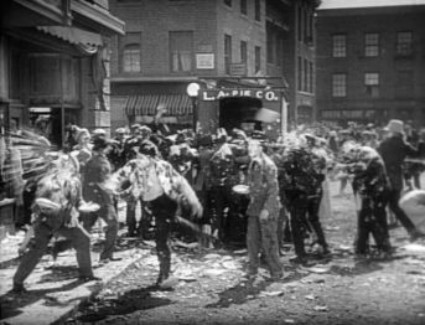
The custard pie fight from Laurel and Hardy’s The Battle of the Century (1927), from http://www.laurel-and-hardy-online.com

The Bioscope is dedicated to peace. Here at Bioscope Towers birds twitter contentedly from the ivy-clad turrets, the sun shines daily down upon the freshly-mown lawns over which butterflies play. A babbling brooks burbles in the distance, and the only sound not gently offered up by nature is the occasional tinkling of piano (or indeed strumming of guitar) and whirr of the hand-cranked projector as another silent plays upon the screen. Likewise the Bioscope’s view upon the world is an evenly-balanced one. It observes; it does not challenge. It does not take sides.

So it is with sorrow, and not a little bemusement, that we report – because it is news from our world and so we feel compelled to report it – of an extraordinary war of words raging at present around the Slapstick festival in Bristol, UK. Slapstick is a festival of comedy, silent and beyond, which each January brings together classic comedy with the live comedians of today in an imaginative concoction of popular entertainments. So, running alongside Keaton, Chaplin, Laurel & Hardy and so forth, audiences over the past five years have seen Neil Innes, Barry Cryer, Tim Brooke-Taylor, Graeme Garden, Phill Jupitus, Eric Sykes, and Paul Merton, the television comedian who has been such a fervent advocate for the art of silent film comedy.

Merton has been the host of past gala events at the festival, but for this year the festival announced that its gala event would feature Michael Palin, the globe-trotting Python. Just before the 2010 festival opened, an open letter appeared on Merton’s website, entitled ‘A Explanation to the People of Bristol‘. Merton writes of his shock at being dropped from the festival:

Over the past five years, I’ve taken great pride and pleasure in presenting the best silent comedies with live musical accompaniment at the Colston Hall as part of the Bristol Silents Slapstick Festival.

Every January, I came to Bristol to host the Gala night featuring some of the best films of Charlie Chaplin, Buster Keaton, Harold Lloyd and Laurel and Hardy. Every year we attracted a large and enthusiastic audience; over a thousand people every single Gala night. The applause at the end of the evening was always deafening …

The continued loyalty of the Bristol audience was very special to me and was matched by my loyalty to them. At the end of every exceptional Gala evening, I’ve stood on the stage and promised to return with more delights the following year. I’m proud that my name has played such a large part in building up the Slapstick Festival’s reputation. I have programmed many events and have been happy to do the lions share of publicity.

So you could have knocked me down with a custard pie last August when Chris Daniels, the self appointed Director of Bristol Silents, emailed my agent to say he was dropping my Gala Night because he believed that we would struggle to sell tickets!!

Merton goes on in some detail about his contributions, personal and financial, to past Slapstick festivals, and details what he feels has been mistreatment by the festival organisers now and in the past.

Not surprisingly with such a public figure taking umbrage in such a public form, the story has spread. The BBC news website has covered it, as have Private Eye (reproduced on Merton’s site) and numerous blogs and other news sources. All was silent for a while from Bristol Silents, organisers of the festival, until a message appeared on the Slapstick site on 27 January from festival director Chris Daniels. This is part of his reply:

We … need to make it clear that Paul most certainly has not been “sacked” by Slapstick. To keep the festival fresh and attract new audiences, we suggested to Paul, through his agent, that we vary the format of the opening Gala for 2010 and offered him several other ideas and venues during the festival, in case the changes didn’t suit him. The exact words of my email to his agent in July were: “Of course, as you know, Paul would be welcome to do almost anything with us, either at Slapstick or at any other time of the year, so if Paul wants to explore other shows or ideas I’m sure we could accommodate most things, for this January or beyond”. To this, I added: “If it’s really only the Gala show that Paul would like to host then I do hope he will want to be on board with us once more in 2011 and on into the future.”

To our dismay, Paul’s agent’s reply was that not only did Paul not like our various proposals, but that “he has asked me to let you know that he hereby withdraws from any future involvement with the Slapstick Festival.” Since then, we have made various efforts to reassure Paul that we value him but, as he insisted that all correspondence had to go through his agent, lack of direct contact may explain why Paul has formed some inaccurate impressions about the day-to-day running of the festival.

Unlike the big budget, well-staffed, production companies with whom Paul usually works, Slapstick is run mostly by unpaid volunteers whose main qualification is that they love silent films and visual comedy and are willing to put in the hours, energy and passion that enable others to enjoy them, too.

The festival is run by a bona fide not-for-profit film society – Bristol Silents – which meets all of the standards of governance required by public funding bodies and sponsors, and has a steering group who advise on festival appointments and plans.

To get to the bottom of this matter and come to your own conclusions, you will need to pursue the various threads of this story for yourselves (the debate on Nitrateville is instructive). What is sad to see is that people who believe in the same thing, namely the preservation of the art of silent comedy, should be falling out so publicly and bitterly. It is unnecessary, it is just a little bit ridiculous, and it should not have been aired so openly when it might have been resolved properly by diplomacy and mutual understanding.

The Bioscope suggests that perhaps a leaf might be taken out of the Python book and to have the contest sorted out by a fish-slapping duel, which we have long thought believed to be a good way of sorting out wars large and small. Or it could be custard pies.
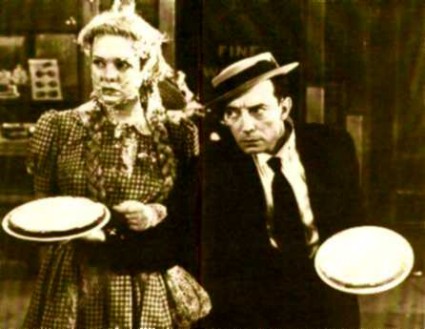
http://www.clown-ministry.com


Silents with accordions

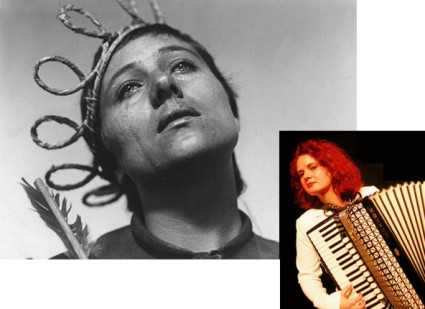
Falconetti in La passion de Jeanne d’Arc with Austrian accordionist Maria Düchler

The Bioscope is unremittingly keen to see new forms of musical accompaniment for silent films, so news of the Akkordeon Festival in Vienna is most welcome. The annual festival is pretty much what you would expect it to be – a festival of accordion music, and quite possibly something of a challenge to the senses were you to attend it in its entirety from 15 February to 23 March 2010. But the festival has assorted strands, and this year one of these is a series of matinees featuring the screening of silent films accompanied by accordionists. Clearly the choice of films has been made to demonstrate the range of the instrument and challenge preconceptions.

On 21 February Buster Keaton in Sherlock Jr. (1924) and Fatty Arbuckle and Keaton in Back Stage (1919) will be accompanied by Sascha Shevchenko on the accordion and Maciej Gloebiowski on clarinet.

On 28 February D.W. Griffith’s Broken Blossoms (1919) will be accompanied by accordionist Christian Bakanic.

On 7 March Carl Th. Dreyer’s La passion de Jeanne d’Arc is accompanied by accordionist Maria Düchler.

On 14 March there is Conrad Veidt in Robert Weine’s Orlacs Hände (1924), accompanied by Stefan Sterzinger on accordion and Franz Schaden bass.

On 21 March there’s Harold Lloyd in Safety Last (1923), with Lothar Lässer accompanying on the accordion.

More information (in German only), including ticket details, can be found on the Akkordeon Festival website. All the silent film screenings take place at the Filmcasino, Margaretenstrasse 78, A-1050, Vienna, Austria.

Scotland’s cinemas

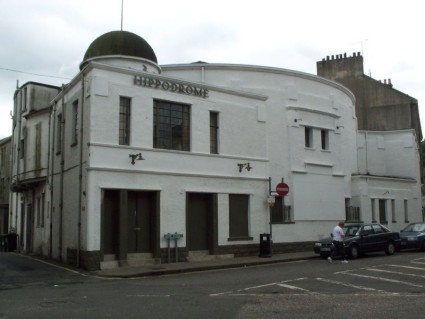
The Hippodrome, Hope Street, Bo’ness, Scotland, which opened in 1912, is now a listed building, and re-opened as a cinema in 2009, from http://www.scottishcinemas.org.uk

The Scottish Cinemas and Theatres Project is a website dedicated to recording and archiving the historic cinema architectural heritage of Scotland. It also acts as a information resource on Scottish cinemas as a subject for social history. Supported by a network of volunteers, the website aims to provide a photographic and historical record of all surviving cinema buildings in Scotland, including those whose purpose and appearance have changed from when they were first cinemas.

This is a fine resource which shows the power of networking in building up a valuable resource collectively. It has a great deal to interest the silent film researcher, as many of the cinemas and former cinemas that it documents have histories that stretch back to our era. Unfortunately there’s no searching by year or time period, so you’ll just have to browse.

At the heart of the website is the Scottish Cinema Database. This contains details of over 1,130 cinemas from over 240 different places, well over half of which are illustrated by photographs (often of the building as it is now rather than in its heyday). As indicated, the database option itself is a little limited in that there is no browse option – one simply enters a keyword for searching across name, address, town, architect etc., with results refinable by all cinemas, surviving cinemas, demolished cinemas or open cinemas. This is fine if you know what you are looking for, but for most the A-Z option will be more helpful, while the website puts a special focus on the cinemas of Glasgow, Edinburgh, Aberdeen and Dundee. The information supplied varies widely, from a one-line description, to detailed, authoritative and well-illustrated accounts, including many historical images from the collection of the Scottish Screen Archive. Collectively the accounts document not only the rise and fall and sometimes rise again of the cinema as a place of entertainment, but the mutability of such urban spaces, as they move in social purpose from places of screen entertainment to become restaurants, garages, hotels, shops and banks. The unevenness of the data makes it of limited use for the systematic study of Scottish cinemas, since one would want consistency of dates, ownership, capacity etc., but as a general finding guide and social record it serves its purpose admirably.

The website also provides a selection of articles on cinema history, a section on listed cinemas and another on cinemas at risk (taken from Scotland’s Buildings at Risk register). There is a somewhat selective links page, and a section showing images of unidentified cinemas. There’s even a section which casts its eye further afield to include some cinemas elsewhere in the UK and worldwide.

All of which is a prompt for the Bioscope to produce a post which surveys cinema databases around the world. The team at Bioscope Towers is already working on it.

Dave Berry, Wales’ finest

It is sad indeed to have the report the sudden death of Dave Berry. Dave was the great champion of Welsh cinema. His monumental Wales and Cinema: The First Hundred Years (1994) is as fine a national film history as exists, and it brought him much acclaim and awards. It is brimful of intelligent enthusiasm, a clear and disciplined work (for all its great size) which charts a very particular film history from the travelling showmen of the 1890s, through the key films (How Green Was My Valley, The Proud Valley, Only Two Can Play) and actors (Ivor Novello, Stanley Baker, Richard Burton, Anthony Hopkins) to the rise of Welsh television in the 1980s and the great boost it gave to Welsh filmmaking.

Dave was knowledgeable across all points of Welsh film history, but his great enthusiasm was for the early years. The lives of pioneers such as Arthur Cheetham, William Haggar and John Codman thrilled him and indeed it was very much due to his passionate engagement that such lives were rescued from obscurity. He championed the few films of Welsh life that survived from the silent era and dreamed of the rediscovery of such lost titles as A Welsh Singer (1915), Betta the Gypsy (1917) and Gwyneth of the Welsh Hills (1920). So there was no one who rejoiced more when the great masterpiece of silent Welsh cinema, The Life Story of David Lloyd George (1918) was rediscovered in 1994, a film whose history he documented (with Simon Horrocks) in David Lloyd George: The Movie Mystery (1998). The last time I saw Dave was last summer when he introduced a screening of the film at the National Library of Wales in Aberystwyth, at the IAMHIST conference. His passion for the film was such that he could hardly bring himself to stop introducing it, so anxious was he that we appreciate fully its cinematic panache and visionary fervour.

The Life Story of David Lloyd George

Dave was a writer and critic, for a long time film critic for the South Wales Echo. He served as a consultant and researcher for the National Screen and Sound Archive of Wales and the Wales Film Council (later Sgrîn), organising screenings, festivals and other such events, continually seeking to find out more, always keeping the flame burning for the cause. He wrote and devised the 1986 HTV four-part television series on Welsh film history, The Dream That Kicks (the phrase is from Dylan Thomas’ poem on cinema, ‘Our Eunuch Dreams’). He was given the Anthony Hopkins Award for outstanding contribution to Welsh film culture in 2002.

I’ve been taking long, engrossing phone calls from Dave for years, helping to pin down some lost film, trying to confirm whether some film fragment was a previously unrecognised part of Welsh film heritage, planning the next project and the next. He was a regular at the British Silent Film Festival and Pordenone, revelling in silent cinema from whatever part of the globe, before cornering you at a pavement cafe and telling his latest discovery about William Haggar. He has been such a part of the scenery for those in Britain who care about silent film that his loss will be felt greatly. Happily for posterity he has left us with Wales and Cinema, the kind of film history that will last. But more than that, he was just a nice man. Thank you for everything, Dave.

Come to the bazaar

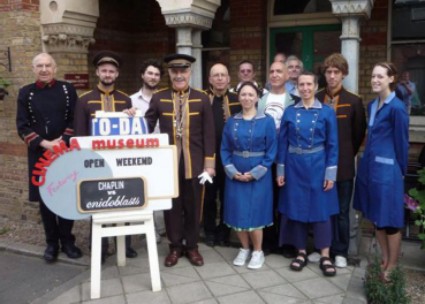
Helpers at the Cinema Museum (the museum’s owner Ronald Grant is on the left)

The Cinema Museum in London is hosting a film bazaar. Billed as the first of its kind, the intention is to help raise funds for this privately-owned institution which precariously holds on to so much precious British film heritage. The event takes place over the weekend of 27-28 February 2010, 10:00-17:00 each day. Here’s the what the publicty says about it:

The Film Bazaar, the first of its type to raise funds for the only museum of the cinema in the country, will be opened by famous British film director Michael Winner.

With dealers and visitors coming from all over the country and abroad, this will be one of the largest collections of film related collectables that has ever been seen in one sale room. Classic original posters from Hollywood to Bollywood, famous original film stills, films of all ages and gauges, cameras and projectors of all shapes and sizes and related film equipment, film books of all types and hundreds of mouthwatering DVD’s etc. etc.

Many will be on sale at bargain prices. An ideal opportunity to search for that ‘Fellini’ or ‘James Bond’ poster you always wanted, or to find that rare film or projector that has so far eluded you.

A Bring and Buy stall for visitors to sell their unwanted film related goods, and a top prize raffle draw.

Film Guests for the weekend – with most giving talks – will include; actress Fenella Fielding, famous for her distinctive voice; Caroline Munro, Bond girl and pinup of many British films of the 60’s and 70’s; Muriel Pavlow, who started as a child actress in 1934 and famously played in ‘Reach For the Sky’ and ‘Malta Story’.

From the world of film history; Kevin Brownlow, internationally renowned British leading silent film historian talking about finding an amazing collection of Charlie Chaplin’s original outtakes, and David Cleveland, founder of the East Anglian film archive talking about the fascinating history of home movie formats.

The Cinema Museum is a treasure-trove of original examples of Cinema, ranging from items relating to film production through to film exhibition and the experience of cinema going. It represents cinema’s rich history from the earliest days to the present.

Admission on the day is £5 and £3 on the second day with first day ticket.

Well that’s the first time – and let’s hope it’s not the last – that Michael Winner has got a mention in the Bioscope, and good on him for helping support the Cinema Museum’s work. If you’ve not been there before, the address is The Cinema Museum, The Masters House, 2 Dugard Way, Kennington, London, SE11 4TH (link to Multimap).

For further details, articles and pictures contact Martin Humphries, email martin [at] cinemamuseum.org.uk, tel 020 7840 2200. And tell your friends.

Silent film/live guitars

(L-R) Gyan Riley, Steve Kimock and Alex de Grassi, from http://www.newyorkguitarfestival.org

For some while now the Bioscope has been championing the guitar as accompaniment for silent film, with such notable figures as Bill Frisell and Gary Lucas having taken up the challenge. So it is pleasing to see that this year’s New York Guitar Festival includes a strand entitled Silent Film/Live Guitars. The Festival is halfway through, but the first of the combination of silent films with guitar music is on 21 January, with two further concerts on 28 January and 4 February. Here are extracts from the festival schedule:

21 JAN Thu
Charlie Chaplin’s One A.M. and Easy Street + Buster Keaton’s Cops
featuring music by Bon Iver’s Justin Vernon and Steve Kimock

Bon Iver is the nom-de-guerre of musician Justin Vernon. His album For Emma, Forever Ago was a critical and commercial hit, making him one of the most talked-about indie artists of 2008. For his scores to One A.M. & Easy Street, he’s joined by Chris Rosenau, of Collection of Colonies of Bees, whom Justin calls his “guitar mentor.” Steve Kimock is best known as co-founder and guitarist for the San Francisco band Zero. He’s recorded and performed with Bruce Hornsby and members of the Grateful Dead—Jerry Garcia once hailed him as his favorite guitarist. He performs music for Buster Keaton’s Cops.

28 JAN Thu
Charlie Chaplin’s Shoulder Arms and The Fall of the House of Usher (directed by James Sibley Watson and Melville Webber
featuring music by Alex de Grassi + James Blackshaw

One of the top fingerstyle, steel-string guitarists, Grammy nominee Alex de Grassi is renowned for his impeccable technique and compelling compositions. He’s explored a variety of world music influences and drawn acclaim for his 14 recordings on Windham Hill and other labels. He presents his original score for Chaplin’s 1918 masterpiece Shoulder Arms. James Blackshaw is a London-based prodigy who’s released seven albums of mesmerizing 12-string compositions. His style is often described as “American primitive” and incorporates elements of Indian raga, improvisation, and psychedelia.

04 FEB Thu
Charlie Chaplin’s Pay Day & The Idle Class plus short animations from Harry Smith’s Early Abstractions
featuring music by Chicha Libre + Gyan Riley

The Peruvian-influenced psychedelic pop of Chicha Libre mixes Colombian cumbia, dreamy surf guitar, and Andean melodies. They present their scores to Chaplin’s Pay Day (1922) and The Idle Class (1921). Gyan Riley is an equally strong presence in the worlds of classical guitar and contemporary music. He’s performed throughout Europe and the U.S., both as a soloist and in ensembles with Zakir Hussain, the San Francisco Symphony, the Falla Guitar Trio, and his father, the composer/pianist/vocalist Terry Riley.

The concerts take place 8pm at the Merkin Concert Hall, Goodman House, 129 W. 67th Street, New York. The first is sold out.