San Francisco Silent Film Festival

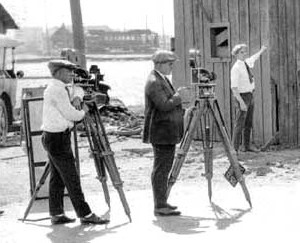
Norma Talmadge in The Woman Disputed (1928), from http://www.silentfilm.org

This year’s San Francisco Silent Film Festival takes place 15-18 July at the Castro Theatre, and what is quite frankly a sensational programme has just been announced. The biggest draw is going to be the new version of Metropolis, but the programme is choc-a-bloc with classics everyone should see, rediscoveries, surprises, and some of the funniest comedy short films ever made. Here are the details:

Thursday, July 15th

The Iron Horse (USA, 1924, 150 mins, 35mm)
Directed By: John Ford
Cast: George O’Brien, Madge Bellamy
Accompanied By: Dennis James
Set in mid-19th century America, The Iron Horse is the silent era’s version of How the West Was Won, weaving its themes of romance and history around the story of the building of the first transcontinental railway. This glorious print is the only surviving 35mm print of the American version.

Friday, July 16th

Amazing Tales from the Archives 1 (60 mins)
Lost Films from the Silent Era: Presentations by Joe Lindner of the Academy of Motion Picture Arts and Sciences, and Paula Félix-Didier and Fernando Peña of Museo del Cine, Buenos Aires (the archivists responsible for finding the lost Metropolis footage).
Accompanied By: Donald Sosin

A Spray of Plum Blossoms (China, 1931, 100 mins, 35mm)
Directed By: Bu Wancang
Cast: Ruan-Lingyu, Jin Yan
Accompanied By: Donald Sosin
One of the most prolific Chinese directors of the silent era, Bu Wancang based this film on William Shakespeare’s “Two Gentlemen of Verona,” setting the action in China, circa 1930 and casting China’s favorite on-screen couple, Ruan Ling-yu and Jin Yan. Like any Shakespeare comedy, Plum Blossoms is replete with star-crossed lovers, mistaken identity, and a satisfying happy ending. By situating the play in the ’30s-era Chinese army, the “gentlemen” of the Shakespeare’s title are the film’s officers, the duke is a warlord, and his daughter’s ladies-in-waiting are military police!
Presented with both Mandarin and English intertitles.

Rotaie (Italy, 1929, 74 mins, 35mm)
Directed By: Mario Camerini
Cast: Käthe von Nagy, Maurizio D’Ancora
Accompanied By: Stephen Horne
One of the most important Italian movies of the late silent period, Rotaie is the story is of two young lovers, very poor and on the brink of suicide, who come into a bit of temporary good luck. Finding a lost wallet in a train station, the lovers hop a train to two thrilling weeks of high living. The film’s exquisite style is influenced by the expressionism of German master F.W. Murnau. Presented with Italian intertitles accompanied by a live English translation.

Metropolis (Germany, 1927, 148 mins, Digital)
Directed By: Fritz Lang
Cast: Rudolf Klein-Rogge, Brigitte Helm
Accompanied By: Alloy Orchestra
When Fritz Lang’s masterpiece debuted in Berlin in January, 1927, the sci-fi epic ran an estimated 153 minutes, but in order to maximize box office potential the German and American distributors cut the film to 90 minutes for its commercial release. For decades crucial scenes from the film were considered lost. In 2001, the Munich Film Foundation assembled a more complete version with additional footage from four contributing archives, and Metropolis had a premiere revival at 124 minutes (widely believed to be the most complete version that contemporary audiences could ever hope to see). But, in 2008 archivists from the Museo del Cine in Buenos Aires made a spectacular discovery—a 16mm dupe negative of Metropolis that was considerably longer than any existing print! That discovery led to this remarkable restoration and Metropolis can now be shown in Fritz Lang’s original—25 minute longer—complete version. Digital print from Kino International. Special Guests: Paula Félix-Didier and Fernando Peña of the Museo del Cine, the pair who found the lost footage!

Saturday, July 17th

The Big Business of Short, Funny Films (62 min)
The Cook (USA, 1918, 22 min), Pass the Gravy (USA, 1928, 22 min), and Big Business (USA, 1929, 18 min)

Variations on a Theme: Musicians on the Craft of Composing and Performing for Silent Film (70 mins)
This special moderated program will shine a light the process of composing scores for silent films. Pianists Donald Sosin and Stephen Horne will take part, along with organist Dennis James, Mont Alto Motion Picture Orchestra, Alloy Orchestra, and Swedish musician and composer Matti Bye. Chloe Veltman, Bay Area culture correspondent for The New York Times and producer and host of public radio’s VoiceBox, will moderate.

The Flying Ace (USA, 1926, 65 mins, 35mm)
Directed By: Richard E. Norman
Cast: Lawrence Criner, Kathryn Boyd
Accompanied By: Donald Sosin
Richard E. Norman was among the first to produce films starring African-American actors in positive roles. Between 1920 and 1928, the Norman Film Manufacturing Co. produced six feature-length films as part of a movement to establish an independent black cinema at a time when blacks were demeaned in mainstream movies. The Flying Ace is the only Norman film that survives and its story of a crime-fighting ace pilot is still a crowd-pleaser! 35mm print from Library of Congress.

The Strong Man (USA, 1926, 75 mins, 35mm)
Directed By: Frank Capra
Cast: Harry Langdon, Priscilla Bonner
Accompanied By: Stephen Horne
This Harry Langdon comedy will be shown in a pristine print from Photoplay Productions in England. Frank Capra’s second feature, this effervescent slapstick has Langdon as Paul Bergot, a mild-mannered Belgian soldier who goes on the road with German strongman Zandow the Great after World War I. When they get to the States, Paul searches for (and finds) his American sweetheart pen pal.

Diary of a Lost Girl (Germany, 1929, 116 mins, 35mm)
Directed By: Georg Wilhelm Pabst
Cast: Louise Brooks, Kurt Gerron
Accompanied By: Mont Alto Motion Picture Orchestra
Diary of a Lost Girl represents the second and final work of one of the cinema’s most compelling collaborations: G.W. Pabst and Louise Brooks. Together with Pandora’s Box, Diary confirmed Pabst’s artistry as one of the great directors of the silent period and established Brooks as an “actress of brilliance, a luminescent personality and a beauty unparalleled in screen history.” (Kevin Brownlow) This version has been mastered from a restoration of the film made by the Cineteca di Bologna with approximately seven minutes of previously censored footage. 35mm print of Kino International.

Häxan: Witchcraft Through the Ages (Sweden , Denmark, 1922, 90 mins, 35mm)
Directed By: Benjamin Christensen
Cast: Maren Pedersen, Clara Pontoppidan, Elith Pio, Oscar Stribolt
Accompanied By: Matti Bye Ensemble
Benjamin Christensen’s legendary film uses a series of dramatic vignettes to explore the scientific hypothesis that the witches of the Middle Ages suffered the same hysteria as turn-of-the-century psychiatric patients. But the film itself is far from serious—instead it’s a witches’ brew of the scary and darkly humorous. 35mm restored, tinted print from the Swedish Film Institute.

Sunday, July 18th

Amazing Tales from the Archives 2 (60 mins)
Presentations by Annette Melville (National Film Preservation Board) and Mike Mashon (Library of Congress, Moving Image Section)
Accompanied By: Stephen Horne
Presentations by Annette Melville (National Film Preservation Board) and Mike Mashon (Library of Congress, Moving Image Section)

The Shakedown (USA, 1929, 70 mins, 35mm)
Directed By: William Wyler
Cast: James Murray, Barbara Kent, Jack Hanlon
Accompanied By: Donald Sosin
Restored to 35mm by George Eastman house, The Shakedown is a superb action-drama about a boxer whose life changes when he meets up with an orphan boy. Director William Wyler is most celebrated for his talkies (The Best Years of Our Lives, Ben Hur, Funny Girl) and this uplifting tale is a splendid introduction to the master’s early career. Beautiful camerawork, fast-paced editing, and remarkable effects make this a riveting feature. Leonard Maltin will interview the children of director William Wyler onstage.

Man with a Movie Camera (USSR, 1929, 70 mins, 35mm)
Directed By: Dziga Vertov
Accompanied By: Alloy Orchestra
Considered one of the most innovative and influential films of the silent era. Startlingly modern, this film demonstrates a groundbreaking style of rapid editing and incorporates innumerable other cinematic effects to create a work of amazing power and energy. This dawn-to-dusk view of the Soviet Union offers a montage of urban Russian life, showing the people of the city at work and at play, and the machines that endlessly whirl to keep the metropolis alive. Vertov’s masterpiece employs all the cinematic techniques at the director’s disposal — dissolves, split-screens, slow motion, and freeze-frames — to produce a work that is exhilarating and intellectually brilliant.

The Woman Disputed (USA, 1928, 110 mins, 35mm)
Directed By: Henry King, Sam Taylor
Cast: Norma Talmadge, Gilbert Roland
Accompanied By: Stephen Horne
This splendid romance is a true discovery, starring the extraordinary Norma Talmadge as a goodhearted streetwalker who is coveted by Austrian and Russian rivals. “I have just seen The Woman Disputed and it’s a remarkable piece of filmmaking. The plot takes Maupaussant’s Boule de Suif to extremes, but it succeeds so well as a brilliant piece of film craft that it MUST be brought back to life.” (Kevin Brownlow).

L’Heureuse mort (France, 1924, 83 mins, 35mm)
Directed By: Serge Nadejdine
Cast: Nicolas Rimsky, Lucie Larue
Accompanied By: Matti Bye Ensemble
This remarkable comedy stars Nicolas Rimsky as Parisian dramatist Théodore Larue whose latest premiere is a disaster. His reputation gone, Larue takes a sea voyage, during which he is swept overboard in a storm and lost. The press and the literary world react with an abrupt revaluation of his work, elevating him to the stature of France’s greatest dramatist. His widow finds herself in possession of a hugely valuable literary property… At which point, Larue — inopportunely — returns home. But, dramatist above all, he decides to masquerade as his colonialist brother Anselme, while industriously turning out posthumous works by Théodore. But then the real Anselme turns up with his Senegalese wife… Beautiful 35mm print from the Cinémathèque Française. Presented with French intertitles accompanied by a live English translation.

The festival website is choc-a-bloc itself with things to explore, quite apart from standard stuff like ticketing details. Every film is illustrated, well described, and comes with links to the IMDB, biography of the musician, recommendations for other film like it in the festival (if you like L’Heureuse mort they suggest you try out The Cook), and chances to mark your favourites through Twitter, Digg and such like. You can view the programme by date, title or musician, follow the very active festival blog, catch up on news from the festival, read articles from past festival programmes, and more.

All in all it looks like quite some four days. The Bioscope particularly recommends The Shakedown, Pass the Gravy and (because it has a particular fondness for silent Shakespeare) A Spray of Plum Blossoms – a pleasant surprise to see that rather delightful curio included in the programme. Lucky all you who can get there.
Classics upon classics

It must be evidence of the increasing taste of the disc-buying public that we seem to be getting more and more classic titles appearing on DVD and Blu-Ray, handsomely produced to appeal to the general cineaste as well as to the silent film specialist. And these are not just the obvious, every-good-home-should-have-one titles, but a range of titles that extends the available canon and increases the chance of discovery for those maybe investigating silents for the first time.

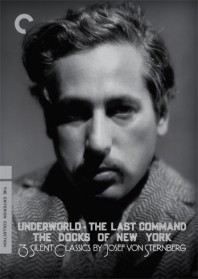
All of which is preamble to the news that Criterion is to release a collector’s set of three classic titles directed by Josef von Sternberg: Underworld (1927), The Last Command (1928) and The Docks of New York (1928). Von Sternberg is known to most film buffs for the exotic films he made in the 1930s with Marlene Dietrich, such as Shanghai Express and Morocco. His silent American films are more cited than seen, so there appearance of these three titles for the first time on DVD will give many the chance to see for the first time how von Sternberg’s brooding, rich visions were established in the 1920s and what continuity there is between the silent and sound era director. Underworld is the archetypal gangster film, The Last Command is a Russian Revolution drama for which Emil Jannings won the first-ever Academy Award for best actor, and The Docks of New York is a fog-bound, intense human drama of waterfront life in the kind of storytelling that silent film does better than another other medium.

The films each come with two scores: one by Robert Israel for each film; two by the Alloy Orchestra, for Underworld and The Last Command; and a piano and voice piece by Donald Sosin for The Docks of New York. The extras include two ‘visual essays’ by Janet Bergstrom and Tag Gallagher, a 1968 Swedish television interview with von Sternberg, a ninety-six-page booklet, the original film treatment for Underworld by Ben Hecht; and an excerpt from Sternberg’s autobiography, Fun in a Chinese Laundry, on Emil Jannings.

The box set will be available from Criterion on 24 August.

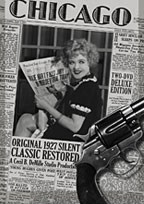
And if that wasn’t enough, Flicker Alley has announced a 2-DVD set of Chicago (1927), based like the recent musical on Maurine Watkins’ gleefully cynical 1926 play. The film was directed by Frank Urson, though it is generally understood to be mostly the work of Cecil B. De Mille (he declined to take a credit because such a tale of low life didn’t really fit in with his King of Kings image – the made both films in the same year). It has become established as a festival favourite since its recent restoration. It stars Phyllis Haver as Roxie Hart and Robert Edeson and Billy Flynn. The music on the DVD is supplied by Mont Alto Motion Picture Orchestra (listen to some extracts here). The extras include The Golden Twenties (1950), a compilation documentary feature produced by The March of Time; a documentary The Flapper Story (1985); a brochure by Thomas Pauly on author Maurine Watkins and the factual background to Chicago, notes by Robert S. Birchard, and a documentary supplement, Chicago; The Real-Life Roxie Hart by Jeffery Masino and Silas Lesnick.

Chicago will be released on 6 July.

The Brand Blackmail

Blackmail

Last year Neil Brand‘s orchestral score for the silent version of Alfred Hitchcock’s Blackmail was premiered (and much acclaimed) at Il Cinema Ritrovato, Bologna in July 2008. Happily there is going to be a further outing for the score, as film and music are to feature at the Barbican in London on 31 October 2010. The BBC Symphony Orchestra will be conducted by Timothy Brock, and tickets can now be booked from the Barbican site. As said before, this is probably the first full orchestral score to be written for a British silent fiction film since the 1920s (The Battle of the Somme, a documentary feature, received the orchestral treatment at the Royal Festival Hall in 2006).

For an extract from the score, photos of the Bologna screening, and extracts from reviews, see the Blackmail page on Neil’s personal site.

And there’s more. As regular readers will know, Neil is progressively building up a further reputation as a radio dramatist, and on 27 and 28 May (each at 14:15) BBC Radio 4 will be broadcasting Waves Breaking on a Shore, a two-part play about early cinema, Jewish culture, nationalism and radical politics in London’s East End, co-written by Neil and Michael Eaton. The two parts will be broadcast in the Afternoon Play slot and will be able to be heard live on the Radio 4 site and – one trusts – for a week thereafter on iPlayer (if you are in the UK).

I’ve read it and I warmly recommend it (and if it ends up mentioning Walter Gibbons’ Phono-Bio-Tableaux, then I contributed three words to it as well).

The art of the benshi

Here’s an interview from the Japanese Times with Midori Sawato, best-known of the small band of voice artists who keep alive the art of the benshi. There are around ten modern benshi in Japan, who continue the tradition of adding live narration to silent films, which was the standard manner in which silent films were exhibited in Japan up to the late 1930s, when – at its peak – there were some 7,000 such benshi in employment. The benshi would be positioned alongside the screen and take on the multiple roles, accompanied by live music, and putting their particular personality onto the film entertainment. Sawato gives around 100 such shows per year.

Sawato has been featured here before, as she is main voice artist featured on Digital Meme’s Talking Silents series of Japanese silents with benshi narration, reported on here. In the interview (which takes a couple of minutes before she gets to silent films) she describes how she was working in publishing in 1972 when she went to a silent film narrated by master benshi Shunsui Matsuda, one of a number of celebrated benshi still active. She became so engrossed by the art that she became his apprentice, making her debut with Chaplin’s The Rink. One of the interesting aspects of the interview is the realisation that benshi narrate for non-Japanese silents as well as Japanese – which is of course how it was during the silent era.

The interview covers how she learned the art (mostly by listening), how she conveys different characters, and her thoughts about the importance of silent film as a means to preserve history and culture. There’s also the oblique admission that she continues to perform to the films despite relatively small audiences, believing that it is good work to be doing whether the audience be large or small. It’s a noble activity.

The video serves as my means to introduce The Bioscope on YouTube. I’ve set up a channel, or playlist, on YouTube which lists almost all of the videos featured on The Bioscope since its inception in February 2007. I say almost all, because some videos have been taken down since then, and some have come from other sites (such as Vimeo). But it’s most of them, and I think they make interesting browsing. I’ll continue to add each new video to the channel as they are featured on the blog. The Bioscope on YouTube is now a link on the right-hand column of this site, alongside our other satellite sites, The Bioscope on Flickr (images featured on or associated with the blog), The Bioscope Bibliography of Silent Cinema (selected from the British Library catalogue, still ongoing), The Bioscope on Twitter (a feed from blog posts only), and Urbanora’s Modern Silents (another YouTube playlist, with some overlaps with the new channel).

Slapsticon returns

Slapsticon is a four-day film festival of rarely seen comedies from the silent and early sound eras, held at Arlington VA every July. This year’s festival takes place 15-18 July at Rosslyn Spectrum Theatre, Arlington, and the programme has just been announced:

Thursday July 15, 2010
12:00 pm — Spectrum Doors Open

1:00 pm

* The Great Radio Comedians (1971)

3:00 pm — Weiss-O-Roni II

* Thick and Thin (1929) — Snub Pollard, Marvin Loback
* Taking the Count (1929) — Ben Turpin, Leo White
* Deaf, Dumb and Blonde (1928) — Poodles Hanneford
* Dizzie Daze (1928) — Jimmy Aubrey

5:00 pm — Dinner Break

7:00 pm — Abbott and Costello Rarities, including Africa Screams (1949) in 35mm

9:00 pm

* The Covered Schooner (1923) — Monty Banks
* Too Many Kisses (1925) — Richard Dix, Harpo Marx

Friday July 16, 2010
8:00 am — Spectrum Doors Open

9:00 am — Early Comedies:

* Medium Wanted as Son-In-Law (1908) — Pathé Comedy
* Miss Stickie Moufie Kiss (1914) — Mr. and Mrs. Sidney Drew
* Cruel and Unusual (1915) — Musty Suffer
* Poor Policy (1914) — Billie Ritchie, Henry Bergman
* Mishaps of Musty Suffer: Going Up (1916) — Harry Watson Jr.
* The Feudists (1913) — John Bunny, Sidney Drew
* Lizzy’s Dissy Career (1915) — Neal Burns, Victoria Forde
* Goodnight Nurse (1916) — Neal Burns
* Ham at the Garbage Gentlemen’s Ball (1915) — Ham and Bud

11:00 am — Kids ‘N’ Animals

* Ladies’ Pets (1921) — Snooky the Humanzee
* Dad’s Boy (1923) — Buddy Messinger
* The Knockout (1926) — Dippy Do Dads
* Buster’s Picnic (1927) — Buster Brown
* The Smile Wins (1928) — Our Gang

12:30 pm — Lunch Break

2:00pm — The Sennett Spot

* Shot in the Excitement (1914) — Al St. John, Alice Howell
* Don’t Weaken (1920) — Ford Sterling, Charlie Murray
* The Funnymooners (1925) — Ralph Graves
* Ice Cold Cocos (1926) — Billy Bevan, Andy Clyde
* The Bluffer (1930) — Andy Clyde
* Courtin’ Trouble (1932) — Charlie Murray, Arthur Stone

4:00 pm — Rob Stone Rarities

6:00 pm — Dinner Break

8:00 pm

* The Round-Up (1920) — Roscoe “Fatty” Arbuckle
* Pop Tuttle’s Movie Queen (1922) — Dan Mason

10:00 pm

* Horse Shy (1927) — Edward Everett Horton
* Wide Open (1930) — Edward Everett Horton

Saturday July 17, 2010
8:00am — Spectrum Doors Open

9:00 am — Cartoon Show

10:30 am — Hal Roach Comedies

* Peculiar Patient’s Pranks (1915) — Harold Lloyd
* Pardon Me (1921) — Snub Pollard
* Shoot Straight (1923) — Paul Parrott
* Cuckoo Love (1927) — Glenn Tryon, Chester Conklin
* Fallen Arches (1933) — Charley Chase
* Taxi Barons (1933) — Taxi Boys

12:30 pm — Lunch Break

2:00 pm

* Modern Love (1929) — Charley Chase
* South of the Boudoir (1940) — Charley Chase

4:00 pm

* You Made Me Love You (1934) — Stanley Lupino, Thelma Todd

6:00 pm &nmash; Dinner Break

8:00 pm

* The Caveman (1926) — Marie Prevost, Tom Moore

10:00 pm — Talkie Shorts

* Fireproof (1929) — Lupino Lane
* Dangerous Youth (1930) — Daphne Pollard
* Gents of Leisure (1931) — Chester Conklin, Vernon Dent
* Old Sawbones (1935) — Andy Clyde

Sunday July 18, 2010
9:00 am — Spectrum Doors Open

10:00 am — More Talkie Shorts

* Honeymoon Trio (1932) — Al St. John, Walter Catlett
* In a Pig’s Eye (1934) — Clark and McCullough
* I Don’t Remember (1935) — Harry Langdon
* Down the Ribber (1936) — Leon Errol
* Teacher’s Pest (1939) — Charley Chase

12:00pm — Lunch Break

1:30 pm

* Luck (1923) — Johnny Hines
* Broken China (1927) — Bobby Vernon
* A Briny Boob (1926) — Billy Dooley

3:30 pm — Ones for the Road

* Papa’s Boy (1928) — Lloyd Hamilton
* Drama Deluxe (1927) — Lupino Lane
* Fluttering Hearts (1927) — Charley Chase

Ah, what joyous things silent and early sound comedies are by their names alone. There’s all the information need on location, accommodation, and registration on the festival site. And, as final temptation, a little bird tells me that those attending may very well be able to see something “that will add a new title to the Charlie Chaplin filmography”. Intriguing.

Forever film

The National Audiovisual Conservation Center of the Library of Congress, Culpeper, Virginia

When good film archivists die, they’ll probably go to Culpeper. Or somewhere quite like it. Culpeper VA is home to the National Audiovisual Conservation Center (NAVCC) of the Library of Congress, a state-of-the-art film preservation centre funded by Packard half of Hewlett-Packard and a temple to the art of preserving the film heritage – 1.1 million film, television, and video recordings, to be precise.

The reason for mentioning the NAVCC is to introduce an engrossing account of the scale of the work that goes on there, written by Ken Weissman, Supervisor of the Film Preservation Laboratory. The piece, ‘The Ultimate Archive System‘, was written for Creative COW Magazine, and although it covers the breadth of the Library’s film collection across the last century and more, it has much to say about the treatment of its earliest films:

Here, for example, is what he writes about paper prints, which were once treated photochemically but are now being tested for digital restoration:

We started as a photochemical laboratory, and are primarily a photochemical laboratory to this day. It has only really been in the past half a dozen years, or less, that you can even begin a conversation that might convince people in the know that preserving motion pictures might be done digitally. So here in our lab, we began a pilot digital project for a very special collection that we have in the Library of Congress: the paper print collection.

These paper prints exist because of a vaguery in the copyright law at the time that motion pictures were invented. The Copyright Office at the Library interpreted the law to say that a motion picture film is simply a series of still photographs, and therefore the still photographic copyright law applied. If you wanted to copyright a motion picture, you had to provide the Library of Congress two copies of the film, and they had to be on paper. Not film.

A process was invented to literally create long strips of photographic paper, exactly the size of 35mm film stock, and then create contact prints from the original 35mm negatives, onto those long strips of paper. These were then deposited with the Library.

There are over 3000 titles within that collection, some of the earliest films ever made — from 1894-1915, with the vast majority from before 1912. Most of them are unique. In other words, these paper prints are the only copies of these films. They represent the single largest collection of early motion pictures in the world, by far. The Library is rightfully very proud of this collection.

The paper prints had been locked in a vault in the bowels of one of the library buildings, and rediscovered by librarian Howard Walls in the late 30s. The paper itself is still stable, but for the most part, you can’t see the images very easily except by looking directly at the paper — where of course there is no motion.

This is why there have been several attempts over the course of history since their rediscovery to put them back on film. One of the first was by Kemp Niver, and his company called Renovare. He took these 35mm prints (and there are some that are actually a larger gauge than that), and re-photographed them using a clever device that he built, printing to 16mm film. We have used various models of these Niver printers, including one where we replaced the 16mm camera with a 35mm camera, in order to print back to 35.

All of the processes have been interesting, and they’ve all been successful to some degree. However, they’ve also been unsuccessful to a great degree, in that the images are alternately soft, or fuzzy, or very shaky. There was also no way to accurately register the images. In fact, we’ve concluded that in many cases, the images aren’t very well registered on the paper.

The obvious solution is to scan the images, then take advantage of digital processing to stabilize them, correct positioning and so on. Our first scans of the paper prints were 2K x 2K, which theoretically should have been good enough, but in our analysis of the imagery, we think it might be better to go to 4K x 4K. But that’s one part of the pilot program, to figure out exactly how to do it. It’s more of a theoretical workflow because we haven’t practically implemented it yet, but we’re getting close.

Georges Méliès on a Library of Congress paper print

From film to paper to film to a row of ones and noughts – these particular ‘films’, a great many of which no longer exist in any other form than the paper on which their successive images are now held, would seem to be ripe for digitisation. But for Weissman, digitisation is essentially a means for returning the images to film. He argues that knowledge of of how ambient temperature and relative humidity affect decay, measured in a Preservation Index, means that film which under normal conditions might only last fifty years before serious degradation sets, when “stored at 25F and 30% relative humidity, you can expect it to last 40 times longer than that – 2000 years.”

That’s why, as we move further into digital technologies, the plan for now is still to scan the images, restore or preserve them as needed, then run them back to film, and put the film away at 25 degrees, 30% relative humidity, for practically forever. For most people, in practice, somewhere between 600 and 2000 years is beyond forever. Because frankly, once you get to that point, what are you really worrying about?

It reads likely a strangely regressive strategy, which so many other institutions are looking to become every more the completely digital library. But film takes up space, digitally speaking – one frame scanned at 4K amounts to 128MB, he informs us, or 24 terabytes for the average feature film. And then you’re not done with it, because you’ll probably have to migrate the files after five years “to the next greatest things”, and have back-up copies, and back-ups of backups, and then repeat the processes five years after that, and then again and again, and keep on paying for it all…

But what also drives Weissman is the love of film itself. A digital file tells you nothing until you can find the kit to run it (if it hasn’t become obsolete in those five years). But with reassuring filmstock all you need is a light source, a lens and a screen, and you can see what you’ve got. And it takes you back to what you started from. “I can’t help feeling in my heart of hearts that the simple solution is usually the best” he argues, adding “and film is a pretty simple solution.”

Film archivists like film, and arguments that film might actually be the best, even the most economic form for storing film long term, is bound to appeal. Until they stop producing film stock, of course. And then there are all those ‘films’ that weren’t ever on film because they were made digitally in the first place, which is what we’re making now. That might at least make the NAVCC’s challenge a finite one, because there will come a point when we stop producing films on film and so you’ll have a measurable problem. But what gets done with the 21st century’s motion picture medium of choice – born digital – doesn’t get mentioned.

It’s not easy having to think about keeping an impermanent medium forever.

Viewing scarlet maple leaves

Ichikawa Danjuro IX (right) and Onoe Kikugoro V in Momiji-gari (Viewing Scarlet Maple Leaves), filmed by Shibata Tsunekichi in November 1899

This is an extraordinary image. It’s a Japanese postcard dating from 1908 (the postage stamp says Meijii 41, which is 1908). However the image that it shows dates from November 1899. It shows on the right the greatest of all kabuki actors, Ichikawa Danjuro IX (1838-1903), and on the left Onoe Kikugoro V (1844-1903), second only in fame at the time to Danjuro. They have been photographed in a scene from the dance drama Momiji-gari, translated as Viewing Scarlet Maple Leaves or Maple Leaf Hunters. And the reason the drama was performed because it was done for a motion picture camera.

Projected film first came to Japan when businessman Inabata Katsutaro, a friend of Auguste Lumière, played host to Lumière operator François-Constant Girel, who gave a film show at the Nanchi Theatre in Osaka on 15 February 1897 (peepshow Kinetoscopes were exhibited in Japan in 1896). Film was an immediate hit with Japanese audiences, and several Japanese entrepreneurs enthusiatically adopted the new medium, among them Yokota Einosuke, Kawaura Ken’ichi and Arai Saburo.

It was Arai who was the first person to approach Danjuro with a proposal to film him, in 1897. Danjuro IX (left) was a legend of the kabuki theatre, ninth in an unbroken line of actors named Danjuro, and considered one of the greatest of all Japanese actors. He did much to preserve the art of kabuki and to raise the status of actors generally. However the actor, a deeply conservative character, reacted to Arai’s proposal with repugnance, refusing to have anything with a ‘shipbrought thing’ (thus equating the cinematograph with any other kind of foreign goods).

Two years later, Danjuro was sixty years old, and his manager Inoue Takejiro, was anxious to record his great art for posterity. On the understanding that such a film would go into his private vault and not been seen by the sort of commonfolk who frequented film shows, Danjuro assented. A film would be made of part of the dance play Momiji-gari, with Danjuro playing an ogress who has disguised herself as a princess (male actors always play female roles in kabuki) and Onoe Kikugoro V as the hero Taira no Koremochi. Wikipedia gives this summary of the plot of the original play (not the film, which could only show a part of the drama):

The original play, performed in both noh and kabuki, is a story of the warrior Taira no Koremochi visiting Togakushi-yama, a mountain in Shinshū for the seasonal maple-leaf viewing event. In reality, he has come to investigate and kill a demon that has been plaguing the mountain’s deity, Hachiman.

There he meets a princess named Sarashinahime, and drinks some sake she offers him. Thereupon she reveals her true form as the demon Kijo, and attacks the drunk man. Koremochi is able to escape using his sword, called Kogarasumaru, which was given to him by Hachiman. The demon gnaws on a maple branch as she dies.

(A longer summary is available on the Kabuki21 site)

The filmmaker selected to create this important document was Shibata Tsunekichi, who had previously made films of geisha dances. Shibata employed a Gaumont camera and left this account of how the film was made:

There was a gusting wind that morning. We decided to do all the shooting in a small outdoor stage reserved for tea parties behind the Kabuki-za. We hurriedly set up the stage, fearing all the time that Danjuro might suddenly change his mind again. Every available hand, including Inoue, was called upon to hold the backdrop firm in the strong wind. Danjuro, playing Sarashi-the-maiden, was to dance with two fans. The wind tore one from his hands and it fluttered off to one side. Re-shooting was out of the question so the mistake stayed in the picture. Later people were to remark that this gave the piece its great charm.

The film was kept from public view, as had been Danjuro’s wish, but a year later it was shown to an audience of kabuki actors. According to historian Hiroshi Komatsu, the film was first shown to a general audience on 7 July 1903 when Danjuro fell ill and was unable to appear on stage. He died in September of that year. Happily the film has survived for posterity to treasure (it is held by the National Museum of Modern Art in Tokyo) and when it was shown at the Pordenone silent film festival in 2001 (where I missed it!) this description of the six-minute, three-scene film was provided in the catalogue:

The first shot, in which Princess Sharashina dances with a fan, is viewed head on, as though she were center stage. The second shot, of the “Yamagami scene”, captures Koremori (played by Kikugoro) in the foreground and Yamagami’s dance behind Koremori. The third shot is from the same camera angle as the first, and shows Koremori and the ogress’s dance.

This is where the postcard comes in, which documents the film’s third scene.

The full postcard with postage stamp

The postcard definitely shows Danjuro IX and Onoe Kikugoro V performing for the Momiji-gari film. It has been photographed in the open air, as one can see from the shadows thrown by the sunlight. Clearly Shibata not only commemorated the event in film but took a photograph (maybe more? maybe three, one for each scene?) at the same time. The postcard, however, dates from 1908, with the legend stating something along the lines that it had been produced to honour the fifth anniversary of his passing. It seems that the production was a little more planned and commercial in intent than the anecdotal histories have suggested. Certainly Danjuro was the subject of innumerable ukiyo-e prints, which suggests an awareness of the importance of image.

There is an interesting parallel with what happened in Britain at almost exactly the same time. In September 1899 the renowned actor-manager Herbert Beerbohm Tree was persuaded by the British Mutoscope and Biograph Company to appear before the Biograph camera in short scenes from Shakespeare’s King John, the play he was presenting at the Her Majesty’s Theatre in London. Four scenes from the play were filmed, which did not tell the whole story but rather showed key points from the drama, just as with Momijigari. In another parallel, a set of promotional photographs were also taken at the same time. Tree was never so fastidious as Danjuro, and his intent was probably more commercial than concerned with posterity, but it is worth noting the coming together of the new medium with the old, the former gaining kudos by association with the other and showing the advantages that it had – to capture performance and defy time. It also demonstrates an idea of cinema as filmed theatre which was to influence Japanese film for several years thereafter, impeding its development as an independent art form for two decades or more.

Herbert Beerbohm Tree (dressed in white) in King John (1899)

I am able to reproduce the postcard by kind permission of its owner, a US collector by name of Dan. He is looking for a buyer for the postcard, and anyone with a serious proposal should get in touch with me and I’ll pass on details to him. My thanks to him also for translations from the Japanese. The postcard is also reproduced on the Ukiyo-e Prints website, and I am grateful to its host Jerry Vegler for being so helpful, and to Stephen Herbert for having first brought the card to my attention.

There are biographies of Danjuro IX on the Who’s Who of Victorian Cinema site and on Portraits of Modern Japanese Historical Figures. Much of the historical information in this post comes courtesy of Peter B. High’s article ‘The Dawn of Cinema in Japan’, Journal of Contemporary History, vol. 19 no. 1 (January 1984), with acknowledgment also to Hiroshi Komatsu’s notes for the 2001 Pordenone catalogue and his essay ‘Questions Regarding the Genesis of Nonfiction Film‘.

Extensive information on kabuki – the performers, theatres, stories and characters – can be found on the Kabuki21 site. You can get an idea of how Momiji-gari would have been performed from this YouTube video (with helpful English subtitles) which shows a modern-day production (part 8 of 8, showing the finale of the drama as depicted in the postcard).

Finally, it was recently suggested that the film be designated by the Japanese government as an Important Cultural Property (juyo bunkazai), the first film to be so honoured.

How I filmed the war

How I Filmed the War – trailer available from traileraddict.com

Has anyone come across a modern silent documentary? I suppose you could point to Godrey Reggio’s wordless Koyaanisqatsi (1982) and its successors, with their Philip Glass scores, but I’ve not come across an example of a documentary from today which emulates the style of documentaries from the silent era. Until now.

How I Filmed the War is a documentary by Yuval Sagiv, a graduate student of Toronto’s York University (the film is his thesis production). It received its premiere last week at Canada’s Hot Docs festival of documentary film. Its subject is Geoffrey Malins, the British cameraman who (with J.B. McDowell) filmed the 1916 documentary The Battle of the Somme, a feature-length account of the conflict from the British point of view produced by the British Topical Committee for War Films, a British film trade organisation formed with War Office support.

Malins went on to gain greater fame than his co-filmmaker because he wrote an account of his experiences, entitled How I Filmed the War (1920), which is something of a vainglorious work (and mentions McDowell not at all), but is nevertheless a lively and informative record that provides us with one of the best written records that we have of filming in the First World War.

Yuval Sagiv’s film adopts the title of Malins’ book and over 75 minutes analyses text and film in the form of a silent documentary, as the Hot Docs blurb explains:

One the most successful films ever made, The Battle of the Somme, shot and edited by Geoffrey H. Malins during the First World War, is brilliantly decoded in this riveting experimental doc that unravels fascinating secrets and manipulations. A compelling contemplation of the ownership of history plays out on intertitles taken from excerpts of Malins’s controversial autobiography juxtaposed with conflicting historical accounts and emotionally devastating clips from the original film. Dispatched to the front as Britain’s “Official Kinematographer,” Malins filmed from the muddy trenches to capture the valour and horror of “the big push” on July 1, 1916—a day that has become synonymous with the futility of war. The British alone suffered 58,000 casualties by nightfall. The rising tension in this fascinating deconstruction of propaganda, illusion, and “truth” in documentary is underscored by a haunting electro-ambient soundscape.

You can get some sense of the effect from the trailer to the film, which is available on traileraddict.com. Malins’ book is available on the Internet Archive, and was covered by a previous Bioscope post, while The Battle of the Somme itself has been made available on DVD by the Imperial War Museum (also covered by an earlier Bioscope post). There is a short biography of Malins on the IWM‘s site.

The Battle of the Somme itself is indeed arguably one of the most successful films ever made, at least in the UK – historian Nicholas Hiley (to whom thanks are due for alerting me to the new film) has calculated that the film was seen by some 20 million people, or half the population of the UK at that time, a degree of social impact for a screen entertainment that would go unmatched until the rise of television. It will be really interesting to see how How I Filmed the War tackles its tremendous subject – the trailer suggests a compelling interplay between original footage and words carefully selected from Malins’ book (with their original typeface and page number) to set up a stimulating counter-narrative. There’s an interesting review at Toronto Film Scene which describes a subtle, challenging work once one has got over the unusual technique and minimalist style. I hope that it makes it to a few other festivals.

Silent animation online

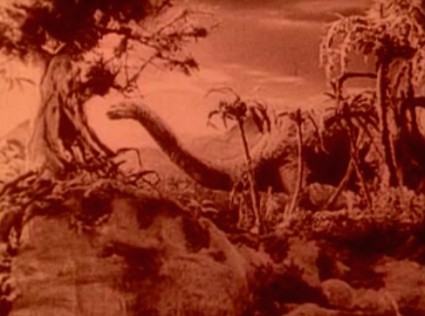
A trailer for The Lost World, from http://animation.library.ucla.edu

Acknowledgments to the Nitrateville discussion forum for news of this latest discovery. The UCLA Film and Television Archive has produced Silent Animation, a section of its website which offers eleven animation films from the silent era for viewing online or download. The films cover all kinds of silent animation productions, including lightning sketches (a ‘lightning’ artist filmed drawing a caricature), hand-drawn animation, stop-frame animation, cut-out animation, animated letters, and films which integrate live action with animation.

These are the eleven film on offer:

A Pool Plunge (1920)
Burr’s Novelty Review
Animator, J.J. McManus

Animated Hair Cartoon (1925)
Red Seal Pictures

Bob’s Electric Theatre (1906)
Pathé frères
Director, Gaston Velle (animation by Segundo de Chomón)

How Jones Lost His Roll (1905)
Edison
Director, Edwin S. Porter

Indoor Sports (1920)
International Film Service
Animator, Paul D. Robinson

Joys and Glooms (1921)
International News Corp.
Animator, John C. Terry

The Enchanted Drawing (1900)
Edison
With, J. Stuart Blackton

The Lost World – Promotional Film (1925)
First National

The Lost World – Trailer (1925)
First National

The Wandering Toy (1928)
Lyman H. Howe Films Co., Inc
Director, Robert E. Gillaum
Animator, Archie N. Griffith

Theatre De Hula Hula (19–)

Each film can be viewed silent, with piano score, with a music score or with a commentary from the film’s preservationist. The download options for each are MPEG-2 (at 8Mbps) or MPEG4 (at 1.1Mbps). You can also view notes by preservationist Jere Guldin and historian Jerry Beck, which are available in longer form as downloadable PDFs. There are also sections giving background information on the UCLA project to preserve and make accessible its silent animation holdings, on the music (commissioned from Michael D. Mortilla), a study guide (which lists many other silent animation films held by the UCLA archive), and an historical overview of animation in the silent era written by Mark Langer, which situates the animation film within the histories of pre-cinema motion picture devices, newspaper cartoons, and early film. As Langer observes, all films at this time were, to a degree, seen as animation films:

Animation’s silent era was a period of discovery and experimentation in which animation was not yet regarded as a separate subset of the cinema at large. Indeed, in the first years of film’s existence as a medium, movies commonly were referred to as “animated films,” based on the principle that all motion pictures were still objects (be they photographs or drawings) magically brought to life through the cinematographic apparatus. What were to be the separate forms of live-action and animated cinema both drew on those pre-existing mass media and entertainments.

It’s a helpful account of the roots of animation film and of the world in which early film in general was situated. All in all this is a most impressive resource, thoughtfully presented with educational and research use in mind. The help notes state that the films are all presumed to be in the public domain; the silent versions are published with a Creative Commons licence “to encourage free and unlimited repurpose for educational use or remix”. All music on the site is copyright Michael D. Mortilla. All written text is published with a Creative Commons Attribution-Noncommercial-Share Alike 3.0 United States Licence.

Lucky us. Go explore.

A luxurious wallowing place

Today (7th May) at Bristol’s Colston Hall there is to be a special screening of Carl Dreyer’s The Passion of Joan of Arc with live music by rock musicians Adrian Utley (of Portishead) and Will Gregory (of Goldfrapp). The music will be conducted by Charles Hazelwood, and will feature six electric guitars, eight members of the Monteverdi Choir, harp, percussion, horns and keyboards. The short documentary above, made by Rick Holbrook, features interviews with Utley, Gregory and Hazelwood, and shows the process of composition, illustrated by clips from the film. The trio previously collaborated on a score for Victor Sjöström’s He Who Gets Slapped at Bristol in 2007.

In The Times last Saturday there was an interview with Gregory and Utley about the project. Gregory came up with this very revealing comment on composing music for silent films:

It’s a luxurious wallowing place for composers. You get to be the whole soundtrack: music, dialogue, background noise and special effects.

I think that pretty much sums up the approach of the rock musicians and jazz musicians who have dabbled in silent film scores in recent years – among them John Cale, Jonathan Richman, Black Francis, The Pet Shop Boys, DJ Spooky, Tangerine Dream, Tom Verlaine, Giorgio Moroder, Bill Frisell, Gary Lucas, Dave Douglas, Joby Talbot, Fred Frith, Marc Ribot, Steven Severin, Maximo Park, and several more. The silent film is a canvas – practically a blank canvas – onto which they can wallow with abandon. This isn’t intrinsically a bad thing, because it is a form of artistic expression, and in some cases a highly successful one, but it is one where the film is subordinated to the music (still more to the star musician). Any regular silent film musician will tell you that their job is to accompany the film, interpreting it in the best possible way to enable the audience fully to appreciate what they are seeing. They don’t provide us with concerts accompanied by the film.

So we have two different ways of approaching the silent film score, and that has to be better than just having the one. Back to The Passion of Joan of Arc, and despite the Colston Hall calling it a unique event, the composers say that they hope to take film and score elsewhere, hinting at Italy and France.