AFI Catalog Silent Film database

We are still ploughing our way through online catalogues and databases for silent film. Next up is the AFI Catalog Silent Film database. The American Film Institute Catalog of Feature Films is a series of catalogues that document the American film. The project began in the late 1960s, with the printed volumes covering decades (with a couple of exceptions), starting with 1921-1930, published in 1971. Subsequently the AFI issued volumes for 1961-1970 (in 1976), 1911-1920 (1988), 1931-1940 (1993), 1893-1910 (1995), 1941-1950 (1997) and Within Our Gates: Ethnicity in American Feature Films, 1911-1960 (1997). Publication of further printed volumes has now stopped (it was just too expensive), and all subsequent records (for the 1950s and some of the 1970s, with a few star titles from the 2000s) have been added to the online version of the catalogue.

The Catalog is a stupendous achievement, one where the AFI’s team got better as they went along, so the volumes for the 1930s and 40s are extraordinarily rich in the detail they provide. The earlier volumes were less thorough in their cataloguing, and the 1960s volume is unusual in that it includes all films released in the USA as opposed to produced in the USA, on account of the large number of co-productions. In 1997 the online edition was published, with the inestimable advantage of bringing all of the titles (some 50,000 of them) into one place. The full database is normally accessible to AFI members only or through the paid service ProQuest, but currently the entire catalogue is open to all. Use it while you can. However, from the outset the AFI decided to make a portion of the database freely available, namely the 25,000 films originally covered by the three volumes for the silent period 1893-1930, and will presumably continue to do so. And’s that’s what we’ll cover here.

The information is uneven because the original volumes are uneven. The 1921-1930 volume, first in the series, covers feature films only – that is, films of four reels or 4,000 feet in length or 40 minutes long (to use the AFI’s own definition). The 1893-1910 volume covers the pre-feature film era and includes every kind of film, fiction and non-fiction. The 1911-1920 volume follows the 1920s volume in concentrating on feature films, so there are no short films despite their high level of production at this time. For example, if you search under ‘Charlie Chaplin’ for the teens you will only get Tillie’s Punctured Romance, Carmen and the compilation films in which he appeared (the absence of Shoulder Arms is a puzzle, however).

Theere is a simple search option (which nevertheless lets you filter requests by title, personal name, character name, genre, summary and others) and a thorough advanced search option. The records give cast, role, credits, release date, duration in feet and reels, physical properties, genre terms and subject terms – all of which are hyperlinked for cross-searching with other records, so you can discover, for instance, how many 7-reel films were produced (3,409), how many films starred Richard Barthelmess (57), how many films featured dogs (457), and how many horror films were made (just 10 for the silent period). There is a plot summary, notes, bibiliographical sources, and information on availability on DVD and VHS (possibly not completely up-to-date, especially since Laserdisc availability is also given). When you first come to a record, do note that you only get partial details at first, and you need to click on Display Movie Detail to see the full details.

The 1893-1910 records do not offer so much detail, taken as they are from copyright records for the most part, often with little more information available than title, production company and date. Some records from this period are fuller, but they seldom have cast details, and plot summaries are rare. It should also be noted that access for some titles from the 1893-1910 period is restricted to AFI members if you use the silent film database, but are available if you search through the unified catalogue, which as we’ve said is currently open to all – but won’t stay that way.

Also to be noted is that films for African-American audiences which were not always covered in great detail in the 1920s volume are given in greater detail here, benefitting from the boom in research in the area in recent years and the publication of the Ethnicity in American Feature Films, 1911-1960 volume of the AFI Catalog, whose relevant records have been added to the silent film database. Finally, do note that not only are short films missing from 1911 onwards, but that the AFI has not included newsreels or magazine series. They are promised for one day, but as always they have been left til last.

And so as we move well into the seventh week of Catalogue Month, the AFI Catalog has been added to the growing list of resources included in the Catalogues and Databases section of the Bioscope Library. Though it is highly pleasurable to handle the printed volumes themselves, which are handsome, weighty productions, nothing can beat the convenience or cross-linking of the online version. The AFI Catalog does aim to be definitive, though some titles are known to be missing, and there are inevitable small errors in credits and descriptions. Also, and disappointingly, the notorious fake record that the AFI included in the teens volume, for a feature film of bizarre plot and ludicrously named actors, entitled Marooned Souls, is not given on the online version. The intention was supposedly to catch out those who might copy out its records wholesale, but beyond wanting to catching out plagiarists I think they just did it for fun.

Chaplin returns to Waterville

A new comedy film festival has been announced, named after Charlie Chaplin. The Charlie Chaplin Comedy Film Festival is intended to be an annual event held in Waterville, Kerry, Ireland. The first such festival will be 25-29 August 2011. Waterville was a favourite holiday location for the Chaplins, and a statue of Chaplin stands there (one of a number of statues of Chaplin around the world, as documented in an earlier post).

There isn’t much in the way of details about the contents of the festival as yet, but it will feature new films and be competitive (with the awards to be known as ‘charlies’), while its patron is Chaplin’s daughter Josephine. However, one does worry a little about a festival which has trouble spelling Chaplin’s name – until it was changed in the past day or two, the website’s banner was proudly announcing the Charlie Chaplain Comedy Film Festival. Ouch.

Image from Wikimedia Commons

Sound Workshop

Adding a soundtrack to Les Kiriki – Acrobates japonais (1907) with Sound Workshop

Now this is fun. Europa Film Treasures, the online collection of film titles from archives across Europe created by Lobster Film Productions has introduced a new online tool, Sound Workshop, with which you can produce your own soundtrack for one of their silent films.

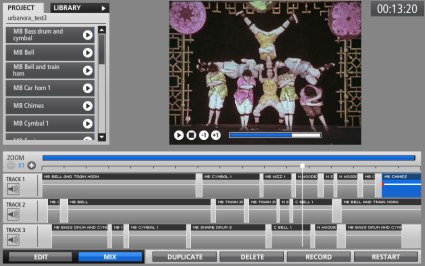
The site (developed in partnership with Court-Circuit, an Arte programme dedicated to short films) is a free service that offers you clips from seven films on the Europa Film Treasures site. You can then select from a wide range of sounds (under four categories: cartoon, sound effects machine, natural or science fiction), music (three ragtime tracks only) or sounds that you have uploaded yourself (if you have registered with the site). Sounds available include birds singing, car horns, percussion instruments, water running, whizzes and whooshes, fire alarms, telephones, doors opening, boings and crashes. Having made your selection, you are presented with a sound mixing page (see above) where you can drag and drop your sounds onto three tracks. Anyone can select the sounds and play back the finished video, but only registered users can save the results and have it made available on the site’s gallery.

The Bioscope had a go with a short sequence from Les Kiriki – Acrobates japonais (1907), a marvellous trick film with gorgeous stencil colour by Segundo de Chomón featuring a troupe of acrobats achieving impossible feats. My efforts aren’t going to put any silent film musician out of a job, but you’ll get the idea (it’s listed under Urbanora), or test out the interesting range of efforts from other users available on the gallery and add comments if you feel so inclined.

Should you want to have a go yourself, do note that the films take a little while to load before you can start playing with them. You can test the sounds beforehand by clicking (and holding down the click) on the arrows for each sound option, and having played back the results you can re-edit before recording. When you have made a recording it doesn’t appear automatically on the site – it took some hours for my video to be published, probably because I created it late in the evening. It appears that the work is done by real humans (‘your results will be put online by our team soon’ it says when you have clicked ‘record’), which seems bizarrely laborious in this day and age. Also I submitted more than one video, but only one made it to the gallery. It all feels a little bit uncertain.

Sound Workshop is a bright idea, if a little creaky in execution. Nevertheless, praise is due once again to the consistently imaginative folk at Lobster for coming up with a new way to engage audiences with silent films and to demonstrate just what new opportunities exist for such content once it exists in digital form and online.

Popular Science

Popular Science looks forward to the talkies in October 1922

Another day, another digitised journal. This time it is Popular Science, the American science and technology journal which has been reporting on scientific developments for a general audience since 1872 (when it was Popular Science Monthly). The journal went online in 1999 and has now gone a step further by putting its entire 138-year archive online as well, and all freely available.

It is a simple resource to use – just a search box (there is no advanced search though advanced features for searching and browsing are promised for the future), and then the list of results. This gives the date of the monthly issue and the page on which the search term can be found (which will be highlighted in yellow on the page itself). Clicking on the link takes you to the specific page, and if you want to browse the issue further you simply have to scroll up or down. The instructions promise a magnifying glass controls to zoom in and out on the page, but this seems only to be available on the Google Books version, where there entire run of the journal can also be found. There is no option for copying text or downloading the documents.

So, using our regular test search term, ‘kinetoscope’ what do we get? There are ten hits, the earliest a passing mention among a list of Edison inventions in January 1895, then a proper description in May 1896, a detailed article and well-illustrated on the new science of motion pictures in general from December 1897, then mentions in March 1905, October 1913, and retrospective mentions in later issues. Other keywords that yield useful results include ‘cinematograph’, ‘kinematograph’, ‘movie’, and ‘motion picture’. There are articles on film production, motion picture technology (cameras, projectors, lighting, sound technology as in the article illustrated above) and experiments using film. There are also several articles on pre-cinema technologies and the work of chronophotographers such as Eadweard Muybridge and E.J. Marey.

The articles are usually illustrated, and in keeping with the journal’s mission the explanations are clear and useful. The older articles (pre-1914) tend to be longer and more scholarly in tone; the later pieces are shorter and more populist in nature. It’s a fine resource, easy to use, and of value both for the intrinsic information offered and for insights into how the new science of motion picture film was viewed and explained to a particular, educated audience. Go explore.

Blogging the silents

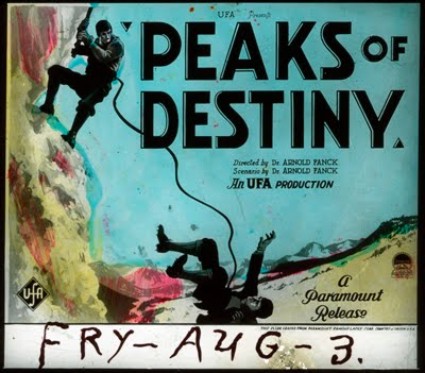
Coming attraction slide for Peaks of Destiny (Der Heilige Berg or The Holy Mountain, Germany 1926), from Starts Thursday!

I was doing a bit of tidying up of the links on the right-hand column, and when I came to the blogs I noticed that a number of those listed there haven’t been updated for a while. It’s a bit of a slog keeping up-to-date with a blog (believe me), but blogs can go through fallow periods and then revive, so I won’t be removing any for the links just yet.

But what I have also noticed is a number of new blogs on silent films have been turning up. And so here’s a round-up of the best of silent film blogs old (but still active) and new that you are warmly encouraged to follow.

  • Cartoons on Film
    Tom Stathes’ blog is dedicated to ‘musings, studying, and collecting of early animated film’, though it is not updated as often as it used to be.
  • Cinegraphica
    An authoritative and well-illustrated blog on early cinema technology, written in Dutch but with English translations.
  • Cine Silente Mexicano
    A scholarly blog (in Spanish) on silent cinema in Mexico, written by Luis Recillas Enecoiz.
  • The Dorothy Gish Project
    Recently-launched blog by Donna Hill on the other Gish sister, which will document the writing of a new biography.
  • Edna’s Place
    Linda Wada’s entertaining blog on Edna Purviance also covers Chaplin subjects and silent cinema in general and is consistently informative.
  • Emma Heslewood’s Blog
    Heslewood is Keeper of History at the Harris Museum & Art Gallery, Preston, and her blog documents research into local filmmaker and film businessman Will Onda.
  • The Faux Charlot
    A fascinating photo blog on those around the world who have dressed up Charlie Chaplin’s ‘tramp’ character.
  • Ferdinand Von Galitzien
    Quite unique. Reviews of silents films (some familiar, some fabuously obscure) undertaken by a ‘German count’, written with insight and exquisite comic style.
  • Fisherscircle
    Media historian David Fisher blogs on early film and related media. A shame that he cannot post more often.
  • Louise Brooks Society
    Thomas Gladysz’s discursive, exhaustive blog on Louise Brooks, her films and her times.
  • Mack Sennett
    Billed as ‘A Celebration of the King of Comedy and his Studio, Films and Comedians’, knowledgeably written by Brent E. Walker, author of Mack Sennett’s Fun Factory.
  • Muy Blog
    Stephen Herbert’s admirable blog on photographer and founding father of motion pictures Eadweard Muybridge is both reportage and research in action, as new discoveries mingle with alerts to new events, publications, online resources and much more.
  • Observations on film art
    David Bordwell and Kristin Thompson’s blog on film art and film style is in a different league to the rest of us and is helping to rewrite how film studies can be done. Its frequent investigations into silent film subjects (often in the context of later film style) are essential reading.
  • Recanto Silente
    Good-looking general blog on silent cinema, written by David Holm, in Galician.
  • Ritrovati Restaurati Invisibli
    One of a number of authoritative blogs and websites on Italian silent cinema (all in Italian) maintained by the prodigious Teresa Antolin.
  • Silent Film Festival Blog
    The San Francisco Silent Film Festival’s blog covers silent film news in general as well as the festival and it has become an essential information source in just a short period.
  • Silent Film Music
    Silent film musician Ben Model’s entertaining blog including video blogging with reports on the festivals at which he plays.
  • Silent film music and other sounding off
    If only silent film musician Donald Sosin were able to sound off a little more often.
  • The Silent Movie Blog
    Christopher Snowden’s witty, mischievous blog draws on an extensive personal archive of stills and film journals to relate an alternative history of American silent film.
  • Silent Volume
    Engaging personal reviews of silent films by Chris Edwards.
  • Starts Thursday!
    This is a joy. Rob Byrne’s subject, the glass lantern slides that promoted coming attractions in cinemas from the silent era well into the sound era, takes a seemingly narrow subject and produces riches. Beautifully illustrated and unobtrusively knowledgeable.
  • Stummfilm-blog
    A bit quiet at the moment, but previously a very useful information source on silent film in German (the site is in German) and elsewhere.

There are many more silent film blogs, or part-silent, part-talkie blogs, than these, but these are mostly all being kept up-to-date, and they each stand out for their individual style and effective use of the blog form. If you have favourites of your own that should be added to the list, please say.

Frankenstein versus Dracula

Sometimes circumstances throw up the perfect title for a blog post, and you just have to run with it. And what if circumstances were then to put a cherry on it by bringing together two of the Bioscope’s favourite musicians in an unexpected coming together of jazz, outré electric guitar and silent film? Well, that’s what we’ve got with the news that trumpeter Dave Douglas and guitarist Gary Lucas will be appearing not alongside one another but in competition at this year’s London Jazz Festival, as they present their respective musical takes on the Frankenstein and Dracula stories. The event is billed as Frankenstein V Dracula: Gary Lucas plays Dracula > Dave Douglas & Keystone re-imagines Frankenstein, and it takes place at the Queen Elizabeth Hall at the South Bank Centre, London, on 21 November 2010.

Dave Douglas (left) and Gary Lucas, from www.londonjazzfestival.org.uk

Dave Douglas‘s adventures in silent film have been documented by the Bioscope on several occasions. One of the many outlets for his musical energies is the group Keystone, which as its name might suggest takes its inspiration from American silent comedy, though the music tends more towards ‘inspired by’ rather than serving as conventional accompaniments to the films of Arbuckle and Keaton that have formed the basis of Keystone forays so far. Douglas’ experimental leanings and use of turntables might not be everyone’s idea of silent film (or jazz, for that matter), but all I can say is that you just have to witness it live when it all makes sense.

Keystone embraces silents overall rather that just the Mack Sennett studio, and Douglas’ latest Keystone project ventures into modern silents, while coinciding with the centenary of notable silent horror film. Spark of Being is a re-imagining of the Frankenstein story that he has devised with experimental filmmaker Bill Morrison (he of the acclaimed Decasia, a haunting art film made out of decaying nitrate clips of silent films). Their project appears in the centenary year of the 1910 Edison Frankenstein film, and they initially considered calling their work Frankenstein: The First 100 Years. The Edison film is a legend in film collecting circles after the one surviving copy was jealously guarded by the late Alois Dettlaff for many years. When Dettlaff finally made the film available to all there was astonishment at how accomplished, indeed horrific it was – a tour de force of the imagination. Charles Ogle plays the monster, the director was J. Searle Dawley, and you can view it on the Internet Archive (ripped from a DVD, so we won’t be embedding it, but it’s there so you are going to find it anyway).

Trailer for the Spark of Being project

Spark of Being started out as an event at Stanford University in April this year. Morrison worked with new, archival, and ‘distressed’ footage, while Douglas and his band supplied the score. The music has now been issued as a single and boxed set CD, and there is the live show with music and film featuring at the London Jazz Festival (and across Europe throughout November).

Gary Lucas is a rock guitarist with avant garde leanings (he started out playing with Captain Beefheart). He has accompanied silent films on several occasions, most notably for The Golem, which he has taken around the world. Other silents given the Lucas treatment (which veers between ambient sounds and dazzling pyrotechnics) are The Unholy Three, J’Accuse and his Sounds of the Surreal set (three films by Clair, Leger and Starewicz). For the London Jazz Festvial his choice isn’t a silent, but it is virtually so. It is the celebrated Spanish version of Tod Browning’s 1931 Dracula, which was discovered in Cuba in the 1980s. Made at night at the same time, on the same set and with the same script as the Bela Lugosi version, the film was directed by George Melford and stars Carlos Villarias as Dracula and Lupita Tovar as Eva.

Gary Lucas accompanies the Spanish-language Dracula (1931) at the Havana Film Festival, 11 December 2009

Though the film has Spanish dialogue, there are long stretches where it is effectively silent, giving Lucas ample space in which to introduce his score, which he has been touring since 2009. The London event will feature Lucas and Dracula first (18:00-19:45), then Douglas and Spark of Being (20:05-21:30). The event is being produced in association with BBC3, so presumably we can look forward to some form of television broadcast as well. At any rate, a gobsmacked Bioscope will be there.

There is more information on both projects at the Dave Douglas and Gary Lucas websites.

Sam Kula

Photograph of Sam Kula by Lois Siegel, www.siegelproductions.ca/ottawarocks/avtrust.htm

This is just a short notice to mark the sad passing of Sam Kula, one of the leading figures in international film archiving for many years. He was 77 years old and died at Ottawa General Hospital on Wednesday, 8 September 8, 2010. Sam joined the BFI in 1958 and became deputy curator under Ernest Lindgren, before joining the American Film Institute (where he was among those who oversaw the publication of the multi-volume AFI Catalog) and then the National Archives of Canada, where he established its film, sound and television section, serving as the director of the audiovisual archives 1973-1989. He served on the executive committee of FIAF, the international federation of film archives, and its television equivalent, FIAT, and was president of the Association of Moving Image Archivists (AMIA) for two terms. He was also founding member of Canada’s Board of the AV Preservation Trust. He was the author of The Archival Apprisal of Moving Images (1983) and Appraising Moving Images: Assessing the Archival and Monetary Value of Film and Video Records (2002), and made notable contributions to moving image history and archiving in numerous authoritative articles.

Sam’s work encompassed the moving image medium in all its forms and for all periods. However one of the most notable incidents in his archival career related to the silent era: the Dawson City collection. He played a major role in the discovery, care and historiography of the extraordinary discovery of over 500 reels of silent film that were found in 1978 underneath a boarded-up swimming pool in Dawson City in the Yukon Territory, where the films had been buried in the permafrost (ideal archival conditions) for forty-nine years. The story of the find has been documented in an earlier Bioscope post. It is the film archivist’s romantic tale par excellence, and alone serves as memorial to one of world audiovisual archiving’s most dedicated servants.

There is a memorial web page with a guest book to sign.

The photograph of Sam Kula is by Lois Siegel, www.siegelproductions.ca/ottawarocks/avtrust.htm.

At the Cinema Museum

The Cinema Museum, located in the administration block of the former Lambeth workhouse in which Charlie Chaplin’s mother was incarcerated

As part of a new fund-raising campaign which aims to secure its future and establish it as an exciting new London venue, the Cinema Museum announces a programme of events presented by key film industry figures and film historians. These are the silent-related ones:

Saturday – 11th September

The Silent Majority: Glenn Mitchell
Glenn Mitchell, the author of “The A-Z of Silent Film Comedy”, will show and talk about films from the less well known comedians, many of whom he regards as geniuses in their own right. There will be films of Charlie Chase, Billy Bevan, Alice Howell, Ben Turpin, Snub Pollard, Charlie Bowers, Al St. John, Lupino Lane, Lloyd Hamilton, to name just a few of these forgotten comic heroes of the silent screen.

Wednesday – 22nd September

Chaplin’s London in Hollywood: David Trigg
Charlie Chaplin was born in Walworth, not far from here. His father left when Charlie was only three, and he then lived at various addresses in and around the Kennington area with his mother Hannah for the next few years. With two young children and no work she slid into destitution, and eventually the family were admitted to this site – The Lambeth Workhouse. The memories and stigma of the extreme poverty never left him.

A hundred years ago to this day Charlie Chaplin left for America. The film historian David Trigg marks the event with a screening of “The Immigrant” – Chaplin’s take on what it was like to cross the Atlantic and start a new life. Chaplin made this in 1917; three years after his film career began. This will be accompanied live on the piano by Cyrus Gabrysch.

David Trigg, will also show clips from other Chaplin films demonstrating how much the film star’s life in the Kennington area influenced his film making, even to the extent of having sets built based on his own London childhood. David points out that one even resembles the building that is now the home of the Cinema Museum, where Chaplin and his mother spent some considerable time.

Thursday – 21st October

Clapperboard: Graham Murray
Graham Murray wrote and compiled around 500 editions of the popular film programme “Clapperboard” which ran from 1972-1982. Clapperboard was a programme about film history, and was presented each week by Chris Kelly. The series covered all aspects of film making and cinema history. Graham will show some clips of the programme plus a full 45 minute Bank Holiday edition of “Clapperboard”.

Film historian Graham Murray was born in Liverpool and came to London in the late 1950’s. In 1959 he joined the film division of the government’s Central Office of Information, and then joined Granada in 1962. He has worked over the years on a large number of mainly archive film based programmes starting with “All Our Yesterdays” – which looked at our history through the newsreels.

Thursday – 2nd December

From the Picturedrome to the Phoenix
Film historian Gerry Turvey explains how the Phoenix Cinema in East Finchley (built 1910), featuring a later unique art deco auditorium has outlived rival cinemas, including those of the big chains. Moving from mainstream to art-house programming, then becoming a charitable trust and servicing North London’s local communities.

Gerry Turvey’s illustrated talk is based on his new book The Phoenix Cinema, A Century of Film in East Finchley published by Phoenix Cinema Trust. Following its fortunes through the various name changes (Picturedrome, Coliseum, Rex, and Phoenix), physical transformations and programming policies that have helped it to endure and outlast its rivals. The wide-ranging account will describe the Phoenix’s construction in the 1910s, the introduction of orchestras and live variety acts in the 1920s, and the response to the threat from the super-cinemas of the 1930s, how it dealt with the decline of cinema-going in the 1950s, the introduction of ‘art-cinema’ films in the 1970s. The story of this unique cinema will be of interest not only to its past and present audiences but also to all those with an enthusiasm for local history, cinema history and twentieth century development in popular culture and entertainment.

Other events taking which veer into the strange world of talking pictures include A Conversation with Julie Harris (7 October), A Conversation with Angela Allen MBE (4 November) and A Conversation with Burt Kwouk (18 November). And taking place at the Museum on 16 October is the annual Home Movie Day, London’s contribution to the international event promoting the personal film. Members of the public can bring in their home movies for inspection, projection and advice. More information on this from www.homemovieday.com/london.html.

Finally on 18-19 September there is a weekend fundraising event, a film and movie memorabilia bazaar between 10:00 and 17:00, entrance price £5. There will be dealers’ tables with books, psoters, stills, films, equipment, campaign books, DVDs and more.

More information on the and other upcoming events from the Cinema Museum site.

Performance, realisation and reception

The AHRC-funded Beyond Text Network “The Sounds of Early Cinema in Britain” has issued a call for papers for The Sounds of Early Cinema in Britain: Performance, Realisation and Reception. The conference takes place Thursday 7-Friday 8 April 2011, at the Institute of Musical Research and the Barbican Centre, London. The deadline for abstracts is 30 November 2010. Here’s the invitation in their words:

We invite papers from all relevant disciplines for the last in a series of events designed to establish and develop a research network concerned with the sonic dimensions of “silent” film exhibition in Britain, interpreted in the broadest possible sense. Papers concerning the performance, presentation and/or reception of these sonic practices are particularly welcome, as are presentations by composers and performers. We are especially interested in papers on British practices, but welcome proposals facilitating comparisons.

Research questions might focus on:

  • Film accompaniment manuals and photoplay collections
  • Key British cinema performers
  • Sonic and musical practices in Britain compared to elsewhere, variations in practices according to county or region, rural versus urban setting, and exhibition context
  • Aspects of cine-variety
  • How differing sonic practices shape our understanding of silent films
  • Relationships between sonic practices and developments in the narrative structure and purpose of early films (e.g. educational, ‘stories’, newsreel, etc.)
  • The practice and/or reception of live accompaniment of early cinema in Britain today (avant garde/pop/historically conscious …)

They invite abstracts of 250 words for individual papers of up to 20 minutes, which should be e-mailed, as a Word attachment, to music@sas.ac.uk with the subject line: The Sounds of Early Cinema in Britain. They will also consider shorter presentations of around 10 minutes on specific issues relating to the conference themes. These may be grouped into a panel, or sent individually. You should include your name and title, institutional affiliation (if any), email address, and postal address.

As in 2009, the conference will be running alongside the peripatetic British Silent Film Festival 2011, which takes place 7-10 April 2011 at the Barbican. Papers that include a practice element (composition, performance) are particularly welcome for that day.

Postgraduate students working in this, and/or related areas may apply for one of two scholarships (to include basic travel and accommodation, and conference fee and refreshments). Applicants should send the following information to music@sas.ac.uk, marking the subject line “PG Scholarships, The Sounds of Early Cinema in Britain: name, institution where studying, and an outline of their (related) research project.

More information about the Network, whose previous events have been advertised here, can be found http://projects.beyondtext.ac.uk/soundsearlycinema/index.php.

For questions about the conference or Network, please contact either Dr Julie Brown (Julie.Brown [at] rhul.ac.uk) or Dr Annette Davison (a.c.davison [at] ed.ac.uk)

Salim Baba

From time to time I’ve been posting on the bioscope tradition in India and the delightful examples of the handful who preserve the tradition of the travelling bioscope showmen or bioscopewallahs by taking film projectors – sometimes of great age – into the streets to show film clips to audiences of eager children.

This phenomenon has been picked up on by a number of filmmakers, as noted in an earlier post about the bioscopewallahs. Some of these videos are available online, and we have already posted the wonderful Prakash Travelling Cinema about a man who tours the streets of Ahmedabad operating a c.1910 Pathé projector, handcranked but adapted for sound.

Children crowding round the street projector, from Salim Baba

Now another of the films has been published online, Salim Baba, a 15-minute documentary by Tim Sternberg, which was nominated for an Academy Award in 2008 in the best short documentary category. It’s about as good a short film as you could hope to find – not startling in any way, just immaculately observant. It tells of 55-year-old Salim Muhammad, who lives in Kolkata and pushes round a small cart with a hand-cranked, customised projector of venerable age (one source says it is an 1897 Bioscope, another says that it is Japanese in origin). Again it has been adapted for sound, and he shows shows snippets of Bollywood songs and action sequences for a gaggle of excited children who crowd round the cart and pop their heads under a curtain to view the blurred and colour faded images. Salim inherited the tradition from his father, who used the same projector from the silent era onwards, and he is now passing it on to his sons. The love of cinema – its contents, its technology and its effect on people – fills the film. Do take a look.

A previous Bioscope post, The last bioscopewallah, tells Salim Muhammad’s story in greater detail.

Acknowledgments to the Documentary Blog where I found the link to the film.