Busy times, folks, and your scribe is otherwise engaged. So until normal service resumes, here’s another modern silent film for you. It’s an exceptionally stylish, award-winning work directed by Arev Manoukian, with visual effects by Marc-André Gray and lush, haunting music by Samuel Bisson, made by Spy Films with the support of the National Film Board of Canada. If you seek romance, and you want your romance in slow motion, this is for you. It’s a quite a piece of work, and there’s a ‘making of’ video too – an impressive (and wordless) production in itself:
Bioscope Newsreel no. 13

Sparrows
Well, here’s another end to the working week, and here’s another edition of the Bioscope newsreel, our weekly round-up of silent matters not otherwise covered by our main posts.
Gypsy Charlie
Charlie Chaplin’s biography has been investigated in immense detail (not least by himself) so one treats the new suggestion that he was born in a gypsy caravan near Birmingham with more than a little scepticism. But a letter in the Chaplin archive at Montreaux claims that this was so. Hmmm. Read more.
Bird’s Eye View
The full programme for London’s Bird’s Eye View film festival has been published, with the usual silent film component, this time around including Dr Jekyll and Mr Hyde, Sparrows and The Wind. The festival takes place 8-17 March. Read more.
Miriam Hansen
There’s a tribute to the late Miriam Hansen, early film theorist extraordinaire, written by her friend Tom Gunning, on the Society for Cinema and Media Studies. Read more.
Shot scales
At the dauntingly erudite Research into Film blog (subtitled “An empirical approach to film studies”), Nick Redfern applies the scientific method to studying films. His analysis of shot scales in 1920s French film includes such challenging observations as “The slope of the linear trendline in Figure 1 is -0.0456 (95% CI: -0.0682, -0.0231) and the intercept is 0.3254 (95% CI: 0.2245, 0.4263)”. Memo to self to write a Bioscope post on cinemetrics some time soon. Read more.
Lovesick on Sheppey
It may only be local news (i.e. local to North Kent), but to be honest not much of cultural interest tends to happen on the Isle of Sheppey, so it’s exciting to note that a modern silent film short has been partly shot there. The film is called Lovesick and it’s described as “a silent film about a couple forced to part after one of them develops gills”. Isn’t it always the way? Read more.
‘Til next time!
La photographie animée

The De Bedts Kinetograph (1896), from La photographie animée
The latest publication to enter the Bioscope Library of early film texts freely available online is Eugène Trutat’s La photographie animée. Trutat was the director of the museum of natural history at Toulouse, a naturalist, mountaineer and photographer. He wrote a number of books on photography and discovery, and in 1899 he produced one of the first books to document the new technology of cinematography, in La photographie animée.
It is a book known to the specialist but not as widely cited as say its British counterpart, Henry V. Hopwood’s Living Pictures which was published the same year (and can be found in the Bioscope Library and on the Internet Archive, in its 1915 edition). That may simply be on account of its comparative rarity, and because it is in French. The Internet Archive has triumphantly overcome the rarity hurdle; whether the language remains a challenge is down to the individual. In any case one of the book’s particular riches is its copious illustrations of film technologies, which need no translation.
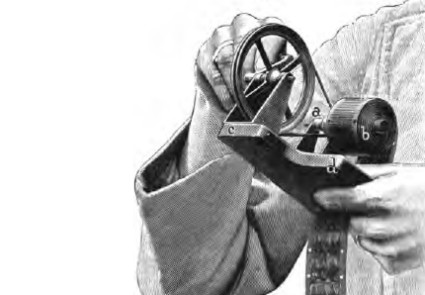
A film winder, from La photographie animée
The main part of the book is a survey of moving image technologies up to 1899, with a particular emphasis on French machines. There is the usual opening thesis on the principles of animated photography and its antecedents found in the ‘pre-cinema’ work of Muybridge, Marey, Londe, Janssen and others. Trutat had a particular interest in multiple-lens cameras, and includes his own invention among those discussed. He then describes the principles and the mechanics of the film devices of Thomas Edison, Georges Demeny, Georges de Bedts, the Lumière brothers and Henri Joly, along with many minor names and technologies now mostly forgotten. For those who have a grasp of such things, Trutat is much given to marking his many illustrations with letters to point out particular mechanical points. It is very much a technician’s book.
He concludes with some practical advice on the production and presentation of films, finishing with a handy list of French patents. So, not a book for everyone, but an invaluable text for the specialist and a fine resource for the iconography of late nineteenth-century motion pictures for the rest of us.
Huntley Film Archives
The Way of a Boy (c.1924), a delightful children’s stop-animation film made by Bradbury Productions, one of the treasures to be found in the Huntley Film Archives. I can find nothing about its production. Is it the American film of this title dated 1926 on the IMDb? Does anyone know?
For a while now I’ve been contemplating a post on silent films to be found on YouTube. However each time I attempt it I find myself defeated by the complexities of the copyright and ethical issues involved. Simply put, some silent film content is put there legitimately, some is not, and of the latter some has been put there in good faith, and some has not. Working out which is which is a minefield, and most people don’t much care. But here at the Bioscope we always check the source of a YouTube video and try to determine its true source and ownership. And we never include videos ripped from DVDs or television programmes (with the occasional exceptional of content re-used in mash-ups to form a new work). Those are the house rules.
Another hazard with YouTube is the inaccuracy of descriptions, something particularly prevalent for silent film era content where owners may not know the correct title, date or other identification of the film in their possession. This came home to me recently when I came across the YouTube channel of Huntley Film Archives, though the channel itself is full of riches and Huntley’s is a collection it would be good to tell you about in any case. So here goes.
Huntley Film Archives is a small British commercial film archive with a big reputation. It is a favourite of many a television researcher look for distinctive footage on social history and popular culture, and it is particularly strong in such subjects as entertainment, transport, travelogues, home movies and early films. Countless television programmes have named Huntley Film Archives in their end credits, and it remains an Aladdin’s cave of a collection, time and again coming up with just the right piece of footage that you couldn’t find anywhere else. It was founded in 1984 by the late John Huntley, a one-time acquisitions officer at the National Film Archive, a renowned film historian (Railways in the Cinema, British Film Music, British Technicolor Films) and an outstanding communicator, who gave hundreds upon hundreds of talks, shows, radio and television interviews on film history, always peerlessly entertaining and equipped with an anecdote for every occasion.
Battleship ‘Odin’ with all her Guns in Action (1900), filmed at Kiel by the British Mutoscope and Biograph Company. Spectacularly filmed in 70mm, the impact of this film on a big screen is considerable and must have been overwhelming in 1900
You can find out more about the collection through its online database, though there are no clips apart from a few showreels. But it has now put some 240 videos onto its YouTube channel, and what an extraordinary collection it is, from home movies of the Festival of Britain to modern day celebrity trivia, from Butlin’s holiday camps to Kuwaiti advertising films, and from early computers to a British Film Institute summer school in 1948. What I want to draw attention to here is the silent films, because there are some real treasures available, though some have been misidentified or just not identified at all, a shame since the knowledge about the films often exists (a number are duplicated in the BFI National Archive for instance). Others, however, seem to be mysteries, as demonstrated by The Way of a Boy at the top of the post. Here are some more highlights.
Clog Dancing for the Championship of England (1898), made by Robert W. Paul
This is a delightful Robert Paul film, unique to the Huntley collection. Entitled Clog Dancing for the Championship of England, it shows the contestants in the world clog dancing championship of 1898, held in Bow. It is described in the Paul catalogue thus:
An extremely fine film of the first four competitors in the famous championship clog dancing contest. Each dances separately, and then altogether, finishing with the champion (Mr. Burns) clog dancing on a dinner plate without breaking same.
I’ve not been able to find Mr Burns’ full name [update: he was James G. Burns – see comments], but he and his competitors (Melia, Nixon and what could be Hannant) are helpfully identified on the film by the use of name cards. The film clearly does not depict the actual contest, instead recreating the event complete with the original judges conveniently bunched together to fit in the shot.
Extract from Dr Wise on Influenza (1919), a public health information film and one of the few films made at the time about the Spanish Flu epidemic that survive
This is a British public information film from 1919, made by Joseph Best for the Local Government Board. It is notable for being one of the very few films in existence that document the Spanish Flu epidemic which killed more people worldwide than had died in World War One. The full film is some 800 feet long; this extract shows how the flu germ is spread in public. (The full film is described in detail on the BFI database here).
Extract from The Coronation of King Peter I of Serbia and a Ride through Serbia (1904), the oldest surviving film of Serbia
This remarkable film was made by Yorkshireman Frank Mottershaw, who travelled to Serbia with Arnold Muir Wilson, a lawyer, journalist and Honorary Consul to the Kingdom of Serbia. Mottershaw was commissioned to film the coronation ceremonies of King Peter I of Serbia on 21 September 1904 and general scenes, and the film’s remarkable nature comes simply from being it being the oldest surviving film of Serbia. This sequence from the film shows people in Belgrade at the time of the coronation. The complete film is held by the Jugoslovenska Kinoteka.
The Taming of the Shrew (1923), a little-known example of a silent Shakespeare film, starting Lauderdale Maitland and Dacia Deane
Finally this is a silent Shakespeare film, one that’s hardly ever been seen or written about. It’s The Taming of the Shrew, made in 1923 by the British and Colonial Kinematograph Company, directed by Edwin J. Collins and adapted by Eliot Stannard, who later wrote scenarios for Alfred Hitchcock. Lauderdale Maitland plays Petruchio and Dacia Deane is Katharina. It’s a two-reeler which concentrating on the wooing of Katharina, and though it’s no masterpiece it’s an adequate film of its type, which is a potted guide to literary highlights of a kind that rather appealed to British filmmakers at this time.
And there are more: for example, a Lumière film of 1897 showing a Japanese family at home in 1897 (the film was shot by François-Constant Girel and I believe shows the family of Inabata Katsutaro); a Bonzo the Dog cartoon from 1925, Bonzoby; rare footage of what Huntley’s call a “working class wedding from the 1910s“; and stunning footage of the Wuppertal suspended monorail, filmed I think by the German branch of Biograph, Deutsches Mutoskop und Biograph Gesellschaft, in the late 1890s.
The video clips don’t look great, often they’ve been transferred at the wrong speed, and each comes with timecode and Huntley’s name at the ID number written along the top. But we must be grateful to Huntley’s for making such treasures available to all, in whatever form. It’s just that they glitter all the more once we know what they are, who made them, and when.
Canadiana

Detail from photograph showing Inuit man looking through a film camera in 1929, from the Library and Archives Canada collection
The Canadiana Discovery Portal is a new service (still in beta mode) that aims to be a ‘one-stop-shop’ (the dream of all administrators and information specialists) for seaching Canadian history. It brings together 60 million pages of information from fourteen institutions: Alouette Canada, Bibliothèque et Archives nationales du Québec, Calgary Public Library, Canadiana.org, Foreign Affairs & International Trade Canada, Library and Archives Canada, Manitobia, Memorial University Digital Archives Initiative, The National Gallery of Canada, Queen’s University, Scholars Portal/University of Toronto, Simon Fraser University, Toronto Public Library, University of Alberta, University of British Columbia, University of Saskatchewan and Vancouver Public Library.
All of these records point to actual digital objects, and on first inspection this looks like the complete digital library for Canada. A second look tells us that this is not quite the case, since some of the those libraries have only provided access to selected items from their digital collections (so Library and Archives Canada has contributed “part of their MIKAN collection, a wide-ranging repository of Canadian images, covering many aspects of Canadian life between 1850 and 1950”). But others have been more comprehensive, and in any case much more content promised in the future. So the result is much like the European Union’s Europeana (recently reviewed by the Bioscope), a portal to digital content accessible on the sites of individual institutions, selectively but handily made available through the one portal. The records on the portal itself are brief, with links taking you to the descriptions and the digial objects themselves on the sites of the contributing organisations.

Children going to Allen Theatre, Edmonton, Alberta in 1922 to see Penrod, from Glenbow Museum
OK, so we know what we’re dealing – now is it any use for researching our subject of silent films? The answer is yes, though the records available so far aren’t quite as extensive as might have been hoped. Searching for our usual test term of ‘kinetoscope’ brings up a measly two results – and that for the same book appearing twice. Trying ‘cinematograph’ yields 36 results, ‘cinema’ gives us 545 (narrowed down to 24 for a date range 1900-1930), ‘motion picture’ provides a more productive 95 (1899-1930 date range). Searches can also be refined by medium and contributor, and sorted by date and relevance.
And yet what you can find there is frequently fascinating, because you are being pointed to such a variety of original documents: books, official papers, photographs, letters, magazine articles, scores, video files and more (mainstream newspapers do not seem to be included). Some quick searches three up a letter from a Canadian soldier based in France in 1917 writing home to his mother to say he is about to see a Chaplin film and The Battle of the Somme; edition no. 1 of of Le panorama: le seul magazine en langue française consacré aux vues animées from 1919; an account of an 1899 screening before 600 doctors in Paris of a film of an abdominal hysterectomy made by Eugène-Louis Doyen, from the journal Maritime Medical News; and a marvellous set of photographs from Glenbow Museum of cinemas in Edmonton in the early 1920s showing how they promoted various films (such as Douglas Fairbanks in The Three Musketeers) (search under ‘motion picture’ and Alouette Canada collection).

Group of cameramen outside the Canadian Government Motion Picture Bureau, Ottawa, in 1923, from the Libraries and Archives Canada collection
It should be noted that some of the digital resources, particularly books contributed by the University of Toronto, are not accessible to general readers but only to Canadian users from higher education institutions.
Anyway, this is a very helpful route in to some rich Canadian resources. Go explore.
P.S. The Bioscope has previously covered other, film-specific Canadian resources. Here are the links:
Bioscope Newsreel no. 12

People on Sunday (Menschen am Sonntag)
Killruddery Film Festival
Ireland’s Killruddery Film Festival, with its strong emphasis on silent film, returns 10-13 March 2011 and the programme has just been announced. Highlights include The O’Kalems in Ireland, La Roue, White Shadows in the South Seas, 7th Heaven, Early Masterpieces of the Avant Garde, The Garden of Eden, Regeneration, People on Sunday and Ireland’s Other Silent Film Heritage (the Irish in Early Hollywood), an illustrated lecture by Kevin Brownlow. Read more.
Kansas Silent Film Festival
The annual Kansas Silent Film Festival takes place 25-27 February 2011. Highlights include David Shepard speaking on Chaplin at Keystone, Speedy, Chang, The Circus, The Last Command, A Thief Catcher, 7th Heaven and Wings. Special guest will be Harold lloyd expert Annette D’Agonstino Llloyd. Read more.
Q&A with film scholar Frank Kessler
On Cinespect, there’s a thoughtful interview with Frank Kessler, early film historian, sometime Bioscope contributor, and all round good chap, discussing issues in media historiography and the trick film by way of Christian Metz and Georges Méliès. Read more.
How to be a motion picture director
Dan North’s rather fine Spectacular Attractions blog offers unusual advice from Marshall Neilan in 1925 on how to be a motion picture director. “How should a director act in public?” “Like a nut or like an owl. Both methods have proved successful. By no means act normal”. Read more.
BBC permanent
It hasn’t much to do with silent films, but the BBC’s quiet announcement of a change in the Service Licence for its TV channel BBC4 and radio channels Radio 3 and Radio 4 is highly significant for access to audio-visual archives online. All three will now all have the the ability to offer programming on-demand for an unlimited period after broadcast, instead of the limited period at present. This is the start of something big – the permanent online archive for broadcast content. Keep watching. Read more.
‘Til next time.
Discovering newspapers
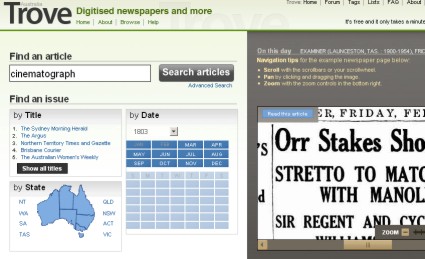
The digitised newspapers section of Australia’s digital library Trove
For some while I’ve been saying we needed an updated round-up post on the collections of digitised newspapers that now exist online. At last its time has come.
The number of historic newspapers titles now available online, either free or through a variety of pay-models, is now prodigious. Though there are some individual titles of particular importance for the study of silent film topics (and I’m referring to general newspapers rather than specialist film journals), this post covers general directories and portals.
British Newspapers
The British Library is engaged on a massive digitisation programme for British newspapers up to 1900. Two million pages have been digitised so far for 19th century newspapers, though the majority are available online to UK higher and further education users only (a checkbox enables searches across free content only). A further 40 million pages will be added in time, with a subscription model aimed at all users. Among the papers covered is The Era, an important source of information for film exhibition in the UK in the 1890s.
Chronicling America
This is a newspaper digitisation programme sponsored jointly by the National Endowment for the Humanities and the Library of Congress as part of the National Digital Newspaper Program. It covers newspapers published 1860-1922 for the following states: Arizona, California, District of Columbia, Florida, Hawaii, Illinois, Kansas, Kentucky, Louisiana, Minnesota, Missouri, Montana, Nebraska, New York, Ohio, Oklahoma, Oregon, Pennsylvania, South Carolina, Texas, Utah, Virginia, and Washington. Papers available include The San Francisco Call, The New York Sun, The Washington Times, The Colored American, and The New York Evening Times. Currently there are some 2.7 million pages from 348 titles, all free to use.
Gallica
Gallica is the digital library of the Bibliothèque nationale de France. Established in 1997, today it contains nearly 1.5 million digital documents. The library includes just under 800,000 periodical pages, including Le Figaro and L’Humanité. The content is all French, of course, and is a mixture of free and paid-for content.
Google News Archive
Google’s news search engine browses historic news resources, both free and subscription-based, so you are offered tantalising glimpses of news stories that can be yours if only you’ll pay. The helpful timeline feature shows you in which period your search term shows up the most. The Google News display is a listing all of the freely-available digitised newspapers on the service (mostly American), which allows you to browse the pages of individual titles by decades, year, month, week or day.

The Easton Free Press reports on Edison’s latest invention, 10 March 1894, from Google News Archive Search
ICON: International Coalition on Newspapers
Listing of past, present, and prospective digitisation projects of historic newspapers worldwide.
News Archives
This is a very useful directory of news sources online, provided by the University of North Carolina’s ibilio information database. It provides links and descriptions (including access information) for news archives (current and historical) from around the world, including U.S. News Archives on the Web, Asian News Archives on the Web, Canadian News Archives, and the particularly useful International News Archives on the Web, covering Central America & Caribbean, South America, United Kingdom and Ireland, Europe, Middle East, Africa, and Australia & New Zealand.
NewspaperARCHIVE
NewspaperARCHIVE describes itself as the world’s largest online archive of historical newspapers. It has tens of millions of newspapers pages and says that it is adding a page a second to the site. Although the greater part of the archive is American newspapers, there are also papers for China, Ireland, South Africa, Denmark, France, Germany, Japan and especially the United Kingdom. It lets you know your search results for free, but access is for subscribers only. Annual membership starts at $5.99 per month (for a 12-month period).
Newspaper Archive Sources on the Web
The Library of Congress’s useful listing of online newspaper directories around the world.
Old Fulton NY Post Cards
This is a private collection of digitised New York newspapers, which boasts over 15,000,000 pages, dating 1795-2007. The source of the newspapers is a microfilm set of the State of New York Newspaper Project of the 1970s/80s, and it’s unclear how a private individual is able to publish all this, but it exists, and all for free.
Papers Past
This excellent site contains over one million freely-available pages from sixty-one digitised New Zealand newspapers and periodicals covering the period 1839 to 1945. The search and presentation tools are a model of their kind.
Trove
Trove is a discovery tool for information on Australia and Australians. It is the digital library par excellence, praised highly when first reviewed by the Bioscope when it was in beta mode). The newspaper section of the site presents the results of the on-going Australian Newspapers Digitisation Program: an eventual 4.4 million pages covering a range of titles from every state and territory, from the earliest newspaper published in Australia in 1803 through to the mid 1950s. To date 1.87 million pages are available online, with exemplary discovery tools.
UK Press Online
Paid access service to two million British newspapers, chiefly boasting the Daily Mirror archive (1903 – current) and the Daily Express archive (1900 – current).
Wikipedia: List of online newspaper archives
This is probably the fullest single listing of newspaper titles available online, both free and pay. It covers Australia, Austria, Belgium, Bulgaria, Cambodia, Canada, Caribbean, Croatia, Czech Republic, Estonia, Faroe Islands, Finland, France, Germany, Hong Kong, Iceland, India, Ireland, Israel, Italy, Kenya, Latvia, Luxembourg, Mexico, Namibia, Netherlands, New Zealand, Norway, Pakistan, Philippines, Portugal, Russia, Singapore, South Africa, Spain, Sweden, Switzerland, Turkey, Uganda, United Kingdom, United States, Zanzibar, and Worldwide.
And there are many more. Others you should try out include ANNO (Austrian Newspapers Online – all free), the California Digital Newspaper Collection (free – and excellent for silent film research), the Caribbean Newspaper Digital Library (free), Iceland’s Timarit.is (free), Irish Newspaper Archives (subscription), and NewspaperSG covering English-language newspapers published in Malaya and Singapore 1831-2006 (free).
There are many more national services and paid services, links to which you are going to find among the directories listed above. But if you have particular favourites do let me know (especially if they have proved useful in researching silent film topics).
I’ll endeavour to keep this post up-to-date as a reference source. Meanwhile, you can always browse previous Bioscope posts on digitised newspapers, other periodicals and film journals under the Digitised Journals category.
Miriam Hansen RIP

News has come through of the death of Professor Miriam Hansen (1949-2011) of the University of Chicago. Hansen was one of the outstanding scholars investigating the silent film period, whose book Babel & Babylon: Spectatorship in American Silent Film (1991) bids fair to be the most influential and most cited work in the field. Hansen’s subject was spectatorship and the public sphere: she investigated early film in pursuit of that mysterious point at which film becomes aware of its viewers. Her book introduces the challenge involved by reference to the Corbett-Fitzimmons boxing film of 1897 and Rudolph Valentino in The Son of the Sheik three decades later. Both had strong appeal for women audiences, but while the latter consciously anticipated the gaze of a female spectator, the former only encouraged such viewers by accident. At what point did the change come?
When, how, and to what effect does the cinema conceive of the spectator as a textual term, as the hypothetical point of address of filmic discourse? And once such strategies have been codified, what happens to the viewer as a member of a plural, social audience?
These questions go to the heart of what makes early cinema such a fascinating subject, because in attempting to answer them we see how central cinema was to a change in consciousness – specificially change in the balance between what scholars like to refer to as the private and the public sphere.

Illustration by Wladyslaw T. Benda that accompanies an article by Mary Heaton Vorse, ‘Some Moving Picture Audiences’, Outlook, 24 June 1911
Miriam Hansen was a great deal more than a one-book woman. Her first book was on Ezra Pound, and she wrote variously on German, Russian, Chinese, and Japanese cinema, on popular culture, film theory, and social theorists such as Walter Benjamin, Theodor W. Adorno and Jürgen Habermas. However it was Babel and Babylon that established her huge reputation, and it has to be the academic dream, to write the one book that changes the way people think.
It’s not a book for the general film enthusiast; indeed there has been many a general enthusiast who has been quite alarmed by it. But read it closely and you’ll find a book of great humanity underneath the dense argument. Hansen’s great achievement was to take the subject of spectatorship, and to show that behind that abstract notion of an idealised viewer, seemingly at the mercy of the ideological predilections of the cinema, there were far more complex forces at work. She showed how important it was to have an understanding of the social history of the early cinema period, allowing for a richer, more various understanding characterised by gender, class, ethnicity and locality. It was her great knowledge of early American cinema in all its forms that made her work so persuasive, and so lasting. She has died too young, and the loss felt will be great. But her ideas have helped ensure that early cinema remains a vital subject for intellectual discovery for many years to come.
The Bioscope on Vimeo
Posting on the modern silent Momentos a few days ago made me think that it was high time there was a Vimeo channel on the Bioscope. There is already a Bioscope YouTube channel, where every YouTube video which features on this blog is gathered together in one handy section, accessible via link on the right-hand column (under Other Bioscope Sites). But though we have been posting videos from Vimeo for some while, there hasn’t been a channel to bring them all together.
Well now there is, and if you look under Other Bioscope Sites you will now see The Bioscope on Vimeo. The link will take you to every Vimeo we’ve featured so far: modern silents, documentaries, pastiches, mashups etc; and as each new Vimeo is added here it will go on the channel. Vimeo, if you don’t know, is YouTube with class. It is the favourite site of up-and-coming filmmakers (film school graduates and the like), who use the site to test of ideas, and as a showcase for work which normally would only get seen on the festival circuit. Comments and likes tend to strees technical and aesthetic achievement, and generally the quality is very high. Moreover, there is a significant body of work within the silent film genre, in its broadest sense.
To celebrate our new channel, I’ve posted some videos to demonstrate the range that exists. At the top of the post we have Michael Fisher’s To a Flame, a visually striking example of an historical subject treated in a modern silent style.
A different approach to silents is taken by Chandler McWilliams for Silent, which the filmmaker describes thus:
Silent is a two minute video created by combining frames from five classic silent films: Metropolis, Faust, Nosferatu, Holy Mountain, and The Dragon Painter and put to the music of Charles Ives’ Hallowe’en. The frames are chosen by custom software that compares data from each of the film’s soundtracks with the data from Ives’ music.
The result is very different to the average mashup of a silent film to a music track, creating something compellingly abstract. (Those sensitive to such things should note that the video features insistent flashing imagery).
Another take on silent films is this six-minute comedy by You Look Nice Today, in which a trio of foley artists discuss the challenges of contributing sounds to silent films. It takes a while to go anywhere and then doesn’t really get there in any case, but if celery jokes are your sort of thing, you’re in luck.
And, finally, a short film. A very short film.
Bioscope Newsreel no. 11
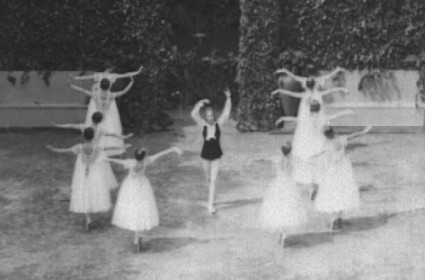
The Ballet Russes at the Fêtes de Narcisses, Montreux in 1928, from British Pathé
Can we make the Bioscope Newsreel a weekly occurrence, say every Friday? We’ll have a go.
Ballet Russes on film
Jane Pritchard, co-curator of the Victorian & Albert Museum’s recent exhibition ‘Diaghilev and the Golden Age of the Ballets Russes, 1909-1929’ writes of the amazing discovery of the first known film of the Ballet Russes lurking in the British Pathé archive. Read more.
50 years of film studies
The Guardian film blog celebrates fifty years of film studies as an academic discipline. The pioneer lecturer was Thorold Dickinson (himself a filmaker of renown); the location was University College London; the pupils included Gavin Millar, Charles Barr, Raymond Durgnat and Lutz Becker. Read more.
Modern elephant taxidermy
Rich Remsberg unearths an extraordinary 1927 film from the American Museum of Natural History that shows you how to stuff an elephant. The taxidermist in question is the multi-talented Carl Akeley, also famed as a motion picture cameraman and inventor – the Akeley camera, with its gyroscopic head, was much used by wildlife filmmakers and newsreels. Read more.
Music for silents
An interesting interview with Ken Winokur of renowned silent film accompanists the Alloy Orchestra raises the issue of venues which insist on showing silent films silently, because André Bazin pronounced that any music accompaniment was mere nostalgia. Go to the Cinémathèque Française to watch your silents to the accompaniment of coughs and the occasional rumbling stomach, and I think most will vote for ‘nostalgia’. Read more.
Farewell to the Silent Movie Blog
For the past couple of years Christopher Snowden’s Silent Movie Blog has provided witty, well-researched and strikingly illustrated accounts of American silent film history. Sadly it is being closed down, and it is not clear whether the archive will remain online (all posts before July 2010 have been removed already). Read more.
And finally
The Bioscope is four years old today. Here’s the link to post number one – a single pithy sentence.
‘Til next time!

