The Moon is yellow

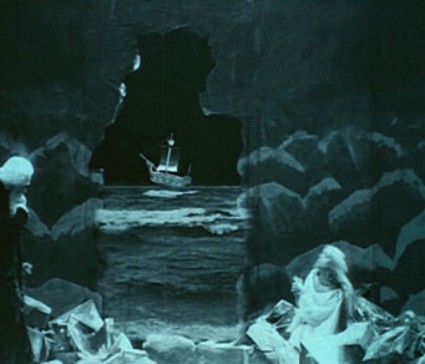
The colour version of Georges Méliès’ Le voyage dans la lune (1902), from http://www.technicolorfilmfoundation.org

May 11 sees the unveiling at the Cannes Film Festival of what may be the film restoration to beat all other film restorations – the colour version of Georges MélièsLe voyage dans la lune (A Trip to the Moon) (1902). Its recovery is little short of miraculous.

The most iconic of all early films is known to so many, if only for the shot of the rocket going into the Moon’s eye, but no-one since 1902 has seen in its hand-painted colour form (see the Bioscope’s 2008 post Painted by hand for a short history of this early method of colouring films). Méliès was able to supply coloured versions of his films, at double the price of black-and-white, but until 1993 no coloured copy of La voyage dans la lune was known to survive. Then a print was discovered by the Filmoteca de Catalunya in Barcelona among a collection of 200 early films, but unfortunately in a state of total decomposition – or so it was thought.

Lobster Films in Paris learned of the print’s existence and arranged an exchange with the Filmoteca for a lost Segundo de Chomón film in their collection. The deal was done, and Lobster examined their purchase:

Inside, there was a 35mm film on which we could distinguish some of the first film images framed by the small perforations characteristic of early films. Unfortunately, our round reel looked more like a ring of wood, such was the extent to which decomposition had transformed the originally supple film into a rigid, compact mass. We decided to consult several specialist laboratories. Their diagnosis was irrevocable: the copy was lost.

http://www.technicolorfilmfoundation.org

But undaunted, and with great patience, they started to unwind the film frame by frame. They discovered that the images were not stuck to one another – only the sides of the images had decomposed and had melded together. There was a glimmer of hope.

We progressed centimetre by centimetre, taking out entire strips of film at a time but often in small fragments. Sometimes the image had disappeared. It took several weeks to uncover the quasi-totality of the images. The reel, now unwound, was still extremely fragile. In its condition, it was unthinkable that we could use wet-gate step printing, the only technique that would enable the images to be copied again onto a new film before they could be restored. We had two options. Either we tried to give the film back its original flexibility so that it could be duplicated, or we photographed each image using an animation stand, but at the risk of breaking the film.

They decided on the first option, which demanded chemical treatment which would render the film pliable for a period, but which would hasten its decomposition thereafter. The work was undertaken by Haghefilm in the Netherlands, who after months of work managed to transfer around a third of the film onto internegative stock. The remainder of the film could not be copied and was now in a highly brittle state. These remaining 5,000 frames (out of a total of 13,375) were photographed individually in 2000 using a 3M pixel digital camera, work which took a year to complete.

Then they had to wait ten years, for technology to catch up with what was required next and for the money to be put in place to complete the restoration. This came about in 2010 thanks support from the Groupama Gan Foundation for Cinema and the Technicolor Foundation for Cinema Heritage. The film now existed in partial internegative form and in different digital file formats at different resolutions, some digitally scanned from the photochemical restoration, some digital images from the 5,000 individual images, many in an incomplete or broken form. It was a huge organisational challenge, as Technicolor’s Tom Burton explains:

Because the digitization took place over a period of years in different physical locations and different technical environments, utilizing dissimilar gear, the resulting data was not natively organized into a sequentially numbered image order. Each digitization session generated its own naming convention and frame numbering protocol … Several versions of some shots had been created as a result of the separate capture sessions. And due to variations in the specific conditions and equipment used in each digitizing session, the files differed greatly from one another in color, density, size, sharpness and position – it was becoming clear that integrating them into a seamless stream of matching images was to be a challenge of extremely large proportions.

Technicolor sorted out the jigsaw puzzle, re-rendered the files as DPX files, then undertook the process of reconstruction the film with reference to an HDCAM version of a black-and-white print of the film provided by the Méliès family, matching it up frame by frame. Much more then followed to clean, stabilise, grade and render the finished film, filling in colours where these were missing with reference to the use of those colours elsewhere in the film, then time-converting it to the original speed of 14fps. The entire restoration project cost 400,000 euros – for a 14-minute film.

http://www.technicolorfilmfoundation.org

And so we come to 2011 (the 150th anniversary of Georges Méliès’ birth) and the restored film’s presentation at Cannes on May 11. It will be presented with a new soundtrack by the vogue-ish French duo Air. The Technicolor Film Foundation has information on the project on its website, including a truly fabulous 192-page PDF book La couleur retrouvée du Voyage dans la Lune / A Trip to the Moon Back in color, in French and English, on Georges Méliès, his career, his methods, the film and its restoration. It is gorgeously illustrated, and serves as a first-rate guide to the special genius of Méliès. I strongly recommend it. It is free to download (the booklet itself is available at Cannes, but apparently it is not going to be on sale generally). A copy has been placed in the Bioscope Library. All illustrations and quotations in this post come from the book.

The Bioscope will pick up on such reports as it can find about the film’s Cannes screening, and any news of screenings thereafter. It will feature at other festivals, but how widely it will get shown further after that (e.g. if there is to be a DVD or Blu-Ray release) has not been said as yet. However, film, digital cinema and HD release versions have been produced.

http://www.technicolorfilmfoundation.org

This is turning out to be the year of Georges Méliès. As well as the colour restoration of Le voyage dans la lune (1902), this month sees the publication of Matthew Solomon’s book on the film, Fantastic Voyages of the Cinematic Imagination. Then at the end of 2011 we will have Martin Scorsese’s Hugo Cabret, his adaptation (in 3D) of Brian Selznick’s children’s book The Invention of Hugo Cabret which features Georges Méliès as a central character. Méliès is played by Ben Kingsley, and the cast includes Sacha Baron Cohen, Jude Law, Asa Butterfield and Chloë Moretz. M. Méliès is about to go global.

Cine-tourism

Google Map showing locations of films made in the early 1900s by R.W. Paul in the Muswell Hill and New Southgate area, produced by the Cine-Tourist

My favourite website of the moment is the Cine-Tourist. The site has been created by Roland-François Lack of University College London as a home for his studies into cinema and place. It’s a model example of how to use the Web as a home for research in forms to which the Web is best suited.

The Cine-Tourist, as Lack bills himself, is interested how films record and depend upon place, both literally and metaphorically. He demonstrates the interrelationships in a number of engrossing ways. For example, his site has sections on cities: that on Paris has 63 frame grabs from Jacques Rivette’s Paris s’en va (1981), identifying the specific locations; that on London has a series of frame grabs rather playfully showing maps that appear in films depicting police stations. That all sounds rather little bit trainspotter-ish, but in practice pinpointing the specifics of place somehow deepens the sense of depth in a film, in the way that it always leads our imagination away from the literal.

This is made clearer in the Cine-Tourist’s blog, The Daily Map, which posts daily frame grabs from a wide range of films, each showing a map significantly positioned in the background, often with an engrossing quotation underneath, from studies of image, place and cultural history. Several of the examples so far are from silent films, as in this frame still from Jean Epstein’s La chute de la Maison Usher (1928):

‘The face is a map’: frame still from La chute de la Maison Usher (1928)

There are other elements to the site, including thoughts on methodologies, a biographical account of his local cinemas, links and a helpful bibliography of “books and essays that read maps in films or films through maps or films as maps …” But I want to draw particular attention to the section Local filmmaker: local film subjects. The Cine-Tourist lives in the Muswell Hill area of London, and one hundred years ago the area was home and workspace for British pioneer filmmaker Robert W. Paul.

Paul lived and maintained a studio and film laboratories in the Muwsell Hill and New Southgate areas. The Cine-Tourist has photographed the intriguingly mundane buildings that were Paul’s homes in the area, but then has studied Paul’s films closely (both those extant and lost films nevertheless indentifiable to a degree through catalogues) and matched locations to film scenes. So far, this is much like the work done by John Bengtson at his Silent Locations blog (recently reported on by the Bioscope). The Cine-Tourist however goes further by subjecting the images to greater topographical and filmographical analysis, and by mapping the locations of some of Paul’s films of the 1900s onto Google Maps, as demonstrated at the top of this post. From this map you can go to the locations specific films, which you can additionally view on Street View or as a satellite view. Additional links take you to detailed information on Paul’s domestic and professional addresses, with further links to the London Project database on pre-First World War film businesses in London.

Robert Paul’s 1903 home ‘Malvern’, now the ‘Muswell Hill Food & Wine’,”the shop to which I go for last-minute, late-night supplies of wine and sundries” (the Cine-Tourist)

This isn’t just a piece of diverting local history. It links up the personal to the professional to the geographical to the Web. Lack begins with himself as London resident, or London traveller; traces his personal history of filmgoing and filmwatching in London (and other cities); documents this through the films in which people are themselves mapped in various ways; then brings all this together into a website which links out again to the greater world of film studies, area studies, and the co-ordinates of place in general. What it may all signify in the end, I couldn’t tell you exactly – but the journey is engrossing.

The Cine-Tourist is an example of an increasing trend in the scholarly study of the mysteries of place. Its inspiration goes back to the flâneur of 19th century Paris, the man in the crowd who was a part of the city yet by perambulating through it was somehow distanced from it, as Baudelaire described:

To be away from home and yet to find oneself everywhere at home, to be at the centre of the world, and yet remain hidden from the world.

The flâneur is a reader of the city through which he passes. Other inspirations for what has become a modern movement are Walter Benjamin’s Arcades project and the ‘situationist’ Guy Debord, who came up with the somewhat loose term ‘psychogeography’ often used to describe such preoccupations. Most recently there is the London writer Iain Sinclair, author of such richly allusive works as London Orbital (a tour of the M25 which circumnavigates London) and Lights out for the Territory, works to be found placed prominently in the London section of many a bookshop, doubtless bewildering the unsuspecting tourists who purchase them. Sinclair, like Debord, is also a filmmaker, and another member of the same ‘school’ is documentary filmmaker Patrick Keiller, whose 2007 exhibition placing images from early films onto the same locations today was covered by the Bioscope.

What is interesting is how such ramblings (literally so) have found their natural home on the Web; indeed are being encouraged by the Web, which by its very nature brings together that association of ideas that psychogeography seeks to achieve. Google Maps, Google Earth, Street View, OpenStreetMap (a free, editable world map), HistoryPin (mapping of people’s historical photos) and Geograph (a project inviting anyone to help document every square kilometre of the UK and Ireland with photographs) each encourage us to explore and share what we have explored.

London Sound Survey‘s mapping of sounds (the orange squares) from the London of today to the Booth maps of 1898, colour-coded to show levels of welath and poverty

Interestingly, many psychogeographical or semi-pyschogeographical sites are rather bad at using the Web. Among some of the better examples, check out Classic Cafes (London and seaside cafes), Derelict London (the strange poetry of abandoned corners of London), Urban Squares (city squares around the world), Mythogeography (“for walkers, artists who use walking in their art, students who are discovering and studying a world of resistant and aesthetic walking, anyone who is troubled by official guides to anywhere …”) and the excellent London Sound Survey (systematically mapping the city though its sounds).

For silent films, we are fortunate in having two outstanding examples of the use of mapping tools, though neither is strictly psychogeographical in intent. Going to the Show documents the experience of movies and moviegoing in North Carolina to the end of the silent film era, bringing together Sanborn fire insurance maps of the period and Google Maps; while Cinema Context documents cinema-going and films seen in the Netherlands, linking its database records to Google Maps and the Internet Movie Database. Both have been highly praised on these pages before now (see here and here). I shall be writing about Cinema Context again soon. For other such empirical studies of cinemas and their place, see the HOMER project website (though some of the links no longer work).

Roland-François Lack has another blog, The BlowUp moment, dedicated to frame stills showing the use of cameras in films, with a new image daily.

Go explore. Literally so.

Bioscope Newsreel no. 22

United States Food Administration cinema slide from World War One, from Starts Thursday!

Jackie Cooper
Another child star of the silent era has died. Jackie Cooper, who made his first film in 1925 aged three, did not suffer the fate of many child stars in having a an adulthood of disappointing anonymity. Instead after success in the Our Gang series, he continued as a top performer throughout the 1930s, moved on to acting with success on stage and TV, then turned TV executive, won a couple of Emmys for directing, and returned to the screen as the newspaper editor in the Superman films. He died aged 88. Read more.

In competition
A late addition to the films in competition in Cannes has been announced – and it’s a silent film. The Artist, directed by Michel Hazanavicius, is described as a ‘silent black-and-white period piece about the rise of a young actress and simultaneous fall from grace of a silent movie star around the time that “talking pictures” started being made’. It stars Jean Dujardin, Bérénice Bejo, James Cromwell and John Goodman. Read more (and see clips with interviews – in French – here).

Class, silents and the public sphere
Acknowledgments to the Illuminations blog for this link to a lengthy and engrossing article by Stephen J. Ross (author of Working-Class Hollywood) on class and politics in silent film, first published in 2003. Ross notes: “Between 1905 and April 1917, when American entry into World War I altered the movie industry and the politics of its films in dramatic ways, producers released at least 274 labor-capital productions. Of the 244 films whose political perspectives could be accurately determined, 112 (46 %) were liberal, 82 (34 %) conservative, 22 (9 %) anti-authoritarian, 17 (7 %) populist, and 11 (4 %) radical”. Read more.

Propaganda between reels
A favourite blog of the Bioscope is Starts Thursday!, in which Rob Byrne covers the glass lantern slides that promoted coming attractions in cinemas from the silent era (and beyond). His latest post is a very informative guest piece by PhD candidate Krystina Benson on the American government’s propaganda campagin during WWI one, including its use of film, all handsomely and illuminatingly illustrated by Byrne’s slides. Read more.

‘Til next time!

Performing arts

The Tempest (UK 1908), based on Shakespeare’s play, directed by Percy Stow

Apologies for the intermittent service, folks – it’s been a bit busy, and the Bioscope has been rather set to one side, gathering dust. But we return with news of a new online catalogue from the British Film Institute, which is some interest to us. The catalogue is The Performing Arts on Film & Television, which is available as part of the BFI website or can be downloaded as a single PDF (7MB). It’s a selective catalogue around 3,500 film and video materials, dating from 1895 to the present, held by the archives and collections of the BFI, Arts Council England, LUX, and the Central St Martins British Artists Film & Video Study Collection. It has been commissioned by MI:LL (Moving Image: Legacy and Learning), an Arts Council England initiative “to support projects and develop strategies that promote engagement with the arts through the moving image”.

So, what does this well-meaning venture give us? It is divided up into seven areas: British Music Hall and Variety on Film 1895-1930, Theatre, Dance, Music, Performance Art and Artists’ Film & Video, From Politics to Poetry, and Cinema Acting Styles. As said, it’s a selective catalogue, so it provides information titles that are likely to be of strong interest of researchers. Some areas are covered in more detail than others (it’s hard to see what value there is in the tokenstic choices given under Political Oratory or Propaganda, which is rather stretching the idea of ‘performing arts’ in any case). But one of the sections that aims for comprehensiveness is British Music Hall and Variety on Film 1895-1930, and that’s our territory, which is good.

The section has been researched by the BFI National Archive’s curator of silent films, Bryony Dixon. It aims to identify most relevant films for the 1895-1930 period held by the BFI that document music hall, which it divides into Records of performances and actualities, Original works made for cinema featuring music hall artistes, and Films based on music hall sketches and plays. So many of these films record the only performance by some of the legendary performers of the past, or document aspects of stage practice which can be read about in many places but never seen again – except through film.

Fred Evans (Pimple) in an unidentified British comedy known as Fat Man on a Bicycle

So, for example we have E. Williams and his Merry Men (1899), a precious record of a seaside minstrel act; Lil Hawthorne singing Kitty Mahone in a 1900 synchronised sound film (1900); an extraordinary record of Hengler’s ‘plunging horses’ in a hippodrome act, c.1902, in a film known only as [Collapsing Bridge]; several Cinematophone, Chronophone and Vivaphone films of singers 1907-1909 which were originally synchronised with sound discs; music hall comedians such as Fred Evans (Pimple), Sam T. Poluski, George Robey and Lupino Lane in original comedies made for the cinema, rare film of the exterior of a music hall made in 1920, in the film Hoxton … Saturday July 3, Britannia Theatre; and numerous examples of DeForest Phonofilms – sound-on-film shorts made in the mid to late 1920s, chiefly of music hall and variety performers.

Other parts of the catalogue are more selective, and have relatively little on silent films. The Theatre section does point us to silent interpretations of classical theatre (an Italian Elektra by Euripedes from 1909, a 1911 Antigone by Sophocles), but the Shakespeare section is disappointingly selective and conventional. It mentions few silents, despite the BFI having the world’s largest collection of silent Shakespeare films. Look instead at the sub-section on 17th to 19th Century playwrights for such surprises as the Thanhouser company tackling Ibsen’s The Pillars of Society in 1911, or the 1915 American production of Ghosts with Henry B. Walthall. The Cinema Acting Styles section has a page on early and silent cinema, but it is peculiarly slender (just Orphans of the Storm, King of Kings, Piccadilly and a couple of documentaries – why bother?).

The catalogue is arranged thematically, so you will find silents dotted about all over the place, which is a good thing. It means researchers look for a theme, a performer or a writer might stumble across works which they could otherwise shun were they presented with a plain chronological listing. All of the archival films come from the BFI’s collections, and there is information on how to access the films from the multiplicity of options that BFI services provide.

I have meant for some while now to write a post on how to use the BFI’s main online database. I’ve refrained from doing so because of planned changes to that catalogue, which might render any advice too quickly out of date. But we’ll see. Meanwhile, targeted productions such as The Performing Arts on Film & Television are often a lot more useful for researchers for a useful selection rather than the bewildering vastness of a complete catalogue. Researchers seldom want everything; they want something that will be immediately useful to them. I hope this new catalogue – though it’s a bit of a curate’s egg, really – performs that function. It certainly makes for fascinating browsing.

Bioscope Newsreel no. 21

The Odessa Steps sequence from Battleship Potemkin (perhaps the Michael Bay widescreen version?). From Obsessed with Film

Returning from their Easter break, the Bioscope editorial team has been scouring the wires for the latest news on all things silent. Here’s what they have dredged up.

Defending D.W.
Peter Bogdanovich, who maintains a rather good blog with the uncomplicated name of Bogdanovich, writes in eloquent defence of D.W. Griffith in particular and against revisionist history in general. His argument is that the racist nature of The Birth of a Nation should not be allowed to blind us to Griffith’s status as an humane artist overall and as an influence on so many great filmmakers. Read more.

Potemkin sails again
The British Film Institute is releasing a newly-restored copy of Sergei Eisenstein’s Battleship Potemkin (with Edmund Meisel’s original score) in some UK cinemas from today. Obsessed with Film enthuses about the film’s popular appeal: “The 71-minute silent film has found itself tagged uncomfortably as an art picture, forever doomed as a source of study and academia. In actuality, it’s a roaring epic, the kind of film that Michael Bay might lay awake at night thinking about, pondering the possibility of a full-on remake”. Hmm, slightly worrying food for thought. Read more.

The political power of Francis X. Bushman
An article from the National Journal on the political power of celebrities comes up with the surprise information that where Bono treads today, silent star Francis X. Bushman once trod before. Bushman was apparently told by President William Howard Taft that he envied the love of people that Bushman enjoyed. Bushman doesn’t make the NJ’s list of the twenty most politically-influential celebrities, however – the only person to have appeared in silents who does is John Wayne. Read more.

Dreyer on Blu-Ray
It’s high time the Bioscope updated its list of silents on Blu-Ray, but it’s getting difficult to keep up. Just announced by the Danish Film Institute is a Blu-Ray release of Carl Th. Dreyer’s Love One Another (Die Gezeichneten) (1922) and The Bride of Glomdal (Glomdalsbruden) (1926), with piano scores by Ronen Thalmay. Intertitles are in Danish and English, and the films are being made available on DVD as well. Read more.

The dying Keaton
How many dance pieces have been produced about silent film stars who weren’t Charlie Chaplin? Not many I think, but this week Chicago Dance Crash and Culture Shock Chicago have come up with The Trials of Busta Keaton (now there’s a bold re-spelling to bring a star of yesteryear to a new audience), which documents the fading of Keaton’s career and his sad attempts to recapture his past. Read more.

‘Til next time!

Kraszna-Krausz award

Warm congratulations to Matthew Solomon and University of Illinois Press for his book Disappearing Tricks: Silent Film, Houdini, and the New Magic of the Twentieth Century, which has just won the Best Moving Image Book Award at the prestigious Kraszna-Krausz Foundation book awards. The biennial awards, established through a bequest by Andor Kraszna-Krausz, the founder of Focal Press, recognise books on the moving image and photography that have made original and lasting educational, professional, historical and cultural contributions to the field.

Disappearing Tricks, as previously reported on by the Bioscope, revisits the golden age of both theatrical magic and silent film to reveal how professional magicians shaped the early history of cinema. The judges of the 2011 competition, Hugh Hudson, Peter Bradshaw and Sir Christopher Frayling said about Disappearing Tricks:

A fascinating enquiry into the early history of film, especially as it involved magicians and magic tricks. Matthew Solomon explores spiritualism and suspension of disbelief in a compelling investigation of the integration of cinema into mainstream entertainment.

So an important vote for publication on silent film, which joins previous such winners of the award, Writing Himself into History: Oscar Micheaux, His Silent Films and His Audiences by Pearl Bowser and Louise Spence, The World According to Hollywood, 1918-1939 by Ruth Vasey, Hollywood’s Overseas Campaign: The North Atlantic Movie Trade, 1920-1950 by Ian Jarvie, and Walt in Wonderland: The Silent Films of Walt Disney by Russell Merritt and J.B. Kaufman. Ours are the best form of movies and the best books about movies, clearly.

Matthew Solomon’s latest book, Fantastic Voyages of the Cinematic Imagination, on Georges Méliès’ Trip to the Moon, was published recently.

The one-stop-shop

Midland Electric Theatre, Babbington Lane, Derby, from Picture the Past, available via JISC MediaHub

Another day, another federated database. The latest offering is JISC MediaHub, which is a bringing together of a number of digital multimedia resources, many of which have been made available individually to UK higher education users by the Joint Information Systems Committee, often under institutional subscription only. Edinburgh University’s EDINA are the people who have put it all together, though all of the original digitising, describing and contextualising has been done by other hands. The resources include Film and Sound Online, NewsFilm Online (previously reviewed by the Bioscope), Spoken Word, Getty, AP Archive and several more.

JISC MediaHub brings all these together in one searchable form, allowing you to refine searches by video, image or sound (the three types featured), and by restricted or unrestricted content – so some of the content is open to all. It is clear to use, though personally I find the design on the busy side and the way descriptions pop up to the side of records a bit off-putting. Further tools and features are promised with later releases. MediaHub began in 2005 as a portal project entitled Visual and Sound Materials and has take quite a while to get to this form. It is to be hoped that it achieves its aim of increasing scholarly use of audiovisual media by making it easier to find high value content all in one place, rather than a set of disparate services. Whether researchers need (or, let’s face it, deserve) to find everything handily in one place is a matter for debate, but that’s the way things are being pushed – so it’s not really up for debate at all. You have all the advantages of the one-stop-shop, and all the disadvantages of content taken out of its curated context (though MediaHub does point researchers back to the original source website).

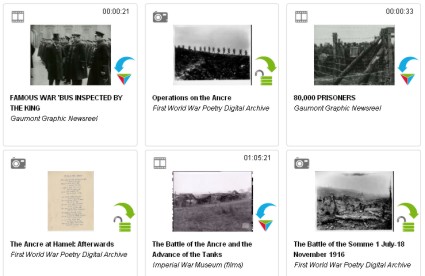
So, what can we find for our area of silent films, either among the restricted content (if we’re in a subscribing UK higher education institution or have password access to some other sites) or unrestricted (the rest of you)? Well, there’s quite a lot. Under content restricted to educational users only, there is a significant number of films from the Imperial War Museum covering the First World War, including the feature films The Battle of the Somme, The Battle of the Ancre and the Advance of the Tanks, and The Battle of Arras, along with other documentary and propaganda films made by British official film outfits. There are also IWM film clips which are available to all included on another resource, the First World War Poetry Digital Archive.

There is a considerable amount of news footage from the ITN collection (NewsFilm Online, originally created by the British Universities Film & Video Council), which includes practically the entire surviving archive of the Gaumont Graphic silent newsreel (1911-1932), with its marvellously rich recod of life, events and manners over two decades. There are also silent films on medical subjects in the Wellcome Trust collection, including the renowed War Neuroses, on the treatment of shell-shock (see the earlier Bioscope post on this), and titles such as Frontal Rhinoplasty and Epidemic Encephalitis, which you tend not to find in standard silent filmographies.

MediaHub search results for ‘Ancre’, showing photographs and film clips from both restricted and open collections

Among the unrestricted content there is the Open Video Project, itself a collection of freely-available online video collections which include a number of early Edison productions (and reviewed previously on the Bioscope); and Culture Grid, a collection cultural objects from UK collections with many photographs that relate to cinema – particularly cinema buildings themselves (type in ‘cinematograph’, ‘bioscope’ or ‘electric theatre’ for some interesting results, such as the image at the top of this post).

There is much more on film outside of silent film. Among the restricted collections are the ETV collection of Soviet and left-wing films, social conscience documentaries and feature films from Amber Films, the Films of Scotland series of documentaries, clips from the Getty collection of stock footage, news footage from Associated Press, and films on archaeology, medicine, chemistry etc., with other collections under negotiation, notably the Royal Mail Film Classics collection (Night Mail and such like). Among the film content that is free to all there is ARKive (footage of endangered species).

All in all it’s a remarkable, if equally curious collection of stuff. There are hundreds of thousands of objects available (around 90,000 being film items), but the randomness of some of the collections gives a sense of lucky dip about the whole research process. You don’t know what you are going to find – and if you are looking for something specific you’re as likely to be disappointed as not – but what you do find is bound to intrigue, and hopefully to encourage scholars to come back for more. The great advantage for those in UK HE is that the restricted content is licensed for them to download and re-use, and that (I can tell you) has taken a lot of neogiating to achieve, and not a little expenditure as well.

For the rest of us, it’s a bit like peering in at the window of a toyshop when you haven’t got any pocket money. It would of course be so much better of all of this content was freely available to everyone, to do what they wanted with it in an entirely open fashion. But that’s not going to happen (yet), and much of this content has only been made available in this way because it can be restricted to educational users under careful licence conditions. So lucky you if you’re a UK student. Now go out and make use of it.

Bologna 2011

Conrad Veidt features on the poster for this year’s Il Cinema Ritrovato

Bologna, Italy is home to one of the world’s leading festival of archive and restored films, Il Cinema Ritrovato. The festival always includes a strong representation of silent films, which are enriched all the more for being exhibited alongside films from later periods. This year’s festival takes place 25 June-2 July, and the main themes have been announced. Below are the blurbs supplied so far for those sections with silent films included.

Howard Hawks
After Frank Capra and John Ford, this year’s big retrospective offers up spectacular editions of early works and later masterpieces by Howard Hawks, the genuine auteur of American film, the “great craftsman” whose stature as a maestro was affirmed by Cahiers in the 50s and a person who influenced the creation of the Hollywood myth as much as the same Ford and Hitchcock. Hawks who challenged and transcended every production condition, Hawks friend to Hemingway, Hawks narrator of the most memorable and ambiguous male relationships in film history, Hawks inventor of a powerful new American female archetype, Hawks relentless creator of his own legend, Hawks who in fifty years covered every genre of film without losing his grip on his incomparable style. We will show all Hawks’s silent films available today (Fig Leaves, The Cradle Snatchers, Paid to Love, A Girl in Every Port, Fazil, Trent’s Last Case) and many sound films from the 30s, starting with his first The Dawn Patrol from 1930 to Barbary Coast from 1935, rare flicks such as Criminal Code, The Crowd Roars, Tiger Shark and milestones of gangster movie and screwball comedy genres such as Scarface, Shame of a Nation and Twentieth Century. And that’s not all; we are working on showing Hawks classics that are the height of their genre and continue to be a thrilling visual adventure, from Gentlemen Prefer Blondes to The Big Sleep. “The evidence on the screen is the proof of Hawks’s genius” wrote Jacques Rivette in 1953. Watch it, and watch it again.

Conrad Veidt, from Caligari to Casablanca
After years of research, this year’s festival will be the one which finally pays tribute to Conrad Veidt, the great actor of silent German film, the sublime mask of expressionism. The “strange creature” of The Cabinet of Dr. Caligari lent his long face with throbbing veins to Wiene, Oswald, Pabst and Leni in various films of the 20s, before leaving Nazi Germany in 1934 and starting an English career that reached its apex with director Michael Powell (The Thief of Baghdad). Veidt’s career and life came to an end in America, where he acted in a few militant anti-Nazi films but is best known for his role as Major Heinrich Strasser, shot dead in the final scene of Casablanca.

Alice Guy: Tribute to a Pioneer of Cinema
Alice Guy Blaché’s story is like no other in the history of moving images: a woman and pioneering filmmaker, Alice was at the forefront of the technological, industrial, and cultural changes that made cinema the new form of mass-media entertainment. From early sound technology, like Gaumont’s Chronophone synchronized sound system, to her American production adventure with Solax (1910-1914), from distribution with the U.S. Amusement Corporation (1916) to feature length films such as The Ocean Waif (1916), Alice Guy participated in every aspect of the evolving motion picture business, adapting to new developments and challenges. Although Alice Guy is most celebrated as the first woman director in film history, this achievement only scratches the surface of her vast accomplishments. She paved the way for women as creative professionals and as powerful agents of economic and social change. Our program features a selection of films produced by Alice Guy’s American company Solax as well as early films she directed at Gaumont and a feature film she made as an independent working in the U.S. industry.

Boris Barnet, Poetic Visions of Everyday Life
Our vast tribute to Boris Barnet spans from early Soviet cinema to the 1960s. Barnet debuted as an actor in the legendary Mister Vest by Kulešov before beginning his career as a director. Refusing to yield to genre formulas, Barnet was all but completely ignored by the mainstream and received off and on criticism. Surrounded by great “revolutionary” filmmakers, the work of this artist faded into the background. Today, however, Barnet is considered one of the most interesting and pioneering directors of classic Soviet film for his narrative style that balances lyricism, irony, spontaneity and drama in a constant dialogue between playground and reality. A view of the world and of humanity that we discover following the “Barnetian” hero from everyday adventures in silent films from the 1920s to Barnet’s final intimist works Alenka (1961) and Polustanok (The Whistle Stop, 1965), interspersed with masterpieces, such as Okraina (The Outskirts, 1933), about the Great War at the turn of the Revolution, and the surreal U samogo sinego morja (By the Bluest of Seas, 1934). Other works include Staryj naezdnik (The Old Jockey), a 1940 comedy that was dear to the director but was banned until 1959, films made during the war between 1941 and 1944, and Podvig razvedčika (Secret Agent, 1947) in which Barnet also acts, admirably playing a German official.

Progetto Chaplin
Here we are pleased to announce some of the programs of the ten year project Progetto Chaplin: Kate Guyonvarch and the author Lisa Stein will present the new biography Syd Chaplin, a unique portrait of Sydney Chaplin’s life and art that also sheds light on unexplored areas of Charlie’s career (the presentation will feature a screening of rare home movies); finally two ‘four-hand’ dossiers: one with Kevin Brownlow dedicated to Eddie Sutherland (director, actor, assistant director to Chaplin in A Woman of Paris and The Gold Rush) also featuring a selection of his silent and sound films; and the other with David Robinson will explore, through the analysis of the archival drafts, Chaplin’s script of The Great Dictator.

Bologna is releasing more information on the festival in advance than is usually the case, which is welcome, and it promises in its next newsletter that there will be information on two further sections, Recovered and Restored, Searching for the color of film and the hardy annual 100 years ago: the films of 1911. Additionally there is a programme strand At the Heart of 20th Century: Socialism between Fear and Utopia, which doesn’t mention any silents, but could conceivably include some, and the evening open-air screenings in the Piazza Maggiore, which will include Michael Powell and Emeric Pressburger’s The Thief of Bagdad (1940), Martin Scorsese’s Taxi Driver (1976), and America America by Elia Kazan (1963).

Information on the festival (in Italian and English), including locations, hotels and extensive details of past festivals are available on the Il Cinema Ritrovato site. And we’ll have more on the colour and 1911 programmes as and when they appear.

Hot off the presses

We had a previous post where we alerted readers to upcoming publications in the area of silent film, and it seemed to be quite well received, so here’s another look into the crystal ball at some of the books scheduled for 2011:

Fantastic Voyages of the Cinematic Imagination looks highly welcome. It is written by Matthew Solomon, author of the excellent Disappearing Tricks: Silent Film, Houdini, and the New Magic of the Twentieth Century. His new book, published by State University of New York Press, concentrates on Georges Méliès’ Trip to the Moon, the key fantastical film of the silent era (and one of the most important of all science fiction films). It places the film in the context of histories of techology, film history, the avant garde, Méliès’ own history, and more. It’s a great idea for a book and I hope to review here in due course.

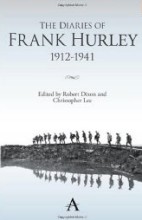
Soon to be published by Anthem Press is The Diaries of Frank Hurley 1912-1941, edited by Robert Dixon and Christopher Lee. Frank Hurley was the photographer and cinematographer for the Antarctic expedition of Douglas Mawson and most famously Ernest Shackleton. He went on to be an official war cameraman on the Western Front and in the Near East, then in the 1920s directed ethnographic dramas such as Pearls and Savages. Onlt short passages of his diaries (which cover all of this period and more) have been published up to now, and this illustrated edition will cast new light on a filmmaker who images alone among the most eloquent (and most arduously achieved) of their time. In October Anthem will publish Robert Dixon’s Photography, Early Cinema and Colonial Modernity: Frank Hurley’s Synchronized Lecture Entertainments which sounds like an important recognition that artists such as Hurley did not produce films so much as multimedia entertainments, combining film, images, music and commentary.

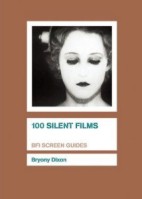
June sees the publication by the BFI of Bryony Dixon’s 100 Silent Films. This is one of a series of BFI books in which 100 essential titles in any given genre (Westerns, Anime, Shakespeare Films, Road Movies etc) are described in pithy, accessible form. The latest is this volume by the BFI’s silent film curator, which will feature one hundred key films of the silent period from a variety of countries, genres and directors, and will doubtless generate much argument as to what should or should not have been included, while being a highly welcome first port of call for anyone discovering silent films. Again, it should be reviewed here in due course.

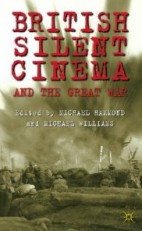
British Silent Cinema and the Great War will be published by Palgrave Macmillan in August. Edited by Michael Hammond and Michael Williams, it is appearing ahead of what is going to be a huge number of texts marking the centenary of the First World War, now just three years away. It covers the complex relationship between British film and the British experience of the war, and is indicative of how confident and sophisticated the discussion of British silent cinema has become in recent years – a far cry from the corner of silent film history that scarcely dared speak its name not so long ago.

The University of California Press is publishing Twilight of the Idols: Hollywood and the Human Sciences in 1920s America by Mark Lynn Anderson. The book looks at the position of silent films stars – particularly Wallace Reid, Rudolph Valentino, and Mabel Normand – and how they shapred ideas of personality and human conduct. As the publishers’ blurb puts it, “Anderson looks at motion picture stars who embodied various forms of deviance – narcotic addiction, criminality, sexual perversion, and racial indeterminacy. He considers how the studios profited from popularizing ideas about deviance, and how the debates generated by the early Hollywood scandals continue to affect our notions of personality, sexuality, and public morals”. So, stuff we’ve heard before, but also stuff that people are going to keep on and keep on reading.

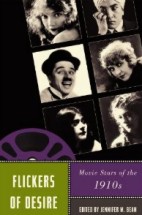
Flickers of Desire: Movie Stars of the 1910s by Jennifer M. Bean is published by Rutgers University Press in August. The blurb states: “The conjunction of the terms “movie” and “star” was inconceivable prior to the 1910s. Flickers of Desire explores the emergence of this mass cultural phenomenon, asking how and why a cinema that did not even run screen credits developed so quickly into a venue in which performers became the American film industry’s most lucrative mode of product individuation. Contributors chart the rise of American cinema’s first galaxy of stars through a variety of archival sources – newspaper columns, popular journals, fan magazines, cartoons, dolls, postcards, scrapbooks, personal letters, limericks, and dances.” Perfomers covered include Charlie Chaplin, Mary Pickford, Pearl White, Sessue Hayakawa, Theda Bara, George Beban and G. M. Anderson.

Nina Baburina’s The Silent Film Poster 1908-1934 is published in July by Art-Rodnik. The book is a little more specific that the title might suggest, being an illustrated study of the Russian film poster. It traces the history from a 1908 poster from Stenka Razin designed by Paul Assaturov in the style of “ancient naive Russian imagery” to an advertisement for a silent movie by Yuri Pimenov from 1934, through 161 full-page repductions. The artists featured include Alexandro Rodchenko, the Stenberg Brothers, Jacob Ruklevski, Nikolai Prusakov and Alexander Naumov, and naturally enough it covers the pre-Soviet as well as the Soviet era, and both Russian/Soviet and foreign films.

If you know of more that are coming up, do add them to the comments.

Omar and his Skyhook

Well, the the sun is shining down brightly on Bioscope Towers, and as Easter arrives the editorial team is downing tools for a while and warming itself in the ornamental gardens in the company of friends and family.

During this short break in service, here’s a modern silent for you, made by Douglas Purver in 2009. Produced in a style that makes one think of Winsor McCay’s Little Nemo in Slumberland, it demonstrates a kind of magical filmmaking that an audience back in 1911 would recognise, could we but send the film back 100 years. That makes it something of a rarity among modern silents, most of which would doubtless baffle the audiences of those times. Just a shame about the unnecessary faux scratches. Films weren’t like that in 1911; at least, not when they started out.

So, enjoy, and we’ll return in a few days’ time.