How to Run a Picture Theatre – part 3

More from How to Run a Picture Theatre (1910) [correction – probably 1912]. Having chosen the building and taken care of the outside appearance, we turn to the interior and the first places to be seen by the prospective customer – the lobby and waiting room. The comments on the lobby indicate how many drab cinemas (usually shop or other such conversions) there still were, with bright lights outside but dismal within:

The Lobby or Entrance Hall. A dingy lobby betokens in the minds of many a poor entertainment. How often the mistake is made that all the public expect for outside appearance is a blaze of light.

Nothing short of 18ft. should be devoted to the lobby. Nor is this waste of space, for it enables an advertising display to be made to advantage, and the passers-by who stop to read the program boards or day bill are well against the pay-box before they realise that their curiosity has already got them almost inside the theatre.

The flooring should be of tiles or cement. A board flooring is an abomination suggestive of hasty construction and a fleeting stay …

Greater variety of material is permitted in walls and ceilings. As a general thing, plaster casting is to be preferred to imitation marble. The last may be sparingly used in the large lobbies, but is almost too heavy to be in keeping with the style of performance. A plaster cast lobby, is tastefully done, finished in white and gold, and kept always fresh by the use of paint and gold leaf is much to be preferred.

White and gold is advocated as a general colour scheme …

A waiting room is considered a necessity on account of the prevalent system of the ‘continuous show’, whereby the same programme of an hour or so would be repeated eight or more times per day, with people able to come in at any time, and often to stay as long as they liked. This contrasted with a more theatre-based policy of two or three longer shows per day with set opening hours, which would become the model a few years later.

The Waiting Room or Lobby Adjunct. … A waiting room has another advantage which should be seriously considered by the exhibitor. With the present system of continuous performance and of allowing anyone to enter or leave the auditorium while a picture is on the screen, you discourage many devotees of motion pictures who, deeply interested in a scene, have either to move to allow someone to pass in front of them or to have some newcomer making the view while looking for a seat, or a lady removing her hat as slowly as possible, and at this most pathetic moment. More than one spectator has expressed disgust when reading a sub-title, to have someone pass in front of him and shut off the view, and the moment he cannot read the sub-title on the screen, he loses the thread of the story and becomes dissatisfied with the show.

… A waiting or ante-room would be a genuine remedy to this drawback …
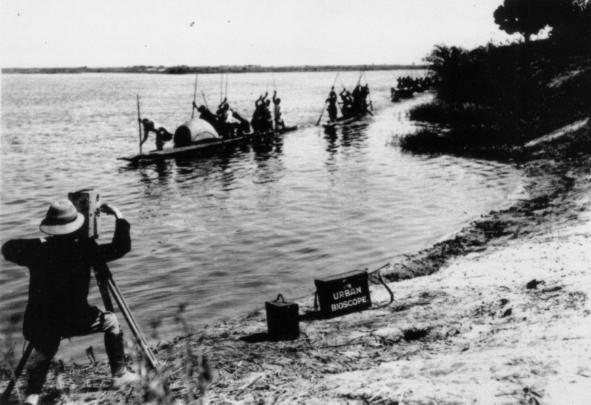
Product placement

drefrenes1.jpg

This photograph shows Joseph De Frenes, cameraman for the Charles Urban Trading Company, filming in Africa around 1908. De Frenes is using a hand-cranked Urban Bioscope camera, and the camera case with the product’s name is placed prominently in this publicity photograph for use in the company’s catalogues and promotional literature. De Frenes was an Austrian who filmed with three of the most notable creators of travel films in the early period of cinema: Burton Holmes, Lyman Howe and Charles Urban. He was Urban’s head cameraman when they made the celebrated Kinemacolor film of the 1911 Delhi Durbar ceremonies. After the First World War he established his own film business, which ran successfully for decades.

American Memory

Among the very best resources on the web is the Library of Congress’ American Memory site. The purpose of American memory is to provide “free and open access through the Internet to written and spoken words, sound recordings, still and moving images, prints, maps, and sheet music that document the American experience”. Its Motion Pictures section is a marvellous example of this, offering users access to a wide range of predominantly early cinema subjects, all available for viewing and downloading, in MPEG, QuickTime and RealMedia formats.

Each collection is usefully contextualised and indexed, and there are impeccable cataloguing records. The collections with silent film material (both fiction and non-fiction, but chiefly the latter) are:

Needless to say, this is all non-copyright material, one of the consequences of which being that eBay is full of DVDs of early film materials which are simply repackaged downloads from this site.

How to Run a Picture Theatre – part 2

More from How to Run a Picture Theatre, the guide to setting up your own cinema, published in 1910 [correction – probably 1912]. Having chosen our site, we now have to consider the building:

The Building and its Fittings. If your venture is to be a “converted” building, either shop premises, a public hall, or a chapel, make certain that the alterations planned are practicable before you sign a lease …

… In the early days of the picture theatre, the mistake was frequently made by those who should have known better, of thinking that anything was good enough for such a place, with the result that ofttimes endless expense had to be incurred after it was opened, to the dislocation of business and irreparable financial loss to the proprietors.

Strange to say, from the very start a certain type of construction has been adopted and has been followed by nearly everyone; a white exterior, a long hall with very little light, bad ventilation and no gallery, a waste of space for a lobby, open to the winds and decorated with a profusion of plaster reliefs and white and gold paints.

The “converted” is now almost a thing of the past. The successful picture theatre of to-day must not only be especially arranged for the purpose, but it must present as pleasing an architectural and decorative aspect as it is possible to make …

Silent film music

Among the joys of experiencing live silent film shows is the music accompaniment. A handful of pianists have established worldwide reputations for their skill in playing (frequently improvised) to the silents, among them Donald Sosin, whose elegant and informative website is at http://silent-film-music.com. As demonstration of something of the working life of a silent film pianist, here’s a list of shows where he can be seen and heard this year:

  • Mar 18 2pm FIG LEAVES (Howard Hawks) at Museum of Moving Image (part of a fashion series)
  • Apr 14 12pm PETER PAN (Herbert Brenon) at Tarrytown Music Hall
    (2nd silent series there)
  • Apr 15 12pm SPEEDY (Harold Lloyd) at Tarrytown Music Hall
  • Apr 19 7:30pm SON OF THE SHEIK (with Valentino) at Tarrytown Music Hall
  • Apr 27-28 residency at University of Wisconsin Stevens Point
  • Workshop with music students, public performance of shorts and THE KID BROTHER (Harold Lloyd)
  • Jun 2 Ithaca Festival films made in Ithaca
  • Jun 3 SUCH IS LIFE and KREUTZER SONATA National Gallery, Wash DC
  • Jun 10 11am STEAMBOAT BILL JR at Coolidge Corner (MA) Theater
  • Jun 12 TBA Brooklyn Academy of Music
  • Jun 30-Jul 7 Cinema Ritrovato, Bologna (performed there since 1999)
  • Jul 14/15 San Francisco Silent Film Festival (films TBA)
  • Sep 14/16 Port Townsend (WA) Film Festival
  • Oct 6-13 Le Giornate del Cinema Muto, Pordenone Italy (since 1993)
  • Oct 17-22 Brooklyn Academy of Music Pordenone at BAM series

More and updated information on his site.

How to Run a Picture Theatre – part 1

cinema.jpg

I’m going to start up a new series of posts, telling you how to set up your own cinema, in 1910. The posts will present extracts from the book How to Run a Picture Theatre: A Handbook for Proprietors, Managers and Exhibitors, published by The Kinematograph Weekly in 1910 [correction – probably 1912]. First thing to consider, where are you going to build it?

On Selecting a Site. It requires but a very slight stretch of memory to go back to the time when the opening of an electric Theatre was an extremely simple operation. Any disused shop to which could be added an attractive looking front, was considered good enough for the purpose of a moving picture display. But with competition has come a change, and to-day, he who would succeed as a moving picture exhibitor needs not only capital, but an artistic taste and business acumen …

… The value of a site naturally depends to a large extent on local circumstances. It must be borne in mind that the public on pleasure bent does not frequent the residential areas in search of entertainment. Therefore a main business artery is to be preferred and care should be also taken to have the theatre on the right side of the street. It is strange, but nevertheless true, that twice as many persons frequent one side of a street as are to [be] found on the other side, and it is the side most used by pedestrians that is best fitted for the electric theatre …

… It is well to consider also from whence your clientele is likely to be drawn when you have opened your theatre. It does not pay to expect one’s patrons after the turmoil of the day to walk miles to the theatre. Therefore, the site should be as near as possible to the part most densely populated by the comfortably-positioned artizan or middle classes, as they are the greatest supporters of the picture theatre.

Electric Theatre was a standard term for cinemas at this time. It seems to have been first used for Thomas L. Tally’s Electric Theater, a storefront show which opened in Los Angeles in 1902. The term was exported to Britain in 1908 by New York businessman Joseph Jay Bamberger, who established the first cinema circuit in London with his Electric Theatres (1908) Ltd. His cinemas were each called Electric Theatres, and the name became generally used for a time. Another name for early cinemas was, of course, a bioscope.

More to follow.

Australia’s Silent Film Festival

It’s all film festivals at the moment. Australia’s Silent Film Festival has its inaugural programme in Sydney over three days, March 30 to April 1. Screenings at the Hayden Orpheum Picture Palace at Cremorne will include Cyrano de Bergerac, Sunrise, Charlie Chaplin, Buster Keaton and Laurel and Hardy. On 1 April, at the New South Wales Art Gallery, there will be a restored print of the 1927 Australian silent classic, The Kid Stakes.

Rather pleasingly, the festival has as its nominated charity the Deaf Society of New South Wales.

The Bioscope, or dial of life, explained

The book which gave us the word ‘bioscope’ is available to download for free from the Internet Archive. The full title of Granville Penn’s 1812 religious tract is The bioscope, or dial of life, explained. To which is added, a translation of St. Paulinus’s Epistle to Celantia, on the rule of Christian life: and an elementary view of general chronology; with a perpetual solar and lunar calendar. It’s available in DjVu (9MB), PDF (21MB) or plain text (340KB) formats. For further information on Penn’s definition of the term, see the post from 6 February 2007.