The web site for The Glow in their Eyes conference on film cultures, film exhibition and cinemagoing is now live. It’s being held in Brussels, 15-16 December 2007 (see the site or earlier post for details).
Nine out of Ten

On May 21st, at the Cannes Film Festival, Martin Scorsese announced the forming of a World Cinema Foundation to restore neglected treasures of world cinema. The Foundation builds on the Film Foundation, which Scorsese established in 1990, with such luminaries as Sydney Pollack, Woody Allen, George Lucas, Clint Eastwood and Francis Ford Coppola. The Foundation has been responsible for establishing funds to save several key films, but as Scorsese pointed out: “90 percent of American silent movies have been lost, as have half of all U.S. movies made before 1950”.
It’s a startling figure – indeed higher than the usual figure of 80% of all silent films being lost that is usually quoted (the Library of Congress gives this figure for American silents). In truth, it is a very difficult figure to determine, not least with the variable quality of national filmographies, nor does the figure includes non-fiction films (as the Film Foundation site admits, “As for shorts, documentaries, newsreels, and other independently produced, ‘orphan’ films, there is simply no way of knowing how many have been lost”). But you only have to consider that less than 4% of all Japanese films made before 1945 are thought to survive, and maybe 90% for silents worldwide is a fair figure.
Of course, very few have seen even a small percentage of the 10% that survives, not least because much of it has not been restored or made available to view. The profileration of silent DVDs that we’re so fortunate to have access to can blind us to the substantial number of films that we haven’t had the chance to see. There also needs to be an element of realism here. Not every silent film was a masterpiece. Every ‘lost’ silent film which gets put back on the screen seems to be hailed as being an inevitable work of art, but silent movies were much the same as movies today – a few gems, a lot of proficiency, and a large amount of dross.
But the overall lesson must be one of shame at how we can allow a medium, the original experience of which is within the memory of some still living, to be disposed of so easily. And here we are in 2007, as cavalier as ever, now failing to get to grips with the preservation of digital media. What percentage of all emails has been preserved? What will happen to the YouTube ‘archive’? Where will all these blogs be in ten years time?
Here’s a report from the International Herald Tribune. Amusingly, several news reports have misquoted Scorsese and stated that “all American films made before 1950 are gone“. One or two dozy entertainment editors out there…
Searching for Albert Kahn
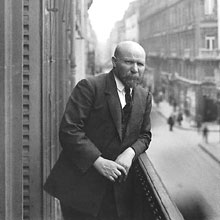
Albert Kahn, from http://www.ejumpcut.org © Albert Kahn Museum – Département of Hauts-de-Seine
A lot of people are coming to this blog in search of information on Albert Kahn, following the BBC4 series The Wonderful World of Albert Kahn. The Kahn collection is best known for its still photographs, which largely lie outside the concerns of The Bioscope, but he did employ motion picture cameramen too (as well as acquiring film from other collections), so here’s a short account of his Archives de la Planète, and some pointers on where to find out more.
Albert Kahn was a millionaire Parisian banker and philanthropist who decided to use his fortune to document the world in photographs. Between 1908 and 1931 he sent out still photographers and motion picture cameramen to create a photographic record of the globe. The project was supervised by geographer Jean Brunhes, who employed around eleven cameramen who visited forty-eight countries and brought back 72,000 Autochrome colour plates, 4,000 steroscopic views, and 600,000 feet of film. They also acquired film from commercial companies, including newsreels and scientific films. Kahn called the project the Archives de la Planète. Kahn lost his money in the Depression, bringing an end to the project, but the collection survived. It has remained remarkably little known, particularly the film component, but a steady trickle of academic interest in recent years has now been followed by the success of the BBC4 series, which has rightly startled people with the beauty of the images and the sheer extent of what they recorded.
Most of the film collection is in the form of unedited rushes of actuality subjects: everything from film taken in Mongolia in 1912-13, to the signing of the Briand-Kellogg Pact in 1928, A.J. Balfour visiting Zionist colonies in Palestine in 1925, fisheries in Newfoundland in 1922, and dancers in Cambodia in 1921. Kahn’s cameramen included Stephane Passet, Lucien Le Saint, Léon Busy, Frédéric Gadmer, Camille Sauvageot and Roger Dumas.
There is an informative and thoughtful article by Teresa Castro, ‘Les Archives de la Planète: A cinematographic atlas’, which is a good place to start, and has some beautiful Autochrome illustrations.
There is no Les Archives de la Planète or Albert Kahn website with a collection of the images on show (update: the BBC has now created www.albertkahn.co.uk). The Hauts-de-Seine.net site has some pages on the Musée Albert Kahn giving basic information and access details, in French. [Another update: the link is now www.albert-kahn.fr]
The Museum is located in the Paris suburb of Boulogne-Billancourt, and is renowned for its beautiful gardens. There is a plain official web page describing these, but you are better off reading the evocative New York Times article, ‘Philosophy in Bloom’, by Jacqueline McGrath, which describes a visit to the gardens (which are apparently not to easy to find).
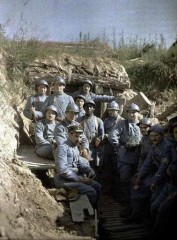
Autochrome of French troops during First World War, from http://www.worldwaronecolorphotos.com
If you are entranced by Autochromes, there are several good sites to visit. This year (2007) sees the centenary of the Autochrome, recognised by www.autochrome.com [link now dead]. The highly recommended Luminous Lint photography site has an explanation of the ingenious Autochrome photographic process, involving the use of dyed potato starch grains acting as colour filters, which helped give them their particular ‘impressionist’ effect.
The site World War I Color Photos has some astonishing images from a conflict we generally only imagine in monochrome. Australian and French First World War Autochromes are reproduced on the Captured in Colour site (which also displays the Paget plate colour system). And there are more First World War Autochromes on the Heritage of the Great War site (though do note this site mixes these up with other coloured images, including artifically-coloured postcards).
The Library of Congress has a page on the restoration of Autochromes. There is an exhibition of the expressive Autochrome work of Gabriel Veyre at www.gabrielveyre-collection.org (Veyre did not work for Kahn but was previously a film cameraman with the Lumière brothers, inventors of the Autochrome). George Eastman House has an online exhibit of eighty Autochromes from the Charles Zoller collection, reproduced in high resolution. The Galerie-Photo site has an exhibition of Autochromes (originally stereoscopic i.e. 3D), with some interesting technical observations.
American academic Paula Amad has written “Cinema’s ‘sanctuary’: From pre-documentary to documentary film in Albert Kahn’s Archives de la Planète (1908-1931)” for the journal Film History, the best single source for information on Kahn’s project, and is writing a book on the collection.
The site www.autochrome.org [link now dead] doesn’t have that much information, but it does tell you in detail how to make your own Autochromes the original way (it’s not easy). If you don’t want to try the original potato starch method, why not use Photoshop? PhotoshopSupport.com will show you how.
Pioneering scientific filmmaker Dr Jean Comandon was one of those who worked for Kahn, late on in the project, as the Institut Pasteur explains (in French).
Definitely the book on Autochromes to buy is John Wood’s The Art of the Autochrome. There will be no more beautiful title on your bookshelves.
Lastly, look out for the National Media Museum’s forthcoming exhibition The Dawn of Colour: Celebrating the Centenary of the Autochrome, which opens on May 25th.
Update (April 2008): The BBC has now produced an Albert Kahn website, www.albertkahn.co.uk, which has information on Kahn, the autochromes and the Albert Kahn museum, as well as promoting the new BBC book The Wonderful World of Albert Kahn: Colour Photographs from a Lost Age. No plans have been announced for a DVD release of the BBC series, presumably owing to licensing issues. However, the Kahn museum section of the new BBC site refers to some DVDs, without going into further details. It has been rumoured that the museum was planning to produce some DVDs of its own, showcasing its Autochrome colour photographs (and its films?). This may be a reference to these, which do not seem to have been published as yet.
Another update (March 2009): There are faint rumours of a possible DVD release, in some form. However, the original The Wonderful World of Albert Kahn series is now available on DVD from the BBC, but only from its educational service, BBC Active, where it is priced at an eye-watering £1,125 for 9x50mins DVDs – the intended market is institutions only. This existence (and price) of this would suggest that any subsequent commercial release to the public will be highlights in some form.
And another update (September 2009): There is now a proper website for the Musée Albert Kahn, at www.albert-kahn.fr. It’s all in French, but includes several examples of the autochromes, photographs of the museum and gardens, a biography of Kahn, and news of exhibitions etc.
Final (?) update (September 2009)
Good news – the BBC has brought out the series on DVD. The Wonderful World of Albert Kahn is a 3-disc set (PAL, region 2), divided into nine parts, running 462mins. It’s released by 2 entertain, which is part-owned by BBC Worldwide.
More Ancestors on Board

As reported in an earlier post, an important new research resource was published this year by the UK’s National Archives and findmypast.com. Ancestors on Board will eventually become a record of everyone who sailed out of a British port (including all Ireland to 1921) on long-distance voyages from 1890 to 1960, taken from the records of the Board of Trade. The first tranche of data released covered 1890-1899; now the site covers 1900-1919 as well. So now there are even more opportunities for historians of silent cinema to track the to and from of actors, filmmakers and executives going to America from Britain. You can find young hopefuls Charles Chaplin and Stanley Jefferson (soon to be Stan Laurel) sailing out in 1912 with the Fred Karno troupe, future Hollywood mogul Samuel Goldfish (later Goldwyn) hoping to find his fortune in 1899, and D.W. Griffith and Billy Bitzer returning to America in 1917 after filming scenes for Hearts of the World in Britain. The name search is free, but there is a charge for viewing images of the ships’ lists or transcripts.
Nineteen (Obscure) Frames that Changed the World

In October 1888 the French-born inventor Louis Aimé Augustin Le Prince recorded what is thought to be the first ‘film’ in the history of cinema. His subject was Leeds Bridge – the ebb and flow of humanity – people going about their daily business unaware that their motions were being inscribed into history. The surviving frames of this footage are owned by the National Media Museum in Bradford where Curator of Cinematography, Michael Harvey, has been working with New York video artist Ken Jacobs for 18 months to provide footage for the unique exhibition Nineteen (Obscure) Frames That Changed the World. As the blurb puts it, “Ken Jacobs probes the magnitude and infinity of the existing frames, using a unique 3D projection system (with 3d glasses) to reveal hidden beauty and unlock great waves of motion. Ken Jacobs’ films, performances and installations inspire a sense of awe and mystery that audiences must have felt when confronted by moving images at the very start of cinema.” The exhibition opens on Thursday 24 May and runs from 25 May–1 June, 11.30am–6.30pm with free entry. Further information here.
Moving Pictures in Westminster
The Moving Pictures exhibition on the film and cinema business is London before the First World War will be on show at the City of Westminster Archives Centre 5-30 June. The exhibition, which was previously shown at Hornsey Library and Hampstead Museum, focusses on the highly active film industry and cinema business in London before 1914, with an emphasis on the relationship with local communities. The exhibition is based on The London Project, a research project hosted by Birkbeck College, London, which resulted in The London Project database of film businesses and cinemas in London before the First World War.
There are associated talks taking place at the Centre on 19 and 26 June, at 6.00 pm (admission free). The Archives Centre is located here.
For the weekend of 23-24 June the exhibition will move temporily from the Archives Centre to feature as part of West End Live, in Leicester Square.
Kevin Brownlow at the SFFF
The San Francisco Film Festival provides assorted video reports to YouTube, including the Scoup du Jour news report. This edition covers Kevin Brownlow receiving an award from the festival for his incomprable work in restoring and promoting the silent film.
Jackeydawra Melford
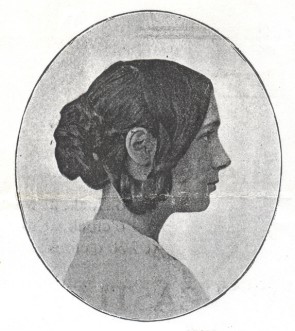
Continuing with the subject of British women filmmakers of the silent era, one remarkable name – literally – is Jackeydawra Melford. She was almost but not quite the first first women to direct a fiction film in Britain (that honour usually goes to Ethyle Batley). She produced and performed in The Herncrake Witch (1912), The Land of Nursery Rhymes (1912) and The Inn on the Heath (1914), the latter of which she also scripted and directed. None is known to survive. [Update (December 2011): a copy of at least part of The Herncrake Witch exists – see comments]
She was the daughter of actor and author Mark Melford (c.1851-1914), who towards the end of his stage career turned to film production. His daughter Jackeydawra was born around 1890 (I haven’t been able to find a birth record), possibly getting her extraordinary name from a comedy opera Jackeydora, or The Last Witch, which toured Britain in 1890. Her name seems to be written differently in every source: Jakidawdra, Jackeydawra, Jackeydora, Jackiedora. She acted in her father’s stage productions from a young age, sometimes billed just under first name. She married Wallace Colegate in London in 1915, and then slips out of history. But we have the above picture of her which accompanied this short profile from The Cinema, 19 March 1913, p. 37:
This young lady, but just out of her teens, is the only daughter of Mark Melford, and, developing an ambition to master the mysteries of the camera, she has acquired that technical knowledge of the art of film-making that, coupled with her artistic gifts in dress, colour, light, &c., has rendered her an invaluable assistant to her able chief. Her clear-cut features and pathetic face are indispensable to the pictures, and her experience of acting from an early age has given her that ease, repose, grace, and power of expression so necessary to ensure good results in this department of her profession.
Miss Jackeydawra Melford has played all the principal parts in her father’s plays and sketches throughout the United Kingdom, and will prove an invaluable addition to the acting staff of this enterprising firm – nay, more, Miss Melford is so admirably adapted to picture work that she will, we think, make a name in the cinema world as she has upon the stage, and Jackeydawra will become a household word.
How much might we want to pursue someone none of whose films are known to survive? Or is the story of lost films and those who made them a special kind of history? Who needs films to write film history anyway?
British Pathe at ITN

Alas, having posted items on the British Pathe newsreel site telling people about the free downloads (with lots of silent material, including some fiction films), the service has changed. The agreement the company had with the Lottery Fund was that it would make its collection freely available online for three years, and then might charge. Well, it’s been a bit more than three years, and the charging has been brought in. It is no longer possible to download low resolution copies for free. Instead you are offered high resolution (512Kb/per sec) copies which can be downloaded for £25 (plus VAT). You can still search the database and view the preview stills for free, but the free downloads have gone.
But do not despair! Because the British Pathe films are also available from ITN Source, ITN currently having the rights to manage British Pathe footage sales. And there, if you go to the Advanced Search option, and select British Pathe from the Collection drop-down menu, you get access to the entire library with free video streams (but not downloads). How long this situation will continue, I’ve no idea, but for now it’s all there to view from ITN – but not to keep.
Modern Gladiators
I am poorer but richer. I have forked out for Antonia Lant’s Red Velvet Seat: Women’s Writing on the First Fifty Years of Cinema, as already promoted here. It is full of riches. The notes alone are a map to a marvellous world, with a host of tempting pathways down which to travel.
There’s so much that one could say about the texts in the volume, but the first thing to catch my eye was two pieces written by women who saw the film of the World Heavywieght Championship bout at Carson City, Nevada, between James Corbett and Bob Fitzsimmons, on 17 March 1897. One is a short, anonymous piece, ‘The Matinee Girl’, from the New York Dramatic Mirror, 12 June 1897; the other is a longer piece by Alice Rix, ‘Alice Rix at the Veriscope’, from the San Francisco Examiner, 18 July 1897, which is about women spectators of the film.
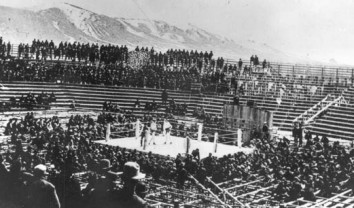
The film was made by the Veriscope Company, which employed three cameras in parallel, housed in a wooden cabin, so that when the film ran out of one the next door camera started (as the picture above shows). The result was a seemingly continuous, single-position record, which ran for well over an hour (there were fourteen rounds). The film was 63mm wide, giving a ‘widescreen’ effect which was shaped to the size of the ring:
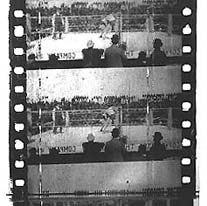
The film was widely shown and enthusiastically watched by audiences worldwide most of whom had never seen a boxing match (boxing was illegal in every American state except Nevada). There was clearly a number of women who went to see the film. And another of them wrote about the experience. Lady Colin Campbell, who wrote a column in The World, on 20 October 1897 wrote about seeing the film at the Aquarium in London (using the pen name Véra Tsaritsyn), under the title ‘Modern Gladiators’:
In spite of all that the humanitarians may say or the Peace Society may preach, the love of fighting will endure to the end of time … it is with satisfaction that I note the number of people who are crowding into the theatre of the Aquarium to see the cinematograph version of the great fight between Corbett and Fitzsimmons, which took place last March in Carson City, Nevada.
It certainly was an admirable idea to have got up this historic encounter for the sake of the pictures to be obtained of it. It is given to comparatively few to see a real prize-fight; but these pictures put the P.R. ‘on tap,’ as it were, for everybody. It is the real thing: the movements of the men, the surging of the crowd, the attentive ministrations of the backers and seconds, are all faithfull represented; only it is so bowdlerised by the absence of colour and noise that the most super-sensitive person, male or female, can witness every details of the fight without a qualm. Evidently the fair sex appreciate such an opportunity, for there are plenty of those tilted ‘coster-girl’ hats adorned with ostrich feathers that would delight the heart of a ‘donah,’ which are fashion’s decree for the moment, to be seen in the theatre … The five-shilling ‘pit’ (which are the lowest-priced seats for this peep-show) is soon filled up; the half-guinea stalls are not long behindhand; and the only part of the auditorium which remains partially empty is the back row of the stalls, which, for some mysterious reason, is thought to offer such exceptional advantages that the seats are priced at a guinea. The seats being exactly the same as the half-guinea abominations in clinging red velvet, and the point of view being precisely similar to that of the front row of the pit (which is only divided off by a rope), we ponder over the gullible snobbishness of the world, while a well-meaning but maddening lady bangs out ‘The Washington Post’ out of an unwilling and suffering piano in the corner. We have nearly arrived at the point of adding our shrieks of exasperation to those of the tortured instrument when the show begins and the ‘Washington Post’ is mercifully silenced.
We are first gratified with a little slice of statistics; the two miles of films on six reels, containing one hundred and sixty-five thousand pictures; the prize of 7000l. which went to the victor; the names of the referee, the timekeeper, and various other details, to which the audience listens with ill-concealed patience … [T]he first picture is thrown upon the sheet, and, having wobbled about a little to find the centre of the canvas, settles down into an admirably distinct view of the platform, with the two champions wrapped in long ulsters, each surrounded by his backers …
Here she goes on to describe the fight in great detail, commenting on the odd effect of the silence, complaining about clinching, and describing the dramatic end where the defeated Corbett in a rage tried to attack Fitzsimmons, causing mayhem in the ring.
The two miles of pictures have taken an hour and a half to pass before our eyes; but though we leave the theatre with aching heads, we regret that so little that we determine to return as soon as we can, to witness again this combat of modern gladiators.
And though here at the Bioscope we’re wary of pointing people to stuff published illegally on YouTube, you can see edited highlights of the bout from a 16mm print probably dating from the 1960s. The intertitles are an obvious modern addition, as is the use of slow motion where they repeat the shot of the knockout blow, where the original film has been damaged. About a third of the film survives today – disappointingly, the scenes showing the uproar at the end of the fight are missing.

