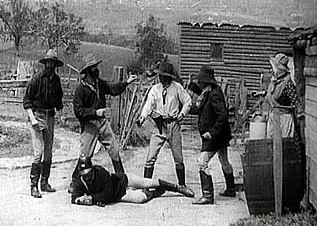
Cowboys and Indians

The East End Years

http://www.amazon.co.uk

I’m a collector of memoirs (published and unpublished) of the film-going experience in the early years of cinema. One particular favourite from my work on London before the First World War is the memoirs of Fermin Rocker, The East End Years: A Stepney Childhood. I just came across a copy in Foyles today, and thought it worth sharing with you.

Rocker (1907-2004) led a somewhat unusual London childhood, in that his father was the German anarchist theorist Rudolf Rocker, while his mother was a Jewish-Ukranian anarchist-syndicalist, and their home was a focal point for revolutionaries. Kropotkin and Malatesta were family friends, and his childhood memories of life in Jewish Whitechapel are fascinatingly coloured by the radicalism that was all around him. This is evidenced by his memories of going to the cinema when very young (maybe six or seven), where his reactions to Westerns were at variance with most children:

High on my list of favourites were the Indians of North America, a people for whom I had an unusual degree of admiration and sympathy. Their picturesque appearance as well as their skill and bravery as hunters and warriors greatly impressed me. Coupled with this regard and affection was a strong feeling of outrage aroused by my father’s stories of the deceit and treachery practised upon them by the white man. I dearly wished that some day the redskins would be able to turn the tables on their white oppressors and drive them from the continent which their cunning and duplicity had helped them conquer …

… My partiality for the redskin was to have some unhappy consequences when I received my first exposure to the cinema. The Westerns, which featured rather prominently in the repertory of those days, invariably had the Indians getting the worst of it in their encounters with the white man, a headlong rout of the redskins being the usual outcome. I found it quite impossible to look on calmly while my friends were being massacred on the screen. Not being nearly so stoical as my Indian idols, I would raise a tremendous commotion and have to be taken out of the theatre to prevent things from getting completely out of hand. After a few experiences of this kind, it was decided not to take me to the “pictures” any more, a resolution I did not in the least regret.

Not every child liked going to the cinema in those days. Rocker much preferred Punch and Judy shows (“I sometimes wonder if the creator of the Punch scenarios was not an anarchist in disguise. His hero was forever running afoul of the law…”). He went on to become a noted artist and book illustrator, examples of which you can see find at www.ferminrocker.com.
Silents at the Barbican

Silent Film & Live Music

http://www.barbican.org.uk

The Barbican in London is putting on a new series of silent films with special music accompaniment for its Silent Film & Live Music series. It’s a superb line-up once again:

16 September: Orphans of the Storm (D.W. Griffith, 1921)
Live piano accompaniment by Neil Brand

Invitation to a Dream – Silent Film & the Avant-Garde

7 October: The Smiling Madame Beudet (La Souriante Madame Beudet) (Germaine Dulac, 1922) + Themes et Variations (Germaine Dulac, 1928)
Live piano accompaniment by Errolyn Wallen
+ Disque 957 (Germaine Dulac, 1928) + Invitation to a Journey (Germaine Dulac)
Live performance by L’Inquiétant Supsendu

+ The Seashell and the Clergyman (La Coquille et le clergyman) (Germaine Dulac, 1927)
With live accompaniment by Minima

21 October: Faust (F.W. Murnau, 1926)
The London premiere of a new score composed by Jean Hasse and conducted by John Traill

31 October: Dr Jekyll & Mr Hyde (John S. Robertson, 1920)
Live accompaniment by DJ Nacho Martin

Crime and Deviancy in Silent Cinema

4 November – Underworld (Josef von Sternberg, 1927)
Live piano accompaniment by Neil Brand

11 November – The Hound of the Baskervilles (Maurice Elvey, 1921)
Live piano accompaniment by Stephen Horne

2 December – The Lodger (Alfred Hitchcock, 1926)
Live performance by Cipher

16 December – Peter Pan (Herbert Brenon, 1924)
Live fairy harp accompaniment by Elizabeth Jane Baldry

More information as always, including booking details, from the Barbican site.

Journal of Film Preservation

Journal of Film Preservation

Journal of Film Preservation, from http://www.fiafnet.org

FIAF, the International Federation of Film Archives, “brings together institutions dedicated to rescuing films both as cultural heritage and as historical documents”. You can find details of the 120 or so institutions from sixty-five countries which belong to FIAF on its multilingual site, as well as standards documentation, news, projects and information on FIAF’s various specialised commissions.

The site also has details of FIAF publications, which include its Journal of Film Preservation. The journal covers theoretical and technical aspects of moving image archival activities, with plenty of information on silent film, which has always been a favoured area of the national film archives. It’s a very good publication, which is not much known about outside the film archiving profession. The journal is published twice a year, and one year after publication is made freely available on the FIAF site.

So there are currently twenty issues of the journal, from 1995 onwards, which can be downloaded from the site in PDF format. Here’s a guide to some of the articles worth looking out for:

  • No. 52 (Apr 1996) – Brian Taves on the work on undersea cinematography pioneer James Ernest Williamson, who made Twenty Thousand Leagues Under the Sea in 1916
  • No. 53 (Nov 1996) – Luke McKernan (yours truly) on programming a season of Victorian cinema (i.e. film to 1901) at the National Film Theatre
  • No. 54 (Apr 1997) – Richard Brown on the copyright records for early British films found in the then Public Record Office (now The National Archives)
  • No. 60/61 (Jul 2000) – Alfonso del Amo on the history of celluloid
  • No. 62 (Apr 2001) – Brian Taves on Michael (Jules) Verne, who both wrote novels in his famous father’s name, and then proceeded to film them
  • No. 64 (Apr 2002) – Sarah Ziebell Mann on the creation of the Treasures from the Film Archives database of early silent short fiction films around the world
  • No. 65 (Dec 2002) – Yoshiro Irie on the question of film speeds of Japanese silent films
  • No. 69 (May 2005) – Thomas C. Christensen on efforts to recover and restore the films of Asta Nielsen
  • No. 70 (Nov 2005) – Tiago Baptista on restoring the early surgical films of Eugène-Louis Doyen
  • No. 72 (Nov 2006) – Steven Higgins on avant garde cinema of the 1920s and 1930s

And much, much more. A fair bit of it is rather more technical than the general reader requires, but most articles combine the practical with the historical in engrossing fashion, and the illustrations are excellent (and rare). The Bioscope will be following up some of the themes above in future posts.

Odd links

Anyone hoping to use the right-hand column links on The Bioscope may notice that they are all in the wrong categories. This is a general problem across WordPress which their brightest minds are at this very moment trying to fix. So, normal service to be resumed as soon as possible.

australianscreen

australianscreen is a first-rate educational website created by the Australian Film Comission, with material from the National Sound and Film Archive, the National Archives of Australia and others.

The site features contains information about, and in many cases excerpts from, a wide selection of Australian feature films, documentaries, television programmes, newsreels, short films, animations, and home-movies produced over the last 100 years, all freely available. It is searchable in a variety of forms, but the broad categories are Feature Films, Documentaries, Television programmes, Short films, Home movies, Newsreels, Advertisements, Other historical footage, Sponsored films, and Short features. Frustratingly, there seems to be no way of search on viewable material alone [correection, there’s something viewable for every title – see Comments], but there is plenty on offer, including MP4 files for download (subject to agreeing to their terms and conditions).

Story of the Kelly Gang

The Story of the kelly Gang, from http://australianscreen.com.au

There is a lot of silent film on view, with helpful contextualising material. Among Feature Films, there are sequences from the world’s first narrative feature film The Story of the Kelly Gang (1906), and two other renowned Australian silents, The Sentimental Bloke (1919) and On Our Selection (1920). Among Documentaries there are such gems as Marvellous Melbourne: Queen City of the South (c.1910) and a Pathé documentary on the making of the newspaper The Sydney Morning Herald (1911). Look out also for Endurance (1933), the sound film version of the film originally shot by Frank Hurley of Ernest Shackleton’s 1914-1916 Trans-Antarctic expedition.

Darwin

Darwin c.1926, from http://australianscreen.com.au

And there’s more. The Newsreels section has extensive material from Australasian Gazette, dating from 1911 onwards. In Other historical footage, look out for Marius Sestier and Walter Barnett’s film of the Melbourne Cup horse race in 1896, one of the first films made in Australia, a parade of Australian troops going off to the Boer War in 1899, filmed by Frederick Wills and Henry Mobsby, and footage of Darwin in 1926 which includes sequences showing the Chinese community.

It’s a marvellous resource, oriented for schools use but of interest to anyone. It’s so clearly laid out and expressed. Go explore.

Border Crossings: Rethinking Early Cinema

And another conference coming up. Border Crossings: Rethinking Early Cinema is taking place 9 February 2008 at the Film Studies department, University of California, Berkeley. There isn’t a conference web page that I can find, but here’s the details of the call for papers – deadline 1 October:

This conference attempts to map cultural travel in silent film. We invite papers on topics which address the mobile nature of silent film. Panels will draw attention to cinematic forms or practices fueled by different forms of international exchange. To this end, papers that approach the specific co-ordinates of silent film – its new forms of visual address, display, and narrative form from a comparative perspective will be given preference.

The attempt will be to track the exportation and intake of a single moving image technology, the cinema, across nations. We seek to open up a critical space to observe the particular ways in which cinema, conceived as a “traveling technology”, understands pleasure, self, world, nation and collectivity. The conference asks but is not limited to the following questions: how did popular silent film proliferate? Which legal systems encouraged the spread of silent cinema? How might the relationship between nation and silent film be characterized? Is “nation” more easily imagined in sound cinema? Which cultural forms, stars, or cinematic genres traveled easily, and which not?

Pleae send a 500 word abstract and a brief vita to rethinking.early.cinema_at_gmail.com. The deadline for sending proposals is Oct 1, 2007.

Conference Organizers:
Anupama Kapse and Laura Horak
Film Studies, University of California, Berkeley
7408 Dwinelle Hall #2670
University of California
Berkeley, CA 94720-2670

Lots of deep questions that you probably hadn’t ever thought of asking.

Women and the Silent Screen V

The year wanes, darkness falls earlier, 2008 diaries are in the shops, and academics are looking to a new year and coming up with conferences. And so we have first news of the Fifth International Women and the Silent Screen Conference, to be held at Stockholm University, Sweden, 11–13 June 2008. Previously held at Utrecht, Santa Cruz, Montreal and Guadalajara, the conference promises a combination of archival screenings, keynote addresses and scholarly panels, on the theme of women and cinema during the first four decades of film history; that is, women as directors, screenwriters, producers, actors and filmgoers.

There’s a call for papers, which asks for abstracts of 200–300 words, together with a paper title and a two-line biographical statement, to be submitted by 15 December 2007, to wss@mail.film.su.se. More details (in English as well as Swedish) on the conference website.

The Cameraman’s Revenge

I’ve written before of those points where my interests in silents and modern jazz/avant garde music match. One particular hero is the American guitarist Gary Lucas, whose extraordinary accompaniment to a scene from Der Golem has already appeared on The Bioscope.

I’ve just found on his website another silent film with his accompaniment. He had a touring show, Sounds of the Surreal, which presents his live accompaniment to Rene Clair’s Entr’acte (1924), Fernand Leger’s Ballet Mecanique (1924), and Ladislaw Starewicz’s The Cameraman’s Revenge (1912), which available as a QuickTime file on his site.

The Cameraman’s Revenge

The Cameraman’s Revenge, from http://www.garylucas.com

Ladislaw Starewicz (1882-1965) is one of cinema’s true originals. His passion was entomology. He was taken on by the Russian company Khanzhonkov as a designer, and turned to directing model animation in 1912. His extraordinary idea was to build on his hobby by animating insects with stop-motion photography, in parodies of human activity. The Cameraman’s Revenge (or Mest’ kinematografičeskogo operatora) is his best-known film from this period, where a bettle and a grasshopper both pursue a dragonfly dancer, and the envious grasshopper captures evidence of a romantic tryst between the pair on his motion picture camera. It is one of the damnednest things you ever saw.

He made several other such stop-motion and animated films, including The Ant and the Grasshopper, Insects’ Aviation Week and Voyage to the Moon. In the 1920 Starewicz moved to France, where he won increased fame for animated films such as La voix du rossignol (1923), Amour noir et amour blanc (1928) and the feature-length Le roman de Renard (1928-39), all produced with dogged independence.

To be honest, the Gary Lucas score, with National steel guitar, doesn’t connect much with the action, and the version online is incomplete, missing the conclusion where the grasshopper’s film is shown. Nevertheless, it’s worth checking out just for being so odd, and selections of Starewicz’s films happily are available on DVD.

Celebrating Toronto

I reported a while back on the Cinema by Citizens: Celebrating the City initiative from the Toronto Urban Film Festival (TUFF), which invited people to submit silent, one-minute videos on a range of urban themes. The festival is currently running, and the sixty winning films are now being exhibited online (all via YouTube). I’ve skimmed through several, and the quality is very high. I rather like this one, My Beautiful City, by Nadia Tan and Maya Bankovic:

Sample the others on the TUFF site or via their YouTube page.

The silent film pianist speaks

OK, back to some semblance of normality after all that mayhem. There’s a good interview with silent film pianist Neil Brand, originally published in The Scotsman, 6 August 2007, that’s just been made available online. Here’s the start of it:

I’m sat, listening to Neil Brand expound upon the history of silent film, when he glances over, across the hotel lobby and acknowledges his principal ally in reviving interest in the works of Chaplin, Lloyd, Laurel and Hardy. Without breaking stride, Paul Merton sallies on past and announces “don’t believe a word”.

As a jobbing silent pianist, and by that I mean he’s constantly being invited to perform at the world’s most prestigious film festivals, Brand routinely eschews words for eloquent arrangements of music. Yet as someone whose career spans from before the talkies to the present day, at least according to definitive internet movie website IMDB, which eerily traces the 49-year-old’s collaborations back to the 1910s, the composer, actor and dramatist can’t half talk a fascinating history.

The previous day at a nearby cinema, I’d witnessed him score a restored print of Buster Keaton’s classic The General and heard Merton, for whose Silent Clowns TV show and live performances Brand played piano, chuckling at a film he’s undoubtedly seen tens of times, if not more. Like many in the audience I suspect, I was initially distracted by the novelty of this bespectacled chap at the piano, though after a while I ceased to notice even his distressingly bright shirt. A significant factor in this was obviously Keaton’s consummate physical performance, but another was the cocooning insulation of the accompanying music.

“It’s odd,” Brand reflects. “What you tend to find is that most audiences, for the first five or ten minutes, they’re mentally struggling with the fact that they’re watching a film and can’t hear anything else. Then something just clicks, I don’t know what it is that pulls them in.

Hmm, that sounds like one of Neil’s shirts alright. Follow the rest of the interview on the Future Movies site.

And see how the Internet Movie Database indeed traces Neil’s career from the present day back to the 1910s…