Three types of authenticity

The Aurora

Douglas Mawson’s ship The Aurora, from http://www.south-pole.com

This evening on Channel 4 there was an intriguing 90 mins documentary on Douglas Mawson, When Hell Freezes, made by the estimable Flashback Television. It’ll need to be some other time for me to produce for you a substantial post on silent film and polar exploration (a particular interest of mine), but this programme needs to be noted now for its use of original archive film of Mawson’s expedition as one type of evidence with which to convince us in our comfortable twenty-first century lives of the splendours and miseries of the golden age of Antarctic exploration.

Mawson is less well-known than Robert Falcon Scott or Ernest Shackleton, whose own Antarctic follies have been richly documented in recent years, Shackleton in particular. Mawson was perhaps less of a self-publicist, though he took care to have a motion picture cameraman with him (the motion picture rights helped pay for several of the Antarctic expeditions of this period), who just happened to be Frank Hurley, later (and particularly of late) to find fame as Shackleton’s cinematographer. Mawson also produced a book, The Home of the Blizzard.

His 1912-13 expedition – naturally conducted for the finest scientific reasons – explored the area of Antarctica to the south of Australia, and aimed to visit the South Magnetic Pole. Disaster struck when team member Edward Ninnis fell through a crevasse, complete with dogs and sled. Mawson and Xavier Mertz, who were with him, turned back from their exploration, but Mertz died on the return journey. Mawson made an astonishing solo journey back, arriving back at the home base only to find that the expedition ship the Aurora had left just a few hours beforehand (happily, some colleagues had remained behind in the faint hope of his possible survival). Hurley, of course, was not with the trio on this ill-fated section of the expedition, and consequently no film of it exists.

What I found intriguing about the film was its multi-layered approach to authenticity. We have in past years had the past made convincing to us through the use of archive film (and photographs). Today, however, the fashion is either for dramatic reconstructions, or a presenter going through the same privations as those suffered in the past. When Hell Freezes gave us all three, plus readings from Mawson’s text. Our modern counterparts were Tim and John, who retraced Mawson’s steps using the same equipment and clothing in the kind of pseudo-authencity one can only achieve when a television programme is to be made about the adventure. The dramatic reconstructions were bleached out to look like Hurley’s original footage, and at time the untrained eye would not have spotted the difference between the two.

The modern adventure failed to thrill, as it was inevitably doomed to do (“will Tim and John survive on the ice…?” Of course they will), but the idea was somehow to blend the three styles so that present became past and past became present. But modern video is too bright, too much of the moment – it anaethetizes the ordeal. The monochrome silent footage, by its very distance, makes those things endured in the past seem all the more astonishing, because they seem so distant. In seeing the films of Scott, Shackleton and Mawson we long for close-ups and the camera techniques of today that will bring them that much closer to us, but maybe it is the lack of intimacy that is their strength. When Hell Freezes‘s own faux dramatised scenes were strongest when they showed figures lost in the white distance, not trying to show the agonies etched on their faces.

Anyway, it was a good programme, and despite my advocacy of the archive footage, probably its best moment was the Touching the Void-like sequence where the exhausted Mawson falls down a crevasse and manages, utterly improbably, to climb back up, fall back, yet somehow find the strength to climb his rope once again to safety – while our modern day hero fails to emulate him. Whatever the means of imaginative recreation at our disposal, some feats lie beyond all comprehension.

Peter’s Polar Place is an excellent source of information on the works of Frank Hurley, including archive holdings of films films and those available on DVD. There doesn’t seen to be DVD available of Hurley’s original 1913 documentary, Dr Mawson in the Antarctic (erroneously known as Home of the Blizzard in some sources), but the film itself is held in the National Film and Sound Archive of Australia.
Animals in motion

These are heady times for the Bioscope, with hundreds of visitors all in pursuit of information on Paul Merton, following the mention of his new book and Silent Clowns tour on Have I Got News for You. So, what can we do to catch the eyes of these passing visitors and maybe entice them to find out more about the worlds of early and silent cinema? Well, what about some nineteenth-century studies of animal motion?

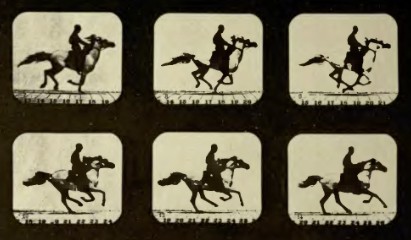
Mohammed running

Mohammed Running, from The Horse in Motion

So, we have two new additions to the Bioscope Library, the first of which is The Horse in Motion, by J.D.B. Stillman, published in 1882. Who he? Well therein lies a tale, because the true author of this work should have been the rather better-known Eadweard Muybridge. The book, commissioned by Muybridge’s patron, the railroad baron Leland Stanford, was based on Muybridge’s now famous photographic studies of a horse galloping. But master and reluctant servant had fallen out, and the book was published under Stillman’s name, giving Muybridge negligible credit. The book contains detailed description of the studies into the motion of the horse (and other quadrupeds), with five of Muybridge’s photographs and ninety-one lithographs based on his photographs, plus line drawings. The book’s publication caused considerable embarrassment to Muybridge at the time, as his contribution to the scientific studies was now questioned by several authorities, but it is an important publication nonetheless in the history which took us from sequence photography (or chronophotography) to the successful creation of cinema. It’s available from the Internet Archive in DjVU (6MB), PDF (67MB) and TXT (279KB) formats.

Marey runner

‘Runner provided with the apparatus intended to register his different paces’, from Animal Mechanism

It’s a happier tale to tell with our other, complementary, addition to the Library, Etienne-Jules Marey‘s Animal Mechanism, or La machine animale, first published in 1873. This was the published expression of Marey’s ‘methode graphique’, where, by a variety of graphical devices devised for the measurement of animal motion, Marey was able to demonstrate diagrammatically the walking motion of humans and horses, and the the flight of birds and insects. By this publication, Marey opened up a world of study not previously imagined, and inspired Muybridge and Stanford to undertake their own investigations. Marey did not use photography for Animal Mechanism, but, inspired in turn by Muybridge’s work, would go on to experiment extensively with sequence photographs, developing the science of chronophotography, and through it the mechanism for cinematography. The Internet Archive has both the 1879 American edition, in DjVu (9.9MB), PDF (20MB), b/w PDF (12MB) and TXT (582KB) formats, and the English third edition (not so well scanned), in DjVu only (33MB).

From 1896 to 1926 – part 5

Cinematograph show under the new L.C.C. rules

Cartoon parodying the alarm over the L.C.C.’s first regulations for film exhibition, from The Showman, 8 March 1901 (signed as being originally from The Photographic Dealer, 1898)

Back to the reminiscences of Edward G. Turner, the pioneer British film distributor. We’re still in the 1890s (we will move out of them eventually), and Turner and his partner J.D. Walker have their first encounter with the London County Council (L.C.C.), which had responsibility for the inner London area, including its public entertainments. The L.C.C. had become alarmed by the threat of fire presented by cinematograph exhibitions.

On November 8, 1897 I had an engagement at the Old Balham Baths, which I believe to-day is a permanent kinema. We had a notification from the L.C.C. that we could not show unless the apparatus and operator were enclosed in a fireproof enclosure.

This notification was delivered to us 48 hours befiore the show. So I worked all day and night in making a box out of corrugated iron. The dimensions were 4 ft. wide, 6 ft. long and 6 ft. high. The sizes were determined by the iron sheets.

This was the first operating-box ever made, and was used at Balham. This box again served as the model for practically every portable iron house, even to its dimensions, and the shutters which I originally made for this box became the standard article for this type of box.

Enter the L.C.C.

In those days the London County Council had no officers for dealing with kinematographic affairs. Somewhere about November they appointed a Mr. Vincent, who, I believe, was the head of the Chemistry Department in Villiers Street, Strand, as the officer responsbile for looking after these affairs. This gentleman inspected our box at Balham on the afternoon of the display, and told us that he would pass the box, subject to same being painted with asbestos paint inside and out.

Why this precaution I have never been able to understand, but the effects on Mr. Walker and myself were disastrous, as we had to work in this confined space, and before the end of the performance we had answered the riddle “Can a leopard change its spots?” We went in in black suits, and came out piebald, with most of the paint adhering to our clothes.

It was at Great Eastern Street that the first operating-box was made, and later improved by the addition of adjustable shutters.

The original box was fitted with a dead-man lever, i.e., the shutters had no means of being held up while the picture was being projected, except by a wire over a pulley, which was attached to a piece of wood about 15 in. long. One end of the wood rested on the floor, and the other, to which the wire was attached, would be about 6 in. off the floor.

The operator placed his foot upon the wood, which by its weight lay flat upon the floor, and the wire would automatically raise the shutter of the operating-box. If he took his foot off the lever, or fainted, or as soon as the pressure was removed from the lever down came the shutter. Later, we did away with the lever.

Soon we moved our offices to the second floor of Wrench’s premises at 50, Gray’s Inn Road, and after nine to twelve months we shifted our quarters to Nos. 77 and 78, High Holborn.

The Safety Shutter

When we had our office at 50, Gray’s Inn Road, we conceived the idea of automatic shutters to fall down between the light and the film. In those days we tested every machine that Wrench made, and, naturally, we took the idea to him, and in his workshop on the top floor, I believe, his mechanic worked out our idea and fitted the shutter, the opening and closing of same being worked by governor balls.

Wrench is Alfred Wrench. The long-established optical firm of J. Wrench & Sons became leading suppliers of cinematographic equipment at this time, and their offices at 50 Gray’s Inn Road housed a number of early film companies, including Will Barker’s Autoscope company, and later the Topical Film Company, as well as the eventual Wrench Film Company.

We then thought of covering in the space between the lensholder and the front of the film gate, working on the known law that combustion cannot take place without air, so that if the film fired in the gate, it went out, because there was not sufficient air left to support combustion, and thus was evolved the first fireproof gate, and we gave it to the world for nothing.

At this time we were doing business with Pat Collins (now an M.P.), Biddell Bros., the late George Green (of Glasgow), Haggar (of Wales), Dick Dooner, Jacob Studd and his sister, Hastings and Whyman, Ralph Pringle, Edison Thomas, Boscoe, all showmen; and, among lecturers, T.M. Paul, A.E. Pickard, A.H. Vidler, Waller Jeffs, Professor Wood, T.R. Woods, Baker (of Liverpool), and Lenton (of the Sherwood Film Agency), who bought his first outfit from me.

We, of course, had a number of competitors:- Joyce, of Oxford; McKenzie, of Edinburgh; Walker, of Edinburgh or Glasgow; Nobby Walker, of Bermondsey; F. Gent, of London; Jury, of Peckham (now Sir William); Brandon Medland; Matt Raymond and his lieutenant Rockett; Fowler and Ward, Ruffles Bioscope; Weisker, of Liverpool; Carter, of Leeds; Lens Bros., of Lancashire; Henderson, of Newcastle, and Gibbons (now Sir Walter). This list by no means exhausts the number.

Early Operators

Some of the operators I can remember who worked for us at this time are as follows:- Chas. Harper, C.H. Coles, W.M. Morgan, “Baby” Morgan, E.T. Williams, Jack Herbert, E. Mason (of Charrington’s, Mile End), J. Gardiner and his brother, George Palmer, W.W. Whitlock (now of gramophone fame), J. Nethercote (a school teacher), A. Malcolm, W. Walker, F. Hull, H. Luner, Joe Saw, Harry Last, F. Haward, Will Turner, T. Bosi (now of Herne Bay).

What an amazing list of names of those involved in the film business in the late 1890s. The showmen’s names are mostly familiar, being prominent fairground figures such as Ralph Pringle, Dick Dooner and William Haggar (soon to be a notable film producer). Edison Thomas is the notorious A.D. Thomas, a larger-than-life figure much associated with Mitchell and Kenyon. Waller Jeffs became a leading exhibitor in the Midlands, Matt Raymond, previously having worked for the Lumières, went on to become a prominent cinema owner (his assistant was Houghton Rockett), the Scottish Walker is William Walker, William Jury went on to become cinema’s first knight, while Walter Gibbons (also knighted) established the London Palladium. But many of those names are unknowns, and offer tantalising new avenues for research.

More from E.G. Turner in a few days’ time.

It’s that man again

There’s an ever so slightly patronising interview with Neil Brand, silent film pianist, from the BBC Today programme, which was broadcast on Thursday 25 October, which can be found on the Today programme site – go to the section 08.00-08.30, and the bit with Neil is at 08.20. You do hear plenty of Neil’s playing while he is being interviewed, which makes for an intriguing news piece. The film he talks about most is The Life Story of David Lloyd George (cue sniggers from the Today interviewer), which is featuring at the Fflics festival in Aberystwyth tomorrow night, with Neil playing.

Motion Pictures in History Teaching

Chronicles of America

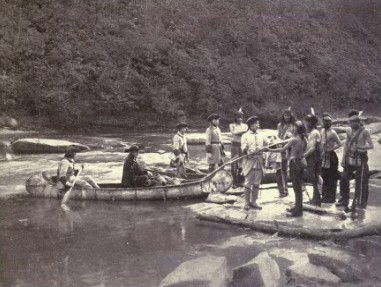
The Gateway to the West (1924), from Motion Pictures in History Teaching

Just added to the Bioscope Library is Daniel C. Knowlton and J. Warren Tilton’s Motion Pictures in History Teaching: A Study of the Chronicles of America Photoplays as a Aid in Seventh Grade Instruction (1929). The Chronicles of America was a 1923-24 series of educational film series produced by Yale University Press. The series included such earnest and traditionalist titles as Jamestown, Yorktown, Daniel Boone, The Declaration of Independence and The Gateway to the West. These three-reeler dramas were relatively lavishly produced, helping to pay their way by getting theatrical screenings. But their target audience was in the classrooms of America, and this study of the series examines its pedagogical value. It looks at how the series contributed to ‘the learning of fundamentals’, and the degree to which they contributed to enrichment, retention and creation of interest’, through a meticulous system of testing groups. The painstaking methodology is as fascinating as the underlying assumptions of the films’ photo-historical validity. It is also handsomely illustrated with stills from the films. It’s available from the Internet Archive in PDF (48MB), DjVu (5.4MB) and TXT (326KB) formats.

21st Century Vertov

You may remember the report of a few months ago about video artist Perry Bard’s idea to recreate Dziga Vertov’s Man with a Movie Camera with uploaded contributions from volunteers around the world.

Man with a Movie Camera, scene 10

Man with a Movie Camera, scene 10, 1928 and 2007 versions, from http://dziga.perrybard.net

The initial deadline for this was 15 September, with the planned new, participatory version of the film being screened on Big Screen Manchester. However, as the project site demonstrates, the uploading continues, with people offering their modern video equivalents of scenes from Vertov’s original (which can be seen on her site in its entirety or scene by scene). You can view each of the sequences, original and remake, though not the new version in its entirety. I haven’t found evidence that it been screened anywhere as yet (does anyone know?), but the site is an extraordinary and thought-provoking work just by itself. Do explore.

Paul Merton’s Silent Comedy

Paul Merton Silent Comedy

Amazon.co.uk

Well, as the Bioscope motors on past the 30,000-views figure, it’s hard to say which has been the most popular topic so far, but it’s probably either Albert Kahn or Paul Merton. Which is ironic, since Albert Kahn has been pursued for the Autochrome colour still photographs he organised rather than the films he commissioned, while Merton is anxious to take a back seat in promoting the work of the silent comedians he so admires.

The latest expression of this is his book, Silent Comedy, which has just been published. I’ve only thumbed through it in a bookshop so far, but what is immediately noticeable is what a wordy, conscientious and carefully-constructed work it is. Merton has paid his dues as a silent film buff, collecting 8mm copies from childhood, reading as well as watching all that he could, and he makes fulsome acknowledgment to Kevin Brownlow and David Gill for their television and restoration work, and to the works of Glenn Mitchell and Simon Louvish. Merton has clearly read a great deal, and the book goes into the personal histories of the silent comedy greats, as well as describing individual sequences in sharp detail. Anyone familiar with this territory will recognise much of the material, but it’s not meant for them. Merton is targetting his young audience, for whom Silent Comedy is a means of discovery, not confirmation of a well-known history. This is a subject that need discovering all over again.

This puts Merton in the awkward position of being the straight man, much as is going to be the case for his forthcoming Silent Clowns tour, where audiences may come to see Merton and his gags, but where Merton is anxious for them to see rather less of him and as much as possible of the films themselves. The book’s cover highlights the problem. Paul stands in the centre, his subjects in the background, but the book itself is organised the other way around.

Well, no matter, it’ll become a favourite Christmas present, and it’s a treasure trove of material that needs to be passed on to a new generation of enthusiasts. It’s also beautifully illustrated. It concentrates on the key names – Chaplin, Keaton, Lloyd, Laurel and Hardy – with little space given to the second tier of comics – Larry Semon, Charley Chase – and no mention at all of ‘minor’ figures like Max Davidson or any European comic except Max Linder (OK, you could argue that Chaplin and Laurel were European…). That’s a bit of a missed opportunity. But it serves a window on a lost world, which might just be that little bit less lost from now on.

Update: There’s a rather muddled (i.e. muddled in that it seems the reviewer can’t decide whether the book is good or not) but nonetheless intriguing review by James Christopher in The Times.

Freak shows and cinematographs

As initiatives such as the Crazy Cinematographe show and DVD are showing, the cinema came out of the fairground and its displays were seen by many as at one with freak shows, waxworks and performing animals. Just as many would probably say that this remains the case. Anyway, published this week is fascinating evidence of this parentage. The Society for Theatre Research has published The Journals of Sidney Race, 1892-1900: A Provincial View of Popular Entertainment. Sidney Race was a gas company clerk, living in Nottingham, who started writing down what he saw of life in the city, including its many public entertainments, notably the Nottingham Goose Fair.

From 1892 to 1900, Race recorded his impressions of bearded ladies, armless wonders, performing seals and dancing bears, with a keen eye for ordinary detail. And so, naturally enough, he took note of the cinematograph when it arrived in Nottingham. His first impression was one of scant glamour:

It was a dirty canvas tent with the sheet arranged by the entrance and the apparatus on an old box or two opposite it where it was worked by a grim looking individual as black as a stoker.

Later he recorded seeing a ‘Living Pictures’ in Long Row, Nottingham, where he recorded that:

an enormous number of photographs, taken consecutively, are whirled with the speed of lightning, before your eyes.

He saw films shown on the Edison Kinetoscope, trick films, dramatised scenes depicting the Greco-Turkish War (made by Georges Méliès), and numerous ‘exceedingly improper’ films’. He describes one film which evidently made a particular impression. It was called The Model’s Bath.

A woman – we could detected a large smile on her face – divested herself of her skirt and other outer objects of clothing and appeared in her white drawers and chemise … The girl was in a large white night dress which had fallen down from the breast disclosing a well developed ‘frontage’ … It was a dirty and suggestive exhibition though we really saw no indecency … I am very glad it was late at night when I saw the thing and that no lady was with me.

This remarkable find was made by theatre historian Ann Featherstone, University of Manchester, who came across the journal in the Nottingham Archives. It’s not unknown to film historians, as Vanessa Toulmin of the National Fairground Archive has used the journals, and cites several passages in her essay ‘The Cinematograph at the Nottingham Goose Fair, 1896-1911’, in Alan Burton and Laraine Porter (eds.), The Showman, the Spectacle & the Two-Minute Silence: Performing British Cinema Before 1930 (2001). She notes Race’s scepticism, indicating that early audiences were not always taken in by the trickery of some films as some have suggested, being able to tell a dramatised war scene from the likely reality, for instance.

I’ve not yet seen a copy of the publication, and it’s not easy to find information on it, not least because there’s nothing as yet on the Society for Theatre Research’s web site. There’s a citation for the original journal on the Nottinghamshire Heritage Gateway. I’ll put up more information when I find it.

Update (March 2008):
This message has come from the Journals’ editor:

Hello, I’m Ann Featherstone. I edited the Journals of Sydney Race, published by the Society for Theatre Research. I’ve been working on and around these fascinating journals for about 10 years (!), and I was really glad when the STR agreed to publish the selection. They are absolutely fascinating. Sadly, the book hasn’t appeared on the STR website – I don’t know why. But if anyone wants a copy, please email me. The cost is £11.50 (inc. p & p).

Email Ann at a.featherstone3 [at] ntlworld.com

New York Morning Telegraph

Just found this out on alt.movies.silent. During a 1980s research project on William Desmond Taylor, Bruce Long photocopied the ‘Pacific Coast News’ column of the New York Morning Telegraph, 1914-1922. As Long says:

During the silent film era, the New York Morning Telegraph had more coverage of the film industry than any other daily New York newspaper; its coverage included a weekly column of movie news from Los Angeles, initially titled “Pacific Coast News.” As the film industry in Hollywood expanded, that column also grew in size. Many of the “news items” came directly from publicity agents, but they still provide a useful historic glimpse into Hollywood’s growing silent film industry. Major Hollywood news stories would have been given separate articles instead of a mention inside this column. The columnists of “Pacific Coast News” included Edward V. Durling, Clem Pope, Margaret Ettinger, and Frances Agnew.

Long has now dusted down his photocopies and put them online. They are JPEGs only, and not word-searchable, but it looks like a handy research source for the patient.

He Who Gets Slapped

He Who Gets Slapped

Lon Chaney in He Who Gets Slapped, from http://www.bbc.co.uk/news

The Victor Sjöström-Lon Chaney classic He Who Gets Slapped is due to get the modern-score-from-rock-musician-seeking-new-challenges treatment, as BBC News Online reports:

Goldfrapp star writes film score

Goldfrapp keyboardist Will Gregory is joining the BBC Concert Orchestra for the premiere of his new score to silent film classic He Who Gets Slapped.

Portishead’s Adrian Utley will also take part in the performances, in Bristol and London in December.

The 1924 film was the first to be made by MGM and stars Lon Chaney – who also appeared as The Phantom of the Opera – as a clown who gets 200 slaps a day.

Gregory said the film was an “overlooked masterpiece”.

‘Presence and charisma’

Chaney, who was one of the biggest film stars of the day, regarded his role in the film as his best.

“Whenever he is on screen he exudes such presence and charisma that it is easy to see why he was the most celebrated screen actor of his day,” Gregory added.

Chaney, who also starred as The Hunchback of Notre Dame, died in 1930, after making his only “talkie”, The Unholy Three. He was played by James Cagney in a 1957 biopic, Man of a Thousand Faces.

Jazz saxophonist Andy Sheppard and drummer Tony Orrell will also perform, while the BBC Concert Orchestra will be conducted by Charles Hazelwood at the shows, at Colston Hall in Bristol and London’s Queen Elizabeth Hall on 1 and 3 December.

There are further details on the Colston Hall and South Bank Centre sites. Silent films are the new rock’n’roll, you know.