The Gold Rush

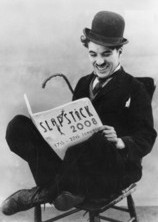
Slapstick 2008

http://www.slapstick.org.uk

We’re still awaiting full programming details for the Slapstick festival in Bristol, though we do at least have the dates – 17-20 January 2008. But meanwhile, tickets have just gone on sale for the festival’s gala event, a screening of Chaplin’s The Gold Rush, hosted by the ubiquitous Paul Merton, and the world premiere of Timothy Brock’s rescoring of Chaplin’s own score, played by the Emerald Ensemble. The evening also features a programme of comedy shorts, including Laurel and Hardy’s Leave ’em Laughing, with musical accompaniment from the no less ubiquitous Neil Brand “and international friends”, plus special guest Paul McGann. All this at Colston Hall, Bristol, on Friday 18 January, tickets £15, £12 conc., £5 for the under-twelves.

Motion Pictures: A Study in Social Legislation

National Board of Review censorship recommendations

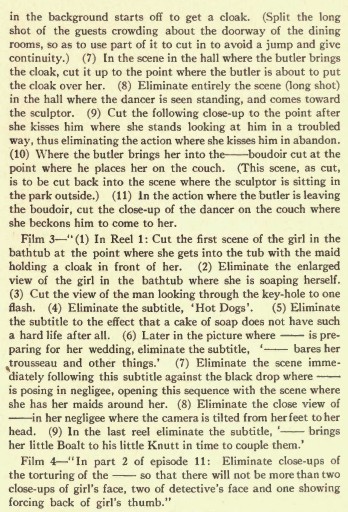
The above document contains some of the recommendations from the National Board of Review of Motion Pictures for cuts to be made to some unnamed films. Donald Young, later professor of sociology at the University of Pennsylvania, was no admirer of this private organisation which made censorship recommendations which were not legally binding and could be ignored locally. Young was the author of Motion Pictures: A Study in Social Legislation, now added to the Bioscope Library. Published in 1922, this PhD thesis must be one of the first doctorates to be awarded for the study of motion pictures.

Young’s subject is the influence of motion pictures upon the American people, particularly children. As a piece of supposedly scientific social investigation it is remarkably partisan. It takes as read reports conducted by various groups with an interest in the morals of society which found motion pictures to be generally pernicious in their effects, and comes down on the side of legalised state censorship (by 1922 eight American states had instituted film censorship laws). A National Board of Censorship, later the National Board of Review, had been instituted in 1909, but its recommendations carried no legal weight. This is therefore not the social study that it claims to be, but rather an expression of fear, albeit one that is artfully and authoritatviely expressed. Under the guide of social investigation, it looks for ways to control the medium whose malign tendencies are taken as a given.

The value of the text is firstly the period attitudes that it demonstrates, with the evidence that it calls on to support this. Secondly, it provides a rich picture of the various forms of municipal and state regulation that existed, their operations and aspirations. Thirdly, there are the several appendices with useful information, including the numbers of cinemas across America, state by state; figures for the importing of films from other countries; the rules of the British Board of Film Censors; the Standards of the Pennsylvania Board of Film Censors (the first US state to have censorship laws); and samples of eliminated scenes by the National Board of Review (as illustrated above). It is available from the Internet Archive in DjVu (3.1MB), PDF (9.4MB), b/w PDF (3.4MB) and TXT (232KB) formats.

Comedians on comedians

comedians.jpg

Paul Merton’s Silent Clowns, from http://www.bbc.co.uk/bbcfour

The television series Paul Merton’s Silent Clowns, first shown on BBC4, is being repeated on terrestrially on BBC2, with the first episode on Buster Keaton having aired this evening. Episodes on Chaplin, Laurel and Hardy, and Harold Lloyd are to follow. It was an engaging, unassuming production which simply wanted to put Keaton’s art first and foremost. It mostly took the format of one of Merton’s live shows, with Merton a lot of the time on stage giving short introductions before showing clips, Neil Brand at the piano, and audience laughing, all rounded off with the one complete film – in this case, The Goat (1921). I laughed heartily at gags I’ve seen a hundred times, and though it really only brushed the surface of Keaton’s comic gift, it must have left every viewer impressed with his art and many determined to check out more on DVD.

Merton is not the first television comedian to use his current popularity to pay homage to the silent comedians of the past. Bob Monkhouse in the 1960s presented a series, Mad Movies, which I can dimly remember, which introduced us to a wide range of silent comedians – not just the Keatons, Chaplins and Lloyds, but minor figures like Billy Bevan, Lupino Lane, Charley Chase, Larry Semon, Chester Conklin, Ben Turpin et al. I think the films all came from his personal collection. It gave us all a marvellous grounding in the names, the gags and the styles of the era (like Merton, Monkhouse explained to us how the gags and stunts worked). Then there was Michael Bentine’s Golden Silents, which was a multi-part, light-hearted history of the cinema, presented at the National Film Theatre, demonstrating as Merton does the great value of showing these films before an audience. You have to be laughing with someone really to appreciate the greatness of the silent comedians.

We were really lucky in the late 60s and early 70s – there was the intensive education in the art of silent comedy that we received from Monkhouse and Bentine, and we would be regularly treated to Robert Youngson’s compilations of comedy clips, such as The Golden Age of Comedy (1957), When Comedy was King (1960), Days of Thrills and Laughter (1961) and Laurel and Hardy’s Laughing 20s (1965). I’ve not seen them since that time, and I expected that the narrator’s interjections and the selectivity of the clips might irritate now, but at the time they helped rescue silent films from oblivion, and we watched them avidly. I can remember also that Chaplin shorts were a regular feature on early evening television – we were soon familiar with almost the entire oeuvre, and would lap up a rare new title with a collector’s fervour.

American TV also did its bit to keep the flame going for silent films in general. Jay Ward’s Fractured Flickers was first shown in 1963 and regularly syndicated thereafter. I’ve no memory of seeing it, but the approach seems to have been to take a rather satirical view of the films. Silents Please, first aired 1960, which used films from the Paul Killiam archive, was a more straightforward homage, and stood up very well when it turned up in some form or other in the UK in the 1980s in the early days of Channel 4. At least I assume it was the same series; someone might know.

Will silent comedies continue to amuse future generations? You have think that they have a good chance, indeed that it is verbal comedy that dates so badly, while there will always be something eternal about the silent art. But slapstick, however elevated a form it could be in the hands of the greatest practitioners, is not a form of comedy that is likely ever to return to the mainstream, and the clothes, the manners, the socio-cultural references, the black-and-whiteness and of course the silence will all inevitably confer too much strangeness upon this material for it ever to gain even the revival in popularity that Youngson and Monkhouse managed to conjure up. Or will artistry win out and will these films always retain a fundamental human appeal? Do we want to continue to admire them because they artistic, or because they are funny?
Brian Coe 1930-2007

Brian Coe

Brian Coe

It is sad to have to report the death of Brian Coe on 18 October 2007. To anyone with an interest in the history of the technologies of cinematography or photography his work over four decades has been, and remains, indispensible. He joined Kodak in 1952, where he helped found its education service. He made a particular impact with his writings in the early 1960s which forensically overturned the romantic myths which had seen William Friese-Greene chauvinistically championed as a pioneer of cinematography.

He was Curator of the Kodak Museum from 1969 to 1984, building up the collection to be one of international renown, and curating many pioneering exhibitions. When the collection moved to the National Museum of Photography Film and Television in Bradford, Brian became Curator at the Royal Photographic Society’s collection in Bath. In 1989 he joined the Museum of the Moving Image as special events co-ordinator, organising shows, events and organisations on an extraordinary range of topics, all underpinned by exemplary research and presented with enthusiasm, finding a perfect balance between scholarship and entertainment.

At Kodak he built up not only a great collection but considerable personal expertise, which found lasting expression in his many publications. The remarkable thing about his books is that they have not dated. Twenty or thirty years on they are still relied upon as standard reference works, notable as much for their clarity of exposition as their steadfastly reliable content. They include The Birth of Photography (1976), Colour Photography (1978), Cameras: From daguerrotypes to instant pictures (1978), and the incomparable The History of Movie Photography (1981). This is still the best book on cinema technology that exists, and it is hard to see how it could be bettered. It is particularly strong on early cinema technologies – magic lanterns, the optical toys and chronophotographic experiments of the so-called ‘pre-cinema’ era, the first cameras and projectors, the development of colour cinematography, early widescreen systems, the birth of home movies. Its illustrations have been plundered by countless other sources. Film archivists swear by the book – it used to be (and I hope it still is) standard reading for anyone working at the National Film and Television Archive’s preservation centre. Another gem is Muybridge and the Chronophotographers (1992), a small exhibition book reportedly thrown together in a great hurry, but a handy reference guide that I turn back to again and again.

Sadly Brian suffered a serious stroke in 1995, and took no further active part in the worlds of film and photography to which he had contributed such invaluable knowledge. It was a sad curtailment to a varied and richly productive career, recognised through such honours as his Fellowship of the Royal Society Arts, but leaving him little known to the general film enthusiast. Check out one of his books – they’ll be in the local library or second-hand book store. They look beautiful, and they wisely and reliably inform. Thank you, Brian.

The Twenties in Colour

Twenties in Colour

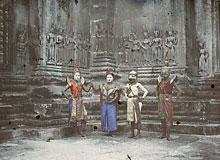
Dancers in ruins of Angkor-Vat, Cambodia, 1922 © Albert-Kahn museum, from http://www.ejumpcut.org

The promised follow-up series on Albert Kahn’s Archives de la Planète project, covering the 1920s, started on BBC4 this evening. The four-part series, The Twenties in Colour, follows on from the earlier series, The Wonderful World of Albert Kahn, in showing how Kahn’s team of still and motion picture photographers continued their task to make a photographic recod of the world. Included in the series is Paris after the Armistice, scenes in the Middle and Far East, and (I hope) some of the scientific-medical cinematography produced by Jean Comandon, who collaborated with Kahn in the late twenties.

Those who want find more about Kahn’s work, and web sources for Autochrome photographs etc, should go to the earlier post, Searching for Albert Kahn, which has the background story and a number of useful links.

Meanwhile, for those of us unable (or in my case, too idle) to get hold of BBC4, the original Wonderful World of Albert Kahn series is to be showing in re-edited, half-hour episodes form on BBC2, starting 16 November, at 19.30pm.

The Smoking Cabinet

Ballet mécanique

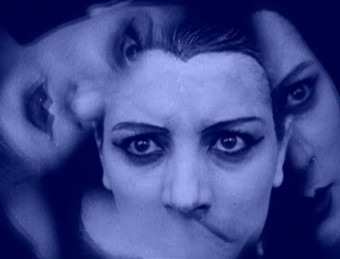
Ballet mécanique, from http://www.thesmokingcabinet.com

I have received a press release from an entertainment entitled The Smoking Cabinet, which is probably best left to explain itself:

The Smoking Cabinet presents:

A Festival of Early Cabaret and Burlesque Cinema 1895-1933
7th – 9th December 2007, Curzon Soho

The Smoking Cabinet presents an exotic array of films that epitomise the flair, eroticism and joie de vire of burlesque, fin de siècle follies, the machine age and modernist cabaret.

Come and celebrate various forms of decadent entertainment from the belle époque to the end of the Weimar Republic, the cinematic history of the subversive! We’ll take a peak into the seductive, sultry and downright bizarre with a series of rarely screened shorts, a well loved classic cabaret feature, and inspiring talks. Revel in the delectable secrets of cabaret inspired early cinema and prepare yourself for the work of Fernard Léger, Man Ray, Percy Smith, Adrian Brunel and Georges Méliès as well as music hall stars, circus performers, early erotic and performing animals.

Screenings:
Friday 7th December: Moody’s Club Follies and Opening Night Soirée, 8.20pm
Bar and performances from 7pm featuring Future Cinema and Bourgeois and Maurice plus interview with writer / broadcaster and author of The Cabaret, Lisa Appignanesi

Saturday 8th December: Electric Women and Additional Oddities, 6pm
Cinematic wonders abound in this series of magic tricks, acrobatics, performing animals and early erotica. Featuring Fred Evans, Adrian Brunel and Georges Méliès; come and join us for a sing a long to Yes We Have No – ! (1923),guffaw at the topsy-turvy world of Vice Versa (1910) and the spine tingling beauty of Electric Women (1927).

– followed by discussion: Burlesque and Cabaret on Film: Screening the Fantastical with Vanessa Toulmin (Mitchell and Kenyon, Admission all Classes) and special guests.

Sunday 9th December: The Blue Angel (1930) Josef Von Sternberg, 12pm
The definitive study of Weimar decay and decadence – Marlene Dietrich stars as the seedy stage starlet who corrupts and then devours an uptight teacher in one of cinema and Europe’s most poignant periods.

– followed by discussion: Women in Burlesque and Cabaret: Empowerment vs Titillation with Amy Lame (Duckie) and special guests.

Sunday 9th December: Tilly Losch in Her Dance of the Hands and Other Rarities, and Closing Night Party, 6pm
Join us for our last shorts programme with live music, cakes and dancing as we wind down with cine dance classic Annabelle’s Butterfly Dance (1895-1897), So This is Paris! (1926) and Tilly Losch in Her Dance of the Hands (1930-1933), and some rampant Dadaism in Ballet mécanique (1923-24).

Booking:
Call Curzon Cinemas on 0871 7033 988 or visit www.curzoncinemas.com

Well, I’m not entirely sure what’s going on here – the link between Percy Smith’s stop-motion films of plant growth and modernist cabaret seems a bit on the tenuous side – but no one can deny that there are great efforts these days to present silent material (and often unfamiliar silent material) in a new and creative ways.

Those seeking further elucidation can visit www.thesmokingcabinet.com, which offers further attractions and, oddly, a cheap deal on Simon Popple and Joe Kember’s book Early Cinema: From Factory Gate to Dream Factory. Or visit the project’s MySpace page, and see clips from Man Ray, Méliès and Josephine Baker dancing.

The Smoking Cabinet, which seems to derive from the ‘smoking concerts’ of the Edwardian era, where some of the fruitier films of the era were shown to men-only audiences, is, they tell us, “four female burlesque/cabaret/cinema fans who enjoy a challenge”.

Lost and found no. 3 – or is it?

The Four Devils

The 4 Devils (1928), from http://www.silentera.com

The web has been buzzling with rumours of two long-lost silent film classics having reportedly been discovered. No physical evidence has been offered for either title.

The first is F.W. Murnau’s circus drama The 4 Devils (1928), starring Janet Gaynor and Charles Morton. It was reported last month, on the Criterion Forum, that a collection of nitrate film has been uncovered in Tacoma, Washington. Its discoverer (apparently based in the UK) was coy at first about revealing the title, then confessed that it was The 4 Devils, the long-lost presumed masterpiece by Murnau, director of Nosferatu, The Last Laugh, Sunrise and all. supposedly the films belong to an engineer in his seventies, who acquired them from the estate of someone who died in the 1960s. The discoverer sounds like he knows what he’s talking about (but then the best scams come from the most knowledgeable), and certainly those on the Criterion Forum are excited by the apparent discovery. But no frame stills have been offered as evidence, no photographs, no proof at all, and now all has gone silent indeed…

Bardelys the Magnificent

Poster for Bardelys the Magnificent, from blog.france3.fr

And then there’s Bardelys the Magnificent (1926), starring John Gilbert and directed by King Vidor. This time the alleged print is said to be in France. A sequence from the film is thought to survive in a private collection, but not the complete film. Again, precise information has not been forthcoming, but here the discoverer claims that the film will be shown on French television next year. The original report in French is available here, and there’s a translation with ensuing discussion on alt.movies.silent. Once again, following the original news alert, all is silent.

In the virtual reality that is the web, anything can be alleged and nothing proven. So the Bioscope remains sceptical, though high-profile lost prints do still turn up, as demonstrated by a discovery a couple of years ago in the Netherlands of Beyond the Rocks (1922), with the piquant teaming of Rudolph Valentino and Gloria Swanson, now available on DVD. It isn’t very good, and for some lost films their very preciousness may even depend on their remaining lost. But the 4 Devils would be a joy to see again…

And now the Scotsman

The Scotsman

I should have spotted this one before now. The first UK national newspaper to make its archive publicly available (as opposed to The Times, which is only available to institutional subscribers) was not The Guardian, but The Scotsman. At http://archive.scotsman.com you can access every issue of the paper 1817-1950. Searching is free and gives you the headlines. To view the full article you need to take out a subscription: a 24 hour pass is £7.95, a 48-hour pass £12.95, a weekly pass £19.95, and so on. Not cheap, but the search system is a good one, and the results promising: over 1,000 hits for the word ‘cinematograph’ between 1895 and 1930, for example.

I’ll do a round up soon of all these online newspaper archives of relevance to silent film research.

Granny gets an MRI

Granny gets an MRI

Granny gets an MRI, from http://www.winanmri.com

Well, this is a little different. Clay County Medical Center, a 25-bed American hospital, has entered a contest to win a new $800,000 magnetic resonance imaging system (MRI). The competition is by public vote on a website, and CCMC has contributed a silent film spoof, Granny gets an MRI. No, it isn’t very good, but it has oddness on its side. To catch a sight of it, and who knows maybe vote for it, go to www.winanmri.com and type in ‘granny’ into the search box. It’s currently lying third…

Essay award reminder

Projection Box

A reminder that the deadline is not so far away for the Projection Box Essay Awards. The aims of this award are to encourage new research and new thinking into any historical, artistic or technical aspect of projected and moving images up to 1915; and to promote engaging, accessible, and imaginative work. The first prize of £250 is for an essay of between 5,000 and 8,000 words (including notes).

The deadline for entries is 18 January 2008. The winning essay will be published in an issue of Early Popular Visual Culture (Routledge). At the discretion of the judges, two runners-up will each receive books and CD-Roms of their choice (published by The Projection Box), to the value of £100.

For further information, visit www.pbawards.co.uk.