Back to the Bible lands

Jesus’s first steps, Mulsant and Chevalier Bible lands films, from http://www.europafilmtreasures.eu

Regulars may remember that in the Bioscope report on the Pordenone 2007 festival, there was a detailed account of the remarkable find by Lobster Films of a cache of films from the earlier years of cinema taken in the ‘Bible lands’ i.e. Palestine. This collection of some eighty or so films included both actualities and dramatised scenes of the nativity. At the time, no one knew who had made these films, though a good guess was made that the filmmaker might have been the Frenchman Léar (real name, Albert Kirchner), known to have filmed nativity scenes in Palestine in 1897. Some of the films were believed to date from that period, but others stylisically suggested a slightly later date.

A year on, and the mystery has been solved. The films were not made by Léar but by the Abbés Mulsant and Chevalier in 1904, supported by the Roman Catholic promotional organisation, La Maison Bonne Presse. Mulsant and Chevalier visited Egypt, Palestine, Lebanon and later Turkey. They filmed the scenes about them, and created dramatised scenes inspired by the celebrated Bible paintings of James Tissot.

Research continues on their work, but Eric Lange of Lobster Films has kindly sent me a text on his discoveries. It’s in French, but that’s not going to present you with any problems (not in these post-Google Translate days). A selection of the films, concentrating on the nativity scenes, can be found on the European Film Treasures site (search under Mulsant or 1904), which has further information on the collection.

Au lendemain de la guerre de 1870, LA MAISON DE LA BONNE PRESSE voit le jour, sous les auspices des Augustins de l’Assomption. Son but est d’affirmer une présence catholique dynamique à travers des manifestations de masse : pèlerinages, enseignements, ou presse avec des organes comme le Pèlerin lancé en 1873 ou La Croix, 10 ans plus tard.

En 1895, le directeur de La Croix confie à Georges-Michel Coissac, futur historien du cinéma, la création et la responsabilité d’un service de projections lumineuses.

Des conférenciers projectionnistes sillonnent alors les paroisses et diffusent la bonne parole grâce aux séries de plaques de verre illustrant sous forme de tableaux vivants, la vie du Christ, des Saints et Martyrs ou les histoires édifiantes de Théodore Botrel.

En 1905, lorsque intervient la séparation de l’Eglise et de l’état, le cinématographe a depuis longtemps perdu son statut de curiosité scientifique pour n’être plus, pour beaucoup, qu’une vulgaire attraction de fête foraine.

Il commence toutefois à intéresser les esprits pieux de la maison de la Bonne Presse.

Lors du deuxième congrès général des oeuvres catholiques de conférences et de projections (19 – 22 février 1906) un conférencier défini ainsi ce point de vue :

« Il n’est personne qui nie l’intérêt des projections cinématographiques et le parti qu’en pourraient tirer les oeuvres catholiques de projections. Celles-ci ne doivent pas, sous peine de rester en retard et de se priver d’un puissant élément de succès, dédaigner cette nouvelle manifestation de l’art dans l’image lumineuse. Aussi semble-t-il tout naturel que le Congrès veuille étudier cette année les moyens de vulgariser le cinématographe et de le mettre à la portée d’un plus grand nombre. »

Ce rapport émane de l’abbé Mulsant qui a déjà mis en pratique sa théorie:

« On me permettra d’exposer ici l’oeuvre que j’ai entreprise en collaboration avec M. L’abbé Chevalier; heureux si notre petite expérience peut être de quelque utilité pour les conférences catholiques.
Ayant à chercher des ressources pour nos écoles du Liban très menacées par la diminution des aumônes venant de la France, et en face de l’impossibilité de quêter en ce moment dans notre pauvre patrie, nous avons songé à donner des conférences aussi intéressantes que possible, et en joignant aux projections lumineuses ordinaires les vues cinématographiques.

Pour cela nous avons fait un long voyage en Orient, pays qui du reste nous était déjà connu, et nous sommes arrivés à récolter en Egypte, en Palestine et au Liban de nombreux documents, clichés et bandes cinématographiques, avec lesquels ont été composées cinq conférences documentaires ou artistiques.

La première, Vers les cèdres du Liban, nous promène à travers les montagnes si pittoresques de la Syrie.

La deuxième et la troisième, s’attachant à la personne sacrée de Notre-Seigneur Enfant, essayent de le faire revivre, soit à la manière de Tissot dans la conférence documentaire Au pays de l’enfance du Christ, soit dans la Vierge et son fils, à la manière des artistes idéalistes qui, si nombreux à tous les ages, ont plus ou moins prêté à la Sainte Famille nos moeurs et nos goûts.

La quatrième conférence, Le Caire pittoresque, conduit dans la capitale de l’Egypte moderne, en fait ressortir les particularités et les contrastes et donne sur la religion musulmane et ses rites, de très curieux documents.

La cinquième, les Hébreux d’autrefois et les Fellahs d’aujourd’hui, transporte l’auditeur à plusieurs siècles de distance et fait revivre les moeurs au temps de Joseph et des Pharaons dans l’étude de la vie des champs et de la construction des temples.

Ces cinq conférences sont établies sur le même modèle, en ce sens que l’illustration lumineuse du texte est toujours composée de vues fixes alternant avec les vues cinématographiques. Un dispositif nouveau, inventé par les conférenciers eux-mêmes, permet la substitution instantanée du cliché à la vue mouvante. Cette méthode a le grand avantage de donner à la conférence plus de vie et de variété, les explications étant données sur les vues fixes qui ne sont que l’analyse du sujet cinématographique suivant.

Le spectateur jouit ainsi beaucoup mieux de la vue cinématographique déjà expliquée et n’est pas fatigue par une projection non interrompue de 600 mètres de bandes. Je puis dire que ces conférences, grâce à l’inédit des documents et à la perfection de l’appareil, ont pu être données en très grands nombres dans les milieux les plus différents, toujours avec le plus beau succès. En dix-huit mois, nous avons fait plus de 250 conférences dans des Grands et Petits Séminaires, des salons, des Sociétés de géographie, des Cercles artistiques, des collèges et couvents, des salles populaires où nous avons réuni plus de 2000 personnes. Nous comptons continuer notre oeuvre et poursuivre notre campagne de conférences, qui, comme nous l’ont dit bien des prêtres et des évêques nos auditeurs, font un bien réel aux âmes et permettent de parler de Notre-Seigneur dans tous les milieux. »

L ‘œuvre entreprise par Mulsant et Chevalier n’est certes pas une première. Dès 1897, Albert Kirchner, dit Léar, avait accompagné le père Bailly dans son pèlerinage aux pays du Christ et en avait ramené les premiers films tournés en Palestine et en Egypte ; des films malheureusement perdus aujourd’hui.

Toutefois, s’ils ont bien été tournés en 1904, comme le laissent à penser les déclarations de l’abbé Mulsant, ces films offrent un des plus anciens témoignages filmés de la vision chrétienne en terre Musulmane.

Tourné in situ, la vie de Jésus détonne par rapport aux nombreuses versions très théâtrales éditées alors par Pathé, Gaumont ou Lumière. Le but est ici de « remettre en scène, sur place, au jour le jour, les personnages bibliques, d’évoquer leurs figures, redire leurs paroles, dans le pays que la Providence avait donné pour cadre à leurs passions, à leur espoir, à leur apostolat. »

Les sujets des autres conférences sont complémentaires puisque l’observation des us et coutumes en Palestine, en Egypte ou au Liban permet de « mettre en évidence les vestiges des traditions antiques, commentaires vivant de l’Ecriture qui éclairent d’un jour nouveau telles pages obscures de la Bible ou de l’Evangile. »

Au delà de leur aspect ethnographique ou religieux, les films de Mulsant et Chevalier sont aujourd’hui le témoignage rare d’une pratique qui va pendant longtemps opposer laïcs et catholiques: celle du conférencier projectionniste.

Le Texte des conférences de Mulsant et Chevalier semble avoir disparu, mais on en trouve toutefois quelques extraits dans les séries de cartes postales illustrées, éditées à partir de 1907 et proposées aux abonnées du Fascinateur, revue consacrée à la projection par la Maison Bonne Presse.

1907 est également l’année de la consécration pour Mulsant et Chevalier. Leur Annonciation de la Vierge est présentée au Vatican devant le Pape Pie X, en vues fixes d’abord, puis en scène cinématographique, avec de brèves explications du P. Chevalier lui-même. Le film vient conclure un programme des plus variés où se succèdent des scènes de la vie militaire, des scènes champêtres ou maritimes sans oublier des portraits de Sa Sainteté et de splendides tableaux de la vie du Christ ou des films comiques tel Toto Aéronaute (Pathé 1906)!

Jusqu’alors, les films de Mulsant et Chevalier ne se trouvaient pas dans le commerce, ce que regrettaient certains congressistes lors du troisième congrès général des œuvres catholiques de conférence et de projection. Après la séance faite au Vatican, un accord est conclu avec Gaumont qui propose fièrement sous le numéro 1821 de son catalogue « A Nazareth », collection de MM. Mulsant et Chevalier, projections représentées devant le Souverain Pontife. Ce films de 70 mètres se divise en 5 parties: L’atelier, Fontaine de Nazareth, Retour de la Fontaine, Le puits, le soir qui tombe.

Curieusement le film n’est qu’en distribution ; les droits de représentation sont réservés pour la France et la Belgique et il faut s’adresser directement aux Auteurs, 14 rue Sainte-Hélène à Lyon.

Peut être Gaumont ne veut il pas faire trop de concurrence à sa Vie du Christ éditée en 1906 et dont certains tableaux s’inspirent également de la Passion du peintre James Tissot. Dans ces mémoires, Alice Guy, qui a réalisé le film, indique que Mulsant et Chevalier étaient présents sur le tournage et portaient un vif intérêt à son travail. On pourrait en déduire d’après ces propos que les deux prêtres se sont inspirés d’Alice Guy, alors que ceux-ci avaient tournés leur vie de Jésus 2 ans plus tôt.

La production cinématographique de la maison de la Bonne Presse ne débute réellement qu’en 1909, avec une version de la Passion de 1000 mètres réalisée par Honoré le Sablais qui dirigera la production jusqu’à la première guerre, avant que l’abbé Danion ne prenne le relai.

En 1909, Mulsant et Chevalier sont certainement en Turquie comme en témoignent une série films retrouvés en même temps que ceux d’Egypte et de Palestine. On y découvre le témoignage de la présence chrétienne dans un orphelinat ainsi que les ruines d’Adana après les premiers massacres d’Arméniens. Ces films n’ont sans doute pas encore révélé tous leurs secrets.

Puis nous perdons la trace de Mulsant et Chevalier après une dernière séance de projection à Moulins, mentionnée par le Fascinateur en 1910:

« M. L’abbé Mulsant, le conférencier bien connu, a organisé cette année à Moulins toute une série de conférences religieuses, pour dames et jeunes filles, sur la vie de Notre-Seigneur, dans le but d’aider à l’intelligence des Evangiles.

Les projections ont été exécutées par M. l’abbé Mulsant lui-même, avec un appareil de haute précision, à la lumière oxy-éthérique. Les vues projetées, dont un bon nombre en couleurs, sont en grande partie l’œuvre originale et personnelle de M. Mulsant. Prises directement sur les Lieux-Saints même ou empruntées aux plus grands peintres de toutes les époques, elles ont pour but constant et unique soit la reconstitution historique des faits évangéliques, soit la représentation la plus expressive des mystères sacrés, d’évoquer en un mot, sous les yeux de la vie même du Christ, telle qu’il la vécut parmi nous, il y a dix-neuf siècle. »

Les recherches continues. A suivre …

Eric has also drawn my attention to his Cinématographes site on early cinema technology. Written in French, it’s a fabulous collection of images and descriptions of cameras, projectors etc., company information, catalogues and more, which I’ll cover in greater detail in a later post.
Caught on film

Just a quick note to let folks know that tomorrow (Tuesday 26 August) at 11.30am there’s a programme on BBC Radio 4 on film archives and silent film, produced at last month’s Bologna film festival. Entitled Caught on Film, the BBC blurb describes it thus:

Our cinematic heritage is literally rotting away. Critic Matthew Sweet visits the Festival Il Cinema Ritrovato in Bologna to explore the vulnerability of film and discovers why both cinematic gems and historically unique documentary films are rapidly disintegrating.

The half-hour programme will be available through the Listen Again service for a week after the broadcast.

Colourful stories no. 12 – Tinting and toning

Nosferatu (1922), from Eureka Video

In our history of the use of colour in silent cinema, there has been probably disproportionate emphasis on Kinemacolor. The first ‘true’ colour system it may have been, and importantly technically and in perceptions of cinema it undoubtedly was, yet was only ever witnessed by a minority. Kinemacolor featured in select theatres which had installed the necessary projection equipment, but in the ordinary cinemas and movie houses it did not feature. The mass early cinema audience, where it saw colour – and it often did – did so in the form of tinting and toning.

As the film industry expanded through the 1900s, and as mass production of prints ensued, stencil colouring (that is, applying artificial colours onto the print using stencil cut-outs and a pantograph system) became a speciality, reserved for historical dramas, exotic travelogues and films with a strong fantasy element, and predominantly the preserve of the Gaumont and Pathé multinationals. Such films also commended higher prices, and once films began to extend in length beyond 1,000 feet they became no longer economically feasible (bar the occasional deluxe exception). For most other, so-called monochrome films, colour tinting and/or toning were widely employed to lift them from the mean appearance of black and white.

Tinting meant bathing the black-and-white print in a coloured dye, though from 1912 onwards suppliers started offering coloured film stocks, which gave greater evenness of colour. The colours were roughly analogous to action and mood: yellow or amber for daylight scenes, red for fire and scenes of dynamic action, green or blue-green for seascapes and scenes of mystery, blue the recognised convention for night. Colin Bennett, in his The Guide to Kinematography (1917), lists how to tint for certain well known effects:

  • Early morning: Tint film lightly in one tenth per cent bath of crystal violet
  • Moonlight (night): Use one quarter per cent patent blue solution
  • Lamp or candle light: Tint in half per cent orange brown (Mandarin) dye bath
  • Fire: Use bath containing one per cent each of brilliant yellow and rose bengal
  • Weird effects: Tint green in a half per cent naphthol green bath
  • Bright sunlight: Use half per cent brilliant yellow bath

Though there examples of just the one tint being used throughout a film, it was more common for different colour tints to be employed, enhancing the drama and varieties of mood. By the start of the 1920s, the large majority of films were exhibited with colour tinting. Even newsreels were commonly seen in tinted colours.

Yellow tint with a green tone added, from http://www.brianpritchard.com

Toning was a little more complex in production and subtler in its effects. While tinting meant simply the application of colour dye to black-and-white film, toning involved converting the black-and-white image to a colour record, reflecting its tonal qualities. There were various chemical methods by which this could be achieved. One was to convert the black-and-white silver image to another, coloured metal. Brian Pritchard’s site on historical motion picture technologies (recommended to the specialist) lists the following effects to be expected:

Iron gives blue
Copper gives red to brown
Vanadium gives green
Uranium gives black to red
Selenium gives red-brown
Sulphide gives sepia

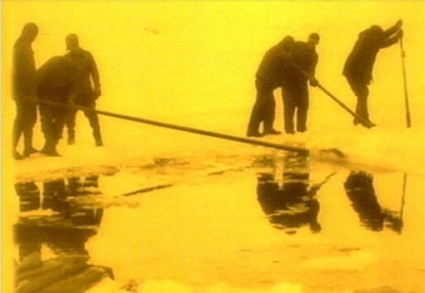
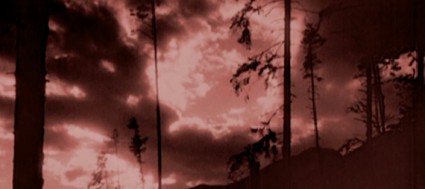
Tinting and toning combined the two methods, for example: a sun setting over the sea might have blue-green toning for the sea and sky, but red tinting for the sun and clouds. The combination led to subtle and often hauntingly beautiful effects, and not just in fiction films, as the illustration from the British Film Institute’s restoration of South, Frank Hurley’s documentary of the ill-fated 1914-15 trans-Antarctic expedition led by Ernest Shackleton, indicates:

South (1919)

Tinting and toning continued as the main means of putting colour before audiences throughout the rest of the silent era. The arrival of sound caused problems, as colour tinting interfered with the sound reproduction, chiefly by absorbing too much of the light that the photocell required to reproduce the sound. Although adapted tinted stocks were produced, and continued in some cases to be used well into the sound era, essentially tinting and toning for films were no more.

The accurate and sensitive reproduction of tinting and toning effects for silent films is a major part of the restoration work undertaken by film archives, and there is much delight taken in the finest results. The Nederlands Filmmuseum, for instance, has built up a worldwide reputation for some of its exquisite colour work on early films. Prestigious silent DVD releases now highlight faithfulness to original tinting and toning. On the other side, and mentioning no names, there have been some real horror stories presented at some silent film festivals, where garish colours grossly applied shock you with their thoughtless vulgarity. It is not, and never was, colour for its own sake, but rather colour for the film’s sake. As with musical accompaniment, decoration had always to be subservient to the drama it was there to enhance.

Trailer for the Eureka Video release of Nosferatu (F. W. Murnau-Stiftung restoration) with state-of-the-art tinting and toning

The outpouring of colour viewing prints of early films (in past years, some archives regrettably had to economise by producing viewing prints in monochrome, even though the originals they were working from were tinted) has in turn encouraged an enthusiastic literature on the aesthetics of colour in silent film. Kinemacolor, interestingly enough, tends not to be discussed so much in such works, owing to the lack of viewing prints. Examples include Daan Hertogs and Nico de Klerk, Disorderly Order: Colours in Silent Films (1996), a special issue of the Italian journal Fotogenia, two essays from which (including a key work by Tom Gunning) are available online in English, and a special issue on colour of the journal Living Pictures (vol. 2 no. 2, 2003), edited by yours truly, which is now alas rather difficult to find. Probably the best text available on tinting and toning in early film, with illustrations, is Paolo Cherchi Usai’s Silent Cinema.

For a rich selection of examples of early colour films – not just tinted and toned films, but Kinemacolor, Prizmacolor, Technicolor and other such processes – Lobster Films has created a marvellous DVD, which is available in the UK from the Projection Box in the 2-DVD set The Birth of Sound and Colour as A Dream of Colour, in the USA from Flicker Alley as Movies Dream in Colour, one half of the Discovering Cinema set, and in Germany from Edition Filmmuseum as part of The First Steps of Cinema set. Under whatever title you find it, it is warmly recommended.

Recommended reading:
www.brianpritchard.com (reproduces documents from the period with detailed information on dyes, processes etc; also frame illustrations of tinting and toning examples)

Tom Gunning, ‘Colorful Metaphors: The Attraction of Color in Early Silent Cinema’ (from Fotogenia)

The Metropolis case

Fritz Rasp as the spy Schmale © Friedrich-Wilhelm-Murnau-Stiftung; Bildbearbeitung: Dennis Neuschäfer-Rube

A day on from all the excitement of the news that a print of the previously ‘lost’, complete Metropolis had been found in Argentina, the dust has settled a little, and more information has filtered through. So here’s a round-up of the film’s history, the discovery of the print, and why the news is so significant.

Let us travel to the year 2026, not so far away now. The giant city of Metropolis is maintained by a slave army which runs the machines which served the pampered ruling class. Freder, son of the city’s ruler, is captivated by a beautiful woman, Maria, and in following her discovers the horrors of the underground life of Metropolis. Maria is a figurehead for the restless workers, and Freder’s father instructs the scientist Rotwang to build a robot in her image so that the workers will follow ‘her’ and be duped into avoiding revolution. But the robot goes beserk and incites a rebellion. Eventually the workers see how they have been misled. They destroy the robot, while Freder, his father and Maria are reunited in happiness, Capital and Labour united at last. So, your typical tale of twenty-first century life.

Such was the vision conjured up by German film director Fritz Lang and his scenarist wife Thea von Harbou for the 1927 film Metropolis, one of the most ambitious, expensive (for the German film industry) and iconic of all silent films. However, at the time it was something of a flop with audiences. The industry reponded as the industry will, and cut the film drastically, to the extent of losing scenes essential to the film’s dramatic logic. Some 950 metres were removed; almost a quarter of its original length. The film at its original length of 4189 metres (147 mins at 25fps, though there is argument over the correct running speed) was therefore only seen for a short while (until May 1927 in Berlin); thereafter a cut version of around 113 mins was all that could be seen, and – so far as posterity aware – all that had survived thereafter, despite various restored versions being produced, most recently that overseen by Enno Patalas in 2001 (which runs at 118 mins).

Move forward to 2008. Paula Félix-Didier, newly installed as curator of the Museo del Cine in Buenos Aires, learns from her ex-huband (director of the film department at the Museum of Latin American Art) of a curiously long screening of a print of Metropolis at a cinema club some years before, a print which was now believed to be in the Museo del Cine. According to ZEITmagazin, which has reconstructed the story, one Adolfo Z. Wilson, who in 1928 ran the Terra film distribution company of Buenos Aires, had secured a copy of the full length version of Metropolis for screening in Argentina. A copy then found its way into the hands of film critic Manuel Peña Rodríguez. In the 1960s he sold the film to Argentina’s National Art Fund, with seemingly neither party to the deal realising the unique value of the film. A print (on 16mm) then came into the hands of the Museo del Cine in 1992. Sixteen years later, Paula Félix-Didier found it.

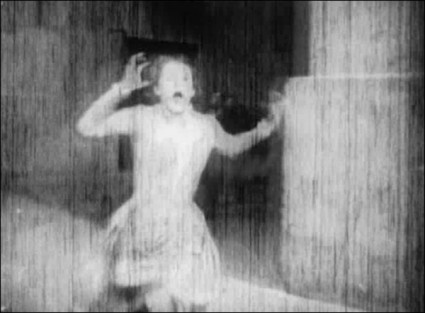
Maria (Brigitte Helm) flees from the mob © Friedrich-Wilhelm-Murnau-Stiftung; Bildbearbeitung: Dennis Neuschäfer-Rube

Félix-Didier then acted with care. Rather than announce the discovery in Argentina (where, apparently, she believed it would not attract so much attention) she chose to have the discovery announced in Germany, where the film had been produced, and where the Friedrich-Wilhelm-Murnau-Stiftung had been responsible for the most recent restored version of the film. She also had a friend who was a journalist for ZEITmagazin, which is how it ended up getting the exclusive and the stills which reveal that the print is indeed a well-worn 16mm copy, but whose very murkiness and lack of sharpness seem only to add to their haunting quality. (Word is that the stills are frame grabs from a DVD copy, so they look a little worse than the print actually is)

So, what is it that we have? What was found was a 16mm dupe neg of virtually the entire original version of Metropolis, minus just one scene, that of a monk in a cathedral, because it happened to be at the end of a reel that was badly torn (this information from Martin Koerber of the Deutsche Kinemathek, via the AMIA-L discussion list). The original 35mm nitrate print is lost. Precise details of the missing scenes (which were cut by the film’s American distributors, Paramount) are unclear, but it is reported that they reveal why the real Maria is mistaken by a rampaging mob for the robot created in her image; the significance of the role of the spy Schmale (played by Fritz Rasp), who pursues Freder, is made clear; and the scene where the workers’ children are saved by Freder and Maria towards the end of the film is revealed to be far more dramatic, and violent (a likely reason for its having been cut in the first place).

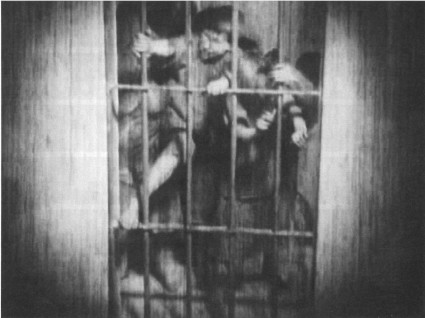
From Ain’t it Cool News, showing the trapped workers’ children trying to escape flood waters

And what will happen now? The above-mentioned restored version was produced in 2001, and has been made available on DVD in deluxe editions by Kino and Eureka. There is also a study or critical edition available from the Filminstitut der Universität der Künste Berlin. Kino recently announced that it would be issuing Metropolis on high-definition Blu-Ray early in 2009 – how will the news affect their plans?. The Friedrich-Wilhelm-Murnau-Stiftung has announced its intention to produce a ‘restored’ version, which would presumably simply mean inserting the relevant ‘lost’ sequences into the existing 35mm restoration. The reports from those who have seen the rediscovered print all indicate how coherent the complete work is, and hence how logically the extra scenes would slot in. Of course, there would be a somewhat brutal shift from pristine 35mm to battle-worn 16mm, but other such attempts at full restorations have shown similar changes in image quality where only inferior material remains, and the effect is not so jarring. Far more important will be the realisation of a story – and of one of the twentieth-century’s masterpieces of art in any form – made whole again. But what will get released, in what form, and when – it’s too soon to say.

© Friedrich-Wilhelm-Murnau-Stiftung; Bildbearbeitung: Dennis Neuschäfer-Rube

Where to find out more:

One last thought. What other lost silents might be lurking in South American film archives, perhaps not as thoroughly investigated as their North American cousins, but a territory where many American prints will inevitably have turned up? After such a tremendous discovery, we can only be greedy for more.

Update (4 July): Today in Argentina journalists were shown extracts from the rediscovered print of Metropolis. Photographs show that they were shown a DVD with brief clips. Reports indicate that the clips they were shown were (i) a worker who has exchanged clothes with Frederer gets in a car and drives to Yoshiwara, Metropolis’ red-light district; (ii) Smale, the spy following Frederer, at a newspaper stand; (iii) the robot Maria is seen in Yoshiwara; (iv) Frederer and the real Maria rescue the workers’ children, including scenes where the children are seen trapped behind bars as the flood water rise.

According to Digital Bits, Kino are intending to include the rediscovered new sequences in their already-announced Blu-Ray release of Metropolis from early next year, though it is surely too early for such confident pronouncements.

Further update (12 February 2010): For a report on the restored film’s premieres and the latest news news, see https://bioscopic.wordpress.com/2010/02/12/the-new-metropolis/.

Eight days in Bologna

http://www.cinetecadibologna.it

An outline of the Bologna festival of archive and restored films, Il Cinema Ritrovato, has been published. Promising “the most memorable eight days of 2008”, the festival takes place in Bologna, Italy, and runs Saturday 28 June to Saturday 5 July.

Bologna always offers a rich mix of films from past decades, both silent and sound, and the great pleasure of attending is being taken from, say, a programe of short films from the 1900s to Cinemascope features of the 1950s, back to 1930s musicals and on to silent features. Its wise eclectism is matched by an eye for the timely and the unusual, and it is deservedly recognised as being among the world’s leading festivals of archive film.

This year there are a number of silent strands, as described on the festival site:

The silent section opens with a series dedicated to films made exactly 100 years ago, curated by Mariann Lewinsky. 1908 will offer a panorama of fascinating themes, national productions, technological attractions (also with sound!), visions of the world and breaking news (from the London Olympic Games to the Messina earthquake) and cultural superproductions like Gli ultimi giorni di Pompei and L’assassinat du Duc de Guise, presented with Camille Saint-Saëns’ original music, during the final evening on Saturday July 5th, dedicated to the avant-gardes.

Emilio Ghione (1872-1930) is the silent star of our 2008 program. The creator of Za la mort and I topi grigi (1918, this year’s morning serial) was a hugely popular actor and director in his day. He was at home in almost every genre, yet he retained an original touch, creating heroes and anti-heroes that were strictly his own with decadent, Gothic elements combining cartoon-like directness and ironic, unexplained elements, as if he was moving through mystical imprints.

Gosfilmofond will have its 60th anniversary at the same time as Russian Cinema celebrates its 100th anniversary. It is thus apt to celebrate the life and work of Lev Kuleshov, one of the fathers of Soviet Cinema and its first great theoretician. Yet his work is little known with the exception of the captivating fun piece The Extraordinary Adventures of Mr. West in the Land of the Bolsheviks (1924) or perhaps By the Law (1926), a harsh adaptation of Jack London. Thus our season will come as a big surprise to many, the testimony of a nuanced, intelligent director inventing a language that reflected everyday life along with the passion and history of the Soviet Union of his time as well as international realities. There are famous titles that most of us know only from books – The Death Ray (1925), The Gay Canary (1929) – and highlights like Gorizont (1932) or The Great Consoler (1933), and even later evidence that Kuleshov (and his actress wife Khokhlova) never lost enthusiasm and creativity.

With the section Irresistible forces: Comic Actresses and Suffragettes (1910-1915), Il Cinema Ritrovato will proceed with the exploration of the origin of comic cinema, this year through a feminine eye. Those are the years of the Suffragettes, characterized by women’s fight for their fundamental rights, as witnessed by the collection of actualities and newsreels preserved by the British Film Institute/National Archive. In this context, characters like Rosalie, Cunegonde, Lea, Gigetta and the wild sisters Tilly and Sally have an explosive and freedom-breaking impact.

While last year’s Chapliniana still echoes in our minds, this year we will launch an annual “Chaplin’s filiation” program with a series of films devoted to Monta Bell, Chaplin’s assistant on A Woman of Paris (1924) and a wonderful director in his own right, as our selection – Lady of the Night (1925), Pretty Ladies (1925), Upstage (1926) – proves beyond question. At the crossroad of a Sternberg retrospective, we will dedicate a dossier to The Seagull/Woman of the Sea (1926), one of the most famous “lost films” of all time. The film was shot by Sternberg and produced by Chaplin who did not like it and eventually refused to release it. Its intriguing story will be traced with images and rare documents gathered from many sources.

Other strands include Josef von Sternberg and Marlene Dietrich, Warner films of the 1930s, films based on the work of Giovanni Guareschi (creator of Don Camillo), Cold War films on the atomic bomb, and a Cinemascope selection.

There are full details on the festival, its venues, booking etc., plus details of the Film Restoration Summer School on the site (in Italian and English). But look out also for the Archive section, which has PDFs on all past Il Cinema Ritrovatos, 1986-2007, plus an Excel spreadsheet listing every film title featured at the festival over those years – a really useful resource (just a shame the spreadsheet doesn’t include the name of the archive which supplied each print – for that you will have to cross-check via the individual programmes).

Retour de flamme

This short piece on the remarkable Lobster Films of Paris is doing the rounds. Here it is (taken from www.france24.com):

Frenchman Serge Bromberg, saviour of more than 100,000 reels of old films, this week marked the 15th anniversary of a world-touring show with a difference – where he accompanies rescued silent movies on the piano.

A twice yearly Paris event, Retour de Flamme (Return of the Flame) has played New York’s MoMA and travels to India next February before going to Italy and the US for shows in San Francisco and New York.

“I like to say I ‘restore’ the spectator,” he said in an interview. “I bring old movies up-to-date with a presentation and a specially-written musical score, to bring the films alive.

Bromberg’s company Lobster Films, set up two decades ago with fellow film addict Eric Lange, has saved from destruction movies dating as far back as 1895, including film’s first movie with sound – Charlie Chaplin’s first 1914 movie “Twenty Minutes of Love” – and the first movies shot in Palestine (1897) as well as the only Marx Brothers shot in colour.

In the first 50 years of cinema, films were recorded on nitrate stocks, which is inflammable and decays. As no-one had thought at the time of preserving film, much of movie history was lost.

“I pick up films all year, with 99 percent unviewable but there’s always one which is extraordinary and which I want to share,” said the 46-year-old film buff.

On DVD now is 1912 footage of the Titanic before it went down, and a 1931 burlesque titled Stolen Jools, featuring Laurel and Hardy, Buster Keaton, Joan Crawford, Gary Cooper and Douglas Fairbanks Jr.

“Fifty percent of the films shot before World War II have been lost,” he added.

Among recently saved treasures are 15 hours of rushes from a 1964 drama featuring the late Romy Schneider and directed by Henri-George Clouzot. The film was never completed and the rushes had been kept at home by Clouzot’s widow Ines.

Another of his 2007 finds is “Bardelys the magnificent” (1926) by King Vidor, starring John Gilbert.

So it’s true, Bardelys the Magnificent has been found, and of course it would be Lobster who found it. All power to them, and three cheers to all film archivists able to accompany their restorations of silent films on the piano. It ought to be a compulsory part of the job.

Nosferatu trailer

Eureka Video has released a YouTube trailer for its forthcoming DVD release of Nosferatu. The two-disc set comes with commentary track by Brad Stevens and R. Dixon Smith, and an hour-long German documentary on the film by Luciano Berriatúa. It’s a F.W. Murnau-Stiftung restoration complete with Hans Erdmann’s original score, performed by the Radio Symphony Orchestra Saarbrücken conducted by Berndt Heller. There’s also a 96-page booklet with articles by David Skal, Thomas Elsaesser, Gilberto Perez and Enno Patalas (former director of the Münchner Stadtmuseum/Filmmuseum, where he was responsible for the restoration of many German classics, including Nosferatu). The Region 2 DVD is released on 19 November. Kino Video will be releasing the Region 1 version in the USA. The trailer looks fantastic – we are starting to get spoiled with deluxe DVD presentations of silent classics.

Update: Do take a look at the Kino Video entry for the film, which includes a Flash video on the digital restoration of the film, one of the DVD extras.

Journal of Film Preservation

Journal of Film Preservation

Journal of Film Preservation, from http://www.fiafnet.org

FIAF, the International Federation of Film Archives, “brings together institutions dedicated to rescuing films both as cultural heritage and as historical documents”. You can find details of the 120 or so institutions from sixty-five countries which belong to FIAF on its multilingual site, as well as standards documentation, news, projects and information on FIAF’s various specialised commissions.

The site also has details of FIAF publications, which include its Journal of Film Preservation. The journal covers theoretical and technical aspects of moving image archival activities, with plenty of information on silent film, which has always been a favoured area of the national film archives. It’s a very good publication, which is not much known about outside the film archiving profession. The journal is published twice a year, and one year after publication is made freely available on the FIAF site.

So there are currently twenty issues of the journal, from 1995 onwards, which can be downloaded from the site in PDF format. Here’s a guide to some of the articles worth looking out for:

  • No. 52 (Apr 1996) – Brian Taves on the work on undersea cinematography pioneer James Ernest Williamson, who made Twenty Thousand Leagues Under the Sea in 1916
  • No. 53 (Nov 1996) – Luke McKernan (yours truly) on programming a season of Victorian cinema (i.e. film to 1901) at the National Film Theatre
  • No. 54 (Apr 1997) – Richard Brown on the copyright records for early British films found in the then Public Record Office (now The National Archives)
  • No. 60/61 (Jul 2000) – Alfonso del Amo on the history of celluloid
  • No. 62 (Apr 2001) – Brian Taves on Michael (Jules) Verne, who both wrote novels in his famous father’s name, and then proceeded to film them
  • No. 64 (Apr 2002) – Sarah Ziebell Mann on the creation of the Treasures from the Film Archives database of early silent short fiction films around the world
  • No. 65 (Dec 2002) – Yoshiro Irie on the question of film speeds of Japanese silent films
  • No. 69 (May 2005) – Thomas C. Christensen on efforts to recover and restore the films of Asta Nielsen
  • No. 70 (Nov 2005) – Tiago Baptista on restoring the early surgical films of Eugène-Louis Doyen
  • No. 72 (Nov 2006) – Steven Higgins on avant garde cinema of the 1920s and 1930s

And much, much more. A fair bit of it is rather more technical than the general reader requires, but most articles combine the practical with the historical in engrossing fashion, and the illustrations are excellent (and rare). The Bioscope will be following up some of the themes above in future posts.

Treasures III

Treasures III

The National Film Preservation Fund has announced the third in its Treasures series of rare silent and early sound films from American archives. The four-DVD set will be published in October by Image Entertainment. For number three in this stunning series, the theme is social issues. Here’s the press release:

Cecil B. De Mille’s sensational reformatory exposé, The Godless Girl; Redskin in two-color Technicolor; Lois Weber’s anti-abortion drama Where Are My Children?; The Soul of Youth by William Desmond Taylor; and dozens of rare newsreels, cartoons, serials, documentaries, and charitable appeals are showcased in the National Film Preservation Foundation upcoming four-DVD box set, Treasures III: Social Issues in American Film, 1900-1934. Slated for release by Image Entertainment on October 16, Treasures III (retail price $89.99) introduces to DVD 48 films from the decades when virtually no issue was too controversial to bring to the screen.

“In film’s first decades, activists from every political stripe used movies to advance their agenda,” said Martin Scorsese, who serves on the NFPF Board of Directors. “These films are an important and fascinating glimpse of history. They changed America and still inspire today.”

Prohibition, birth control, unions, TB, atheism, the vote for women, worker safety, organized crime, loan sharking, race relations, juvenile justice, homelessness, police corruption, immigration—these issues and more are brought to life in the new 12-1/4 hour set. In addition to the four features, the line up includes the first Mafia movie, a 1913 traffic safety film, management’s version of the Triangle Shirtwaist fire, temperance and suffragette spoofs, A Call for Help from Sing Sing!, an action-packed Hazards of Helen episode, a patriotic “striptease” cartoon for war bonds, the earliest surviving union film, and a medley of prohibition newsreels kicked off by Capital Stirred by Biggest Hooch Raid.

The motion pictures are drawn from the preservation work of the nation’s foremost early film archives: George Eastman House, the Library of Congress, the Museum of Modern Art, the National Archives, and the UCLA Film & Television Archive. None of the works has been available before in high-quality video.

Treasures III is playable worldwide and has many special features for DVD audiences:

  • Newly recorded music contributed by more than 65 musicians and composers
  • Audio commentary by 20 experts
  • 200-page illustrated book with essays about the films and music
  • More than 600 interactive screens
  • 4 postcards from the films

The third in the award-winning Treasures series, the new set reunites the curatorial and technical team from the NFPF’s earlier DVD anthologies. The project is made possible through the generous support of the National Endowment for the Humanities and the National Film Preservation Board of the Library of Congress. Net proceeds will support further film preservation. A four-page brochure with the full contents list can be downloaded from the NFPF Web site: www.filmpreservation.org/T3_brochure.pdf.

Program 1: The City Reformed

The Black Hand (1906, 11 min.)
Earliest surviving Mafia film.
How They Rob Men in Chicago (1900, 25 sec.)
Police corruption Chicago-style.
The Voice of the Violin (1909, 16 min.)
A terrorist plot is foiled by the power of music.
The Usurer’s Grip (1912, 15 min.)
Melodrama arguing for consumer credit co-operatives.
From the Submerged (1912, 11 min.)
Drama about homelessness and “slumming parties”
Hope—A Red Cross Seal Story (1912, 14 min.)
A small town mobilizes to fight TB
The Cost of Carelessness (1913, 13 min.)
Traffic safety film for Brooklyn school children.
Lights and Shadows in a City of a Million (1920, 7 min.)
Charitable plea for the Detroit Community Fund.
6,000,000 American Children…Are Not in School (1922, 2 min.)
Newsreel story inspired by census data.
The Soul of Youth (1920, 80 min.), with excerpts from Saved by the Juvenile Court (1913, 4 min.)
William Desmond Taylor’s feature about an orphan reclaimed through the juvenile court of Judge Ben Lindsey with excerpts from the political campaign film Saved by the Juvenile Court (1913. 4 min.)
A Call for Help from Sing Sing! (1934, 3 min.)
Warden Lawes speaks out for wayward teens.

Program 2: New Women

The Kansas Saloon Smashers (1901, 1 min.)
Carrie Nation swings her axe.
Why Mr. Nation Wants a Divorce (1901, 2 min.)
Role-reversal temperance spoof.
Trial Marriages (1907, 12 min.)
Male fantasy inspired by a feminist’s proposal.
Manhattan Trade School for Girls (1911, 16 min.)
Profile of the celebrated progressive school for impoverished girls.
The Strong Arm Squad of the Future (ca. 1912, 1 min.)
Anti-suffragette cartoon.
A Lively Affair (ca. 1912, 7 min.)
Comedy with poker-playing women and child-rearing men.
A Suffragette in Spite of Himself (1912, 8 min.)
Boys’ prank results in an unwitting crusader.
On to Washington (1913, 80 sec.)
News coverage of the historic suffragette march.
Hazards of Helen: Episode 13 (1915, 13 min.)
Helen thwarts robbers and overcomes workplace discrimination.
Where Are My Children? (1916, 65 min.)
Provocative anti-abortion drama by Lois Weber.
The Courage of the Commonplace (1913, 13 min.)
A young farm woman dreams of a better life.
Poor Mrs. Jones! (1926, 46 min.)
Why wives should stay on the farm.
Offers Herself as Bride for $10,000 (1931, 2 min.)
Novel approach to surviving the Depression.

Program 3: Toil and Tyranny

Uncle Sam and the Bolsheviki-I.W.W. Rat (ca. 1919, 40 sec.)
Anti-union cartoon from the Ford Motor Company.
The Crime of Carelessness (1912, 14 min.)
Management’s version of the Triangle Factory fire.
Who Pays?, Episode 12 (1915, 35 min.)
A lumberyard strike brings deadly consequences.
Surviving reel from Labor’s Reward (1925, 13 min.)
The American Federation of Labor’s argument for “buying union.”
Listen to Some Words of Wisdom (1930, 2 min.)
Why personal thrift feeds the Depression.
The Godless Girl (1928, 128 min.)
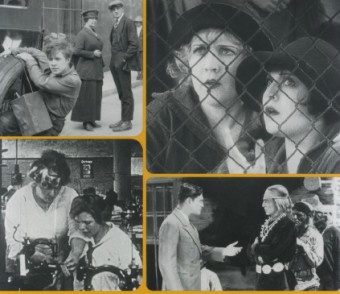
Cecil B. DeMille’s sensational exposé of juvenile reformatories.

Program 4: Americans in the Making

Emigrants Landing at Ellis Island (1903, 2 min.)
Actuality footage from July 9, 1903.
An American in the Making (1913, 15 min)
U.S. Steel film promoting immigration and industrial safety.
Ramona: A Story of the White Man’s Injustice to the Indian (1910, 16 min.)
Helen Hunt Jackson’s classic about racial conflict in early California, retold by D.W. Griffith and starring Mary Pickford.
Redskin (1929, 82 min.)
Racial tolerance epic, shot in 2-color Technicolor at Acoma Pueblo and Canyon de Chelly.
The United Snakes of America (ca. 1917, 80 sec.)
World War I cartoon assailing homefront dissenters.
Uncle Sam Donates for Liberty Bonds (1918, 75 sec.)
Patriotic “striptease” cartoon.
100% American (1918, 14 min.)
Mary Pickford buys war bonds and supports the troops.
Bud’s Recruit (1918, 26 min.)
Brothers learn to serve their country in King Vidor’s earliest surviving film.
The Reawakening (1919, 10 min.)
Documentary about helping disabled veterans to build new lives.
Eight Prohibition Newsreels (1923-33, 13 min.)
From Capital Stirred by Biggest Hooch Raid to Repeal Brings Wet Flood!

The National Film Preservation Foundation, the nonprofit organization created by the U.S. Congress to help save America’s film heritage, is the charitable affiliate of the National Film Preservation Board of the Library of Congress. Since starting operations in 1997, the NFPF has helped save more than 1,100 films at archives, libraries and museums across 41 states, Puerto Rico, and the District of Columbia.

The NFPF website has details of Treasures volumes I and II, with some video clips, and a Treasures IV on the avant garde 1945-1985 will be available next year.

Nine out of Ten

Decomposing nitrate film

On May 21st, at the Cannes Film Festival, Martin Scorsese announced the forming of a World Cinema Foundation to restore neglected treasures of world cinema. The Foundation builds on the Film Foundation, which Scorsese established in 1990, with such luminaries as Sydney Pollack, Woody Allen, George Lucas, Clint Eastwood and Francis Ford Coppola. The Foundation has been responsible for establishing funds to save several key films, but as Scorsese pointed out: “90 percent of American silent movies have been lost, as have half of all U.S. movies made before 1950”.

It’s a startling figure – indeed higher than the usual figure of 80% of all silent films being lost that is usually quoted (the Library of Congress gives this figure for American silents). In truth, it is a very difficult figure to determine, not least with the variable quality of national filmographies, nor does the figure includes non-fiction films (as the Film Foundation site admits, “As for shorts, documentaries, newsreels, and other independently produced, ‘orphan’ films, there is simply no way of knowing how many have been lost”). But you only have to consider that less than 4% of all Japanese films made before 1945 are thought to survive, and maybe 90% for silents worldwide is a fair figure.

Of course, very few have seen even a small percentage of the 10% that survives, not least because much of it has not been restored or made available to view. The profileration of silent DVDs that we’re so fortunate to have access to can blind us to the substantial number of films that we haven’t had the chance to see. There also needs to be an element of realism here. Not every silent film was a masterpiece. Every ‘lost’ silent film which gets put back on the screen seems to be hailed as being an inevitable work of art, but silent movies were much the same as movies today – a few gems, a lot of proficiency, and a large amount of dross.

But the overall lesson must be one of shame at how we can allow a medium, the original experience of which is within the memory of some still living, to be disposed of so easily. And here we are in 2007, as cavalier as ever, now failing to get to grips with the preservation of digital media. What percentage of all emails has been preserved? What will happen to the YouTube ‘archive’? Where will all these blogs be in ten years time?

Here’s a report from the International Herald Tribune. Amusingly, several news reports have misquoted Scorsese and stated that “all American films made before 1950 are gone“. One or two dozy entertainment editors out there…