Photoplay online

Do you remember if those early days of the Web, when businesses and organisations would proudly announce that they had just launched a website? Apart from start-ups, you don’t get so many such announcements these days, particularly for well-established businesses. But some move at more casual pace than others, and so it is that Photoplay Productions – established 1990 – has just launched its first website, which also marks its twentieth anniversary.

Photoplay is the independent company, run by Kevin Brownlow and Patrick Stanbury, dedicated to film history and in particular to reviving and sustaining interest in silent film. It was formed in 1990, but as the About Us section recounts, the history goes back to 1955, when Kevin Brownlow first entered the film industry as an editor. While working on documentaries and feature films (notably editing Tony Richardson’s The Charge of the Light Brigade, 1968) and directing his own distinctive features (It Happened Here, 1964, and Winstanley, 1975) Brownlow was building on his childhood passion for silent film. His extensive interviews with people from the then sorely neglected silent era of film helped make up his classic 1968 book, The Parade’s Gone By.

The book encouraged the UK’s Thames Television to commission a television series, Hollywood – The Pioneers (1980), made by Brownlow and TV director and former ballet dancer David Gill (left, with Brownlow). The series teamed Brownlow and Gill for the first time with composer Carl Davis, whose sweeping scores came to be synonymous with the silent film revival. That revival took the form of eye-opening screenings of restored silents, shown in optimum conditions and correct running speeds with live orchestral accompaniment. The first and most spectacular of these was Abel Gance’s Napoleon, first shown at the London Film Festival in 1980. Its success led Jeremy Isaacs, then setting up the new UK television channel Channel 4, to commission a series of restorations and broadcasts under the title of Thames Silents. Those of us around at the time sat awestruck as The Wind, Ben Hur, The Crowd, The Thief of Bagdad and others were returned to the screens large and small. Thames Silents also led to three exemplary television series, Unknown Chaplin, Buster Keaton: A Hard Act to Follow and Harold Lloyd: The Third Genius.

Thames Television lost its franchise at the end of the 1980s, which meant the end of Thames Silents (Channel 4 Silents followed it for a while). The changes in the UK broadcast landscape encouraged the formation of independent production companies to chase commissions, and one of these was Photoplay Productions, formed in 1990 by Brownlow, Gill and finance expert Patrick Stanbury. The new company continued to undertake restorations and to produce television series on aspects of film history, notably D.W. Griffith: Father of Film (1993) and Cinema Europe: The Other Hollywood (1995).

David Gill died in 1997, but Brownlow and Stanbury have carried on, in the face of increasing difficulty in obtaining commissions or funding restorations for the ‘difficult’ subject of silent film. The distribution of their ‘live cinema’ titles is a major part of the business, and the website lists all of their productions, with full technical details and information on disribution services and licensing. The site also has information on Kevin Brownlow’s book publications, and its News and Upcoming Shows section lists screenings of Photoplay productions and restorations around the world. In particular, for those in the UK, there are three screenings being held at the Barbican in London to mark Photoplay’s 20th anniversary – Orphans of the Storm (7 February, above), The Chess Player (11 April) and The Iron Mask (30 May).

It’s is great to seen the new site, which makes clear all of the tremendous work undertaken by Brownlow, Gill, Stanbury and colleagues in support of the undying medium that is the silent film. A few dud links need to be sorted out (how curious it is that the link for Napoleon – rarely-screened owing to technical complications, expense and legal issues – isn’t working as yet), but this is not just a guide to the industriousness of one company but a primer on the appreciation of silent film. Congratulations, and many happy returns, to Photoplay Productions.

Scotland’s cinemas

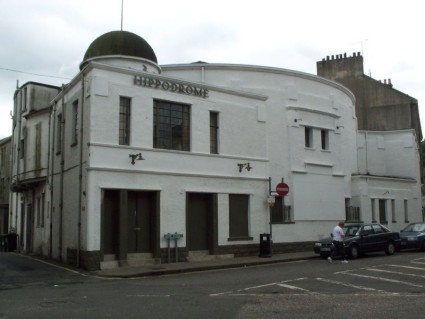
The Hippodrome, Hope Street, Bo’ness, Scotland, which opened in 1912, is now a listed building, and re-opened as a cinema in 2009, from http://www.scottishcinemas.org.uk

The Scottish Cinemas and Theatres Project is a website dedicated to recording and archiving the historic cinema architectural heritage of Scotland. It also acts as a information resource on Scottish cinemas as a subject for social history. Supported by a network of volunteers, the website aims to provide a photographic and historical record of all surviving cinema buildings in Scotland, including those whose purpose and appearance have changed from when they were first cinemas.

This is a fine resource which shows the power of networking in building up a valuable resource collectively. It has a great deal to interest the silent film researcher, as many of the cinemas and former cinemas that it documents have histories that stretch back to our era. Unfortunately there’s no searching by year or time period, so you’ll just have to browse.

At the heart of the website is the Scottish Cinema Database. This contains details of over 1,130 cinemas from over 240 different places, well over half of which are illustrated by photographs (often of the building as it is now rather than in its heyday). As indicated, the database option itself is a little limited in that there is no browse option – one simply enters a keyword for searching across name, address, town, architect etc., with results refinable by all cinemas, surviving cinemas, demolished cinemas or open cinemas. This is fine if you know what you are looking for, but for most the A-Z option will be more helpful, while the website puts a special focus on the cinemas of Glasgow, Edinburgh, Aberdeen and Dundee. The information supplied varies widely, from a one-line description, to detailed, authoritative and well-illustrated accounts, including many historical images from the collection of the Scottish Screen Archive. Collectively the accounts document not only the rise and fall and sometimes rise again of the cinema as a place of entertainment, but the mutability of such urban spaces, as they move in social purpose from places of screen entertainment to become restaurants, garages, hotels, shops and banks. The unevenness of the data makes it of limited use for the systematic study of Scottish cinemas, since one would want consistency of dates, ownership, capacity etc., but as a general finding guide and social record it serves its purpose admirably.

The website also provides a selection of articles on cinema history, a section on listed cinemas and another on cinemas at risk (taken from Scotland’s Buildings at Risk register). There is a somewhat selective links page, and a section showing images of unidentified cinemas. There’s even a section which casts its eye further afield to include some cinemas elsewhere in the UK and worldwide.

All of which is a prompt for the Bioscope to produce a post which surveys cinema databases around the world. The team at Bioscope Towers is already working on it.

The original Neil Brand

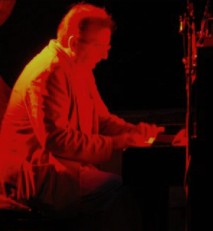
Neil Brand is a silent film pianist. That much is known by most enthusiasts for silent film in the UK, and by a good many around the world as well. It may not always be realised that Neil is also a writer, composer, actor and scholar, one whose prodigious energies and superabundant talent make him not far short of a national treasure. Hmm, why that note of qualification? – he is a national treasure. And now, as if accompanying silents live and on DVD, writing radio scripts and musical comedies, acting on film and TV, writing books and educating students were not enough, now he has turned online archivist with his latest venture, The Originals.

The Originals is a new section of Neil’s personal site which brings together original materials relating to the performance of music to film in the silent era. For some while now Neil has been collecting articles, scores, interviews, memoirs and eye-witness accounts which document the experience of seeing or performing to films in the 1910s and 1920s. He has now started to put some of this material online.

http://originals.neilbrand.com

The site is in three sections: Interviews, Archive and Memories. Interviews features a small collection (so far) of interviews and articles which give the point of view of musicians who were employed in cinemas during the silent era. These include a transcription of a 1988 interview with the 94–year-old Ella Mallett, former silent movie musician (carried out as part of the BECTU History Project which records interviews with veterans of the British film and television industries); an extract from Maurice Lindsay’s memoir of Glasgow life, As I Remember; an extract from New Zealander Henry Shirley’s memoir Just a Bloody Piano Player; and a highly evocative piece from novelist Ursula Bloom about her experiences as a teenage silent film pianist in St Albans (contributed by yours truly).

Archive is the section that is going to attract the most interest. This offers PDF copies of various original documents relating to silent film music, including extracts from original music that would have been performed with various films. The jewel here is selected pages from the score for The Flag Lieutenant, compiled by Albert Cazabon, and the only surviving full score for a British silent fiction film in existence. You’ll also find music for the Douglas Fairbanks picture The Black Pirate, an eyebrow-raisingly dismissive article on the profession of silent film pianist, cue sheets for Hell’s Heroes and The Hound of the Baskervilles, and more.

The third section, Memories, presents extracts from the 1927-1930 diaries of Gwen Berry, who played ‘cello in the orchestra pit of the Grand Cinema, Alum Rock Road, Saltley. The extracts, from 1929, show Gwen’s apprehension at the arrival of the “terrible talkie pictures” which were going to throw so many musicians such as her out of work. The diary is presented in a elegant turn-the-pages digital form, which does require that you install a plug-in for DNL ebook software.

All in all, The Originals is an excellent idea, and one that The Bioscope hopes will grow and grow, not least if those interested are able to send relevant materials to Neil so that they might be shared by all.

Meanwhile, here’s a handy survey of other things NeilBrandian…

Bravo, Neil.

Voici Gallica

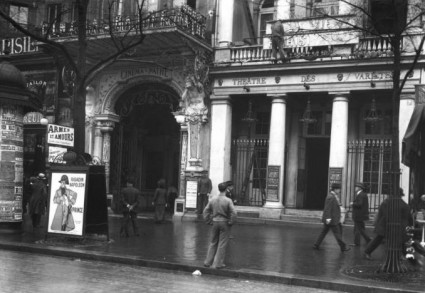
Cinéma Pathé next door to the Théatre des Variétés, boulevard Montmartre, 1913, from Gallica (http://gallica2.bnf.fr/ark:/12148/btv1b6927366c). Note the poster for Rigadin Napoleon, starring Charles Prince.

Gallica is the digital library of the Bibliothèque nationale de France. Established in 1997, today it contains just under one million digital documents, including 150,000 monographs (over 90,000 of which are word-searchable), 675,000 pages from over 4,000 periodicals, over 115,000 images, 9,000 maps, 1,000 sound recordings, 5,500 manuscripts and 2,300 music scores. Content comes both from the BnF and a range of partner libraries. It is unquestionably one of the outstanding digital resources worldwide, and one which anyone with a serious interest in researching silent cinema will want to use, however limited their French might be.

To begin with, Gallica is reasonably Anglo-friendly. There is an English language option (plus Spanish and Portuguese), with basic user guidelines, though introductory texts remain in French. The front page includes the main Search option and link to Advanced Search. This offers a thorough range of options, allowing you to refine searches by title, author, text, date, language, broad subject, document type and access type (i.e. free versus paid-for content). Look also for the link to Themes, providing a handy way into what can a bit bewildering at first on account of its sheer size.

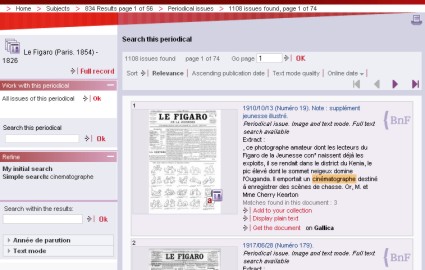
Also linked from the front page is the newspaper section. As far as I can see, the main front page search option does not cover the newspaper holdings, so you will want to follow this link to discover the digital library for such key titles as Le Figaro, L’Humanité, Le Temps, La Croix and many more (for film journals see below). Searching is by periodical title – so, for example, if you select Le Figaro, you are presented with a table of years, from 1826-1942, and you can either click on one of those years and browse a calendar to get to a specific day’s edition, or else use the search option to investigate all titles. Search for ‘cinematographe’, and this is what you’ll see:

One you have identified a newspaper that you are interested in, you can add it to you digital collection (an option provided for registered users), view the plain text, or view the scanned document. When you click on the document, check on the left-hand side for the page number where the search term you have used can be found, because the full digitised newspaper will have turned up, and it is necessary either to scroll through page by page or you can type in a number and go direct to the desired page. Your search term will be highlighted in yellow on the page. You can download pages as PDFs, print them, email the refernece to yourself, or even listen to the citation for the selected newspaper – in French, of course. There are also full screen and zoom options, as well as a range of other options to assist your searching and browsing.

There is much more to Gallica than simply newspapers. As said the main search option on the front page covers everything else, which means chiefly digitised books, manuscripts, serials and images. Content ranges from the ancient to the recent (more recent texts are only available under subscription through external providers), and there is extensive material that relates to silent cinema. Searching on ‘cinematographe’ yields 1,318 hits, ‘melies’ brings up 280 hits, ‘pathe’ 2,128, and ‘gaumont’ 957. Note the option to refine searches given on the left-hand column; so, for example, the ‘gaumont’ search can be narrowed to searches by periodical (537), book (413) or image (7), as well as by author, date, theme and language. Remember also when searching for phrases to put the words in quotation marks for more accurate results. Much of it is books and serials, but you can dig up treasures such as the photograph of a Montmatre Pathé cinema above or this Max Linder scenario complete with sample film strip:

Scenario with filmstrip for Les Débuts de Max Linder au cinématographe (1912), from Gallica (http://gallica.bnf.fr/ark:/12148/btv1b6404152z)

Also to be found through the main search option are a number of film journals from the silent era. There is no simple way of identifying these, so (with the help of some Bioscopists) here’s a listing of journals that I’ve managed to locate:

Given the scarcity of silent era film journals online generally, this is an absolute treasure trove all by itself. Most important among them is Cinéa, which was the focal point for intellectual debate on film culture in France at this time.

Raquel Meller in Carmen, front cover of Cinéa, 15 November 1926, from Gallica (http://gallica.bnf.fr/ark:/12148/bpt6k5739086t.vocal.f1.langEN)

Gallica is an amazing resource, and one which has been in the news recently. It has been billed for some while now as France’s answer to Google Books, and it was announced this week that France is making further moves to counter the Anglo-Saxon hegemony by developing a still more extensive online portal, based on Gallica, by establishing deals with publishers an private companies (including Google?) to build up all-encompassing French digital library. Last month Nicolas Sarkozy announced that €750 million would be allocated for the ongoing digitisation of France’s libraries, specifically to counter the threat represented by Google’s plans for extensive digitisation of out-of-copyright works (Google Books is currently ten times the size of Gallica). Gallica will be the outlet for this digital activity, as will the European digital library, Europeana (which will be the subject of Bioscope post some day soon). At any rate, we are all going to be the beneficiaries – all the more so if we can only brush up on our French.

I’ve added a new category to the options of the right-hand side of the Bioscope, ‘digitised journals’, and I’ll go back over the blog and mark all those posts that have covered digitised newspapers and journals under this category as a reference aid. And look out soon for a post which will round up newspaper digitisation projects around the world which are relevant to our area.

Now go explore.

Losing films

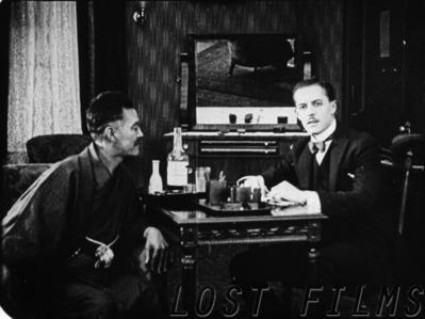
Production still for 4 Devils, from http://www.lost-films.eu

The keen-eyed among you may have noticed that there has been no announcement for the Bioscope Festival of Lost Films. I’ve decided not to pursue the festival any further. It ran for two years, and attracted quite a bit of interest, but I was never quite happy with the way it worked, and then there were the various people who contacted me subsequently who wanted to know where these long-lost films were, and who couldn’t grasp what was going on. And then there was the embarrassment of one of the films that I wrote about not being lost at all – or so I understand (I’ll identify it and report on its happy rediscovery when more concrete information emerges). All in all, it’s time to move on to other things.

But while we’re on the subject of lost films, it would be handy to summarise where things are these days, in particular to reassess the Lost Films site created by the Deutsche Kinemathek. Established in 2007, the ‘Lost Films’ project set out to gather information on films believed to be lost, with archivists and historians invited to add information, documents etc. What started out as a wiki with a strong emphasis on lost German films has grown into a fully-fledged portal, “aimed at collecting and documenting film titles, which are believed or have been declared ‘lost'”. 3,500 titles are now listed, many of them described in detail and illustrated by photographs and documents, and while the emphasis remains with German cinema the range has extended greatly to include lost films from around the world. Not all are silent films, but given the biases of time, the great majority comes from the pre-1930 era.

As an example of what one can now find on the site, take a look at one of the most keenly sought of all lost films, F.W. Murnau’s 4 Devils (US 1927). Starring Janet Gaynor, Charles Morton, Barry Norton and Nancy Drexel, this circus drama was Murnau’s second American film, and it was issued both as a silent as with a Movietone score (not with Murnau’s co-operation) with synchronised sound effects, music and dialogue sequences.

Lost Films gives us a synopsis (including different versions of the ending), cast and credits for both silent and sound versions, release information including length and censorship details, premiere dates, and this commentary by the Deutsche Kinemathek’s Martin Koerber on the film’s ‘lost status:

A print of this was last seen in the 1940s in the Fox warehouse in Los Angeles. According to the files on this title in the Fox papers at UCLA, the print was given to Mary Duncan, lead actress. Legend has it that she either burned it or drowned it in her swimming pool. We can still hope this is an urban legend. No one has traced Mary Duncan’s things, she died only in the 1990s, and there may be heirs. Janet Bergstrom’s video essay about this lost film is a fascinating story, presenting all the surviving stills and sketches and other evidence. This is a bonus on the SUNRISE DVD (or on some of them, anyway.)

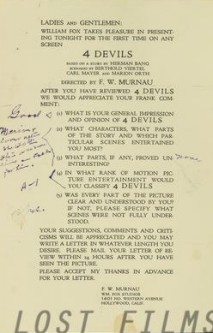
Attached to this record are a mouth-watering 172 digitised documents:stills, programmes, advertisements, audience questionnaires (see above), censorship documents, drawings, screenplay (just a sample page, alas), distribution documents and more. The documents come from the Deutsche Kinemathek’s F.W. Murnau collection, and obviosuly not every lost film will be so richly documented, but nevertheless Lost Films has become a rich research resource, not just for specific lost films but for silent film history in general.

There are various ways in which you can search for films – by title, director, country, or year. One needs to be aware of the bias towards German production, and that the numbers of lost films per country is not a measure of overall loss – so, for example, there are currently 1,931 German films listed, but only 42 Japanese, yet the survival rate for Japanese silent film is catastrophic – at least 95% of all production is estimated to be lost (more on such figures in a moment). There are 752 American films listed, and 174 from the UK. Not all are silents, do note. Many of the American and British titles come from the Presumed Lost section of Carl Bennett’s Silent Era site.

Unidentified film no. 145 from Lost Films, a drama of Europeans in Japan, thought to date c.1925, possibly American

Lost Films invites you to register and then contribute information, including adding your own digital materials. It has a helpful links section (though I wish they’d spell my name right), which covers not only lost films but report on films which have been re-discovered. There are different kinds of lost film – those which we know about but no longer exist; those which exist in incomplete form or some non-original version only; those which exist but are hard to find (or see); and those which exist but are effectively lost because they are unidentified. So Lost Films has a section on films that require identification, all illustrated with stills, and a number (chiefly American) happily now identified.

A number of the stills has been contributed by the Nitrate Film Interest Group, and off-shoot of the Association of Moving Image Archivists (AMIA), which is using Flickr to host images of unidentified films in the hope that someone somewhere can identify a name, place or film company logo. There are some highly knowledgeable folk out there who can, and there is pleasure to be had simply in witnessing how sharp-eyed some people are. Do have a go, becuase if you don’t recognise the performers you may be able to spot a location, or a form of dress, and a piece of décor which may provide the vital clue.

There are other lost film resources out there, either aimed at the film history enthusiasts or the archivist looking to identify the mysterious or to help complete a national collection.

  • Moving Image Collections – Lost Films
    The AMIA and Library of Congress-support film archives portal includes a lost films section (all American), and a complementary found films section too.
  • The Silent Era – Presumed Lost
    The aforementioned Silent Era service list hundreds of lost silents from around the world, with credits, references and technical information, plus updated information on films previously listed as lost which survive complete or incomplete somewhere.
  • Recherche des films perdus
    Listing (in French) of films which were listed as lost in 1996 but which have been discovered in archives around Europe by the LUMIERE project (the list is arranged by country of archive, then by country of production).
  • Der Stummfilm in Lateinamerika
    This handy site on Latin America silent cinema (it’s in German) includes a listing of key lost films from Argentina, Brazil, Mexico etc.
  • Wikipedia
    Wikipedia has a selective list of lost films, arranged by decade, which many of the most sought-after titles. It also provides lists of incomplete or partially lost films and rediscovered films. (Much of the information derives from The Silent Era).

  • For the rest, check out Lost Filmslinks page.

To review all of the Bioscope Festival of Lost Films entries, visit the Series section of this site which has all the links – and see if you can guess which one now survives. While you’re there, you can also follow the links for the Lost & Found series, which tells the stories of the discovery of lost film collections.

There are some books on the subject too: Harry Waldman, Missing Reels: Lost Films of American and European Cinema; David Meeker and Allen Eyles, Missing believed Lost: The Great British Film Search; Frank T. Thompson, Lost Films: Important Movies that Disappeared. Note also Anthony Slide’s Nitrate Won’t Wait: a history of film preservation in the United States (2000); David Pierce’s essay, ‘The Legion of the Condemned: Why American Films Perished’, Film History vol. 9 no. 1 (1997), a revised version of which appears in Roger Smither (ed.), This Film is Dangerous: A Celebration of Nitrate Film (2002); and Gian Luca Farinelli and Vitorio Martinelli, ‘The Search for Lost Films’, in Catherine A. Surowiec, The LUMIERE Project: The European Film Archives at the Crossroads (1996).

There are different kinds of lost film, and different degrees of loss. Indeed, some argue that no film can be described as being definitively lost, since by the very nature of the medium multiple copies were produced, so there is always the chance that one may be squirreled away somewhere. Lost films are found in archives, in private collections, on distributors’ shelves, in projection rooms, in people’s basements, attics or garden sheds, in auction sales, and in some romantic cases among a collection of old radios (The 1895 Derby), hoarded by a Swiss school (the Joseph Joye collection), in a Chinese flea market (The Case of Lena Smith), at the bottom of the sea in the wreck of the Lusitania (The Carpet from Bagdad), buried underneath a Canadian swimming pool (the Dawson City collection), or on eBay (Zepped).

Nitrate films in an advanced state of decomposition, from http://www.archives.gov

But just how many silent films are lost? The figure generally bandied about is 80% of all films from the pre-1930 era, this was put together quite a few years ago (I believe it was at the behest of the Federation of Film Archives, or FIAF), and it hasn’t been challenged much since. It may be correct, but it was estimated by matching titles held in national film archives with the titles recorded in national filmographies. But national film archives don’t hold everything (as any proud collector will tell you) and national filmographies have tended until recently to restrict themselves to the fiction film. Nowadays there seems to be a less blinkered approach, but as the Film Foundation says, while “a mere 10 percent of the [fiction] films produced in the United States before 1929 are still in existence … for shorts, documentaries, newsreels, and other independently produced, ‘orphan’ films, there is simply no way of knowing how many have been lost”. Where did that 10% figure come from? The American Film Institute calculated in the mid-1970s that 25% of American silent era films were lost, a much-quoted figure, but as Anthony Slide points out, “such figures, as archivists admit in private, were thought up on the spur of the moment, without statistical information to back them up”.

Solid information for other countries is hard to find, and is certainly not gathered together in any one place that I know of. Here’s a start, however:

  • Australia – 50 out of 250 feature films made between 1906 and 1930 survive in whole or in part (source: National Library of Australia)
  • Brazil – around 10% of silent feature films survives, though many only in a fragmentary state (interview with Carlos Roberto de Sousa)
  • China – 5% of 1,100 productions made 1905-1937 survive (source: Griffithiana no. 54, 1995)
  • Germany – No overall figure, but of 700 films made in 1916 just 60 survive, while one fifth of films made in 1925 are held by the Bundesarchiv (source: Bundesarchiv, ‘Lost Films’)
  • India – of around 1,330 silent fiction films made, thirteen survive, all incomplete (India Profile)
  • Japan – 95-99% of all silents are estimated to be lost (Le Giornate del Cinema Muto catalogue, 2001)
  • Russia – 286 films, out of an estimated 1,716 films produced 1907-1917, or one sixth of production, is preserved by Gosfilmofond (Silent Witnesses: Russian Films 1908-1919, 1989)
  • United Kingdom – “a huge proportion of Britain’s early film heritage is believed lost” (BFI Collecting Policy document)
  • USA – a survival rate of 7-12% for each year of the teens (feature films only), moving to 15-25% for the 1920s (Library of Congress figures from 1993, cited by David Pierce)

(Anyone who has a source for figures from other countries, or better figures, please let me know)

We need an up-to-date international set of figures, one which takes into account the most authoritative filmographic work and which makes it clear the proportion of fiction and non-fiction, professional and amateur film that we should be considering. It would need to make clearer the national differences in survival rates, and what survives in public institutions, commercial concerns, and privately (however much of a guess the latter would have to be). Where certain figures cannot be computed, we need formulae that give an indication. The methodology needs to be made clear. We need the same for the talkie era, for the television era, and now all over again for the digital era, when user-generated content is rewriting the rules for what can be produced. Only then will we know with accuracy just how shamefully we have treated the medium that supposedly is the great mark of the modern age. And we will treasure what survives all the more.

Alas for Intute

It is possible that the majority of the readers to the Bioscope will not have heard of Intute. This is a shame, because for a long time it has been a gem of a research resource, but one whose future has just been stylied by funding cuts. Intute (a terrible name – it was much better when it was known as the Resource Discovery Network, or RDN) is a directory of websites selected for their value to academic research and then described and classified by a team of subject specialists. It is funded by the Joint Information Systems Committee, a somewhat scary-sounding UK body which supports online services for UK universities, but the JISC has just announced a funding cut from August 2010, the result being that Intute will no longer be updated from that point onwards.

This is a great shame, because Intute is a well-organised, imaginative and useful service. Among the several thousand web resources it lists, under such academic areas as Biological Sciences, Geography and Environment, Pyschology and Social Sciences, there are many under Media Studies and Creative and Performing Arts which relate to film, and some of those relate to silent film. Of these, most will be familiar to you (or can be found among the links on the right-hand column of this site), but looking again I found a few that were new to me. Here are three, with Intute’s own descriptions:

Bibliografie des fantastischen films : bibliography of fantastic film
http://www.bibfan.de

The ‘Bibliography of Fantastic Film’ is a free online bibliography of the secondary literature on such films. As of August 2008 the bibliography contains around 54,000 items. The bibliography is a personal project by Holger Schnell, begun in 1991. Schnell describes the bibliography as covering “the whole range of fantastic film from the silent era to nowadays including horror, science fiction and fantasy as well as animation and experimental film”. Books and articles from magazines are covered, as well as thesis and dissertations. The bibliography can be browsed by person, film title and subject, and a free search can be conducted for the whole database or in a selected index. The website contains a special feature on ‘Religion In Film’, and lists on selected subjects, directors, and key films. The website is cleanly designed and easy to use and navigate.

Cinema and film industry in Weimar Republic, 1918-1933
http://www.korotonomedya.net/theoria/weimar.html

‘Cinema and film industry in Weimar Republic, 1918-1933’ is a 14,000-word extract from an unpublished thesis undertaken by Secil Deren at the Middle East Technical University, Ankara in 1997. The text outlines the Expressionist Period through an examination of ‘Das Kabinett Des Dr. Caligari’ and the films that Caligari influenced, including ‘Metropolis.’ The text then outlines: the ‘Stabilization Period After the Dawes Plan’; ‘Montage Documentaries and Walter Ruttmann’; ‘Cinema as a Means of Political Propaganda’; and ‘Cinema Industry and the Left-Wing Intelligentsia’. Students will find the analysis here of the intrusion of political and economic matters into cultural life in the Weimar period to be an interesting starting point for further study. There is a bibliography.

Spanish-American war in United States media culture
http://chnm.gmu.edu/aq/war/

The “Spanish-American War in United States media culture” website contains a hypertext essay with pictures and drawings about the representation of the 1898 Cuban-Spanish-North American War (or Spanish-American War) in United States media culture. The essay investigates the role of the film “Unthinking Eurocentrism” in the larger mediation of the Spanish-American War and attempts to increase the understanding of pre-classical cinema in the United States. Contained here is an introduction followed by six sections that includes “Film studies and the Spanish-American War”, “Media culture and representations of war”, “Early cinema and the Spanish-American War”, “Receptions of war”, “The war at home” and “Resisting spectators”. Each major section links to pages both inside and outside that section or to a different website. In addition, there is a bibliography, a link to American Quarterly and links to other online resources.

Unfortunately such a labour-intensive service could not be sustained by central funding for ever, particularly when there are so many of us out there who are happy to do much the same sort of work for free, if not quite so thoroughly. It’s good that at least what Intute has produced so far will be kept online, but the Web never stands still, and the information Intute preserves will gradually become irrelevant. Such is the fate of every reference guide that is fixed in time, alas.

Chronicling America

Cartoon from The Evening World Daily Magazine, 16 January 1909, from http://chroniclingamerica.loc.gov

A couple of years ago we covered the Library of Congress’ newspaper digitisation project, Chronicling America, alongside a number of other digitised newspaper collections. The resource allows researchers to search and view a million newspaper pages for free from 1880-1922, covering the following American states: Arizona, California, District of Columbia, Florida, Hawaii, Kentucky, Minnesota, Missouri, Nebraska, New York, Ohio, Pennsylvania, Texas, Utah, Virginia and Washington.

The Chronicling America team is producing a number of subject guides with sample articles to assist researchers. Subjects selected so far include Baseball’s Modern World Series, Ellis Island, Jack Johnson, Patent Medicines, the Russo-Japanese War, and Early Cinema. Topics in Chronicling America – Early Cinema provides a list of key dates, a list of helpful search terms (Moving Pictures, Motion Pictures, Muybridge, Chronophotographic, Kodak, Kinetograph, Kinetoscope, Mutoscope, Cinematographe, Vitascope, Thomas Edison, Nickelodeon), and sixteen sample articles, from “All the Gaits of Horses” [Shown in Moving Pictures by Zoopraxiscope], New York Sun (New York, NY), 18 November 1882, to “Colored Moving Pictures”, The Sun (New York, NY), 21 March 1909 (the majority of the newspapers selected for Chronicling America don’t go beyond 1910).

My thanks to regular Bioscopist David Pierce for bringing this to my attention. An updated survey of digitised newspaper resources handy for the study of early film is long overdue. I’ll set to work on it.

Searching for Mary Murillo

marymurillo

Recently I was invited to speak at an event taking place Saturday 7 November at the BFI Southbank in London, on women and British silent cinema. There is increasing interest in the role of women in the early years of filmmaking (as demonstrated by Duke University’s Women Film Pioneers project), and as part of this trend the industrious Women and Silent British Cinema project has been investigating all traceable women filmmakers active in Britain in the silent era – including some rather obscure names, for whom little information survives. For my talk I offered to take on a scriptwriter about whom little was known, Mary Murillo, to demonstrate the research process and some of the online sources available. This blog post serves as part of my response.


Mary Murillo does not turn up in any standard motion picture encyclopedia or reference book. Her name is absent from all of the histories of the silent film era that I have consulted (bar a film credit or two), yet she was a significant screenwriter in American film for ten years, then worked in British films for six or more years where her name brought prestige to three different film companies, before she moved to work in French films at the start of the talkies. The fact that she has almost disappeared from film history says a lot about the way in which women filmmakers have been allowed to slip out of early film history, and about the low status of scriptwriters generally. So, how do we go about recovering that history?

Type her name into Google
Type “mary murillo” into Google and you get 15,500 hits. Initially this seems the very opposite of obscurity, but one quickly discovers that the same film credit data has been lifted from one or two sources to be reproduced on numerous filmographic and DVD sales sites, and what is useful information about her is very thin on the ground (one also finds many sites which refer to paintings of the Virgin Mary by the Spanish artist Murillo).

So there’s Wikipedia, which does have a short entry for her – a one-paragraph biography, a filmography and a couple of links. The biography tells us that she was born in Britain, wrote for the Fox, Metro and Stoll studios (the latter in Britain), that most notably she wrote for Theda Bara and Norman Talmadge, and that she was Irish by nationality, though some sources have her as being Latina. This is useful – and correct, because unfortunately the major piece on Mary Murillo available online, ‘Mary Murillo, Early Anglo Latina Scenarist‘ by Antonio Ríos-Bustamante, makes the fatal assumption that her surname meant that she was of Latin American extraction, despite evidence that she was born in Bradford. The writer has uncovered some useful information, but having made a wrong turning at the start, goes off in totally the wrong direction. There are other errors, notably in the filmography, and one is better off with her credits on the Internet Movie Database – over fifty titles – yet one should never accept the IMDb as being accurate or complete, especially for the silent film era, when credits can be difficult to determine (particularly for scriptwriters). Certainly she made more films that are listed there.

Family history sources
For a proper grounding in biographical film research, it is essential to use family history sources. This is where some small investment is necessary, because apart from the volunteer-produced FreeBMD (births, marriages and deaths in the UK, roughly to 1900), the major sources – Ancestry, Findmypast.com etc. – require payment. Ancestry, however, is essential, offering not just births, marriages and deaths, but census records, shipping registers, military records, and much more. The Bioscope has produced a guide to using family history sources in film research, here. Mary Murillo is a problem, however, because it was an assumed name. Her real name was Mary O’Connor. She was of Irish parentage, which is a problem because there are few Irish family history resources online and most pre-1901 census records were destroyed in 1922 during the Civil War. However, Murillo / O’Connor was born in Bradford (explained below) in 1888, yet I can find no official birth record – the first indication of what seems to have been an unconventional childhood.

1912shipping

Mary De Murillo, bottom line of this insert from the ship’s register for the S.S. New York, sailing from Southampton 2 August 1909, from http://www.ancestry.com

Shipping records
These are essential. One of the great boons for biographical research recently has been the publication of shipping records, particularly between Britain and the USA before 1960, which give access to passenger registers, or manifests, which contain much biographical information, as well as certain dates. Ancestry has some, Findmypast provides Ancestors on Board using records from The National Archives, but best of all is Ellis Island, a free database with digitised documents of New York passenger records 1892-1924. From Ancestry’s shipping records we discover that Mary first went to American in 1908, under the name Mary de Murillo, where we learn her age (19), that she was Irish but living in England, that she was born in Bradford, that she was an actress, and that she was travelling with her step-sister, Isabel Daintry.

isabeldaintry

This seems a wonderful clue, though it has proven to be a bit of a dead-end. I’ve not been able to trace a family history for Daintry, who was an actress herself, appearing in a few films in the early 1910s, before fading from history, leaving just a photo (left) from the Billy Rose Theatre Collection in New York Library. One also discovers from the shipping record that Murillo does not give a family member as contact back in England, instead naming a Mrs Henderson of Eton Avenue, London as her friend. One her assumes that her parents were dead. We also learn that she was 5′ 4″ tall, with fair complexion, fair hair and brown eyes, and that she was in good health.

Databases
Why was she travelling to America? Well, she was calling herself an actress, and she was looking for work. Among the several handy databases that one can employ to find biographical information for those in the performing arts, a particularly useful one is the Internet Broadway Database, a free database of production credits for all stage performance’s on New York’s Broadway. And sure enough, there early in 1909 is Mary Murillo appearing alongside Isabel Daintry in the chorus of a musical, Havana. It was not a notable dramatic career – she has three further credits on the IBDB in 1912 and 1913, from which we may infer that she was on tour in stage productions during this period. As newspaper and theatre records reveal, she was a member of Annie Russell’s Old English Comedy Company, performing way down the cast list in plays such as She Stoops to Conquer and The Rivals. This correlates with shipping records, because we find she sailed again from Britain to New York in October 1912, this time on her own, revealed by the manifest for her departure (on Ancestors on Board) and for her arrival (on Ellis Island), with useful the information that her previous stay in the country had lasted for three-and-a-half years.

Census records
Normally census records are the bedrock of biographical research. You get a person’s age, place of birth, family members, occupation, place of residence, and incidental information that one can glean, such as social status. Unfortunately I have not been able to find Mary Murillo/O’Connor on any British or Irish census, though I have found family members (her sisters, but not her parents). However she does turn up in the 1910 New York census, where she is a lodger in Manhattan, given as born in England, profession stage actress, no other family member with her. Something to be wary of – the electronic versions of such data, in this case Ancestry, are based on transcriptions and often the names have been written down wrong – for the 1910 census, Ancestry has her name as Mary Minter. Later census records have not yet been made publicly available.

Newspapers
At some point in 1913 or 14, Mary Murillo sold a film scenario to the husband-and-wife production team of Phillips Smalley and Lois Weber. Her career as an actress had not taken off, and like many others before her she looked to the movie industry as a way out, though in her case it was through her pen. She clearly had talent, because within two years she was one of the leading film scenarists in the American film business, becoming chief scriptwriter at Fox in 1915. This rise to fame one can trace through the best source for any online research of this kind, the newspaper archives. There are so many of these, though few are free, so either you pay a subscription or you hope your local library subscribes. Major resources include Newspaper Archives.com (for American papers), the Times Digital Archive and Guardian Archive. Free resources include Australian Newspapers, New Zealand’s Papers Past and a private archive of American papers, Old Fulton NY Post Cards. Film publicity departments sent out supporting bumf worldwide, and you can find Mary Murillo’s name scattered all over the place, becase such was her prominence that her name was frequently mentioned as a leading feature – in ‘reviews’, advertisments and posters. The Bioscope has produced a guide to newspaper archives online, though it’s in need of some updating.

bara_ad

Advertisment for Her Double Life, from the Sandusky Star Journal, 28 September 1916, available from Newspaper Archives.com

Mary Murillo specialised in exotic melodrama, and wrote five scripts for Theda Bara, Hollywood’s archetypal vamp. The films were Gold and the Woman, The Eternal Sapho, East Lynne, Her Double Life and The Vixen. From an article in the New York Clipper, 1 May 1918 (found at Old Fulton’s NY Post Cards), entitled ‘The Scenario Writer’, we learn this:

Even as late as the year 1914, there were few companies who deemed the writer worthy of mention on the screen and as for proper financial reward, many an excellent five reeler brought the magnificent sum of seventy-five dollars. Slowly but surely, however, the big film producers have come to realize the importance of the scenario writer in the general scheme of things with the result that from being one of the most poorly paid individuals connected with the industry, the men and women who create the successful screen plays today, now receive monetary recompense of substantial proportions. Mary Murillo, for example, a scenario writer, who made over twenty-five thousand dollars last year, sold her first script for twenty-five dollars, four years ago. She is but one of many scenario authors, who unsung and ignored but a few years back, are now reaping similar big rewards in the scenario field.

Quite a leap from stage obscurity to $25K a year in just four years. Newspaper records also tell us that Murillo left Fox at the end of 1917 to go independent, working for Metro amongst others, before joining the staff of Norma Talmadge productions in 1919, where she scripted such titles as Her Only Way, The Forbidden City and The Heart of Wetona, plus others such as Smilin’ Through where her name does not turn upon official credits but where she seems to have been a script doctor – a role she performed many times, making her exact filmography a difficult subject on which to be precise.

She ended her American film career in 1922. Why this was one can only speculate. Perhaps she wanted new challenges, perhaps her penchant for high-flown romanticism was starting to be out of fashion, or perhaps it was related to a revealing report in the New York Times of 18 March 1923, where we learn of the seizure by a deputy sheriff of a five-storey at 338 West Eighty-Fifth Street leased by Miss Mary Murillo, “a scenario writer, now said to be in Hollywood”. She had defaulted on her payments. Among the goods seized were “tapestries alleged to be valuable, a mahogany grand piano, phonograph and a quantity of records, a lot of silver and a leopard skin”. Mary had been living the movie life, and how.

Contemporary movie guides
It’s worth remembering that there were reference guides produced from the early 1910s onwards that provide biographical information on those before and behind the camera in the film business. Often the personal information provided needs to be taken with a pinch of salt, but it’s always a handy starting point. Some of these are available on the Internet Archive: for example, Charles Donald Fox and Milton Silver’s Who’s Who on the Screen (1920), and the 1921 edition of William Allen Johnston’s Motion Picture Studio Directory and Trade Annual. The latter has an entry on Mary Murillo, which seems to be wholly accurate, as follows:
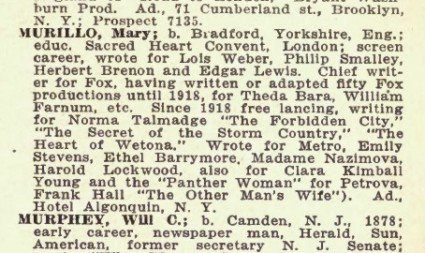
1921directory

Motion Picture Studio Directory and Trade Annual 1921

Trade papers
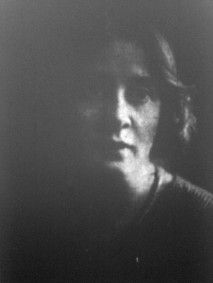
There is plenty one can find about Mary Murillo from American newspaper sources, even if mostly of a superficial kind. Once she moved to Britain, the online sources dry up, because she gets little mention in the digitised British newspapers. She started writing for Stoll Film Productions, the major British studio of the early 1920s, resulting in five films: The White Slippers (1924), The Sins Ye Do (1924) and A Woman Redeemed (1927), plus two (possibly three) titles for other studios. Information on these is best found in film trade papers, such as the Bioscope and the Kinematograph Weekly, which do not exist online and need to be located at the BFI National Library, British Library Newspapers (which has produced a useful list of British and Irish cinema and film periodicals that it holds), or on microfilm sets at film research centres. There are no indexes to such resources – you just have to scroll through them and hope to strike lucky, though the BFI’s onsite database provides many references (these are missing from the online version of the database). One trade journal that does have a handy index is the American Moving Picture World, and it is from Annette M. D’Agostino’s invaluable Filmmakers in the Moving Picture World: An Index of Articles, 1907-27 that I found an article on Murillo from 16 March 1918 – though only after looking twice, because her name was indexed as Murrillo (remember never to trust indexes implicitly – always look laterally, and be prepared for mispellings etc). From that I got the photograph at the top of this post and some tantalising biographical information, including her schooling at a convent in Roehampton, near London. (By the way, the American journal Variety does publish indexes, for film titles and an obituaries index, only in printed form).

Ask people
Of course, asking people is a hugely important part of research. It’s always best to do a bit of research yourself rather than expect others to do all your work for you, but armed with some information you’ve been able to gather, turn to the experts. Having taken my research so far, I posted a query on the classic film forum Nitrateville, which is jam-packed full of knowledgeable people only too willing to help. It so happened that none knew anything about Mary Murillo directly, but one or two respondees came up with excellent leads. One used Google Books, which enables you to search through snippets of texts from books old and current and found a mention of her in a Belgian memoir – more of that below. Another looked in the Irish Times Digital Archive, a subscription site, and found that there seemed to be an article on her in 1980. I have access to the site at work (see here for a list of all full-text, word-searchable newspapers and journals available electronically at the British Library), and discovered that the article was a piece by Irish film historian Liam O’Leary on the director Herbert Brenon, with whom Murillo worked. O’Leary, as an aside, revealed the precious information that her real name was Mary O’Connor, and that she came from Tipperary.

Tipperary and Bradford? Something odd there, but the Liam O’Leary papers are held in the National Library of Ireland, where former cameraman and known walking encyclopedia of Irish film history, Robert Monks, has care of the papers. Bob looked up Liam’s card index for me and found reference to an article on her in the October 1917 issue of Irish Limelight, a short-lived film trade journal. Happily, the British Library has Irish Limelight. From this I learned that her family came from Ballybroughie – though there’s a problem there, as there is no such place as Ballybroughie, at least as far as I can find. Her early years were spent near Tipperary, though as she and her sisters (more of them in a minute) were born in Bradford the family clearly moved around a bit. She mentions her father (no name) but not her mother, boasts of her great muscial gifts when young, says that she chose the name Murillo because she was compared when young to a Murillo madonna painting, and describes how tough she found it finding work as an actress.

She also mentions the convents she went to – St Monica’s in Skipton, Yorkshire, and Convent of the Sacred Heart School in Roehampton. This is now Woldingham School and the archivist there told me that Mary O’Connor (born 22 January 1888) and her sisters Philomena and Margaret were at Roehampton for a year (1903-04) before deciding that its tough regime was not for them. The parents’ (parent?) address is given as Thomas Cook c/o Ludgate. He, or they, were overseas (the travel agents Thomas Cook’s main offices were in Ludgate Circus, London). In the 1901 census Philomena, Margaret and another sister Winifred (but not Mary) are given as boarding at St Monica’s, aged respectively 4, 3 and 7. What were the first two doing in a boarding school at that age? Were the absent parents touring performers, or involved in international (Empire?) business, or just plain neglectful?

Mary Murillo turns up in a couple of British newspapers in the late 1920s when her name was used by two film companies issuing prospectuses in the hope of investment. In The Times, 29 November 1927, the British Lion Corporation (with backing from the author Edgar Wallace) announced that its grand plans included “a contract with Miss Mary Murillo, whereby she is to write two complete Film scenarios for the Company during the year 1928”. It also makes the surprise claim that she wrote the script for The Magician by Rex Ingram (Irish himself, of course), something not otherwise recorded in any source. She also turns up in the prospectus the Blattner Picture Corporation (found in The Daily Mirror 21 May 1928, available from pay site ukpressonline) where it declares that “the company will from its inception will have expert technical assistance, and in particular Miss Mary Murillo (formerly Scenarist for the Metro-Goldwyn Corporation, Messrs Famous-Players Lasky, Mr D.W. Griffith, Miss Norma Talmadge &c.) will write Scenarios for this Company’s first year’s programme”.

This is useful, though only a couple of films seem to have come out of her association with British Lion, and none with Blattner. She made some films in France, apparently working on English versions of French releases, though she is credited for the script of the 1930 classic Accusée, levez-vous!. Her last film credit is as a co-writer of the British film, My Old Dutch, in 1934. Then what? Well, the Belgian source I mentioned was Les Méconnus de Londres (2006), the memoirs of Tinou Dutry-Soinne, widow of the Secretary to the Belgian Parliamentary Office in London, which cared for Belgian exiles during World War II. She met Mary Murillo in London at that time, and provides a sketch of a lively, interesting character with a fascinating history in film behind her who was keen to help Belgian exiles. An email to the obliging people at the Belgian embassy in London got me Mme Dutry’s address, and she wrote me a most friendly and detailed letter with all the information she could find on her social contacts with Mary Murillo up 10 October 1941, the last time she saw her. Murillo wanted to do what she could to help the Belgian cause (she seems to have spent some time in Belgium before the war), but suddenly disappeared from the scene.

Archives
And then what? I don’t know. She just vanishes. She appears not to have married nor to have had children. I have found no death record, though admittedly Mary O’Connor is not an easy name to research. But for the film researcher the biographical information, though a necessary backbone, is not the main business. She was a scriptwriter, and we want to find film her surviving scripts, and surviving films. Firstly we need reliable film credits. I’ve said that IMDb is a good start, but always double-check with at least two other sources. The filmography at the end of this post comes from a combination of the IMDb, references in newspapers, the Library of Congress Catalog of Copyright Entries: Motion Pictures 1912-1939 (available in PDF form from the Internet Archive), the American Film Institute Catalog (for which the records for silent films are accessible to all), Denis Gifford’s British Film Catalogue 1895-1985 and the BFI database. There are some uncertain titles in the filmography – as said, she seems to have tidied up others’ scripts at times, or to have developed scripts which were then completed by other hands, so determining what is her work outright is not easy.

tangledlives_herrick

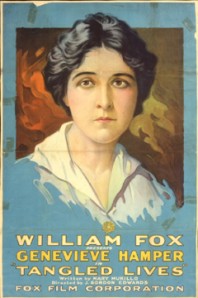
There is no register of all extant film scripts, and one has to search in multiple places. I found two Murillo shooting scripts in the indexes of the BFI National Library in London (The Sins Ye Do, A Woman Redeemed). The Margaret Herrick Library of the Academy of Motion Picture Arts and Sciences has a Motion Picture Scripts Database, from which I found nine scripts, held by UCLA and AMPAS itself: Ambition, The Bitter Truth, The Little Gypsy, Love’s Law, The New York Peacock, A Parisian Romance, Sister against Sister, Two Little Imps and The Vixen (the poster, right, for her 1917 film Tangled Lives, comes from the Margaret Herrick Library site). Some of these scripts are also held in the Twentieth Century-Fox archives, as Antonio Ríos-Bustamante discovered. WorldCat, the union catalogue of world libraries, lists two scripts available on the microfilm set What women wrote: scenarios, 1912-1929. All in all, a remarkable fourteen Murillo scripts survive, a gratifyingly high number.

Finding what films exist in archives (as opposed to the DVD store – I think only two of Murillo’s films are available this way – The Forbidden City, from Grapevine and Accusée levez vous! from Pathé – but Silent Films on DVD is the place to check) is not easy. Again, no central register exists, and not all film archives publish catalogues of their holdings, let alone online catalogues. A list of world film archives is provided by the Federation of International Film Archives. A useful first source for checking whether a film survives and where (chiefly American titles, though) is the Silent Era website, which continues on its way to becoming the single-stop essential source for information on silent films. Otherwise, you just to check a lot of catalogues and ask in a lot of places (once again specialist fora such as Nitrateville or the Association of Motion Picture Archivists (AMIA) discussion list are home to many experts, archivists and collectors). The filmography at the end of this post lists the dozen Murillo films known to survive.

Round-up, and a few tips
This post documents some of the avenues down which I’ve travelled trying to uncover information on one obscure film scriptwriter from the silent era. It’s not a typical research enquiry, but then what such enquiry ever is? It should show that you start out with some basic sources and some key questions to ask, but then will find yourself led down all sorts of unexpected avenues, because people are unexpected.

And why research someone so obscure? You have to ask? Is there any nobler activity out there than to recover a life? Certainly it is always excellent when anyone recovers a corner of history that has been lost or ignored, however small it may seem. It’s a contribution to knowledge, and telling us something that we didn’t know before is a whole lot better way to spend your time as a researcher than re-telling that which we already know. So go out and do likewise – and then tell the world about it. Meanwhile, I’ve much more to try and find out somehow about Mary Murillo. What was her connection with D.W. Griffith? What films did she write for Nazimova? Who were her parents? Do any other photographs of her exist? When did she die? The quest goes on.

A few tips. Never trust any source on its own – always verify the information in two or three other places. Remember that people tell lies about themselves. Official documents such as birth certiifcates, census forms and shipping registers tell us much, but they can also mislead (sometimes deliberately – people lie about ages etc.) and the electronic databases suffer from mistranscriptions. Always think laterally. Remember when searching for female subjects that names change on marriage, and of course with Mary Murillo we have someone who lived under an assumed name. Don’t expect to find everything online, and don’t expect to find everything immediately, and be prepared to spend a little money for valuable resources that have taken a lot of money and effort to compile. Use the Bioscope Library for standard reference sources of the period, its FAQs page for tips on searching, and the categorised links on the right-hand column as a guide to the online world of silent film.

And have fun.

Filmography
This post is long enough as it is, so the Mary Murillo filmography can be downloaded here as a PDF of an Excel file. It includes script and print sources.

Revisiting Pathé

nouvelleluttes

Georges Méliès’ Nouvelle Luttes Extravagantes (1900), from http://www.britishpathe.com

In the early, far-off days of the Bioscope I wrote two posts on the British Pathe collection of newsreels, 3,500 hours of freely-available digitised newsreels covering the period 1896-1970. One post was on the newsreels, the other on the early silent fiction films which lurk on the site, if you know where to look.

The site is still very much active, but after British Pathe was bought by private equity interests recently (the previous owner was the Daily Mail and General Trust) the site has undergone a revamp and has become that much easier for researchers to use. Previously you had to register to use the site, and to view any film you had to fill in personal details and then you could download a low resolution version. It was a somewhat laborious business, and in the new version (for which British Pathé has regained the acute accent on the e) the films are no longer downloadable Window Media files but are instantly accessible streaming files in Flash, without any of the form filling-in. Of course, it’s a little disappointing to not be able to take copies away, and it is disappointing also that the frame stills library has been removed, but the ease of access is a real boon.

The site is a marvellous resource for discovering silent film, and the life and times of the silent era. To remind you about what you can expect to find on the site, I’m going to reproduce some of my original 2007 posts. So, firstly, there’s searching for non-fiction material:

In 2002 British Pathe, owners of the Pathé newsreel library, put up the whole of its collection, thanks to a grant from the New Opportunities Fund’s NOF-Digitise programme. It was a controversial decision, because a commercial company was being given public money to do what some felt the company might have done for itself, but others welcomed a new kind of public-private initiative. The result for the public was 3,500 hours of newsreel footage from 1896 to 1970, available for free as low resolution downloads. Later 12,000,000 still images were added, key frames generated as part of the digitisation process. It was, and remains, one of the most remarkable resources on the net, and a major source for those interested in silent film.

Charles Pathé established the Société Pathé Frères, for the manufacture of phonographs and cinematographs, in 1896. A British agency was formed in 1902, and its first newsreel (which was the first in Britain), Pathé’s Animated Gazette, was launched in June 1910. This soon became Pathé Gazette, a name it retained until 1946, when it was renamed Pathé News, which continued until 1970. These newsreels were issued twice a week, every week, in British cinemas, and were a standard feature of the cinema programme in silent and sound eras.

Pathé also issued other films. It created the cinemagazine Pathé Pictorial in 1918, which ran until 1969. Eve’s Film Review, a cinemagazine for women, was established in 1921 and ran to 1933, while Pathétone Weekly ran 1930-1941. There were other film series and one-off documentaries.

All of this and more is on the site. Pathé were distributors of others’ films, some of which turn up unexpectedly on the site. For example, there are some of the delightful Secrets of Nature natural history films made by Percy Smith in the 1920s. There are also actuality films from before 1910 which Pathé seems to have picked up along the way, though not all of them are Pathé productions by any means – for example, assorted films from the Anglo-Boer War of 1899-1902.

For the silent period, researchers should note that the collection is not complete. For the First World War and before (what British Pathe calls Old Negatives) the surviving archive is patchy, and the cataloguing records less certain with dates. For the 1920s, the record is substantially complete – indeed, there is unissued and unused material as well as the standard newsreels. These of course show events great and small throughout the decade, with an emphasis on sport, celebrity, spectacle and human interest. Look out in particular for the women’s magazine Eve’s Film Review, a delightful series with an emphasis on “fashion, fun and fancy”. For silent film fans, there are newsreels of Chaplin, Valentino, Pickford, Fairbanks etc. There are all sorts of surprise film history discoveries to be made, such as a Pathé Pictorial on feature film production in Japan in the 1920s.

Then there are the fiction films:

Pathé somehow picked up assorted pre-First World War films, some though not all made by its French parent company, and these got digitised alongside the newsreels and are available on the site. There is no index to these fiction films, so below is a list of some of the ones that I have been able to find, with descriptions and some attempts at identifying them, as few are given correct titles or dates:

(the first title given is that on the British Pathe database – enter this in the search box to find the film)

THE FATAL SNEEZE = comedy in which a man suffers from an increasingly violent sneeze. This is That Fatal Sneeze (GB Hepworth 1907).

THE RUNAWAY HORSE = comedy in which a runaway horse causes chaos. This is a famous comedy of its time, Le Cheval Emballé (FR Pathé 1907).

FLYPAPER COMEDY = This is a French comedy with Max Linder, in which Max has flypaper sticking to him which he then finds sticks to everything else.

THE FANTASTIC DIVER = early trick film in which a man dives into a river fully clothed then returns by reverse action in a swimsuit.

THE RUNAWAY GLOBE = Italian? comedy in which a giant globe intended for a restaurant runs away down a street and is chased by a group of people before being sucked up by the sun, only to be spat out again.

THE MAGIC SAC [sic] = French trick film in which an old man hits people with a sack and makes them disappear.

MYSTERIOUS WRESTLERS = French trick film where two wrestlers pull one another to bits. This is a brilliant George Méliès trick film, Nouvelle Luttes Extravagantes (FR Star-Film 1900).

ATTEMPTED NOBBLING OF THE DERBY FAVOURITE = section from a British racing drama, made by Cricks and Sharp in 1905.

THE POCKET BOXERS = trick film in which two men place two miniature boxers on a table and watch them fight.

ESCAPED PRISONER RETURNS HOME = guards wait while prisoner bids a tearful farewell to his sick wife. This must be a James Williamson film, perhaps The Deserter (GB 1904).

LETTER TO HER PARENTS = extract from a drama at which elderly parents are upset at a message they receive.

ASKING FATHER FOR DAUGHTER’S HAND = scenes from a film where a fiancée has to prove himself to the father.

HAVING FUN WITH POLICEMEN = British comedy in which two legs stick out of a hole in an ice-covered pond, placed there by boys to trick a policeman.

POINT DUTY = a policeman is run over by a car and put back together again. This is How to Stop a Motor Car (GB Hepworth 1902).

THE MOTOR SKATER = comedy where man buys a pair of motorised skates and causes chaos.

RUNAWAY CYCLIST = comedy where man buys a bicycle and causes chaos (as can be seen, this was a common theme for comedies of the period).

FIRE = mixture of actuality film of a fire brigade and a dramatised fire rescue. This is Fire! (GB Williamson 1901).

HAMLET = scene with Hamlet and his father’s ghost, using trick photography, from Sir Johnston Forbes-Robertson’s production of Hamlet, a feature-length film (GB Hepworth 1913).

THE DECOY LETTER = early, rudimentary Western, where a soldier lures away an innkeeper with a decoy letter and attempts to assault his wife.

THE VILLAGE FIRE = comedy fire brigade film. This is The Village Fire Brigade (GB Williamson 1907).

THE RUNAWAY CAR = French comedy in which three men try to ride a bicycle and then a car.

RESCUED BY ROVER = a dog finds a kidnapped baby. This is of course the famous Rescued by Rover (GB Hepworth 1905).

One other point. British Pathe used to be managed by ITN Source and available from that company’s website as well, but the licensing deal has come to an end and all of the Pathé films have been removed from the ITN site.

The Bioscope Bibliography of Silent Cinema

bookshelf1

I’d like to invite you to take part in an interesting project. For some while now I’ve been thinking about using the Bioscope, and the collective knowledge of its readers, to produce a research resource of some kind that would benefit the silent film studies community.

And so I’m announcing the creation of the Bioscope Bibliography of Silent Cinema. The aim is to create as comprehensive a bibliography as possible for early and silent cinema, using the catalogue of the British Library. The Library (my esteemed employer) recently published an experimental version of its online catalogue which allows registered users to tag, comment upon and sort records, and export data to annotation programmes. The aspect that interests me in particular is the tagging. This enables you to mark any titles in the catalogue with a keyword of your choosing. This facility hasn’t been used much as yet, but to me it seems a marvellous opportunity for creating catalogues. All one needs to do is to establish a keyword, assign it to every title that comes under that category, and you have your own catalogue. If it is a major subject, such as silent cinema, then you could make it a collective endeavour, benefitting from the shared wisdom of an intelligent crowd. Hence this project.

This is only open to those with British Library reader’s passes. The test catalogue can be consulted by all, but only those who sign in (with your reader number and password) can add tags. The tag I have created is “silent cinema”. All you have to do is select a book title from the catalogue; on the right-hand side of the record (see example below), under Tagging, you will see the instruction Assign/Remove Tags. Click on this and a box pops up inviting you to add a tag. You type in “silent cinema”, click on Save, and it’s done ((once you have done so, for the next title you click on, the tag will appear as a check-box automatically). The beauty of the system is that anyone can use the same keyword, so a team of people can be involved.

searchbetabluk

http://searchbeta.bl.uk

The British Library doesn’t have every book on silent film, but it has most. Moreover, this new version of the catalogue includes journals and newspapers (titles, that is, not individual issues), theses and music scores, with other media to follow in due course, such as manuscripts and sound recordings. I’ve no idea how long this bibliography might be eventually (a few thousand titles, certainly), but what the catalogue programme does is to break down the titles under any subject (such as “silent cinema”) by author, publisher, decade, material type, language or narrower subject, which aids searching and encourages discovery.

I have tagged some 430 records already, and you can see the results here: silent cinema.

Now I hope there may be some of you out there who will be willing to take part. Obviously some management is required. I have started to tag all the books indexed under ‘silent film’, but there are a great many that are not traceable that way. The books of the silent era themselves were not titled or classified as ‘silent film ‘ or ‘silent cinema’, and for the earlier years they may have been classified under photography, or theatre. Hidden or obscure titles can be brought to the surface in this way. One can select titles that one knows; one can select by author, or keyword. What I suggest is that anyone who is interested should get in touch, either via the comments to this post or through www.lukemckernan.com, and say which area you’d like to cover. It could be an author, a sub-subject area, a language of publication, a country, or whatever. I can then keep a record of what has been done.

Some rules to follow: make sure you tag every example of a title (the BL sometimes has more than one copy of a book); in choosing titles you should make sure they are relevant to silent cinema (and its antecedents), but you can include works that are not wholly about silent cinema (e.g. cinema histories); you must keep to the tag exactly as written (“silent cinema”); don’t interfere with anyone else’s tags. You can include novels (how useful it will be just to have a list of the literature of silent cinema), indeed anything that relates to silent cinema in one form another, published at any time. I haven’t attempted to define what silent cinema is. If in doubt, include it.

bookshelf2

And then what will be do with such a work? Well, it will become – if enough people contribute to it – an invaluable research tool for all of us. It won’t just list all of the silent cinema books we can identify, but it will classify and sub-divide them. It will enable easy searching of themes. It will reveal titles that won’t turn up in conventional catalogues. It will open up new areas of study as different media that cover silent cinema are brought together. It will grow as new titles are published. And additional features and means to manipulate the data will emerge as the British Library further develops the functionality of its catalogue. One could even imagine other libraries, when have have similar catalogue functions, also being mined for silent cinema subjects and some glorious joint catalogue being created.

This will be a long job. I’ll be taking on the bulk of it, and I’m not expecting anyone to volunteer for a massive amount of tagging. You could simply select a dozen or so titles. Just let me know that you are interested, so that the project can be monitored. Remember, only those British Library reader passes can take part – but everyone can benefit from the results.

Let me know what you think.