The instruction of disabled men in motion picture projection

Projectors

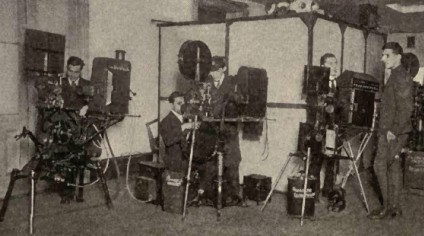
Motion picture projectors for instruction at the Red Cross Institute

It’s been a while since we added anything to the Bioscope Library. The latest addition is James R. Cameron’s The Instruction of Disabled Men in Motion Picture Projection (1919). Cameron was Instructor of Projection at the Red Cross Institute for Crippled and Disabled Men, in New York. The Institute sought to instruct soldiers disabled during the First World War in suitable professions, and motion picture projection was one of them. As Cameron tells us, “almost any man with both hands intact could, with a course of study of about two months in duration, acquire sufficent knowledge to enable him to enter an operating booth, and take charge of the machines”.

Twelve pupils joined the inaugural class in May 1918 – “Most all were leg cases, either paralysis or amputation”. Cameron tells of the success of most of those undertaking the course, their earnings, and the elements of training that they received. The remainder of the booklet is then concerned with the practicalities of motion picture projection, with illustrations, terminology and lengthy question-and-answer sections, all presumably derived from the course itself, though little further mention is made of disability. The booklet therefore serves as a standard technical guide to projection at this period.

However, there is more to the history than this. There is an exceptional website, Project Façade, based on a 2005 National Army Museum exhibition, which looks at the treatment of facial injuries of British soldiers during the First World War. Some men had injuries so terrible that they were unrecognisable to family and friends, and, as the site says, “unable to see, hear, speak, eat or drink, they struggled to re-assimilate back into civilian life”. The site celebrates the pioneering plastic surgery undertaken by Sir Harold Gillies, but even with surgery and prosthetics etc., some men remained so disfigured that they felt they could not return to normal society. The site tells us that one profession that remained open to them was that of projectionist. Such men could arrive for work before anyone else, spend their working day on their own, shut away from society, and then return home in darkness. This sad revelation may be what partly lies behind the Red Cross Institute’s interest in the profession, though Cameron’s booklet, perhaps not surprisingly, makes no mention of it.

Tin facial prosthetics film

Tin facial prosthetics film (c.1916), from Project Façade

Project Façade also has a remarkable film on the making and fitting of tin masks and facial prosthetics for injured servicemen, from around 1916. There is no information on who made the film, or where it came from, but I do encourage you to see it (it requires QuickTime and is available in small and larger versions). It is gentle and inspiring. It contains nothing particularly unsettling, but do be warned that there are images elsewhere on the site which might upset some.

The Instruction of Disabled Men in Motion Picture Projection is available from the Internet Archive, in DjVu (4.3MB), PDF (14MB) and TXT (161KB) formats.

The Sea Gull

The Sea Gull

http://ednapurviance.com

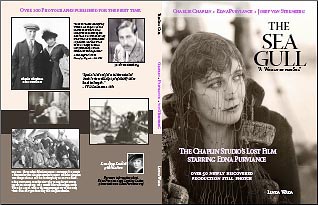
On the eve of the Bioscope Festival of Lost Films, congratulations go out to Linda Wada of the esteemed Edna’s Place blog and www.ednapurviance.org website, for today publishing her long-awaited book The Sea Gull, on this mysterious lost Chaplin film. The film, originally known as Sea Gulls or The Sea Gull, and later as The Woman of the Sea was produced by Chaplin but written and directed by Joseph von Sternberg, in 1926. The film was a melodrama set among the fishermen on the coast of California, and starred Edna Purviance, Chaplin’s great leading lady. According to von Sternberg, the film had just one screening, before Chaplin withdrew it for reasons that remain unclear, though he did say at one point that it simply wasn’t good enough for release.

The book explores the history of one of the most renowned of lost films, with over 100 photographs published for the first time, including over fifty recently discovered production stills from Purviance’s grand nieces, the Hill family. Here are Kevin Brownlow’s words on the publication:

The Sea Gull is an important contribution to film history, and worth buying for the stills alone. The look of the film, revealed in these marvellous photographs, makes it all the more tragic that it was destroyed. This book provides the nearest experience we will have to seeing it.

Details of how to order the book can be found at http://ednapurviance.com. It is being published as print-on-demand by Leading Ladies, price $39.95 plus shipping, and can be bought using PayPal.

Projection Box essay competition

Just a reminder for anyone with an unpublished essay on early cinema tucked in the desk or on the hard drive somewhere that the deadline for the Projection Box essay award is January 18th. The aims of the award are to encourage new research and new thinking into any historical, artistic or technical aspect of projected and moving images up to 1915; and to promote engaging, accessible, and imaginative work. The first prize of £250 is for an essay of between 5000 and 8000 words (including notes).See the earlier post on the award (which is being awarded for the first time) for details of how to enter, or visit the Award site.

From silent screen to multi-screen

From Silent Screen to Multi-Screen

http://www.amazon.co.uk

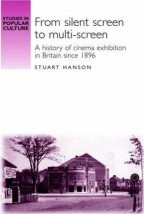
There are still so few books out there on cinema exhibition that the appearance of any new title is a cause for celebration. So it is very pleasing to note the publication of Stuart Hanson’s From Silent Screen to Multi-screen: A History of Cinema Exhibition in Britain Since 1896, published by Manchester University Press in its ‘Studies in Popular Culture’ series.

The book is a survey of British film exhibition from the 1890s through to the present day, organised chronologically, with an emphasis on economic, legislative and sociological conditions. It is a huge subject, and Hanson has evidently read very widely and absorbed and explained a great diversity of material. It is a very useful text, aimed squarely at the academic market, and as said there are too few titles on cinema audience studies still (it is a growing subject) not to call this book a welcome addition to the field. There is really isn’t anything quite like it which covers the whole range of British film exhibition.

New Egyptian Hall

Film audience at the New Egyptian Hall, London, 1907-08

That said, there need to be a few words of caution regarding its chapters on the silent era. For the most part the author has relied on secondary sources, and provides a useful summary of material to be found in Rachael Low and in the recent studies by Nicholas Hiley and Jon Burrows. However, while he has been attentive to arguments, he has not always alert when it comes to facts. There are several errors over dates (the ‘first’ British cinema, the Daily Bioscope, opened in 1906, not 1904) and numbers (there certainly weren’t forty films on offer at the inaugural British Kinetoscope exhibition in October 1894). There is also an unfortunate tendency to peddle old myths. For instance, we get the hackneyed story about people running away from film of an approaching train at the first Lumière show, despite the known fact that the December 1895 show did not feature Arrivée d’un train, and audiences in general did not run away in panic at films of approaching trains. Hanson has apparently read Stephen Bottomore’s subtle historical investigation of the ‘panicking’ audience phenomenon, but quotes from it as though unquestioningly supporting the myth. There are several such selective readings. In general Hanson is less at home with the early cinema period than he is with later developments, and it is a shame that some of the factual slips were not picked up on before publication (referring to the unquestionably male film historian Deac Rossell as a woman is another).

So do read it, but read the first two chapters with caution, and if you can check out the original essays by Bottomore, Hiley and Burrows which Hanson generously cites and which contain so much valuable primary information and insight.

If you are interested in early cinema audience studies, these are some of the key books to look out for:

And the best single book, in my humblest opinion, covering the phenomenon of audiences in general and so placing early cinema audiences within wider contexts, is Richard Butsch’s The Making of American Audiences: From Stage to Television, 1750-1990 (2000). If you are looking for a place to start, start here. It is clear, inclusive and wise.

Albert Kahn in print

Albert Kahn book

http://www.amazon.co.uk

Fans of the BBC series The Wonderful World of Albert Kahn will be delighted to learn that the BBC is publishing a book featuring the glorious Autochrome colour photographs from the series. The Wonderful World of Albert Kahn: Colour Photographs from a Lost Age will be published on 3 April 2008.

Other books on Autochromes already available are John Wood, The Art of the Autochrome and Victor Gray’s The Colours of Another Age: The Rothschild Autochromes, 1908-1912, subject of the recent National Media Museum exhibition.

For background information on Autochromes and the Albert Kahn collection, see the Searching for Albert Kahn post.

Update (January 2008): Intriguingly, the cover of the book as publicised on Amazon has now changed. Here’s the new look:

Wonderful World of Albert Kahn

Peter Kobel’s Silent Movies

Silent Movies

http://www.readexpress.com

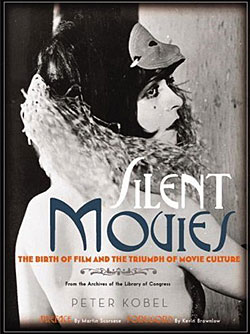
It’s not published in the UK until 6 December, but just in case you were thinking about writing that letter to Santa, you might want to add Peter Kobel’s Silent Movies to the list. This is a deluxe history of the genre, grandolinquently subtitled ‘The Birth of Film and the Triumph of Movie Culture’, and has been five years in the making. It accompanies a Library of Congress touring programme, and it gets a preface by Martin Scorsese (what doesn’t these days?) plus an introduction by Kevin Brownlow, which should be stamp enough of approval for anyone. I’ll post something here once I’ve actually got my hands on a copy, but meanwhile the book has been published in the USA already, and generated a lot of comment. Here are some related links:

The Library of Congress press release for the book.

An interview with Kobel (an arts and entertainment journalist) on readexpress.com.

Richard Schickel’s rather jaundiced review of the book for the Los Angeles Times.

Peter Kobel’s personal site.

Theses and dissertations

A few days ago I posted something on Donald Young’s Motion Pictures: A Study in Social Legislation, a 1922 doctoral thesis available from the Internet Archive. I said that it had to be one of very first doctoral theses to be awarded on the subject of film. But was it the first?

Well, The Bioscope is loathe to leave such questions lie unanswered, and it so happens that I knew where to find the answer. In 1979, Raymond Fielding, author of standard books on American newsreels and The March of Time, produced A Bibliography of Theses and Dissertations on the Subject of Film: 1916-1979, published as University Film Association Monograph no. 3. This is a fascinating piece of work. It lists every traceable graduate dissertation and thesis on film from American universities, up to 1979. It lists 1,420 of them. However, it is not until the 1960s that we really start to get academic studies of films and filmmakers as we might expect now. Before then, subjects such as the educational film, sociological studies, and the economic aspects of film are common. Film as a means to learn about other subjects predominates for the early decades.

So, was Donald Young first? No – his was the second doctoral thesis to be awarded, and both of those were preceded by a masters dissertation by one Ray L. Short in 1916, awarded by the University of Iowa. Whatever happened to him? (see comments) Anyway, here are the twelve dissertations and theses that were awarded up to 1930:

  • Ray L. Short, ‘A social study of the motion picture.’ M.A., University of Iowa, 1916
  • Perry Roberts, ‘The social aspect of the motion picture.’ Ph.D, Southern Baptist Theological Seminary, 1920
  • William Breidenbach, ‘Design of a moving picture theater.’ M.A., Ohio State University, 1922
  • Donald Young, ‘Motion pictures: A study in social legislation.’ Ph.D, University of Pennsylvania, 1922
  • Harold Morgan, ‘Wish-fulfillment in drama and motion pictures.’ M.A., University of Wisconsin, 1925
  • H.F. Cummings, ‘Motion pictures in education.’ M.S., Boston University, 1929
  • Margaret Akin, ‘Social valuations of two hundred [and?] three motion pictures.’ M.A., University of Washington, 1930
  • Ralph Cassady, ‘Historical analysis of competitive practices in motion picture production, distribution, and exhibition.’ Ph.D, University of Califonia, Berkeley, 1930
  • Henry Hawley, ‘Distribution as a factor in commercial integration in the motion picture industry.’ D.C.S., Harvard University, 1930
  • Perry Holaday, ‘The effect of motion pictures on the intellectual content of children.’ Ph.D., University of Iowa, 1930
  • E.M. Porter, ‘The curve of retention in moving pictures for young children.’ M.A., Universiy of Iowa, 1930
  • Victor Rapport, ‘The motion picture: A study in commercialized recreation.’ Ph.D, Yale University, 1930

There’s a Ph.D to be undertaken reinvestigating all those. Fielding doesn’t provide a chronological index to his bibliography, but from his index to themes we learn that the first dissertation on Chaplin was in 1949 (the next wasn’t until 1974). The first on D.W. Griffith was in 1961. Buster Keaton was first so recognised in 1970.

But what about British universities, or elsewhere? What was the first British film Ph.D? This time round, I don’t know. Does anyone? (OK, the answer might be found on Index to Theses, but I don’t have a subscription).

Update: Stephen Bottomore has passed on the following information about theses and dissertations that were produced elsewhere, and an American dissertation that precedes that of Ray L. Short. The information is in the comments, but I’m reproducing it here as well:

Some time ago I started updating Fielding’s list for these theses re/from the early era, and found there was even one before Short’s:

Joseph Richard Fulk, “The Motion Picture Show with Special Reference to Its Effects on Morals and Education,” M.A., Univ. of Nebraska, 1912.

In the same year was the first (?) French one: Jean Marchais, “Du Cinématographe Dans ses Rapports Avec le Droit d’Auteur,” Doctorat, Faculté de Droit, Université de Paris, 1912.

Germany’s first (?) came in 1913. I haven’t researched the UK so much, but the first I’ve found is Frances Consitt, “The Use of Films in the Teaching of History,” Leeds, 1931.

Thanks as always, Stephen. I have a copy of Frances Consitt’s work, which was research conducted on behalf of the Historical Association, and which was published formally in 1931. More on what is a fascinating work at another time, perhaps.

Another update: Frank Kessler has just reminded me that the first German doctoral thesis was Emilie Altenloh’s Zur Soziologie des Kino: Die Kino-Unternehmung und die Sozialen Schichten Ihrer Besucher, awarded by the University of Heidelberg in 1913, and published in book form in 1914. This is an exceptional piece of work, a sociological study strikingly modern in method and conclusions. It is based around a questionnaire and interview survey of some 2,400 filmgoers in the medium-sized industrial town of Mannheim during 1912 and 1913. It is in two parts: part one on production; part two on audiences and reception. The latter is available in an English translation by Kathleen Cross, as ‘A Sociology of the Cinema: the Audience’, Screen, vol. 42 no. 3, Autumn 2001, pp. 249-293. It’s a work I should return to at another time. Meanwhile, for those able to read German, the full text is available from the University of Oldenburg site.

And another update: How could I have forgotten? There was a doctoral thesis submitted by George Esdras Bevans, How workingmen spend their time, submitted to Columbia University in 1913, which has already been the subject of a post. Although not directly about the cinema, it does include data about cinema-going in its survey of American working class entertainments.

And a final update: There is one doctoral thesis that beats all the above. The French medical researcher, Jean Comandon, as part of his work on microscopic organisms, such as the syphillis spirochete, employed microcinematography (combining cinematograph with microscope), observations from which which were included in his 1909 thesis De l’usage clinique de l’ultra-microscope en particulier pour la recherche et l’étude des spirochètes. In the same year he was taken on by the Pathé company to make microcinematographical films of organisms for the popular cinema market, and he went on to enjoy a notable career as a scientific filmmaker (including a period in the late 1920s working for Albert Kahn).
Motion Pictures: A Study in Social Legislation

National Board of Review censorship recommendations

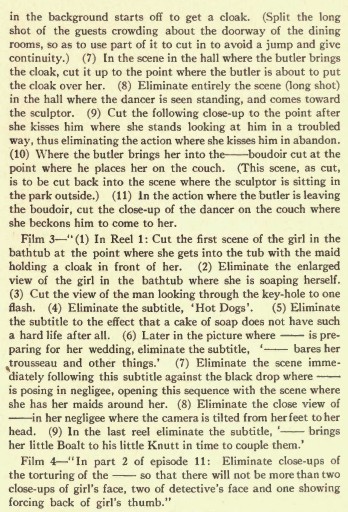
The above document contains some of the recommendations from the National Board of Review of Motion Pictures for cuts to be made to some unnamed films. Donald Young, later professor of sociology at the University of Pennsylvania, was no admirer of this private organisation which made censorship recommendations which were not legally binding and could be ignored locally. Young was the author of Motion Pictures: A Study in Social Legislation, now added to the Bioscope Library. Published in 1922, this PhD thesis must be one of the first doctorates to be awarded for the study of motion pictures.

Young’s subject is the influence of motion pictures upon the American people, particularly children. As a piece of supposedly scientific social investigation it is remarkably partisan. It takes as read reports conducted by various groups with an interest in the morals of society which found motion pictures to be generally pernicious in their effects, and comes down on the side of legalised state censorship (by 1922 eight American states had instituted film censorship laws). A National Board of Censorship, later the National Board of Review, had been instituted in 1909, but its recommendations carried no legal weight. This is therefore not the social study that it claims to be, but rather an expression of fear, albeit one that is artfully and authoritatviely expressed. Under the guide of social investigation, it looks for ways to control the medium whose malign tendencies are taken as a given.

The value of the text is firstly the period attitudes that it demonstrates, with the evidence that it calls on to support this. Secondly, it provides a rich picture of the various forms of municipal and state regulation that existed, their operations and aspirations. Thirdly, there are the several appendices with useful information, including the numbers of cinemas across America, state by state; figures for the importing of films from other countries; the rules of the British Board of Film Censors; the Standards of the Pennsylvania Board of Film Censors (the first US state to have censorship laws); and samples of eliminated scenes by the National Board of Review (as illustrated above). It is available from the Internet Archive in DjVu (3.1MB), PDF (9.4MB), b/w PDF (3.4MB) and TXT (232KB) formats.

Essay award reminder

Projection Box

A reminder that the deadline is not so far away for the Projection Box Essay Awards. The aims of this award are to encourage new research and new thinking into any historical, artistic or technical aspect of projected and moving images up to 1915; and to promote engaging, accessible, and imaginative work. The first prize of £250 is for an essay of between 5,000 and 8,000 words (including notes).

The deadline for entries is 18 January 2008. The winning essay will be published in an issue of Early Popular Visual Culture (Routledge). At the discretion of the judges, two runners-up will each receive books and CD-Roms of their choice (published by The Projection Box), to the value of £100.

For further information, visit www.pbawards.co.uk.

Animals in motion

These are heady times for the Bioscope, with hundreds of visitors all in pursuit of information on Paul Merton, following the mention of his new book and Silent Clowns tour on Have I Got News for You. So, what can we do to catch the eyes of these passing visitors and maybe entice them to find out more about the worlds of early and silent cinema? Well, what about some nineteenth-century studies of animal motion?

Mohammed running

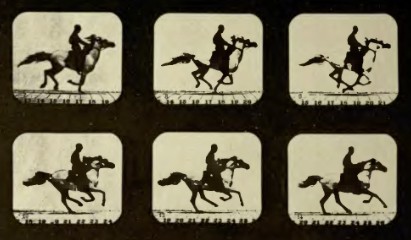
Mohammed Running, from The Horse in Motion

So, we have two new additions to the Bioscope Library, the first of which is The Horse in Motion, by J.D.B. Stillman, published in 1882. Who he? Well therein lies a tale, because the true author of this work should have been the rather better-known Eadweard Muybridge. The book, commissioned by Muybridge’s patron, the railroad baron Leland Stanford, was based on Muybridge’s now famous photographic studies of a horse galloping. But master and reluctant servant had fallen out, and the book was published under Stillman’s name, giving Muybridge negligible credit. The book contains detailed description of the studies into the motion of the horse (and other quadrupeds), with five of Muybridge’s photographs and ninety-one lithographs based on his photographs, plus line drawings. The book’s publication caused considerable embarrassment to Muybridge at the time, as his contribution to the scientific studies was now questioned by several authorities, but it is an important publication nonetheless in the history which took us from sequence photography (or chronophotography) to the successful creation of cinema. It’s available from the Internet Archive in DjVU (6MB), PDF (67MB) and TXT (279KB) formats.

Marey runner

‘Runner provided with the apparatus intended to register his different paces’, from Animal Mechanism

It’s a happier tale to tell with our other, complementary, addition to the Library, Etienne-Jules Marey‘s Animal Mechanism, or La machine animale, first published in 1873. This was the published expression of Marey’s ‘methode graphique’, where, by a variety of graphical devices devised for the measurement of animal motion, Marey was able to demonstrate diagrammatically the walking motion of humans and horses, and the the flight of birds and insects. By this publication, Marey opened up a world of study not previously imagined, and inspired Muybridge and Stanford to undertake their own investigations. Marey did not use photography for Animal Mechanism, but, inspired in turn by Muybridge’s work, would go on to experiment extensively with sequence photographs, developing the science of chronophotography, and through it the mechanism for cinematography. The Internet Archive has both the 1879 American edition, in DjVu (9.9MB), PDF (20MB), b/w PDF (12MB) and TXT (582KB) formats, and the English third edition (not so well scanned), in DjVu only (33MB).