Granny gets an MRI

Granny gets an MRI

Granny gets an MRI, from http://www.winanmri.com

Well, this is a little different. Clay County Medical Center, a 25-bed American hospital, has entered a contest to win a new $800,000 magnetic resonance imaging system (MRI). The competition is by public vote on a website, and CCMC has contributed a silent film spoof, Granny gets an MRI. No, it isn’t very good, but it has oddness on its side. To catch a sight of it, and who knows maybe vote for it, go to www.winanmri.com and type in ‘granny’ into the search box. It’s currently lying third…

Live in Trafalgar Square

Silents in Trafalgar Square

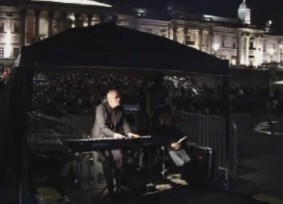
Frame still taken from BBC News video of Capital Tales in Trafalgar Square

Recently, as you’ll know, the London Film Festival hosted two screenings of silents in Trafalgar Square, with live music accompaniment. There’s a BBC video news report on the second screening, Capital Tales, which featured a pot pourri of London footage, much of it silent, with John Sweeney at the piano.

John Sweeney in Trafalgar Square

John Sweeney accompanying Capital Tales in Trafalgar Square, from http://www.bbc.co.uk

The report features short interviews with John, BFI programmer Robin Baker, and assorted members of the public. The general feedback from this event, and the screening of Blackmail the day before, has been very positive, and I think we can expect more screenings of silents in the London open air in the future. I’m entirely in favour of this. Take the films to the people. Let’s have people stumbling upon archive films in unexpected places. Let’s bring the past into the present. Archives should be everywhere.

All at Sea

All at Sea

Frame still from All at Sea, http://film.guardian.co.uk/video

The Guardian has published a short section from the 1993 Alistair Cooke home movie All at Sea, of Charlie Chaplin clowing around on a yacht. The film was featured as a long-lost discovery at this year’s Pordenone silent film festival. Curiously, the Guardian makes no mention of the film’s notable provenance. The thirty-second sequence shows Chaplin impersonating Janet Gaynor, Greta Garbo, and the Prince of Wales. Above shows Janet Gaynor, by the way.

21st Century Vertov

You may remember the report of a few months ago about video artist Perry Bard’s idea to recreate Dziga Vertov’s Man with a Movie Camera with uploaded contributions from volunteers around the world.

Man with a Movie Camera, scene 10

Man with a Movie Camera, scene 10, 1928 and 2007 versions, from http://dziga.perrybard.net

The initial deadline for this was 15 September, with the planned new, participatory version of the film being screened on Big Screen Manchester. However, as the project site demonstrates, the uploading continues, with people offering their modern video equivalents of scenes from Vertov’s original (which can be seen on her site in its entirety or scene by scene). You can view each of the sequences, original and remake, though not the new version in its entirety. I haven’t found evidence that it been screened anywhere as yet (does anyone know?), but the site is an extraordinary and thought-provoking work just by itself. Do explore.

Nosferatu trailer

Eureka Video has released a YouTube trailer for its forthcoming DVD release of Nosferatu. The two-disc set comes with commentary track by Brad Stevens and R. Dixon Smith, and an hour-long German documentary on the film by Luciano Berriatúa. It’s a F.W. Murnau-Stiftung restoration complete with Hans Erdmann’s original score, performed by the Radio Symphony Orchestra Saarbrücken conducted by Berndt Heller. There’s also a 96-page booklet with articles by David Skal, Thomas Elsaesser, Gilberto Perez and Enno Patalas (former director of the Münchner Stadtmuseum/Filmmuseum, where he was responsible for the restoration of many German classics, including Nosferatu). The Region 2 DVD is released on 19 November. Kino Video will be releasing the Region 1 version in the USA. The trailer looks fantastic – we are starting to get spoiled with deluxe DVD presentations of silent classics.

Update: Do take a look at the Kino Video entry for the film, which includes a Flash video on the digital restoration of the film, one of the DVD extras.

The Wisconsin Bioscope

Urban Bioscope

Urban Bioscope Model D, from http://www.wisconsinbioscope.com

The Wisconsin Bioscope is, as its own proud boast has it, “the leading silent film production company in the Midwestern United States, if not the world, today”. It is the brainchild of Dan Fuller, of the University of Wisconsin-Madison department of communication arts, who every year takes a group of students on a seminar, “Making the Early Silent Film”, with the result being a genuine silent film production.

The company takes its name from an Urban Bioscope Model D of 1907, with which their first two films, Plan B (1999) and Winner Takes All (2000) were filmed. Since then they have used a more accommodating Universal newsreel camera, circa 1923. The films are made in imitation of silent films of the 1907-1912 period, with loving attention paid to sets, performance, titles, developing, printing and music. The Wisconsin Bioscope website (recently revised), goes into fascinating detail about the technology employed, and the whole exercise is a delightful mixture of authentic investigation and tongue-in-cheek pastiche, as these introductory words from the website’s front page indicate:

All our productions are photographed with a hand-cranked motion picture camera on black & white 35 millimeter film, almost always at the rate of 16 frames per second. To crank faster is simply wasteful.

All our productions are developed, printed, toned, and edited by ourselves, following the motto:

If you want it done right, do it yourself.

Whenever possible, we film using daylight. Why pay for something that the sun freely provides?

We understand that other companies have experimented with motion pictures that, to some extent, duplicate color and sound.

This is a grave error.

If the public were to want color, it would visit a picture gallery or, better still, a botanical garden in the full bloom of spring!

If it were to want sound, it would attend the theatre or concert hall!

Although it may be temporarily seduced by kinemacolor, talking pictures, or even tele-vision, we know the great mass of the public has a deep desire for high-quality motion pictures produced and exhibited in the tried-and-true manner:

Pantomime accompanied by Live Music.

When false attractions grow tiresome, as they always do, the public will again demand the product pioneered by Mr. Edison and the frères Lumiére.

The Wisconsin Bioscope stands ready for that day!

Well, it’s hard to argue with any of that, but are the films any good? You bet they are – remarkably so. Technically excellent, but also wittily and sympathetically constructed. They’ve been good enough to feature regularly at the Pordenone Silent Film Festival, where three new titles will be showing next week. The revised website now has QuickTime examples of several of them: A Expedição Brasileira de 1916 (2006), Cosmo’s Magical Melt-A-Ways (2006), Rent Party (2006), A Day’s Work (2006), The Rivals (2005), Daddy Don’t (2005), The Dancer (2004), The Starving Artist (2004), The Sick Child (2004), Cadtastrophe (2003), The Magic Tree (2003) and Winner Takes All (2000). All of them are worth a peek. Or else take a look on YouTube at A Visit with Grandmother (2005), with piano by David Drazin.

The website is rich in information, including production stills. All in all, a project done in absolutely the right spirit. and named after just the right piece of equipment, of course.

Gallaudet University Video Library

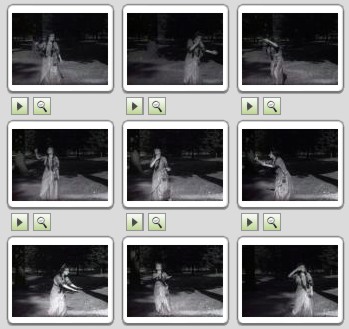
Minnehaha

Mary Williamson in The Death of Minnehaha (1913), from http://videolibrary.gallaudet.edu

A while ago I told you about the digitised series of the American journal for the deaf, The Silent Worker, which had such fascinating material on the relationship of the deaf community to silent cinema. The journal has been digitised by Gallaudet University, Washington, which specialises in education for deaf and hard-of-hearing students. The remarkable range of work it does includes a commitment to film, which leads us to the excellent Gallaudet University Video Library.

This is a model database with video streams in Windows Media and QuickTime, and first-rate associated metadata. And among the many titles available on the site are silent films, including – astonishingly – the first surviving film using American Sign Language, from 1910, and nine titles from 1913 made for the National Associaition of the Deaf. The films are known about by historians of deafness, but has anyone written about these from the film history angle?

Gallaudet provides this cataloguing data for the films:

The Lorna Doone Country of Devonshire England
(12 min., B & W, silent, signed 1910)
The earliest surviving film in sign language. Dr. Edward Miner Gallaudet, prominent educator of the deaf and founder of Gallaudet University, lectures on his visit to England. [The Video Library gives the date of 1913, but this seems to be an error]

Dom Pedro’s Visit to Gallaudet College
(6 min., B&W, silent signed: 1913)
E.A Fay relates the story of the Emperor of Brazil’s visit to Gallaudet and his American Travels, in 1876.

Memories of Old Hartford
(16 min., B & W, silent, signed: 1913)
Dr. John B. Hotchkiss talks of his youth in Hartford, Connecticut in the “good old days” of the mid-1800s.

An Address at the Tomb of Garfield
(6 min., B & W, silent, signed: 1913)
Willis Hubbard leads a delegation of deaf persons who have come to Washington for a memorial service at the tomb of the late President James A. Garfield. Hubbard summarizes Garfield’s life and achievements and speaks on Garfield’s deep interest in Gallaudet University (then called the Columbia Institution) and his role in defending the fledgling college against Congressional opponents and budget-cutters.

Discovery of Chloroform
(8 min. B&W, silent, signed: 1913)
Dr. George T. Dougherty, a leading chemist in the industrial world and leader among the deaf, lectures on the chloroform in one of the world’s first educational films.

The Death of Minnehaha
(16 min., B&W, silent, signed: 1913)
Mary Williamson relates Longfellow’s famous poem in costume and sign language. [Illustrated above]

A Lay Sermon
(16 min., B& W, silent, signed: 1913)
A sermon by the Rev. Robert McGregor about the universal brotherhood of man and the Fatherhood of God.

A Plea for a Statue of De l’Epee in America
(6 min., B&W, silent, signed: 1913)
An address read by Rev. McCarthy and interpreted in sign language by Dr. James H. Cloud. The Abbe de’l Epee was a French cleric who invented the French (and indirectly, the American) sign language in the late 1700’s.

The Preservation of Sign Language
(16 min., B & W, silent, signed: 1913)
An address by George William Veditz in which he deplores the debasing of the “pure” sign language and urges its preservation.

Yankee Doodle, The Irishman’s Flea, and the Lady and the Cake
(6 min., B&W, silent, signed: 1920)
Three humorous short tales in sign language.

The films are mostly lectures in sign language form, so comprehension is going to be a bit limited for those not conversant with ASL, but I recommend the performance by Mary Williamson of the death of Minnehaha from Longfellow’s Hiawatha and the lecture on chloroform. They are well produced (the titles are later additions) – the person behind most of them was George Veditz, president of the National Association of the Deaf, and there’s an account of their production on the PBS site. In part it seems they were made to help preserve the art of sign language by demonstrating the work of its finest practitioners (Veditz appears on one dedicated to just this theme).

To view the films, go to the Video Library site, click on the public access link at the bottom of the page, then from the menu on the left choose ‘Deaf History’ [Update: the web page has changed, so Deaf History now appears on the main menu straight away]. There are other films extant not included here, but there is more than enough to provide a fascinating window on this world, and to show us once again that the early cinema was such an exciting and creative time. More, much more, was going on that the history books have yet been able to tell us.

There’s a history of deaf people and cinema, John S. Schuchman’s Hollywood Speaks: Deafness and the Film Entertainment Industry. My copy’s on order.

australianscreen

australianscreen is a first-rate educational website created by the Australian Film Comission, with material from the National Sound and Film Archive, the National Archives of Australia and others.

The site features contains information about, and in many cases excerpts from, a wide selection of Australian feature films, documentaries, television programmes, newsreels, short films, animations, and home-movies produced over the last 100 years, all freely available. It is searchable in a variety of forms, but the broad categories are Feature Films, Documentaries, Television programmes, Short films, Home movies, Newsreels, Advertisements, Other historical footage, Sponsored films, and Short features. Frustratingly, there seems to be no way of search on viewable material alone [correection, there’s something viewable for every title – see Comments], but there is plenty on offer, including MP4 files for download (subject to agreeing to their terms and conditions).

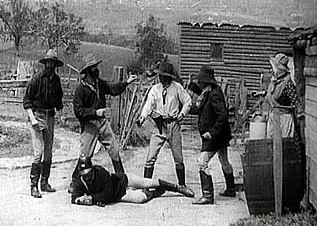
Story of the Kelly Gang

The Story of the kelly Gang, from http://australianscreen.com.au

There is a lot of silent film on view, with helpful contextualising material. Among Feature Films, there are sequences from the world’s first narrative feature film The Story of the Kelly Gang (1906), and two other renowned Australian silents, The Sentimental Bloke (1919) and On Our Selection (1920). Among Documentaries there are such gems as Marvellous Melbourne: Queen City of the South (c.1910) and a Pathé documentary on the making of the newspaper The Sydney Morning Herald (1911). Look out also for Endurance (1933), the sound film version of the film originally shot by Frank Hurley of Ernest Shackleton’s 1914-1916 Trans-Antarctic expedition.

Darwin

Darwin c.1926, from http://australianscreen.com.au

And there’s more. The Newsreels section has extensive material from Australasian Gazette, dating from 1911 onwards. In Other historical footage, look out for Marius Sestier and Walter Barnett’s film of the Melbourne Cup horse race in 1896, one of the first films made in Australia, a parade of Australian troops going off to the Boer War in 1899, filmed by Frederick Wills and Henry Mobsby, and footage of Darwin in 1926 which includes sequences showing the Chinese community.

It’s a marvellous resource, oriented for schools use but of interest to anyone. It’s so clearly laid out and expressed. Go explore.

Celebrating Toronto

I reported a while back on the Cinema by Citizens: Celebrating the City initiative from the Toronto Urban Film Festival (TUFF), which invited people to submit silent, one-minute videos on a range of urban themes. The festival is currently running, and the sixty winning films are now being exhibited online (all via YouTube). I’ve skimmed through several, and the quality is very high. I rather like this one, My Beautiful City, by Nadia Tan and Maya Bankovic:

Sample the others on the TUFF site or via their YouTube page.

Prakash Travelling Cinema

Part one

Prakash Travelling Cinema is a delightful short film, posted on YouTube by the filmmaker, Megha B. Lakhani. She made the 14-minute film while at the National Institute of Design, India, and it has gone on to win festival awards.

The film documents two friends who maintain a travelling bioscope show on the streets of Ahmedabad. The ramshackle outfit, which they take around on a hand-cart, comprises a genuine c.1910 Pathé projector, adapted for sound, with peep-holes all around the mobile ‘cinema’ itself (which they call their ‘lorry’), through which children watch snippets plucked from popular Bollywood titles. One of the amazing sights of the film is either of the two men hand-cranking their sound projector at exhausting speed.

Part two

Although they are not showing silent films, the whole enterprise is imbued with the spirit of the original travelling bioscope operators of India, and of course the technology hails from the silent period. The word ‘bioscope’ still persists in places in India for cinema, as it does in South Africa. However, the film wants to do more than show a quaint operation, and it is very much about friendship, conviction, Indian society, and the persistence of a human way of doing things in the face of modern media technologies.

There are an estimated 2,000 mobile cinema shows in India today, and the travelling bioscope has been made the subject of other recent films. There is Andrej Fidyk’s 1998 documentary film Battu’s Bioscope, on a modern travelling show in rural India; Vrinda Kapoor and Nitesh Bhatia’s short film Baarah Mann Ki Dhoban (2007), on modern bioscope workers whch also touches on the history of India film exhibition; and Tim Sternberg’s film Salim Baba (2007), again about a modern travelling bioscope show, this time with an adapted 1897 Bioscope. Plus there’s Tabish Khair’s acclaimed novel Filming, published this year, which moves from a travelling bioscope show in 1929 to the Bombay cinema of the 1940s as a means to examine the rise of modern India. Clearly there’s a metaphor in the air.

Prakash Travelling Cinema was made in 2006, and there’s a full set of credits here. The film is in Hindi, with English subtitles, and on YouTube, owing to its length, it comes in two parts.