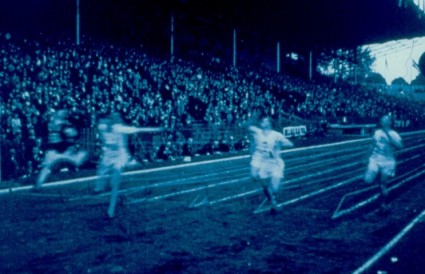
Hints to newsfilm cameramen

New in at The Bioscope Library is P.D. Hugon’s Hints to Newsfilm Cameramen, a booklet produced in 1915. Hugon was managing editor of the American newsreel Pathé News, having previously worked in the editorial department of the British newsreel Pathé’s Animated Gazette and before that as foreign editor of the London Evening News newspaper. Hugon’s text is a common-sense guide to filming the news, just as newsreels were emerging as a standard feature of every cinema programme.

Hugon’s notes for cameramen cover what to film and how to film it. He discusses what makes pictorial news, which is a different concept to textual news (“The object of motion pictures is to show motion. Only things in which there is motion are worthy of the cameraman’s attention”). He identifies suitable subjects, and emphasises that pictures should always tell their own story. There are basic guidelines to filming the commonest news stories, such as races:

Where speed is the dominant factor turn slowly, about half speed. Failure to do this is unpardonable. Remember then that you must shut down your iris diaphragm so as not to over-expose.

Take all moving objects coming toward the camera, never going away.

Every race must show at least four scenes: beginning, middle, finish, winner; and if possible an extra scene in the middle.

Hugon covers such practical questions as filming in long and close shot, how to film sky, water and silhouettes, managing correct focus, exposure, shutter speeds, handling film and camera, how long shots should be, and has interesting strictures on methods such as panoramic shots.

Panorams. There should never be a panoram, either vertical or horizontal, unless it is absolutely essential to obtain a photographic effect, and in any case the panoram should be, not from the main subject to others, but from others to the main subject, where the attention will finally rest. It is very much better to take two scenes than one panorammed scene. Panoraming is the lazy man’s remedy.

Finally he tells the news cameraman how to dispatch negatives (how to label and seal the can, how to post in by express train etc.), before ending with his golden rule:

Make as good a picture for others as you would like others to make for you.

The guidelines seem particularly directed towards the freelancer hoping to sell footage to the main newsreel companies (his last words are “the money is there waiting for you”). They nevertheless provide a valuable insight into the practicalities and ambitions of early newsreel production. Hints to Newsfilm Cameramen can be found on the British Universities Newsreel Database website, with an introduction and afterword by historian Nicholas Hiley (the afterword discusses how much Hugon’s hints represent reality or an ideal).

Colourful stories no. 14 – À la recherche du chronochrome

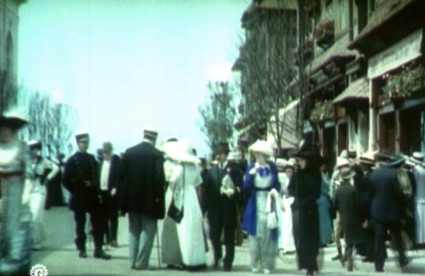
Chronochrome film c.1913, from Les Premiers Pas du Cinéma

Perhaps the most beautiful of all the early colour film systems, whether ‘natural’ or ‘artificial’, was Chronochrome. Though its commercial life was not long, and though it was apparently not seen widely, recent restorations have unveiled a precious colour record of belle époque France, whose dreamy visions have a magical reality about them, capturing an ineffable something of those Proustian times.

Chronochrome was patented by Léon Gaumont in 1911. It was the first working example of the dream of the first motion picture colour inventors, a three-colour additive system in natural colours. Gaumont’s system employed a three-lens camera with red, green and blue filters, through which three images were exposed simultaneously. To get around problems experienced by previous inventors trying to move three frames of film intermittently at high speed (48 frames per second), Gaumont came up with a narrower frame height (14mm). The projector was likewise equipped with three lenses, similarly reduced in height to oblong shapes to reduce fringing.

The result was first exhibited to the Société Français de Photographie on 15 November 1912, and in London at the Coliseum on 16 January 1913. It was also exhibited in New York. Reports show appreciation of the colour, but with some complaints at the lack of brightness (all additive systems have problems in projection because they absorb so much light – a three-colour system that much more so than two-colour Kinemacolor). Accounts in some British histories of Chronochrome being a commercial failure owing to fog having drifted into the variety theatre where it was being showcased may be put down to national rivalry, but Chronochrome seems to have made a relatively modest commercial impact, at least to judge from its relative absence from the literature (Brian Coe has little to say about it, Adrian Klein still less). It had some prestige screenings, particularly in the Gaumont-Palace in Paris, and there were screenings where the colour films were exhibited with synchronised sound using the Gaumont Chronophone. There was also a dedicated cinema at 8, faubourg Montmartre, named Gaumontcolor. But it never rivalled Kinemacolor, nor even Gaumont’s own, artificial stencil colour method. Its greatest limitation was the need for the special projector to show, which naturally limited its exposure. It could be marketed as a high-class treat, but it failed to make any real inroads into a market Kinemacolor had claimed as its own.

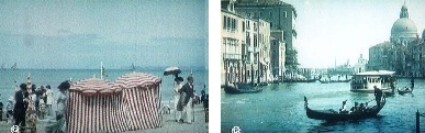
Chronochrome images of Deauville and Venice, from http://www.gaumontpathearchives.com

It has taken modern restorations, which can overcome the original problems in projection by creating synthesized colour prints, to reveal Chronochrome in all its evocative beauty. George Eastman House have some thirty titles, and Gaumont itself (now Gaumont Pathé Archives) has two hours’ worth of the films (the same titles as George Eastman House, maybe?), which it has restored to a richness and delicacy of colour that perhaps the films never enjoyed at the time, subject as they were to the limitations of projection at a ferocious speed and inevitable problems of registration and parallax. Gaumont kept the process going during the First World War, and there is a Chronochrome film of the victory parade in Paris in 1919.

If the above description of Chronochrome tempts you at all, you can view examples of the system on Lobster Films’ 2-DVD set on the early history of sound and colour in cinema, Les Premiers Pas du Cinéma/Discovering Cinema, available from the Projection Box in the UK, from Flicker Alley in the USA, and from Edition Filmmuseum in Germany. Chronochrome films are all actualities, filmed in bright sunlight – static, or semi-static subjects (to avoid the colour fringing exposed by too much movement), taken at Deauville, the Riviera, and in Venice. They capture a lost world.

Recommended reading:
François Garçon, Gaumont: Un siècle de cinéma (1994)

Karine Mauduit and Delphine Warin,’La Couleur dans le fonds Gaumont: le Chronochrome

Images of a forgotten war

http://www.nfb.ca/enclasse/ww1

Images of a Forgotten War is a site hosted by the National Film Board of Canada. The forgotten war in question is the First World War, which you might be forgiven for thinking is not quite as forgotten as some conflicts, but the theme here is in particular the history of the Canadian Expeditionary Force, whose key role in the conflict might not be so well known. The site seeks to redress the failings of collective memory through contemporary, non-fiction motion pictures.

The site comprises some 120 archival films (many of them from the Imperial War Museum), accompanied by photographs, historical essays, and teaching materials. A lot of attention has gone into creating an elegant, properly commemorative site. The films are arranged in five categories: Prologue, Building a Force (subdivided into Mobilization and Training), Wartime (subdivided into Support, Battles, Aviation and Behind the Lines), Postwar Period (subdivided into After the Armistice and Return to Canada), and Epilogue. Those divisions and subdivision may indicate that the site is a little on the elaborate side, and indeed it encourages patience in uncovering the histories it has to tell. Of course you can dip in, but you’ll miss much.

The films are in Flash, up to ten minutes or so long, with longer films are broken up into sections. There are small and full screen options, and each film comes with title, date, running time, production company and synopsis. It concerns me greatly that all titles and intertitles have been replaced by the same words (presumably) in a modern font. This is mistrustful of the medium. One cannot judge accurately the provenance of the films, a matter exacerbated by a failure to indicate which are actual release titles and which supplied titles – because these films are a mixture of commercial releases and archive/library material. In general, the site is not interested in film as film, but in film as a window on the past, and it is noticeable that the accompanying essays have little to say about film (one unfortunately chooses to tell us that “The first feature of a Great War-era movie to strike the modern viewer is the jerkiness of people’s movements, which stems from the low number of frames per second of the film of that time” – how could such a hoary myth be allowed get past?).

The Battle of Arras (1918), from Images of a Forgotten War

That said, there is a fabulous range of films here, all of it freely available, and most it not to be found elsewhere. It concentrates on the Canadian Expeditionary Force, but there is much film of general interest. The Canadian War Records Office, headed in Britain by Max Aitken (later Lord Beaverbrook) was in the forefront of using film for state information and propaganda, and directly influenced the creation in Britain of the War Office Cinematograph Committee and ultimately the use of film by the Ministry of Information (formed in 1918 and headed by Beaverbrook). These films were produced by official cameramen working under military censorship – propaganda, therefore, but a modest propaganda by latter standards, and one which emphasised the plain ‘objective’ truth of the photographic record to show things as they were.

The films feature classic imagery of the war – not film of fighting as such, but recruitment, trenches, craters, ruined buildings and landscapes, troops on the march and behind the lines, gunfire, explosions, and mud, mud, mud. It is a rich lesson in the methods used to portray actuality in wartime through the film medium of the time. Among the key titles are Sons of the Empire, The Battle of Arras (in thirteen parts), With the Royal Flying Corps and The Royal Visit to the Battlefields of France June 1917. All are shown silent – and (contrary to that essay’s pronouncement) run at the correct speed.

As said, there are photographs, historical essays (focussing on the Canadian experience of the war), ‘other materials’ (diary extracts, letters, book extracts etc.) and teaching materials. The best place to start is the Search option, where you will find all the titles listed, and the option to search across all resources, or narrow down a search by films (i.e. searching across the catalogue data), the essays, visuals, other materials or teaching materials. The Display All option gives you a list of all resources under any one category, and reveals just how much lurks deep within this impressive site. Despite some qualms about the the treatment of the films, and the understanding of film history, this is a most impressive and welcome resource. Go explore.

Lost sites

Here at The Bioscope we do our best to alert you to interesting new web resources on the subject of silent cinema, or indeed sites that have been around for a while but aren’t necessarily well known. But what about sites that are no more? We’ve all experienced the frustration of the dead link, discovering that some site or page has been taken down because the domain registration wasn’t kept up, the page was taken down because the owner thought it no longer of interest, or the web links on a site have all been changed. Whatever the reason, the Net is an impermanent place, and many worthwhile sites in our field are around no more.

Happily we have the Internet Archive and its ‘Wayback Machine‘, which has archived a great deal of the Internet (85 billion web pages from 1996 to 2008), taking ‘snapshot’ records of sites periodically (usually every few months). Images are not always retained, and you can’t find movie files, databases or other such complexities in the archive, but you will find the plain HTML. But how do you know what to look for? There is no subject guide or keyword searching (yet). You have to know the web address, and even then that only find you what you knew was there to find. What about those lost sites that you never knew were lost?

Despair not. The Bioscope presents this initial guide to some of the silent cinema sites and web pages which can no longer be found on the Web as such, but do lurk within the Internet Archive. There will be many more than those listed below, of course, but it’s a start (do let me know if you know of any). All links will take you to the Internet Archive record.

The Silents Majority
Old hands will have recognise the gentleman at the top of this post as ‘Merton of the Movies’, the silent town crier who featured on Diane MacIntyre and Spike Lewis’ The Silents Majority, the essential silents information site before it disappeared in 2003 and Silent Era took its place. Here you can still find biographies, reproductions of articles, featured books and videos, photo gallery, guest articles and Cooking with the Stars. Not everything remains (some images and the QuickTime movies won’t be found there), but it’s still a treasure trove. Check also for the final year of its existence when it changed its URL and became www.silentsmajority.com.

A Trip to the Moon
A simple but engaging site dedicated to Georges Méliès’ Voyage Dans La Lune, with an essay on the film, Méliés’ own outline and commentary for the film, film stills (not of terribly high quality, unfortunately), and extracts from the associated imaginative literature of Wells, Verne, Poe and others.

Questions Regarding the Genesis of Nonfiction Film
A stimulating essay on early non-fiction filmmaking, its essence, problems of definition, and neglect by film scholars, by renowned Japanese scholar Komatsu Hiroshi. It does exist elsewhere in print in the journal Documentary Box, but a key text like this ought not to be lost to the online research community.

The Human Motor
This stems from a scientific project to map the human body by the University of Colorado, and was part of a larger site, Building Better Humans. It has sound information on the chronophotography of Etienne-Jules Marey and Eadweard Muybridge, complete with a fine selection of images.

Les Frères Lumière et le Japon 1895-1995
This site accompanied a touring exhibition of films shot in Japan in the 1890s by the Lumière cameramen François-Constant Girel and Gabriel Veyre. It comprises an excellent essay (in French) on the first films and filmmaking in Japan by Hiroshi Komatsu.

Eadweard Muybridge: Father of Motion Pictures
An imaginative, beautifully-designed site on the master photographer who captured motion. Some of the photographs no longer appear, but there some animated gifs of Muybridge sequences, and the whole thing is just done with such style.

Dive cinema muto
Italian site (in Italian) devoted to silent film actresses, especially the Italian ‘divas’ such as Lyda Borelli and Francesca Bertini, plus other femme fatales such as Asta Nielsen and Theda Bara. With biographies, essays and illustrations.

Archiving the Internet is becoming a subject of increasing concern. The Internet Archive leads the field, of course, but the UK Web Archiving Consortium is building up to the day when every UK website will be archived as a matter of legal deposit. For those intrigued by dead sites in general, take a look at Ghost Sites of the Web (these are sites that still exist on the Web, but which have been abandoned).

Please let me know of any lost sites (as opposed to dead ones that just aren’t updated any more) on silent cinema, and I’ll update this list. Note also that not every lost site may necessarily be found on the Internet Archive – the website whose passing I most regret, Charl Lucassen’s beautiful Anima site on chronophotography and other optical delights, once one of the genuine treasures of the Web, is nowhere to be found at all. Such a loss.

Flicking through the magazines

A new publication, Emily Crosby and Linda Kaye’s Projecting Britain: The Guide to British Cinemagzines, opens up a hidden corner of film history, a corner in which the silent cinema played its part. The book’s subject is the cinemagazines, or screen magazines, or just plain magazine films, those unconsidered programme fillers that were a mainstay of cinema shows for decades and out of which sprang the television magazine format. Overlooked by practically all film histories, the cinemagazine has a rich tale to tell, not simply for its form and content, but for the diverse audiences that it reached and the various bodies – entertainment, governmental, industrial – that used the magazine film format to hook audiences to their purposes.

The richest history of the cinemagazine, as indicated by that title Projecting Britain, comes from the sound era, when the British government in particular latched onto the form in the post-World War II era as means to further its strategic aim of ‘national projection’ (i.e. we may have lost an empire and it may be a post-war world, but we still have our part to play in it). But the cinemagazine was an invention of the silent cinema, and it was not the sole preserve of Britain.

The first person to come up with a magazine film series (as opposed to the newsreel – a related form, but tied much more to topicality) was Charles Urban (have I mentioned him before?). Late in 1913 Urban devised the Kinemacolor Fashion Gazette, directed by Abby Meehan, a magazine series highlighting women’s fashions, filmed naturally in colour using the Kinemacolor process. It probably did not extend far beyond Kinemacolor’s London theatre, the Scala, and only lasted a couple of months, but a new film form was born. The next pioneer was the naturalist and filmmaker Cherry Kearton, who devised The Whirlpool of War, a behind-the-scenes war magazine presenting footage from Belgium and France in the first few months of the First World War.

Title design from Around the Town no. 105, 1921 (BUFVC)

But the cinemagazine as a regular entertainment in the cinemas really began in 1918 with Pathe Pictorial. This offshoot of the Pathe newseel in Britain amazingly ran uninterruptedly until 1969, bringing together light stories of fashion, personalities, travel, customs, sport, hobbies, innovations, animals, quirky events – anything that didn’t quite define itself as news. The idea swiftly caught on. In Britain, though the 1920s, there was Around the Town (1919-1923), created by Aron Hambuger, distributed by Gaumont, concentrating on London goings-on, especially theatrical; Eve’s Film Review (1921-1933), Pathe’s iconic magazine series for women; Vanity Fair (1922), produced by Walturdaw; Gaumont Mirror (1927-1932), sister series to the newsreel Gaumont Graphic; and British Screen Tatler (1928-1931), sister series to the newsreel British Screen News. Ideal Cinemagazine (1926-1932), produced for Ideal by Andrew Buchanan, gave the form its name, and introduced a (limited) educational element that was to characterise later developments of the cinemagazine.

Also throughout the 1920s the cinemagazine was becoming a staple of American screens, with Charles Urban once again the pioneer. When Urban established an American film business after government service during the First World War, he based much of his hopes on two cinemagazine series, Movie Chats (1919-1923) and Kineto Review (1921-1923). A typical Movie Chats issue (no. 4) contained the stories ‘View of the River Thames at Henley on Regatta Day’, ‘Experiments in Static Electricity’, ‘Visting the Sacred Monkey Temple at Benares India’, ‘Camel Fight in Desert of Turkey’, and ‘Three Views of the River Seine with Cloud Effects’. Ever the one to make good use of library material, much of Urban’s cinemagazine content came from films his companies shot in Britain before the First World War (and in turn Movie Chats footage was sold to Britain and used by Andrew Buchanan in his Ideal Cinemagazine).

Other American cinemagazines of the 1920s were Screen Snapshots (1920-1958), which focussed on Hollywood stars; Grantland Rice’s Sportlights (from 1924 at least), a mainstay of American cinemas for decades; and several series from James A. Fitzpatrick, an Urban protégé, whose Fitzpatrick Traveltalks (begin 1931) were an equally enduring feature of American screens (with the legendary closing lines “… and so we say farewell to …”). Undoubtedly the form spread to other countries, though information on these seemingly inconsequential components of the cinema programme is particularly difficult to find.

Light the cinemagazine may have been, but inconsequential it was not. An enduringly popular form, it spoke to audiences in an engaging, comforting manner, sometimes quaintly, sometimes with a degree of sly subversiveness. The use of the cinemagazine form in the 1920s to attract women audiences, through a mixture of knowingness and unknowingness, is covered by Emily Crosby in Projecting Britain and by Jenny Hammerton in one of the few other publication to consider the genre, For Ladies Only? Eve’s Film Review: Pathe Cinemagazine 1921-33. There’s also a German thesis available commercially, Nicola Gölzhäuser-Newman’s Eve’s Film Review: Genre und Gender im britischen screen magazine der 1920er Jahre. Some information on the American cinemagazine at this time (though the term is not used) can be found in Leonard Maltin’s The Great Movie Shorts. The use of the cinemagazine in the 1920s to tackle educational subjects remains under-researched, and I know of no publication that I can point you to (though I have some unpublished writing myself…).

You can find plenty of examples of Pathe Pictorial and Eve’s Film Review on the British Pathe site (same content also available through ITN Source). Examples from issues of Around the Town are available on the British Universities Film & Video Council’s Video Showcase (look out in particular for H. Grindell Matthews demonstrating his sound-on-film invention in 1921). It was the BUFVC which hosted the ‘Cinemagazines and the Projection of Britain‘ project which resulted in this book, a project in which I played a small part (mostly obstructive). The BUFVC’s newsreel database now included records of some 19,000 British cinemagazines.

There’s still so much to be discovered in film history, particularly early film history, if we will only start looking in the right places. Projecting Britain (a collection of essays, original documents and reference guide) opens another door.

Filmarchiv Leuzinger

Ben Hur exhibited at Meisterschwanden, Switzerland, May 1930, from http://www.filmarchiv-leuzinger.ch

I was introduced to this website a while ago (by its author), and thought you ought to know about it. The subject of Filmarchiv Leuzinger is a small town family cinema business from Rapperswil, Switzerland. It was founded by restaurant owner Willy Leuzinger, who began organising film screenings in his restaurant in 1909, going on to open two cinemas in the Lake Zurich district. In 1919 he began a touring cinema business, the Wanderkino Leuzinger, which dominated film exhibition in north-eastern Switzerland from the mid-1920s to 1943. Leuzinger was also a filmmaker, shooting many local topicals (local newsfilms) throughout the 1920s, around eighty of which survive. After Willy Leuzinger’s death in 1935, his eldest daughter took over, and today his granddaughter Marianne Hegi still runs three cinemas, in Rapperswil and Altdorf.

The Wanderkino Leuzinger in 1923

All of this is a charming story, but in the hands of Mariann Lewinsky Sträuli it has been turned into an eye-catching and evocative website. Filmarchiv Leuzinger (click on the Übersicht link to find the main ‘archive’ page) arranges an archive of family memorabilia – biographies, photographs, documents, music, background information and film clips in thematic columns to create an innovative and enticingly explorable site that opens up the Leuzinger’s world. The film clips (in QuickTime format, with MPEG-4, DVD-quality downloadable versions also available) show local festivals, parades, fairs, gynmatic events, and so on, each meticulously described. Every clip, image, audio file or other link leads to a page of information (with larger versions of the images), progressively building up a resonant picture of time, place and occupation.

It is a delightful site, quite an inspiration in conception and design. Unfortunately for the linguistically-challenged English speaker, it is in German. But don’t let that deter – it’s clear enough just from looking that it is a fine piece of social and cinema history (the numerous photographs of cinemas in the 1920s and 30s will delight many), put together with a loving archivst’s care. Mariann Lewinsky Sträuli prrogrammes section of Il Cinema Ritrovato in Bologna, teaches film history at the University of Zurich and directs restoration projects at Memoriav, the Swiss audiovisual heritage organisation.

Go explore.

Colourful stories no. 13 – Kinemacolor, its rise and fall

Coloured illustration from the 1912 Kinemacolor catalogue attempting to give an impression of the colour effect of With Our King and Queen Through India (1912)

After something of a gap, we return to our on-going history of colour and the silent cinema by marking the end of Kinemacolor. The attention given to Kinemacolor so far in this series might give the impression that it was widely experienced by audiences. This was not the case. Ordinary cinema audiences were far more likely to experience colour in the form of tinting or toning, or stencil coloured prints. Kinemacolor films were restricted to theatres equipped with specialist projection equipment, often charging higher prices. Kinemacolor was a select entertainment. The impression it made was therefore on the wealthier sort (relatively), and there is plenty of evidence for people deciding to attend a Kinemacolor show would have never deigned to attend a film show previously. The film industry recognised how Kinemacolor was attracting new audiences, raising the possibility of a different, classier kind of film show in the future. Although the trade respected Kinemacolor for its technical achievement, its real significance was social.

Kinemacolor had started off in Britain in 1908. It received its commercial debut in February 1909, when it was first named Kinemacolor, and the Natural Color Kinematograph Company was formed to produce Kinemacolor films, both dramas and actualities – the latter always being the company’s stronger suit. Kinemacolor’s producer, Charles Urban, set about making a hoped-for fortune by licensing Kinemacolor across the world. The policy enjoyed mixed fortunes.

In establishing a system of international licences, Urban sometimes managed to sell Kinemacolor three times over: the national patent rights, the exhibition rights (for restricted periods, then to be re-negotiated) and naturally the exclusive Kinemacolor apparatus and films necessary to put on such programmes. The sale of patent rights was the most lucrative business, though they were negotiated for eight territories only. £2,500 was paid for Switzerland, £4,000 for Brazil, £6,000 for Holland, Belgium and Luxembourg, £8,000 for Italy, £10,000 for France, £10,000 for Japan, £10,265 for Canada, and £40,000 for the United States of America. Few made much money for the investors, a general get-rich-quick mentality having taken over. Kinemacolor was a hard sell, and few outside Britain really understood how to market something so out of the ordinary. The demise of the Kinemacolor Company of America, after high hopes, has already been covered, but the stories of France and Japan are of interest.

France
Kinemacolor opened in France with a special exhibition in Paris on 8 July 1908. A three month engagement began at the Folies Bergère from September 1909. The French patent rights were sold in 1912 to the Raleigh et Robert firm, which created a prestige centre for Kinemacolor exhibition in Paris at the Biograph Theatre, Rue de Peletier. In July 1912, an attempt to float an independent company, Kinemacolor de France to supersede Raleigh et Robert’s business failed when insufficient working capital was raised by subscription. The Natural Color Kinematograph Company bought back the French patents for £5,000 more than they had sold them for, and this led Urban to attempt to repeat the formula through purchasing the lease on premises in the Rue Edouard VII, Boulevard des Capucines, Paris. Here he undertook to build his very own theatre, the Théâtre Edouard VII in 1913. This extravagant move proved catastrophic, with the theatre taking too long to build, being too small in size (it seated 800), obscurely located, and tickets priced too highly. Urban lost tens of thousands, and Kinemacolor in France came to an ignominious end.

Japan
Japan was a comparative success story. The patent rights for Japan and East Asian were acquired in 1912 by the Fukuhodo company, which paid 40,000 yen (£10,000). The rights then passed on to Toyo Shokai. A three-hour Kinemacolor programme was given before the Emperor of Japan in August 1913, and in October the first commercial Kinemacolor programme opened at the Kirin-kan in Asakusa, Tokyo. Toyo Shokai reformed itself on 17 March 1914 as Tennenshoku Katsudoshashin Kabushiki Kaisha (Natural Color Kinematograph Company), abbreviated to Tenkatsu. Kinemacolor exhibition in Japan was well-managed and profitable, and local film production followed, predominantly fiction films, which were adaptations from kabuki plays. However, the onset of the war led to a sharp rise in the cost of film stock, and as Kinemacolor used double the amount of film to monochrome production, its use became restricted to special scenes in selected productions. After a gap of two years the last Japanese film to use Kinemacolor (and quite probably the last Kinemacolor film produced anywhere), Saiyûki Zokuhen, was released in July 1917, but the novelty had passed.

Charles Urban (centre) with camera team in Delhi for the filming of the Durbar, December 1912

The Delhi Durbar
In Britain Kinemacolor enjoyed four or five years of spectacular success, driven by its films of travel and actuality, in particular scenes of royal spectacle. Urban was fortunate that the rise of Kinemacolor coincided with a series of royal events whose ceremonial pageantry naturally suited the colur system, and which proved excellent subjects for export. The funeral of King Edward VII (1910), the coronation of King George V (1911), the investiture of the Prince of Wales (1911), and above all the Delhi Durbar, a huge extravaganza held in India to mark the coronation of the new King-Emperor (1911), all made Kinemacolor a must-see attraction for many. The Delhi Durbar films, entitled With Our King and Queen Through India (first exhibited 1912), lasted for over two hours and was more of a flexible multimedia show than a film as such, as its many component parts could be shifted about according to taste, and its showings were accompanied by orchestral music that copied that which was played at the event itself, a lecturer, and in its prestige screenings at the Kinemacolor London showcase theatre, the Scala, a stage that was made up to look like the Taj Mahal. This lyrical passage – a favourite of mine – from the British film trade paper The Bioscope sums up the awe-struck reaction many had to seeing the Delhi Durbar films, and Kinemacolor in general:

Last Friday evening, at the Scala Theatre, was an occasion in many respects as significant and memorable as it was wonderful. It may be left for future generations to realise the full extent of its importance – men and women yet unborn who, by the magic of a little box and a roll of film, will be enabled to witness the marvels of a hundred years before their age, in all the colour and movement of life. Perverse old grandfathers will no longer be able to indulge disdainfully in reminiscences of the superiority of the times ‘when they were boys’; the past will be an open book for all to read in, and, if the grandfathers exaggerate, they may be convicted by the camera’s living record. Man has conquered most things; now he has vanquished Time. With the cinematograph and the gramophone he can ‘pot’ the centuries as they roll past him, letting them loose at will, as he would a tame animal, to exhibit themselves for his edification and delight. The cinematograph, in short, is the modern Elixir of Life – at any rate, that part of life which is visible to the eye. It will preserve our bodies against the ravages of age, and the beauty, which was once for but a day, will now be for all time.

The end
Kinemacolor was not to be for all time. Its demise came not from the failings of the international licensees but destruction at the centre. In 1913 a court case was launched against the Natural Color Kinematography Company by Bioschemes, a company marketing a rival motion picture colour system, Biocolour, invented by William Friese-Greene. Biocolour was an additive system which employed film frames alternatively stained red and green, close therefore in principle to Kinemacolor. Bioschemes had struggled to get off the ground because its every move seemed to infringe the Kinemacolor patent. With backing from motor racing driver S.F. Edge, Bioschemes challenged the Kinemacolor patent’s validity in the courts. The Friese-Greene case was lost, but on appeal in March 1914 the decision was reversed. The appeal judge declared that the patent claimed to produced natural colours, but also stated that it did not reproduce a true blue, since it used only red and green filters. The judge declared that it could not therefore support its claim to be natural. So the patent was invalid.

The decision was catastrophic for Kinemacolor, because it destroyed the foundations on which the whole licensing scheme was based. However, it did not of itself mean that Kinemacolor was necessarily over. The system was there for anyone to use – it was just that Urban no longer could market it exclusively. But tied to specialised projection, and being more expensive to produce (as said, Kinemacolor films were double the length of conventional films), no one (outside of Japan) was prepared to make a go of it.

‘Firing Four 12-in Gun Salvoes’, a Photochrom postcard recreating a colour scene from Britain Prepared (1915)

Urban did make a few more Kinemacolor films himself. With the outset of the First World War, he created another multimedia show, With Our Fighting Forces in Europe, which mixed library footage of troops and nations with some actuality film taken in Belgium in late 1914 – the only colour film taken of the war on land (none of this footage is known to survive today). Then for the British propaganda outfit Wellington House he made a documentary feature, Britain Prepared (1915), which included colour sequences of the British navy at sea off Scotland in October 1914. Some of these scenes were discovered recently in an American commercial archive, and are – I believe – now on their way to the Library of Congress. I’ll be able to say more on this later. (A monochrome-only Britain Prepared is held by the Imperial War Museum)

More later in this series also on Kinekrom, a would-be successor to Kinemacolor that Urban attempted to develop in the 1920s. But next up will be Gaumont’s Chromochrome, perhaps aesthetically the most sucessful of the pre-war colour processes, and then the winner of the colour wars – Technicolor.

Recommended reading:

Welcome to Newsfilm Online

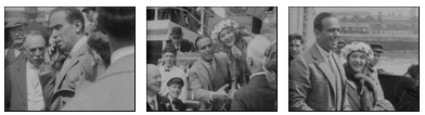
Southampton: Arrival of Mary Pickford & Douglas Fairbanks, Gaumont Graphic, 21 June 1920, from http://www.nfo.ac.uk

Quietly launched this week (with an official launch due in October) is Newsfilm Online. This is 3,000 hours of UK cinema newsreel and television news content, dating 1910s-2000s, all of it taken from the collection of ITN Source. ITN is the UK’s largest commercial footage library, (if you don’t count the BBC as such), and doesn’t just own ITN news programmes, such as News at Ten and Channel 4 News, but most of the UK’s newsreel archives (Pathe, Paramount, Gaumont, Universal). The 3,000 hours (about 2% of the ITN news collection) have been digitised and made available for free downloading and re-use, so long as you are a member of a subscribing UK institution of higher or further education. Sadly that’s going to leave out a lot of you, but the project was funded by the Joint Information Systems Committee, which exists to support UK HE/FE (as we call it in the trade), and the conditions under which the newsfilms were digitised stipulated that they would be available to HE/FE users only.

But despair not, because although you may not be able to see the films, the catalogue records are searchable and browsable by all. And for the silent era, there are 1,241 news stories from the 1910s and 5,091 from the 1920s, making this a marvellously rich resource for historical study, even without the films themselves – not least because you get thumbnail images, like those of Doug and Mary illustrated above. It’s supposed to be every example of the Gaumont Graphic newsreel held by ITN, and shopws how alert the newsreels were to the stories, concerns, fads and personalities of their era. The thumbnails alone excitingly bring the 1910s and 20s back to vivid, varied life.

Remarkably, the publication of Newsfilm Online means that the majority of British newsreels (I’d guess between 80-85%), 1910-1979, are now digitised, encoded and available on the Web in one form or another, albeit with restricted access in some cases (the Paramount and Universal newsreels are the big gaps). That’s a sensational thing to be able to report, achieved in little over five years by a mixture of public money (around £3.5M, at a rough guess, though the £2M that Newsfilm Online cost was for TV news as well as its Gaumont newsreels) and private (no idea how much). The four main sources (with the silent newsreels that they include) are:

  • British Pathe – including Pathe Gazette, Eve’s Film Review, freely available (low resolution)
  • British Movietone News – Movietone itself was a sound newsreel, but the site include a rag-bag collection of silent actualities, freely available (low and middling resolution)
  • Newsfilm Online – includes Gaumont Graphic, movies available to subscribing UK educational institutions only
  • Screenonline – the BFI online ‘encyclopedia’ has many examples of the Topical Budget newsreel, movies available to UK schools, colleges and libraries only

What a fantastic achievement. Having played a small part in making NfO (as we call it in the trade) happen, I’m just a little bit chuffed to see it published at last. For a record of most British newsreel stories in one place, I warmly recommend the British Universities Newsreel Database (still has some gaps to fill for silent newsreels), which also lists other digitised newsreel collections around the world (Australia, France, Germany, Italy, Sweden – America, alas, lags seriously behind).

Let’s have every newsreel around the world available online – it can be done; it would delight and benefit so many if it could be done.

BFI on YouTube

The Bioscope has reported on the BFI’s You Tube channel before now, but this just to alert you to the fact that they have been adding many more videos to the site, a good number of them silent. There are currently 177 videos, and there isn’t time or space enough to point out all of the gems that lie therein. So I’m just going to point you to three, and then urge you to go explore for yourselves.

To start with, here’s an odd little newsreel story from 1921 which I first showed at the National Film Theatre in 1992 (ah, memories):

The peculiar event on show is the Eton Wall Game, filmed by the Topical Budget newsreel. This sport, which only the British public school system could have produced, involves the schoolboys piling up into a scrum and trying to push a ball along the wall. If they get it to the end of a wall it’s a goal, but in the traditional St Andrew’s Day game there hasn’t been a goal scored since 1909. What is of interest here is that one of the boys taking part was Eric Blair – yes, the future George Orwell is somewhere in the pile of boys, and despite many people having stared very closely at the film over the past sixteen years, no one has spotted him as yet. So now it’s your turn.

This next gem is called Old London Street Scenes. That’s what we call a supplied title in the trade. It wasn’t called that originally, someone gave it the quaint title later:

This is a piece of footage which has been shown countless times on television because of its spectacular closing shots of London traffic. It demonstrates how a fixed camera single shot of ordinary human life can nevertheless astonish. Look out in particular for the epoch-making moment when a motor car appears among the horse-drawn carriages. It dates from 1903 (we know this because of some of the London shows seen advertised on posters on the passing vehicles). The likely production company is Walturdaw.

Finally, some more sport:

This is part of the extraordinary Mitchell & Kenyon collection of Edwardian era films. Having presumably sold all of the DVDs that they are probably likely to sell of this collection, the BFI has put up quite a selection on the YouTube site. This cricket film has been given the supplied title Arthur Mold Bowling to A.N. Hornby, and was made in 1901. As the DVD commentary (courtesy of Adrian Chiles) explains, there had been a huge controversy at the time when Lancashire’s Arthur Mold was accused of having a dodgy bowling action; that is, throwing (apologies for American readers who may not appreciate how profoundly shocking this to any cricket follower). So he appeared before the cameras demonstrating his bowling style, so that viewers could judge for themselves how legitimate he was. Compared to, say Muttiah Mulitharan, you may wonder what the fuss was about (a bit sideways on, maybe, but hardly chucking). Or, for poetry lovers among you, note simply that the batsman in the nets with Mold is A.N. Hornby, subject of a famous set of lines by Francis Thompson (the poem is called ‘At Lord’s’), recalling the cricket of his youth (when, of course, the game was always better):

For the field is full of shades as I near a shadowy coast,
And a ghostly batsman plays to the bowling of a ghost,
And I look through my tears on a soundless-clapping host
As the run stealers flicker to and fro,
To and fro:
O my Hornby and my Barlow long ago!

On which wistful note, let me just recommend once again the BFI’s YouTube site (not all silents, not all non-fiction, by the way), and look out for further posts on the stories behind one or two of the videos to be found there, in due course.

The silent Olympics

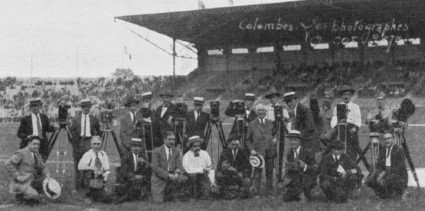
Photographers and cinematographers at the 1924 Olympic Games in Paris, from the official report, available at http://www.la84foundation.org

Note: This post has now been updated with new information at https://thebioscope.net/2012/06/27/let-the-games-begin

It is less than a month now until the Olympic Games in Beijing begin, and for two weeks hundreds of cameras will be trained on the athletes, images of whom will be beamed out to billions. Perhaps nothing better illustrates the ubiquity, power and global shared experience that the motion picture has grown to represent from its simple beginnings in 1896 than that concentrated period, every four years, when it covers the Olympic Games, a phenomenon which likewise traces its (modern) roots to 1896.

The modern Olympic Games and motion pictures share a common heritage, beyond that shared birthdate of 1896 (motion pictures existed before 1896, of course, but 1896 was when they first made their real impact upon the world). The two phenomena grew up together, in sophistication, intention and global reach. To view the films of the early Olympic Games is to witness the growth of the medium in how it captured action and form, from analysis, to (relatively) passive witness, to a medium that shaped athletic events to its own design. We see a transition from a formality bred of militaristic roots to entertainment, art and a focus on the individual. In the words of Olympic historian Allen Guttmann (talking of modern sports overall), we see a movement from ritual to record. The survey that follows summarises the history of the Olympic Games on film throughout the silent era, that is, to 1928.

Athens, 1896

No one filmed the first Olympic Games of the modern era. The Games, which were held in Athens 6-15 April and attracted 241 athletes from fourteen nations, enjoyed some notice around the world, probably appealing as much to classicists as to athletes, but the motion picture industry was in its infancy and not as yet geared up to reporting on world news. Motion pictures had not yet reached Greece, America would really only awake to motion pictures on a screen on 23 April, with the debut of the Edison Vitascope, and the Lumière brothers – really the only possible candidates – did not think to send one of their operators to Athens. Occasionally on television you will see film purporting to show the Games of 1896. Such scenes are false – in most cases, you are being shown images from 1906.

Paris, 1900

The 1900 Games were something of a disaster after the modest triumph of Athens. Organised to run alongside the great Paris Exhibition of 1900, the Games were barely recognised as such, being so chaotically organised and poorly promoted that many of the athletes who did take part in the events (which stretched from May-October 1900) were unaware that they had taken part in the Olympics. It is no surprise, therefore, than no standard films were made of Paris Games (several films of the Paris exhibition survive, but none show the athletic contests).

However, fleeting cinematographic records do exist. The Institut Marey, the scientific institute led by Etienne-Jules Marey, who had developed the art and science of chronophotography (sequence photography undertaken for the purposes of analysing motion), decided to record some of the visiting American athletes, to compare their methods with those of French athletes. Alvin Kraenzlein (winner of gold medals for long jump, 60 metres race, 110 metre hurdles and 200 metre hurdles), Richard Sheldon (illustrated, gold medal winner in the shot put), and the legendary Ray Ewry (exponent of the now discontinued events of standing high jump, long jump and triple jump) were among those filmed. The ‘films’ are a few frames long, lasting less than a second each, yet they were enough to demonstrate the superiority of the dynamic attack of the American technique over the correct military bearing of the equivalent French athletes. These fleeting images survive today – there are examples in the National Media Museum – and illustrations from them can be found in the official report on the Games.

St Louis, 1904

Paris was a disaster for the nascent Olympic movement, but St Louis was worse. Again, they went for the convenience of being part of a general Exposition, and again the Olympic events were mismanaged from start to finish, with little sense of a Games with a distinct identity, and the distant location putting off many athletes not hailing from America. Nor, to the best of my knowledge, were any films taken on the Games. The International Olympic Committee’s site exhibits a video clip which it says shows running events from 1904 (click on the Photos section of the site), but I don’t think those are the 1904 Games (the background looks wrong), and I’ve found no evidence from catalogues of the period of any such film being taken.

Athens, 1906

Archie Hahn (USA) winning the 100 metres in 1906 (still photograph, not from a cinematograph film)

The intercalary Games of 1906 did not occur during an official Olympiad (i.e. the four-yearly period that marks when the Olympic Games are held), but this intermediary contest, designed partly as a sop to the Greeks who were disappointed that the Games were not being held permanently in Athens, was a relative success and did much to get the idea of the Olympics back on track. It also attracted the film companies. Gaumont and Pathé from France, the Warwick Trading Company from Britain, and Burton Holmes of America all made short films of the Games (we are long way yet from feature-length documentaries). The films that survive (one from Gaumont, one unidentified) emphasise the ritual, concentrating on the opening ceremonies and gymnastic displays. Individuals are lost in the mass.

London, 1908

Dorando Pietri finishing the 1908 Marathon (still photograph)

The Games started to come of age in London in 1908. Although they were again held in tandem with an exhibition, in this case the Franco-British Exhibition, for which the famous White City and associated stadium were built, this time the Games were welcomed by the organisers. The result was a popular success and a qualified triumph for sport – the qualification being necessary because the Games were marred by some bitter rivalry between America and Britain, geo-political tensions being played out on the athletics track not for the last time.

The Games were filmed by Pathé, in what seems to have been a semi-exclusive deal. The Charles Urban Trading Company filmed events outside the stadium, including the Marathon, but within the stadium it was Pathé alone, an indication of arrangements to come. Around ten minutes survive, a selection of which can be found on the British Pathe site. Basic coverage is given to the pole vault, high jump, tug o’ war, discus, water polo and women’s archery, though no names are given for athletes. But what distinguishes the 1908 coverage is the Marathon. Around half of the extant film of the Games is devoted to the race, concentrating on the Italian Dorando Pietri, who staggered over the line first, only to be disqualified because he had received help after he collapsed in the stadium within sight of the finishing line (something the film makes quite clear). For the first time on film we thrill at the sight of Olympic endeavour.

Stockholm, 1912
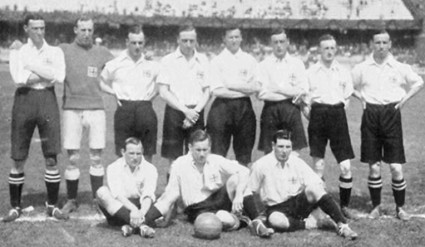
The Great Britain football team, gold medal winners in 1912 (still photograph)

The Stockholm Games of 1912 were the most successful yet. Twenty-eight nations, 2,407 athletes (just forty-eight of them women), a triumph of organisation, and an event followed more eagerly around the world than ever before. Responsibility for filming the Games went to the A.B. Svensk –Amerikanska Film Kompaniet, which commissioned Pathé exclusively to film a series of short newsfilms. All this footage survives in the archives of Sveriges Television. Now, at last, the athletes are named, and we get a sense of competition and achievement. In the first of two reels covering the Games held in the BFI National Archive, we see the inevitable gymnastic display, first by Scandinavian women’s team (for display purposes alone – women’s competitive Olympic gymnastics only began in 1928) followed by men’s team and individual gymnastics; the Swedish javelin thrower Eric Lemming, winner with the world’s first 60 metre throw; fencing, shot put, the 10,000 metres walk and the shot put, won by Harry Babcock of the USA. The second reel features men’s doubles tennis, the soccer tournament (Great Britain – not England – beating Denmark 4-2 in the final), Graeco-Roman wrestling, hammer throwing, the standing high jump, and the Marathon, run on an exhaustingly hot day that caused half the runners to retire. Filmed in engrossing detail, the drama of the Marathon is built up well, the tension in the sporting endeavour pushing forward the form of the film attempting to encapsulate it. The race was won by Kenneth McArthur of South Africa.

Antwerp, 1920

The Sixth Olympiad was to have been held in Berlin in 1916. Those Games were, unsurprisingly, cancelled, though film exists of German athletes training for the Games. After the war, the Games were awarded to Belgium, which perhaps was not entirely ready for the compliment after all it had been through, and the 1920 Games were hastily and cheaply organised. Despite this, the growing world interest in athletic competition had continued to grow, and there were several notable athletes who made their mark on Olympic history, including the ‘Flying Finn’ Paavo Nurmi, America’s Charley Paddock winning the 100 metres, and France’s Suzanne Lenglen at the start of gaining worldwide fame as a tennis player. Sadly, only a few newsreels were made of the events. The IOC website features film of the opening ceremony, American hammer thrower Patrick McDonald, and one of the stars of the Games, 14-year-old American diver Aileen Riggin.

Paris, 1924

Harold Abrahams winning the 100 metres, from Les Jeux Olympiques Paris 1924 (frame still)

And then we come to 1924. The second Paris Games have become familiar to many through their recreation in the 1981 film Chariots of Fire. There is a particular thrill in seeing the two British athletes whose fortunes are covered by the Oscar-winning film, Eric Liddell and Harold Abrahams, turning up for real in such detail. For this was the first time where we had a feature-length documentary dedicated to the Games. Strictly speaking, the film produced by Rapid-Film of France was a series of two-reelers dedicated to different sports, including those from the first Winter Games, held in Chamonix. Nevertheless, it was also compiled as a complete film, Les Jeux Olympiques Paris 1924, a daunting three hours long (unexpectedly, it is preserved in its entirety by the Imperial War Museum Film and Video Archive).

[Update (September 2008): Les Jeux Olympiques Paris 1924 is no longer held by the IWM, having been passed to the International Olympic Committee. An incomplete copy of the film is held by the British Film Institute]

Viewing the film in one sitting is something of a challenge, but individual events are never less than efficiently portrayed (aside from some tedious wrestling) and occasionally marvellously so. Particularly thrilling is the football, where the Uruguyan gold medal winners demonstrate a level of tehnical accomplishment light years ahead of the sturdy endeavours of the European teams. The 100 metres, won by Abrahams, is a highlight, with choice details such as the athletes digging holes in the track for their heels. Slow motion is used artfully (particularly for the 3,000 metres steeplechase). The Marathon is a tour de force, a real drama in itself, with such carefully observed details as the anxious look of officials at the drinks stations (and how delightful in itself that the French served wine as well as water). Few who were there can have forgotten Neil Brand’s bravura accompaniment to the 1924 Marathon at Pordenone in 1996, when the Giornate del cinema muto put on a special programme of silent Olympic films.

Star athletes on show include Nurmi, his great Finnish rival Ville Ritola, the Americans Jackson Scholz (sprinter) and Helen Wills (tennis player), but disappointingly all we see of the future Tarzan Johnny Weismuller is his submerged figure in long shot as he raced to fame as a swimmer. Les Jeux Olympiques Paris 1924 (produced by Jean de Rovera) is no film masterpiece, but as a sporting record, it captures greatness.

Amsterdam, 1928
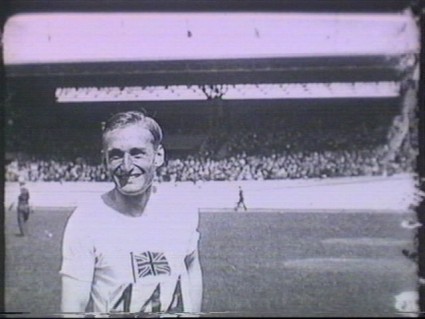
Lord Burghley, winner of the 400 metre hurdles, from Olympische Spelen (frame still)

The last Olympic Games of the silent film era were held in Amsterdam in 1928. The Games were by now thoroughly established as an event of worldwide significance. The idea of a film dedicated to the Games had also been established, though the problems that beset the 1928 film, Olympische Spelen, were such that it was barely seen, and it remains little known. The history is complicated, but essentially in 1927 the Dutch Olympic Committee approached a federation of Dutch film businesses to mange the filming of the Games. Negotiations fell down over financial considerations – and because the Dutch commitee was, at the same time, negotiating with foreign film companies. Eventually they did a deal with the Italian company Istituto Luce. For the first time a director was chosen with an ‘arthouse’ pedigree (Leni Riefenstahl’s Olympia of 1936 was neither the first Olympic film nor the first with a notable director, as some histories would have us believe). The director was the German Wilhem Prager, who had enjoyed notable success with the 1925 kulturfilme sports documentary Wege zu Kraft und Schönheit (Ways to Strength and Beauty), in which Riefenstahl takes a fleeting acting role.

Prager’s film (preserved in the Nederlands Filmmuseum) is no more than efficient, though it does have some innovations such as having the names of athletes in some distance races appear as captions alongside them as they run. The film shows us Nurmi and Ritola once more; Boughera El Ouafi, the Algerian-born (but running for France) winner of the Marathon; the ebullient Lord Burghley (played by Nigel Havers in Chariots of Fire) winning the 200 metre hurdles; and Japan’s triple jumper Mikio Oda, the first Asian athlete to win an Olympic gold medal. But alas, owing to the considerable mishandling of the whole affair by the local Olympic Committee, Dutch exhibitors boycotted the official film, and hardly anyone saw it.

Das Weiss Stadion, from http://www.filmportal.de

There was also a feature-length film made of the 1928 Winter Olympics at St Mortiz, Das Weisse Stadion. Directed by Dr Arnold Fanck (the man who discovered Leni Riefenstahl as a film actress) and Othmar Gurtner, it was made for Olympia-Film AG of Zurich, and edited by the great Walter Ruttmann. However, Fanck appears to have viewed it as a chore and to have filmed it in a perfunctory manner. Only two cameramen were used, which would have hampered its coverage to a serious degree – which we have to assume, since the film is not known to survive.

Olympic drama
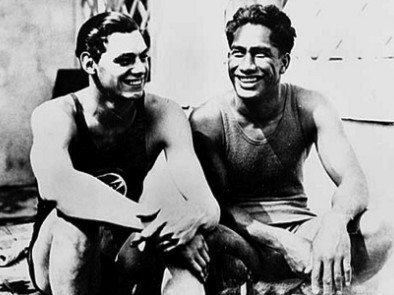
Johnny Weissmuller (left) and Duke Kahanamoku

Finally, to complete the history, note must be made of those Olympic athletes of the silent era who went on to appear in fiction films once their fame had been established through sporting endeavour. Johnny Weissmuller, star of the 1924 and 1928 Games, of course went on to eternal fame as Tarzan. The American sprinting hero of 1920 and 1924, Charley Paddock, starred in Nine and Three-Fifths Seconds (1925), The Campus Flirt (1926), The College Hero (1927), High School Hero (1927), and (guess what) The Olympic Hero (1928). The Hawaiian swimmer Duke Kahanamoku was in five American Olympic teams between 1912 and 1932, but could also be seen swimming and acting in Adventure (1925), Lord Jim (1925), Old Ironsides (1926), Woman Wise (1928) and The Rescue (1929). Buster Crabbe, like Weissmuller a swimming champion in 1928, went on to become Flash Gordon, while Herman Brix (shot put silver in 1928) went on to become Tarzan and as Bruce Bennett starred in many films, including Treasure of the Sierre Madre.

Finding out more

There are few histories of Olympic film, and where these do exist they either get elementary facts wrong or assume that everything started in 1936 with Olympia. As the above should indicate, there was a rich history of Olympic filmmaking going back to 1900, and many of the innovations in Olympic film which we might associate with later times had been achieved before films gained sound. One exception is Taylor Downing’s Olympia, in the BFI Film Classics series, which has a brief but reliable history of Olympic film prior to 1936. And if you can get hold of it, my long article ‘Sport and the Silent Screen’ in Griffithiana 64 (October 1998) has much of the history recounted above, though I have now had the opportunity to correct some facts, and amend some opinions. The best general book on the Olympic Games, by several miles, is David Wallechinsky and Janine Loukey’s The Complete Book of the Olympics, a sport-by-sport historical survey which also includes (if you look hard) information on the film careers of some Olympic athletes.

The easiest place to see some of the films is the International Olympic Committee’s www.olympic.org site. Under the Olympic Games section there is a mini-history of each Games from 1896 (excluding 1906), and in each of these sub-sections at the bottom of the page there is a Photo Gallery which (if you click on any image) also contains some video clips. Information on the Olympic Games generally is all over the place, of course, but for the researcher particular attention should be drawn to the LA84 Foundation site, an astonishingly rich resource originally create to commemorate the 1984 Los Angeles Games but now providing free access to a vast range of digitised historical documents on all of the modern Games (including, for examples, the official reports).

Some other sites of interest: The Olympic Studies International Directory, a directory of research in all aspects of the Olympic Games; the Olympic Television Archive Bureau, or OTAB, the company which markets Olympic footage from all periods; and the rather wonderful www.dorandopietri.it, which celebrates (in English and Italian) the life of the Marathon runner the centenary of whose triumph and disaster is marked this year.