Pordenone On Screen

This evening BBC World Service radio is broadcasting an item on the Pordenone music masterclasses as part of its On Screen film programme. Every year at the Giornate del Cinema Muto there are masterclasses held on the art of accompanying silent films, in which aspiring silent film musicians work all week with the established musicians who accompany the films during the festival, with audience. It has become one of the most popular features of the festival.

The World Service programme was recorded during the festival, and features Pordenone regulars Donald Sosin, John Sweeney, Gabriel Thibaudeau and Neil Brand. The programme is being broadcast today, Wednesday 14 November at (GMT) 09.30, 19.30 and 23.30 and tomorrow at 02.30. It will then remain available online for a week. The item is 20mins into the 27mins programme.

It’s an encouraging item about the general rise in the popularity of silent cinema of late, and its affirmative tone is in marked contrast to the snide attitude revealed by that recent Today broadcast. I particularly like John Sweeney contrasting silent cinema with sound, arguing that the latter offers no sense of surprise, but the latter’s liveness is like going to the theatre – “if you weren’t there, you missed it”.

The Gold Rush

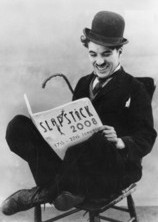
Slapstick 2008

http://www.slapstick.org.uk

We’re still awaiting full programming details for the Slapstick festival in Bristol, though we do at least have the dates – 17-20 January 2008. But meanwhile, tickets have just gone on sale for the festival’s gala event, a screening of Chaplin’s The Gold Rush, hosted by the ubiquitous Paul Merton, and the world premiere of Timothy Brock’s rescoring of Chaplin’s own score, played by the Emerald Ensemble. The evening also features a programme of comedy shorts, including Laurel and Hardy’s Leave ’em Laughing, with musical accompaniment from the no less ubiquitous Neil Brand “and international friends”, plus special guest Paul McGann. All this at Colston Hall, Bristol, on Friday 18 January, tickets £15, £12 conc., £5 for the under-twelves.

Live in Trafalgar Square

Silents in Trafalgar Square

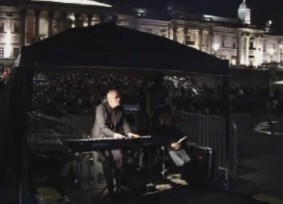
Frame still taken from BBC News video of Capital Tales in Trafalgar Square

Recently, as you’ll know, the London Film Festival hosted two screenings of silents in Trafalgar Square, with live music accompaniment. There’s a BBC video news report on the second screening, Capital Tales, which featured a pot pourri of London footage, much of it silent, with John Sweeney at the piano.

John Sweeney in Trafalgar Square

John Sweeney accompanying Capital Tales in Trafalgar Square, from http://www.bbc.co.uk

The report features short interviews with John, BFI programmer Robin Baker, and assorted members of the public. The general feedback from this event, and the screening of Blackmail the day before, has been very positive, and I think we can expect more screenings of silents in the London open air in the future. I’m entirely in favour of this. Take the films to the people. Let’s have people stumbling upon archive films in unexpected places. Let’s bring the past into the present. Archives should be everywhere.

It’s that man again

There’s an ever so slightly patronising interview with Neil Brand, silent film pianist, from the BBC Today programme, which was broadcast on Thursday 25 October, which can be found on the Today programme site – go to the section 08.00-08.30, and the bit with Neil is at 08.20. You do hear plenty of Neil’s playing while he is being interviewed, which makes for an intriguing news piece. The film he talks about most is The Life Story of David Lloyd George (cue sniggers from the Today interviewer), which is featuring at the Fflics festival in Aberystwyth tomorrow night, with Neil playing.

He Who Gets Slapped

He Who Gets Slapped

Lon Chaney in He Who Gets Slapped, from http://www.bbc.co.uk/news

The Victor Sjöström-Lon Chaney classic He Who Gets Slapped is due to get the modern-score-from-rock-musician-seeking-new-challenges treatment, as BBC News Online reports:

Goldfrapp star writes film score

Goldfrapp keyboardist Will Gregory is joining the BBC Concert Orchestra for the premiere of his new score to silent film classic He Who Gets Slapped.

Portishead’s Adrian Utley will also take part in the performances, in Bristol and London in December.

The 1924 film was the first to be made by MGM and stars Lon Chaney – who also appeared as The Phantom of the Opera – as a clown who gets 200 slaps a day.

Gregory said the film was an “overlooked masterpiece”.

‘Presence and charisma’

Chaney, who was one of the biggest film stars of the day, regarded his role in the film as his best.

“Whenever he is on screen he exudes such presence and charisma that it is easy to see why he was the most celebrated screen actor of his day,” Gregory added.

Chaney, who also starred as The Hunchback of Notre Dame, died in 1930, after making his only “talkie”, The Unholy Three. He was played by James Cagney in a 1957 biopic, Man of a Thousand Faces.

Jazz saxophonist Andy Sheppard and drummer Tony Orrell will also perform, while the BBC Concert Orchestra will be conducted by Charles Hazelwood at the shows, at Colston Hall in Bristol and London’s Queen Elizabeth Hall on 1 and 3 December.

There are further details on the Colston Hall and South Bank Centre sites. Silent films are the new rock’n’roll, you know.

The protean Neil Brand

Neil Brand

http://www.neilbrand.com

Those passing through central London early this evening would have heard the unexpected tones of a piano being played in the middle of Trafalgar Square. There, in the chill October air, beneath Nelson’s Column was a huge screen, and beside it beneath a canopy, elegantly accoutred in black tie and pounding said piano for all he was worth, the one and only Neil Brand. He was accompanying screenings of Blue Bottles (1928), a comedy made by Ivor Montagu, starring Elsa Lanchester, and based on an idea by H.G. Wells (allegedly he wrote just the single line: “Elsa blows a whistle”, and the rest of the action just followed), and the silent version of Hitchcock’s Blackmail (1929). Crowds sat on the steps, stood beside the fountains, stopped by on their way home to look this curiousness, or just walked on by, oblivious or bewildered. It was a rather magical experience.

Neil was on top form, naturally, and Neil watchers should be aware that he is going to be seen or heard in the next few days displaying his talents as musician, writer and actor. His tour with Paul Merton for their Silent Clowns show is taking silent comedy films around the UK, from 10 November to 9 December. In a few weeks’ time, his new radio play, Seeing it Through, on the covert First World War British propaganda outfit (whose outputs included film), Wellington House, will be broadcast on BBC Radio 3. More on that nearer the time. And tomorrow, he appears at the Canterbury Festival as Mark Twain, Rudyard Kipling, Kier Hardie, Edward Burne-Jones and several others in Queen Victoria’s Diamond Jubilee, a multi-faceted entertainment written and presented by yours truly.

Pordenone diary – day three

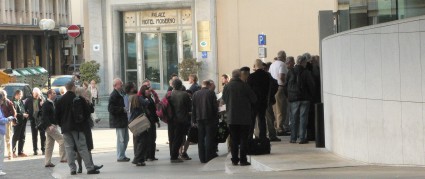
Queue outside the Verdi

Queue outside the Teatro Verdi

It was during the Pordenone festival that Peter Greenaway announced the death of cinema. He wasn’t at the festival himself, but rather in Korea at the Pusan International Film Festival, giving a masterclass, but his words went round the world, as words will these days. Now, the unfortunate demise of cinema is commonly reported – Pordenone stalwart Paolo Cherchi Usai has written a book on the subject – and still the corpse keeps dancing around on our many and various screens, but Greenaway had an interesting specific point to make:

Cinema’s death date was in 1983, when the remote control was introduced to the living room … Bill Viola is worth ten Martin Scorseses. Scorsese is old-fashioned and is making the same films that D.W. Griffith was making early last century … Every medium has to be redeveloped, otherwise we would still be looking at cave paintings … My desire to tell you stories is very strong but it’s difficult because I am looking for cinema that is non-narrative.

Well, aside from the irony that Scorcese wrote the foreword to Cherchi Usai’s book (which admittedly is on the preservation of cinema rather than the present and future reception of cinema), is he still making films like Griffith, and what have we been doing these past few years at Pordenone sitting through the entire works of Griffith, the arch-master of narrative cinema? And why aren’t the art works of Bill Viola on show at this silent film festival?

Pordenone serves both an academic-historical and a sentimental function. It displays the films of the first thirty years or so of cinema with full archival and scholarly rigour – intelligently selected titles presented as products of national, artistic or thematic output, with credits, sources, informative writing, all backed up with the best-available prints shown in the best-possible conditions. It also caters to the nostalgic, with conventional, albeit brilliantly played and usually improvised, music rich in themes from the early twentieth century, and an abiding fondness for the stars of that era. On day three (October 8th), for instance, we were treated to a visit from Jean Darling, one-time star of the ‘Our Gang’ shorts, and the day before we spoke on the phone to Hungarian actress and singer Márta Eggerth to thank her for the film of her that we had just seen. Some acknowledgment of modern silents is made at Pordenone, such as the ingenious pastiches of the Wisconsin Bioscope, but Bill Viola would look sadly out of place. This is a festival which looks back – to the roots of cinema, and to a lost past.

And, however scholarly, this is an audience that likes its stories. Non-fiction does begrudgingly receive its due at Pordenone, but many choose the opportunity of such screenings to visit the restaurants and cafés. Narrative cinema reigns supreme, and much of the academic enquiry seems in any case rooted in the ways in which silent cinema discovered how to tell a story. It’s a fundamental need. Martin Scorcese is still making films in the way D.W. Griffith made them, because the audience still wants to identify people, their personalities, their predicaments, and what happens to them under crisis. I suspect that he would be rather flattered by Peter Greenaway’s comparison of him with D.W. Griffith. But I also suspect that Greenaway would be dismayed by Pordenone’s faith in a cinema held in amber.

D.W. Griffith

D.W. Griffith

But enough of such speculation – what of the immediate reality of sitting through another Griffith turkey, One Exciting Night (1922)? Word went round that this unfamiliar title was even worse than Dream Street, and at 136 mins it was going to be a grim ordeal. The film is a murder mystery set in an old dark house – a theme that is all too familiar now, but was fresh then. Griffith had tried to secure the rights to The Bat, a hugely popular play about a mysterious house with money hidden in it and many suspicious characters after it. Unable to afford the rights, Griffith simply rewote the story himself (using the pseudonym Irene Sinclair). The plot concerns an inheritance, an orphan (Carol Dempster), bootleggers’ loot, and a host of characters in the obligatory multi-roomed house, one of whom is a murderer. Title cards warn us of the mysteries that are to follow and how we should not reveal the identity of the murderer to those who might want to see the film after us. However, the identity of the murderer is glaringly obvious from the start, the plot is incomprehensible, and the handling of it inept. Griffith simply could not apply the necessary techniques for the mystery genre, filming in a flat, obvious style, failing to bring any clarity to a complex, incoherent plot, and leaving the audience both bored and bewildered.

And yet, and yet… Three quarters of the way through the film changes. The plot becomes so incoherent, the rushing between rooms of the increasingly panicky characters so manic, that all narrative coherence disappears and a kind of insane magnificence takes over. It’s at this point that a hurricane is introduced into the proceedings. There’s nothing to announce it – it has just built up in the background, and suddenly the characters are all outside and at the mercy of the wild elements. The expensive hurricane sequence was added on as an afterthought (clearly hoping to recreate the excitement of the final scenes of Way Down East), and has been much criticised as an illogical irrelevance. But to me it seemed to have a mad logic to it, and the pianist John Sweeney (on top form throughout the festival) certainly responded with gusto. One Exciting Night is a bad film by any conventional standard, but the way in which it tries to hold up a narrative, gives up, then welcomes in chaos, might have found it some favour with Peter Greenaway after all. Even Carol Dempster is not that bad. What is dreadful is more eye-rolling blackface ‘comedy’ from Porter Strong, which critics at the time shamefully found among the film’s best features.

OK, so what else did we have on day three? More of Starewitch’s stop-motion animations, from his Russian period: Strekoza i Muravei (The Grasshopper and the Ant) (1911) and Veselye Stsenki iz Zhizni Zhivotnykh (Amusing Scenes from the Life of Insects) (1912); and from his French period: L’Épouvantail (1921) and Le Mariage de Babylas (1921). L’Épouvantail mixes live action (Starewitch himself as a yokel, plus his daughter Nina) with puppet animation in a very effective mixture of film trickery and slapstick, while Le Mariage de Babylas is a delightful tale of a spoiled wedding among a child’s toys, which shows Starewitch’s agreeable lack of sentimentality – he is the Roald Dahl of animators, showing meanness and mischievousness as well as wide-eyed wonder in his childhood tales.

Posta

The Teatro Verdi and the Posta café, Pordenone

The main place for conversations and future plans is the Posta café, immediately across the street from the Verdi, and here I spent some time discusing with others the ongoing Women and Film History International project, co-ordinated by Jane Gaines, which is investigating women film pioneers from the silent era worldwide, in an ambitious programme of investigation and publication. The aim is not only to bring some unfamiliar names to the fore, but to challenge received ideas about the creative filmmaking process. Hopefully some major screen retrospectives will follow as well, and that we keep up this process of continually reinvestigating film history.

Georges Melies

Georges Méliès, from http://www.victorian-cinema.net

I kept ducking out of the German feature films to engage in such chats, alas, but it just isn’t possible to see everything and stay sane. I ducked out of Jean Darling and the ‘Our Gang’ shorts for reasons of taste, but it was back to the Verdi for four newly discovered Georges Méliès titles. How wonderful it is that new Méliès titles keep turning up, and that Pordenone always makes a special presentation of them. This year, the Filmoteca de Catalunya delighted us with Évocation Spirite (1899), La Pyramide de Triboulet (1899), L’Artiste et le Mannequin (1900) and especially Éruption Volcanique à la Martinique (1902), a spectactular recreation of the eruption of Mount Pelée and the destruction of St Pierre on 8 May 1902 with vivid hand-coloured explosions. It’s high time we had an up-to-date list of extant Georges Méliès films published.

I saw about fifteen minutes of the Soviet-Armenian comedy feature Shor I Shorshor (1926). Fascinating as its peasant comedy might have been, and intriguing as it was that such a picture of ‘backward’ rural lifestyles should be issued by a Soviet studio, I do object to being made witness to a comic routine which involved a live chicken being pulled apart by our two heroes. Animals overall had a hard time of it at the Giornate. I walked out.

The day for me was rounded off in happy style by René Clair’s Paris Qui Dort (1923-25), which I’d not seen before. It’s an odd film really – Paris is frozen by a mysterious ray, and only a few characters who were in a plane plus a man who lives at the top of the Eiffel Tower remain active because they were above the ray when it shot out. There is ample opportunity for satire, when the comic group discover that normal social rules no longer apply, but little is done with the concept. Instead it is the lightness of spirit which carries the film. It was surprising however to see such clunking continuity errors – several people could be seen walking around in the supposedly sleep-bound streets of Paris. Lastly we had a generally very funny Louis Feuillade comedy, Séraphin ou les Jambes Nués (1921), starring Georges Biscot. We cannot now of course make films about the social embarassment caused by someone losing his trousers, for today no one would blink an eye at Séraphin’s dilemma. Happily, we can still laugh at such films, because we understand the time and place. Imaginative sympathy – that’s what Pordenone audiences do best.

Pordenone diary – day two

You could always go to the Pordenone Silent Film Festival, not see any films at all, and still have a marvellous and rewarding time. Some, it would appear, do just that. The weather is gorgeous, the restaurants inviting, every street is strewn with the chairs of pavement cafés, and much negotiating over the higher and lower politics of film archives goes on. It is the place where alliances are made, projects are hatched, and deals are done.

The Bioscope, however, rose with the lark (should they have such in Italy) on day two and headed for the Verdi. At Pordenone, screenings start at 9.00am in the main cinema and run til around 1.00pm, then resume 2.30pm, stop again around 6.00pm, then after supper it’s back for the final long haul from 8.30pm to midnight or so. There’s a second, smaller theatre, used for repeat showings and video screenings, the Ridotto. Had you seen everything at the Verdi on the Sunday, you would have seen seventeen titles. Many come with intertitles other than English, so earphone translation is provided. I have a stubborn belief that if a film is well-made enough, not knowing the language of the titles is not a problem – the pictures alone will suffice. This doesn’t entirely work, but I shunned the headphones, and just about got by.

First up was a selection of American shorts on social interest themes from the forthcoming Treasures from the American Film Archives III DVD. Regrettably, I missed The Black Hand (1906), the first Mafia-themed film and The Cost of Carelessness (1913), an educational film with a scene of children watching an educational film (OK, not everyone’s idea of a thrill, but I’d have been intrigued to see it). So, we kicked off with The Hazards of Helen: Episode 13 – The Escape on the Fast Frieght (1915). Not an obvious choice for a selection of films on social themes, but it was argued that Helen’s (Helen Holmes) position as a railroad telegraph operator assumed by her co-workers to be too feeble to do anything made an interesting social comment on the many women office workers of the time. Because, of course, Helen heroically fought villains across the top of the carriages of a speeding train, before returning to her job where no one was any the wiser about her. It’s not always realised that many of the early serials were not cliff-hangers, but rounded off the story neatly at the end of each episode, before resuming much the same narrative with the succeeding episode. Bud’s Recruit (1918) was a two-reel recruiting drama, where a group of neighbourhood kids form themselves into a ramshackle troop, led by all-American Bud, but it is his effete, bespectacled elder brother who by accident ends up joining the army – and of course discovering that it has made him into a true man. So a bit resistible in theme, but well-made – the director was King Vidor. Lastly in this set there was Labor’s Reward (1925), the one surviving reel of five from a dramatised history of unionism produced by the American Federation of Labor. It put particular emphasis on the exploitation of women workers, and begged audiences to buy only from shops which advertised union-made products. Quite fascinating, and a highly-polished production too.

The Cameraman's Revenge

The Cameraman’s Revenge, from Wikipedia

Pause for breath, then down go the lights for the first of the Ladislaw Starewitch strand. The reason for this seemes to have been a fine touring exhibition of artefacts and photographs of Starewitch’s work which was on display, but the films themselves were a mish-mash of old restorations. We saw Mest’ Kinematograficheskogo Operatora (The Cameraman’s Revenge) (1911), Prekrasaia Lukanida (The Beautiful Lucanid) (1910) and Rozhdestvo Obitatelei (The Insects’ Christmas) (1911), all products of Starewitch’s mindboggling idea to make stop-frame animation films using models of grasshoppers, stag beetles and such like. The Insects’ Christmas was a special delight, Santa Claus climbing down off a Christmas Tree to wake some insects out of hibernation and to treat them to their own festivities.

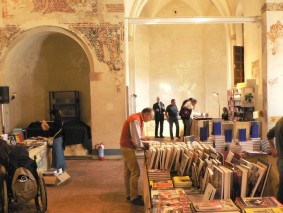
Pordenone Film Fair

Pordenone Film Fair

I missed the German film Rivalen (1923) as I had to go to my own crucial pavement café negotiation (the fruits of which you’ll have to wait until January 2009 to see), then to the Pordenone book fair, a fascinating mix of sturdy academic volumes on improbable themes in a multiplicity of languages, and posters, photographs and tattered memorablia for the cinema of the childhood of many of the older festival goers – but such is Pordenone.

The afternoon kicked off with Entr’acte (1924), first off in the René Clair retrospective, with musical accompaniment of Erik Satie’s score by two pianists, Barbara Rizzi and Antonio Nimis. What more is there to say about one of the great jeu d’esprit of avant garde cinema, originally a filmed interlude shown between the two acts of the Dadaist Francis Picabia’s notorious ballet Relâche? The central action is a funeral procession, with the mourners initially lollopping along behind in mock-serious manner, before having to speed up to a manic rush as the hearse (pulled by a camel, naturally) gets faster and faster. A promo-reel for the festival was projected on the outside of the Verdi at night, which included this magical sequence, like so:
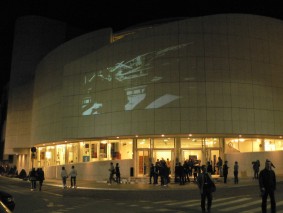
Teatro Verdi at night

Teatro Verdi at night, showing promotional video with scene from L’Entr’acte

Another strand was The Other Weimar. This initially puzzling title introduced the German cinema of the 1920s that we seldom see. Thanks to the studies of Kracauer and Eisner, much of the studies of German cinema at this time has focussed on Expressionism and the fevered productions whose themes seemed to anticipate the nightmares of Nazism. This strand showed the work of the directors who did not get round to making Caligari or Metropolis – those who tended to make the films that people actually went to see.

Wege Zu Kraft und Schönheit (The Way to Strength and Beauty) (1924-25) was a surprise inclusion, being a health, dance and sports documentary, albeit a popular one at the time – probably on account of its liberal displays of nudity. It was an example of the Ufa studio’s documentaries, or Kulturfilme, and most entertainingly had the festival-goers squirming in their seats as its theme of the need for us to get up off our backsides and start walking seemed all too relevant. Though it was a bit long and repetitive, it was made with mocking wit and some style, with plenty to fascinate fans of dance (including Mary Wigman and Tamara Karsavina) and sport (Babe Ruth, Helen Wills, Charley Paddock). And the keen-eyed would have spotted Leni Riefenstahl in her first film, no doubt picking up ideas for Olympia twelve years away, as a maid in a Roman bath sequence.

I cannot now remember what crucial meeting it can have been that led me to miss Fatty Arbuckle in The Cook (1918) and Max Davidson in the immortal Pass the Gravy (1928), but I hope it was really important.

In the evening, Jean Vigo’s A Propos de Nice (1930). We had been promised Michael Nyman playing his own piano score, but he was unwell, and was replaced by one of the Pordenone regulars, John Sweeney – who was magnificent. The films at Pordenone are accompanied by a small team of pianists, generally hidden from view beneath the stage, with a monitor showing them the action and headphones translating the titles. This year we had Neil Brand, Gabriel Thibaudeau, Günther Buchwald, John Sweeney, Stephen Horne, Donald Sosin, Phil Carli and Antonio Coppola. High praise to them all. A Propos de Nice is surprisingly amateurish in places (they didn’t know much about focus), but its cumulative vision of the human madness on display in Nice confirmed its greatness.

To mark the fiftieth anniversary of the Hungarian Film Archive, the evening’s feature film was Csak Egy Kislány Van a Világon (Only One Girl in the World) (1930), the first Hungarian sound film, though most of it was silent with sonorised score. This was the tale of two war veterans who love the same woman. She falls for the livelier, he falls for another woman when he travels to the city, his friend brings them together again, culminating in a sentimental rendition of the title song. It was a simple yet curiously appealing piece with the quality of a folk tale and a structure in movements that seemed to cry out for its expression as a nineteenth-century symphony. The heroine was played by the 18-year-old Márta Eggerth, now aged ninety-five, who remakably was not able to be at the screening because she is still working (as a teacher of singing). But David Robinson, the festival director, called her on the phone afterwards, and we were treated to the extraordinary experience of listening to this lively woman who sounded as spirited and lively as she had been in 1930, while she experienced the oddness of having her telephone conversation warmly applauded by an invisible audience.

And so to bed.
Indiana University Sheet Music Collections

Take Your Girlie to the Movies

Sheet music for Take Your Girlie to the Movies, from http://www.letrs.indiana.edu

Indiana University is a specialist provider of digitisation services and digitised resources, among which is Indiana University Sheet Music Collections. This is a database of some 150,000 examples of sheet music in their collection, immaculately presented with sound cataloguing detail and many of the records having digitised cover images and sheet music. There is a simple and advanced search option, and searching on titles and using the option to choose digitised images only brings up records associated with going to the movies from the silent era.

The rise of cinema-going in the 1910s and 1920s was also the great era of recorded popular song, and many tunes were composed which celebrated the stars or were title songs designed to promote particular films. Among those to look out for on the site which have covers and music score available are:

Mary Pickford: The darling of them all (1914) – composers/lyricists: Richard A. Whiting, Dave Radford, Daisy Sullivan.

Poor Pauline (1914) – composer: Raymond W. Walker, lyricist: Charles R. McCarron, a ditty celebrating Pearl White and the Perils of Pauline serial.

Kathleen Mavourneen (1919) – composer: Albert Von Tilzer, lyricist: Will A. Heelan – written to accompany the Theda Bara picture of that name.

Mickey (1919) – composer: Neil Moret, lyricist: Harry Williams, written to promote the Mabel Normand picture.

Smilin’ Through (1920) – music/lyrics by Arthur Penn – written to accompany the Norma Talmadge film.

And the near-legendary Take your girlie to the movies (If you can’t make love at home) (1919) – composer: Pete Wendling, lyricists: Edgar Leslie and Bert Kalmar.

“Take your girlie to the movies,
If you can’t make love at home.
There’s no little brother there who always squeals,
You can say an awful lot in seven reels!

Take your lessons at the movies,
And have love scenes of your own!
When the picture’s over and it’s time to leave,
Don’t forget to brush the powder off your sleeve!”

etc etc

At the Moving Picture Ball

Finally, there’s At the Moving Picture Ball (1920) – composer: Joseph H. Santly, lyricist: Howard Johnson. There’s an MP3 file of this sung by Maurice Burkhardt on Project Gutenberg and the Internet Archive that’s free to download, and here are the name-dropping lyrics should you wish to sing along:

Reel 1
Hip hooray I feel delighted, yesterday I was invited
To a swell affair, all the movie stars were there
Oh what fun, the party lasted till the break of dawn
Famous players turned to cabareters, how they fooled and carried on.

Chorus:
Dancing at the Moving Picture Ball, some scenario
Great big stars paraded ’round the hall, they were merry oh,
Handsome Wallace Reid stepped out full of speed,
And Theda Bara was a terror, she “vamped the little lady”, so did Alice Brady,
Douglas Fairbanks shimmied on one hand, like an acrobat
Mary Pickford did a toe dance grand, and
Charlie Chaplin with his feet
Stepped all over poor Blanche Sweet
Dancing at that Moving Picture Ball.

Reel 2
Ev’ry girl a handsome looker, had a dance with Mr Zukor
Mr Thomas Ince stepped around just like a prince
William Fox and Jesse Lasky both joined in the fun
Big directors mingled with the actors, why the whole bunch seemed like one.

Chorus:
Dancing at the Moving Picture Ball, some scenario
Great big stars paraded ’round the hall, they were merry oh,
Handsome Wallace Reid stepped out full of speed,
And Theda Bara was a terror, she “vamped the little lady”, so did Alice Brady,
Douglas Fairbanks shimmied on one hand, like an acrobat
Mary Pickford did a toe dance grand, and
Sennett’s bathing girls were there, each one was a little ‘bear’
Dancing at that Moving Picture Ball.

Love that rhyming of looker with Zukor…

Peter Pan and the fairy harp

null

Elizabeth-Jane Baldry, from http://www.stgeorgesbristol.co.uk

If you were puzzled by the mention in a recent post of the screening of Peter Pan (1924) as part of the Barbican Silent season being accompanied by the fairy harp, be puzzled no more. There is a short piece on the Music from the Movies site, which introduces up to Elizabeth-Jane Baldry, who plays the instrument:

The fascination with recreating music for silent film goes ever on; Carl Davis is perhaps the best known composer doing this in the UK today, while Michael Nyman has of course dabbled with projects like his re-scoring of Dziga Vertov’s Man With a Movie Camera. The Pet Shop Boys famously applied their musical stylings to Sergei Eisenstein’s legendary Battleship Potemkin a couple of years ago and, as we reported last week, John Scott has written new music for the 1922 film Robin Hood.

Peter Pan is another such character that was of course given ‘the silent treatment’ and the 1924 Hollywood film directed by Herbert Brenon is probably the first celluloid outing for the pesky Neverlander. While the film was given a new score by composer Philip Carli in 1999, the film will receive an interesting musical accompaniment in Bristol in November. Playing live to the film at the City’s delightful ‘St. George’s Bristol’ concert venue, ‘Fairy Harpist’ Elizabeth-Jane Baldry will improvise a score on the Harp. Baldry, whose performances have appeared in numerous stage and screen guises, is well known for her exploration of what has become known as ‘Victorian Fairy Harp Music’ and applies those enchanting refrains to Peter Pan, a fitting accompaniment indeed!

You can find out more about the Victorian fairy harp – indeed hear sound samples, from Baldry’s personal site, www.fairyharp.com. She accompanies Peter Pan at St George’s Bristol on 25 November, and at the Barbican in London on 16 December.