Screen Heritage is becoming a key phrase in the discussion about the preservation, dissemination and understanding of moving image history, particularly in the UK. The British Film Institute has announced a Strategy for UK Screen Heritage, with a strategy document published and an invitation for comments (deadline 7 September). This is focussed on the future maintenance and growth of public sector moving image archives. Secondly, a group of museums and archives, headed by the National Media Museum, has formed a Screen Heritage Network, with funding from the Museums Libraries and Archives Council, and an understanding of ‘screen heritage’ which extends beyond moving images to artefacts, documents etc. And MeCCSA (the Media, Cultural Studies and Communications Association) has announced a seminar on screen heritage, taking place on 22 September 2007 at Roehampton University, which aims to bring a focus to the many discussions on-going about the long-term future of the UK’s moving image and screen heritage. There’s a lot going on, and Bioscope readers may be interested to participate or to follow the arguments.
Category Archives: General
Questions, questions, questions
I’ve turned the Questions section of this site into an FAQs (frequently asked questions). You can still post questions at the bottom of the page, but I’ve now added a range of general questions on silent film and using the Bioscope, which I’ll add to (and correct) as needed. Hope it’s useful.
The Silent Treatment
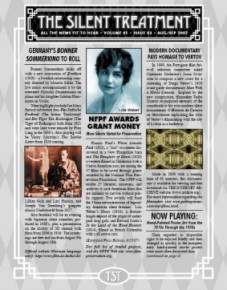
The Silent Treatment is an online newsletter isued in PDF format with news on silent cinema. Vol. 1 issue 3 is out now, for the August/September period, and includes news on screenings, festivals and discoveries, as well as reviews and other small items. Some stories you’ll have read in The Bioscope, many others are new, and each helpfully has its source cited. There’s no website for the four-page newsletter, which is a two-person operation, though one is planned. If you are interested in subscribing (it’s free), e-mail the editors at: tstnews – at – yahoo.com.
Update (March 2008):
There is now a website for The Silent Treatment, though to obtain the PDFs you still have to email them to join the subscription list.
Times past
There are several large-scale digitisation progammes going on world wide which are starting to make substantial numbers of historic newspapers available online, a God-send for anyone engaged in research into early film. Some are freely available, some restricted to universities, some are commercial operations. There are various ways of getting at all of them, and in any case one shouldn’t shy away from paying a little for access to such treasures, given the huge efforts made to digitise them (something I know a little about).
This survey covers some of the major historic newspaper resources available. For each, I’ve tested them out with the word ‘Kinetoscope’ (i.e. Thomas Edison’s peepshow viewer which first exhiited motion picture films to the public, and which was most commercially active in the 1894-1896 period, but carried on as a common term for a few years after that).
Chronicling America
The Library of Congress is co-ordinating a huge newspaper digitisation programme, entitled Chronicling America. The project is sponsored jointly by the National Endowment for the Humanities and the Library of Congress as part of the National Digital Newspaper Program. So far it has digitised selected newspapers for the period 1900-1910, covering California, District of Columbia, Florida, Kentucky, New York, Utah, and Virginia. That’s thirty-six newspapers, including such key titles as The San Francisco Call, The New York Sun, The Washington Times, The Colored American, and The New York Evening Times.

Searching across all papers and all dates for the word ‘kinetoscope’ got me 71 hits. Clicking on a result gives me a picture of the full page, then options to view the OCR text (i.e. text derived throgh scanning using Optical Character Recognition, which may bring up some small errors), PDF, or I can download the image as a jp2 file. The term I searched for is highlighted on the image, and I can zoom in or out. Each hits gives you the title of the newspaper, the date of the issue, and the page number. On a quick survey of the texts, I saw the Kinetoscope was being commonly used as a generic term for motion pictures, rather than the Edison machine specifically.
Chronicling America is free to all, easy to use, and is certain to grow as the phased digitisation programme develops. The site has background information, including technical details for those entranced by TIFFs and JPEGs.
Times Digital Archive
Probably the most outstanding of the newspaper digitisation programmes, and the one that has had a great impact on research across any number of disciplines, is the Times Digital Archive. This is a commercial operation, managed by Thomson Gale. It offers every page from the London Times 1785-1985. It is possible to search for a term or phrase across all dates, a specific date or a date range, and across all types of section, or restricted to Advertising, Business, Editorial and Commentary, Featurees, News, People and Picture Gallery – this is a very useful feature for narrowing down searches.
Searching on ‘kinetoscope’ across all fields got me 60 hits. As it covers the 1890s period, the rsults were excellent, tracing the Kinetoscope’s appearance in London, from a first mention on 8 March 1894 of Edison’s latest invention, to the surprise discovery that in 1897 there as a racehorse called Kinetoscope (not a very successful racehorse, it seems). Search results cite the date, page, issue number and page column of the relevant article, with the search term highlighted on the page. You can view the relevant article or page as PNG images, or view the page as PDF.

Such a wonderful resource comes at a price. It isn’t freely available, and instead it is made available to institutions in a variety of subscription packages. In the UK, most universities subscribe to it, under the Athens password system (which restricts online resources to UK academic users), but it can also be found in many public libraries. It is also available through subscribing international institutions as well.
Google News Archive
And then there’s the Google News Archive search. Naturally enough Google has provided us with a search engine which browses historic news resources, both free and subscription-based, so you are offered tantalising glimpses of news stories that can be yours if only you’ll pay. Typing in ‘kinetoscope’ yields 2,210 results. The results seem all over the place, but it is possible to narrow down the search by date or newspaper, as Google assesses which areas are likely to yield the most results from your broad search query. It can also arrange results in a handy ‘timeline’ fashion.

It’s worth noting that many of the subscription sites, such New York Times, give you at least the first few lines of the requested article. Speaking of the NYT, you can pay $4.95 to view a single page, $7.95 a month (up to 100 articles) or $49.95 per year (up to 1,200 articles). Find out more from its TimesSelect service.
The Google News Archive is a wonderful research tool, not least for showing the sheer range of digitised newspaper collections out there, and as a quick spot-check method of seeing when a subject was being discussed, in what way, and by whom. I certainly want to read more of the Los Angeles Times article of 31 March 1897 entitled ‘Kill the Kinetoscope and its Kindred’, with the tantalising opening lines, “The Senate Judiciary Committee did well in reporting favorably the bill to prohibit the exhibition of prize-fight pictures by means of the kinetoscope and kindred devices in the District of Columbia or the Territories of the…”
British Library Newspapers
The British Library maintains the national collection of newspapers (still housed in quaint conditions at Colindale in North London). It has had had for some while a test online historic newspaper service, using Olive Software, which offers some year-long slices from four sample papers: News of the World, Manchester Guardian, Daily News and The Weekly Dispatch, from which only the News of the World gives a Kinetoscope story – on the racehorse, in 1900.
But now the British Library is engaged on a massive British newspaper digitisation programme, with higher education funding money (the JISC Digitisation Programme). The first stage of this, recently completed, has digitised 2 million pages of 19th century newspapers. Stage two, just begun, will add a further 1.1 million pages from 1690-1900. The results, however, will be accessible to UK higher and further education users only.
The lessons to be learned are simply that, if you want serious access to knowledge, you need to pay or to be a student. The number of precious resources being made available only to universities is a problem for the outside researcher, though that’s where the money is coming from, and in many cases it’s the only way of getting round licensing restrictions.
What else is out there?
There are commercial sites, such as ProQuest, which is a world leader in providing access to digitised resources to institutions, including historic newspapers. Like a number of these services, it offers free trials – but only to institutions. The massive NewspaperARCHIVE.com welcomes individuals. It boasts over 68 million pages, and lets you know your search results for free, so Kinetoscope yielded a tantalising 2,923 hits. Annual membership starts at $8.95 per month.
But there are many smaller initiatives to look out for. A while back, I wrote a post on The Silent Worker, a newspaper for the deaf, which had many articles on the deaf and silent films. I found the information on that from the British Columbia Digital Library, which has a very useful listing of digitised newspaper collections around the world. And if you are frustrated at not being able to get hold of subscription-based collections, I recommend the Godfrey Memorial Library, an American library specialising in genealogy resources which for a very cheap annual subscription (from $35.00) offers access to a large number of newspaper libraries, including the Times Digital Archive.
There’s so much out there. If you know of other collections, or directories of information, do let me know.
Links
All of the links on the right-hand side of this site now come with brief descriptions when you hover your mouse over the link. I hope this will help people explore further the world of early and silent film. I’m always interested to hear of good websites and online research resources, if you know of any.
Early Popular Visual Culture

A bit of a plug for a journal with which I am involved. There are few scholarly journals out there which concern themselves with early film, which makes Early Popular Visual Culture all the more precious.
It was originally published in 2001 as Living Pictures: The Journal of the Popular and Projected Image before 1914. It reinvented itself as EPVC in 2005, with Routledge as publishers. It is dedicated to publishing research on all forms of popular visual culture before 1930. It takes as its particular brief to
… examine the use and exploitation of popular cultural forms such as (but not limited to) cinema, photography, magic lanterns and music hall within the fields of entertainment, education, science, advertising and the domestic environment; and is primarily concerned with the evolving social, technological and economic contexts which such popular cultural products inhabited and defined.
… which is spreading things as broadly as you could wish. So it’s not just silent movies, but akin popular projected forms, and the world they inhabited, which is demonstrated in the range of essays in the most recent issue (vol. 5 issue 1, April 2007):
- Joe Kember, ‘The Functions of Showmanship in Freak Show and Early Film’
- Paul Myron Hillier, ‘Men and Horses in Motion: Thomas Eakins and Motion Photography
- Gerry Turvey, ‘Ideological Contradictions: The Film Topicals of the British and Colonial Kinemaograph Company’
- John Hewitt, ‘Designing the Poster in England, 1890-1914’
- Eric Faden, ‘Movables, Movies, Mobility: Nineteenth-century Looking and Reading’
- plus an archive feature, introduced by Vanessa Toulmin, ‘Magic Ephemera’ and book reviews.
All that, and it looks great. Get your local library to take our a subscription today!
Slapstick

Things may be a little quieter from The Bioscope for the next few days, as I’ve broken a bone in my thumb, and typing has become rather slow process.
So, to mark my falling over and crashing into a glass-fronted picture, from which I have learned that pratfalls hurt in real life, here’s a short item on slapstick.
First of all, a slapstick was a jointed piece of wood used in harlequinades and minstrel acts to make a slapping noise. If you are in a UK educational institution or library, you can see one in use in an 1899 film of seaside entertainers E. Williams and his Merry Men at Rhyl, filmed by Arthur Cheetham and available from Screenonline.
For slapstick comedians themselves, start off with David B. Pearson’s excellent Silent-Movies.org site, which incorporates several web sites on silent comedy stars, one of which is Slapstick. This has MP4 movie files of Charlies Chaplin, Fatty Arbuckle, Buster Keaton, Harold Lloyd, Mabel Normand, Harry Langdon, and Max Linder. They are clips, not complete films, but they capture the artistry of falling with style perfectly.
Or look further at the individuals by visiting www.busterkeaton.com, Arbucklemania, Harold Lloyd, Madcap Mabel, The Harry Langdon Society or Chaplin.
On the latter, check out the Chapliniana web site, about the festival of all things Chaplin which is currently running in Bologna. The site looks great, but is only in Italian. Or check out the very helpful Charlie Chaplin UK DVD and Video Guide.
Or, if you are in the US, check out Kino range of slapstick DVDs including the encyclopedic Slaptick Symposium DVD collection – 1264 minutes of Oliver Hardy, Stan Laurel, Charley Chase and Harold Lloyd.
And, of course, between 19-22 July, at Arlington, Virginia, there’s the Slapsticon festival, with Laurel and Hardy, Harry Langdon, Harold Lloyd Larry Semon, Mabel Normand, Leon Errol, Ford Sterling, Fatty Arbuckle, Billy Bevan, Monty Banks, Max Davidson, Charley Chase, Lupino Lane, Ben Turpin, Wallace Beery…
And, thinking laterally about these things, here’s some recipes for making custard pie.
Why not read Simon Louvish’s, Keystone: The Life and Clowns of Mack Sennett, about the cinema’s prime producer of comic mayhem.
Finally, plenty of people visit this site loking for dates of Paul Merton’s Silent Clowns shows this autumn, and the main post on this is updated as I find new tour dates. Merton’s book, Silent Comedy, will be published in October.
Anyone spot the self-referential gag in the picture?
Stand up, Norma

Browsing through Project Gutenberg, I have found a great many short or incidental references to silent movies which might never otherwise be found by researchers.
An example is Roving East and Roving West, a 1921 collection of essays by E.V. Lucas. Edward Verrall Lucas (1868-1938) was an over-prolific essayist, with an easy style and a view on practically everything. He was an interested observer of the rise of motion pictures in the early years of the twentieth century, but by 1921, he had grown cynical at the numbing qualities of popular cinema and the medium’s failure (in his eyes) to live up to the promise of the documentary account of Cherry Kearton’s African films or Herbert Ponting’s Antarctic films. The simple response to Lucas would be that a cinema that only showed us visits to the jungle or the South Pole would soon lose its appeal, and he lapses too easily into criticising a mass audience for its simple pleasures. Nevertheless, the whole Norma Talmadge sequence can still make us squirm. The essay is called ‘The Movies’:
We have our cinema theatres in England in some abundance, but the cinema is not yet in the blood here as in America. In America picture-palaces are palaces indeed – with gold and marble, and mural decorations, built to seat thousands – and every newspaper has its cinema page, where the activities of the movie stars in their courses are chronicled every morning. Moreover, America is the home of the industry; and rightly so, for it has, I should say, been abundantly proved that Americans are the only people who really understand both cinema acting and cinema
production. Italy, France and England make a few pictures, but their efforts are half-hearted: not only because acting for the film is a new and separate art, but because atmospheric conditions are better in America than in Europe.It was in Chicago that I had my only opportunity of seeing cinema stars in the flesh. The rain falling, as it seems to do there with no more effort or fatigue to itself than in Manchester, I had, one afternoon, to change my outdoor plans and take refuge at the matinee of a musical comedy called “Sometime,” with Frank Tinney in the leading part. Tinney, I may say, during his engagement in London some years ago, became so great a favourite that one performer has been flourishing on an imitation of him ever since. The play had been in progress only for few minutes when Frank, in his capacity as a theatre doorkeeper, presented by his manager with a tip. A dialogue, which to the trained ear was obviously more or less an improvisation, then followed:
Manager: “What will you do with that dollar, Frank?”
Frank: “I shall go to the movies. I always go to the movies when there’s a Norma Talmadge picture. Ask me why I always go to the movies when there’s a Norma Talmadge picture.”
Manager: “Why do you always go to the movies when there’s a Norma Talmadge picture, Frank?”
Frank: “I go because, I go because she’s my favourite actress. (Applause.) Ask me why Norma Talmadge is my favourite actress.”
Manager: “Why is Norma Talmadge your favourite actress, Frank?”
Frank: “Norma Talmadge is my favourite actress because she is always saving her honour. I’ve seen her saving it seventeen times. (To the audience) You like Norma Talmadge, don’t you?” (Applause from the audience.)
Frank: “Then wouldn’t you like to see her as she really is? (To a lady sitting with friends in a box.) Stand up, Norma, and let the audience see you.”
Here a slim lady with a tense, eager, pale face and a mass of hair stood up and bowed. Immense enthusiasm.
Frank: “That’s Norma Talmadge. You do like saving your honour, don’t you, Norma? And now (to the audience) wouldn’t you like to see Norma’s little sister, Constance? (More applause.) Stand up, Constance, and let the audience see you.”
Here another slim lady bowed her acknowledgments and the play was permitted to proceed.
What America is going to do with the cinema remains to be seen, but I, for one, deplore the modern tendency of novelists to be lured by American money to write for it. If the cinema wants stories from novelists let it take them from the printed books. One has but to reflect upon what might have happened had the cinema been invented a hundred years ago, to realise my disturbance of mind. With Mr. Lasky’s millions to tempt them Dickens would have written “David Copperfield” and Thackeray “Vanity Fair,” not for their publishers and as an endowment to millions of grateful readers in perpetuity, but as plots for the immediate necessity of the film, with a transitory life of a few months in dark rooms. Of what new “David Copperfields” and “Vanity Fairs” the cinema is to rob us we shall not know; but I hold that the novelist who can write a living book is a traitor to his art and conscience if he prefers the easy money of the film. Readers are to be considered before the frequenters of Picture Palaces. His privilege is to beguile and amuse and refresh through the ages: not to snatch momentary triumphs and disappear.
The evidence of the moment is more on the side of the pessimist than the optimist. I found in America no trace of interest in such valuable records as the Kearton pictures of African jungle life or the Ponting records of the Arctic [sic] Zone. For the moment the whole energy of the
gigantic cinema industry seemed to be directed towards the filming human stories and the completest beguilement, without the faintest infusion of instruction or idealism, of the many-headed mob. In short, to provide “dope.” Whether so much “dope” is desirable, is the question to be answered. That poor human nature needs a certain amount, is beyond doubt. But so much? And do we all need it, or at any rate deserve it? is another question. Sometimes indeed I wonder whether those of us who have our full share of senses ought to go to the cinema at all. It may be that its true purpose is to be the dramatist of the deaf.
What great novels were lost because writers were lured by the easy money of Hollywood? What a ridiculous accusation. Why not ask what great films were made because bright minds were put to working on the medium made for the times, sparing readers from sub-Dickensian epic novels. The movies have given us much to be thankful for.
Remaking The Lodger
It just been announced that a remake of Alfred Hitchcock’s 1927 classic silent The Lodger is planned. Alas, it’s not been remade as a silent, nor is it being set in a fog-bound London. This time round, director David Ondaatje is setting the film in modern-day Los Angeles, and making The Avenger (originally played by Ivor Novello) a copycat killer (originally Jack the Ripper, maybe). Oh well.
More information from The Guardian.
Any questions?

I’ve added a new section to The Bioscope, and taken one away. The deleted section is Publications, which was done in a hurry and never updated. One day it will return, in a hopefully far better form.
The new section is Questions. If you have any questions on early and silent cinema, particularly if you have a research interest in some aspect of silent film, and it isn’t being covered by regular posts, do use the comment box on the Questions page (unfortunately it isn’t possible to set up a proper enquiries form within a WordPress blog). I’ll answer what I can, or find someone who can (such as one my co-contributors), and post the results where appropriate. If you’d rather contact me privately, then of course you can (contact details on the About page).
 The Bioscope