Got £90,000 spare? Charlie Chaplin’s Bell & Howell camera is being auctioned by Christies in London on 25 July, and is expected to fetch a price between £70,000 and £90,000. The silent Bell & Howell 2709 model camera was bought by Chaplin in 1918. It was used by Chaplin throughout the 1920s (The Kid, The Gold Rush, The Circus etc) and into the 1903s for City Lights and Modern Times. It continued in use up to the 1950s for animation work and shooting titles. It’s part of a motion picture equipment sale, and will be on view at Christies’ showrooms from 21 July.
Category Archives: Filmmakers
Land and Kinemacolor

As reported earlier, I’ve been reading Simon Ing’s The Eye: A Natural History, which is not only an exceptional, highly-readable account of the mysteries and mechanics of eyesight, but incidentally has information of use to us in the study of early film. I’ve already covered his demolition of the persistence of vision fallacy. A later chapter covers how we see colour.
Silent cinema was filled with colour. From the earliest years selected films were hand-painted, a process that was then mechanised by a system of stencils (and massed ranks of women operatives) by the Pathé and Gaumont companies. Later films were subtly tinted and toned throughout, with colours used to denote emotions as well as settings. Restorations of sophisticated colour effects in silent films are the pride and joy of film archives. There is an excellent essay by Tom Gunning, ‘Colorful Metaphors: The Attraction of Color in Early Silent Cinema’ which places early, artificial colour within the broader context of colour reproduction across other media.
However, there was also ‘natural’ colour in the silent era. The 1920s saw systems such as Prizmacolor and two-colour Technicolor in use for a handful of films, but the first of them, and the colour system with the most romantic history, was Kinemacolor. You can read all about the history of Kinemacolor, which was invented in 1906 and first exhibited in 1908, on my Charles Urban website, Urban being the entrepreneur behind Kinemacolor.
The relevance of Ings’ book here is his account of the work of Edwin H. Land. Land was an American scientist and inventor, best known for having given us the Polaroid camera. In 1959, Land devised an experiment which challenged previous theories of colour vision. This is how Ings describes the initial discovery:
On evening, at the end of a long series of experiments with three projectors [they were experimenting with red, green and blue light], Land and his assistants shut off their blue projector and took the green filter out of the green projector. Then, one of Land’s assistants, Meroe Morse, called their attention to the screen. The red projector was still running, projecting the red record on the screen in red light, and the unfiltered green projector was projecting the green record with white light. That combination of red and white lights should, in Morse’s mind, produce something pinkish. But there was the original image, its every colour still identifiable. How could red and white lights throw blues and greens on the screen?
Answer – because in colour vision, context is everything. The eye perceives colours in relation to other colours, and even though Land and his team ‘removed’ colour filters in assorted combinations, they could still generate a full colour, projected image. The eye filled in the gaps.
This property of vision, however, had been discovered and exploited fifty years earlier by Charles Urban and G.A. Smith, the inventor of Kinemacolor. Kinemacolor (patented 1906) used rotating red and green filters on both camera and projector, with panchromatic black-and-white film being used at double the conventional speed (i.e. around 32 frames per second). The result, despite some colour fringing inevitable given the separation of the red and green records, produced a record that was remarkably close to full colour. Red and green in combination covered a fair bit of the spectrum, and the eye did its best to fill in the rest. Hence eye-witnesses reported seeing blues which, according to pure Newtonian colour theory, could not be there. Ironically, Kinemacolor eventually failed as business after a 1913 court case in which its patent was ruled invalid because it claimed to show all the natural colours, but could not reproduce blue.
Today, few Kinemacolor films survive, and we can in any case only judge (or be fooled by) the colour effect if a true Kinemacolor film is projected using correct equipment. However, it is possible to approximate the effect photo-chemically or electronically, as in these frames from the surviving fragment of the famous Delhi Durbar film of 1912 (‘red’ record, ‘green’ record and composite effect):

Land knew nothing of Kinemacolor, and Ings makes no mention of it, which is a shame, because its history has much to tell us about perception, the socio-psychological construction of colour, and the wider understanding of the phenomenon of moving pictures.
If you are interested in knowing more about the history of Kinemacolor, why not download the chapter from my thesis on Urban which covers Kinemacolor, available from my personal website.
Find out more about Land’s experiments from Chris Taylor’s site, which plays with generating colour images using just red and white.
If you are heavily into optics and want to know more about Land’s work, see Gerald Huth’s Rethinking the Vision Process blog.
And, if you are in a UK university, college, school or public library, you can see sample Kinemacolor films from the BFI’s Screenonline site, together with other examples of Charles Urban’s remarkable film career.
William Haggar – Fairground Film-maker

Tomorrow sees the publication of William Haggar: Fairground Film-maker (Accent Press), by Peter Yorke. Yorke is the great-grandson of William Haggar, fairground entertainment and pioneer of Welsh cinema, whose energetic dramas such as A Desperate Poaching Affray (1903) and The Life of Charles Peace (1905) were hugely popular in their time and are treasured by early film historians now. Yorke’s biography draws on oral reminiscences, unpublished family memoirs and contemporary press reports to tell the rags-to-riches story of a travelling theatrical who became one of Britain’s select band of pioneer film-makers. The Bioscope understands that the mispelling of Haggar’s name on the book cover being publicised on Amazon has been corrected since…
Chapliniana
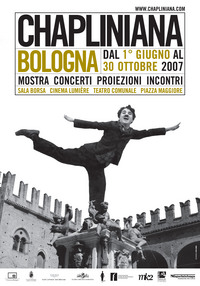
The Cineteca di Bologna in Italy is hosting Chapliniana between 1 June and 30 October 2007. This major celebration of Chaplin’s life and work will comprise an exhibition, Chaplin e l’Immagine (Chaplin in Pictures), at the Sala Borsa, Bologna; live orchestral screenings of The Chaplin Revue, City Lights, The Kid, Modern Times, The Gold Rush, The Circus and A Woman of Paris to be performed in Piazza Maggiore and the Teatro Communale during the summer evenings; and the majority of Chaplin’s films will be screened during this period, particularly during the Cinema Ritrovato film festival June 30-7 July 2007. The Cineteca is also working on the Chaplin Archive Database, which is logging the cataloguing, digitisation and preservation of the huge Charlie Chaplin paper archive.
There’s a Chapliniana site registered but nothing is on it as yet. 2007 is the thirtieth anniversary of Chaplin’s death, and a major revival of interest in his work and socio-cultural significance seems to be underway.
Update: The Chapliniana site is now active, and full of details, all of it in Italian.
Ways to Strength and Beauty
A new biography of Leni Riefenstahl by Steven Bach – Leni: The Life and Work of Leni Riefenstahl – contains the remarkable discovery that she made her film debut in the once celebrated 1925 German sports documentary Ways to Strength and Beauty (Wege Zu Kraft und Schönheit). This proto-Nazi film, a celebration of physical culture interlaced with scenes of classical humbug was highly popular in its day, probably on account of its several scenes of nudity. The film, directed by Wilhelm Prager, has long been seen as a pecursor of Riefenstahl’s Olympia (her brilliant film of the 1936 Olympic Games) but it was not known (or at least not proven) that she appeared in Prager’s film, in various cod-classical scenes. It can’t be entirely unknown, since Riefenstahl is credited on the IMDB entry for the film, but I think it is the first time solid evidence (a credited photograph) has been found to support the rumour.
Il Cinema Ritrovato
Il Cinema Ritrovato is held every June/July at the Cinemateca Bologna, Italy, and is one of the world’s major festivals of film restoration. It always has a major silent film component. Details of this year’s festival, which takes place Saturday 30 June-Saturday 7 July, have just been published. Those to be featured include Charlie Chaplin (subject of a major Bologna retrospective and exhibition); Asta Nielsen; films from 1907; the American silents and early sound films of Michael Curtiz; and some major silent restorations from Lubitsch (Als Ich Tot War, 1916), Von Stroheim (Austria’s restoration of Blind Husbands, 1919), De Mille (Dynamite, 1929), Stiller (Madame de Thèbes, 1915); and from Germany, Schatten der Weltstadt (Willi Wolff, 1925); a Polish find, A Strong Man (Henryk Szaro, 1929); and what the festival is calling its most amazing discovery of all, a Swedish film called The Spring of Life (Paul Garbagni, 1912), with Sjöström, Stiller, and af Klercker as actors. From Italy they will have L’Odissea (Bertolini-Padovan, 1911), Maciste imperatore (Guido Brignone, 1924), and the beginning of the Ghione Project.
The festival will also cover CinemaScope, melodrama of the 1940s/50s, Raffaello Matarazzo, and Sacha Guitry. More details from the Ritrovato site.
Moving Pictures

Oh to be in Washington, as this exhibition sounds excellent. Moving Pictures: American Art and Early Film is running 17 February-20 May at the Phillips Collection, 1600 21st Street, NW, Washington, DC 20009. As the blurb says, “This exhibition will present American realist painting from the late 19th and early 20th centuries side-by-side with the earliest experiments in film. Approximately 100 works, including nearly 60 short films (a few minutes long) by Thomas Edison, the Lumière Brothers, and the Cinémathèque Française, along with works by American masters such as George Bellows, William Merritt Chase, Thomas Eakins, Maurice Prendergast, and John Sloan, will provide a new context for looking at the artists’ choice and presentation of subject matter. For the first time, film will be fully integrated into the history of American art.”
The connection between art and early film is a fascinating subject that needs to be explored more. The work of chronophotographers like Eadweard Muybridge, trying to capture reality through sequence photography, had a particular fascination for realist artists like Frederic Remington, whose paintings of horses must be seen in the light of Muybridge’s famous achievement of photographing a galloping horse. And then the emergence of moving pictures themselves provided an extra challenge for artists who had already had to face up to photography, provoking them into new ways of expression. The early filmmakers were the first surrealists!
The silent films of Alfred Hitchcock

I’m still experimenting with what The Bioscope should be doing, and I’ve decided to ditch the Lists section. Other more suitable Pages will be introduced in due course. Meanwhile, I’ve moved the one filmography that was under Lists to here. And so…
Here is a complete listing of Alfred Hitchcock’s silent film work, including his apprentice work at the Famous Players-Lasky British studio where he only designed titles, up to Blackmail, his last silent and first sound film. Noted are his credits for each film, and whether or not it is known to survive. All are feature-length except Number Thirteen and Always Tell Your Wife, which were both two-reelers.
1920 The Great Day (titles) [lost]
1920 The Call of Youth (titles) [lost]
1921 The Princess of New York (titles) [lost]
1921 Appearances (titles) [lost]
1921 Dangerous Lies (titles) [lost]
1921 The Mystery Road (titles) [lost]
1921 Beside the Bonnie Brier Bush (titles) [lost]
1922 Three Live Ghosts (titles) [lost]
1922 Perpetua (titles) [lost]
1922 The Man from Home (titles) [lost]
1922 Spanish Jade (titles) [lost]
1922 Tell Your Children (titles) [lost]
1922 Number Thirteen (director/film unfinished) [lost]
1923 Always Tell Your Wife (co-replacement director) [one reel of two survives]
1923 Woman to Woman (co-script, assistant director, art director) [lost]
1923 The Prude’s Fall (script, assistant director, art director) [survives incomplete]
1924 The Passionate Adventure (co-script, assistant director, art director) [survives]
1924 The Blackguard (script, assistant director, art director) [survives]
1924 The White Shadow (art director) [lost] [update – discovered in 2011, see comments]
1925 The Pleasure Garden (director) [survives]
1926 The Mountain Eagle (director) [lost]
1926 The Lodger (director, actor) [survives]
1927 Downhill (director) [survives]
1927 Easy Virtue (director) [survives]
1927 The Ring (director, screenplay) [survives]
1927 The Farmer’s Wife (director) [survives]
1928 Champagne (director, adaptation) [survives]
1929 The Manxman (director) [survives]
1929 Blackmail (director, adaptation, actor) [silent and sound versions were made, both survive]
None of the films that Hitchcock did the titles for are known to survive. It is unclear whether the one reel that survives of Always Tell Your Wife features Hitchcock’s work or not. Around 2,000ft of The Prude’s Fall survives. The Passionate Adventure survives in a German titled version. There are at least two different prints of The Pleasure Garden in existence, a print which was shown a few years ago on Danish television being different in a number of respects to that in the BFI National Archive. Easy Virtue seems to exist only in 16mm. The Mountain Eagle is the only silent feature film directed by Hitchcock which remains lost. There are some striking stills from the production reproduced in Dan Aulier’s Hitchcock’s Secret Notebooks. All of Hitchcock’s extant silent work is available on videotape or DVD, with the exception of Always Tell Your Wife.
For more information, see Charles Barr’s English Hitchcock, Marc Raymond Strauss’ Alfred Hitchcock’s Silent Films, or the catalogue for the 1999 Giornate del Cinema Muto, which featured a retrospective of all Hitchcock’s extant silent films.
Chaplin – listen again
Charlie Chaplin
The Mark Kermode Radio 3 programme Chaplin, Celebrity and Modernism was excellent. It pursued the thesis of Chaplin as subversive everyman, beloved by not just by cinema audiences, but by modernists, Dadaists, surrealists, politicians, writers and fellow filmmakers. Kermode admitted that, in common with many modern critics, he had dismissed Chaplin as a sentimentalist, inferior as a film artist to Buster Keaton. Instead, he discovered Chaplin’s essential role as a figure (there was much emphasis on his body) of modernism. You got a real sense of a need to rediscover Chaplin as one of the key figures of the twentieth-century, given all that he meant to society and the worldwide broadcasting of images and ideas. That said, Chaplin is an everyman figure no more, despite his image being used in advertising around the world. So our everymen change, and that is part of his significance too.
Contributions from David Robinson, Mike Hammond, Tom Gunning, David Thomson, Michael Chaplin, Geraldine Chaplin and comedian Mark Steel. It will remain available online for the next week through the Listen Again service. Don’t miss it.
Chaplin, celebrity and modernism
There a programme in the Sunday Feature slot on BBC Radio 3 tonight (21.30 GMT), called Chaplin, Celebrity and Modernism. Thirty years after Chaplin’s death, Mark Kermode investigates the great comedian’s celebrity role and influence on world culture from the modernists and Dadaists to the Russian avant-garde and imitators in Bombay. The 45-minute programme makes use of privileged access to Chaplin’s private archive to reveal remarkable letters from Truman Capote, Winston Churchill and James Agee. As usual with BBC radio programmes, it can be listened to worldwide online, and will remain available for a week thereafter through the Listen Again service.
 The Bioscope